Buyer Fit Snapshot
| Best fit | Calculate Right Box Dimensions for Custom Packaging projects where brand print, material claims, artwork control, MOQ, and repeat-order consistency need to be specified before quoting. |
|---|---|
| Quote inputs | Share finished size, material target, print colors, finish, packing count, annual reorder estimate, ship-to region, and any compliance wording. |
| Proofing check | Approve dieline scale, logo placement, barcode or warning zones, color tolerance, closure strength, and carton packing before bulk production. |
| Main risk | Vague material claims, crowded artwork, missing packing details, or unclear freight terms can make a low unit price expensive after revisions. |
Fast answer: Calculate Right Box Dimensions for Custom Packaging: Board, Finish, Dieline, and Unit Cost should be specified like a repeatable production item. The safest quote records material, print method, finish, artwork proof, packing count, and reorder notes in one written spec.
Production checks before approval
Compare the actual filled-product size with the drawing, then confirm tolerance on folds, seals, hang holes, label areas, and retail display edges. Reserve space for logos, QR codes, warning copy, and material claims before decorative graphics fill the panel.
Quote comparison points
Review material grade, print process, finish, sampling route, tooling charges, carton quantity, and freight assumptions side by side. A quote is only useful when the supplier can repeat the same color, closure quality, and packing count on the next order.
What Right Box Dimensions Really Mean
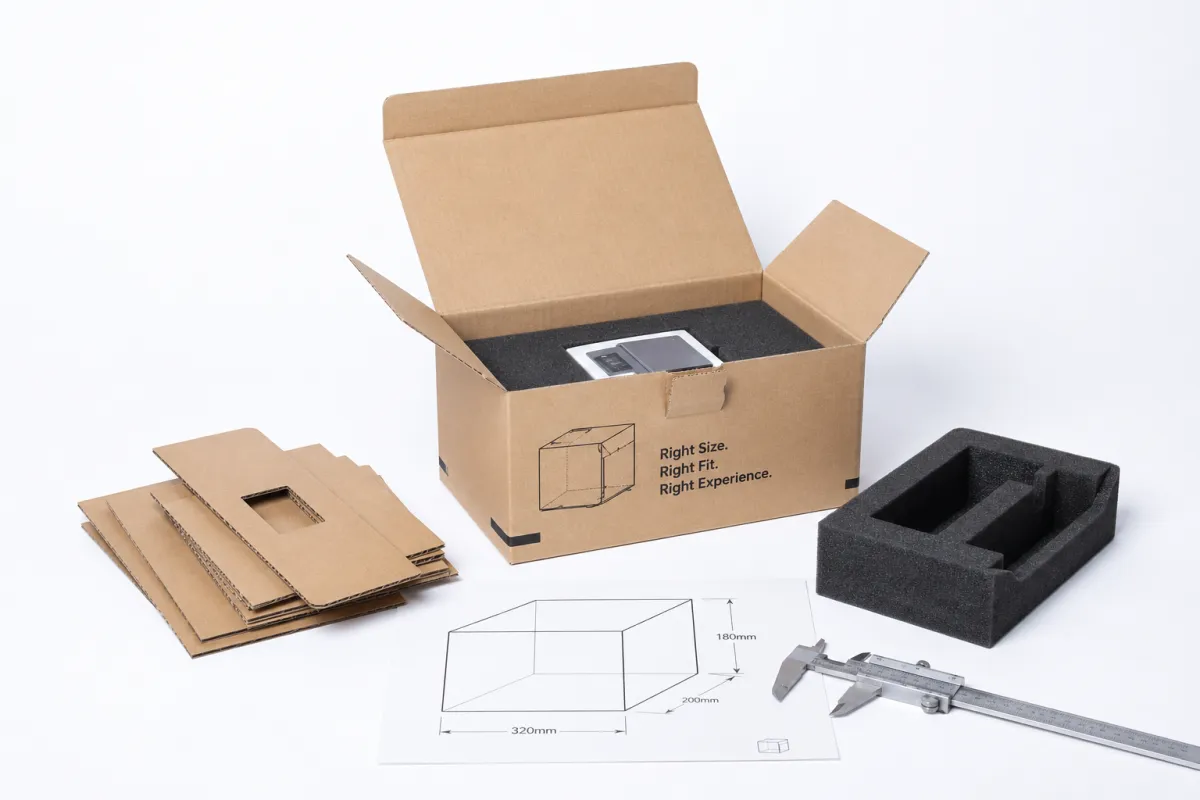
The first time I had to explain how to calculate right box dimensions to a brand team, I held up two cartons that looked nearly identical: one measured 124 mm x 82 mm x 39 mm, the other 128 mm x 82 mm x 39 mm. The 4 mm difference added only about $0.03 per unit in board cost on a 5,000-piece run, but in the warehouse it changed pallet count, void fill, and carton stability on a 1.2 m x 1.0 m export pallet. Someone in the room stared at the samples like the cartons had betrayed them. They had not. The geometry did exactly what geometry does.
“Right” does not mean tight. It means the smallest practical box that still protects the product, supports the unboxing experience, and runs cleanly on the packing table without operators forcing the item in. If you are learning how to calculate right box dimensions, think in terms of clearance in millimeters, board thickness in gsm or flute depth, and handling speed in units per minute, not just length, width, and height. A box that is 2 mm too snug can crush a printed sleeve, scuff a 350gsm C1S artboard panel, or slow pack-out by 8 to 12 seconds per unit. A box that is 8 mm too loose can wobble on a shelf and push dimensional weight up by 0.5 to 1.2 kg-equivalent, depending on the carrier band. That is not subtle. That is packaging math being blunt.
I have seen this play out on factory floors in Shenzhen and Dongguan more than once. In one Shenzhen meeting, a cosmetics client wanted a 68 mm glass jar boxed in a very tight retail carton. The first sample fit until the 3 mm closure flap stack added height and the lid started touching the board. We fixed it by changing the insert depth, not the box wall. That is the part people miss when they ask how to calculate right box dimensions: the final size is often the sum of the product, the closure, the insert, and the coating build-up from lamination, not the product alone. Packaging is rarely one thing. It is a stack of little things that start acting like one big thing.
Here is the simplest way to think about it. The right size is the one that preserves the product, keeps the line moving, and avoids paying for empty space in every carton, master case, and pallet layer. That balance matters even more in custom packaging from Custom Logo Things, where branding, shipping, and protection all need to fit into a single dieline approved in 12 to 15 business days after proof approval. If you are serious about how to calculate right box dimensions, treat size as a production decision, not a guess based on a ruler and a hope. I know that sounds plain. It is also the reason one launch clears QA on the first pass while another spends three weeks in sample loops.
“We thought we were saving money with a smaller carton,” a purchasing manager told me during a March 2024 review in Los Angeles. “Then we spent the savings on damaged returns, extra tape, and a second packing station.”
That line stuck with me because it is so common. A box that is 2 mm too small can force rework; a box that is 8 mm too large can add void fill, increase dimensional weight, and make a premium shelf face look sloppy in a store in Chicago or Manchester. The job of how to calculate right box dimensions is to find the middle ground where the product is secure, the quote is predictable, and the customer still sees a polished package. That middle ground is where good packaging lives, especially for runs of 2,000 to 10,000 units where even $0.02 per unit changes the final margin. Little numbers add up fast. Faster than people expect, anyway.
How Do You Calculate Right Box Dimensions?
The short version is simple: measure the fully packed product, add the smallest useful clearance, then verify the result against the closure, insert, and shipping method. If you are learning how to calculate right box dimensions, start with the packed assembly, not the naked item. That one distinction prevents most sizing mistakes, because the box has to fit the product as it ships, not the product as it looked on the bench.
After that, compare the internal dimensions with the packed unit, then check the external dimensions against freight, palletization, and shelf limits. In practice, how to calculate right box dimensions is less about one formula and more about respecting the whole packaging system: board thickness, void fill, closure build-up, and the way the carton behaves once it is packed. It is kind of like tailoring a suit. You can measure the body perfectly and still miss the fit if you forget the lining, shoulder roll, or the way the jacket actually hangs.
How Box Dimensions Work in Packaging
Most suppliers expect dimensions in a standard order: length, width, height. That sounds simple until a buyer sends the numbers in a different sequence and the sample comes back rotated. I have watched a 180 mm x 120 mm x 60 mm carton turn into a wasteful redo because one side was described as “front” on the PO and “depth” in the dieline notes. On a 5,000-piece order, that kind of confusion can cost a week and about $150 in resampling and courier charges. If you are learning how to calculate right box dimensions, consistency in measurement order saves time, samples, and a few headaches that never needed to happen.
The next distinction is internal versus external dimensions. Internal dimensions tell you whether the product fits. External dimensions tell you what the carton will do to freight, pallet loading, and retail shelf space. For corrugated boxes, board thickness matters a lot. A single-wall E-flute board around 1.5 mm to 1.8 mm per wall can add 3 mm to 3.6 mm across the length and width once both walls are counted, while a rigid set-up box built with 1.8 mm greyboard and wrapped paper can change the footprint more dramatically because of wrap turn-ins and lining. That means the arithmetic for how to calculate right box dimensions has to include the material, not only the item. Paperboard is not invisible; it takes up space, and a lot of it over 10,000 cartons.
Orientation changes the math more than most people expect. Rotate a bottle, a jar, a power bank, or a candle tin and you may reduce the carton size without changing protection. I once helped a consumer-electronics client in Ningbo cut 14 mm off carton height simply by turning the accessory tray 90 degrees and sliding the cable into a side channel. Same product, same drop-test result, less board, less air, and a freight quote that dropped from $1,260 to $1,090 for the first export pallet batch. That is the kind of detail that separates rough estimates from how to calculate right box dimensions with real production discipline.
Inserts, trays, and dividers also change usable space. A box can stay the same outer size while the inside becomes tighter because a paperboard insert, molded pulp tray, or foam cradle steals volume. That is why I tell teams to measure the packed assembly, not the loose item. If the product ships wrapped in tissue, sleeved in printed board, or nested inside a 10 mm molded pulp tray, those layers belong in the dimension calculation. For anyone serious about how to calculate right box dimensions, the product and its packaging should be measured as one system. Otherwise you are measuring ingredients and pretending you already have a meal.
For standards-minded teams, packaging organizations such as Packaging & Processing Professionals and test bodies like ISTA are useful references because they remind you that a box is not just a container. It is part of a distribution system that may be handled 6 to 14 times between factory and customer, especially on routes through Dallas, Rotterdam, and Sydney. That point sounds abstract until you see a carton fail a drop test because the dimensions looked right on the drawing but ignored how the item actually shifted inside by 5 mm under vibration.
Key Factors That Change the Right Box Dimensions
Fragility is the first variable. A rigid metal component may need almost no extra clearance, while a painted glass bottle or a luxury cosmetic jar may need 3 mm to 8 mm of breathing room depending on the insert. Surface finish matters too. Soft-touch coatings, 1-color foil stamping, and high-gloss lamination can scuff if the product rubs the board during transit, especially in humid regions like Guangzhou or Singapore where cartons sit in 70% to 85% relative humidity for hours. In practice, how to calculate right box dimensions is partly about how much contact the product can tolerate before the finish starts showing wear.
Weight distribution matters just as much. A tall item with a heavy base can shift during parcel handling if the height is too generous and the center of gravity sits too high. I saw this in a meeting with a beverage client in Ho Chi Minh City who kept asking for deeper cartons because the artwork looked better with 12 mm more headroom. The problem was simple: the bottle leaned during shake testing at 1.2 m/s^2 vibration. We shortened the cavity by 5 mm and the stability improved immediately. That is the kind of result that comes from how to calculate right box dimensions with physics in mind, not only branding goals.
Packaging method changes the answer too. Tissue paper adds thickness even when it looks soft; two sheets of 17gsm tissue can add 1.5 mm to 2 mm to the packed profile. Foam corners can add 10 mm to a diagonal. Molded pulp usually needs a little more room than a CAD file suggests because the tray flexes under load. Paper fill behaves differently again; it can stabilize light items but does little for a dense object that shifts like a stone in a shoebox. Every one of these changes affects how to calculate right box dimensions because the product is no longer traveling alone.
Shipping and storage constraints deserve their own line item. Dimensional weight can punish oversized cartons, especially for parcel shipping on USPS, UPS, or DPD rate cards. Palletization can push you toward a specific footprint so cartons stack cleanly in 2-layer or 4-layer pallet builds, such as 600 mm x 400 mm modules used in parts of Europe and Japan. Retail shelving may limit height to 150 mm or 200 mm, and warehouse racking can limit carton width. The EPA has long pushed waste reduction as a practical business step, not a slogan, and reducing empty space in a shipper carton fits that logic well. For a quick reference on source reduction, see EPA waste reduction guidance.
Closure style changes the final spec in a way many teams underestimate. Tuck-end cartons, auto-lock bottoms, magnetic rigid boxes, telescoping lids, and two-piece set-up boxes all consume different amounts of material and internal height. A structure that fits on screen can fail in production if the flap overlap steals the last 2 mm you needed. That is why how to calculate right box dimensions should always include the closure method, the board thickness, and any print or lamination build-up on the material, such as 350gsm C1S artboard with gloss varnish or 1.8 mm greyboard with wrapped paper.
| Box style | Fit behavior | Typical unit price at 5,000 pcs | Best use case |
|---|---|---|---|
| Folding carton, 350gsm C1S artboard | Tight printed fit, low structural margin | $0.15 to $0.24 | Light retail products, cosmetics, supplements |
| E-flute mailer, 1.6 mm single-wall | Moderate clearance, good parcel protection | $0.39 to $0.62 | Subscription kits, e-commerce shipping |
| Mailer with molded pulp insert | Controlled fit, better shock protection | $0.72 to $1.28 | Glass, premium electronics, fragile sets |
| Rigid set-up box with wrapped board | Precise cavity, premium presentation | $1.18 to $2.15 | Luxury gifting, high-margin retail, presentation packs |
Those numbers are not universal, and I would never pretend they are. A carton produced in Dongguan with 350gsm C1S artboard and water-based coating may land closer to $0.15 per unit for 5,000 pieces, while the same footprint in a smaller 1,000-piece run can jump to $0.31 or more. The pattern is still clear: as box dimensions grow or the structure becomes more complex, board usage, labor, and shipping all climb. That is why how to calculate right box dimensions should happen before you ask for quotes, not after you are shocked by them.
How to Calculate Right Box Dimensions Step by Step
If you want the practical version of how to calculate right box dimensions, start with the finished packed product. Not the loose product. Not the marketing render. The packed product. That means the item after sleeves, labels, inserts, caps, seals, and any protective wrap are already in place. Measure the longest, widest, and tallest points of that fully assembled unit, then write those dimensions down in a consistent order. I know that seems almost too basic, but basic is where most mistakes hide, especially on orders where the final carton is only 62 mm high and 2 mm matters.
Measure the packed item first
Use a metal ruler, a caliper, or a tape measure with millimeter markings. I prefer digital calipers for small cartons because a 1 mm error on a cosmetic jar can change the fit enough to matter, and many reliable calipers read to 0.01 mm. Measure at least twice. If the product has a handle, nozzle, or irregular corner, include the farthest point, not the most convenient point. That is where how to calculate right box dimensions stops being theoretical and starts becoming usable. A tape measure is not psychic, and a CAD screenshot cannot tell you whether a cap protrudes 3.4 mm past the shoulder.
Add the smallest useful clearance
Clearance is not padding for its own sake. It is the gap that lets the item slide in, close cleanly, and survive normal handling. For a rigid item, 1 mm to 3 mm can be enough. For a hand-packed premium kit, 3 mm to 6 mm may be safer. For fragile goods, the number depends on the insert, the board, and the test result. Anyone serious about how to calculate right box dimensions needs to remember that too much clearance increases movement, while too little creates pressure points. I personally prefer the smallest clearance that still lets the packer breathe, because forcing products into boxes is how people start saying things they later regret on the packing line. And yes, I have heard those things.
Account for inserts and closure build-up
If your box uses trays, paperboard locks, tissue wraps, or molded pulp, measure the packed assembly again with all components included. Then check the closure style. A tuck flap, lid overlap, or magnetic closure can take a surprising amount of interior height. I once watched a team approve a box on a screen at 92 mm internal height only to discover the folded flap stack reduced usable space to 88 mm. That 4 mm gap cost them one round of samples and 9 business days. It is a reminder that how to calculate right box dimensions must include the build-up of the box itself. Screens are obedient. Paperboard is not.
Turn the fit into a production spec
Write the internal dimensions first, then confirm the external dimensions against freight, pallet, and shelving limits. If the supplier wants length x width x height, send the numbers in that order and say whether they are internal or external. That one sentence prevents a lot of back-and-forth. In the most practical sense, how to calculate right box dimensions is really about translating a product fit into a manufacturing instruction that someone else can build without guessing. A clean spec sheet can save a 12-day sample cycle and a second proof payment.
Prototype, pack, and test
Never skip the sample. A mockup is worth more than a long email thread. Pack one unit, close the box, shake it gently, turn it upside down, and set it on its side. Then open it and inspect the corners, edges, and closure points. If you can, have a second person repeat the test because different packers use different hand pressure. That is why how to calculate right box dimensions should end with a physical check, not a spreadsheet alone. I have seen a box look perfect in CAD and behave like a stubborn old suitcase in a 20-minute lab test.
Here is the simple sequence I use in the field:
- Measure the fully packed product in millimeters.
- Add the minimum clearance needed for loading and protection.
- Confirm the closure, insert, and board thickness do not steal cavity space.
- Check external size against shipping and pallet constraints.
- Build a sample and test it with real handling.
That five-step method is not flashy, but it works. It is also the fastest way I know to teach a new buyer how to calculate right box dimensions without turning the project into an endless sample cycle. No drama, no guesswork, no mysterious 4 mm shortfall at the worst possible moment.
How Box Dimensions Affect Pricing and Timeline
Small changes in box size can trigger bigger changes in cost than most buyers expect. Add 5 mm to a folding carton and you may use a little more board. Add 20 mm and you may change the sheet layout, reduce the number of cartons per master case, and increase freight because the carton no longer nests as efficiently. That is why how to calculate right box dimensions is not only a fit question. It is a budget question with a line item attached. On a 5,000-unit run, one size jump can mean $120 to $300 more in packaging spend before shipping even begins.
I learned that in a supplier negotiation in Dongguan, where the quote jumped by 8 percent the moment the carton width crossed a board-conversion threshold. Nothing else changed. No print upgrades. No insert redesign. Just width. The corrugator’s die layout shifted, and the labor plan shifted with it. Buyers often assume the cost curve is smooth. It is not. Once you understand how to calculate right box dimensions, you begin to see the thresholds where a tiny change becomes a line item. That moment is equal parts useful and irritating.
Dimensional weight is another quiet cost driver. A box that ships mostly air can be billed as though it weighs more than it does. For parcel carriers, that can be the difference between staying in one band or jumping to the next. Storage adds its own tax. Larger cartons take more rack space, more shelf depth, and more warehouse labor to handle. If you want the shortest path through how to calculate right box dimensions, keep asking: how much extra space is this really buying me, and what does that space cost downstream in Dallas, Frankfurt, or Brisbane?
Timeline matters too. A clean spec sheet can move a project quickly. A vague one can stall it for days. The usual sequence runs from measurement, to structural design, to sample, to approval, to production. If the first sample misses by 3 mm, the schedule stretches. If the insert is wrong, it stretches again. If artwork needs to move because the panel shrank, prepress adds another round. That is why I tell clients that how to calculate right box dimensions early is one of the easiest ways to protect launch dates. I have watched teams lose 7 to 10 business days because nobody wanted to “bother” with a second measurement.
Below is a simple comparison of how pricing often changes as the dimension strategy changes:
| Dimension strategy | Material impact | Shipping impact | Typical risk |
|---|---|---|---|
| Snug custom fit | Lower board usage, fewer fillers | Lower dimensional weight | Too tight if product varies by 1 mm to 2 mm |
| Moderate clearance | Slightly higher board usage | Balanced parcel and pallet efficiency | Usually the safest production choice |
| Oversized carton | More board, bigger insert or fill needs | Higher dimensional charges and pallet waste | Loose product, higher damage risk, higher cost |
That table reflects what I have seen on real programs, not a lab-perfect world. A rigid cosmetics box with 350gsm C1S artboard with soft-touch lamination can be beautiful, but if the cavity is wrong by 2 mm, the whole premium feel disappears. The most expensive box is often the one that needs a second sample because no one treated how to calculate right box dimensions as part of the buying decision. I wish that were dramatic. Instead, it is just common, especially on premium runs in New York, Seoul, and Paris where presentation standards are high and margin pressure is higher.
Common Mistakes When Measuring and Ordering Boxes
The most common mistake is measuring the naked product instead of the packed product. I see this constantly. Someone measures a jar at 64 mm tall, then forgets the lid, the tissue, and the insert add another 7 mm. The sample arrives, the closure bows, and everyone wonders where the extra height went. If you are serious about how to calculate right box dimensions, measure the full packed form every time. The box does not care what the product looked like before the sleeve went on, and it certainly does not care about the photo on the mood board.
The second mistake is mixing up internal and external dimensions. I have seen a buyer ask for a “100 x 80 x 40” box without saying whether those were internal numbers. The supplier assumed internal, the warehouse expected external, and the first pallet was built wrong. That kind of confusion can turn a routine order into a costly correction, often 2 to 3 extra days in production and about $80 in reshipment or rework on a small run. A single sentence in the RFQ can fix it: internal dimensions for fit, external dimensions for shipping. That clarity matters more than most people realize when they are learning how to calculate right box dimensions.
Tolerance is another blind spot. Board thickness, humidity, laminate, and die-cut variation all create small shifts. A box that is right on a drawing can still be off by 1 mm to 2 mm in production. That is not a defect by itself; it is manufacturing reality in places like Shenzhen, Ho Chi Minh City, and Ningbo. But if your clearance budget is already zero, those small shifts become big problems. I have seen a line stop because a closure tab rubbed against a laminated panel that had swollen just enough to matter. That is a textbook failure in how to calculate right box dimensions without a tolerance allowance.
Another error is designing only for one channel. A box made for shelf display may be too delicate for courier handling. A box made for pallet freight may be too bulky for retail presentation. A carton that looks perfect in a showroom may fail after two drops from 76 cm or after vibration on a 1,500 km road route. That is why good teams compare channels before they finalize how to calculate right box dimensions. The best size for parcel shipping is not always the best size for a retail buyer standing 3 feet away from a display. Packaging is context-dependent, which is why one perfect box design almost never exists for every channel.
One more trap: ignoring how the box is assembled on the line. If a packer has to fold extra flaps, orient the product a certain way, or fit an insert that only works one direction, throughput drops. That is not theory; that is labor cost. I once watched a team lose 14 seconds per pack because the opening was 6 mm too tight and the operator had to twist the product to make it fit. Multiply that by 20,000 units and the number becomes painful fast. That is why how to calculate right box dimensions should always account for human handling, not only product geometry. The people packing the box are part of the equation, whether the spreadsheet remembers them or not.
Most of these mistakes are preventable. They happen because teams rush to artwork before they lock the cavity, or because procurement asks for a quote before operations has tested the pack. Honest advice: stop treating how to calculate right box dimensions like a one-line spreadsheet task. It is a cross-functional decision that affects design, production, shipping, and returns. That sounds grand, but really it just means more things can go sideways if you skip the boring steps.
Expert Tips and Next Steps Before You Order
Build a one-page packaging spec before you request a quote. Keep it practical: product dimensions, weight, finish, insert type, closure style, shipping method, and whether the item ships loose, retail-ready, or in a kit. If you have ever wondered why one quote comes back clean and another takes five emails, this is usually why. Clear specs make how to calculate right box dimensions much easier for everyone involved. It also saves you from the deeply unglamorous task of explaining, for the third time, that “medium” is not a measurement, especially on a 5,000-piece RFQ.
Request a sample or prototype before full production, especially for fragile, premium, or oddly shaped products. A rigid sample may cost a little more up front, but it often saves far more than it costs. I have seen clients approve a structure from a CAD drawing and then discover the real product pinched the insert at one corner. A physical sample would have caught that in 10 minutes and a $35 courier fee. That is the difference between theory and how to calculate right box dimensions in the real world.
Run a pack test with at least two operators. Different hands create different results. One person may tuck the item in cleanly; another may press too hard and deform the corner. If both operators can pack the product, close the box, and shake-test it without damage, you are closer to the right answer. That kind of test sounds simple, but it is one of the most reliable tools I know for how to calculate right box dimensions without overengineering the project. Also, it gives you a rare moment where everyone in the room is looking at the same carton instead of their own spreadsheet tab.
Be honest about your shipping conditions. Parcel, pallet, retail shelf, export carton, and fulfillment center all prioritize different things. If your supplier knows the channel, they can usually help you avoid wasted volume. The same box that works for a boutique display in Chicago may be a poor choice for a multi-stop parcel route through Atlanta and Phoenix. That is normal. It is also why how to calculate right box dimensions should be tied to the actual journey, not only the product photo. Pretty mockups are nice. Packages that survive the trip are nicer.
If you want to sanity-check your plan, compare it against established test and sourcing references, then walk it through the same sequence every time: measure, pack, test, adjust, approve. That process aligns well with the discipline promoted by packaging groups and transport testing standards, and it reduces the odds of a noisy surprise after launch. It also keeps the approval window tight enough that a 12- to 15-business-day sample cycle can still lead into production on schedule.
My final advice is straightforward. Confirm the fully packed size, verify internal versus external dimensions, test the sample under real handling, and compare the result against freight and storage limits before you sign off. If you do those four things, how to calculate right box dimensions stops being a guessing exercise and becomes a repeatable buying process.
That is the difference between a carton that merely holds a product and a carton that moves efficiently through production, shipping, and retail without paying for empty space. If you remember only one thing, remember this: how to calculate right box dimensions is not about making the box as small as possible; it is about making it as right as the product, the process, and the carrier allow. And if a sample is fighting you, trust me, it is probably telling you something useful.
How do I calculate the right box dimensions for a product that uses inserts?
Measure the product as it will ship, not as it sits bare on the bench. Inserts change the effective footprint and height, sometimes by 5 mm to 20 mm, especially with molded pulp trays or 2-piece paperboard cradles. Add only the clearance needed for packing and protection, then test the packed assembly inside the box. That is the most reliable way to apply how to calculate right box dimensions when trays, tissue, foam, or molded pulp are part of the design. I have seen a tray save the day more than once, but only after somebody measured the tray, not just the product.
Do I use internal or external measurements when ordering the right box dimensions?
Use internal dimensions for fit, because that tells you whether the product will actually enter the box. Use external dimensions for freight, storage, pallet builds, and shelf planning. If a supplier asks for one format only, say whether you want a fit dimension or a shipping dimension before you approve the quote. That small clarification keeps how to calculate right box dimensions from turning into an expensive misunderstanding. I cannot overstate how often one missing word causes a very silly problem and a 2-day delay.
How much extra space should I add when calculating right box dimensions?
Add the smallest practical clearance that still lets the product load without force. For rigid goods, 1 mm to 3 mm may work. For hand-packed or fragile items, 3 mm to 6 mm is often safer, but the exact amount depends on the insert, the board thickness, and the handling method. If the fit feels uncertain, prototype the box instead of guessing, because how to calculate right box dimensions works best with real samples. Guessing is how you get a box that looks elegant in a render and acts like a stubborn drawer in real life.
What is the fastest way to check if my box dimensions are correct?
Pack one sample unit, close the box, and see whether the product moves, compresses, or scrapes the walls. Then repeat the test with a second unit if the product varies in shape, finish, or accessory count. If the fit changes after taping or folding, measure the fully assembled box again. That quick routine is the fastest practical check for how to calculate right box dimensions. It is simple, a little old-fashioned, and much better than arguing about it in a meeting for 30 minutes.
What should I send a supplier so they can help me calculate right box dimensions?
Send product dimensions, weight, photos, packing method, shipping channel, and any warehouse or carrier limits that affect the carton size. If possible, include a sample, sketch, or packed reference so the supplier can verify the fit instead of estimating it. The better the input, the cleaner the answer will be for how to calculate right box dimensions. A good supplier can work miracles, but they still need something better than “pretty close” to go on.
Related packaging resources
Use these related guides to compare specs, costs, quality checks, and buyer decisions before making the final call.

