Buyer Fit Snapshot
| Best fit | custom beverage bottle labels what for packaging buyers comparing material specs, print proof, MOQ, unit cost, freight, and repeat-order risk where brand print, material, artwork control, and repeat-order consistency matter. |
|---|---|
| Quote inputs | Share finished size, material target, print colors, finish, packing count, annual reorder estimate, and delivery region. |
| Proofing check | Approve dieline scale, logo placement, barcode or warning zones, color tolerance, and any recyclable or compostable wording before bulk production. |
| Main risk | Vague material claims, crowded artwork, or missing packing details can create delays even when the unit price looks attractive. |
Fast answer: Custom Beverage Bottle Labels What: Material, Print, MOQ, and Cost should be specified like a repeatable production item. The safest quote includes material, print method, finish, artwork proof, carton packing, and reorder notes in one written spec.
What to confirm before approving the packaging proof
Check the product dimensions against the actual filled item, not only the sales mockup. Ask for tolerance on folds, seals, hang holes, label areas, and retail display edges. If the package carries a logo, QR code, warning copy, or legal claim, reserve that space before decorative graphics fill the panel.
How to compare quotes without losing quality
Compare board or film grade, print process, finish, sampling route, tooling charges, carton quantity, and freight assumptions side by side. A lower quote is only useful if the supplier can repeat the same color, closure quality, and packing count on the next order.
Custom Beverage Bottle Labels: What Actually Works Best
I remember standing in a cold room in Guangzhou once, watching 1,200 glass bottles fail before lunch on a line moving 126 units a minute. The paper labels softened into paste at 4 degrees Celsius, the corners curled after 14 minutes, and the cartons looked like they had spent a week in standing water. Nobody had to say it out loud; we all knew the polished mockup had lied. That gap between a screen render and custom beverage bottle labels that survive reality is bigger than most brands want to admit, and it usually shows up as a reprint invoice.
People love to treat a label like decoration. I do not. In packaging, the label is part of the bottle, part of the line speed, part of the shelf read, and part of the complaint rate if the spec is wrong. A label that costs $0.11 can turn into $1,800 in relabeling, plus two missed distributor appointments and a very quiet conference room. Cheap labels get expensive fast, usually somewhere between the sample approval and the first refrigerated shipment.
For brands building beverage packaging, the subject sits at the intersection of packaging design, branded packaging, and production reality. If you are also building Custom Labels & Tags for a broader launch, or coordinating Custom Packaging Products with bottle labels, the details need to line up. Bottle, adhesive, finish, carton, and case pack all have to tell the same story. If they do not, the shelf copy falls apart before the customer even touches the product, and the retailer notices within one receiving cycle.
A rendering can fool almost anybody. A clean image on a screen says nothing about condensation, cold storage, oily hands, fast application, or a shipping route with three warehouse transfers and one forklift operator in a bad mood. That is the real job of custom beverage bottle labels. They are a packaging decision first and a design decision second. I have seen teams reverse that order and then spend $2,400 correcting a mistake that a 10-minute cooler test would have caught in New Jersey or Shenzhen.
There is also a trust issue here. When a supplier says a label is “fine for cold storage” but cannot explain the adhesive family, the label face stock, or the test condition, that is not expertise. That is sales fog. I have been on enough plant floors to know the difference, and it is not subtle.
What Custom Beverage Bottle Labels Really Are
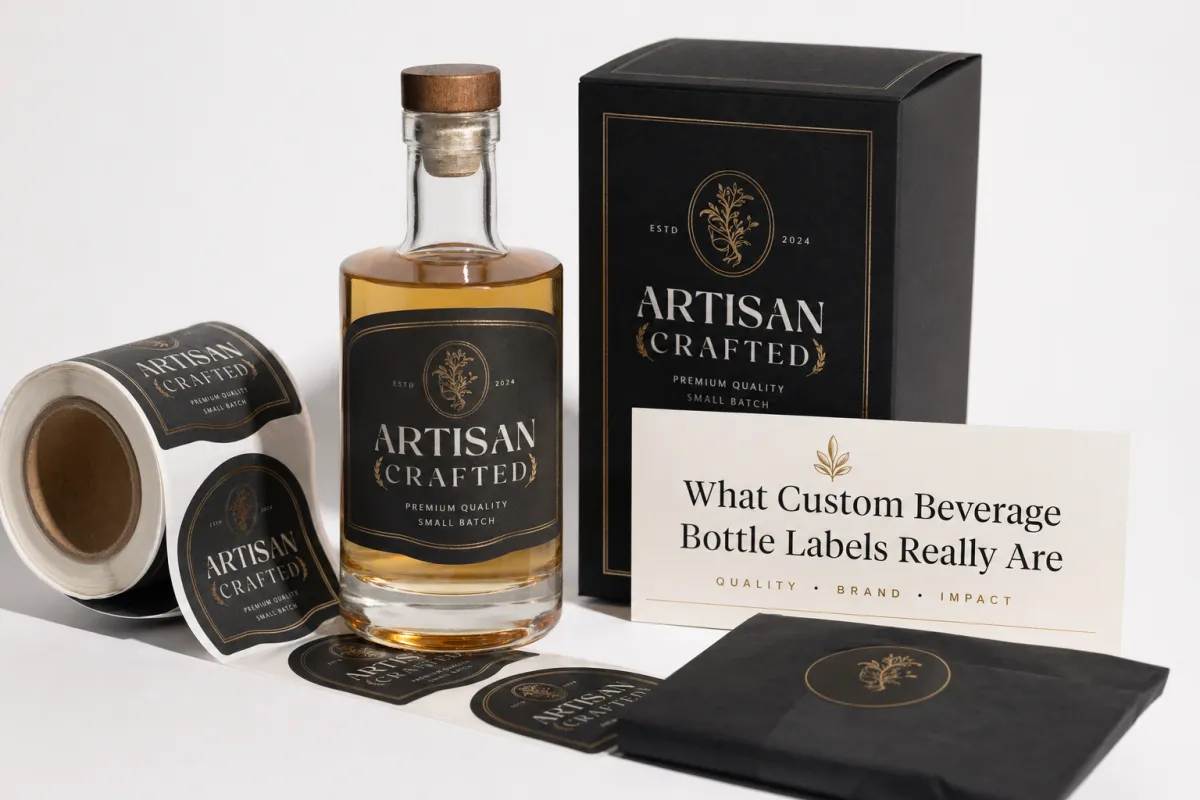
Custom beverage bottle labels are not one product. They are a chain of choices: face stock, adhesive, finish, print method, die shape, and application format. A label that works on a dry pantry shelf may fail on a bottle sitting in ice water for four hours, then getting passed through ten hands on the way to a refrigerator. Bottle shape matters too. A straight-sided 12 oz glass bottle is straightforward. A tapered 16 oz kombucha bottle with a 38 mm neck and a curved shoulder behaves like a different species, and it usually proves it during the first sample run.
I learned that the hard way in Shenzhen, standing beside a filling line moving about 140 bottles a minute. The client wanted a clear label on chilled craft soda for a launch in Hong Kong and Singapore. The paper sample looked fine on the table. Ten minutes after the first carton reached the cold room, condensation turned the edges into white flaps. The artwork was not the problem. The spec ignored the environment, which is a very expensive way to discover physics. Nobody wants to be the person who saves $0.03 per label and loses the whole first production week.
These labels show up everywhere: breweries in Portland, cold-pressed juice plants in Austin, kombucha brands in Melbourne, sparkling water in Lyon, bottled cocktails in Brooklyn, tea in Taipei, sauces in Chicago, and specialty drinks that need retail packaging with real shelf presence. Sports recovery drinks use them too. So do premium mixers, where the bottle itself may be ordinary but the packaging has to do the selling. Good package branding can make a $3.00 bottle feel like a $7.50 bottle. Poor labels make expensive liquid look discount-bin cheap, which is a very unfair little magic trick that no brand wants to perform.
Buyers often miss one basic point: they are not just purchasing print. They are purchasing how the label behaves after production. Will it stay put on a wet bottle? Will it wrinkle on a shoulder curve? Will the ink scuff in a case pack after 300 miles of trucking? Will the finish still look clean after two hours in a cooler at 38 degrees Fahrenheit? Those are the questions that separate functional custom beverage bottle labels from decorative stickers that collapse at the first cold splash.
The best way to think about labels is as a small piece of product packaging engineering. Visual appeal matters, sure. Fit, adhesive grab, and durability matter more once you are shipping 5,000 or 50,000 units. A good label should make the bottle easier to sell, easier to handle, and less likely to come back as a complaint. That is the whole point, even if nobody says it that plainly in a kickoff meeting in Dallas or Rotterdam.
Promotional labels and production labels are not the same thing. A promotional label can survive a trade-show table, a flat counter, and a few photos at a 2024 expo in Las Vegas. Production-grade custom beverage bottle labels need to survive cold storage, refrigerated display, distribution vibration, and hands with a little moisture or oil on them. If the bottle is going anywhere near an ice bucket, the spec changes immediately. I usually say the cooler is where good assumptions go to die, and I have seen that happen in under 20 minutes.
One more distinction matters: a label meant for a boutique tasting room might be elegant but fragile, while a label for regional retail has to be boringly dependable. That sounds less glamorous, but boring labels tend to be the ones that keep the schedule intact. And, honestly, intact schedules are underrated.
How do custom beverage bottle labels work on the line?
The line starts with artwork, not ink. A decent supplier should review the file, check the dieline, confirm the bleed, and flag trouble with barcodes, small type, or white ink layers before anything reaches press. For custom beverage bottle labels, I ask for vector logos, 300 dpi images, CMYK builds, and a clear safe area. If the label uses transparent film, white ink separation is mandatory. Without it, a crisp graphic turns into a washed-out ghost. I have had to explain that more than once in Dongguan and again in Tilburg, and yes, it gets old.
Production moves through proofing, material selection, printing, die cutting, rewinding, and packing. If the customer uses an applicator, roll direction, core size, and gap spacing matter more than most design teams expect. I have seen a line stall because the core size was off by 1/8 inch and the roll would not seat properly on a semi-auto applicator rated for 90 bottles a minute. It was not dramatic. It was worse than dramatic. It was small, dumb, and expensive in minute-by-minute losses.
Hand application and machine application live in different worlds. By hand, you can forgive a little extra liner. On an applicator, you need repeatable spacing, clean unwind tension, and a label shape that fits the bottle without fighting it. With custom beverage bottle labels, I always ask whether the team will use a tamp applicator, a wipe-on system, or a semi-auto labeler. A label that looks fine on a bench can misfeed badly at 60 bottles a minute, and misfeeds have a way of becoming overtime. Nobody wants to be out there at 9:40 p.m. because a roll was wound the wrong way.
Bottle shape changes the rules. Tapered bottles can cause edge lift. Curved PET bottles can stretch the label visually even when the material is technically fine. Cold glass creates condensation. Squeeze bottles flex under pressure. Each of those needs a different spec, and the best suppliers say that out loud instead of pretending one roll stock handles every bottle on earth. That honesty is worth more than a polished sales deck, and it saves everyone from the delightful little fire drill of reordering two weeks before launch.
"We tested two label stocks on the same bottle and one of them lasted exactly 17 minutes in the cooler at 39 degrees Fahrenheit. The other one stayed clean for three days." That came from a brewery client in Asheville after we switched their custom beverage bottle labels from coated paper to white BOPP with freezer-grade adhesive.
If you want the label to work on the line, treat the production setup as part of the design brief. Give the supplier the bottle diameter, the application speed, the storage temperature, the expected handling, and whether the label must come off cleanly later. Custom beverage bottle labels are not just an artwork order. They are an equipment compatibility order too. I wish more teams understood that before the first proof, because it would save a lot of awkward calls and a few too many “can we just make it work?” messages.
- Artwork files: vector logo, 300 dpi images, CMYK, outlined fonts, and a 1/8 inch bleed.
- Label specs: bottle size, curvature, taper, neck finish, and exact label dimensions.
- Application details: hand-applied, semi-auto, or automatic applicator with roll direction and core size.
- Performance needs: refrigeration, ice bucket exposure, oil resistance, scuff resistance, or removable adhesive.
Key Materials, Finishes, and Adhesives to Compare
This is the part where most buying decisions succeed or fail. For custom beverage bottle labels, the face stock, finish, and adhesive do more work than the art. I have seen beautiful labels fail because the paper stock absorbed moisture in a 34-degree cooler. I have also seen simple labels look premium because the finish and adhesive were chosen with care. Fancy is not the same thing as effective, and that distinction has saved me from a surprising number of bad approvals.
Paper, BOPP, clear film, and specialty stocks
Paper usually fails first in moisture-heavy environments. It can work for shelf-stable products, dry storage, and lower-cost runs, but it is a risky choice for chilled bottles or anything that will sit in a cooler in Miami, Houston, or Manila. White BOPP, a polypropylene film, is the workhorse for many custom beverage bottle labels. It resists water better, handles scuffing better, and stays cleaner when someone grabs the bottle with a wet hand. Clear film works well when the design wants a no-label look, but it needs strong white ink handling and a clean bottle surface. I have a soft spot for clear film, though it has a nasty habit of exposing every design mistake like a spotlight.
Specialty textured stocks can look excellent on premium drinks, though they come with trade-offs. A cotton-fiber or felt-finish label can look fantastic on a small craft gin bottle, a 375 ml seasonal mixer, or a distillery release from Scotland, yet those materials are rarely the first choice for wet refrigeration or high-speed applicators. If you need a heavier outer-panel feel for a gift pack, 350gsm C1S artboard is a better fit for the carton or neck card than for a direct-contact bottle label. The more tactile the stock, the more likely you are paying for aesthetics rather than toughness.
There is a practical caveat here. Paper can still be the right answer for dry, short-life products, especially if the bottles are sold quickly and stored upright in controlled conditions. I have recommended it myself more than once. The honest answer is never “paper is bad”; it is “paper is wrong for this use case.” That difference matters.
Finish choices that change the shelf story
Matte, gloss, soft-touch, and metallic finishes all create different visual effects. Matte can feel quiet and premium. Gloss gives color a brighter pop and often helps with wipe-down resistance. Soft-touch feels expensive in the hand, though it can show abrasion faster than a hard gloss if the bottle gets tossed into a carton with rough edges. Metallic effects can make a seasonal SKU stand out, but they need restraint. Too much shine can make a drink look like a perfume bottle, and that is a mistake that tends to cost more than the foil itself.
For custom beverage bottle labels, I usually recommend finish based on shelf and handling together. If the bottle will be refrigerated, scuffed in a case, or handled by retailers, a durable gloss or a well-laminated matte is safer than an untreated decorative surface. If the brand is going for artisan credibility and will ship only to boutique accounts in Santa Fe or Copenhagen, there is more room to play. The bottle still has to survive a distributor warehouse, and warehouses are rarely gentle. That is not a criticism; it is just the truth of forklifts, pallet wrap, and rushed receiving.
I have seen brands spend a fortune on foil, then skip lamination, and wonder why the corner scuffed during transit. That is the kind of decision that looks clever in a mockup and awkward on a pallet. There is a reason experienced buyers test both the visual and the abuse resistance. Labels are a weird mix of aesthetics and endurance, kinda like a good pair of boots that still has to look good in a meeting.
Adhesives that actually hold up
Adhesive choice is the quiet killer. Permanent adhesive works for most standard dry applications, but moisture, low temperature, and textured glass can change the equation. Removable adhesive is useful when the label has to come off cleanly later, though it may sacrifice grip. Freezer-grade adhesive matters for chilled or frozen storage. Wet-stick options deserve a serious look if the bottle is labeled in a damp environment or if condensation is part of daily operations. For custom beverage bottle labels, the adhesive can matter more than the print. That sentence sounds boring until a thousand labels start peeling in a cooler.
When I negotiated with a supplier rep from Avery Dennison on a bottled-tea run in Changzhou, we spent more time talking about adhesive tack at 4 degrees Celsius than we did talking about print color. That is normal. The rep from UPM Raflatac gave the same advice in a different voice: if the product sweats, do not assume a standard permanent glue is enough. 3M comes up often for specialized performance needs too, especially when you want tested adhesion instead of marketing language. I trust suppliers who can explain why a stock passed a specific test, not just say it was "premium."
There are also practical standards worth understanding. ASTM D3330 can help assess peel adhesion, and ASTM D3654 is useful for shear performance if the bottle rides through heat and vibration. ISTA testing is useful for shipping and distribution abuse, especially if the bottles are packed in cartons that may get bounced around from Chicago to Phoenix. For responsible sourcing, FSC-certified paper can matter if the brand wants a documented paper trail. I have seen teams choose the wrong material because they chased a cheaper quote and forgot that a label has to live in the real world.
My blunt rule is simple: if the bottle sweats, gets chilled, or sees rough handling, the material spec should be built for abuse. That is the whole game with custom beverage bottle labels. A nice mockup is not a substitute for a label that survives a cooler, a delivery truck, and a bar back's left hand after a shift. I would rather be slightly overcautious in a sample run than explain a peeling label to an irritated buyer at a chain in Denver.
| Material | Best For | Typical Price at 5,000 Units | Strengths | Watch-Outs |
|---|---|---|---|---|
| Coated paper | Dry storage, shelf-stable drinks | $0.07-$0.13 per label | Lowest upfront cost, easy print quality | Weak in condensation, can wrinkle or stain |
| White BOPP | Refrigerated bottles, cold drinks | $0.12-$0.19 per label | Water resistant, durable, scuff resistant | Slightly higher cost, needs the right adhesive |
| Clear film | Premium "no-label" look | $0.14-$0.23 per label | Clean visual effect, moisture friendly | Needs clean bottle surface and white ink planning |
| Textured specialty stock | Artisan or premium limited runs | $0.19-$0.31 per label | High-end tactile feel, strong shelf presence | Can be costlier and less tolerant of moisture |
| Metallic or laminated film | Premium retail packaging | $0.21-$0.39 per label | Strong visual impact, added protection | Easy to overdo, costs more on short runs |
Custom Beverage Bottle Labels: Cost, Pricing, and Minimums
Pricing is where a lot of buyers get surprised, mostly because they compare the wrong things. Two quotes for custom beverage bottle labels can look close on paper and still be wildly different in reality. One may include the exact adhesive, a lamination, and a die line that fits your bottle. The other may be a cheaper stock with none of the performance you actually need. Cheap quotes are easy. Accurate quotes take work, a few extra questions, and a willingness to sound slightly annoying in email. I am fine with that trade.
What drives the price
The biggest cost drivers are quantity, material, finish, adhesive, shape complexity, color count, and print method. Digital printing usually makes sense for shorter runs and frequent artwork changes. Flexographic printing can be more economical on larger volumes, but setup is heavier and plate costs need to be spread across more units. For custom beverage bottle labels, a short run of 2,500 pieces might land at $0.21 to $0.36 per label depending on stock and finish, while 10,000 pieces may drop closer to $0.10 to $0.22 per label. That is a broad range because material choice changes everything, and because reality refuses to fit inside one tidy price point.
Custom shape increases the price too. If the label has a complicated contour, extra cut rules, or an unusual bottle neck wrap, the die and setup cost more. I have seen a brand save $400 by simplifying a shape and then spend $900 later because the first version wrinkled on the shoulder. That is the kind of math people hate, but it is the real math of custom beverage bottle labels. It also explains why I ask awkward questions early, especially about shoulder radius and label wrap distance.
Setup charges matter as much as the unit price on low-volume orders. A plate charge, a die charge, a proof charge, and a sample fee can all show up if you do not ask early. Some suppliers fold them into the quote. Others split them into separate line items. Ask. Always ask. I have sat in client meetings where the "cheap" label quote suddenly picked up $250 in setup, $90 in freight, and a $35 sampling fee that nobody budgeted. Suddenly the deal was not cheap. It was just easier to misunderstand.
One thing I keep coming back to is order economics. If you are buying 5,000 labels and the supplier offers an attractive unit rate but charges extra for every adjustment, you may not actually be ahead. On the other hand, a slightly higher per-label price with a lower failure rate can be the smarter buy. Packaging buyers who track actual yield usually make better decisions than buyers who chase the lowest number and hope the rest sorts itself out. Hope is not a procurement strategy.
How to compare quotes without getting fooled
Do not compare price alone. Compare price per thousand, lead time, sample policy, and whether the quoted spec includes the exact adhesive and finish. Ask whether the quote assumes paper or film. Ask if the label is for hand application or roll-fed machine application. Ask whether the quoted price covers white ink if the artwork needs it. With custom beverage bottle labels, the spec sheet matters more than the sales pitch, and I say that with the quiet exhaustion of someone who has watched more than one “budget-friendly” quote grow horns after review.
One more thing: freight can erase a win. If a supplier quotes $180 less on the labels but charges $220 more in shipping, you did not save money. You moved it around. That happens constantly with packaging projects, which is why I prefer landed cost over unit price alone. I use the same habit for Custom Printed Boxes, folding cartons, and any other piece of product packaging where the quote is only one layer of the bill. The invoice rarely tells the whole story by itself.
Typical cost framework
- Short run: 500 to 2,500 labels usually costs more per unit because setup is spread across fewer pieces.
- Mid run: 5,000 to 10,000 labels often lands in the best balance of unit cost and flexibility; 5,000 white BOPP labels with gloss laminate commonly price near $0.15 per unit.
- Large run: 25,000 labels or more can reduce unit cost, but artwork changes get expensive.
- Rush fee: Expect an extra 10% to 25% if the timeline gets squeezed, especially under 72 hours.
- Sample charges: Some suppliers waive them; others charge $25 to $75 for test sheets or roll samples.
I usually tell clients to budget one correction cycle. If the first proof misses the bottle curve, the barcode quiet zone, or the finish they expected, a second round may be necessary. That is normal. What is not normal is pretending every label quote is identical when one includes a tested adhesive and one does not. A $0.18 label that survives a chilled shelf is cheaper than a $0.12 label that peels in a cooler. That sentence has saved more budgets than any slick pitch deck I have seen.
Custom beverage bottle labels do not exist in a vacuum. They sit inside a broader branded packaging system, and the economics should be examined that way. If the same launch needs cartons, inserts, and shipping materials, I would rather see a cleaner spec across the whole packaging stack than a random bargain hunt on one line item. Coordinated choices usually cost less than a string of isolated ones pretending to be strategy.
Custom Beverage Bottle Labels: Process and Timeline
Most people want a simple answer on timing. The honest answer is that it depends on proof approval speed, artwork readiness, material availability, and shipping. For custom beverage bottle labels, I usually see 12 to 15 business days from proof approval to production-ready shipment on standard digital runs in Shenzhen or Xiamen, and 15 to 20 business days for more complex jobs with specialty stocks, cold-foil effects, or custom finishing. Rush jobs can compress that to 7 to 10 business days, but only if nothing changes after the first proof.
Where delays actually happen
The biggest delays usually come from artwork fixes, not press time. Missing dielines, fuzzy logos, RGB files, bad barcodes, and tiny legal copy can add two to four business days before production even starts. Material changes are another common problem. If a client starts with coated paper and then realizes the bottle sweats in a 4-degree cooler, the job may need a different stock, a different adhesive, and a re-proof. That is a delay, but it beats printing the wrong thing and pretending nobody will notice.
I had one client meeting in Minneapolis where marketing loved a clear label, operations wanted a white label, and the distributor wanted something that could survive six weeks in refrigerated storage at 38 degrees Fahrenheit. The meeting took 42 minutes and three coffee refills. We moved the launch by five business days because nobody had checked the storage condition. That kind of friction is common with custom beverage bottle labels, which is why I push for early sample testing.
When to sample and when to move
Sample first if the bottle is new, the storage environment is cold, or the label has to fit a curved neck or shoulder. If the product is a seasonal SKU or a first launch, I want at least one physical sample on the actual bottle before approval. For custom beverage bottle labels, a flat proof tells you almost nothing about how the label behaves around a curve or under condensation. A proper sample tells the truth in about 20 minutes, which is one of the few kinds of honesty I trust immediately.
Go straight to production only when the bottle is already proven, the label size is fixed, and the material spec matches a prior order. That is the only time I am comfortable skipping a full sample cycle. Even then, I still want a proof on the exact bottle image and a final sign-off from the person who handles production. One small mistake in the dieline can cost more than the sample would have, especially if the bottle shoulder is just 3 mm off from the last run.
Planning buffer time
Shipping always needs buffer time. If your retailer deadline is hard, add three to five business days for transit and receiving. If the order crosses borders, add more. I have seen custom beverage bottle labels arrive in perfect condition and still miss a launch because the receiving warehouse held the pallets for a day of intake inspection in Los Angeles. Planning only for print time is rookie math. Planning for print plus transit plus receiving is how experienced teams avoid panic.
Standard production usually makes sense for ongoing SKUs. Rush production is for emergencies, not comfort. If a supplier promises a miracle with zero extra cost and no trade-offs, I would be suspicious. Good production has physics attached to it. Press time, curing time, and shipping time do not care about your launch party in Atlanta or your investor demo in London. I have tried to convince several calendars of this fact, and they remain stubborn.
A solid timeline for custom beverage bottle labels looks like this: brief and artwork on day one, proof review within one to two business days, sample approval if needed, production after final sign-off, then packing and transit. If all goes well, you are moving in under two weeks. If the bottle is unusual, the finish is special, or the legal text keeps changing, give yourself more room. There is no prize for pretending a hard deadline is easy. There is, however, a prize for not reprinting 10,000 labels because somebody forgot the storage condition.
Common Mistakes That Ruin Beverage Bottle Labels
The biggest failure I see is designing for a dry room when the bottle will live in condensation, ice, or refrigeration. It sounds obvious, and yet I still see paper-based custom beverage bottle labels approved for chilled SKUs because the mockup looked clean. Two days in a cooler later, the corners lift, the ink softens, and the brand looks careless. That is not a design problem. That is a spec problem. I wish I had a dollar for every time someone discovered this after the fact instead of before sign-off.
Another common mistake is choosing the wrong adhesive. Chilled glass, textured bottles, and containers that need clean removal later all need different glue behavior. A label that works on a smooth PET bottle may fail on a frosted glass surface. A removable adhesive that peels nicely in testing may lose bite after a week in cold storage. The bottle surface matters, and so does the temperature. I wish more teams respected that. I also wish less of my life involved explaining why “it stuck on the desk” is not a test method.
Artwork mistakes cost money too. Blurry logos, tiny legal copy, low-contrast type, and barcodes placed too close to seams or curves can force a reprint. I have also seen brands forget that metallic backgrounds can interfere with barcode readability unless the design is planned carefully. If you are producing custom beverage bottle labels, test the barcode on the real stock, not just in a PDF preview. A barcode that scans badly in the warehouse is a problem you can feel in your wallet, especially when the warehouse team starts giving the label that same stare they reserve for broken pallet jacks.
Production mistakes are just as annoying. Ignoring roll direction can cause feeding issues. Forgetting the applicator speed can lead to misalignment. Approving a proof that does not match the real bottle size is how you end up with a label that floats too high on the shoulder or disappears into the taper. Those are avoidable errors. They are also expensive, which is usually what gets people to pay attention after the fact. I am not proud of how often “expensive” is the only language that gets heard.
I have seen one more mistake over and over: treating the label as separate from the rest of the package. It is not separate. The label has to match the bottle, the carton, the case pack, and the shelf story. That is why packaging design and package branding should be discussed together instead of in different meetings with different assumptions. Labels do not rescue weak planning. They expose it, usually in very public ways.
- Wrong environment: paper labels on refrigerated bottles.
- Wrong adhesive: standard glue on sweaty glass or textured PET.
- Wrong artwork: tiny type, weak contrast, or poor barcode placement.
- Wrong line setup: roll size, core size, or spacing that does not match the applicator.
- Wrong assumption: believing a screen mockup equals a production-ready label.
A small but common trap is approving color from a monitor and never checking it under store lighting. Beverage shelves are not lit like your office. A blue that looks crisp in a studio can feel muddy under refrigerated case lighting. That sort of mismatch does not ruin the package, but it can shave off the premium impression you paid for.
What makes custom beverage bottle labels last in cold storage?
The short answer is a film-based label stock, the right adhesive, and a finish that can handle condensation. For custom beverage bottle labels, cold storage is where paper, weak glue, and vague specs go to fail. White BOPP is a common choice because it handles moisture better than paper, and freezer-grade adhesive gives the label a stronger grip when the bottle sweats at 34 to 40 degrees Fahrenheit.
The bottle surface matters too. Smooth glass, frosted glass, curved PET, and squeeze bottles all behave differently under chilled conditions. A label that survives on a flat test panel may lift on a shoulder curve or soften when exposed to ice water. That is why I like testing actual pressure-sensitive labels on the real bottle before approval. A flat proof is useful for color; it is not enough for adhesion.
If the product will sit in a cooler for hours, ask for refrigerated beverage packaging tests that mimic real handling. Chill the bottle, wipe it down, and check the corners after 24 hours instead of 5 minutes. That simple step catches problems early and keeps the custom beverage bottle labels from becoming a quiet source of returns, complaints, and relabeling costs.
There is a second layer here that people skip: the label should still look decent after the bottle has been picked up, put back, moved across a shelf, and chilled again. The first hour matters, but so does the third day. I have seen labels that survived the cold yet scuffed badly because the top coat was too soft. Durable is not one thing; it is a chain of small choices that has to hold together.
Expert Tips and Next Steps for Custom Beverage Bottle Labels
If you want better results, test three versions: one paper option, one film option, and one finish option on the actual bottle. That is the simplest way to separate theory from performance. For custom beverage bottle labels, I want the bottle chilled to 38 degrees Fahrenheit, wet, and handled with slightly oily hands because that is closer to real use than a tabletop demo. Let it sit for a full day. Check the corners after 24 hours, not after five minutes. The five-minute check is how people fool themselves into feeling productive.
Build a spec sheet before you order. Include bottle type, fill temperature, storage conditions, label size, finish, adhesive, application method, and whether the bottle will be in retail refrigeration or dry storage. Do that and your supplier can quote accurately while your team compares apples to apples. Without that sheet, you are comparing one supplier's guess to another supplier's guess, and guesswork is a terrible buying strategy for custom beverage bottle labels. I cannot say that loudly enough without sounding like someone shouting from a warehouse aisle, so I will just say it plainly instead.
My favorite client teams ask hard questions early. They want the material name, the adhesive type, the expected lead time, and the exact test method. They do not settle for "premium quality" as an answer. They ask for the bottle sample to be labeled and chilled before sign-off. That discipline saves money, especially on first runs. It also improves the rest of the branded packaging because the label spec becomes a reusable asset instead of a one-off scramble. I respect that kind of team deeply because they are not chasing aesthetics alone; they are building something that has to survive the week.
Here is the order I recommend: confirm the dieline, request samples, test in real conditions, approve the proof, then place the order with a clear timeline. If the supplier can explain why a specific film, finish, or adhesive was chosen, you are dealing with someone who understands the work. If they cannot, keep looking. There are plenty of people who can print in Guangdong or Ohio. Fewer can make custom beverage bottle labels that actually behave in the wild. And the wild, in packaging terms, includes coolers, warehouses, damp hands, and the occasional shoulder shrug from a stressed operator.
One last practical note: compare the label quote with the rest of the launch package. If the project also needs folding cartons, inserts, or shipper boxes, the whole kit should feel consistent. I would rather see a slightly simpler label paired with smarter custom printed boxes and coordinated product packaging than a flashy label that falls apart under real use. Good packaging is a system, not a parade of disconnected parts, no matter how tempting it is to treat each item like its own little island.
So if you are planning custom beverage bottle labels for a beverage launch, start with performance, then appearance, then price. That order has saved me from more bad decisions than I can count, and it is still the cleanest way to get labels that look good, stick right, and hold up in the places that actually matter. It is also the closest thing I have found to packaging common sense, which is rarer than it should be.
In practice, the winning move is pretty simple: use the real bottle, the real temperature, and the real application method before you approve anything. If the label passes those three checks, you are in good shape. If it does not, fix the spec now, because the press room is not gonna forgive a guess later.
FAQ
What material works best for custom beverage bottle labels in the fridge?
BOPP or another film stock usually performs better than paper in cold, wet conditions. Pair it with a moisture-tolerant or freezer-grade adhesive if the bottle sweats in refrigerated display at 34 to 40 degrees Fahrenheit. I always recommend testing the exact label on the real bottle, because a flat sample sheet will not show edge lift after 8 hours in a cooler. The label that “looks fine” on the table can get very dramatic once it meets condensation.
How much do custom beverage bottle labels usually cost?
Price depends on quantity, material, finish, adhesive, shape, and print method. Short runs usually cost more per label because setup is spread across fewer units. A practical way to compare quotes is to ask for the price per thousand, plus any setup, sample, rush, and freight charges, so you can see the real landed cost. I always tell people to compare the full bill, not the cheerful little number sitting at the top of the quote.
How long do custom beverage bottle labels take to make?
Timeline depends on proofing speed, sample approval, production method, and shipping. Standard jobs can move in roughly 12 to 15 business days after proof approval, while more complex specs may take 15 to 20 business days. The biggest delays usually come from artwork fixes, material changes, or a last-minute decision to change the bottle itself. That last one has ruined more schedules than I care to remember.
Can custom beverage bottle labels survive ice buckets and condensation?
Yes, if you Choose the Right film, adhesive, and finish for wet conditions. Paper labels usually struggle unless the use case is dry and light-duty. The fastest way to avoid a surprise is to chill the bottle, dunk it in ice water, and check for lifting after a full day, not just a short tabletop test. A five-minute pass is not a test; it is wishful thinking with good lighting.
Do custom beverage bottle labels need a special shape for curved bottles?
Often yes. Tapered bottles, narrow shoulders, and heavily curved bodies can cause wrinkling or edge lift if the dieline is too generic. A custom shape improves fit, appearance, and machine application, and that is why the bottle geometry should be part of the label design brief from the start. I have seen one tiny curve create one very big headache, and it was never cheaper to ignore it.

