Buyer Fit Snapshot
| Best fit | Right Box Size for Custom Packaging That Fits projects where brand print, material claims, artwork control, MOQ, and repeat-order consistency need to be specified before quoting. |
|---|---|
| Quote inputs | Share finished size, material target, print colors, finish, packing count, annual reorder estimate, ship-to region, and any compliance wording. |
| Proofing check | Approve dieline scale, logo placement, barcode or warning zones, color tolerance, closure strength, and carton packing before bulk production. |
| Main risk | Vague material claims, crowded artwork, missing packing details, or unclear freight terms can make a low unit price expensive after revisions. |
Fast answer: Right Box Size for Custom Packaging That Fits: Board, Finish, Dieline, and Unit Cost should be specified like a repeatable production item. The safest quote records material, print method, finish, artwork proof, packing count, and reorder notes in one written spec.
Production checks before approval
Compare the actual filled-product size with the drawing, then confirm tolerance on folds, seals, hang holes, label areas, and retail display edges. Reserve space for logos, QR codes, warning copy, and material claims before decorative graphics fill the panel.
Quote comparison points
Review material grade, print process, finish, sampling route, tooling charges, carton quantity, and freight assumptions side by side. A quote is only useful when the supplier can repeat the same color, closure quality, and packing count on the next order.
How to choose right box size for custom Packaging That Actually fits
I watched one beauty brand pay to ship air because the carton was 1.25 inches too tall. That small miss turned into a freight bill that climbed by $1.38 per parcel on a 4,200-unit run, and the warehouse manager stared at the invoice like it had personally insulted his family. I still remember that meeting because the room went quiet for 6 or 7 seconds, which is rare in packaging and usually means somebody has just found a hidden cost. If you are trying to figure out how to Choose Right Box Size, that story matters more than a polished dieline ever will.
The goal is not the smallest possible box. It is the best fit for the product, the protection method, and the carrier rules that decide what you pay. If you want to know how to Choose Right Box Size without getting hit by rework, void fill, or dimensional weight charges, you need to examine the whole chain: product size, insert design, box style, freight math, and how the package feels in a customer’s hands after a 14-hour truck ride or a 2-day parcel route. Skip one of those pieces and the bill usually gets ugly.
A lot of buyers get trapped by drawings that look perfect on a screen. Then the first sample arrives from Dongguan or Shenzhen, the flap collides with a molded tray by 3 mm, and suddenly everyone is "revising" things for another two weeks. I have seen it in Shenzhen, in Los Angeles, and in a Chicago warehouse off I-55 where a client had already printed 8,000 cartons before checking fit. That is not a learning moment. That is an expensive lesson, the kind that makes people stare into the middle distance and mutter things they should not say in front of interns.
How to choose right box size: why it matters more than you think
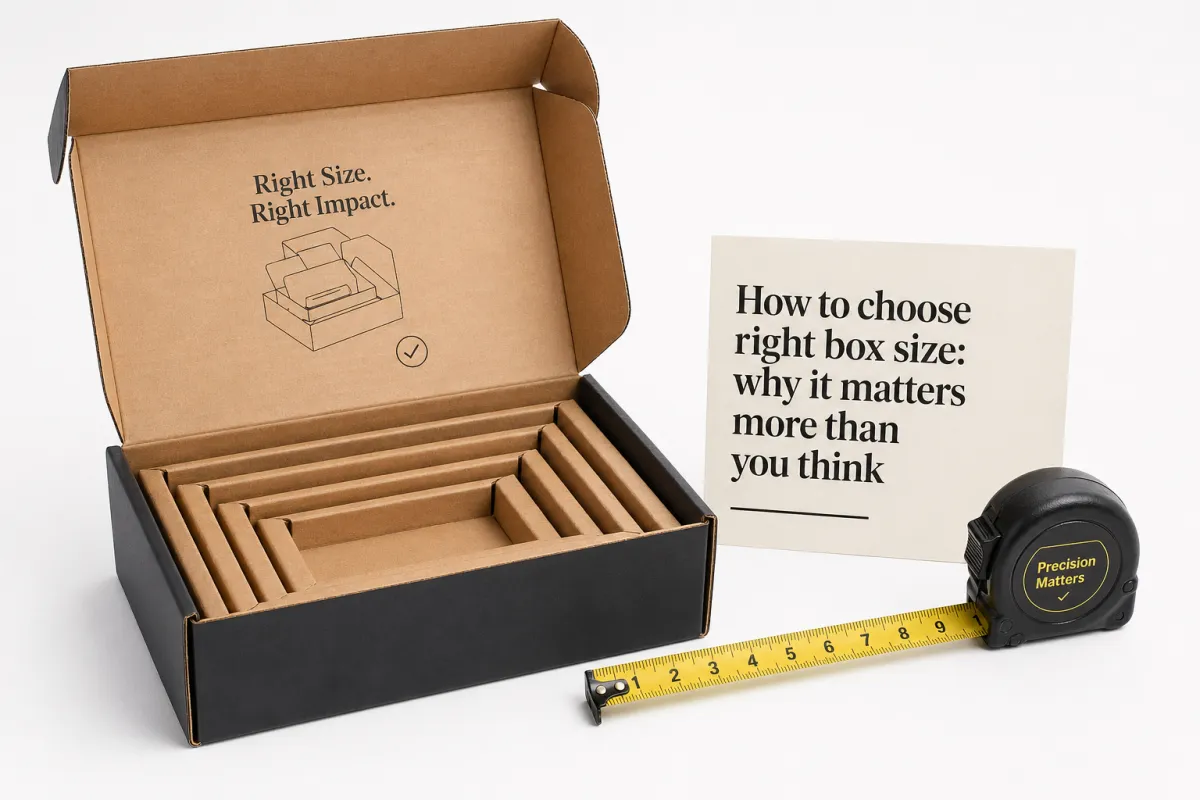
If you are trying to learn how to choose right box size, start with the unglamorous truth: size changes almost everything. It changes shipping cost, because carriers usually switch to dimensional weight once a carton gets bulky enough. It changes product protection, because empty space means motion, and motion means scuffs, corner crush, or a cracked pump bottle. It changes shelf presentation too, because a box that looks too loose or too cramped sends a message before the customer opens it, especially on a retail shelf in New York, Toronto, or Munich where the first glance lasts maybe 2 seconds.
I remember a subscription brand in Austin that wanted a premium feel and asked for an oversized rigid mailer with a deep shoulder. The sample looked elegant on the showroom table. In the warehouse, though, the box used 14% more board than needed, required 2 extra grams of void fill per unit, and pushed parcel rates up by $1.42 on average for Zone 5 shipments. That is the kind of detail that turns a clean design idea into a budget headache. I was the one who had to explain why "elegant" was now a line item, which is never a fun sentence to say out loud.
The most common mistake is thinking how to choose right box size means finding the smallest dimensions that hold the product. It does not. It means balancing three things at once: the item’s real footprint, the protection system around it, and the way the box moves through production, storage, and delivery. If one of those three is off, the whole package feels off, and the problem shows up in a shipping dock in Dallas or a fulfillment center in Rotterdam before it shows up in a sales report.
Brand perception rides on the size decision too. A carton that arrives with crushed corners, sloppy fill, or a product rattling inside makes the company look careless, even if the product itself is good. That first impression is brutal. Customers forgive plain kraft board. They forgive simple printing. They do not forgive a package that looks like it lost a fight with a conveyor belt in Memphis.
"The box looked fine on the sample table, but UPS charged us like we were shipping pillows." I heard that from a client after they approved a box that was 2 inches too tall for the item and its insert, which turned a $0.46 carton into a $1.88 shipping problem.
If you want to get serious about how to choose right box size, treat the box as part of the product system, not a side note. The right dimensions can cut filler, protect your goods, and keep your freight bill sane. The wrong dimensions can do the opposite with impressive speed, especially if your packing line is running 600 units per hour and every extra fold costs 4 to 5 seconds. That is kinda the whole game.
How the box sizing process actually works
The box sizing process starts with a basic distinction that people mix up constantly: internal size versus external size. Corrugated board has thickness. Rigid board has thickness. Even a simple mailer changes once you account for the flutes, wraps, and glue flaps. If you are measuring only the outside of a mockup, you are not actually learning how to choose right box size. You are learning how to confuse yourself with a ruler and a false sense of certainty.
Internal size is what matters for fit. External size is what matters for shipping, stacking, and carton planning. A B-flute mailer with 1/8-inch board on each wall can lose more than 1/4 inch across two sides before you even talk about inserts. On a luxury setup with wrapped rigid board and 157gsm art paper, the difference can be even more annoying. I once watched a buyer approve a drawer box in Guangzhou, only to discover the insert needed another 3 mm of clearance for the pull ribbon. Three millimeters. That tiny gap held up a whole shipment, and I could practically hear the collective sigh from three departments at once.
How to choose right box size also depends on the product’s largest finished dimension. Measure the widest point, the tallest point, and the deepest point, then check for anything that sticks out: caps, corners, handles, chargers, closures, or a molded bump from a pump head. If you are packing multiple units together, use the largest configuration, not the prettiest one. The worst-case set is the one that saves you, because a 250 mL bottle with a 5 mm shoulder ridge does not care about your mockup mood board.
Box style changes the rules too. A straight tuck end carton behaves differently from a mailer. A regular slotted container has more practical tolerance for bulk shipping than a rigid box that must open and close with a polished feel. If you are choosing between a folding carton, a mailer, and an RSC, the measurement logic shifts with each style. "Same size" can mean three different things in a single sourcing call, which is a neat little trap if you enjoy confusion and unnecessary email threads stretching from Ho Chi Minh City to London.
There is also dimensional tolerance. A carton can be technically correct on paper and still fail in the plant if the tolerances are too tight. Paperboard can vary by batch. Glue can add a fraction of a millimeter. A die can drift by 0.8 mm after a few thousand impressions. That is why I never approve a size just because the numbers look pretty in a spreadsheet. I want a mockup, a fill test, and a real closure test with the actual product, the actual insert, and the actual tape or tuck system.
For structural guidance, I often point teams to packaging references from ISTA and standards from ASTM. They will not pick the box for you, because nobody sane should expect that, but they help set the testing bar so you are not guessing. On a 350gsm C1S artboard folding carton, for example, the test protocol matters just as much as the artwork if the product weighs 180 grams and includes a glass component.
Quick rule: if the mockup needs force to close, it is too tight; if the product slides more than 3 to 4 mm, it is too loose. That simple check catches a lot of bad decisions before anyone spends money on print plates, a steel rule die, or a 2,000-piece pilot run.
How to choose right box size for cost, shipping, and branding
Once you understand how to choose right box size from a fit perspective, the next question is money. Box size touches the board usage, the die layout, the print sheet yield, the carton freight, and the amount of filler you burn through every week. Those numbers add up fast. A box that is only 0.5 inches larger in each dimension can waste a surprising amount of paperboard across 10,000 units, especially if you are using a 24 x 36 inch press sheet in a plant outside Dongguan or Foshan.
Here is a simple comparison I use when clients want to compare options before locking a custom size. The cheapest unit price is not always the cheapest total cost. That is the trap, and it shows up in procurement spreadsheets more often than anyone wants to admit.
| Option | Internal Size | Estimated Unit Price | Shipping Impact | Best Use |
|---|---|---|---|---|
| Small snug mailer | 8.5 x 6.25 x 2 in | $0.34/unit at 5,000 pcs | Lower dimensional weight, fewer void-fill grams | Lightweight kits, cosmetics, small electronics |
| Mid-size mailer | 9.5 x 7 x 3 in | $0.39/unit at 5,000 pcs | Moderate carrier cost, easier packing for inserts | Gift sets, candles, accessory bundles |
| Oversized mailer | 10.75 x 8 x 4 in | $0.45/unit at 5,000 pcs | Higher dimensional weight, more filler, more damage risk if empty | Bulkier products, fragile premium sets with trays |
That table is exactly why how to choose right box size is a cost conversation, not just a packaging conversation. A $0.05 difference in unit price can be wiped out by a $0.90 freight penalty and a $0.30 insert change. I have seen this happen with a skin-care client in Orange County who saved $600 on box manufacturing and then lost almost $4,800 in extra parcel charges over a single quarter. Cheap boxes can be very expensive, which is a dumb little miracle the industry keeps repeating.
Dimensional weight is the part that catches teams off guard. If a carton crosses a carrier threshold, you can get billed for space instead of actual weight. A one-inch height increase may not sound like much, but on a run of 2,000 shipments it can shift the freight class enough to matter. If you are asking how to choose right box size for ecommerce, this is the first place to check, especially on routes from California to Zone 7 or from Poland to Germany.
MOQ matters too. A custom die can cost $180 to $450 depending on the structure, and a unique box size can reduce sheet yield if it does not nest efficiently on the press sheet. In one negotiation with a Guangdong supplier, I got a quote of $0.41/unit for 10,000 pieces on one size and $0.36/unit on a slightly adjusted size that fit the board better. The product fit stayed the same. The manufacturing math got better. That is the kind of win people skip because they fall in love with a number on a spec sheet.
Branding sits on top of all of this. A box that is too large can make a premium item feel floating and underdressed. A box that is too tight can make the opening feel cheap or aggressive. How to choose right box size for branding is really about control: enough room for a nice reveal, enough structure to hold shape, and enough restraint to avoid waste. If your box looks expensive but costs you $1.20 extra in freight and filler, that is not luxury. That is theater with a bad accountant.
My practical tactic is simple: ask for 2 or 3 size quotes side by side. Put the unit price, estimated freight, insert cost, and expected damage rate in one sheet. Compare the total landed cost, not the sticker price. That one habit has saved clients more than any premium packaging upgrade ever did. It also saves you from that maddening moment where somebody points at the cheapest quote and says, with complete confidence, "So we're done, right?" No, we are not done. We have only begun the budget argument.
How do you choose the right box size step by step?
If you want a repeatable method for how to choose right box size, use the same five-step process every time. No guessing. No "looks good enough." Just a controlled workflow that ends with a sample you can actually trust and a production order that does not need rescue work from a plant in Ningbo or Nashville.
-
Measure the finished product.
Take at least 5 samples from production if you can. Measure the longest, widest, and tallest points of the finished unit, not the catalog dimensions. I once checked a set of glass bottles that were supposed to be 2.75 inches wide. Three measured 2.74 inches, one was 2.79 inches, and one had a slightly thick base that created the real problem. The biggest unit sets the minimum safe size. The one surprise bottle always seems to be the one that causes the whole procurement meeting to get weirdly tense.
-
Add room for inserts and opening clearance.
If the item needs a cardboard insert, molded pulp tray, or bubble wrap, that space counts. A snug fit is good; a crushed fit is nonsense. For a presentation box, I usually leave 1.5 to 3 mm per side for clean removal, depending on the board structure and the closing style. For fragile items, I would rather use engineered inserts than pile in loose fill and hope for the best. Hope is not a packing method, no matter how often people try to make it one.
-
Build a mockup or dieline sample.
A drawing can lie by omission. A sample tells the truth. When I visited a folding carton line in Shenzhen, the buyer had approved a box on screen, but the front flap hit the insert lip by 4 mm once the glue tab was real. The paper spec looked fine. The physical sample looked like a fight. Mockups catch that before you place a full order, which is preferable to discovering the problem after production has already started and everybody suddenly remembers they have a "very busy week."
-
Pack test the box.
Shake it. Drop it from 18 to 24 inches if the product is fragile. Stack three cartons high for 24 hours if the warehouse will do that in real life. Test the worst version, not the easiest one. If the closure pops open after a shake test, the size is off. If the product drifts to one side and leaves a dead corner, the size is off. If you are designing for shipping, look at the finished pack under stress, not just under studio lights.
-
Lock timing and approvals.
Sample review, structural edits, print proofing, and final production have to fit the launch calendar. A simple structure might need 7 to 10 business days for sampling and 12 to 15 business days for production after approval. A more complex rigid box can take 18 to 22 business days if it includes foil stamping, embossing, or a custom tray. How to choose right box size is partly a design task and partly a scheduling task, which is why people who ignore timelines end up sending apologetic messages on Friday evening.
There is a practical detail here that people ignore: the product should move through the box with a predictable amount of resistance. Too much resistance damages edges during packing. Too little resistance causes rattle. For shipping-ready packaging, I like a controlled snug fit. For retail presentation, I may allow a cleaner reveal with a bit more headspace, but only if the closure remains sharp and the pack still survives a 24-inch drop.
One of my clients sold a premium tea set in a rigid gift box with a foam insert. The first sample looked luxurious until we tested a second unit with a slightly taller tin lid. That 2 mm difference caused the top panel to bow. We adjusted the internal depth by 3 mm, changed the foam cutline by 1 mm, and the problem disappeared. No drama. No reprint. Just better sizing, which is almost always the boring answer and, inconveniently, the correct one.
Common mistakes when choosing the right box size
The biggest mistake is using outside dimensions and calling it a day. That sounds obvious, but I still see it. A buyer gets a quote for a 10 x 8 x 4 inch carton, assumes the item fits, and forgets that the actual inside clearance might be closer to 9.75 x 7.75 x 3.75 once the board thickness is included. That is how good plans turn into bad samples, especially when the box is made with 1.5 mm board and the insert adds another 2 mm.
Another mistake is ignoring variation. One SKU may have a thicker cap, a slightly bent corner, or an accessory that sits proud by 5 mm. If you are choosing how to choose right box size for a product line, you cannot size only for the average unit and hope the outliers behave. The outlier is the one that creates a customer complaint, and customer complaints always seem to arrive on the same day as a replenishment deadline.
People also choose a box for shelf appearance and forget the warehouse. A beautiful carton that is annoying to pack will slow the line down. If a packer has to force-flip a product or wrestle with a tight tuck, your labor cost rises. A box that looks elegant but wastes 12 seconds per pack can be far more expensive than a plainer structure that runs cleanly at 800 units per hour on a line in Ohio or Puebla.
Dimensional weight is the financial mistake with the biggest sting. A larger carton can trigger a higher carrier charge even when the product is light. Add in carton strength, and the problem gets worse: if the box is too large for the product, you may need more filler or a stronger board grade just to keep the package from collapsing. That means more cost in board, freight, and damage claims, plus a very annoyed logistics manager with a highlighter.
There is also a timing mistake. Teams finalize graphics before they finalize size, then discover the barcode sits too close to a fold or the copy blocks the top panel seam. I have seen a line manager at a Midwest plant stop a run because the logo wrapped over the edge by 1/8 inch after a last-minute size change. That was a fun phone call. By fun, I mean expensive and annoying, the sort of call that makes everyone involved suddenly very interested in "process improvements."
Here is the blunt truth: if you ask how to choose right box size only after the design is locked, you are already late. Size should be part of the structure conversation, not the cleanup crew. Once the artwork, insert, and shipping method are tied together, the wrong dimension gets harder and pricier to fix. I have seen a 3 mm mistake cost a brand $2,100 in retooling, and that was before the second round of proofs.
Expert tips for choosing the right box size in real production
My first tip is to set a fit ratio target. I do not need a fancy formula for every project, but I do want a controlled relationship between product volume and empty space. For fragile goods, that often means allowing enough room for a 3 to 6 mm insert buffer on each side. For presentation packaging, it can mean a slightly looser reveal as long as the item does not move. How to choose right box size becomes much easier when you define what "good fit" means before anyone quotes the job.
Second, ask for a sample early. I have watched polished drawings turn into ugly surprises once inserts showed up. One time, a rigid box for a candle line looked perfect until the lid closure rubbed against the insert wall because the wick protector was 7 mm taller than spec. We caught it on the first sample. If we had skipped that step, the whole order would have become a very expensive guess, and somebody would have made a very dramatic spreadsheet about it later.
Third, talk to the supplier about board grade and flute choice. A stronger board can sometimes let you reduce unnecessary space because the package holds shape better under load. A 32 ECT C-flute may behave differently from a 44 ECT B-flute, and that difference can affect both the fit and the shipping performance. If the box is for ecommerce, I would usually ask how the structure performs under compression and whether the supplier can support an ASTM D4169 or ISTA 3A style test plan if needed. In Mexico City, Vietnam, or Suzhou, that question usually separates the serious vendors from the ones who just want to send glossy renderings.
Fourth, standardize where you can. If you have 12 SKUs, you do not always need 12 unique sizes. A smart family of 3 or 4 box sizes can reduce storage headaches, simplify reorder planning, and improve your purchase power. I once helped a brand collapse 9 mailer sizes into 4, which cut inventory clutter in half and saved roughly $1,100 in annual carton storage and handling costs. Not glamorous. Very useful. Also, no one misses the old chaos once it is gone.
Fifth, document the final spec like it matters, because it does. Write down the exact internal dimensions, board grade, flute, print method, tolerance, closure style, and insert note. If the box uses a 1.5 mm foam insert or a 2-piece rigid tray, record that too. A reorder should not require anyone to re-interpret a half-remembered email from six months ago. I want the spec to survive a staff turnover, a new buyer, and a supplier change in Qingdao or Querétaro.
For sustainability-minded projects, I also like checking certification and recycling guidance. The FSC site is useful if you need to talk to suppliers about certified paper sources. The EPA has solid information on paper and paperboard materials, especially if your brand is trying to make honest claims instead of vague marketing copy. A 350gsm C1S artboard or a 100% recycled kraft mailer tells a different story, and the material spec should match the story.
One more thing from the factory floor: do not let the word "custom" scare you into overcomplicating the project. Many of the best results come from small, practical adjustments. A 3 mm height reduction. A different insert cutout. A board grade that handles compression better. That is how to choose right box size in the real world: not by chasing perfection, but by nailing the details that matter in a plant where the first shift starts at 7:00 a.m. and the second shift does not care about your mood board.
How to choose right box size and lock in your next steps
If you want to finish the job cleanly, start with a measurement sheet for each SKU. Keep the longest, widest, and tallest finished dimensions in one place, along with the insert notes, the product weight, and any fragile points. That single sheet makes how to choose right box size repeatable instead of emotional, which is useful when three teams are arguing over a 4 mm gap and nobody agrees whose fault it is.
Next, request 2 or 3 quotes with sample dielines. Ask the supplier to show the internal dimensions, the expected board grade, and the freight impact side by side. If you are buying at scale, ask for the price at 1,000, 5,000, and 10,000 pieces. The spread matters. Sometimes the unit price drops by $0.06, but the board layout improves enough to save another $0.02. Those little numbers matter more than the brochure copy, especially if the supplier is quoting from Shenzhen and the warehouse is in New Jersey.
Then pack test the most fragile version of the product. Not the easy one. Not the "we usually ship that SKU fine" version. The worst-case version. If the worst-case unit fits, the rest usually follow. If it fails, you know the box is not ready, and you saved yourself from a warehouse headache later. I would rather find a problem on a folding table with a $12 sample than in a 3,000-piece production run with a Friday afternoon pickup waiting outside.
After that, compare the sample against shipping rates, storage space, and retail presentation. That is the final screen. The box that wins on total performance is the one you should keep. I would rather see a brand choose a slightly more expensive carton that saves $1.10 in freight and cuts damage claims than chase the cheapest printed box and spend months explaining why returns jumped. A good decision in this space can feel dull at the moment you make it, then brilliant when the November freight bill arrives.
Finally, put the decision in writing. Save the internal dimensions, the approved sample photo, and the reorder notes in the project file. That way, how to choose right box size is already solved before the next run starts. No guessing. No panic. No "can we just make it a little bigger?" email chain at 9:40 p.m. from someone who has just discovered the value of a tape measure.
That is the real answer to how to choose right box size: measure carefully, test honestly, compare total cost, and document the final spec so the next order does not repeat the same mistakes. If you do that, how to choose right box size stops being a problem and starts being a process. And, refreshingly, a process is a lot less irritating than a last-minute packaging fire drill.
How do I measure a product to choose the right box size?
Measure the longest, widest, and tallest points of the finished product, not the flat drawing size. I like checking at least 5 samples because a single unit can hide a 2 to 5 mm variation that breaks the fit. Add space for inserts, wrap, or movement if the item shifts in transit. That is the practical core of how to choose right box size without getting surprised later, especially if the product is glass, metal, or a molded plastic assembly.
Should I choose a tight fit or leave extra space in the box?
Aim for snug, not crushed. Too much empty space increases movement and damage risk, but too little space can pinch the product or deform the closure. Fragile items usually need engineered inserts or cushioning rather than loose fill. If the box is more about presentation, allow just enough room for a clean open and close with no rattle. That balance is central to how to choose right box size, whether the carton is 300gsm SBS or a 24pt rigid setup with a wrapped lid.
How does box size affect shipping cost?
Larger boxes can trigger dimensional weight charges even when the product is light. A carton that grows by 1 inch in height can push a shipment into a higher carrier tier, depending on the route and the parcel service. Right-sizing can reduce freight cost and the amount of void fill you need. If you are working on how to choose right box size for ecommerce, this is the line item to watch first, especially on 500-unit or 5,000-unit monthly shipments.
What is the best box size for multiple products in one package?
Choose the worst-case packed footprint, not the smallest item in the set. If the products need to stay separated or centered, use inserts or dividers. Test the heaviest and tallest combination before locking the size, because that configuration usually exposes the real issue. This is a very common place where how to choose right box size gets messed up by optimism, especially if one SKU has a cap that sits 6 mm higher than the others.
How long does it take to finalize a custom box size?
A simple sample-and-approval cycle can move quickly, but custom structural changes take longer. Plan time for dieline review, sample production, testing, revisions, and final manufacturing. I usually tell clients to leave 7 to 10 business days for sample work and 12 to 15 business days for production after approval, with extra room if the size change affects tooling or print setup. That timeline is part of how to choose right box size without wrecking your launch schedule, especially when your factory is in Guangdong and your launch date is tied to a retail reset in California.