Buyer Fit Snapshot
| Best fit | Design Brand Stickers That People Keep projects where brand print, material claims, artwork control, MOQ, and repeat-order consistency need to be specified before quoting. |
|---|---|
| Quote inputs | Share finished size, material target, print colors, finish, packing count, annual reorder estimate, ship-to region, and any compliance wording. |
| Proofing check | Approve dieline scale, logo placement, barcode or warning zones, color tolerance, closure strength, and carton packing before bulk production. |
| Main risk | Vague material claims, crowded artwork, missing packing details, or unclear freight terms can make a low unit price expensive after revisions. |
Fast answer: Design Brand Stickers That People Keep: Material, Adhesive, Artwork, and MOQ should be specified like a repeatable production item. The safest quote records material, print method, finish, artwork proof, packing count, and reorder notes in one written spec.
Production checks before approval
Compare the actual filled-product size with the drawing, then confirm tolerance on folds, seals, hang holes, label areas, and retail display edges. Reserve space for logos, QR codes, warning copy, and material claims before decorative graphics fill the panel.
Quote comparison points
Review material grade, print process, finish, sampling route, tooling charges, carton quantity, and freight assumptions side by side. A quote is only useful when the supplier can repeat the same color, closure quality, and packing count on the next order.
When I first learned how to design brand stickers, I watched a sharp logo disappear under warehouse lighting because the clear gloss laminate reflected the overhead LEDs in a 14,000-square-foot fulfillment center outside Chicago. The artwork looked crisp on a calibrated Eizo monitor, and it even passed a tabletop proof review in our Portland office, but the first roll failed the only test that mattered: a bright packing line where the silver detail washed out at arm's length. That mistake cost $1,240 on a 5,000-piece run, and it changed the way I think about every die-cut, every adhesive choice, and every finish note that goes to press.
Most people treat how to design brand stickers like a small poster exercise, which misses the point by a wide margin. A sticker is a compact brand carrier that gets handled by greasy fingers, tossed into poly mailers, rubbed against laptop sleeves, and judged from 18 inches away or less in a coffee shop, warehouse, or trade-show queue. If it cannot survive that kind of use, the design is only decoration. I have seen one 2.5 inch circle outperform a 3 inch die-cut with four typefaces and a gradient fade because the circle had high contrast and a 0.5 mm keyline. Same budget, very different results, and that is usually the part people underestimate.
At Custom Logo Things, I approach stickers the same way I approach carton graphics and retail inserts: they need to earn their place in the unboxing experience, support brand identity, and print cleanly at scale. A useful sticker brief usually starts with size, shape, finish, quantity, and target ship date, not a vague note that says "make it pop." The rest of this piece walks through the design choices, print specs, budget traps, and proofing details that matter most when you are figuring out how to design brand stickers that customers keep on a water bottle, laptop lid, or shipping box for months instead of tossing after one week.
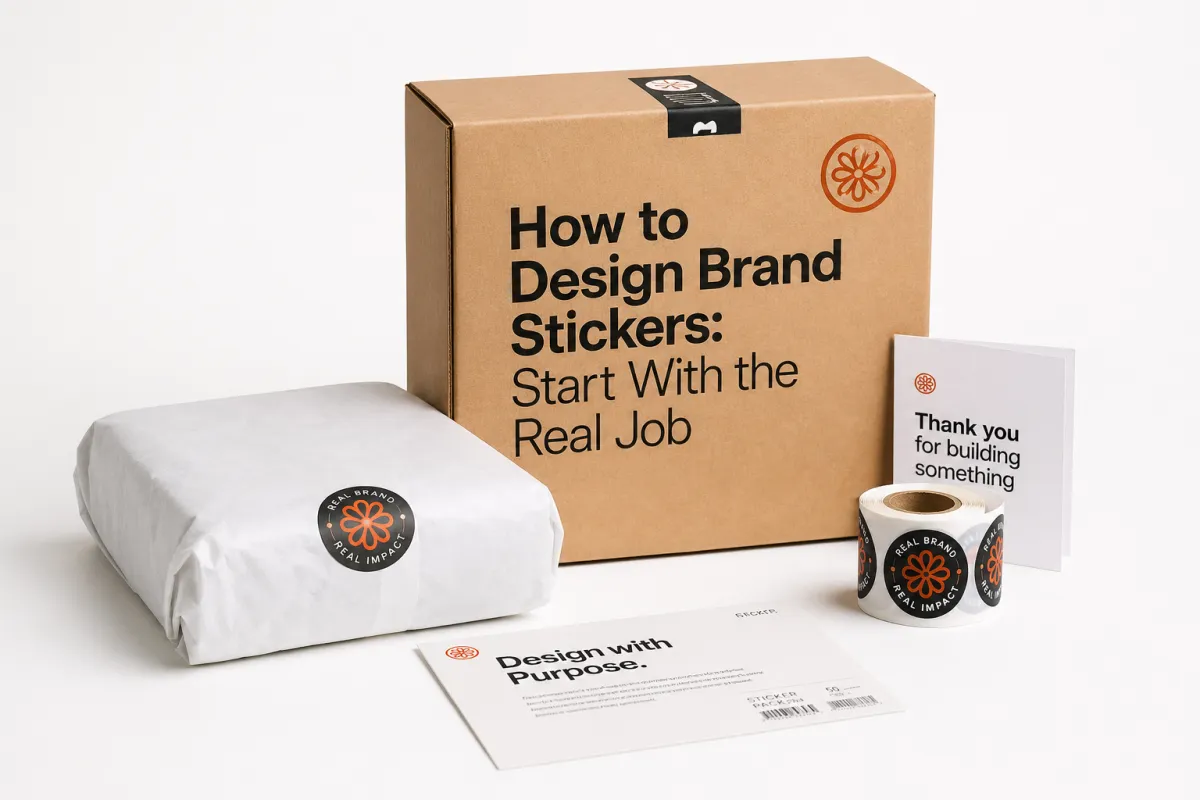
How to Design Brand Stickers: Start With the Real Job
The first mistake I see in how to design brand stickers is starting with the logo instead of the job. A sticker meant for a shipping carton needs different contrast, adhesive, and finish than a sticker meant for a retail bottle, a conference handout, or a laptop cover that gets wiped down with alcohol once a week. That sounds obvious in a deck. In a real review, after the mood board has gotten polished and expensive, it is the first thing people forget. One cosmetics client wanted a 4 inch clear sticker with pale gray type because it felt minimal, but on frosted glass in a Seattle showroom it vanished at two feet. We shifted the type to black, added a 0.75 point outline, and the sticker finally did its job: read cleanly in under 2 seconds.
Think of stickers as tiny sales reps that travel through your fulfillment center, your retail shelf, and your customer's kitchen drawer. They show up on boxes, notebooks, takeout bags, and event kits, and they either reinforce brand consistency or muddy it. That means how to design brand stickers should start with three concrete questions: Where will the sticker live, what will people be doing with it, and what single message should register first? If the answer is "everything," the design is already in trouble. The strongest stickers I have approved over the years did one clear thing well, often with a 1-color imprint, a 2 inch footprint, or a clean die-cut that matched the mark without extra decoration. I have a strong opinion here: restraint usually looks smarter than cramming every available millimeter.
"I do not need a miniature brochure. I need a sticker that makes the box feel like it came from a brand with a point of view and a print budget that was spent on purpose."
That line came from a coffee client in Portland during a 9:15 a.m. proof review, and she was right. How to design brand stickers is not about squeezing in every tagline, social handle, and decorative line. It is about building a tiny object that earns retention. If someone keeps the sticker on a laptop for 18 months, it keeps extending your brand identity long after the package is gone. That is why I favor designs with one primary focal point, one support message at most, and a finish that fits the brand personality instead of fighting it. If the sticker needs a paragraph, it probably belongs on a hangtag, insert card, or 350gsm C1S artboard card instead.
If you want a useful benchmark, look at the stickers in our Case Studies. The successful ones usually share the same traits: strong contrast, simple geometry, and a shape that still reads at 3 feet when the box is moving on a conveyor. That is the real work behind how to design brand stickers. Not decoration. Function with style, cut with purpose, and a surface treatment that knows the difference between a display shelf in Atlanta and a parcel lane in Louisville.
How Do You Design Brand Stickers From Brief to Print?
Good how to design brand stickers work starts with a brief that includes the use case, size, material preference, quantity, and target ship date. If you send only a logo file and a vague note that says "make it pop," your printer has to guess at the rest, and guessing is expensive. A proper brief usually takes 20 minutes to write and saves 2 rounds of revisions. I ask for the intended surface, the expected handling, and whether the sticker needs to survive moisture, UV exposure, or cold-chain packaging at 38 to 42 degrees Fahrenheit. Those details decide whether we specify BOPP, vinyl, paper, or a clear film. That is the practical answer to how to design brand stickers that survive production instead of just looking good on screen.
Once the brief is clear, the process usually moves through concept sketches, file prep, proof review, production, and shipping. For a simple run, I have seen concepting take 1 to 3 business days, artwork cleanup another 1 to 2 days, and digital proof approval within 24 hours if the client answers quickly. Standard production in a shop near Dongguan or Shenzhen typically takes 12 to 15 business days from proof approval, and specialty finishes like foil, white ink, or soft-touch lamination can add 3 to 7 more days. If you are learning how to design brand stickers for a product launch, build in that buffer, because the fastest way to wreck a launch is to treat proofing like an afterthought and shipping like a miracle.
Printers live in the details most designers ignore: dielines, cutlines, bleed, safe area, and finish notes. A dieline tells us where the sticker cuts, bleed gives the cutter room to trim without exposing a white edge, and safe area keeps type away from the knife path. If you are working with a rounded shape, give the art at least 0.125 inch of bleed and keep live text 0.06 to 0.1 inch inside the cut. That is boring math, but boring math is cheaper than a reprint, especially on a 10,000-piece job shipped by air freight from Guangzhou.
On a factory floor in Shenzhen, I watched a carton of 10,000 stickers get held up because the client approved a proof with a gold border that sat 0.5 mm too close to the die line. The cut wandered just enough to nick the border on every 12th sticker, which was enough to fail a premium packaging spec. The material was fine. The concept was fine. The file prep was not. That job cost an extra $380 in rerun charges and another 4 days of lead time. Packaging teams love to romanticize creativity, but the press only cares about the file, the tolerance, and the approval timestamp.
A clean workflow checklist keeps everyone honest:
- Confirm the sticker purpose, surface, and expected handling.
- Send vector artwork in PDF, AI, or EPS format.
- Specify size, shape, finish, and quantity.
- Ask for a dieline, proof, and any finish samples.
- Approve the proof only after checking color, cut, and text size.
- Plan 12 to 15 business days for standard production after proof approval, longer for special finishes or overseas freight.
If you are comparing broader packaging specs, I also recommend reading the educational resources at Packaging Machinery Manufacturers Institute and checking transit and handling guidance at ISTA. They will not design the sticker for you, but they will remind you that the real world is not a mood board, especially once a 250-piece pilot run gets compressed inside a mailer at the USPS hub in Kansas City. That matters when you want how to design brand stickers that survive shipping, stacking, humidity, and a customer's impatient thumb.
Key Factors That Change How You Design Brand Stickers
Size is the first decision that changes how to design brand stickers. A 1.5 inch label can carry a logo, but not a paragraph. A 4 inch sticker can handle more breathing room, but it also costs more to print, especially if you are using a custom die-cut or a specialty finish. I usually start by matching size to the viewing distance: 1 to 2 inches for product seals, 2 to 3 inches for laptops and mailers, and 3 to 4 inches if the sticker needs to live on a box front or retail bag. Bigger is not automatically better, and if the layout is weak, bigger just means more expensive ink and more waste trim.
Shape changes perception faster than most brands expect. A square sticker feels structured, a circle feels friendly, and a die-cut can feel premium if the outline is clean and the silhouette is recognizable from across a room. The last time I negotiated with a supplier in Dongguan, they quoted a standard 3 inch circle at $0.07 per unit in 5,000-piece volume, but the same art as a tight die-cut jumped to $0.12 because of extra cutting time and waste. That $0.05 gap matters when you print 20,000 pieces across two warehouse locations in Phoenix and Nashville. Shape is not just visual branding. It is a line item.
Material and finish do a lot of heavy lifting. Matte laminate gives a softer, more understated feel and helps reduce glare under retail lighting in a Los Angeles shop window or a fluorescent stockroom. Gloss boosts saturation and can make colors feel brighter, but it can also reflect hard light and kill readability. Clear film works well for glass, jars, and minimalist brands, though light type on clear stock can disappear if the background is busy. Metallic film and foil bring attention quickly, but I only use them when the design has enough contrast to hold up under a 5000K light source. If your brand identity is already bold, a gloss or metallic finish can amplify it; if the design is thin, shiny stock will expose every weak decision.
Typography is where a lot of sticker designs quietly fail. Thin serif fonts that look elegant at 1200 pixels can fall apart at 1.75 inches wide, especially on a 2.25 inch circle with a tight trim. I like to keep the smallest text at no less than 5.5 pt in print, and I avoid lines thinner than 0.25 pt on any label that might get rounded corners or a slight cut variance. Strong contrast matters more than fancy type. If a customer has to squint from 18 inches away, the sticker has already lost the first 3 seconds, which is most of the battle for brand recognition.
Eco-friendly material choices matter too, but they need a real spec, not a slogan. If sustainability is part of the story, ask for FSC-certified paper stocks where appropriate, or discuss recycled liners and lower-waste finishes. For a sticker that ships with a beauty set, you might choose an FSC paper face stock on a 60 lb liner; for a bottle label, you might move to a compostable-looking paper only if the adhesive and coating match the actual use. For general material guidance and environmental context, the EPA sustainable materials page is a good reference point.
| Material or Finish | Typical Use | Estimated Cost at 5,000 pcs | What It Does Best |
|---|---|---|---|
| Paper matte | Indoor packaging, inserts, envelopes | $0.03 to $0.06 per unit | Low cost, easy to write on, clean look |
| Gloss BOPP | Retail boxes, bottles, bright graphics | $0.05 to $0.09 per unit | High color pop, decent moisture resistance |
| Matte BOPP | Premium packaging, mailers, minimalist brands | $0.06 to $0.10 per unit | Soft finish, reduced glare, modern feel |
| Clear vinyl | Glass, jars, see-through packaging | $0.08 to $0.14 per unit | Invisible edges, clean product integration |
| Metallic or foil | Luxury kits, limited editions, promos | $0.12 to $0.22 per unit | Attention, shine, premium signal |
If you are still deciding between a sticker and another branded piece, our Custom Labels & Tags page can help you compare use cases faster. A tag on 350gsm C1S artboard might be the better answer for apparel, while a BOPP sticker is usually the right call for a bottle that gets chilled in a 34-degree walk-in cooler. The point is not to choose the fanciest option. The point is to match the finish, material, and shape to the role the sticker plays in the unboxing experience and the cost structure that supports it.
How to Design Brand Stickers on a Budget
If you want to understand how to design brand stickers without blowing the budget, start with the cost drivers. Quantity is the biggest one. Size is next. Then material, finish, shape complexity, and setup fees. I have seen a 500-piece order cost $0.42 per unit because the client wanted a custom die-cut, soft-touch laminate, and white ink on clear stock. The same artwork at 5,000 pieces dropped to $0.09 per unit because the setup spread across a larger run. Printing is strange like that, and a line item that feels painful at 500 pieces often calms down fast at 2,000 or 5,000.
One of the smartest budget moves is simplifying the silhouette. A circle, square, or rectangle can save $40 to $120 in die-cut setup compared with a complex custom outline, especially at smaller quantities. You can still make the sticker feel custom by adjusting the artwork, border treatment, or corner radius. Another good move is standardizing size across multiple SKUs. If six product lines all use a 2.5 inch sticker, you buy more efficiently and avoid six separate setups. That is one of the quiet secrets behind how to design brand stickers that feel premium without looking expensive.
Here is where brands overspend for no useful return: specialty inks on tiny stickers, multiple metallic layers, and ultra-short runs below 250 pieces. A client once asked for a 1.25 inch round with three spot colors, a foil accent, and a varnish line. The quote came back at $1.08 per sticker, which is a painful number to stare at in a spreadsheet. We cut it to one bold spot color, switched to matte BOPP, and got it down to $0.19 per unit at 2,000 pieces. Same logo. Same message. Less theater, more margin.
Short runs are expensive because setup is where the pain lives. A printer may charge $45 to $125 for file prep, plate setup, or cutting setup depending on the method, and that fee barely changes whether you print 200 stickers or 2,000. So if you know a design will be used across a trade show, an ecommerce shipment, and a retail insert, I would rather see one strong master design and one or two size variants than three wildly different concepts. That keeps brand consistency intact and keeps your finance team from glaring at you over lunch.
For a practical pricing framework, I often explain it like this:
- 500 pieces with a custom shape: expect a higher per-unit cost, often $0.18 to $0.45 each depending on finish.
- 2,000 pieces with standard shapes: usually a better balance, often $0.07 to $0.16 each.
- 5,000 pieces or more: the unit price can fall into the $0.03 to $0.10 range if the artwork is clean.
- Special finishes: add $0.02 to $0.12 per unit depending on foil, white ink, or lamination.
I will say this plainly: how to design brand stickers is often less about saving pennies and more about avoiding waste. A sticker that is cheap but unusable is expensive. A sticker that costs a little more and gets used on every box, laptop, and event bag is usually the better buy. If you need more proof, ask your printer for a quote with three quantities on the same spec sheet. Seeing the 500, 2,000, and 5,000-piece pricing side by side usually makes the economics click in about 30 seconds, which is usually faster than a budget meeting and a lot less painful.
Step-by-Step: How to Design Brand Stickers Your Customers Keep
The easiest way to approach how to design brand stickers is to define the sticker's job before you open Illustrator. Is it a packaging seal, a freebie, a laptop sticker, or an event handout? Each one has a different life span and a different expectation. A packaging seal might only need to survive one shipment from a fulfillment center in Indianapolis to a condo lobby in Brooklyn. A laptop sticker needs to survive months of friction, heat, and a few coffee spills. That changes the material, adhesive, and finish before we even talk about color.
Next, build the visual hierarchy. One element should win immediately. Usually that is the logo, but not always. Sometimes the brand mark is the secondary piece and the product name or message is the hero, especially on a limited-edition release or a 2.75 inch promotional sticker. If you are working with a wordmark, keep plenty of negative space around it. If you are using an icon, make sure the icon can still read at 1 inch wide. This is the part of how to design brand stickers where designers often try to make the sticker do 4 jobs at once. Resist that urge. You are kinda designing a tool, not a poster.
Then prep the artwork correctly. Use vector files whenever possible, convert fonts to outlines, and work in CMYK if the sticker will be printed digitally or in offset-style production. Keep important text inside a safe zone, and deliver the file with clear notes on bleed, cutline, and finish. I usually ask for a PDF proof before final approval, because a screen mockup is not enough. One client sent me a 72 dpi PNG and expected the linework to hold at 1.75 inches; it did not, and the type edge broke at the proof stage. That kind of mistake is why how to design brand stickers needs a file-prep checklist, not just a mood board.
Mockups matter, but only if they are honest. Put the sticker on a box, a bottle, a kraft mailer, or a matte pouch that looks like the real surface. I once had a beauty client approve a mockup that looked gorgeous on glossy glass, then panic when the same design felt too dark on soft-touch carton. We corrected the contrast by 12 percent and added a 0.8 mm border to separate the type from the edge. That tiny change made the sticker feel intentional instead of crowded. If you are serious about how to design brand stickers, test at least 2 surfaces before you approve the print file.
A simple approval sequence keeps the work moving:
- Confirm size and shape on a real mockup.
- Review the dieline and bleed area.
- Check colors, type size, and contrast at 100 percent zoom.
- Ask for material and finish confirmation in writing.
- Approve only after the proof matches the intended use.
The final step is making sure the sticker supports the overall brand story. A clean minimalist label can strengthen visual branding for a premium skincare line shipped from Santa Monica. A playful die-cut can make a snack brand feel more social and giftable at a booth in Austin. A recycled paper sticker can reinforce a sustainability story if the substrate and adhesive are actually aligned with that message. That is the part most people miss: how to design brand stickers is not just about art. It is about fit, behavior, and the way a small object carries a brand through the world.
Common Mistakes When You Design Brand Stickers
The biggest failure I see in how to design brand stickers is too much detail. Thin outlines, tiny iconography, and long copy all collapse once the sticker shrinks below 3 inches. I had a client insist on fitting a full slogan, a QR code, the website, and a seal mark onto a 2 inch circle. The QR code printed, technically. It also scanned about half the time on a phone camera held 10 inches away, which is not a good ratio. We fixed it by stripping everything back to one message and a cleaner edge, which is boring to describe and very satisfying to see.
Another common mistake is weak contrast. Gray on silver, white on cream, or pale colors on clear stock often look elegant in a deck and underwhelming in production. A printer can hit the ink spec perfectly and still deliver a sticker that fails because the design never had enough separation to begin with. Customer perception gets slippery fast. People do not say, "The contrast ratio is poor." They say, "It feels cheap." That is usually the verdict when how to design brand stickers has not been tested on a real surface in real lighting.
File problems are just as costly. Missing bleed can leave a white edge. Low-resolution raster art can blur at the cut line. Unoutlined fonts can shift if the printer does not have the typeface installed. I have also seen color shifts when a brand approves RGB artwork and expects the printer to magically match a neon blue on coated stock. That is not how print works. If the color matters, ask for a CMYK build and a proof under consistent light, ideally the same 5000K lighting you use in your warehouse or studio.
There is also the generic and forgettable problem. A sticker can be technically flawless and still feel flat if it copies the same rounded badge, same sans-serif, and same gradient every other brand uses. The cure is not more decoration. It is a clearer point of view. Maybe that means a tighter shape, a stronger color, or a cleaner wordmark with one intentional accent. I have seen tiny shifts raise brand recognition because the piece finally looked like it belonged to the brand, not a template made in a rush before a Tuesday launch.
On the sustainability side, I have watched brands print a thousand "eco" stickers on materials that made no sense for their own packaging story. A paper stock with an aggressive adhesive can still be the right answer, but only if the surface and disposal path make sense. If you need a paper source to support a procurement brief, FSC documentation can help, and you can learn more at FSC. The honest version of how to design brand stickers usually sounds less glamorous than the marketing version, but it protects your budget and your credibility.
Expert Tips and Next Steps After You Design Brand Stickers
My first tip is simple: ask for the dieline and digital proof before you approve anything. If the supplier cannot show you the cut shape, bleed, and finish in a clean proof, you are buying blind. I learned that on a 15,000-piece job where the client approved a round sticker and the production line used a corner-radius file by mistake. The fix cost $620 and two phone calls I would rather forget. Good how to design brand stickers habits reduce those disasters before they happen.
Second, order a sample or a small test run if the sticker is new, the surface is unusual, or the finish is expensive. A 250-piece pilot run can save a 5,000-piece mistake, especially if the sticker will touch corrugated board, coated cartons, frosted glass, or textured kraft paper. I have also found that a test run helps clients settle arguments that no meeting can settle. Once they hold the sample, they stop debating theory and start seeing the actual result.
Here is the checklist I use before I green-light a job:
- Artwork in vector format, with fonts outlined and images at print resolution.
- Final size, shape, and quantity confirmed in writing.
- Material and finish chosen for the real surface, not the mockup surface.
- Dieline reviewed, bleed added, and safe area respected.
- Budget, freight, and delivery date aligned before production starts.
If you are deciding among options, keep the conversation practical. A matte BOPP sticker at 5,000 pieces might be the best balance for a direct-to-consumer brand shipping 300 orders a week from a warehouse in Nashville. A clear sticker might make sense for a premium bottle line, but only if the type is dark enough to hold up against a busy background. A paper sticker might be fine for inserts, but not for an ice-packed product that sweats in transit for 2 hours. That is why how to design brand stickers should always be tied to the physical job, not just the brand deck.
My last piece of advice is to compare printers like you are comparing a real supply chain partner, not a price tag. Ask what the setup fee includes. Ask how they handle proof revisions. Ask whether they can repeat a color on the next run. Ask what their turnaround is for a 3,000-piece reorder versus a brand-new file. If you want to see how this thinking shows up in the field, look at the details in our Case Studies. If you need adjacent packaging components, our Custom Labels & Tags page is a useful next stop. The cleanest version of how to design brand stickers is the one that gets approved once, prints cleanly, and still looks good six months later on a laptop, box, or bottle.
So yes, how to design brand stickers starts with the art file, but it ends with how the sticker behaves in the wild. If the shape is smart, the print spec is honest, and the finish matches the brand, the sticker does more than decorate. It builds brand consistency, improves the unboxing experience, and quietly keeps your logo in circulation long after the package is gone. I have had people keep a sticker for years on a MacBook lid or a road case, which is either great brand strategy or the world's longest unpaid endorsement. Either way, the practical takeaway is the same: design for the surface, the light, and the hands that will actually touch it, then approve nothing until the proof matches that reality.
FAQ
How do I design brand stickers that look premium without overspending?
Use one strong focal point, a simple shape, and a finish that matches the brand story, then keep the first order to a standard size so you do not pay extra setup charges. If you are working through how to design brand stickers on a Tight Budget, matte BOPP or quality paper stock usually gives a cleaner result than chasing foil on a 300-piece run. I will always vote for a clean composition over a crowded one with shiny extras that do not earn their keep.
What size should I choose when I design brand stickers?
Start with the object the sticker will live on, then make sure the logo reads at arm's length, not only on a 27-inch monitor. In practice, how to design brand stickers usually means testing 2 or 3 sizes on a real box, bottle, or laptop mockup before you place the order. I like to print paper comps and tape them on the actual surface because the screen can lie with a straight face.
How long does the brand sticker design process usually take?
A simple project can move from concept to proof in 2 to 5 business days if your logo files are ready and decisions are fast. Custom cuts, special finishes, or multiple revision rounds can stretch how to design brand stickers into a 1 to 2 week process before production even starts, and overseas production often adds 12 to 15 business days after proof approval. If someone on the team says, "We can probably rush it," I usually hear, "We may be spending Friday night reviewing proofs."
How much does it cost to design brand stickers?
Design cost depends on whether you already have a finished brand file or need artwork built from scratch, and print cost depends mostly on quantity, finish, and cut complexity. When clients ask me how to design brand stickers on a known budget, I usually separate design, setup, print, and freight so the quote is actually comparable. That makes the decision less confusing and, frankly, less likely to become a very expensive surprise.
What file format is best when I design brand stickers?
Vector formats like PDF, AI, or EPS are the safest choices because they keep edges sharp at 1 inch or 10 inches. For how to design brand stickers, I also want outlined fonts, added bleed, and a CMYK proof before anything goes to press. If you send me a flattened JPG and hope for the best, I am going to ask for the real file, politely but very specifically.