Buyer Fit Snapshot
| Best fit | Eco Friendly Packaging for Tea Brands projects where brand print, material claims, artwork control, MOQ, and repeat-order consistency need to be specified before quoting. |
|---|---|
| Quote inputs | Share finished size, material target, print colors, finish, packing count, annual reorder estimate, ship-to region, and any compliance wording. |
| Proofing check | Approve dieline scale, logo placement, barcode or warning zones, color tolerance, closure strength, and carton packing before bulk production. |
| Main risk | Vague material claims, crowded artwork, missing packing details, or unclear freight terms can make a low unit price expensive after revisions. |
Fast answer: Eco Friendly Packaging for Tea Brands: Retail Fit, Compliance Space, Print, and Cost should be specified like a repeatable production item. The safest quote records material, print method, finish, artwork proof, packing count, and reorder notes in one written spec.
Production checks before approval
Compare the actual filled-product size with the drawing, then confirm tolerance on folds, seals, hang holes, label areas, and retail display edges. Reserve space for logos, QR codes, warning copy, and material claims before decorative graphics fill the panel.
Quote comparison points
Review material grade, print process, finish, sampling route, tooling charges, carton quantity, and freight assumptions side by side. A quote is only useful when the supplier can repeat the same color, closure quality, and packing count on the next order.
I still remember one tea launch in Shenzhen where a compostable pouch looked flawless under studio lights and then failed the seal test by 3mm, which is the sort of tiny miss that can turn a 5,000-piece run into a very expensive reprint. The film was a little too soft, the sealing jaws were running about 8 degrees too hot, and Eco Friendly Packaging for tea brands turned into a lesson in process control instead of a polished brand story. The customer never saw the scramble behind the curtain, only the boxed-up regret stacked beside a heat-sealer that had already done too much damage.
That kind of failure shows up more often than people admit. I have stood on factory floors in Shenzhen, Dongguan, and Huizhou while operators wrestled with films that sounded noble in a pitch deck and behaved like wet tissue the moment they hit the line at 40 packs per minute. Good Eco Friendly Packaging for tea brands is not virtue signaling with a kraft texture. It is a stack of decisions that keeps aroma in, moisture out, and a fill line moving at a pace that does not have the production manager muttering before lunch, which, yes, I have seen happen more than once at 7 a.m. on a Monday.
What Eco Friendly Packaging for Tea Brands Means in Practice
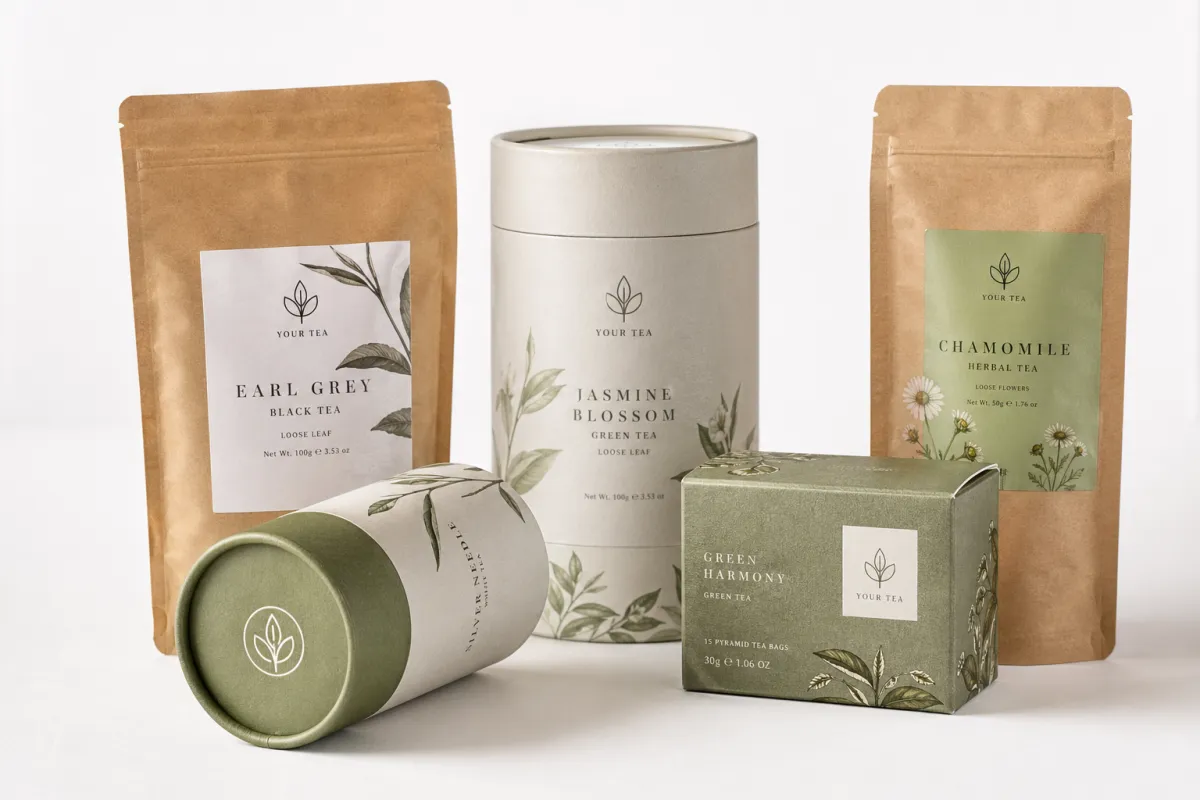
Eco Friendly Packaging for tea brands means lowering material impact without wrecking freshness, shelf life, or line speed. A pack has to do two jobs at once: represent the brand honestly on the shelf and perform like proper food packaging once it reaches the warehouse, the transit lane, and the customer’s kitchen drawer in Seattle, Singapore, or Saigon.
Plenty of brands think sustainability begins and ends with plain kraft paper, but that is a quick way to make a package look earnest and then fail in storage after 60 days at 70 percent relative humidity. Tea is sensitive. It absorbs odor, loses volatile aroma compounds, and goes stale when the barrier is weak. Real eco friendly packaging for tea brands is a material choice plus a performance choice, and the better projects never pretend those can be separated. Honestly, that is where a lot of well-meaning teams go off the rails: they fall in love with the story and forget the physics.
The formats I see most often are pouches, folding cartons, tea tins, compostable inner liners, labels, and shipping cartons. Each one carries a different burden. A pouch protects freshness with a 3-side seal or stand-up zipper. A folding carton sells the story and gives the line a premium face, often in 350gsm C1S artboard with CMYK plus one Pantone ink. A tin adds reuse value and a stronger shelf presence. A shipping carton keeps the branded packaging from arriving scuffed, crushed, or half-torn before it ever touches a shelf. When packaging design ignores that division, the bill usually comes due after launch, usually on the second reorder.
At a buyer meeting for a premium jasmine tea line in London, the client told me they wanted "the greenest option possible." Fair enough. Then they showed their DTC returns data: 7 percent damage from crushed corners and print abrasion, plus 240 units that needed rework after a 900-mile courier run. That is not a sustainability win. It is more waste dressed in better intentions. Eco friendly packaging for tea brands has to cut waste across the whole system, not just earn applause in a design review.
"It looks eco friendly" is not a spec. I said that to a brand owner in Dongguan after we split open a failed sample with a weak zipper and no real barrier. He laughed, then asked for a 48-hour rework on the spot, and by the next morning he had rewritten the entire specification.
Tea brands usually settle into one of three camps. Some want a paper-heavy look with a proper barrier liner inside, such as an FSC-certified outer wrap paired with a 60-micron PE or aluminum-free barrier layer. Some prefer recyclable mono-material films with a cleaner retail packaging feel. Some insist on compostable packs because the brand story depends on it. All three can work, though only when the tea, the market, and the machinery agree with the plan. That agreement is the part many teams skip, then act surprised when the numbers go sideways.
If you want to see how those choices connect to real builds, our Custom Packaging Products page gives a practical starting point. I treat it as the hands-on side of eco friendly packaging for tea brands: less slogan, more structure, more material truth, and a better way to compare a 50g retail pouch against a 100g refill pack without guessing.
How Does Eco Friendly Packaging for Tea Brands Keep Tea Fresh?
Eco friendly packaging for tea brands keeps tea fresh by blocking oxygen, moisture, light, and odor transfer while still holding up on the filling line, in transit, and on the shelf. Miss one of those and the tea starts sliding downhill. Sometimes the decline is slow enough to hide in early samples. Sometimes it is fast enough that the first customer emails you before the second reorder, especially if the pack sat for two weeks near a loading dock in humid weather.
Oxygen barrier matters because aroma compounds fade when air keeps sneaking in. Moisture barrier matters because tea leaves and matcha do not forgive humidity, and a fill room sitting above 55 percent relative humidity can undo a great material choice. Light protection matters because green teas, white teas, and many herbal blends lose their color and character under harsh shelf lighting. Seal integrity matters because even a beautiful film fails if the heat-seal jaws are too cool, too hot, or slightly misaligned by a few millimeters. I have lost count of how many times a "great" pack turned out to be a sealing problem in disguise.
I once tested a compostable tea pouch that passed the shelf mockup and then failed after a simple waist-height drop from 90cm onto a concrete floor. The zipper split open, the side gusset popped, and the client watched $8,400 worth of sample inventory turn into useless powder and torn film. That is why I push eco friendly packaging for tea brands to pass real tests, not just photo shoots and tabletop approval.
The main material paths usually break down like this:
- Kraft paper with barrier layers gives a paper-forward look, but the inner liner still does the heavy lifting, often with a 48- to 60-micron barrier film.
- Recyclable mono-material films can deliver strong barrier performance and better end-of-life potential, depending on the local recycling stream in places like Germany, Ontario, or California.
- Compostable films can fit short shelf life or a brand position with a strong disposal story, but they need honest instructions and realistic use cases, especially if the tea sells through DTC channels.
- Molded fiber cartons work well as outer packaging or gift packaging, not as the only freshness barrier for most tea.
- Metal tins are strong on aroma protection and premium shelf presence, though they are usually heavier and costlier to ship, especially if you are moving 20,000 units by sea from Ningbo.
The tea type changes the answer. Loose-leaf tea needs room, a reseal, and serious odor control, especially for 100g and 250g formats that get opened and closed 20 or 30 times. Pyramid sachets need line-friendly film and clean, repeatable seals on the machine. Matcha needs excellent moisture protection because it clumps and fades quickly, even in a 30g tin if the lid does not close tightly. Herbal blends often need less light protection than green tea, though they still absorb smells from nearby products in a warehouse. Premium single-origin teas usually need the strongest retail packaging story because buyers are paying for flavor, provenance, and the confidence that nothing spoiled the trip.
One mistake shows up again and again: the greenest option that fails freshness is still a bad purchase. If tea spoils, the waste includes product, labor, freight, and customer trust, and a single 2,000-unit run can disappear in a month if the barrier spec is wrong. That is not a tiny tradeoff. It is the whole bill. I would rather see a tea brand choose a slightly heavier film that holds product stable than chase a fragile concept that dies in storage.
The Key Factors Behind Eco Friendly Packaging for Tea Brands
Eco friendly packaging for tea brands gets judged in several places at once: shelf life, aroma sensitivity, humidity exposure, shipping distance, and how long the pack sits in a warehouse before it moves. That is why one material can look perfect for a boutique brand in Portland and feel completely wrong for a wholesale tea line shipping into Dubai or Riyadh where temperatures can hit 40C before noon.
Branding matters too. A tea pack has to earn its shelf space. Matte finishes, soft-touch lamination, window cutouts, foil accents, and print coverage all shape how premium the pack feels in the customer’s hand. Every design choice carries a consequence. A giant window can weaken light protection. Heavy ink coverage on 350gsm C1S artboard can make a minimalist pack harder to recycle. Deep embossing on a 2mm carton can raise cost quickly. Packaging design needs to serve the tea first, then the look.
I had a client once insist on a very minimal natural-paper look for a white tea blend. Nice idea, clean art direction, exactly the kind of thing a buyer likes to pin to a board. The pack sat on a bright retail shelf under fluorescent lighting for six weeks, and the tea started looking tired before the first reorder. We shifted to a lighter barrier structure, adjusted the print area, and kept the visual language calm without leaving the product exposed to unnecessary light. That is the kind of compromise eco friendly packaging for tea brands usually needs. Not glamorous, maybe, but effective.
Compliance and usability matter just as much. Food contact safety is non-negotiable. Label space has to fit ingredients, net weight, country of origin, and barcode placement with at least 2mm bleed and enough quiet zone for the scanner. Resealability matters if the tea is sold for multiple uses. Warehouse durability matters if the product is stacked, wrapped, or shipped with other product packaging in bulk. If the converter cannot keep the pack stable through storage and filling, the whole plan gets shaky fast.
Supplier capability is the silent killer. A polished sample means nothing if the converter cannot hit your 5,000-piece MOQ, match your print method, or keep lead times honest. I have watched projects die because a buyer fell in love with a compostable structure that only existed in tiny runs at a painful cost, often from a plant in Guangdong that could make samples but not stable repeat orders. For sourcing and comparisons, our Case Studies page shows what different eco friendly packaging for tea brands decisions look like after launch, not just in renderings.
If you are checking standards, I trust real testing more than glossy promises. For shipping abuse, ISTA drop and transit testing guidance beats a sales pitch every time, especially ISTA 3A-style drops for e-commerce parcels. For fiber sourcing, FSC certification still reads as one of the cleaner signals in the market. That does not solve every problem, but it is better than guessing while a freight container sits on the water for 24 days.
A useful way to sort the key factors is this:
- Freshness risk: match barrier strength to the tea’s sensitivity, not to the marketing copy.
- Brand impact: decide how much of the pack should stay minimal, matte, or printed.
- Operational fit: check sealing equipment, fill speed, and reseal type before you sign off.
- Supply reality: confirm MOQ, lead time, and sample support with the actual converter.
Eco Friendly Packaging for Tea Brands: Cost and Pricing Basics
Money gets messy fast if nobody breaks the numbers apart. eco friendly packaging for tea brands usually includes unit cost, tooling, plates, sampling, freight, and testing. People love to quote one number and forget the other four. That is how budgets drift off course before production even starts, often after a buyer has already promised a retail launch date in 30 days.
In my experience, stock kraft pouches are usually the cheapest starting point. A simple stock pouch might land around $0.12 to $0.22 per unit at 5,000 pieces, depending on size, zipper, and barrier. A custom printed mono-material pouch often sits closer to $0.22 to $0.38 per unit. Compostable films can climb to $0.30 to $0.55 per unit or higher if the specs are strict. Tea tins can run anywhere from $0.85 to $1.80 per unit, especially once you add custom decoration, inserts, and the kind of lacquer work that makes a buyer nod in a showroom.
That is only the unit cost. The real number is landed cost. A project can also carry $180 to $600 in plate or tooling charges, $60 to $250 for sample rounds, and anywhere from $280 to $1,200 in freight depending on size, route, and whether you are moving cartons, tins, or palletized pouches. I have seen a buyer celebrate a low unit price, then get hit with sample fees, air freight from Shenzhen to Los Angeles, and rework charges that added another 18 percent to the project. The math stopped being cheerful very quickly.
| Packaging option | Typical use | Barrier level | Approx. unit cost at 5,000 pcs | Best fit |
|---|---|---|---|---|
| Stock kraft pouch | Entry-level tea line, refill packs | Medium with liner | $0.12-$0.22 | Fast launch, simple branded packaging |
| Custom mono-material pouch | DTC and retail packaging | High | $0.22-$0.38 | Better balance of sustainability and performance |
| Compostable pouch | Short shelf life, brand story focus | Medium to high, spec dependent | $0.30-$0.55 | Eco messaging with careful testing |
| Tea tin | Premium lines, gift sets | High | $0.85-$1.80 | Luxury shelf presence and reuse |
| Folding carton plus inner pouch | Retail display and secondary packaging | Depends on inner pack | $0.18-$0.42 for carton alone | Strong shelf appeal and clear product packaging story |
What pushes cost up? Low MOQs. Custom print. Specialty barrier layers. Compostable materials. Zippers. Window films. Custom cartons. Every extra feature adds another line item, and in eco friendly packaging for tea brands, those line items pile up quickly if you try to make the pack do everything at once. The printer loves those extras, by the way. Your budget does not, especially when a 10-color design is being quoted against a 2-color layout.
Where can you save without making the brand feel cheap? Reduce SKUs. Use standard sizes. Keep the print system simple. Choose one packaging platform for multiple tea blends if the fill weights allow it. If a 50g pouch and a 100g pouch can share a carton architecture, that is easier on inventory, easier on design, and easier on cash flow. I like boring efficiency when the tea is good, especially when the plant in Ningbo is already quoting a 15-business-day turnaround.
The cleanest way to think about eco friendly packaging for tea brands is to sort every option into three buckets: display, protection, and shipping. The strongest project is usually the one where each layer does one job well instead of three jobs badly, whether that means a 350gsm C1S carton for display, a mono-PE pouch for protection, or a kraft shipper with 32 ECT strength for transit.
Step-by-Step Process and Timeline for Tea Packaging
A clean process saves money. A sloppy process burns it. eco friendly packaging for tea brands usually moves from brief to launch in a sequence that looks simple on paper and slightly annoying in real life. That is normal. The trick is knowing where the delays hide, because they always hide somewhere, usually in sample approval or a late change to the zipper spec.
- Product brief: define tea type, fill weight, shelf life target, sales channel, and target price point.
- Material shortlist: narrow the structure to two or three real options, not twelve fantasy options.
- Dieline and structure: confirm dimensions, zipper location, seal width, and barcode placement.
- Sample rounds: review physical samples, not just PDF mockups.
- Testing: check seal strength, drop behavior, odor retention, and storage stability.
- Final approval: lock the artwork, material, and production spec.
- Production and freight: run the order, inspect the run, and plan logistics.
Timelines depend on how custom the build gets, but a realistic rhythm looks like this: 2 to 3 business days for brief alignment, 2 to 4 business days for dielines, 7 to 10 business days per sample round, 1 to 3 weeks for performance testing, and 12 to 15 business days for production after proof approval. Freight sits on top of that. Air moves fast and costs more. Ocean is cheaper and slower. Physics still gets a vote, annoyingly enough, and a container from Shenzhen to Long Beach can take 18 to 24 days depending on the route.
I once watched a team delay launch by three weeks because they forgot to confirm the fill weight before they approved the art. The pouch looked great. The dimensions were wrong. The tea rattled around in the bag like loose screws in a toolbox. That is the kind of mistake eco friendly packaging for tea brands does not forgive. Lock the size before the artwork. Every time, even if the designer wants another hour with the layout.
My advice is to run a pilot on one hero SKU first. Pick the tea that matters most, the one that sets the tone for the rest of the line, and test 500 to 1,000 units before you commit to a larger print run. Launch that pack. See how it behaves in the warehouse, on the shelf, and in customer hands. Then scale the system across the rest of the range. I have seen brands save thousands by learning on one pack instead of learning on eight.
If you want more examples of what that rollout looks like, the project notes in our Case Studies section show how eco friendly packaging for tea brands performs once it leaves the render and enters the real world, including a 2024 tea line that moved from prototype to shelf in 38 days.
Common Mistakes With Eco Friendly Packaging for Tea Brands
The biggest mistake is obvious, but people still make it. They pick compostable packaging because it sounds good, then discover there is no composting access in the customer’s market. That turns eco friendly packaging for tea brands into a feel-good claim with no real end-of-life path. If your buyers are tossing the pack in general waste in Toronto, Austin, or Manchester, the environmental story weakens fast.
Second mistake: under-specifying the barrier. Tea absorbs odor. Tea fades. Tea stales. If your film cannot hold up against oxygen and humidity, your shelf life shrinks and your returns creep up. I have seen loose-leaf blends go flat in under four months because the buyer focused on paper texture and ignored barrier data. Pretty does not preserve flavor, no matter how nice it looks in a mockup, especially if the moisture vapor transmission rate is not written into the spec sheet.
Third mistake: ignoring the filling line. A sample can look excellent on a table and behave like a headache on actual equipment. Zippers misfeed. Seals wrinkle. Gussets collapse. Film slips. If your line runs at 40 packs per minute, a pack that only behaves at 20 is not a solution. It is a delay dressed up as sustainability, and the operator on the factory floor in Dongguan will tell you that in plain language.
Fourth mistake: overdesign. Too many materials. Too many finishes. Too much empty space. Oversized packs that use more material than the tea needs. I have seen brands order massive folding cartons for a 30g sample set, then wonder why the carton freight bill was absurd. Good eco friendly packaging for tea brands should right-size the pack, not inflate it for shelf drama or squeeze in six decorative panels that nobody reads.
There is also the trust problem. If you slap leaf icons and recycled claims on everything without backing them up, buyers notice. Retailers notice. Distributors notice. Honest labeling beats decorative sustainability every time. If a supplier cannot tell you the barrier spec, the seal range, the fiber source, and the test result from a 1-meter drop, keep walking.
- Do not choose compostable material without checking local disposal reality.
- Do not assume kraft paper equals low impact if the inner structure is overbuilt.
- Do not approve packaging design before confirming the fill line and seal settings.
- Do not make the pack bigger than the product needs.
One client came to me with a lovely matte pouch and a bright idea to print 14 ingredients across the back panel in tiny type, plus a QR code that sat too close to the bottom seal. Good luck with that. The copy became unreadable after the first test batch because the ink density made the panel dark and the regulatory text failed to pop. Even in eco friendly packaging for tea brands, design still has to earn its keep, down to the last 4pt line of copy.
Expert Tips and Next Steps for Tea Brands
If you want the cleaner route, start with the weakest point in the product system. Is freshness the issue? Humidity? Shipping distance? Premium shelf presence? Start there. eco friendly packaging for tea brands works best when the first decision solves the biggest risk instead of trying to impress everyone at once, especially if your first launch is a 60g loose-leaf blend and a 30g sample pack in the same month.
Ask suppliers for real data. Barrier specs. Seal strength numbers. Material construction. Carton strength if you are using Custom Printed Boxes. Sample photos are nice. Numbers are better. A supplier who can explain why their structure works is worth more than a salesperson who keeps saying "very sustainable" like that settles everything. It does not, and I have sat through enough of those meetings to know better, especially when the actual spec is a 12-micron PET outer, 60-micron PE liner, and a 130C to 150C seal window.
I also recommend ordering a sample kit and testing it in the real world. Put tea in the pack. Store it in a warm room at 28C. Leave one sample near a shipping dock. Drop another from counter height. Check aroma after two weeks. Check the seals after pressure. Check the corners after transit. That is how I learned to trust a spec instead of a presentation, and it works just as well on a mint blend as it does on a jasmine green.
The best tea packaging projects I have seen were not the prettiest at first glance. They were the ones where the brand owner asked hard questions, accepted a few compromises, and kept the product in the center of the decision, even if that meant choosing a 350gsm C1S carton over a softer-looking but weaker board.
If I were starting from scratch, I would keep the path simple. Pick one hero SKU. Compare two material options. Request quotes from at least two suppliers in Guangdong or Zhejiang. Ask for a sample pack, not just a sample pouch. Run a drop test and a storage test. Then choose the system that balances freshness, cost, and shelf appeal.
For a brand that wants to move quickly without wasting money, the smartest path is usually plain in the best way: one strong pouch format, one clear carton style, one stable print system, and one source of truth for specs. That is how branded packaging gets easier to scale and easier to reorder, whether the final format is a 100g refill pouch, a 50g gift carton, or a tin shipped in a custom corrugated shipper.
In my experience, tea brands do not need more packaging drama. They need better product packaging decisions, cleaner sourcing, and more honest tradeoffs. If your structure is solid, your visuals will do the rest. If the structure is weak, even beautiful package branding will eventually get exposed by humidity, shipping, or a buyer with good taste and a return policy from a warehouse in Chicago.
So keep it practical. Keep it tested. Keep it honest. For most teams, the next move is simple: choose one tea, one market, and one packaging structure, then test it for freshness, drop resistance, and label compliance before you scale the line. That is the real path to eco friendly packaging for tea brands, and it holds up whether your first production run is 3,000 units or 30,000.
What is the best eco friendly packaging for tea brands that sell loose-leaf tea?
For loose-leaf tea, I usually point brands toward a high-barrier pouch or a tin that protects aroma and moisture, especially for 80g to 250g fills. If you want a paper look, use paper on the outside and a proven food-safe barrier inside instead of plain kraft only. Resealability matters a lot for repeat use, because freshness is the whole point of eco friendly packaging for tea brands.
Is compostable tea packaging better than recyclable packaging?
Not automatically. Compostable works best when the shelf life is shorter and the market actually has compost access, such as a city with municipal organics pickup and a clear disposal label. Recyclable packaging often wins for tea because it can deliver stronger barrier performance and broader disposal options. The better choice is the one that matches your tea, your buyers, and the local waste system behind eco friendly packaging for tea brands.
How much does eco friendly tea packaging usually cost per unit?
Stock sustainable pouches can start low, while custom printed high-barrier or compostable packs usually cost more. Expect pricing to move based on MOQ, print colors, barrier layer, zipper type, and whether you add cartons. The real budget question is total landed cost after tooling, samples, freight, and testing for eco friendly packaging for tea brands, and a simple 5,000-piece run can swing by 20 percent if you change the material spec.
How long does it take to develop custom eco friendly packaging for tea brands?
A simple project can move in a few weeks, but custom work with samples and testing usually takes longer. Most delays come from sample revisions, artwork approvals, and shipping, not the actual printing run. Build in extra time if you need barrier testing, shelf-life checks, or a new filling setup for eco friendly packaging for tea brands, because 12 to 15 business days after proof approval is only the production window, not the whole schedule.
Will eco friendly packaging keep tea fresh enough for retail and DTC sales?
Yes, if the material has the right barrier and the seal is strong enough for your tea type. Retail and DTC both need oxygen, moisture, and odor protection, but DTC usually adds more shipping abuse, especially on 1- to 3-day courier routes. Always test the actual tea in the actual pack before scaling, because pretty packaging is not a preservation strategy for eco friendly packaging for tea brands.


