Buyer Fit Snapshot
| Best fit | Optimize Corrugated Box Nesting for Less Waste projects where brand print, material claims, artwork control, MOQ, and repeat-order consistency need to be specified before quoting. |
|---|---|
| Quote inputs | Share finished size, material target, print colors, finish, packing count, annual reorder estimate, ship-to region, and any compliance wording. |
| Proofing check | Approve dieline scale, logo placement, barcode or warning zones, color tolerance, closure strength, and carton packing before bulk production. |
| Main risk | Vague material claims, crowded artwork, missing packing details, or unclear freight terms can make a low unit price expensive after revisions. |
Fast answer: Optimize Corrugated Box Nesting for Less Waste: Board, Finish, Dieline, and Unit Cost should be specified like a repeatable production item. The safest quote records material, print method, finish, artwork proof, packing count, and reorder notes in one written spec.
Production checks before approval
Compare the actual filled-product size with the drawing, then confirm tolerance on folds, seals, hang holes, label areas, and retail display edges. Reserve space for logos, QR codes, warning copy, and material claims before decorative graphics fill the panel.
Quote comparison points
Review material grade, print process, finish, sampling route, tooling charges, carton quantity, and freight assumptions side by side. A quote is only useful when the supplier can repeat the same color, closure quality, and packing count on the next order.
If you want to understand how to Optimize Corrugated Box Nesting without turning it into a week of sample requests, redraws, and polite arguments over a carton that nobody wants to touch, start with one lesson I learned on a loud corrugated floor in Dongguan, Guangdong: a single blank rotation can lift pallet density without changing the board grade, the die, or the line itself. I watched a shift supervisor turn the stack by 90 degrees, keep the same 32 ECT single-wall spec, and fit 18 more cartons onto each pallet. That was not a theory exercise. That was freight cost dropping off the invoice, and on a 5,000-piece run, even a $0.15 per unit improvement can move the margin in a way finance notices by Friday.
I have spent enough time in packaging plants to know how far a neat CAD layout can drift from a carton that actually behaves on a packing line in Ningbo or Suzhou. That gap is where budgets leak out. The goal here is practical: how to optimize corrugated box nesting for less waste, fewer damaged units, better cube use, and fewer surprises at the dock in Los Angeles, Rotterdam, or Chicago. Nobody needs a packaging engineering degree by tomorrow morning. What matters is a method that respects flute direction, score placement, labor time, and the plain arithmetic of freight that gets very real when a 40-foot container leaves Shenzhen.
Teams often blur nesting with ordinary carton packing, and that confusion costs money in Guangzhou and Memphis alike. They are not the same thing. How to optimize corrugated box nesting means arranging corrugated blanks or finished cartons so they fit tighter, process faster, and ship with less dead space, fewer dunnage fillers, and less board wasted on air. That matters whether you are running a hand-pack station with six operators, a semi-auto erector rated for 18 cases per minute, or a high-speed line pushing 40 cases a minute on a 1,200 mm conveyor. I have seen a clean nesting adjustment save $1,800 a month on a mid-volume SKU simply by tightening the footprint and reducing void fill, and on another line in Foshan the same kind of change shaved 11 minutes off each 2-hour shift changeover. Packaging is rarely glamorous, but the numbers are.
The process below stays practical. I will walk through what nesting means in real production, how it behaves on a packing line, which variables change the result, and how to test options without disappearing into meetings for a month. Packaging jargon has its place, especially when you are discussing flute profiles like B flute at 3 mm or E flute at 1.5 mm, but I care more about what survives a forklift, a carrier transfer, and a customer opening a damaged shipper with a dull box cutter and a bad attitude in a warehouse on a rainy Tuesday.
How to Optimize Corrugated Box Nesting: What It Means
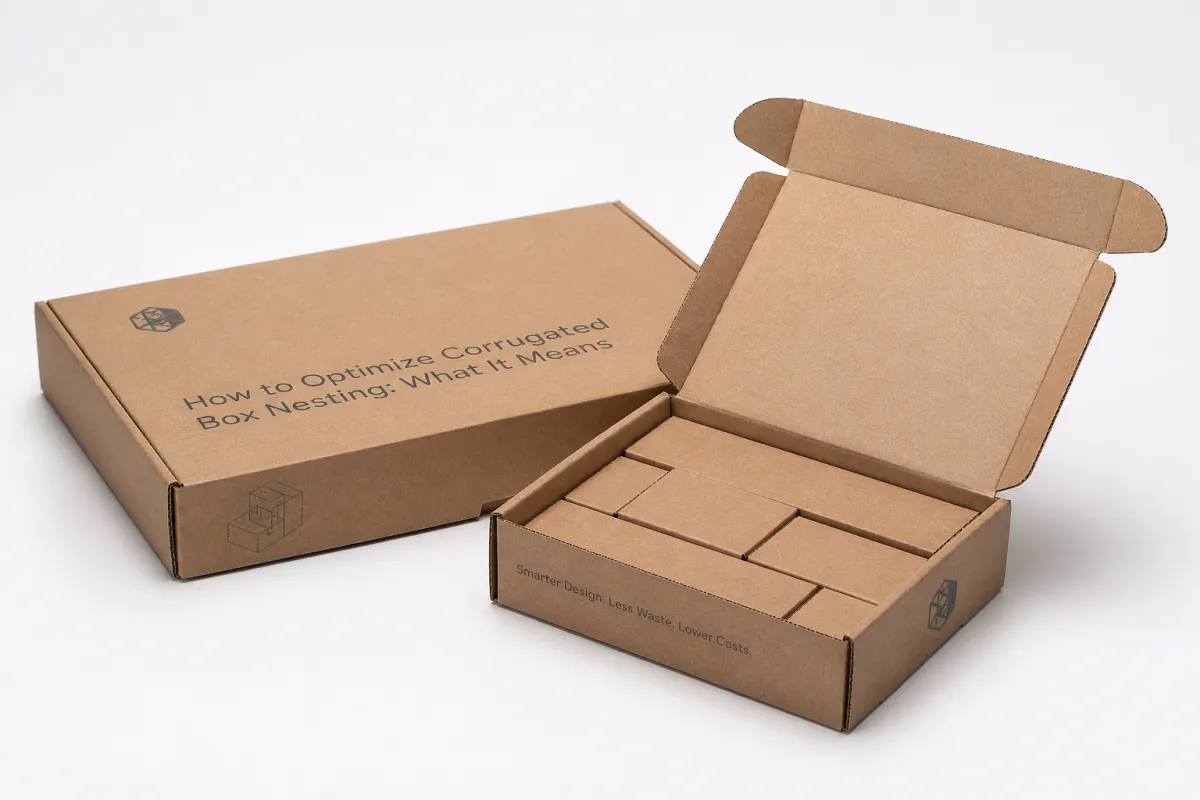
Plainly stated, how to optimize corrugated box nesting is about arranging corrugated blanks or cartons so they use the least possible material and space while still protecting the product. In a factory, that can mean fewer sheets on a master pallet, tighter blank stacking, or a carton layout that nests cleanly on a pack table without extra hand adjustment. It is not the same as pallet nesting, where finished cartons are stacked in a staggered load on a 1,000 x 1,200 mm pallet. It is also not the same as carton packing, which is simply getting a product into a box. People use those terms loosely, and that looseness shows up later as wasted material, slower pack-outs, or a pallet that looks full but ships like a stubborn mule from the port of Xiamen to a DC in Dallas.
At a beauty brand review in Shenzhen, I watched a team spend 40 minutes arguing about “nesting” when they actually meant pallet patterning. The cartons were fine. The waste came from the blank layout and the way the glue flap stole 11 mm on one side. We changed the score location, kept the same 350gsm C1S artboard sleeve insert, and cut dunnage by 22% on a 3,000-unit run. No new press, no heroic redesign, just a cleaner layout and a better understanding of the parts actually doing the work. I still remember one buyer staring at the sample like it had personally offended him, which is exactly how packaging meetings look when a small dimension change saves $420 in one week.
How to optimize corrugated box nesting matters because every inch of wasted cube gets paid for in four places: freight, storage, damage, and labor. If a worker has to pry apart stacked blanks, the line slows. If the carton shape leaves too much dead air, you pay to move emptiness from Dongguan to Chicago. If the box crushes because someone forced the fit too far, returns and claims start to eat the savings. Packaging people love to debate board grades and dielines; the warehouse just wants boxes that behave, and after watching a pallet fail a stack test at 45 lbs of top load, I cannot blame them.
Nesting also affects the person loading cartons at 6 a.m. in a 14 C warehouse, the buyer checking freight quotes for a 5,000-piece order, and the customer who receives a shipper that either opens cleanly or falls apart in their hands. I have seen a company save $0.18 per unit on 5,000 pieces and still lose the margin because the layout created enough void fill to wipe the gain out. That is why how to optimize corrugated box nesting deserves a line-by-line look, not a shrug and a guess, especially when one revised dieline can change the landed cost by $900 on a single container load.
“I do not care how good the CAD looks,” a production manager told me while standing beside a noisy case erector in Suzhou. “If it slows my line by eight seconds, it is a bad box.” He was right, and I have quoted him more times than I can count because line speed, not presentation polish, decides whether a carton earns its keep.
For background on corrugated structures and material behavior, I point teams to the industry resources at Packaging.org. When a project needs real validation instead of a polished drawing, transit testing standards such as ISTA are worth the time, especially when you are moving product through humid lanes from Guangzhou to Singapore or across winter routes into Minneapolis. Good nesting is not only about fitting more in. It still has to survive compression, vibration, moisture swings, and human handling, which is a more hostile environment than most slide decks admit.
How Corrugated Box Nesting Works on a Packing Line
How to optimize corrugated box nesting begins with the blank itself. Length, width, depth, score lines, flute direction, and the position of the tuck or glue flap all decide whether cartons nest cleanly or fight each other like cousins at a wedding reception in Foshan. If the grain runs the wrong way, the board can bow. If the glue flap lands where the product needs room, the fit gets sloppy. If the scores are off by 2 mm, a layout that looked elegant on a screen can turn into a floor-level headache when the operator is trying to keep up with a 24-case-per-minute target. I have seen beautiful packaging drawings collapse the second a run started moving at line speed, which is humbling for everyone in the room and especially for the person who said, “It should be fine.”
I once stood beside a semi-auto erecting line in Dongguan where the team blamed the operator for every issue. The operator was not the problem. The flap interference was. The carton design had a 7 mm overlap that looked harmless on the drawing, but on the line it caught the conveyor guide and created a tiny jam every 14 to 18 cycles. We rotated the blank, adjusted the panel width by 3 mm, and the jam rate dropped to almost nothing. That is a textbook example of how to optimize corrugated box nesting with the real machine in mind, not the fantasy version of the machine that lives only in CAD and in the memory of the person who wrote the spec six months earlier.
There are a few nesting patterns that show up again and again, and each one behaves differently on a 600 mm pack table or a pallet deck with a 5 mm tolerance:
- Offset nesting: one carton or blank shifts slightly so it tucks into the gap of the next unit. This is common for hand-pack stations and mixed-size sets, especially in cosmetics and accessories packed 12 units per master carton.
- Rotated nesting: blanks turn 90 degrees to gain a tighter fit on sheets or pallets. This works well when one dimension is clearly shorter, such as a 210 mm panel fit into a 290 mm sheet width.
- Interlocked nesting: panels or cartons overlap in a repeating pattern. It can save cube, but it needs disciplined setup, stable board moisture, and a predictable 2 to 3 mm tolerance window.
- Stacked layout: cartons sit directly above one another. It is simple, though it often wastes space unless the dimensions are already close to ideal, such as 300 x 200 x 150 mm shippers on a standard pallet footprint.
What matters on the line is not the prettiest drawing. It is whether the erector can form it, whether the glue gun can reach it, whether the case sealer can close it, and whether the conveyor can move it without scuffing the print or crushing a 350gsm C1S label panel. I have seen teams post a 9% material reduction and then lose half of it because packers had to hand-adjust every fifth carton on a 6-hour shift. That is why how to optimize corrugated box nesting should be checked against actual equipment, not just software. A machine with a temper is still a machine with a temper, no matter how elegant the spreadsheet looks.
Think of the workflow this way: the CAD engineer builds the layout, the sample shop in Shenzhen makes the blank, the line crew runs a short trial, and the warehouse in the receiving region tells you whether the pallet pattern holds up under freight stress. If those four groups do not agree, the packaging spec is not finished. It is just a draft with nicer fonts and a more expensive filename, and I have seen drafts like that sit untouched for 11 months because nobody wanted to admit the first layout was wrong.
Key Factors That Change Nesting Efficiency and Cost
If you want to master how to optimize corrugated box nesting, do not start with cost alone. Start with geometry. Length, width, depth, caliper, score placement, and board thickness all affect how tightly boxes can nest without crushing the product or fighting each other. A 1/8 inch change in score position can sound trivial in a meeting in Guangzhou. On a line in Ningbo, it can decide whether the box closes with one motion or three, and those extra motions are exactly where labor minutes disappear at $18 to $22 per hour including shift premiums.
Product behavior matters just as much. A rigid metal part wants a different nesting approach than a soft textile bundle. A glass bottle, a cosmetic jar, and a molded plastic component each react differently to compression and void space, especially when they are shipped in ambient heat at 32 C through southern China. I remember a client shipping kitchenware in a 44 ECT box from a plant in Foshan. Their nesting looked efficient on paper, but the corners took damage because the product flexed under top load. We changed the interior fit, kept the same carton footprint, and cut claims by 17% over a 60-day period. That is the kind of practical result people mean when they talk about how to optimize corrugated box nesting. Not poetry, just fewer broken pieces and a calmer receiving dock.
Compression strength is the tradeoff that gets ignored too often. A tighter layout is not useful if it weakens the case and causes stacking failure on the pallet. ASTM D642 compression testing exists for a reason, and good converters do not pretend otherwise. If you are using FSC-certified board or recycled content, pay attention to how that stock behaves under humidity and compression. Material that looks perfect on the spec sheet can shift under a warm warehouse roof in Shanghai or after a wet trailer run through the Gulf Coast. I have watched a batch of otherwise decent board turn uncooperative after a humid week in a coastal plant, which is just packaging’s way of reminding everyone who is in charge.
The cost trail usually runs through these buckets:
- Board usage: fewer square feet of corrugate per unit means lower material spend, sometimes by $0.02 to $0.05 per box on large runs.
- Scrap: poor nesting creates offcuts and unusable remnants, especially on custom die-cut sheets.
- Dunnage: when the fit is loose, you pay for void fill, wraps, air pillows, and molded inserts.
- Freight class: a tighter cube can improve pallet utilization and reduce dimensional weight on carrier invoices.
- Labor minutes: slow packing costs more than most budgets admit, particularly at 6 a.m. and again after lunch.
That is why how to optimize corrugated box nesting is really a systems question. Board cost, freight, and labor all move together. A small dieline change can be worth far more than the $300 sample fee attached to it. I once negotiated with a converter in Guangdong over a $280 prototype charge because the buyer thought it was too high. Two weeks later, the better layout saved enough board and freight to cover the sample run six times over. Cheap and expensive are not the same thing in packaging, and I say that with the calm confidence of someone who has watched a cheap decision cost a very expensive quarter.
Why the converter’s quote is only half the story
When you ask for options, a good partner should show more than a unit price. I want board grade, flute profile, finish, sample cost, lead time, and an explanation of what changes if we move the glue flap or rotate the blank. If a quote says $0.21 per unit but ignores nine minutes of extra labor per hundred cases, that quote is hiding part of the cost. The same thing happens with so-called free rework. Nothing is free. Someone is paying for it, usually the dock crew or the next shift, and they are not thrilled about it either. In one project out of Dongguan, the converter quoted a very tidy $0.19 per piece on 10,000 units, but the true landed cost only made sense after we added a $180 tool tweak and a 15-business-day production window.
How Do You Optimize Corrugated Box Nesting Step by Step?
The cleanest way to approach how to optimize corrugated box nesting is to start with one SKU. Not five. Not the whole family. One SKU. Scope creep is how packaging projects lose air and burn through two months of schedule. Choose the highest-volume unit or the worst damage lane, because that is where a small gain pays back fastest. I have watched entire packaging teams spend three weeks debating low-volume edge cases while a top seller kept bleeding freight dollars every day in a 30,000-unit monthly program. It is a strange kind of tragedy, and it happens more often than I would like to admit.
- Audit the current state. Pull actual dimensions, pack-out photos, damage reports, line speed logs, and pallet photos. Measure the box with a ruler and a caliper, not only the drawing. I have seen drawings claim 10.00 inches while the actual fold landed at 10.18 inches. That 0.18 inch matters more than people want to believe, especially if the tray nests inside a master carton with only 0.25 inch of clearance.
- Identify the bottleneck. Is the problem board waste, void fill, slow assembly, poor pallet density, or damage? You cannot fix everything with one layout. If labor cost is the issue, focus on line speed. If freight is the issue, focus on cube. If damage is the issue, focus on compression and fit. I have seen one plant in Shenzhen lose more money on six seconds of extra pack time than on the material itself.
- Build two or three concepts in CAD. Try one rotated layout, one interlocked version, and one conservative revision. Ask for board usage, blank yield, and a quick assembly estimate. That is the heart of how to optimize corrugated box nesting without guessing, and it saves you from falling in love with a single pretty idea too early. A good converter in Guangdong should be able to return those options within 48 hours for a standard kraft-line structure.
- Run sample blanks or a short pilot. A polished screen render means nothing until a packer folds it while a conveyor is moving. I like to watch setup time, pack rate, and whether the worker has to press or reseat the carton. If the operator mutters under their breath, that is data too. For a 2,000-piece pilot, I usually want a real shift, a real pallet stack, and a real tape gun on the table.
- Measure transit performance. Check damage after a local shipment, a rough carrier lane, or an ISTA-style test sequence. Do not stop at the mockup table. Real shipping vibration finds fake confidence very quickly, and it does so without apology. A 48-hour loop through a regional hub in Chicago can tell you more than a polished presentation.
- Validate with operations and finance together. One team will care about labor minutes, another about freight, and another about claims. If the new layout saves $0.04 per unit but adds six seconds per pack, you need to know that before launch. Otherwise, you are just moving the pain around. I like to put both functions in the same meeting for exactly 20 minutes and make the numbers do the talking.
For timing, a focused SKU can often be audited in one day. CAD changes and sample production usually take two to three business days if the converter responds quickly from Dongguan, Shenzhen, or Zhongshan. A pilot run can happen in one shift. Validation may take one to two weeks if you need transit checks and internal approvals. If someone promises a perfect answer in 20 minutes, they are selling optimism, not packaging. A more honest schedule is 12 to 15 business days from proof approval to production tooling on a standard die-cut program, and that is the timeline I trust more often than not.
How to optimize corrugated box nesting also means documenting the spec before the project gets buried under email threads. Lock down the board grade, flute type, score dimensions, glue requirements, print position, and acceptable tolerances. If the plant in your network has different humidity or a different case erector, note that too. Production in a dry Midwest warehouse is not identical to production in coastal humidity in Shenzhen or Taichung, and pretending otherwise creates avoidable damage. I have seen a carton that behaved beautifully in the sample room turn into a nuisance the second it hit a damp dock in August, where the relative humidity sat above 80% for three straight days.
I also recommend a simple side-by-side matrix. Put the old layout next to the new one and compare unit count, board use, labor time, and damage risk. You do not need a 40-slide deck. You need a decision. That is the real value of how to optimize corrugated box nesting: it turns packaging from a vague complaint into a measurable change, and once the numbers are clear, a $0.15 per unit box becomes easy to defend when it saves $2,500 a month in a 50,000-unit program.
Cost and Pricing: What Better Nesting Really Saves
Pricing makes people nervous because they want a single number, and packaging rarely behaves that neatly. When I explain how to optimize corrugated box nesting to a buyer in Chicago or Rotterdam, I split the spend into four buckets: artwork or die work, prototype samples, production changeover, and training time. Leave out any one of those and the ROI math will lie to you with a very polite face, usually by $200 to $800 depending on the line.
Here is a simple way to think about payback. Compare the recurring savings in board, freight, and labor against the one-time cost of redesign, sample cutting, and line adjustment. If a revised blank saves 0.03 per unit on material and 0.02 per unit on freight damage reduction across 50,000 units, that is $2,500 a month. A $400 sample and a two-hour pilot are tiny beside that. That is not exaggeration. That is arithmetic, and it is the kind of arithmetic that tends to make finance people sit up a little straighter while the packaging engineer finally gets to speak without interruption.
| Option | Typical One-Time Cost | Best Use Case | Likely Savings Path |
|---|---|---|---|
| Blank rotation change only | $0 to $150 engineering time | Same box footprint, better sheet yield | Less scrap, tighter pallet density |
| Prototype and sample run | $250 to $450 | New score or flap layout | Lower labor minutes, fewer jams |
| Structural redesign | $500 to $1,200 | Damage-prone or high-volume SKU | Reduced claims, lower dunnage, better freight cube |
I used a table like that during a packaging review for a consumer electronics client in Shenzhen. Their team was focused on unit cost, which sat at $0.24. The problem was that the old layout forced a 14% increase in void fill and slowed packers by almost five seconds per case. Once we changed the nesting, the project saved more in labor than in board. That is why how to optimize corrugated box nesting is not only a materials conversation. It is a throughput conversation, and occasionally a patience test for everyone in the room, especially when the line is already pushing 1,800 cases per shift.
Be direct with your converter. Ask for two alternate layouts, a sample charge upfront, and a clear lead time. A straightforward quote might read like this: 12 to 15 business days from proof approval for production tooling, two to three days for a sample blank, and $300 for a short-run prototype. That kind of pricing detail lets you build a real budget. Vague quotes are great if your hobby is guessing, but if you are trying to land a 10,000-piece launch in Guangzhou, specificity is worth its weight in kraft board.
One more practical note: do not get hypnotized by the cheapest unit price. I have seen a converter win the business with a low number, then the warehouse quietly spends another $0.06 per unit on rework, inserts, and damage handling. The box on the invoice was cheap. The box on the dock was not. If you remember only one thing from how to optimize corrugated box nesting, let it be this: the cheapest box is often the most expensive one after handling, especially once the cartons hit a humid truck yard or a carrier transfer point with rushed labor.
Common Mistakes That Ruin Corrugated Box Nesting
The first mistake is thinking how to optimize corrugated box nesting means cramming as many cartons as possible into the smallest possible space. That is how you end up with crushed product, bent scores, and angry returns. Tighter is not always better. Better is better. There is a difference, and the difference shows up in damage claims, often after the third pallet stack in a 4-pallet load when the bottom layer starts to complain.
The second mistake is ignoring flute direction, board grain, or glue flap interference. A layout can look perfect on screen and still fail on the floor because the board wants to flex a certain way. I once reviewed a carton where the designer moved the flap by 9 mm to improve nesting. Nice idea. The problem was simple and brutal: the flap now collided with the auto-erector finger at cycle speed. The line did not care about the drawing. It cared about physics, which is usually a rude conversation partner in every plant from Dongguan to Indianapolis.
The third mistake is testing only in CAD. Software does not load pallets, tape corners, or hear a jammed carton squeal through a warehouse at 7 a.m. You need a live pilot, even if it is short. If you are serious about how to optimize corrugated box nesting, you need evidence from a real operator and a real line, not just a spreadsheet with prettier cell borders. I would rather watch one 30-minute shift trial in Foshan than inspect 18 pages of screenshots with no tactile feedback.
The fourth mistake is forgetting pallet stability and carrier handling. A layout that maximizes carton count can still create a top-heavy pallet that leans in transit. Retailers have their own requirements, and so do carriers. If your pattern fails a tilt test or arrives with crushed corners, the supposed savings evaporate. I am a fan of efficient cube, but not at the expense of a pallet that wobbles like it has bad knees on a dock in the rain.
The fifth mistake is over-optimizing the carton count and accidentally slowing production. If one nesting design adds 12 cartons per pallet but forces the pack team to reorient every third box, the labor cost can erase the gain. This is exactly where teams get fooled by headline numbers. How to optimize corrugated box nesting is about total system performance, not one flashy metric that only looks good in a slide deck. The box has to work for the line, the warehouse, and the truck, not just for the person who made the presentation and walked out before the first jam.
“We thought we won because the pallet looked fuller,” a warehouse lead told me after a bad launch in Memphis. “Then the line slowed, the cases scuffed, and finance found the real cost two weeks later.” That happens more than people like to admit, especially when the sample came from a plant 1,100 miles away and nobody validated the handoff.
Keep your guard up for specs that are too thin. If the vendor says the new layout is fine but cannot explain compression strength, sample timing, or machine compatibility, ask again. Calmly. Twice if needed. Packaging projects go sideways when everyone nods and nobody measures. I have no patience for a room full of nods and no data, particularly when the trial was supposed to support a launch in 15 business days and nobody documented the tolerance stack.
Expert Tips and Next Steps to Optimize Corrugated Box Nesting
If you want practical progress, start with the highest-volume SKU or the worst damage lane. That is where how to optimize corrugated box nesting pays back fastest. A 3% improvement on a million units matters a lot more than a 12% improvement on a product that ships twice a month. I know that sounds obvious, but I still watch teams burn months on tiny SKUs because they feel easier to discuss in a meeting and safer to postpone.
Use a scorecard, not gut feel. I like to rank material use, labor time, damage risk, pallet density, and line speed on the same page. Give each concept a simple pass/fail or 1-to-5 score. That keeps the conversation grounded. If one layout saves board but increases setup time by 20%, you can see the tradeoff before you commit. This is where how to optimize corrugated box nesting becomes a management tool, not just a design trick. Even a basic scorecard can show that a $0.17 box with 6 seconds of extra labor is worse than a $0.19 box that runs cleanly.
Ask your converter for at least two alternate layouts every time you open a project. One should be conservative. One should be aggressive. Then sample both. Make the sample fee clear at the start so pricing does not turn into a mysterious dance at the end. I have had suppliers try to bury a $180 sample charge inside a larger quote because they thought nobody would notice. I noticed, and I always advise clients to notice too, especially when the run size is only 2,500 units and every line item matters.
After launch, do a 30-day check. Watch line speed, damage, freight cost, and operator feedback. If the new layout creates a hidden bottleneck, fix it quickly. Sometimes the answer is a small flap tweak. Sometimes it is a different board grade. Sometimes it is simply changing the stack orientation by 90 degrees. Good packaging work stays flexible without becoming sloppy, and a box that ships cleanly in Shanghai in July should also behave in Chicago in January.
Here is the exact sequence I recommend if you need to move now:
- Pull one high-volume SKU and measure the current blank, finished carton, and pallet pattern.
- Request two alternate nesting options from your converter or internal packaging team.
- Compare the options on board usage, setup time, line speed, and damage risk.
- Run one live pilot shift with real operators and real products.
- Validate freight, damage, and labor results after launch.
If you need a starting point for the carton itself, our Custom Shipping Boxes are a good place to test structural changes before you scale them across a larger line. I would rather see one clean pilot than six half-finished spec sheets. The pilot tells you whether how to optimize corrugated box nesting is actually working, or whether the team just fell in love with a drawing because the drawing looked neat in a meeting. For launches in Guangdong or Jiangsu, I also like to pair the carton trial with a printed sleeve or insert on 350gsm C1S artboard so the whole pack-out can be evaluated in one pass.
At Custom Logo Things, I always push clients to treat nesting like a recurring profit lever, not a one-time packaging tweak. The best projects I have seen came from one clear question, one measured trial, and one honest review of the data. That is how to optimize corrugated box nesting Without Wasting Money on overcomplicated solutions. Start with the SKU that hurts most, test two layouts, and make the line tell you which one deserves to ship, because a box that saves $0.04 per unit across 50,000 pieces is a box worth keeping.
FAQs
What does how to optimize corrugated box nesting mean in packaging?
It means arranging corrugated blanks or cartons so they use less board, waste less space, and still protect the product. The goal is better cube efficiency without sacrificing pack speed or box strength, whether the run is 1,000 units or 25,000 units from a plant in Shenzhen or Dongguan.
How do I know if my corrugated box nesting is inefficient?
Look for leftover board, awkward gaps, slow manual packing, or frequent product damage after transit. If your pallet patterns vary a lot or your line keeps needing hand fixes, the layout probably needs work. A good warning sign is when a 20-minute setup turns into a 45-minute setup because the carton keeps fighting the erector.
Does better corrugated box nesting lower shipping costs?
Yes, when it improves pallet density, reduces dunnage, and cuts freight damage or rework. The savings usually show up in cubic efficiency, fewer shipments, and less labor handling. On a 5,000-piece run, even a $0.15 per unit improvement can add up fast if it trims a half-pallet per load.
How long does it take to optimize corrugated box nesting?
A focused SKU can be reviewed in a day, while CAD changes and sample testing may take a few more days. Plan on one to two weeks to validate the change on a real line and check post-launch performance, or 12 to 15 business days from proof approval if a new tool or die is involved.
Can I optimize corrugated box nesting without changing the box size?
Sometimes yes, by rotating blanks, changing score layout, or adjusting tuck and glue placement. If the current dimensions are already locked by the product or pallet footprint, you may need a structural change. A 3 mm score move or a 90-degree rotation can solve more problems than people expect.
The best next move is simple: measure one real SKU, test two nesting options against the actual line, and keep the layout that improves total cost without slowing pack-out or weakening the stack. If the numbers are close, choose the design that is easier for operators to run at 6 a.m. on a damp Tuesday; that is usually the one that holds up when the freight gets messy.