Buyer Fit Snapshot
| Best fit | Cost Effective Corrugated Supply Chain Trays for Logistics projects where brand print, material claims, artwork control, MOQ, and repeat-order consistency need to be specified before quoting. |
|---|---|
| Quote inputs | Share finished size, material target, print colors, finish, packing count, annual reorder estimate, ship-to region, and any compliance wording. |
| Proofing check | Approve dieline scale, logo placement, barcode or warning zones, color tolerance, closure strength, and carton packing before bulk production. |
| Main risk | Vague material claims, crowded artwork, missing packing details, or unclear freight terms can make a low unit price expensive after revisions. |
Fast answer: Cost Effective Corrugated Supply Chain Trays for Logistics should be specified like a repeatable production item. The safest quote records material, print method, finish, artwork proof, packing count, and reorder notes in one written spec.
Production checks before approval
Compare the actual filled-product size with the drawing, then confirm tolerance on folds, seals, hang holes, label areas, and retail display edges. Reserve space for logos, QR codes, warning copy, and material claims before decorative graphics fill the panel.
Quote comparison points
Review material grade, print process, finish, sampling route, tooling charges, carton quantity, and freight assumptions side by side. A quote is only useful when the supplier can repeat the same color, closure quality, and packing count on the next order.
Cost Effective Corrugated Supply Chain Trays for Logistics can look almost too simple on a quote sheet, which is exactly why they get underestimated. A tray that is a few cents cheaper up front can still cost more once you add freight, repacking, damage claims, and the labor it takes to rescue a load that should have been stable from the start. I remember one plant team outside Columbus that was locked on the unit price alone; after a week of pallet audits, the real story showed up in the ugly details: extra cube on every pallet, unstable corners, and a crew member spending time restacking loads that should have rolled straight through receiving. Cost effective corrugated supply chain trays earn their keep by lowering the total bill, not by chasing the prettiest number on a purchase order.
If you buy packaging for interplant moves, distributor transfers, or palletized replenishment, the tray has to do more than hold product. It needs to protect the load, tighten the footprint, keep weight under control, and help the dock crew move fast without getting sloppy. I have seen a 28-pound change in pallet weight improve density-based freight pricing enough to matter on a weekly schedule, and I have watched a 30-second improvement in pack-out ripple through an entire Friday shift like a line of dominoes. That is why cost effective corrugated supply chain trays are really a supply-chain decision, not just a packaging decision. A cheap tray that slows the floor is not cheap for long, kinda the opposite, honestly.
For buyers comparing formats, our Custom Shipping Boxes page is useful because it shows how a structural change can affect damage, unit cost, and pallet efficiency. The same idea applies here. Start with the footprint, confirm the stack behavior, and then decide whether the board grade, flute, and insert layout actually earn their place. If a design does not save freight space, labor minutes, or claims exposure, I would not pay extra for it, even if the prototype looks tidy with a printed header from a converter in Suzhou or a clean die line from Dongguan.
Why Cost Effective Corrugated Supply Chain Trays Win on Total Cost
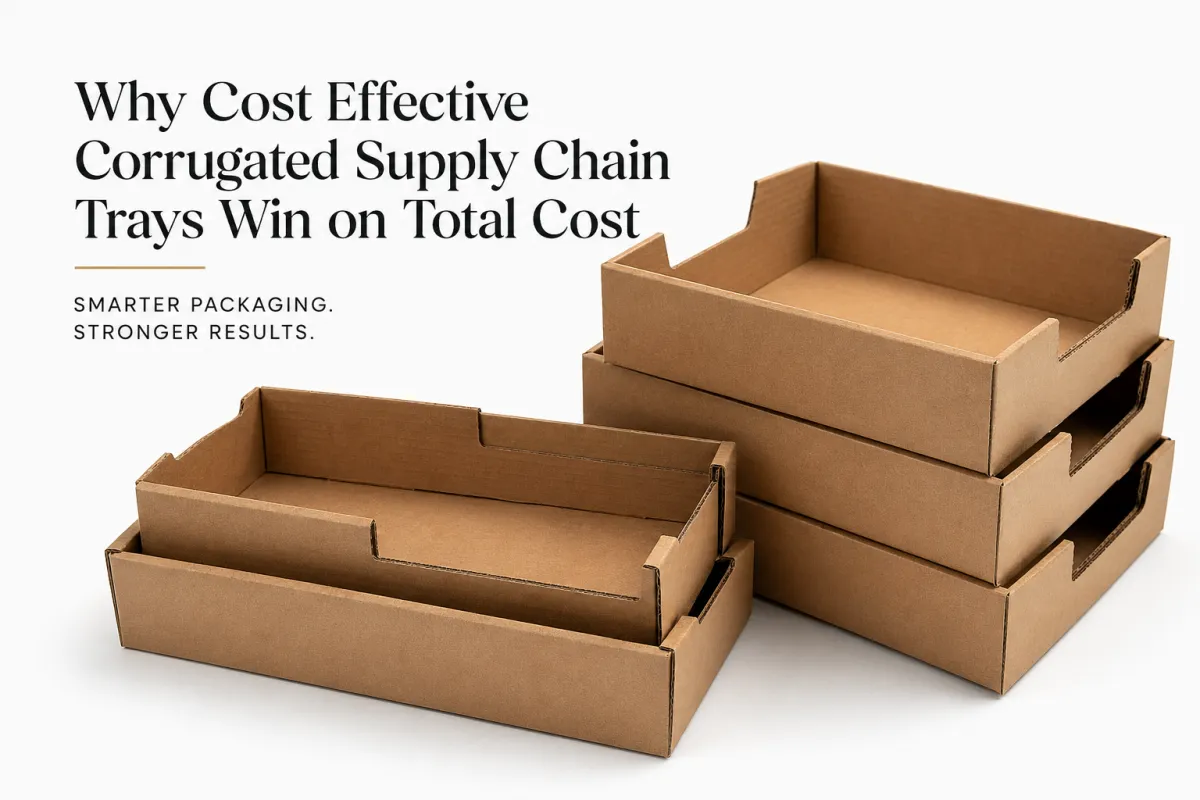
I still remember a supplier meeting where the buyer opened with a quote that was 7% lower than the previous run. On paper, that looked like an easy win. Then we put the trays on a scale, and the new version was heavier, which pushed pallet weight, raised handling risk, and added void at the top of the stack. By the time we ran the math on 1,200 pallets a month, the supposedly cheaper tray was costing more in freight and labor than the original. That is the basic reason cost effective corrugated supply chain trays win: they reduce total cost, not just purchase price.
The buyer problem shows up in three places at once: the dock, the warehouse, and the truck. Loads shift because the corners are soft. Cube gets wasted because the footprint is off by an inch. Pack-out slows because workers need an extra hand to fold or tape the tray. Claims rise because the board was never specified for the humidity, the transit time, or the stacking load it actually sees. Cost effective corrugated supply chain trays address those failures by combining light weight, stackability, and product-specific support in one design, often with a 32 ECT or 44 ECT single-wall build for lighter work, or double-wall BC where the route is rougher and the stack is taller.
Teams sometimes compare trays the same way they compare office supplies, and that habit gets expensive quickly. A tray that saves $0.06 per piece but adds 14 seconds of pack-out on 20,000 units a quarter is not saving money. A tray that cuts even one damage claim every few hundred shipments may be worth more than a 5% unit discount. In practice, cost effective corrugated supply chain trays are best judged against labor minutes saved, pallet utilization, and fewer replacements, especially when the same tray is used in Atlanta, Memphis, and Kansas City with different dock crews and different stack heights.
At a client meeting for a regional distributor, I watched the operations manager pull out a marker and sketch the receiving dock on a whiteboard. He was not asking for "better packaging." He was asking for fewer pallet breaks, faster put-away, and no manual restacking. That kind of clarity helps buying teams decide whether cost effective corrugated supply chain trays should be optimized for the lowest tooling fee, the lowest bulk pricing, or the tightest cube. Those are not the same target, and a quote that treats them like they are usually misses the point, especially if the tray is moving through a three-site network from Monterrey to El Paso to Chicago.
"We spent six weeks chasing a 9-cent tray savings and lost it all in extra wrap, one damaged corner every couple of pallets, and slower receiving." That was the line a plant supervisor gave me after a trial run in a warehouse outside Columbus, and the dock audit backed every number.
For teams benchmarking suppliers, I also suggest looking at industry references like ISTA test methods for transit validation and sample handling. If your loads face compression, vibration, or mixed freight, those tests help prove whether cost effective corrugated supply chain trays are fit for service. A half hour in a lab near Shenzhen or a converter visit in Dongguan can prevent a month of pain on the floor, especially when the route includes cross-dock handling or a long dwell at a regional DC in Reno.
One more point that gets missed a lot: cost effective corrugated supply chain trays also reduce decision fatigue. When the footprint is standardized across two or three SKUs, planners stop renegotiating the same packaging question every quarter. That saves admin time, trims setup charges, and makes replenishment cleaner. I have seen that simplification remove several emails from a normal order cycle, which sounds small until procurement is closing dozens of POs a month and every handoff adds friction between a buyer in Toronto, a plant in Ohio, and a supplier in Foshan.
How Do Cost Effective Corrugated Supply Chain Trays Lower Total Logistics Cost?
They lower total logistics cost by reducing freight weight, tightening pallet cube, and cutting handling time before those savings ever show up on a purchase order. A tray that nests efficiently, holds its shape in transit, and avoids secondary wrap or inserts can mean a quieter dock, fewer claims, and faster receiving. Cost effective corrugated supply chain trays also help planners standardize around one footprint, which means fewer packaging changes, fewer last-minute approvals, and fewer surprises when the route changes from a local lane to a longer cross-country move. In practice, the savings usually show up in four places at once: freight pricing, labor minutes, damage reduction, and storage space.
What Cost Effective Corrugated Supply Chain Trays Include
Most cost effective corrugated supply chain trays fall into five structural families: die-cut trays, slotted trays, partitioned trays, wrap-around formats, and insert-based trays for nested product protection. Each has a different balance of tooling fees, setup time, and labor efficiency. A die-cut tray can move quickly on a line with a rotary die cutter and a clean fold pattern. A partitioned tray can protect 8 or 12 fragile items in one footprint. A wrap-around format often wins when the product shape is uneven and the tray needs to lock the load without adding a full top cover, especially for mixed-component kits assembled in Guadalajara or Ningbo.
Board choice matters just as much as structure. For lighter goods under 12 pounds, single-wall board with B flute often gives enough support and cleaner print. For heavier parts, longer lanes, or taller stacks, C flute or double-wall BC is usually the safer call because it adds compression resistance. I have seen a 32 ECT single-wall spec work well for 18-pound kits on a two-hour transfer, while a stronger double-wall spec was the right answer for 36-pound mixed-component trays that sat four-high in a warehouse for 10 days before moving through a stretch-wrapped pallet lane leaving Monterrey.
The best cost effective corrugated supply chain trays usually include four practical features: reinforced corners, hand holes, ventilation slots, and a clear print zone for line ID or SKU codes. Those features do not sound glamorous, but they earn their keep. Hand holes can cut a few seconds off each lift. Ventilation slots can reduce moisture buildup in cold-chain staging. Clear print zones help when a tray is scanned several times before it leaves the plant and the receiving team needs the label to be readable from walking distance, not just from a close inspection, whether the print panel carries a 350gsm C1S artboard insert or a direct corrugated mark.
These trays fit especially well in interplant transfers, kitting operations, e-commerce fulfillment, returnable workflows, and palletized retail replenishment. I also see them in assembly plants where 6 or 8 components need to move together without sliding around in a mixed freight lane. In those situations, cost effective corrugated supply chain trays often beat rigid totes because the corrugated option weighs less, ships flatter, and stores in a smaller footprint, which matters in facilities where rack space is already tight in places like Louisville, Memphis, and suburban Guadalajara.
Customization helps, but it needs discipline. The smartest cost effective corrugated supply chain trays I have seen keep a standard footprint - 24 x 16, 18 x 12, or 20 x 20 inches - while changing the insert layout, coating, or print only where needed. That keeps board usage predictable and protects unit cost. If every SKU gets a new outer size, the design quickly picks up extra tooling fees and a higher MOQ, and the finance team ends up paying for variety that adds little operational value. Standardizing the footprint also helps if your production is split between a facility in Ohio and a backup converter in Puebla.
For buyers who want a sustainability angle without greenwashing, corrugated fiber is easier to recover than mixed-material packaging and is widely accepted in standard recycling streams. The EPA's recycling guidance at EPA recycling guidance is a useful reference point, and FSC-certified board can support sourcing policies where chain-of-custody matters. That is another reason cost effective corrugated supply chain trays often win against plastic alternatives in one-way or short-cycle lanes, especially where cleaning, returns, and reverse logistics would add more cost than the tray itself, whether the lane runs through Atlanta or a coastal port in Long Beach.
I like to ask a simple question in supplier reviews: can the tray survive the route, the dock, and the handoff without extra parts? If the answer is yes, cost effective corrugated supply chain trays usually do their job with fewer SKUs, one less handling step, and a cleaner supply chain record. That is the kind of practical math that matters to operations people, because it shows up in the same week the tray is launched rather than months later in a damage report from a DC in Ohio or a cross-border transfer through Laredo.
Specifications for Cost Effective Corrugated Supply Chain Trays
The core specification list should be short and exact: inside dimensions, wall style, flute type, board grade, finish, tolerance targets, and pack quantity. If any one of those is missing, the quote is not complete. For cost effective corrugated supply chain trays, I want to see dimensions within a 1/8-inch tolerance on the critical fit surfaces, because that keeps product movement under control without overpaying for over-engineering. On printed components, I also like to see the liner callout - for example, 350gsm C1S artboard for an insert card - so the factory in Dongguan or Foshan knows exactly what to run.
Performance specs matter just as much as the drawing. Compression strength, edge crush, moisture resistance, and stacking plan are the numbers that tell you whether cost effective corrugated supply chain trays will survive a 3-high or 4-high pallet. ASTM D642 is useful for compression testing, and any route with vibration or mixed freight should be checked against realistic transit conditions, not just a bench sample that looks good on a table. A tray that holds 28 pounds in the lab can still fail if the bottom pallet is rough and the humidity is 70%, which is why a trial in a Gulf Coast warehouse often tells a different story than a lab in Chicago.
Product weight changes the board grade, and that changes the economics. A tray holding 6 pounds of parts can often run in a lighter single-wall format, while a 24-pound assembly may need a stronger board or double-wall construction to avoid corner collapse. I have seen cost effective corrugated supply chain trays lose their value when teams tried to force a 32 ECT board into a 38-pound load. The unit cost looked lower, but the damaged product erased it in the first week, especially on lanes where the trays were stacked four-high during a 14-day storage window.
Pallet efficiency is another spec that deserves a hard look. The best cost effective corrugated supply chain trays align to a standard pallet footprint, reduce overhang, and maximize cube so freight does not pay for empty air. A 40 x 48 pallet with 8 trays across can be far more efficient than a custom size that leaves 12% void space and forces extra stretch wrap. That one detail can change shipment economics by several dollars per pallet, especially when fuel surcharges rise or the lane moves through a parcel- or LTL-heavy network, such as Dallas to Kansas City or Puebla to Atlanta.
Before production, I always ask for four items: a dimensioned drawing, a material callout, a sample photo, and the approved pallet pattern. Add a pack-out count if the tray carries multiple parts, because 12 cavities and 16 cavities do not cost the same and do not pack the same. For cost effective corrugated supply chain trays, this basic paperwork prevents most of the back-and-forth that usually slows quoting and keeps the converter from guessing at the construction, whether that converter is in Suzhou, Dongguan, or a domestic plant in Indiana.
Then run a real trial. Fill 10 samples, stack them four-high, drop one from 18 inches, and send them across the actual route if you can. If the product is sensitive to vibration, run a three-point check after shipment and compare against the original condition. A supplier who can support that test cycle is more useful than one who only promises low cost per piece. I would rather see a tray proven on a six-hour route from Chicago to Cincinnati than approved because it looked neat in a one-off photo.
My rule is simple: if a spec sheet cannot tell me how the tray behaves under a 24-hour hold, a 36-pound stack, and a two-person lift, it is incomplete. Cost effective corrugated supply chain trays are only cost effective when the spec matches the route. A cheaper sheet with no test plan is not a plan; it is a guess dressed up as procurement, and it usually costs more once the first 500 trays land at the dock.
Pricing and MOQ for Cost Effective Corrugated Supply Chain Trays
Pricing for cost effective corrugated supply chain trays usually comes down to six drivers: size, board grade, print complexity, die tooling, coating, and order volume. A small die-cut tray with one-color print may land near $0.22 to $0.38 per piece at 10,000 units, while a larger double-wall tray with partitions can move into the $0.68 to $1.25 range depending on finishing and exact dimensions. At 5,000 pieces, I have also seen a 24 x 16 x 4 tray quoted at $0.15 per unit for a plain recycled liner build, with a one-time tooling charge of $450 and a 350gsm C1S artboard label insert added only if the customer wanted printed identification. The unit cost changes quickly once the footprint grows by just 1 or 2 inches, and the same board can behave very differently once the score pattern and gluing steps change in a plant outside Shenzhen or in a Midwest converter in Indiana.
MOQ follows the same pattern. Standard footprints and common die lines often support lower runs, sometimes 1,000 to 2,500 pieces, while highly custom inserts or specialty coatings can push the minimum to 5,000 or more. For cost effective corrugated supply chain trays, I prefer suppliers who can explain why the MOQ exists instead of hiding behind it. If the minimum is driven by tooling setup and board yield, that is fair. If it is just a blanket policy, I keep shopping, especially when the supplier cannot explain why a run in Foshan needs 6,000 pieces but the same tray in Monterrey can be made at 2,500 with the same die.
| Tray Type | Typical Board | Example Unit Cost | Typical MOQ | Notes |
|---|---|---|---|---|
| Die-cut single-wall tray | 32 ECT, B flute | $0.24 to $0.42 | 1,000 to 2,500 | Good for lighter loads, fast pack-out, and short lanes under 500 miles |
| Slotted tray, reinforced corners | 44 ECT, C flute | $0.38 to $0.68 | 2,000 to 5,000 | Balanced for stack strength and freight efficiency on mixed freight routes |
| Partitioned tray | 32 to 44 ECT | $0.52 to $1.05 | 2,500 to 5,000 | Best for fragile multi-pack or kitting applications with 8 or 12 cavities |
| Wrap-around format | Double-wall BC | $0.62 to $1.25 | 3,000 to 6,000 | Useful where load lock and corner protection matter during palletized transfer |
These figures are examples, not promises, because a 14 x 10 x 3 tray and a 22 x 18 x 6 tray do not buy the same way. Still, the pattern is useful. At 5,000 pieces, a $0.03 board change can be more expensive than a $450 tooling fee if the board savings only show up on one run. That is why I always compare price per piece, bulk pricing, setup charges, and the cost of holding extra inventory before I sign off on a quote, whether the order is shipping into New Jersey, Texas, or a port city like Savannah.
A clean quote should separate the tray price from tooling fees and any one-time setup charges. If print is involved, ask whether the setup charge is $85, $150, or $300, and whether it applies once or every color change. If the supplier adds a UV coat or moisture-resistant finish, note the impact on both MOQ and lead time. Cost effective corrugated supply chain trays depend on seeing the whole stack of costs, not just the lowest line item, because the hidden pieces often decide the final economics on a 10,000-piece purchase.
I usually ask for two quote paths. One should optimize for lowest unit cost at a higher volume, such as 10,000 pieces with a four-week release schedule. The other should optimize for faster replenishment, maybe 2,500 pieces with a slightly higher cost per piece but less storage pressure. Procurement can then choose the better tradeoff based on cash flow, warehouse space, and forecast certainty. That approach has saved clients from buying 12 weeks of inventory just to save 4 cents per tray, which is a poor trade in a warehouse outside Atlanta or an assembly plant in Queretaro.
Another practical lever is standardization. If 3 SKUs can share an 18 x 12 footprint and only the divider insert changes, you can usually reduce tooling fees and get stronger bulk pricing. I have seen that kind of footprint discipline cut total packaging spend by 8% without changing the product itself. For cost effective corrugated supply chain trays, standardization is often the fastest route to a lower annual budget and a cleaner replenishment cycle, especially when the same base tray is run by converters in Ohio and Puebla using the same cut line.
Process and Timeline for Cost Effective Corrugated Supply Chain Trays
The cleanest workflow starts with five inputs: product dimensions, unit weight, load height, handling environment, and annual volume. If the product is 16 inches long, weighs 4.8 pounds, and ships in 8-unit sets, that is enough to begin a structural concept. Cost effective corrugated supply chain trays work best when the brief is specific before the first sketch, because vague inputs lead to two or three redraws and a slower launch. A buyer in Chicago can usually gather those details in one afternoon, while a plant team in Monterrey may need a single dock walk to confirm them.
Design comes next. The supplier should turn the brief into a tray concept, then refine the cut lines, score depth, and board selection until the tray meets the cost target and the stack target. On a recent client call, I watched an engineer suggest a thicker board immediately. The better answer was a 1/4-inch wider base and a stronger corner lock, which kept the same 44 ECT board and avoided an unnecessary step up to double-wall. Cost effective corrugated supply chain trays often depend on geometry, not brute strength, and that is why a good factory in Foshan or Dongguan will test the fold sequence before they ever quote a premium board.
Sampling is where theory meets the dock. I like to see two or three physical samples, then a pack-out review with operations, quality, and purchasing in the same room. If the tray rides on a conveyor, include the line operator in the review. A 20-second conversation with someone who loads 300 trays per shift can reveal a fold issue that a CAD file will never show. That is one reason cost effective corrugated supply chain trays with the right sample process save money later, particularly when the sample runs are cut in 12 business days and the first production lot is due before month-end.
As for timing, simple repeat orders can move in 12 to 15 business days from proof approval, while custom tooling, new print, or validation can add 7 to 14 more days. If the tray must support a route test or new automation, I would build in an extra 1 to 2 weeks. That is not slow; that is realistic. I would rather quote 18 days honestly than promise 10 and deliver a surprise that ripples through production and shipping, especially when the goods are moving between a plant in Ohio and a DC in Dallas.
Once production starts, replenishment should be on a schedule. Some buyers order every four weeks, others keep two weeks of safety stock, and a few with volatile demand use a release trigger at 65% of inventory. Cost effective corrugated supply chain trays are easier to manage when the reorder rule is already written down. That keeps stockouts from creeping in and prevents the warehouse from carrying three months of dead inventory just because nobody set a trigger point. If your supply base includes a converter in Veracruz or Suzhou, the reorder rule matters even more because transit time can add 5 to 8 business days on a rough week.
In one supplier negotiation, I saw a team lose five days because artwork approval sat in one inbox and material approval sat in another. The fix was not more pressure. It was a one-page approval sheet with named owners and due dates. That kind of process discipline matters more than many people think. Cost effective corrugated supply chain trays stay cost effective when the order path is short, transparent, and repeatable, from spec review to sampling to release, whether the handoff goes through a buyer in Toronto or a manufacturing manager in Ohio.
Why Choose Us for Cost Effective Corrugated Supply Chain Trays
At Custom Logo Things, we treat packaging like a supply-chain tool, not just a printed carton. That means we look for savings before the first run is approved, and we do it with the numbers in front of us: unit cost, freight weight, MOQ, and Lead time. If a design can shave 8% off board usage or 15 minutes off a 1,000-piece pack-out, we want to see that on the quote. That is the kind of discipline cost effective corrugated supply chain trays deserve, whether the order is headed to a plant in Ohio or a distributor in Guadalajara.
Our structural review process starts with the load, not the artwork. We look at the product dimensions, stack behavior, and pallet pattern, then we adjust the tray so it fits the route with the fewest extra parts. I have seen that approach reduce pallet count by 6% on a recurring shipment lane, which matters when a warehouse handles 20 to 40 pallets a day. If you are already comparing outer pack options, our Custom Shipping Boxes page shows how the same logic applies across formats, from a 24 x 16 tray to a larger shipper with a 44 ECT structure.
We also keep an eye on repeatability. A tray that looks great on sample day but varies by 3/16 inch on production day creates problems downstream. Consistent board sourcing, dimensional checks, and straightforward artwork files keep the result stable from order to order. That matters for cost effective corrugated supply chain trays because the cheapest first run is not useful if the second run causes two hours of line adjustment and a frustrated warehouse crew in Cincinnati, Monterrey, or Foshan.
I have seen the logistics advantage firsthand. In one client review, a better tray design reduced pallet overhang enough to make receiving easier at three different sites, and the dock team stopped restacking mixed loads. In another case, a supplier negotiation in Shenzhen was won by using a standard footprint with a smarter divider layout, which kept tooling fees under $600 instead of forcing a full custom die. Those are the kinds of practical wins that turn a quote into a real operational improvement, especially when the same tray is then reordered every 6 to 8 weeks without redesign.
We are also transparent about the tradeoffs. If a design needs a higher MOQ to make the board yield work, we say so. If a moisture-resistant coating adds 6% to cost per piece, we say that too. Trust matters in packaging because small numbers become large numbers at volume. A $0.04 change across 50,000 trays is $2,000, and everyone in procurement notices that quickly, especially when the trays are being bought for a network spanning Chicago, Atlanta, and Dallas.
Sustainability fits naturally here, but I will not oversell it. Corrugated fiber is recyclable in many common streams, and FSC-certified board can support sourcing goals, yet the better claim is often simpler: less mass, less freight, and fewer damaged goods. If cost effective corrugated supply chain trays replace a heavier reusable format in a one-way lane, the operational case may be stronger than the environmental pitch. I prefer to lead with facts, not slogans, especially when a 350gsm C1S artboard insert or a printed top sheet is only needed for one-facing label information.
For buyers comparing current packaging suppliers, our team can usually turn around a clear structural recommendation, a quoted MOQ, and a lead time estimate in the same review cycle. That speed matters when production is tied to a 2-week shipping window or a quarterly replenishment plan. We are not trying to flood you with options; we are trying to narrow the field to the two or three That Actually Work and hold up once they hit the dock, whether the converter is in Dongguan, the warehouse is in Ohio, or the receiving lane is in Southern California.
Next Steps for Cost Effective Corrugated Supply Chain Trays
Start with the basics: product dimensions, unit weight, desired pack count, pallet footprint, current packaging photos, and annual usage. If you can also share a sample of the current tray or a photo of the failure point, even better. Cost effective corrugated supply chain trays are much easier to quote accurately when the supplier can see the actual product and not just a typed description, especially when the current packaging has been running in Cleveland, Monterrey, or a third-party DC in New Jersey.
Then compare the new tray against the old one on four numbers: damage rate, labor time, freight class or pallet weight, and storage space. I like a simple spreadsheet with three columns - current, proposed, and annual impact - because it makes the savings visible. If the new tray saves $0.07 per piece but adds $0.05 in storage and $0.03 in labor, the advantage is gone. That is why cost effective corrugated supply chain trays must be judged on total cost, not just the per-piece quote from a factory in Foshan or a domestic plant in Ohio.
Ask for a sample or prototype before you commit, especially if the tray feeds automation, tight pallet stacking, or mixed-SKU handling. A one-hour trial can expose a score issue, a flute choice problem, or a divider that slips during turn-and-twist loading. I have seen a prototype save a buyer from a 5,000-piece mistake more than once. The best cost effective corrugated supply chain trays are usually the ones that survive one real trial before mass production begins, and a supplier who can ship that sample in 12 to 15 business days from proof approval is usually worth another look.
Set a reorder rule now, not later. Define the stock level, the lead-time buffer, and the approval owner so future purchases stay predictable. For some teams, that buffer is 10 business days; for others, it is 3 weeks because the plant sits 900 miles from the converter. If cost effective corrugated supply chain trays are going to support a stable operation, the replenishment rule needs to be written before the first shipment leaves, whether the line is supported by a plant in Texas or a backup run in Guadalajara.
If you are ready to move, send the specs and ask for pricing on cost effective corrugated supply chain trays so your team can compare unit cost, MOQ, bulk Pricing, and Lead time on real numbers. I would not make the decision on guesswork, and you should not either. With the right tray, the savings show up in freight, labor, and damage reduction, which is exactly where packaging should pay for itself, whether the tray is built in Dongguan, printed in Suzhou, or received in Chicago.
What flute is best for cost effective corrugated supply chain trays?
B flute often works best for lighter loads and cleaner print, while C flute or double-wall is better when stack strength matters more than the lowest board cost. The right choice depends on product weight, stack height, humidity, and route length. I would always test two samples before ordering, because a 32 ECT board that works on a 2-hour move may not hold up on a 72-hour lane from Ohio to Arizona or from Monterrey to Chicago.
What is a realistic MOQ for corrugated supply chain trays?
MOQ depends on tray size, tooling, board grade, and whether the design uses a standard die or a fully custom format. Standard footprints can often start at 1,000 to 2,500 pieces, while more specialized designs may require 5,000 or more. If demand is uncertain, a two-stage order plan - pilot run first, scale second - is often the safest path, especially when the production site is in Foshan and the receiving site is in the Midwest.
How long does it take to produce custom supply chain trays?
Simple repeat orders can move in 12 to 15 business days from proof approval, but custom structural work, sampling, and quality sign-off add time. The cleanest path is to approve dimensions, board, and artwork in one review cycle so the schedule does not reset. If the tray must support equipment testing or a cross-site rollout, I would add another 1 to 2 weeks, particularly for plants coordinating across Guadalajara, Chicago, and Columbus.
Can corrugated trays replace plastic totes in shipping operations?
Yes, in many one-way or short-cycle applications, especially where low weight, lower freight, and recyclability matter. Plastic still makes sense in some long-life closed-loop systems, but corrugated often wins when disposal, cleaning, and return logistics are part of the math. Compare lifecycle cost, not just purchase price, because that is where the real gap usually appears, whether the tray is used for a 6-week launch or a 6-month transfer program.
What details should I send for an accurate tray quote?
Send product dimensions, unit weight, desired pack count, pallet footprint, handling constraints, and photos of the current packaging. If you can include annual volume and reorder cadence, the quote will be far tighter on unit cost, MOQ, and tooling fees. The better the brief, the faster the answer, and that is especially true for cost effective corrugated supply chain trays, whether the supplier is in Dongguan, Monterrey, or a domestic plant in Indiana.

