Buyer Fit Snapshot
| Best fit | seal compostable mailers methods and for packaging buyers comparing material specs, print proof, MOQ, unit cost, freight, and repeat-order risk where brand print, material, artwork control, and repeat-order consistency matter. |
|---|---|
| Quote inputs | Share finished size, material target, print colors, finish, packing count, annual reorder estimate, and delivery region. |
| Proofing check | Approve dieline scale, logo placement, barcode or warning zones, color tolerance, and any recyclable or compostable wording before bulk production. |
| Main risk | Vague material claims, crowded artwork, or missing packing details can create delays even when the unit price looks attractive. |
Fast answer: Seal Compostable Mailers Methods and: Film, Closure, Print, and Fulfillment should be specified like a repeatable production item. The safest quote includes material, print method, finish, artwork proof, carton packing, and reorder notes in one written spec.
What to confirm before approving the packaging proof
Check the product dimensions against the actual filled item, not only the sales mockup. Ask for tolerance on folds, seals, hang holes, label areas, and retail display edges. If the package carries a logo, QR code, warning copy, or legal claim, reserve that space before decorative graphics fill the panel.
How to compare quotes without losing quality
Compare board or film grade, print process, finish, sampling route, tooling charges, carton quantity, and freight assumptions side by side. A lower quote is only useful if the supplier can repeat the same color, closure quality, and packing count on the next order.
How to Seal Compostable Mailers: Best Methods and Tips
The first time I watched how to seal compostable mailers go sideways, it was 6:40 a.m. on a Sunday shift in a warehouse just outside Columbus, Ohio, during a rush for a 14,000-order apparel drop. A crew had copied a 175 C impulse setting from a standard polyethylene bag without checking the compostable film, which was a 1.8 mil PLA/PBAT blend with a narrow heat window. The seal looked fine for about ten minutes, then a carton split on a vibration table and everyone blamed the mailer. The real problem sat in the settings. I still remember the look on the supervisor's face: disbelief, annoyance, and that special kind of warehouse despair that says, "Great, now I get to explain this to three different people before lunch."
How to seal compostable mailers starts with the material, not the machine. Many of these films use PLA, PBAT, starch-based resin, or a multi-layer compostable structure with a 20 to 30 micron sealant layer, which behaves more like a narrow-window laminate than a forgiving PE poly mailer. The bag can still be strong enough for parcel shipping, yet the seal range is tight. A setting that looks normal on a plastic bag can overcook a compostable seam in seconds. If the supplier can show ASTM D6400 or EN 13432 paperwork, I pay attention. And I always ask one more question: is the bag industrial-compostable only, or does it have a different end-of-life path? That distinction matters. A lot. The claim and the seal behavior need to agree before a single carton leaves the dock, whether the bags were made in Shenzhen, Dongguan, or a converter in northern Vietnam.
The core problem in how to seal compostable mailers is simple: the seam can go from glossy to brittle faster than a poly seam if the dwell or clamp pressure runs too long on a 1.5 mil or 2.0 mil structure. I have watched operators try to rescue a weak seal by turning up heat in 10-degree jumps, from 150 C to 180 C, as if the bag were a stubborn oven roast. That usually creates wrinkling, edge curl, and false confidence. The parcel passes a hand check, then fails after conveyor vibration or a rough truck ride. One client in Chicago put it best after we moved the seal band back by 2 mm: the bag stopped fighting them once they stopped fighting the bag. That line still makes me smile, because it is true in packaging and, frankly, in half the meetings I sit through.
"We stopped fighting the mailer and started respecting the seal window," a fulfillment manager in Chicago told me after a simple 2 mm seam change cut rework and damaged returns on his 11,000-piece monthly line.
How do you seal compostable mailers?
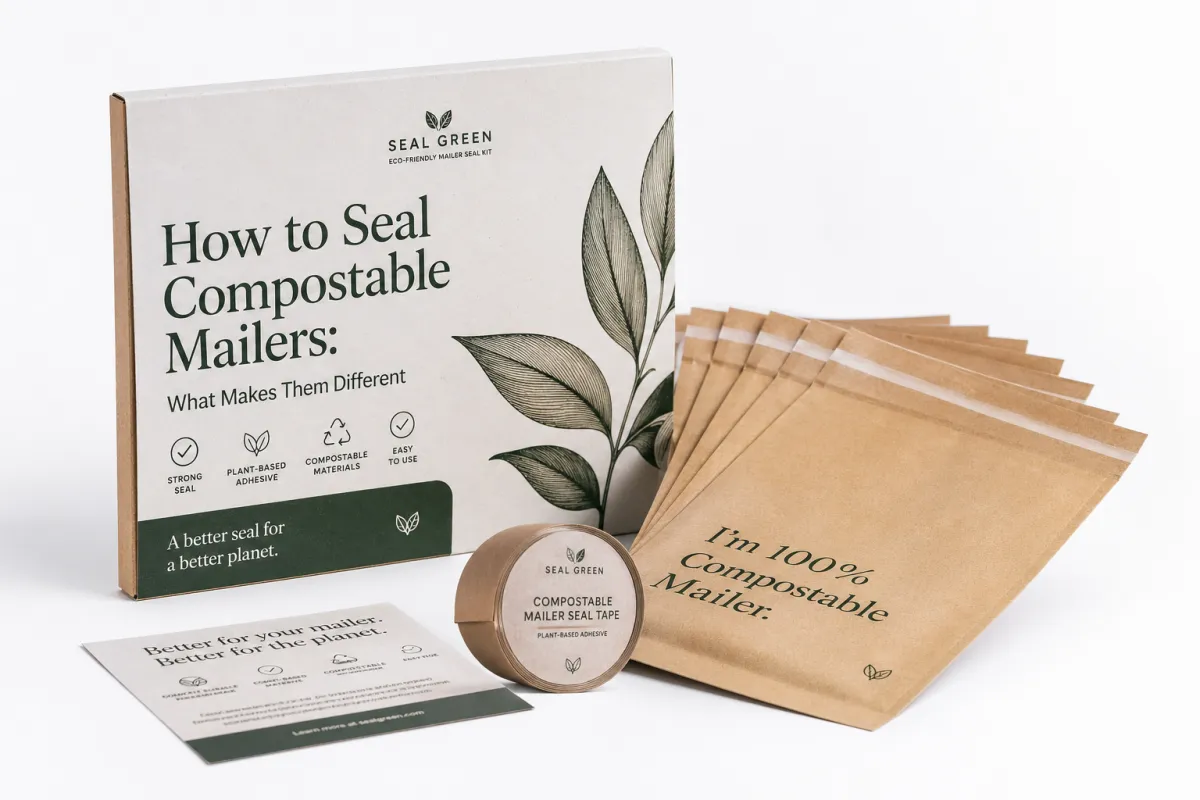
The shortest answer to how to seal compostable mailers is this: match the closure method to the film spec, then tune heat, pressure, and dwell time in small steps. For a heat seal, start with the supplier's recommended window, run 10 to 25 sample bags, and check for a flat seam, no scorching, and no edge curl. For an adhesive strip or pressure-sensitive closure, keep the top edge clean and dry before you close it. The safest version of how to seal compostable mailers is the one that survives pull tests, vibration, and real parcel handling, not just a quick bench check.
How to seal compostable mailers is really about keeping transit performance intact for a 2-day parcel while leaving the material fit for composting conditions later. That balance matters when a team is trying to reduce carbon footprint, keep packaging aligned with a circular economy, and avoid the very un-green pile of returns that comes from a weak closure. I care about that balance because I have watched too many sustainability plans collapse over a $0.03 seal mistake. Three cents. That is roughly the price of a bad mood and a return label, which is a terrible trade on any line shipping 500 to 2,000 parcels a day.
How to Seal Compostable Mailers on Real Packing Lines
How to seal compostable mailers on a real packing line comes down to three dials: heat, pressure, and dwell time. Miss one by a small amount and the seam can look fine under a quick inspection, then fail after a 90-minute truck ride or a few hard drops on a sortation belt. I tell line leads that the goal is not just to make the mouth stick closed. The goal is a repeatable seal that survives parcel handling and still respects the compostable structure. That sounds obvious until you watch a line operator grab the setting knob like it owes him money.
Closure type matters before temperature does. Adhesive strips work well for hand packing at about 50 to 100 parcels per day, pressure-sensitive closures help on low- to mid-volume runs, and heat seals usually give the cleanest tamper evidence when the film supplier supports them. A built-in closure is not always better than a separate strip. It does lower the odds that someone misplaces a liner or applies the strip crooked by 5 mm. Small errors pile up fast on a busy line, and packaging is famously unforgiving about tiny mistakes. Five millimeters on a desk is nothing. Five millimeters in a seal path is how you buy yourself an afternoon of complaints.
I have seen how to seal compostable mailers change from one shift to the next just because dock humidity jumped from 38 percent to 72 percent and room temperature rose 4 degrees after lunch. One warehouse in North Carolina ran smoothly in the morning, then a damp afternoon made the same closure tacky and slow. Operators pressed harder to compensate and overcompressed the film. That is why I never trust a single setting card unless the room, the film lot, and the operator all match. The machine did not suddenly become moody. The environment moved, and the package paid for it.
For standards and transit context, I cross-check supplier claims against the Sustainable Packaging Coalition at Packaging.org and the parcel testing framework at ISTA. If a supplier cannot show the compostability proof, I treat the seal claim as a claim, not a promise. That applies whether the bag is labeled for green packaging, lower-waste programs, or retail mail order. I also ask for a sample sheet with the sealing window in degrees, seconds, and millimeters, plus the line speed in bags per minute. A vague recommendation is how you end up guessing on the line, and guessing is not a quality program (it is a dare).
Key Factors That Change Seal Quality, Cost, and Timing
How to seal compostable mailers depends as much on bag thickness as on the machine. A 1.2 mil film on a manual bar sealer behaves very differently from a 2.0 mil gusseted mailer on an automatic fin-seal line. Thicker film usually buys a wider process window. It can also raise unit cost by a few cents and slow the close by 0.5 seconds if the machine needs more dwell. I have watched an operator blame himself for a weak seam when the real culprit was a film spec too thin for the packing speed. That kind of mistake is maddening, because it feels personal when it is actually mathematical.
Cost enters the picture quickly. A cheaper bag with a seal window only 10 degrees wide can create 3 to 5 percent scrap, while a slightly pricier film that seals cleanly may save labor on every 1,000-piece run. If you are still comparing compostable stock against our Custom Poly Mailers, the real math is not just unit price. Failed seals, reships, and the 15 minutes an operator spends cleaning up a sticky seam belong in the calculation too. On a site shipping 400 parcels per day, that hidden labor adds up quickly. A few pennies up front can either save you money or quietly invite a tiny administrative disaster. I prefer the first option.
Procurement teams often ask how to seal compostable mailers at scale, then forget to ask about volume, print coverage, custom sizing, and whether the closure is built into the film or added as a separate adhesive strip. Those choices can move a quote by 12 percent or more, especially when a converter in Guangzhou or Dongguan needs a special die cut, a wider mouth, or a custom logo print with 3-color coverage. During a supplier negotiation in Shenzhen, a 0.3 mm change in seal band width affected line cost more than the ink itself because the trim pattern and tooling time shifted with it. That was one of those meetings where everyone stared at the spreadsheet like it had insulted their mother.
Before a full switch, I want at least 25 sample bags, three seal settings, 10 pull tests per setting, and one short transit-style shake test. That is the smallest data set that usually tells me whether the line will hold. A pilot run of that size takes about 45 minutes on a stable line, and it is almost always cheaper than finding the issue after 5,000 bags already left the building. That is the practical side of how to seal compostable mailers: test first, then scale. The romantic version of packaging says "innovate boldly." The warehouse version says "prove it before the truck leaves."
"Once we measured the scrap rate instead of guessing at it, the whole seal conversation changed," a plant manager in Ohio told me after a 25-bag pilot exposed a weak setting in under an hour on a line running 680 units a day.
How to Seal Compostable Mailers Correctly
When I train a line on how to seal compostable mailers correctly, I start with inspection. The mailer size, closure type, and load weight all need to match before a single carton opens. A 10 x 13 inch mailer that works for folded apparel will not behave the same way with a boxed candle, and a 6-ounce beauty kit can still wreck a seam if one hard corner lands in the seal zone. That first check takes 30 seconds, but it often saves 30 minutes of troubleshooting later. I have never met a line that was too rich in patience and too poor in quick inspection.
The cleanest way I know how to seal compostable mailers is a repeatable sequence: fill to the same 80 to 90 percent volume, keep the product at least 15 mm from the mouth, flatten the top edge, and apply the closure with steady pressure instead of a rushed squeeze. Hand sealing rewards rhythm more than speed. Uneven folds create weak points that can split when a package is stacked 3 high on a pallet. The best operators I have seen move like clockwork, not like they are late for lunch. The whole room calms down when they do, which is not a coincidence.
- Confirm the mailer lot and closure style before the shift starts.
- Run 3 test seals on sample bags at the lowest workable setting.
- Check that the seam is flat and free of product edges or dust.
- Increase heat or dwell in small steps, never more than one setting at a time.
- Perform a pull test and a 5-second hold test before the batch is released.
If you are using a heat sealer, the safest way to learn how to seal compostable mailers is to start with a 25-bag strip test and watch the seam surface under bright light. A healthy seam should look even, not scorched, and it should resist a gentle pull without tearing the film edge or peeling like tape on a cold morning. A shiny blister or a wrinkled ridge tells me the setup needs to come back down by at least 5 degrees or the dwell needs to shorten by a few tenths of a second. Packaging people spend a weird amount of time staring at tiny melted edges, but there is no glamour in quality control, only results.
I once watched a co-packer in North Carolina solve a rash of seal splits by moving the product 1 cm lower in the bag and shortening dwell from 1.4 seconds to 0.9 seconds. That is why how to seal compostable mailers is a process, not a guess. The line was packing 700 units a day, and one tiny geometry change eliminated the micro-channels causing returns. Real floors run on small corrections and a lot of discipline, not expensive equipment. And yes, there was a lot of muttering before the fix, because of course there was.
Common Mistakes That Lead to Failed Seals and Returns
The most common mistake in how to seal compostable mailers is assuming the same heat setting that worked on a standard polyethylene bag will work here. Compostable film can overcook, wrinkle, or lose seam strength in just a few seconds. I have seen a 170 C setting that was perfect for a PE mailer turn a compostable mouth into a glossy, brittle strip that peeled apart with almost no effort. One error like that can turn a clean packout into a return request by the end of the week. I wish that sounded dramatic, but it happens more than anyone wants to admit.
Product migration into the seal zone causes another failure. A lip balm tube, a folded box corner, or even 20 grams of trapped tissue paper can create a micro-channel that looks fine until the parcel rides a belt for 200 feet. Teams also rush the close and trap one corner of a card insert under the seal, which is enough to create a leak path on a 2-pound shipment. These are small errors, but they show up as customer complaints, not immediate line alarms. That delayed pain is the worst part, because by the time the email hits customer service, the root cause is already three departments away.
| Closure method | Best use | Typical setup / pricing impact | Operational note |
|---|---|---|---|
| Heat seal | Mid- to high-volume parcel runs | Sealer cost often ranges from $300 to $1,200; film can add $0.02 to $0.06 per bag | Strongest tamper evidence, but the narrowest heat window |
| Adhesive strip | Hand packing and smaller batches | Low equipment cost; labor often adds 2 to 4 seconds per bag | Simple to train, but the liner must be applied straight |
| Pressure-sensitive closure | Light apparel, inserts, and low-weight orders | Moderate unit cost; usually $0.03 to $0.05 more than a plain bag | Fast, but performance can dip in hot or humid storage |
Storage matters too. In how to seal compostable mailers, I have seen hot docks, damp paper rooms, and sunlit staging areas change the film's behavior enough to turn a clean seal into a weak peel. When stock sits for 48 hours near a loading bay, the mouth can curl slightly, and a rough edge on a bag pallet can create a crease the operator only notices after 200 bags have already been packed. The storage room is often the reason the seal moved, not the machine. I would love to say packaging ignores weather. It absolutely does not, especially in humid months in Atlanta, Miami, or Houston.
The downstream cost is where the pain shows up: a 2 percent failure rate on 10,000 parcels is 200 customer problems, plus rework, repack, and reship labor. One retailer I met during a supplier review in Dallas thought the issue was only a material complaint, but the actual cost was closer to 14 labor hours per week once the team counted call handling and second shipments. Seal failures are a financial issue, not just a packaging annoyance. The spreadsheet always looks calmer than the floor.
Cost, Pricing, and Timeline When Switching to Compostable Mailers
The switch from plastic to compostable looks simple on paper, but how to seal compostable mailers usually adds 1 to 2 days of line tuning, one short operator training session, and a sample approval step that can save a week of headaches later. If your team is used to poly mailers, that adjustment is normal, not a sign that the compostable option is wrong. I have seen plants spend 90 minutes on setup and then run smoothly for the next 3 weeks once the seal settings were documented properly. The boring part is often the part that pays for itself.
Pricing is less about the seal itself than the total landed cost. For a 5,000-piece printed run, I have seen unit prices land between $0.28 and $0.62 depending on size, print coverage, and whether the closure is integrated. A plain unprinted bag is cheaper, but if the wrong seal process generates a 4 percent scrap rate, the savings disappear quickly. For brands scaling up, how to seal compostable mailers is usually a training issue as much as a buying issue, especially when the goal is to keep green packaging claims believable at the warehouse level. A sustainability plan that creates a mountain of waste in a back room has a credibility problem, and customers notice more than companies like to think.
Procurement timing matters too, because how to seal compostable mailers influences the spec sheet. Custom sizes, gusset changes, and multi-color print often push lead times to 12 to 15 business days after proof approval, and that is before freight from the converter in Foshan, Shenzhen, or Ho Chi Minh City. If you are building a full packaging kit, I would rather see the mailer spec discussed alongside Custom Packaging Products than treated as an afterthought. The mailer, carton, insert, and label all affect handling. The fastest projects are the ones where purchasing, operations, and design agree on the same closure style on the first pass. Anything else is just three teams hoping reality will be polite.
I like a 1-week pilot of 500 to 1,000 units because it lets us compare scrap rate, labor minutes per carton, and customer complaints before a full rollout. On one client line in Ohio, that tiny trial cut the forecast error by 9 percent and made the carbon-footprint discussion a lot less abstract. The team could see the waste pile shrink from two half-full gaylords to one tidy tote a day. That is lower-waste packaging in a real warehouse: not perfect, just measurably better. Honestly, I trust measurable better over glossy ambition every time.
How to Seal Compostable Mailers: Expert Tips and Next Steps
The best expert tip I can give for how to seal compostable mailers is boring and effective: write the sealer settings down, tape the sheet near the bench, and keep one backup operator trained on the same 3 numbers - heat, pressure, and dwell. Plants that do this well usually have fewer surprises because the settings are visible to everyone on the shift, not trapped in one supervisor's head. I have seen that simple habit save 20 minutes of troubleshooting on a Monday morning more than once. Small systems beat heroic memory. Every single time.
Another habit that pays off in how to seal compostable mailers is QC at every shift change: pull 3 sample bags, inspect the seam edge under light, and hold the pouch by one corner for a 5-second hang test before anyone starts boxing cartons. If the seam lines up cleanly and the film does not stretch at the mouth, you have a good first signal that the process is stable. This routine takes less than 2 minutes, which is a small price compared with opening a pallet and finding 100 weak seals. I have done the math; the short ritual wins.
A final note on how to seal compostable mailers: keep the process visible, measurable, and boring enough that a new shift can repeat it without guessing. If you are still choosing between compostable stock and a more traditional format, start with the closure you can support on Monday morning and match the packaging to the labor you have, not the labor you wish you had. I have watched teams overbuy a fancy option and then discover they needed an extra 15 seconds of hand work per parcel. That is a fast way to burn out a 4-person pack line. The smartest packaging decision is usually the one the smallest overnight crew can repeat without guessing. A perfect spec that nobody can run is just an expensive document.
For me, the final test in how to seal compostable mailers is whether the seal holds in transit, the work stays predictable across a 40-hour production week, and the packaging still fits a compostable, lower-carbon strategy that makes sense for the brand. If you take anything from this piece, let it be this: how to seal compostable mailers is not about copying a plastic setting. It is about building a steady habit of inspecting, testing, and recording so the seal stays dependable and the shipping cost does not drift out of control. That is the practical, real-floor answer I give every time. Start with a supplier-approved setting, run a small pilot, and lock the numbers to the bench before full production. Also, it saves you from the deeply unglamorous experience of explaining to accounting why a "small" seal issue turned into a very real pile of refunds.
Can you heat seal compostable mailers the same way as plastic mailers?
Not always, because compostable films often have a narrower heat window and can distort if the temperature is too high. I always recommend a small test run of 10 to 25 bags, then stepping heat up in small increments while watching seam strength, wrinkle formation, and edge scorch. If the supplier specifies an adhesive strip or pressure-sensitive closure, use that method instead of a generic plastic setting, because the film structure and closure design were built for different handling speeds. I know that sounds fussy, but so does repairing 400 failed mailers at 4 p.m. in a 95-degree dock.
What temperature should I use to seal compostable mailers?
There is no universal temperature, since the right setting depends on film thickness, blend, and sealing equipment. A 1.2 mil bag on a manual sealer may behave very differently from a 2.0 mil automatic setup, so the manufacturer spec sheet should be your starting point. If the seam scorches, wrinkles, or peels apart easily, lower heat or shorten dwell time before you run full batches of 500 units or more. I would rather be annoyingly precise here than casually optimistic and wrong.
How long does a compostable mailer seal last in transit?
A properly formed seal should hold through normal parcel handling, conveyor movement, sortation, and last-mile delivery. Performance depends on fill weight, package shape, and whether the seal area was kept clean and flat, so I always suggest a transit-style test with 3 drops from parcel height and a short vibration check. For fragile or heavy contents, test the mailer under worst-case handling before you approve it for production use. Shipping lanes are not gentle, and pretending they are is how you earn a box of complaints.
Do compostable mailers cost more to seal and ship?
The mailers themselves often cost more upfront, but the sealing cost is usually driven by labor, machine setup, and scrap rate. A reliable process can reduce returns, damage claims, and rework, which helps offset the higher unit price, especially on orders over 1,000 units. Bulk purchasing, standardized sizes, and one stable closure method make the total landed cost much easier to forecast. I usually tell teams to compare the full cost per successful shipment, not the sticker price per bag, because that is where the truth sits.
What should I do if the seal on a compostable mailer keeps failing?
Check the basics first: heat setting, dwell time, pressure, bag alignment, and whether product is interfering with the closure area. Then inspect storage conditions and the age of the stock, because heat and humidity can change how the film behaves after 24 to 48 hours in a hot dock or damp room. If failures continue, request fresh samples from the supplier and run a side-by-side test with a known-good bag and setting so you can isolate the variable in one afternoon instead of chasing it for a week. I have done the "chasing it for a week" version, and I would not recommend it to my enemies.