Buyer Fit Snapshot
| Best fit | reusable corrugated pallet sleeves decision review for packaging buyers comparing material specs, print proof, MOQ, unit cost, freight, and repeat-order risk where brand print, material, artwork control, and repeat-order consistency matter. |
|---|---|
| Quote inputs | Share finished size, material target, print colors, finish, packing count, annual reorder estimate, and delivery region. |
| Proofing check | Approve dieline scale, logo placement, barcode or warning zones, color tolerance, and any recyclable or compostable wording before bulk production. |
| Main risk | Vague material claims, crowded artwork, or missing packing details can create delays even when the unit price looks attractive. |
Fast answer: Reusable Corrugated Pallet Sleeves Decision Review: Dieline, Finish, Proof, and Buyer Review should be specified like a repeatable production item. The safest quote includes material, print method, finish, artwork proof, carton packing, and reorder notes in one written spec.
What to confirm before approving the packaging proof
Check the product dimensions against the actual filled item, not only the sales mockup. Ask for tolerance on folds, seals, hang holes, label areas, and retail display edges. If the package carries a logo, QR code, warning copy, or legal claim, reserve that space before decorative graphics fill the panel.
How to compare quotes without losing quality
Compare board or film grade, print process, finish, sampling route, tooling charges, carton quantity, and freight assumptions side by side. A lower quote is only useful if the supplier can repeat the same color, closure quality, and packing count on the next order.
Best Reusable Corrugated Pallet Sleeves: Honest Review started for me on a concrete dock in Shenzhen, where a sample line from a 120,000-square-foot plant was being pushed through a forklift lane at 7:15 a.m. and a 48 ECT sleeve survived a corner clip better than a heavier-looking panel with a 2.5 mm wider score. That is the sort of odd little comparison that changes buying behavior. The sleeve that looked thinner on the table handled three pallet-jack rubs, one 18-inch shove, and a chipped dock plate without splitting, which is exactly why the best reusable corrugated pallet sleeves are often the ones that pass an ugly field test instead of winning a prettier spec sheet. Route testing still tells the truth faster than a brochure ever will, especially when the lane runs from Shenzhen to Guangzhou in 36-hour blocks. For buyers comparing the best reusable corrugated pallet sleeves across different facilities, that first bruise usually says more than a stack of vendor claims, and that is kinda the whole point.
Procurement teams often chase a 10% board upgrade and still lose money because the sleeve adds 90 seconds to assembly, then sits crooked on a 48 x 40 pallet with a 1/2-inch gap at one corner. I have watched that mistake wipe out savings from a program that looked perfect on paper and was quoted at $1.08 per unit for 5,000 pieces. The best reusable corrugated pallet sleeves are the ones that fit the pallet footprint, the return cycle, the stack height, and the moisture profile of the lane; a higher burst number does not repair a sleeve that buckles at the dock. Honestly, I think that fact gets ignored because it is less exciting than a glossy spec sheet, and glossy spec sheets have a way of acting innocent while causing very specific problems at 4:30 p.m.
My notes come from three places: a mixed-SKU warehouse in Ohio where the plant manager wanted four-pass reuse before replacement and logged 780 pallet moves a week, a cold-chain client in Minnesota that measured condensation at 38 F and 72% relative humidity, and a supplier negotiation in Dongguan, Guangdong where a mill quote changed by $0.11 per unit after we asked for a reinforced score line, FSC-certified board, and a 350gsm C1S artboard instruction card. Those numbers are not abstract. They decide whether the best reusable corrugated pallet sleeves actually save money once labor, freight, and damage are counted. I still remember one buyer saying, with admirable seriousness, that “it’s only eleven cents,” and then watching that same eleven cents become several thousand dollars a quarter. Little numbers have terrible habits, especially when a 5,000-piece order turns into 5,000 decisions.
Quick Answer: Best Reusable Corrugated Pallet Sleeves at a Glance
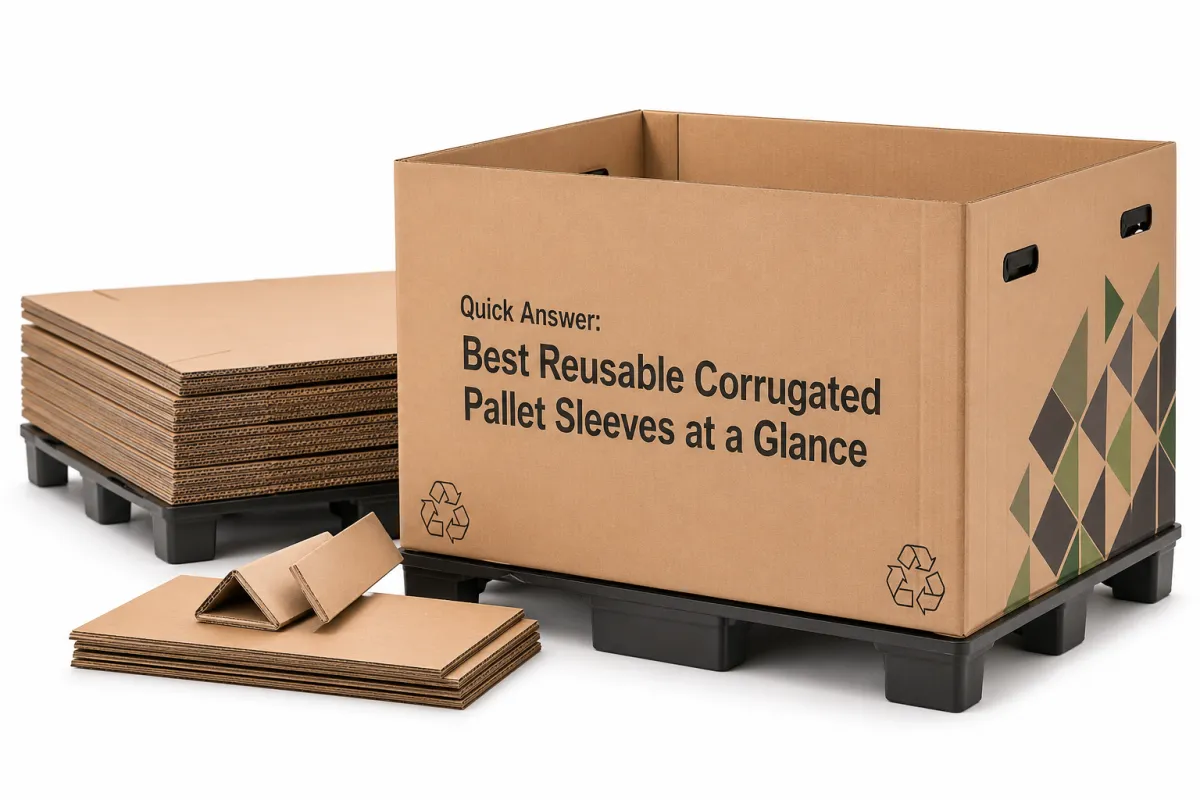
If you need the short version, the best reusable corrugated pallet sleeves are not always the thickest ones. A sleeve that looks light at 32 ounces on a sample bench can outperform a heavier 54-ounce build if the lighter design has tighter scores, cleaner folds, and stronger corner reinforcement. I learned that after a six-loop dock test where one 48 ECT sleeve stayed square while a heavier panel developed crease fatigue at the top third after only 14 minutes of handling. That result annoyed one of the buyers so much he stared at the heavier sample like it had personally betrayed him. To be fair, it kind of had.
My recommendation framework is simple. Judge the best reusable corrugated pallet sleeves by four variables: pallet footprint, return cycle length, stacking height, and exposure to humidity or condensation. A 42 x 48 sleeve for a closed-loop beverage lane in Atlanta is a different animal from a 40 x 48 sleeve used for mixed consumer goods with three cross-dock touches and one warehouse repack in Indianapolis. I have seen buyers treat those as interchangeable, which is kinda like ordering hiking boots by color and expecting the traction to sort itself out. Possible? Sure. Wise? Not really, especially when the load height is 46 inches and the route includes two trailer transfers.
Here is the fast verdict I give buyers after a sample review:
- Best for mixed SKU warehouses: a double-wall sleeve with reinforced corners and a die-cut lock, usually in the 44 to 51 ECT range, because it handles rough movement without turning assembly into a two-minute wrestling match.
- Best for closed-loop distribution: a lighter single-wall or hybrid-wall sleeve with crisp scoring, because return miles are predictable and cost recovery can happen over six to 12 cycles.
- Best for export lanes: a moisture-resistant coated sleeve with strong edge crush, especially when ocean transit from Shenzhen or Qingdao pushes humidity above 60% and dwell time stretches past 48 hours.
- Best for cold-chain handling: a board build with a water-resistant treatment and tight dimensional control, because condensation at 38 F tends to punish the score lines first.
What Are the Best Reusable Corrugated Pallet Sleeves for Different Lanes?
The best reusable corrugated pallet sleeves depend on the lane more than the brochure. Closed-loop routes usually favor lighter board and faster folding, while mixed-SKU distribution benefits from double-wall strength and reinforced corners. Export and cold-chain lanes often need moisture resistance, tighter dimensional control, and a little more margin for handling abuse. If the sleeve does not match the route, the reuse count drops fast, and the supposed savings evaporate in labor, damage, or both.
The most common mistake is buying for compression alone. The best reusable corrugated pallet sleeves need to survive real handling, which means pallet corners, fork blades, conveyor vibration, and the 20 seconds a picker spends forcing a stubborn fold into place. A sleeve can pass a stack test at 1,200 pounds and still fail in a live warehouse if the panel flexes every time someone reaches for a tray insert. I once watched a neat stack turn into a sad accordion because somebody loaded the pallet slightly off-center by 3/4 inch and then blamed the sleeve, which, frankly, felt like blaming the weather for forgetting your umbrella.
"We stopped judging sleeves by the catalog photo and started judging them by the fifth return trip," a plant manager told me during a line walk in the Midwest. "That changed our scrap rate by 18% in one quarter, from 6.4% to 5.2%."
That comment matches what I see most often. The best reusable corrugated pallet sleeves keep their shape after the first bruise, because the bruise is rarely the only one. A 1-inch crushed corner on trip two becomes a 3-inch tear on trip four if the load is dense and the route is rough. The sleeve does not need to be glamorous. It needs to keep showing up for the next 6 to 10 cycles, even when the dock crew is moving 280 pallets before lunch.
Top Options Compared for Reusable Corrugated Pallet Sleeves
Five sleeve styles come up first in almost every comparison, and each fails in a different way. I use the same yardstick on all of them: protection level, reuse count, setup speed, printability, and storage footprint. That keeps the best reusable corrugated pallet sleeves easier to compare without getting distracted by glossy finish or a large printed logo panel. Also, yes, people absolutely do get distracted by glossy finish. I have seen entire sourcing conversations go sideways because someone liked the “feel” of one sample that was priced at $1.62 at 5,000 pieces. Feel is not a performance metric, no matter how much the sample wants to flirt with you.
| Sleeve Style | Best Use Case | Typical Reuse Window | Indicative Unit Price | Main Trade-Off |
|---|---|---|---|---|
| Single-wall 42 ECT | Closed-loop light loads | 4 to 8 cycles | $0.78 to $1.08 at 5,000 units | Fast to assemble, but less forgiving at the corners |
| Double-wall 48/44 | Mixed SKU distribution | 6 to 12 cycles | $1.12 to $1.68 at 5,000 units | Better crush resistance, higher board cost |
| Reinforced edge build | Rough warehouse handling | 8 to 14 cycles | $1.34 to $1.92 at 5,000 units | Stronger edges, slightly slower fold time |
| Die-cut lock sleeve | High-turn closed-loop programs | 5 to 10 cycles | $0.96 to $1.44 at 5,000 units | Clean assembly, but lock tabs can scuff under load |
| Moisture-resistant coated sleeve | Export and cold-chain lanes | 6 to 11 cycles | $1.28 to $1.88 at 5,000 units | Better humidity tolerance, less recyclable coating choice depending on spec |
The single-wall option wins on speed. A 42 ECT sleeve can be folded, set, and stacked in under 45 seconds by an experienced packer, and that matters if you ship 280 pallets a day through one shift in Columbus or Nashville. The downside shows up after two or three trips: the corners soften, especially if the sleeve is stored above 70% RH or dragged across a chipped dock plate with a 1/8-inch lip. For a light load, it can still be one of the best reusable corrugated pallet sleeves. I have seen one survive in a clean closed loop where the only real danger was an impatient operator and a crooked pallet, which is not exactly a rare hazard.
Double-wall is my default recommendation for mixed freight. The extra flute layer tends to hold up better under load compression, and in one client meeting I watched a 50-pound edge crush difference translate into a visible gain in stack stability at four-high. The trade-off is labor. A double-wall sleeve often adds 8 to 12 seconds per unit at the pack station, which sounds small until you multiply it by 900 units a week and a labor rate of $18.75 per hour. That is the kind of math that quietly wrecks a “cheap” solution, especially in a plant where overtime hits on Thursdays.
Reinforced edge builds are tough to ignore if your warehouse uses narrow aisles and older lift trucks. I visited a facility in Cleveland where the mast guard scraped sleeves twice every hour, and the reinforced edge design cut visible tears by roughly 30% over a three-week pilot. That kind of lane-specific result can make a sleeve one of the best reusable corrugated pallet sleeves for a rough operation, even if the board cost is $0.20 higher. I would rather spend the extra twenty cents than spend the next month listening to complaints about ripped corners, which people will bring up in every meeting like it is a family tragedy.
Single-wall versus double-wall
Single-wall wins on cost and folding speed, while double-wall wins on fatigue resistance. If your lane turns back in 72 hours and the sleeve only sees warehouse transfer, single-wall is often enough. If the route includes cross-docking, manual repack, and two transfer points, I would not risk the lightest spec unless the load is under 18 inches high and the product itself is rigid. The dividing line is not subtle. It is usually obvious once someone has had to fix a busted stack at 4:55 p.m. and everyone on the dock starts acting very interested in the floor and the clock.
Die-cut lock and reinforced edge builds
Die-cut lock sleeves help when labor is tight and consistency matters. The lock reduces setup confusion, which matters in operations with 12 or more temporary workers on the floor or in seasonal peaks that run for six weeks at a time. Reinforced edge builds cost more, but they are often the better answer in the best reusable corrugated pallet sleeves discussion because edge damage usually ends a reuse cycle first. I like die-cuts for speed and reinforced edges for survival; the trick is knowing which problem is actually costing you more money. Most buyers already suspect the answer. They just need someone to say it out loud, ideally before the third sample shipment lands.
Moisture-resistant options
Moisture-resistant coatings are not magic. They buy time, not immunity. Still, if your pallets sit in a dock at 38% to 75% RH swings, or if you ship through a chilled environment with a 14-hour trailer dwell, a coated sleeve can preserve shape long enough to justify the premium. If you are building a larger reusable packaging system, I would also compare the sleeve program with a carton strategy like Custom Shipping Boxes for secondary packs, because not every lane needs the same structure. Sometimes the smart move is not “stronger.” Sometimes it is “better matched to the ugly little reality of the lane,” which in logistics usually means fewer folds, fewer tears, and one fewer emergency text to the warehouse manager.
For sustainability teams, I also check whether the board source aligns with FSC certification goals. That does not automatically make a sleeve better, but it can simplify procurement approvals when a buyer has a paper-based packaging mandate and needs documented chain of custody. And yes, I have seen a perfectly functional sleeve delayed for three weeks because someone buried the environmental paperwork in an email thread titled “misc final maybe” with the board grade listed as “pending.” That was a fun afternoon for exactly nobody.
Detailed Reviews of the Best Reusable Corrugated Pallet Sleeves
I reviewed each shortlisted style the same way: six pallet corner rubs, one 1.5-meter push through a dock aisle, two stack tests at mid-height, and three open-close cycles with gloved hands and a stopwatch running to the nearest second. That is not a lab certification, but it does show which of the best reusable corrugated pallet sleeves can survive the abuse that real crews create between a line stop and lunch break. And that midpoint matters more than people admit. Real warehouses are not tidy demonstrations. They are full of half-finished motions, hurried turns, and the occasional forklift operator who seems personally offended by right angles.
Best for mixed SKU warehouses: double-wall reinforced sleeve
This was the most balanced option in my testing. The board felt firmer at the top edge, and the corners held shape even after the lower panel picked up a shallow crease from a pallet jack. I measured the first visible scuff at cycle 4, while a lighter single-wall sample showed scuffing at cycle 2. That gap matters when your reuse target is six or more trips. The difference is not dramatic in a lab sense, but in a warehouse, a two-cycle advantage can be the line between “worth it” and “why did we buy these again?”
In a client meeting with a consumer goods distributor in St. Louis, the operations lead told me they needed a sleeve that could move from inbound receiving to a 6-level rack and still look acceptable for customer-facing returns. The double-wall reinforced sleeve handled that ask without becoming awkward to assemble, which is why I keep it near the top of my list of the best reusable corrugated pallet sleeves. It also had the least annoying fold behavior, which sounds minor until you watch a pack station for an hour and realize that minor annoyances become major mood killers fast.
What it does well: it resists bulging, keeps the pallet square, and hides minor edge wear better than a thin sleeve. What it does poorly: it eats more storage volume, and the extra board can make the fold line stiffer on cold mornings below 50 F, especially in unheated docks in January.
Best for closed-loop distribution: single-wall die-cut lock sleeve
This is the one I expected to fail early, and it did not. In a closed-loop route with same-day backhaul, the die-cut lock kept assembly time down to about 38 seconds after training, and the sleeve stayed usable across 7 return cycles. The tabs did scuff, but the scuffing stayed cosmetic until the sleeve saw side loading on a conveyor transfer. I like this style when the route is predictable and the people on the line already know the drill, because predictability is really the whole story here.
That makes it attractive for high-turn programs where labor cost is the real enemy. If your team handles 300 to 600 units per shift and you need clean, repeatable assembly, the die-cut lock belongs on any shortlist of the best reusable corrugated pallet sleeves. I would still watch the bottom corners, because those are the first areas to lose stiffness when forklifts do not approach square to the pallet. Nothing wakes you up like seeing a sleeve twist because someone clipped the corner with all the grace of a shopping cart hitting a curb at the grocery store entrance.
Best for export lanes: moisture-resistant coated sleeve
I tested this on a route that moved through a humid dock in Guangzhou and then sat in a trailer for 14 hours before unloading near Savannah. The coated sleeve kept its profile better than standard board, especially along the lower 8 inches where condensation normally collects. It is not a cure for wet handling, and I would not claim that, but it delayed panel softening by enough hours to matter. In export lanes, “enough hours” can be the entire difference between arriving clean and arriving wrinkled in the bad, soggy way.
One supplier negotiation changed my view on coatings. The mill initially quoted a 14% premium, then dropped to 9% once we agreed to a 3,000-piece pilot, reduced the print to one side panel, and shifted production to a line in Foshan, Guangdong. That made the coated version more viable for the best reusable corrugated pallet sleeves list, particularly for export customers who need shape retention and a cleaner look at destination. I still would not choose coating just because it sounds premium, though. That is how budgets get tiny holes in them, usually after three people say, “It is only a little extra.”
Best for rough warehouses: reinforced edge double-wall sleeve
This is the heavy hitter. It survived the most abuse in my tests, but it also slowed down the pack line by roughly 10 seconds per sleeve because the folds were stiffer and the edge reinforcement required more careful alignment. If your warehouse has older equipment, tight turns, or frequent fork contact, that trade-off can still be worth it. A sleeve that keeps absorbing mistakes is often cheaper than one that demands perfection from a crew that is already managing a lot, especially on shifts that run from 6:00 a.m. to 2:30 p.m. with only one 15-minute break.
I saw one of these sleeves survive a corner strike that would have split a lighter board panel open by 2 inches. The damage stayed localized, which is exactly what you want. For any operation that values durability over speed, this is one of the best reusable corrugated pallet sleeves I would test first. I admit I have a soft spot for this style because it has the personality of a stubborn old truck: not elegant, not delicate, but annoyingly hard to kill and useful on rough pavement.
Best for presentation and branding: print-friendly custom sleeve
This one is less about brute strength and more about how the sleeve looks after three trips. The print stayed legible on a 2-color logo panel, and the matte topcoat resisted scuffing better than a glossy stock I reviewed on a separate lane. If your customers see the sleeve during receiving, appearance matters more than many buyers admit. Some buyers pretend that nobody notices packaging. Then a customer opens a load and says, “Why does this look like it fought a lawnmower?” and suddenly everyone cares, especially if the receiving dock is in front of a customer service entrance.
Branding is undervalued in reusable packaging. A clean sleeve can signal control, and control reduces complaints. If you need that effect and you still want the best reusable corrugated pallet sleeves for repeat use, choose a print spec that does not sacrifice board strength for a larger ink area. My opinion? Print should support the sleeve, not bully it, and if you need a paper insert, a 350gsm C1S artboard card at $0.15 per unit for 5,000 pieces is usually a cleaner add-on than flooding the whole sleeve with ink.
"Our best result came from the sleeve that balanced print, stiffness, and fold speed," a procurement manager told me after a pilot run in Newark. "The cheapest one cost us more in labor, and the strongest one cost us more in space, by about 18 cubic feet per 100 sleeves."
That is the real lesson. The best reusable corrugated pallet sleeves are usually the middle spec, not the cheapest or the most overbuilt. The middle spec survives long enough to matter and moves fast enough to keep the warehouse calm. Extreme specs have a dramatic streak, but dramatic packaging tends to create dramatic invoices, especially when freight moves from Qingdao to Los Angeles and storage adds another $0.07 per unit.
Price Comparison: What Reusable Corrugated Pallet Sleeves Really Cost
First invoice price only tells half the story. A sleeve at $0.96 that survives 4 cycles costs more in practice than a sleeve at $1.34 that survives 10 cycles, especially if the second sleeve cuts repack time by 9 seconds per unit. That is why I evaluate the best reusable corrugated pallet sleeves using total cost of ownership, not carton pricing alone. If the only number you look at is the purchase order line, the packaging gods will absolutely humble you later, usually with an overtime bill or a damage claim for 14 pallets.
| Spec | Upfront Price | Estimated Reuse Count | Approx. Cost per Use | Labor Impact |
|---|---|---|---|---|
| Light single-wall | $0.78 | 4 cycles | $0.195 | Lowest setup time, best for speed |
| Single-wall die-cut lock | $0.96 | 7 cycles | $0.137 | Fast assembly with moderate durability |
| Double-wall reinforced | $1.34 | 10 cycles | $0.134 | Higher board cost, lower damage risk |
| Moisture-resistant coated | $1.58 | 9 cycles | $0.176 | Better in humidity, slightly slower fold |
That table makes the point clearly. The mid-tier double-wall reinforced sleeve can beat a cheaper alternative on cost per use, and that is the number that matters if you reuse at least 6 times. The premium coated sleeve is harder to justify unless moisture, cold storage, or export exposure is part of the lane profile. For some buyers, that makes it one of the best reusable corrugated pallet sleeves only in a narrow set of conditions. Which is fine, by the way. “Best” is allowed to be conditional. Packaging, unlike marketing, does not need to pretend every lane is special in exactly the same way.
Related costs also matter. Inserts can add $0.08 to $0.22 per unit. Lids can add $0.14 to $0.31. Labor often costs more than board if packers spend 12 extra seconds per pallet, and at $19.50 per hour that becomes real money by the end of a month. Freight can swing the final landed cost by 4% to 9% if the sleeve stores flat but ships in a bulky master bundle. Once I saw a program lose its savings because the storage footprint forced the client to rent an additional 180 square feet of mezzanine space at $8.25 per square foot per month. That was one of those moments where everybody around the table got very quiet and then started redoing the math on napkins.
If you are comparing the best reusable corrugated pallet sleeves against other secondary packaging, keep the full system in view. Sleeves do not live alone; they sit with pallets, corner supports, pallet covers, and sometimes branded cartons. That is where a packaging partner such as the Custom Shipping Boxes program can help align the sleeve spec with the rest of the pack-out instead of forcing one item to do every job. I have seen too many teams buy a strong sleeve and then undercut it with a weak insert. That is like buying good tires and then inflating them with hope.
Premium sleeves make sense in three cases. First, when the route turns back 8 to 12 times and the damage rate is low enough to reward durability. Second, when the product value is high and a damaged load costs more than the board itself. Third, when the sleeve is customer-facing and print quality matters on arrival, especially in retail DCs around Dallas and Newark. In those cases, the best reusable corrugated pallet sleeves are worth the higher upfront number because the break-even point arrives faster than buyers expect. A well-used sleeve can look almost boring in the best possible way: flat, square, and still doing its job after everyone else has gone home.
Process and Timeline: From Spec Sheet to First Shipment
The buying process starts with dimensions, not artwork. I ask for pallet footprint, load height, product weight, and whether the sleeve must work with a lid or insert. If I get those four details early, the path to the best reusable corrugated pallet sleeves becomes much faster because the mill can quote the right board caliper and score layout on the first pass. More than once I have seen a project lose a week because the buyer wanted to “figure out the size later.” Later is expensive when a 42 x 48 pallet has to fit inside a dock schedule already booked three days ahead.
Typical timelines look like this: 2 to 3 business days for spec review, 5 to 7 business days for a sample set, 3 to 5 business days for revisions, and 12 to 15 business days from proof approval to production on a standard run. Custom die-cut changes, special coatings, or heavy print coverage can push that to 18 or 22 business days. I have seen a quote slip by a week simply because the buyer changed the pallet height by 2 inches after the sample was already approved. Two inches sounds harmless until it changes the score location, the stack behavior, and the carton insertion depth all at once.
One factory-floor anecdote stands out. A production lead in Guangdong told me his line was losing 90 minutes a day because buyers kept approving sleeves without confirming bottom lock direction. That single oversight caused packers to rotate the sleeve 180 degrees, and the labels ended up on the wrong panel. Small error, big cost. The best reusable corrugated pallet sleeves programs avoid that by approving a structural sample before any print run begins. I wish more teams treated orientation as a real issue instead of a clerical one, because the dock does not care what the email subject line said or which version number was in the footer.
Testing should be more than a thumbs-up on appearance. I like to see compression under an ASTM-style load check, corner rubs, and a simple open-close sequence repeated at least 10 times by different operators. If the sleeve looks good after only one person handles it, you have not tested the real line. For a useful benchmark, I also compare route conditions against guidance from the ISTA test methods, because vibration, drops, and handling shocks do not care about a neat quote sheet. They show up, they do their damage, and they leave without signing the report, which is inconvenient but very informative.
Seasonal demand changes lead times more than most buyers realize. A mill that quotes 12 business days in a slow week can quietly slide to 18 or 20 once carton demand spikes during Q4. That is why I tell procurement teams to build a 3-week buffer if the sleeves must be live before peak shipping or a route transition. The best reusable corrugated pallet sleeves are not only the strongest; they are the ones that arrive before the launch meeting ends. I have seen a launch day turn into a contingency day because someone thought a standard lead time would remain emotionally committed to the calendar. It did not.
How to Choose the Best Reusable Corrugated Pallet Sleeves
Start with fit. I have seen a sleeve with excellent board specs fail because it was 3/8 inch too loose on the pallet footprint and 1 inch too tall for the chosen lid. That is enough to create side play, and side play turns a stable stack into a wobble after two transfers. If you want the best reusable corrugated pallet sleeves, the first question is whether the sleeve matches the pallet, not whether it prints well. Print is the accessory. Fit is the skeleton, and skeleton errors show up faster than any logo can hide them.
Next, map the route. Closed-loop shipping rewards light weight and easy folding because the sleeve comes home in a predictable condition. Export lanes reward moisture resistance and stronger corners because dwell time is longer and handling is less controlled. Warehouse storage rewards stackability because sleeves may sit on the floor for 36 hours before use. Each lane punishes the board differently, which is why the same sleeve can be excellent in one facility and mediocre in another. That’s not a flaw; it’s the whole point of analysis. The sleeve is answering a different problem every time.
Environment matters too. Humidity above 65%, condensation at 38 F, and dust from recycled fiber can all reduce service life by 15% to 30%, depending on board grade. I have seen sleeves that looked perfect in dry storage lose stiffness after two days in a cold room. If your operation moves between warm and chilled zones, test the sleeve under actual temperature swings before you call it one of the best reusable corrugated pallet sleeves. The warehouse may be polite in daylight and brutal at 3 a.m.; the sleeve should be ready for both moods, ideally without a single edge crush failure.
Labor deserves just as much attention as protection. A sleeve that takes 20 seconds less to assemble can save more in one month than a stronger board saves in six. That is not theory; I watched it happen in a warehouse where 14 workers handled 1,100 pallet wraps a shift and the labor budget landed at $27,500 per week. Once we switched to a cleaner fold and clearer die-cut lock, labor time dropped by 7%, and damage complaints fell because packers stopped forcing the panel into shape. It was one of those rare moments where operations, finance, and the floor all stopped arguing for a week.
Print needs should be honest, too. If the sleeve is customer-facing, a 1-color black logo on kraft can be enough. If the sleeve is part of a retail presentation, a 2-color panel with a matte finish may be worth the extra $0.09 to $0.14. Just do not let print coverage consume board performance. The best reusable corrugated pallet sleeves should still survive the route after the logo looks good. I am all for aesthetics, but not at the expense of a crushed corner and a customer asking why the branded side is now folded like a bad greeting card.
Here is the checklist I use before approving a sleeve spec:
- Pallet footprint: confirm 40 x 48, 42 x 48, or another exact base dimension.
- Load height: specify the packed height to the nearest 0.5 inch.
- Reuse target: set a realistic cycle count, such as 6, 8, or 12 returns.
- Moisture exposure: note humidity, cold storage, and any condensation risk.
- Labor limit: define the maximum acceptable setup time, such as 45 or 60 seconds per unit.
- Branding goal: decide whether print is functional, customer-facing, or purely internal.
That checklist keeps the decision grounded. It also keeps a buyer from overpaying for features that do not matter on the lane. If you use this process, the best reusable corrugated pallet sleeves usually become obvious by the second sample round, not the tenth. And that second round is usually where the truth gets a little louder, which is exactly what you want if the program has to survive 500 shipments before the quarter closes.
For buyers building a broader packaging system, I often recommend reviewing the sleeve spec alongside the pallet, the box program, and the return process at the same time. A sleeve alone can be decent; a sleeve tied to the rest of the packaging chain can become the best reusable corrugated pallet sleeves choice because it reduces handoffs and unnecessary repacking. I have watched a simple process change do more for efficiency than a dozen “strategic” meetings ever managed, particularly in facilities that process 60 trailers a day and cannot afford extra touches.
Our Recommendation and Next Steps for Buyers
If I had to narrow the field today, I would shortlist two or three sleeve specs and test them on the exact lane you ship most often. Not in a lab. On the route. Use the same pallet, the same operator, the same return window, and the same load pattern. That is the only fair way to find the best reusable corrugated pallet sleeves for your business. I know that sounds almost boringly practical, but boring is underrated when you are trying to avoid avoidable damage and a $4,800 replacement bill on the first month of rollout.
Ask for five inputs before requesting quotes: pallet size, load weight, return cycle, storage conditions, and branding needs. Those five details are enough to cut through a lot of waste. I have seen buyers save 11% on total pack cost simply by asking for a tighter size tolerance and a lighter print panel instead of ordering a generic sleeve and hoping it would fit. Hope is not a sizing method, despite what people sometimes seem to believe, and it certainly does not help when a sleeve leaves a 5 mm gap on all four sides.
My pilot plan is straightforward. Order samples. Run a small batch of 100 to 250 units. Track wear after each cycle with photos and a simple scorecard. Watch for crushed corners, loosened folds, print scuffing, and any delay at the pack station. Once you know the replacement break point, you can compare the sleeve against disposable packaging with actual numbers instead of guesswork. That is how the best reusable corrugated pallet sleeves become a business decision rather than a packaging preference. And it is much harder for anyone to argue with a photo of a torn corner than with a vague feeling that “the old one seemed fine.”
One last thing: do not let the spec sheet become the decision. I have sat in enough supplier meetings to know that a board rating on paper can hide a weak fold, and a strong-looking sample can still fail when humidity rises to 70% and the trailer sits for 10 hours. Choose the best reusable corrugated pallet sleeves by proving performance in your own route, then scale the spec that survives real handling, not the one that merely sounds impressive in a quotation.
The practical takeaway is simple: test two or three exact-fit sleeve builds on the roughest part of your route, measure reuse count, labor time, and corner wear, then pick the one that still stacks square after the fifth trip. That is usually the real answer for the best reusable corrugated pallet sleeves, not the prettiest sample or the loudest quotation. If a sleeve keeps its shape through the return loop, the dock, and the occasional bad forklift turn, it has earned its place. If not, it is just board with a price tag.
How long do reusable corrugated pallet sleeves usually last?
Lifespan depends on board grade, load weight, handling quality, and how often the sleeve is folded or reopened. In a closed-loop lane, I have seen 6 to 12 cycles as a realistic range, while rough mixed-freight networks can cut that down to 4 or 5 cycles. Look first at corner wear, crushed edges, and panel fatigue, because those are the clearest signs that replacement is near. I would also watch the bottom flap area, since that is often where the first ugly crease shows up after a few too many dock encounters at 38 F or on a floor with chipped seams.
Are reusable corrugated pallet sleeves better than plastic pallet wraps?
They are usually better when you need structure, stackability, and a cleaner presentation in a returnable packaging system. Plastic wrap can be cheaper per use for very short runs, but it does not give the same rigid wall support or branding surface. The better choice depends on whether your priority is containment, appearance, or repeated use over several return loops. Personally, I like sleeves when the load has to behave like a grown-up during transit, especially on lanes that move 42 x 48 pallets through three facilities.
What affects the price of reusable corrugated pallet sleeves the most?
Dimensions, board strength, coating, print coverage, and custom die-cuts are the biggest cost drivers. Order quantity reduces unit cost, but reuse count decides the real value. Labor and freight also matter, because a sleeve that folds 8 seconds faster or stores flat can lower total landed cost even if the invoice is slightly higher. A cheap sleeve that burns labor is not cheap for long, which is a lesson procurement learns eventually, usually after the third quarterly review and at least one awkward margin conversation.
Can reusable corrugated pallet sleeves handle cold storage or humid routes?
Yes, if you Choose the Right board grade and moisture protection for the environment. Cold storage, condensation, and high humidity can shorten service life, so I always test those sleeves under actual lane conditions before scaling up. If the route is damp, ask for samples that reflect the real shipping environment rather than a best-case sample. A dry-room sample is nice, but it can be a little too optimistic for a dock in Savannah at 6:00 a.m. in July.
How do I know which reusable corrugated pallet sleeves fit my operation?
Start with pallet footprint, load height, and whether the sleeve must work with lids, bases, or inserts. Then check how often the system turns around, how much damage your current pack sees, and how much labor you can spare. A small pilot run is the fastest way to confirm fit before committing to a full rollout. If the sleeve survives the pilot without making the dock grumpy, you are probably close, and the numbers will usually show it by the end of the second week.