Buyer Fit Snapshot
| Best fit | Lightweight Poly Mailers Price projects where brand print, material claims, artwork control, MOQ, and repeat-order consistency need to be specified before quoting. |
|---|---|
| Quote inputs | Share finished size, material target, print colors, finish, packing count, annual reorder estimate, ship-to region, and any compliance wording. |
| Proofing check | Approve dieline scale, logo placement, barcode or warning zones, color tolerance, closure strength, and carton packing before bulk production. |
| Main risk | Vague material claims, crowded artwork, missing packing details, or unclear freight terms can make a low unit price expensive after revisions. |
Fast answer: Lightweight Poly Mailers Price: Film, Print, MOQ, and Carton Packing should be specified like a repeatable production item. The safest quote records material, print method, finish, artwork proof, packing count, and reorder notes in one written spec.
Production checks before approval
Compare the actual filled-product size with the drawing, then confirm tolerance on folds, seals, hang holes, label areas, and retail display edges. Reserve space for logos, QR codes, warning copy, and material claims before decorative graphics fill the panel.
Quote comparison points
Review material grade, print process, finish, sampling route, tooling charges, carton quantity, and freight assumptions side by side. A quote is only useful when the supplier can repeat the same color, closure quality, and packing count on the next order.
The lowest lightweight Poly Mailers Price can look like a clean win until the first carton tears open, the seal lifts in transit, or freight climbs because the packing plan was built on hope instead of math. I have seen that play out more than once: a buyer saves a few cents on paper, then spends the afternoon reworking returns and explaining damage claims. Cheap is not the same thing as economical. A true lightweight poly mailers price should be judged against shipping performance, labor time, and damage risk, not just the number printed on the quote.
Buyers who handle packaging for a living usually ask a better question than "What is the cheapest unit?" They ask what each shipment costs after film gauge, closure strength, size fit, and return risk are all counted. A slightly higher lightweight poly mailers price can still be the smarter purchase if the mailer closes faster, resists splitting, and protects soft goods through the kind of handling that turns neat plans into messy claims. That is where the real money hides.
If you are comparing formats across cartons, bags, and inserts, our Custom Packaging Products page is a useful starting point. If your order is centered on apparel, accessories, or soft goods, the more direct reference is our Custom Poly Mailers page.
What Affects Lightweight Poly Mailers Price?
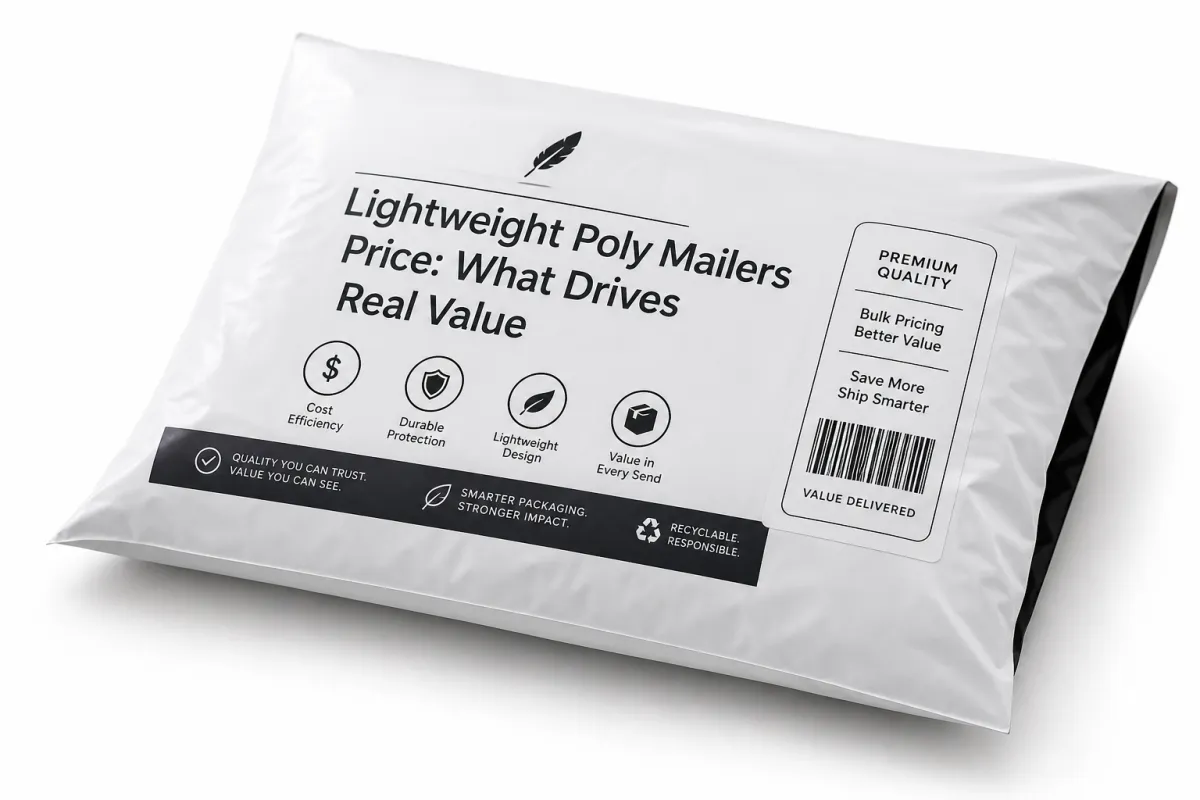
The lowest quote is often the loudest one, and that makes it dangerously persuasive. A low lightweight poly mailers price can hide thin film, weak seals, or sizing that creates wasted space and nudges shipping costs higher than expected. If a mailer arrives with poor side seals or an adhesive strip that peels under pressure, the buyer pays twice: once for the bag and again for the failure.
That is why the complete shipping outcome matters more than the unit line. A sound lightweight poly mailers price supports fast packing, keeps the product secure, and avoids unnecessary overpacking. If your team has to double-bag orders, fight with the closure, or stop the line to sort out damaged units, the invoice is only telling part of the story.
Film gauge is one of the clearest examples. A 1.5 mil mailer can be enough for light apparel or flat textile items. Move up to 2.0 mil or 2.5 mil, and the bag usually handles heavier garments, mixed-item shipments, and rougher routes with less trouble. That bump can push the lightweight poly mailers price up a little, yet it often reduces re-shipments and customer complaints enough to justify the difference.
Size fit matters just as much. A bag that is too large wastes film and can make the shipment look careless. A bag that is too small slows packing and risks split seams. The right fit keeps the line moving and gives the package a finished look, which sounds minor until you compare the cost of a neat order with the cost of a repack.
A mailer that saves a fraction of a cent but creates rework is not a bargain. It is a small problem with a polite invoice.
From the buyer side, the better comparison is landed cost per successful shipment. That includes the lightweight poly mailers price, freight, labor, defect rate, and the number of orders that need to be rebuilt before they leave the dock. If a supplier trims damage and shortens packing time, the unit price does not need to be the absolute lowest to deliver the best result.
For steady product lines, the strongest value usually comes from matching the mailer to the item instead of guessing. Lightweight tees do not need the same film spec as heavy hoodies. Small changes in gauge, closure type, and seal width can move the lightweight poly mailers price less than buyers fear, while moving performance a lot. That imbalance is where the savings usually live.
Product Details That Change the Quote
No two mailers are priced exactly the same, and the differences show up quickly once the spec is real. The main drivers behind lightweight poly mailers price are film grade, layer count, seal design, and whether the closure uses a pressure-sensitive strip, a double adhesive strip, or a tamper-evident option. Each one changes material use or production time, which changes cost.
Standard Opaque Poly Mailers usually sit at the lower end of the range because they are simple to run and easy to keep in stock. Recycled-content mailers can cost a bit more if the resin mix is less consistent, though many buyers accept that tradeoff for sustainability goals and the story they want to tell customers. Custom Printed Mailers add setup, artwork handling, and press time, so the lightweight poly mailers price rises, though not always sharply once the order gets large enough.
Size range pushes the quote too. A mailer for small accessories uses less film than a large apparel bag, and that difference becomes obvious at volume. Bigger formats also influence freight efficiency because heavier cartons and wider pallets can raise shipping cost. When the quote arrives, it should reflect the actual size, not a generic estimate that was copied from a template.
Practical add-ons deserve a close look. Tear strips improve the end customer's opening experience. Extra adhesive helps when parcels face humidity or longer transit windows. Reinforced seams matter when the product has corners, zippers, or mixed contents that press hard against the film. These features do not always send the lightweight poly mailers price soaring, but they do move the bag to a different place on the value scale.
Some features sound expensive and barely shift the quote. A slight change in tint, a minor adjustment in print placement, or a basic logo repeat usually costs less than buyers expect. Full-bleed graphics, metallic ink, and special coatings are a different story. Those choices can push the lightweight poly mailers price up quickly because production becomes more complex and more sensitive to waste.
The useful skill is separating functional upgrades from cosmetic ones. If a feature does not improve seal strength, protection, brand visibility, or packing speed, it may just be decoration. Decoration is fine as long as the buyer knows it is decoration. That is how the lightweight poly mailers price stays honest.
| Option | Typical Spec | MOQ | Typical Price Range | Best Fit |
|---|---|---|---|---|
| Stock opaque mailer | 1.5-2.0 mil, self-seal closure | Low to moderate | $0.08-$0.16 per unit | Simple apparel and soft goods |
| Recycled-content mailer | 2.0 mil, opaque or gray tint | Moderate | $0.10-$0.19 per unit | Brands with sustainability targets |
| Custom printed mailer | 2.0-2.5 mil, one to full color print | Higher | $0.14-$0.28 per unit | Branded ecommerce shipping |
| Reinforced premium mailer | 2.5 mil+, tear strip, stronger seam | Higher | $0.18-$0.35 per unit | Heavier garments and rough transit |
These ranges are broad working figures for planning, not a promise. Resin cost, freight, order size, print coverage, and seasonal demand can move them up or down.
If you want a fast benchmark, start with the item you ship most often. A basic tee, a folded hoodie, and a small accessory box each need a different answer. That is the part people miss when they compare lightweight poly mailers price without matching the mailer construction to the product.
Specifications Buyers Should Check Before Ordering
Before anyone signs off on a quote, the spec sheet needs to be clear enough that two suppliers are comparing the same thing. The most useful checks are thickness, finished dimensions, tolerance, adhesive performance, and puncture resistance. If those five items are vague, the lightweight poly mailers price comparison is already skewed.
Thickness should be measured in mils or microns, and the buyer should ask whether the figure is nominal or actual. A mailer that claims 2.0 mil on paper but varies wildly in production is not the same as a controlled run with tight tolerance. For shipping apparel, that difference can matter more than a flashy print. A tiny shift in spec may change the lightweight poly mailers price by less than a penny, but it can change failure rates in a way that shows up fast.
Dimensions need the same scrutiny. If the bag is too large, shipping efficiency drops and the pack looks sloppy. If the bag is too short, the adhesive area may not close properly once the product is inserted. I prefer to see buyers test the actual folded product, not just the flat size on the quote. That is how the lightweight poly mailers price stays tied to how the bag will really be used.
Adhesive performance is another place where bargain options can disappoint. Pressure-sensitive adhesive should hold cleanly, not curl open after a few minutes in a warm packing room. Some buyers ask for stronger adhesive because they ship through humid regions or want better tamper resistance. That upgrade can raise the lightweight poly mailers price a bit, but weak adhesive is expensive in the wrong direction.
Puncture resistance matters if the shipment includes zippers, pins, hard corners, or boxed items with sharp edges. A mailer that is fine for soft tees may not survive a bundle with accessories or hardware inside. Sample testing should use the actual product, not a dummy load. A good supplier can show whether the lightweight poly mailers price matches the protection level you actually need.
Print choices deserve a careful look too. One-color logos are usually simpler and cheaper than full-color artwork, especially if the artwork repeats on one face only. Heavier ink coverage can increase setup time and push production cost upward. It is not the logo itself that changes the lightweight poly mailers price; it is the difficulty of putting that logo on film cleanly and consistently.
Stock sizes are usually faster and easier to quote. Custom dimensions take more planning, more approval, and sometimes more lead time because the run has to be set up around exact measurements. That can make the lightweight poly mailers price look less attractive at first, but the value may improve if the custom size cuts waste or packs better on the line.
A proper sample review should include a short checklist:
- Measure the filled product, not just the empty item.
- Check seal strength after the bag has been handled.
- Look for print clarity at the corners and edges.
- Confirm the adhesive closes without forcing the film.
- Test the bag against the product's sharpest point.
For buyers who care about transport stress, ISTA test guidance is useful because it gives a more disciplined way to think about shipping abuse and package failure. Their methods are a better filter than guesswork: ISTA packaging testing resources. For broader material and waste reduction context, the EPA also has helpful information on packaging and solid waste: EPA packaging and waste resources.
Once those details are clear, the lightweight poly mailers price becomes much easier to compare because the apples-to-apples part is finally real. The better question is no longer which quote looks lowest on the page. It is which spec gives the best result for the product that is actually being shipped.
Lightweight Poly Mailers Price, MOQ, and Bulk Discounts
MOQ changes the math quickly. Smaller runs usually carry a higher lightweight poly mailers price because setup, film sourcing, and labor get spread across fewer units. That is not a trick. It is the normal shape of production when fixed cost has not been diluted by volume.
At low quantities, a buyer may see stock mailers in the $0.08-$0.16 range, while custom printed bags can sit closer to $0.14-$0.28 depending on size, color count, and artwork coverage. At mid volumes, the unit price often starts to ease as setup charges spread out. By the time you reach larger bulk runs, the lightweight poly mailers price can become meaningfully sharper, especially if the spec is simple and the artwork is clean.
The cheapest quote is not always the best spend. A distributor with a higher margin can still be the better option if they offer a lower MOQ and faster delivery, especially for a first launch or seasonal product. A direct factory quote may come in lower but require a larger minimum and a longer approval cycle. In that case, the better lightweight poly mailers price depends on cash flow, storage space, and how much inventory risk you can tolerate.
Print complexity can move the line more than some buyers expect. One-color repeat prints are usually easier to run than multi-color art with tight registration. Full-bleed graphics, metallic effects, and custom finishes raise setup costs. In practical terms, a simple logo can keep the lightweight poly mailers price manageable, while a design that tries to do everything at once can eat the savings you thought you had.
There is also a gap between what the buyer sees and what the factory quotes. Direct factory pricing may look lower, but it can include separate charges for tooling, proofing, packaging, and freight consolidation. Distributor pricing may bundle more into one line but leave less room for negotiation. A useful comparison should show all-in cost so the lightweight poly mailers price is not hiding inside separate line items.
For forecasting, I like breaking the order into three simple tiers:
- Trial or launch volume: enough to test fit, print, and customer response.
- Repeat reorder volume: enough to lock in a more efficient unit rate.
- Annual use volume: enough to negotiate on consistency and freight terms.
That structure shows where savings begin. A small jump in quantity can drop the lightweight poly mailers price more than a minor spec change, especially if the order crosses a production threshold. If you can move from a test order to a repeatable purchase plan, the cost curve usually improves.
Bulk discounts also depend on whether the supplier is holding raw material inventory, whether the film is standard, and whether the order needs a special size. Standard-sized poly mailers usually benefit the most from volume. Custom dimensions can still improve with scale, but the drop is not always as dramatic. That is why tiered quotes are smarter than a single number and a guess.
For buyers, the question should not be "What is the cheapest unit?" The better question is "At what volume does the lightweight poly mailers price become efficient enough that margin stays healthy and packaging stays consistent?" That question leads to cleaner sourcing decisions.
If you are comparing broader packaging choices, our Custom Packaging Products page gives a useful cross-category view. If you already know mailers are the right format, our Custom Poly Mailers page makes it easier to compare size and print options against your own SKU mix.
Process and Timeline From Quote to Delivery
A clean order starts with clean information. If the size, thickness, print area, quantity, and closure style are unclear, the quote slows down and the revisions multiply. That is how the lightweight poly mailers price gets messy before production has even started.
The usual flow is straightforward: spec confirmation, artwork review, sample or proof approval, production, quality check, and shipment. Stock mailers move faster because the film and dimensions already exist. Custom printed orders take longer because artwork and production settings need approval. That extra time is worth it if the final lightweight poly mailers price reflects a better fit for the product and the brand.
Artwork approval is one of the biggest timeline variables. If the files arrive in the right format, with proper bleed and clear logo placement, approval moves quickly. If the design needs to be rebuilt, the order slows down. That delay does not only affect the calendar. It can also affect the quoted lightweight poly mailers price if the project has to be re-scheduled or re-quoted.
Sampling is usually worth the time when the order includes custom branding or a new bag size. A sample lets you check seal quality, print tone, and how the product actually fits. A stock sample may be enough for a repeat item that has already been tested. If the bag is new to your operation, one extra day on approval can save a long list of headaches, and it keeps the lightweight poly mailers price tied to something measurable instead of hopeful thinking.
For standard runs, production windows are often short enough to keep projects moving without drama. Custom runs take longer because film, printing, curing, and packing all happen in sequence. The exact window depends on design and volume, but buyers should expect the lightweight poly mailers price to reflect that reality rather than assume every order can move like a stock item.
Freight is the final piece many people underestimate. Air shipment is faster and more expensive. Ocean or ground freight is cheaper and slower. Destination matters too. A good supplier should be able to quote production separately from shipping so the buyer can see where time and money are actually going. That is more honest than giving one blended number and calling it simple.
Quality control should happen before cartons leave the facility. That means checking seals, count accuracy, print alignment, and size consistency. If the supplier can show that step clearly, the buyer has a better chance of a stable reorder. Consistency matters because the best lightweight poly mailers price in the world does not help if every shipment behaves differently on the packing line.
One practical tip: if a launch date is tight, ask for a baseline spec and a fallback spec at the same time. If one version is delayed by print complexity or material availability, the alternate option is already waiting. The lightweight poly mailers price may shift slightly, but the order keeps moving instead of stalling on one detail.
Why Choose Us for Lightweight Poly Mailers
Buyers do not need more marketing language. They need clear specs, honest lead times, and a quote that does not hide the real cost behind vague language. That is the standard we work from. A good lightweight poly mailers price should come with plain language, visible tradeoffs, and enough detail to make a confident order.
Consistency matters more than noise. If the film gauge drifts, the seal changes, or the print color is off from one run to the next, the buyer loses time sorting problems that should never have existed. Careful quality control is what keeps the lightweight poly mailers price from turning into a false bargain.
We also keep MOQ and lead time expectations clear. Some buyers need a stock solution right away. Others want custom printing and are willing to wait for a stronger brand presentation. Both are valid. The useful part is knowing which path you are on before money changes hands. That is how the lightweight poly mailers price stays useful instead of becoming a guessing game.
Support matters too, especially for first-time buyers or teams switching suppliers. A good packaging partner should explain why one film spec works better than another, what extra adhesive actually does, and where it makes sense to spend a little more. That kind of guidance can lower the real lightweight poly mailers price by keeping you from overbuying strength you do not need.
We also help buyers think about shipping damage in practical terms. If a garment is soft and low-risk, there is no reason to overspec the bag just to feel safe. If the shipment is heavier or rougher, a stronger seam may be worth the extra cost. That balance is the difference between a smart lightweight poly mailers price and a random number pulled from a catalog.
Most teams want three things: predictable product, fair pricing, and a supplier who answers the question directly. That is the lane we stay in. No theatrics. No fake urgency. Just packaging that does the job and a lightweight poly mailers price that makes sense for the order size and spec.
Next Steps to Lock In Your Order
If you are ready to quote, gather the basics first: bag size, film thickness, print area, quantity, and whether you need stock or custom. That alone makes the lightweight poly mailers price conversation cleaner because the supplier can compare the right spec without guessing.
Ask for two options if you can. One should be the baseline spec that gets the job done. The other should be a better-value version with a slightly different gauge, size, or print setup. Side-by-side quotes make the tradeoff obvious and keep the lightweight poly mailers price tied to function instead of assumptions.
If your order includes branding, approve a proof or sample before the full run. A few extra hours upfront is cheap insurance. It protects the print, the size fit, and the final appearance. It also helps the lightweight poly mailers price stay honest because there is no room for hidden mistakes.
Compare landed cost, not just unit cost. Freight, count accuracy, packing labor, and defect risk all belong in the same conversation. A lower invoice can still produce a worse result if the bags are too thin or the adhesive fails. That is why the right lightweight poly mailers price is the one that performs well after delivery, not the one that simply looks lean on the quote sheet.
Do a test run before scaling if the product is new or the route is rough. Small trials catch problems early and show whether the spec needs a tweak. That is far cheaper than discovering weak seams after a large reorder lands. A controlled start usually gives the best lightweight poly mailers price outcome over time because it prevents waste, returns, and rushed replacements.
If you want the short version, it is this: confirm the spec, compare tiers, and place the order that fits your product instead of chasing the lowest number in the room. The right lightweight poly mailers price is the one That Holds Up in production, shipping, and customer use. That is the real test.
Frequently Asked Questions
What affects lightweight poly mailers price the most?
Thickness, size, and material grade are usually the biggest drivers. Custom printing, special finishes, and higher adhesion standards also add cost. Lower MOQ almost always pushes the unit price up, because setup cost has fewer pieces to spread across.
Are lightweight poly mailers cheaper than padded mailers?
Yes, usually, because they use less material and ship in less space. They work best for non-fragile goods that do not need cushioning. If the item needs protection, a cheap mailer can become expensive fast.
What MOQ should I expect for lightweight poly mailers?
Stock items can be available in smaller quantities, while custom runs usually need a larger minimum. MOQ depends on size, print method, and whether tooling or setup is required. Ask for tiered quotes so you can see the cost at different volume levels.
How long does production usually take?
Stock orders move faster than custom printed orders. Artwork approval and sample sign-off are the main timeline variables. Freight choice can add more time than production itself, especially if the order has to cross a long distance by ocean or ground.
Can I get a better lightweight poly mailers price with custom printing?
Yes, if you order enough volume to spread setup costs across more units. Simple artwork and fewer print colors usually keep pricing sharper. A good supplier will show the break-even point instead of hiding it, and that is usually the clearest way to improve lightweight poly mailers price without giving up presentation.