Buyer Fit Snapshot
| Best fit | To Holiday Packaging Budget Planning That Holds Up projects where brand print, material claims, artwork control, MOQ, and repeat-order consistency need to be specified before quoting. |
|---|---|
| Quote inputs | Share finished size, material target, print colors, finish, packing count, annual reorder estimate, ship-to region, and any compliance wording. |
| Proofing check | Approve dieline scale, logo placement, barcode or warning zones, color tolerance, closure strength, and carton packing before bulk production. |
| Main risk | Vague material claims, crowded artwork, missing packing details, or unclear freight terms can make a low unit price expensive after revisions. |
Fast answer: To Holiday Packaging Budget Planning That Holds Up: Material, Print, Proofing, and Reorder Risk should be specified like a repeatable production item. The safest quote records material, print method, finish, artwork proof, packing count, and reorder notes in one written spec.
Production checks before approval
Compare the actual filled-product size with the drawing, then confirm tolerance on folds, seals, hang holes, label areas, and retail display edges. Reserve space for logos, QR codes, warning copy, and material claims before decorative graphics fill the panel.
Quote comparison points
Review material grade, print process, finish, sampling route, tooling charges, carton quantity, and freight assumptions side by side. A quote is only useful when the supplier can repeat the same color, closure quality, and packing count on the next order.
Guide to Holiday Packaging Budget Planning That Holds Up
A guide to holiday packaging budget planning should begin with a blunt reality: the box is rarely the thing that blows the budget. The surprise usually shows up later, after someone says, “We can probably handle that later.” That little shrug is how brands end up paying for rush freight, extra inserts, reprints, and overnight approvals that chew through margin faster than a post-holiday return wave.
Holiday runs do not behave like normal production runs. They act more like a supply shock. One weak assumption in one department becomes a cost problem somewhere else, and fast. A practical guide to holiday packaging budget planning is less about decoration and more about disciplined forecasting, calendar control, and risk management from day one.
That is why a guide to holiday packaging budget planning cannot stop at the carton quote. The real picture includes printing, coatings, inserts, assembly, storage, freight, damage allowance, and a buffer for the one thing that always goes sideways. If you are comparing options on Custom Packaging Products, treat the quote as a starting point, not the answer. The real budget lives in total landed cost and cost-to-serve, not the prettiest line item.
Holiday packaging gets expensive for a reason. Production queues tighten. Carriers add surcharges. Suppliers hit minimums. Approvals wait on someone who is traveling, buried, or mysteriously unreachable. A delay in March is annoying. A delay in November can mean expensive air freight, rushed assembly, or a structural compromise that looks fine in a conference room and terrible in a customer photo. That is the uncomfortable arithmetic behind guide to holiday packaging budget planning.
"The cheapest quote is usually the one that forgot freight, inserts, and the second proof."
What Is a Guide to Holiday Packaging Budget Planning and Why Does It Matter?
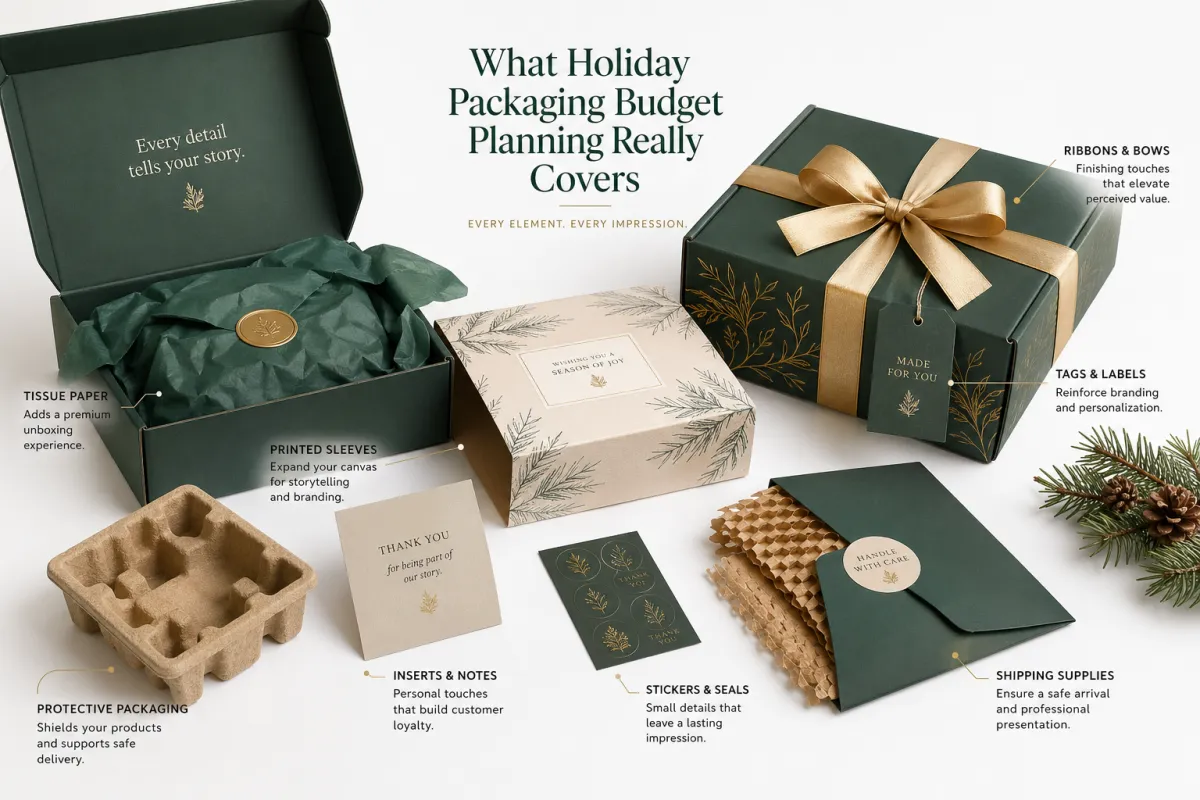
In a lot of teams, holiday packaging gets treated like a decorative add-on. That is the first mistake. A real guide to holiday packaging budget planning includes the printed carton or mailer, yes, but also the pieces nobody wants to discuss during launch planning. Printing. Coatings. Finishes. Inserts. Assembly labor. Warehousing. Freight. Replacement stock. Even the boring parts matter because they are the ones that keep the order moving when season volume spikes.
Think about the path a package takes. It starts as a design file, becomes a dieline, gets sampled, approved, produced, packed, shipped, received, kitted, and finally handed to a customer or a fulfillment team. Every step carries a cost. If the box needs a custom insert, the budget shifts. If the artwork uses metallic foil, the budget shifts again. If the packaging needs hand assembly, the budget shifts a third time. That is why a guide to holiday packaging budget planning works best when it is built from the bottom up instead of guessed from a single unit price.
The season changes the math because demand spikes can be abrupt. If your brand sells gifts, sets, or limited-edition bundles, volume can jump 2x or 3x in a short window. That affects more than quantity. It affects supplier capacity, transit time, and how much room you have for mistakes. A delayed proof in November costs more than a delayed proof in May because every week closer to launch carries a price tag. That is the part people underestimate, and it keeps biting them.
From a buyer’s point of view, the cheapest-looking quote is often the most annoying invoice. It may exclude plate charges, dieline revisions, storage fees, or freight to multiple receiving points. If the package also needs to feel premium, you are balancing branded packaging, durability, and speed at the same time. The rule I have seen hold up in practice is simple: if an input is required to ship successfully, it belongs in the budget before approval, not after.
If you want a cleaner starting point, compare the packaging structure to the order type. Retail packaging for shelf display has different requirements than e-commerce mailers. Custom Printed Boxes for direct-to-consumer shipments may need stronger crush resistance. Gift packaging may need a sharper presentation layer and a cleaner unboxing sequence. Once those needs are clear, guide to holiday packaging budget planning becomes easier to defend internally because each dollar ties to a business objective instead of a style preference.
One practical point: plan for a damage allowance. Even a well-made package has a real-world failure rate. In parcel networks, rough handling happens. If your team sells fragile goods, a few extra units for replacement stock are not waste. They are insurance against margin erosion and reputational risk. A strong guide to holiday packaging budget planning does not pretend every unit survives ideal handling. It budgets for reality, which is kinda the whole job.
When we talk about the right metric, one useful correction matters: unit economics should include failure and rework assumptions. If you skip that logic, the budget can look clean at 12 weeks and red by week two before launch.
Holiday Packaging Budget Planning: What Drives Cost
The biggest cost drivers in a guide to holiday packaging budget planning usually fall into five buckets: substrate, structure, decoration, quantity, and fulfillment. Substrate is the material itself, like SBS board, corrugated, kraft, or rigid chipboard. Structure is the box style, such as a tuck-end carton, mailer, sleeve, drawer box, or folding carton with a custom insert. Decoration includes print method, coatings, and finishes. Quantity affects setup economics. Fulfillment includes assembly, storage, kitting, and freight.
Material choice matters more than most people expect. A simple kraft mailer can be efficient for a lightweight item, while a 350gsm C1S artboard carton may be better for a retail presentation. Corrugated board adds protection, but it also adds bulk and shipping weight. Rigid packaging looks premium, but it costs more to produce and often needs more labor to assemble. If you are building a guide to holiday packaging budget planning for internal approval, these are the trade-offs that deserve actual numbers, not adjectives.
Print method changes the math too. Digital print is useful for lower volumes and versioning, while offset becomes more efficient as quantity rises. Flexographic print can work well for certain corrugated runs, especially when you need repeatability and clean large-area graphics. Then there are coatings and finishes: aqueous coating, matte or gloss lamination, soft-touch lamination, embossing, debossing, spot UV, hot foil, and specialty inks. One finish is usually manageable. Four finishes can turn a straightforward run into a budget headache. That pattern repeats often enough to be predictable.
Quantity is where a lot of brands lose perspective. At low volume, setup fees dominate. At higher volume, unit pricing improves because the setup cost gets spread out. That sounds obvious until someone tries to order 500 boxes and expects a 5,000-unit price. It does not work that way. A short run may also limit your choices on decoration or custom structural tweaks. Holiday packaging budget planning should define the sweet spot between quantity, per-unit cost, and inventory risk, because overordering is its own kind of waste.
Hidden costs sneak in through revisions and production extras. Dieline changes cost time. Proof rounds cost time. Color matching can cost money if you need a specific brand tone across different substrates. Plates and dies can be one-time charges, but they still belong in the budget model. Kitting labor matters if the package ships with tissue, cards, stickers, or inserts. Warehousing matters if stock arrives early and needs to be stored until launch. Freight matters because holiday surcharges and peak season capacity can move landed cost materially.
The cleanest way to compare options is usually to build a simple per-unit target first, then ask whether the landed cost can realistically hit it. If the answer is no, the design has to change or the margin does. Below is a practical comparison of common formats.
| Packaging Option | Typical Unit Cost Range | Setup / One-Time Costs | Best For | Watch-Outs |
|---|---|---|---|---|
| Stock mailer + label | $0.35-$0.85 | Low | Fast launches, tight budgets, simple product packaging | Limited branding, less premium unboxing, weaker package branding |
| Custom printed corrugated mailer | $0.85-$1.60 | Moderate | E-commerce, moderate protection, branded packaging | Print coverage and freight can raise landed cost quickly |
| Folding carton with insert | $1.10-$2.40 | Moderate to higher | Retail packaging, gift sets, small consumer goods | Insert labor and structural fit need careful planning |
| Rigid gift box | $2.50-$6.00+ | Higher | Premium gift packaging, luxury product packaging, limited editions | Assembly, storage, and freight can become the real budget driver |
If the package needs to survive parcel networks, transit testing is not optional fluff. A standard like ISTA transit testing gives you a realistic view of whether the structure is strong enough before you commit to full production. That kind of test can save a lot of money compared with replacement inventory and frustrated customers. A guide to holiday packaging budget planning does not confuse optimism with durability.
Freight deserves its own line because holiday shipping is not calm shipping. Peak season rates, fuel surcharges, residential delivery fees, liftgate needs, and split shipments can all show up at once. If you are importing components, customs and lead times need to be part of the model too. A box that looks cheap at the factory gate may not be cheap after it crosses a warehouse dock. That is the core problem a practical guide to holiday packaging budget planning solves.
For brands using recycled paper or certified sources, material choice also intersects with claims and compliance. If sustainability matters to your retail packaging story, look for FSC-certified paper and board instead of vague green language. Buyers and retailers are getting less patient with weak claims, and the documentation matters as much as the message.
Key Factors That Shape Your Holiday Packaging Budget
The first factor is order forecast. If you do not know how many units you need by SKU, everything else becomes shaky. A packaging budget that assumes one flat volume for every product is usually too optimistic. In practice, holiday campaigns often create uneven demand: one gift set spikes, another plateaus, and a third rises after a retailer asks for it at the last minute. A stronger guide to holiday packaging budget planning starts with separate forecasts for each SKU or pack-out because that is where unit economics become real.
Next is margin. A box can look affordable and still be wrong for the business. If an order averages $18 and the packaging eats $2.80 before freight, that is a different conversation than a $120 gift set where the same box cost is manageable. Packaging should protect margin, not casually consume it. I like to think of it as a ceiling, not a wish list. Set the maximum packaging cost per order, then design toward that number.
Product type changes the budget too. Fragile goods need protection, which means more structure, more inserts, and sometimes more testing. Premium gifts need presentation, which means attention to unboxing flow, print quality, and finishing. Fast-moving e-commerce items need durability and speed. A beauty kit and a ceramic mug are not budget cousins just because they are both “holiday packaging.” The structure, labor, and failure risk are different. That distinction sits at the center of a good guide to holiday packaging budget planning.
Brand choices also affect spend. Full-coverage printing costs more than a restrained design. Foil stamping, embossing, and spot UV can elevate package branding, but they also add setup and make revisions more expensive. Sustainability claims can add cost too, especially if you want a specific board grade, certified stock, or recycled content documentation. None of that is bad. It just belongs in the guide to holiday packaging budget planning conversation from the start.
Operational capacity matters more than many marketing teams realize. If the warehouse packs by hand, the packaging has to be easy to assemble. If the team is short on labor during peak season, a more complex structure becomes a hidden expense. If the pack line is automated, the dieline and tolerances need to fit the machine. If your internal approval workflow is slow, the budget needs more slack because delays are expensive. Even the best guide to holiday packaging budget planning falls apart if the team cannot move on time.
Supplier factors are just as important. Minimum order quantities can force a larger buy than expected. Seasonal capacity can mean a supplier says yes to your quote but cannot realistically fit your run into the schedule without a premium. Lead-time reliability matters because a vendor with an attractive price and shaky delivery is not actually cheap. Ask whether they can handle repeat holiday reorders. You may need a second run if sales spike or a retailer expands the assortment.
There is also a difference between brand promise and budget reality. If your product packaging says premium, the packaging should support that story. If your brand is practical, then the system should be efficient, strong, and clean rather than overloaded with decoration. Package branding should align with the sales channel. A direct-to-consumer bundle can tolerate a different look than a shelf-ready retail box. That alignment helps a guide to holiday packaging budget planning avoid spending on signals that do not move conversion or retention.
When teams run the numbers, they often discover a useful connection: the most expensive-looking option is not always the worst, and the cheapest-looking option is not always the best. The answer is a balanced packaging solution where the procurement schedule, production complexity, and fulfillment model are all in sync.
Holiday Packaging Budget Planning: Step-by-Step Timeline
A budget is only as good as the timeline behind it. In guide to holiday packaging budget planning, timing is cost control. Miss the date for sample approval and the entire schedule compresses. Compression is expensive. It usually shows up as rush charges, expensive freight, fewer proof rounds, or a design compromise that should have been caught earlier. A good timeline protects both quality and margin.
Start with forecast volume. Break the forecast by SKU, then add a realistic buffer for promotions, gift bundles, and late-season orders. A 5% buffer is light if your holiday campaign is aggressive; 10% to 15% is often safer for fast-moving seasonal programs. If your product is fragile or the packaging is custom printed, a few extra units for replacement stock can be worth more than a slight increase in inventory. That is a practical part of guide to holiday packaging budget planning, not a luxury.
- Concept and brief - define the product, size, target cost, and brand role of the package.
- Quote stage - compare structural options, print methods, finish choices, and MOQs.
- Dieline and artwork - build the structure, check fit, and confirm artwork dimensions.
- Sample and proof - verify color, structure, and assembly before mass production.
- Final approval - lock the files so the job can move without rework.
- Production and finishing - print, cut, coat, fold, glue, and inspect.
- Freight and receiving - move the goods into the warehouse and confirm counts.
- Assembly and launch prep - kit, store, or preload the packaging for season use.
For a simple stock-and-print project, the timeline may be shorter, especially if the artwork is clean and the fit is already known. For fully custom packaging, the work should begin much earlier. In practical terms, simple projects may need only a few weeks after proof approval, while custom holiday runs often need substantially more time once samples, revisions, and shipping are included. If the packaging includes inserts or specialty finishing, plan even earlier. That is the less glamorous side of guide to holiday packaging budget planning, but it is the side that prevents panic in December.
One simple way to keep the schedule honest is to assign one owner to every milestone. Who approves the dieline? Who signs off on the proof? Who confirms freight timing? Who receives the shipment? If nobody owns the step, the budget drifts. A late sign-off can cost more than a slightly better box design ever saves. That is where many holiday packaging budgets go sideways.
If the order includes custom printed boxes for multiple SKUs, create a deadline map for each version. One SKU may be ready early while another waits on a final product image or compliance note. The packaging does not need to wait for unrelated assets if you plan the process well. Good guide to holiday packaging budget planning is less about heroic speed and more about removing avoidable stops.
There is also a carrying-cost angle. If packaging arrives too early, it takes warehouse space and may need protection from dust, moisture, or damage. If it arrives too late, you pay for speed and stress. The sweet spot is narrow. A good calendar keeps packaging close enough to launch to avoid storage pain, but not so close that one carrier delay ruins the season. That balance is why I tell buyers to build the timeline backward from launch, not forward from the quote.
Another hard lesson from seasonal programs: procurement is cumulative. A missed lead time in the middle of the cycle does not just delay one item, it compounds across inventory planning, staffing, and media timing. A guide to holiday packaging budget planning that ignores this compounding effect will rarely hold.
Common Mistakes That Blow the Holiday Budget
The first mistake is quoting only the unit price. It happens constantly. Someone sees a box at $0.74 and thinks the budget is under control. Then comes the insert, the ink upgrade, the freight, the assembly charge, and the replacement stock. By the time the real invoice lands, the “cheap” option has become the expensive one. That is why guide to holiday packaging budget planning has to start with landed cost and end with landed cost.
Overdesign is another budget killer. Too many finishes. Too many color changes. Too many SKU variants. Too many approval loops. It is easy to make packaging prettier by adding things. It is harder to make it better by removing things. A single strong finish often does more for the customer experience than three random embellishments. Packaging design should support the product, not audition for a trophy case.
Late ordering is the obvious mistake, but still worth saying because people keep doing it. Holiday calendars fill up early. The earlier you start, the more control you have over price, proofing, and freight choices. The later you start, the more you pay for speed. Rush jobs can be saved, sure, but they usually cost more than the original budget. A disciplined guide to holiday packaging budget planning should treat timing as a financial decision, not an administrative afterthought.
Fit errors are another classic. If the package looks attractive but does not fit the product properly, it wastes money in three ways: damaged product, rework, and customer dissatisfaction. Too much empty space can also make the packaging feel sloppy, especially in retail packaging or gifting. A custom insert is sometimes the smartest spend on the page because it reduces damage and improves presentation at the same time. That is money well used.
Then there is the contingency mistake. A lot of teams budget for the base case and hope the season behaves. It rarely does. Freight can swing. A proof can need correction. A carton can need a reprint. One line of extra inventory can cover the gap, but only if you planned for it. I like to keep a contingency buffer in every guide to holiday packaging budget planning because it prevents one small issue from becoming a financial story everyone regrets later. If a guide does not include a cushion, it is missing the part that keeps the season calm.
Another mistake is ignoring internal labor. Assembly takes time. Kitting takes time. Inventory checks take time. If the team has to fold, label, or assemble custom packaging by hand, the labor can exceed the box cost faster than people expect. That is especially true for gift packaging and premium branded packaging with multiple components. A quote that ignores labor is not a full quote. It is a teaser.
Finally, some brands chase every premium signal at once and end up with a package that looks expensive but does not sell better. If the customer never notices three of five upgrades, why pay for all three? It is better to choose one memorable element and keep the rest practical. That approach usually protects margin and still delivers a sharp unboxing experience.
Expert Tips to Stretch the Budget Without Looking Cheap
If the budget is tight, the answer is not always “buy less.” Often the answer is “choose better.” The easiest savings in guide to holiday packaging budget planning usually come from standardizing sizes, reducing the number of SKUs, and reusing a dieline instead of inventing a new one for every product. Every custom change adds time and complexity. Simple systems are boring, but boring is profitable.
Spend where the customer actually notices. Structure matters. Print clarity matters. Protection matters. A box that opens poorly or arrives damaged hurts the brand more than a modest design. On the other hand, some expensive extras do very little. If a finish is only there because someone liked it in a sample room, that is not strategy. That is decoration with a receipt attached.
One strong finish usually beats three weak ones. Matte lamination with a clean logo can look far more polished than a box with foil, embossing, and spot UV all fighting for attention. Controlled contrast often reads as more premium than visual noise. The same applies to color. A restrained palette can feel more thoughtful than full-coverage print with no visual hierarchy. This is where packaging design starts acting like package branding instead of just surface treatment.
Negotiate around repeat orders if you can. Suppliers often price more favorably when they can see a season rather than a one-off emergency. If you know a holiday item will restock or a gift set will repeat in waves, say so. That gives the vendor a better forecast and may improve pricing, scheduling, or flexibility. A useful guide to holiday packaging budget planning should treat forecasting as a bargaining tool, not just a planning tool.
Use the right package for the channel. A retail packaging program needs different visual cues than a direct-to-consumer mailer. A rigid box might be too much for a fast-moving item, while a corrugated mailer might be enough if the product is light and the brand story is in the graphics. If you need a starting point, compare the options on Custom Packaging Products and think in terms of product fit, not just appearance. The cheapest package is not always the best value, and the prettiest one is not always the best fit.
It can also help to test one premium element and keep the rest simple. For example, use a custom insert and a clean printed exterior, but skip foil. Or use a strong print story and a standard closure instead of custom hardware. That kind of controlled contrast usually feels intentional. It also keeps the quote from getting ridiculous. Experienced buyers keep saying the same thing for a reason: fewer variables mean fewer surprises.
For brands concerned about sustainability and retail presentation, look for materials that support the message without forcing a costly redesign. Recycled board, FSC-certified stock, and smarter material choices can do a lot of the work. A plain but well-made box can be better than an overdecorated one with shaky environmental claims. The message should be credible. That matters more than a shiny label.
What To Do Next Before You Place the Order
Before you place the order, turn the plan into a checklist. Forecast volume. Set a per-unit ceiling. Collect at least two or three quotes. Compare landed cost, not sticker price. Confirm the number of proof rounds included. Confirm freight assumptions. Confirm who owns approval at each stage. That is the practical end of guide to holiday packaging budget planning, and it keeps the decision from becoming a guess.
Then pressure-test the budget with three scenarios: ideal, realistic, and worst-case. Ideal is what happens if every approval is fast and freight behaves. Realistic is what usually happens. Worst-case is what happens if a proof needs revision, a carrier adds a surcharge, or the launch date moves up. If the package only works in the ideal scenario, the budget is too thin. A useful guide to holiday packaging budget planning should survive a delay, not just celebrate success.
It also helps to write down the timeline in plain language. Sample approval by this date. Final art by that date. Production start on this date. Warehouse receipt by this date. Kitting by this date. If anyone can look at the plan and find the weak link in five seconds, you have a better chance of fixing it before it costs money. That kind of clarity is underrated, probably because it is less glamorous than talking about finishes.
For teams building holiday packaging from scratch, I would keep the process grounded in three questions: What is the customer supposed to feel? What does the product need physically? What can the budget truly support? If the answers do not align, the design is not ready. A strong guide to holiday packaging budget planning is really a guide to decision-making under pressure.
If you are still comparing options, start with the structure, then the print story, then the finishing. That order is usually safer than falling in love with a visual and trying to make the budget catch up later. The job is to protect margin and present the brand well. Both matter. Neither should be treated as an afterthought.
Use this guide to holiday packaging budget planning to lock specs, protect margin, and place the order while production capacity is still available. The cleanest version of the season is not the fanciest one. It is the one where the budget includes freight, labor, approvals, and a cushion for the inevitable hiccup, so no one is scrambling in December.
How do I start holiday packaging budget planning if I only know my sales forecast?
Work backward from the forecasted order count and set a maximum packaging cost per order. Use a margin-based ceiling so the packaging does not eat profit on lower-value items. Add a contingency buffer for waste, replacements, and holiday freight swings. If the forecast is still rough, build the budget in ranges instead of pretending the number is exact.
What is the biggest hidden cost in holiday packaging budgeting?
Freight, rush production, and assembly labor usually surprise brands more than the box itself. Revisions and last-minute artwork changes can add setup costs you did not plan for. Storage and fulfillment labor matter too if packaging arrives early or needs kitting before launch. The box price is rarely the whole story.
How far in advance should I plan holiday packaging orders?
Simple stock packaging may only need a short lead time, but Custom Holiday Packaging should be planned much earlier. Allow time for quotes, samples, revisions, production, and transit before launch. Build extra time if you need international freight, multiple SKUs, or a larger seasonal run. If the calendar is already tight, assume it will get tighter.
How can small brands reduce holiday packaging costs without hurting the unboxing experience?
Reduce the number of finishes, colors, and box sizes before you cut protection or structural quality. Reuse dielines and standard components wherever possible. Use one standout premium detail instead of layering several expensive extras. A cleaner package often feels more deliberate than an overworked one.
What should I compare when reviewing holiday packaging quotes?
Compare the full landed cost, not just the printed unit price. Check setup fees, minimum order quantities, sampling costs, freight, and any assembly charges. Ask whether the quote includes overages, replacements, and timeline assumptions. If those details are missing, the quote is not really comparable yet.