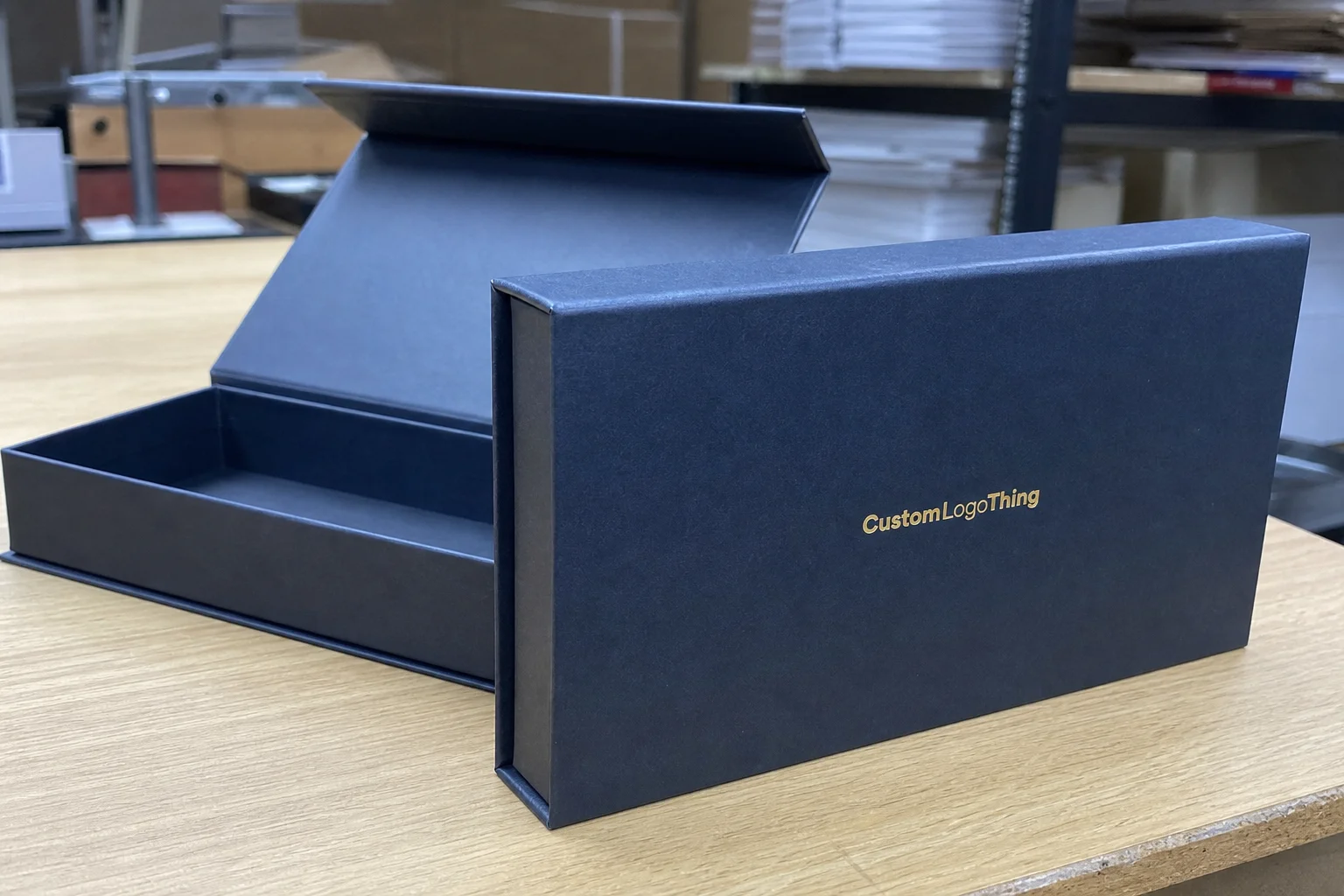
Buyer Fit Snapshot
| Best fit | Luxury Magnetic Closure Gift Boxes projects where brand print, material claims, artwork control, MOQ, and repeat-order consistency need to be specified before quoting. |
|---|---|
| Quote inputs | Share finished size, material target, print colors, finish, packing count, annual reorder estimate, ship-to region, and any compliance wording. |
| Proofing check | Approve dieline scale, logo placement, barcode or warning zones, color tolerance, closure strength, and carton packing before bulk production. |
| Main risk | Vague material claims, crowded artwork, missing packing details, or unclear freight terms can make a low unit price expensive after revisions. |
Fast answer: Luxury Magnetic Closure Gift Boxes: Design, Cost, and Fit should be specified like a repeatable production item. The safest quote records material, print method, finish, artwork proof, packing count, and reorder notes in one written spec.
Production checks before approval
Compare the actual filled-product size with the drawing, then confirm tolerance on folds, seals, hang holes, label areas, and retail display edges. Reserve space for logos, QR codes, warning copy, and material claims before decorative graphics fill the panel.
Quote comparison points
Review material grade, print process, finish, sampling route, tooling charges, carton quantity, and freight assumptions side by side. A quote is only useful when the supplier can repeat the same color, closure quality, and packing count on the next order.
Luxury Magnetic Closure gift boxes look simple from the outside. Then you stand on a factory floor in Shenzhen and watch 800 units get checked by hand, one lid at a time. I’ve done that. I’ve also watched a buyer in Dongguan stare at foil samples for 20 minutes, then finally smile only when the snap of the magnet felt right. That tiny click matters more than people want to admit. For premium launches, luxury magnetic closure gift boxes do a lot of selling before anyone even touches the product.
I’m Sarah Chen, and after 12 years in custom printing, I can tell you the closure feel is what people remember. Not always the print. Not always the emboss. The closure. A box can have soft-touch lamination and a clean foil logo, but if the lid flops open too easily or needs two hands to close, the whole thing feels off. That’s the dirty little secret of luxury magnetic closure gift boxes, whether they’re made in Shenzhen, Ningbo, or a specialty workshop in Suzhou.
For Custom Logo Things, the goal is straightforward: make the box look expensive, protect the product, and fit the budget without turning the job into a mess. That means talking about rigid board thickness, magnet placement, insert fit, freight, and whether your customer actually needs a book-style opening or a lid-style box. Sounds dry. It isn’t. It’s where good packaging earns its keep or gets blamed for a weak launch. A well-built sample can cost $85 to $180, but it can save a $12,000 reprint later.
Luxury Magnetic Closure Gift Boxes: Why They Feel So Premium
Luxury magnetic closure gift boxes feel premium because they slow people down. The lid resists just enough. Then the magnet catches with a crisp pull. That controlled open builds anticipation, and anticipation is half of luxury. In my experience, customers don’t say, “Wow, the board was 2 mm.” They say, “That box felt expensive.” Same box. Different language. Different buying decision.
These Magnetic Gift Boxes are usually built from rigid chipboard wrapped in printed or specialty paper, which puts them in a different league from folding cartons and tuck boxes. A folding carton depends on paperboard structure and tabs. A rigid box depends on thickness, wrap quality, and internal support. That extra structure gives luxury magnetic closure gift boxes the giftable feel brands want for cosmetics, jewelry, candles, influencer kits, watch sets, and corporate gifting. In most factory specs I review, the base board is 1.5 mm, 2 mm, or 3 mm rigid grayboard, wrapped with 128gsm art paper or 157gsm C2S art paper depending on the finish.
I remember a fragrance launch in Guangzhou where the product team had spent $18,000 on a campaign video and then nearly torched the whole thing with a box that opened too loosely. Gorgeous print. Good foil. Cheap feel. We adjusted the magnet strength and shifted the flap by 1.5 mm, and the box suddenly felt like a different product. That’s not marketing poetry. That’s manufacturing tolerance, and it’s the difference between a box people keep and a box people toss.
Another time, in our Shenzhen facility, I watched a worker reject a run because the corner wrap tension was a hair too loose. Not dramatic. Just enough to show a ripple under the paper. To most people, that looks minor. On luxury magnetic closure gift boxes, it reads as rushed. Luxury brands hate rushed. A 0.5 mm wrinkle can make a $3.20 box feel like a $0.30 mistake.
There’s also a psychological piece people miss. A hidden magnet suggests intentional engineering. A sturdy board suggests protection. A neat reveal suggests care. Put those together and the box starts carrying the brand story before the customer touches the product. That’s why luxury magnetic closure gift boxes show up so often in premium gifting and press kits from Seoul to New York. The box is doing the first 3 seconds of the pitch.
For brands that need a wider packaging system, I usually recommend comparing formats on the same shelf: rigid magnetic boxes, folding cartons, and custom inserts. If you want to browse broader options, our Custom Packaging Products page is a good starting point. One client in Los Angeles narrowed a launch from four formats to two after comparing samples side by side, and that saved them roughly $0.28 per unit across 8,000 pieces.
“If the closure feels sloppy, customers assume the brand is sloppy. They usually don’t separate packaging from product quality.” — something I’ve heard from more than one sales director after a bad first sample
How Luxury Magnetic Closure Gift Boxes Work
At a structural level, luxury magnetic closure gift boxes are straightforward. The shell is made from rigid chipboard, usually 1.5 mm, 2 mm, or 3 mm thick. That board is wrapped with printed art paper, coated paper, textured paper, or specialty stocks. Inside the lid and front flap area, small magnets are inserted and hidden under the wrap, then aligned so the closure pulls shut cleanly. In many production runs, the magnet is a 10 mm x 2 mm or 15 mm x 2 mm neodymium disc, though the exact spec depends on box size and product weight.
The motion matters. You open the lid, the hinge flexes, the magnet releases, and the box either stays open neatly or fights you like a stubborn lid on a cheap tin. Good luxury magnetic closure gift boxes feel balanced. The lid doesn’t crash open. It doesn’t snap shut like a mousetrap either. It lands in that sweet spot where the customer notices quality without thinking about it. If the opening force is off by even a few grams, the whole effect changes.
There are two common construction styles. The first is a book-style magnetic box, where the front panel opens like a book cover. The second is a lid-style magnetic box, where the lid lifts from the top or front edge. Book-style formats are popular for PR kits, jewelry sets, and product launches because they create a more theatrical reveal. Lid-style versions are easier for some product categories and can work well for cosmetics and gift sets. In our factory samples from Dongguan, book-style boxes typically need tighter hinge scoring, especially on 2 mm board.
Inside, the insert changes the whole experience. A paperboard insert is economical. EVA foam is more protective and more polished. Molded pulp is better for brands that want a lower-plastic story. Ribbon pulls can help lift a product out cleanly, while a die-cut tray can hold multiple items in fixed positions. The insert is not an accessory. It’s the thing that keeps luxury magnetic closure gift boxes from turning into a fancy empty shell with a rolling bottle inside. A 350gsm C1S artboard insert works for lighter items; a 2 mm EVA insert is better for glass bottles and heavier sets.
Quality control on these boxes is all about tiny checks that consumers never see. Magnet placement. Hinge consistency. Corner wrap tension. Closure test force. Creasing accuracy. I’ve stood beside inspectors in Shenzhen who opened and closed the same sample 30 times because if the magnet is off by even a few millimeters, the box may close on one side and gape on the other. That’s the sort of detail that decides whether luxury magnetic closure gift boxes feel custom or careless. For a 200 x 200 x 80 mm box, even a 1 mm shift can be visible.
For a practical standard reference, packaging teams often look to general performance and shipping expectations from groups like the ISTA testing protocols. Not every gift box needs full transit torture testing, obviously, but fragile or high-value kits should still be checked for compression, vibration, and drop risk. A 1-meter drop test on a master carton can save a retailer from 50 damaged units later.
Key Factors That Affect Luxury Magnetic Closure Gift Boxes
If you want luxury magnetic closure gift boxes to look premium without blowing the budget, You Need to Know what actually drives cost. Spoiler: it is not just the magnet. Magnets are a small line item, often only $0.03 to $0.12 per box depending on size and source. The expensive parts are usually board thickness, wrap paper, finish complexity, insert design, and labor time. People love blaming the magnet because it sounds fancy. It usually isn’t the main culprit.
Board thickness is one of the biggest decisions. A 1.5 mm rigid board works for lighter products and smaller boxes. A 2 mm board is the sweet spot for many mid-range luxury magnetic closure gift boxes. A 3 mm board gives more stiffness and a heavier feel, which can be ideal for premium watch sets or corporate gifts, but it also adds cost and shipping weight. More thickness is not automatically better. I’ve seen 3 mm boxes look impressive and still fail because the insert was sloppy. A 220 g candle in a 3 mm shell still rattles if the cavity is off by 2 mm.
Wrap paper changes both look and cost. Coated art paper is economical and prints cleanly. Soft-touch lamination adds a velvety feel, which clients love because it masks fingerprints and feels upscale. Textured paper can elevate the box without needing as much finish work. Then you’ve got foil stamping, embossing, debossing, spot UV, and all the usual ways people try to make one box do the job of four design decisions. Choose carefully. If everything is special, nothing is special. A single hot-stamped gold logo on 157gsm C2S paper often reads more expensive than five mixed effects fighting each other.
Fit is another silent cost driver. Even a 2 mm mismatch between the product and insert can create movement, edge pressure, or closure problems. On luxury magnetic closure gift boxes, that tiny mismatch can force a rework on the insert, a retool on the dieline, or both. I once saw a client’s perfume bottle shift in transit because the insert cavity was measured to the bottle cap instead of the widest shoulder. One silly assumption. Several thousand dollars later, everyone suddenly cared about calipers. We re-cut the tray to 62.5 mm wide, and the problem vanished.
Pricing drivers you should actually watch
Here’s a simple way to think about the price stack for luxury magnetic closure gift boxes:
| Option | Typical Effect on Cost | Notes |
|---|---|---|
| 1.5 mm rigid board | Lower | Good for lighter products and lower shipping weight |
| 2 mm rigid board | Moderate | Common for most luxury magnetic closure gift boxes |
| 3 mm rigid board | Higher | Stiffer feel, heavier carton, more freight impact |
| Soft-touch lamination | Moderate to higher | Great feel, but adds process steps |
| Foil + emboss + spot UV | Higher | Looks rich if used with restraint |
| EVA foam insert | Higher | Excellent hold and presentation |
| Paperboard insert | Lower | Budget-friendly, lighter, less protective |
For actual pricing, I usually tell clients to think in bands. A simple luxury magnetic closure gift box with standard printing and a basic insert might land around $1.20 to $2.50 per unit at 5,000 pieces, depending on size and spec. Add soft-touch lamination, foil, and an EVA insert, and that can move to $2.60 to $4.80 per unit pretty fast. Small runs can be much higher. I’ve quoted 500-piece jobs where tooling and setup made the per-unit cost look ridiculous. That’s not the factory being evil. That’s just math. On a 500-piece order in Guangzhou, the setup alone can add $120 to $300 before a single box is wrapped.
MOQ matters too. Overseas production often lowers unit cost, especially for luxury magnetic closure gift boxes made in Shenzhen, Dongguan, or similar manufacturing hubs in Guangdong province, but it adds timeline complexity, freight exposure, and sample coordination. Tooling can be modest for standard formats, but custom inserts, specialty wrap paper, or unusual magnet placement can create extra setup charges. Freight is its own monster. A quote that looks great at the factory gate can look less charming once ocean freight, carton pack-out, and destination charges show up. Shocking, I know. I’ve seen a $1.48 unit price turn into $2.05 landed after export cartons, palletizing, and New Jersey delivery fees.
If sustainability is part of your brief, look at paper sourcing and material selection early. For brands that need fiber-based sourcing confidence, FSC-certified paper options can help support the story. The FSC site explains the chain-of-custody concept clearly, and I’ve had plenty of clients ask for that documentation before approving luxury magnetic closure gift Boxes for Retail shelves. It’s a lot easier to ask for FSC paperwork before sampling than to rewrite the spec after production starts.
One more thing: if your product is shipped in bulk, think about the outer carton too. Packaging doesn’t stop at the pretty box. A beautiful box in a weak master carton is still a problem. I’ve seen a brand save $0.08 on the box and lose $0.40 on freight because the master pack was inefficient. Not a bargain. In one case, adjusting the master carton from 24 units to 20 units per carton added 1.2 cubic meters to the shipment. That’s a real bill, not a theory.
Luxury Magnetic Closure Gift Boxes Pricing and Timeline
Pricing for luxury magnetic closure gift boxes should always be broken into separate buckets: sample cost, unit cost, and shipping cost. Too many people compare supplier quotes like they’re buying apples at the farmers market. They are not. You need to separate the prototype, the mass run, and the logistics, because each piece behaves differently. A printed sample in Shanghai may cost $45, while a fully finished pre-production sample with insert and foil can hit $180 or more.
A sample might cost anywhere from $60 to $250 depending on whether the supplier is making a white sample, a printed sample, or a fully finished pre-production sample with inserts. If foil stamping, custom paper, or special magnets are involved, the sample price climbs. That does not necessarily mean the supplier is expensive. It means the sample needs more hands and more setup. If the design uses a 157gsm specialty wrap and a custom EVA insert, I usually expect at least 2 sample rounds.
For mass production, I’ve seen luxury magnetic closure gift boxes priced from $0.90 to $1.80 per unit for very simple specs at higher volumes, and from $2.00 to $6.00+ per unit for more premium builds, smaller runs, or complicated inserts and finishes. If you’re ordering 1,000 units, don’t expect the same economics as 10,000. Volume changes everything. Anyone telling you otherwise is trying to sell you a fantasy with a logo on it. A 5,000-piece run in Dongguan will usually land far better than a 1,000-piece run in the same factory.
The timeline usually runs like this:
- Dieline setup: 1 to 3 business days
- Artwork and proof review: 2 to 5 business days
- Sample production: 7 to 12 business days
- Revisions if needed: 3 to 7 business days
- Mass production: typically 12 to 15 business days from proof approval for standard runs, or 15 to 20 business days for more complex luxury magnetic closure gift boxes
- Packing and freight booking: 3 to 7 business days
- Transit: about 3 to 6 weeks by sea, faster by air
So from concept to delivery, luxury magnetic closure gift boxes often take 4 to 8 weeks if everything moves cleanly, and longer if the artwork team keeps changing copy after proof approval. That last part happens more than anyone wants to admit. I once watched a launch slip because the legal team changed one compliance line on page two of the insert, which then changed the fold, which then changed the fit. Packaging is a chain. Pull one link and the rest moves. If the supplier is in Ningbo and the ship date is fixed, one extra proof round can cost you 5 to 7 calendar days right away.
Holiday shipping congestion is another issue. If your boxes are tied to a retail launch or influencer drop, you need buffer time. I usually tell clients to lock specs early, especially if they need custom inserts or specialty paper. Build in at least two extra weeks of margin. If the supplier says “no problem” too quickly, ask better questions. Specifically: are the magnets already in stock, is the paper sourced locally in Guangdong, and is the printer running the same sheet size this month? That’s how you find out whether your “easy” order is actually easy.
For more general packaging planning, industry references like The Association for Packaging and Processing Technologies are useful for understanding material trends and supply-chain basics. I’m not saying you need to become a packaging nerd. I am saying the people who read specs before negotiating usually waste less money. The buyer who knows the difference between a standard 2 mm shell and a 2.5 mm custom board usually gets better outcomes.
Step-by-Step Process for Designing Luxury Magnetic Closure Gift Boxes
The best luxury magnetic closure gift boxes start with real product dimensions, not guessed ones. Measure width, depth, height, and weight. Measure the widest point, not just the neat middle. Measure with any caps, droppers, sleeves, or accessories included. If the product is 280 grams in the bottle but 320 grams once packaged, design for 320 grams. That extra 40 grams matters in transit and in how the insert holds the item. I’ve seen a 72 mm bottle fail in a 70 mm cavity because someone measured the label wrap and ignored the shoulder.
Step one is choosing the box style. Do you want a book-style magnetic box that opens like a cover, or a top-lid magnetic box that lifts straight up? Do you want the product revealed on the right side, the left side, or centered? That opening direction changes the perceived luxury of the box more than people expect. In one client meeting in Shanghai, we flipped the opening direction of luxury magnetic closure gift boxes from left-hinge to right-hinge, and the whole unboxing video suddenly looked more elegant. Same structure. Better motion. Better social content.
Step two is choosing the insert. If the product is fragile, use EVA foam or a well-formed paperboard tray. If the product is part of a bundle, design each cavity around the item’s real footprint. A candle, a serum bottle, and a card are not the same species of object. They should not be treated like they are. For example, a 60 ml glass bottle usually needs a cavity tolerance of about 1.5 mm to 2 mm, while a flat accessory card may only need a 0.5 mm allowance.
Step three is material and finish selection. Match the spec to the brand. If the product is a prestige skincare line, soft-touch lamination with spot UV can work beautifully. If it’s a heritage jewelry brand, a textured wrap with foil stamping may feel more appropriate. If it’s a corporate gift kit, a cleaner, more restrained palette often lands better. Luxury magnetic closure gift boxes should reinforce the brand, not compete with it. A 350gsm C1S artboard collar, for instance, can help frame a lighter item inside without adding unnecessary bulk.
Step four is dieline, artwork, and proofing. This is where a lot of teams get sloppy. The dieline should show bleed, fold lines, magnet areas, insert positions, and any artwork restrictions. Then the proof needs a real human to review it. I mean someone who can spot a misaligned logo, not someone who just clicks “looks good” because the PDF opened without crashing. A solid proof review can catch a 2 mm text shift, which is the difference between “premium” and “why is the logo almost touching the edge?”
Step five is sample approval. A physical sample is non-negotiable for serious orders. Test the magnet. Test the hinge. Check the corner wraps. Put the real product inside. Shake the box a little. If you hear movement, fix it. If the lid springs open on one side, fix it. If the soft-touch coating shows fingerprints too easily, fix it. The sample is your last cheap chance to make changes. In practice, a proper sample review takes 15 to 30 minutes and can save weeks of avoidable rework.
Here’s a quick checklist I use before approving luxury magnetic closure gift boxes:
- Product dimensions verified to within 1 mm
- Insert cavity matches product shape and weight
- Magnet closure is centered and strong enough
- Artwork proof checked for spelling and bleed
- Corner wrap and hinge lines inspected under bright light
- Outer carton size confirmed for shipping efficiency
That list sounds basic. It is. Basic is good. Basic is what keeps a premium box from becoming an expensive embarrassment. A box that looks great on a screen and fails at the sample table is still a failed box.
Common Mistakes With Luxury Magnetic Closure Gift Boxes
The first mistake is making the box too big. Oversized luxury magnetic closure gift boxes let the product rattle around, and rattling kills the premium feel immediately. The customer opens the lid and sees empty space, then hears movement, then assumes nobody cared. I’ve watched beautiful packaging lose credibility because someone added “extra room just in case.” Just in case of what, exactly? A little chaos? If the product only needs a 130 x 90 x 55 mm cavity, don’t build a 150 x 110 x 70 mm box and call it elegance.
The second mistake is overdecorating. Foil, embossing, spot UV, textured paper, ribbon, window cutouts, and a giant logo all in one box can look desperate rather than elegant. Luxury is not about throwing every finish at the wall. It’s about restraint. A matte black box with one clean foil mark often beats an overdesigned package that looks like it went through a craft store and survived. I’ve seen brands spend an extra $0.55 per unit on finish upgrades that made the box busier, not better.
The third mistake is ignoring freight weight and carton optimization. A 3 mm board box with a heavy EVA insert may feel wonderful in hand, but if you are shipping tens of thousands of units, the added grams become real money. I once helped a brand trim 14% from their carton shipping cost by adjusting insert material and outer pack count. Same presentation. Less air. Better economics. We moved from 16 units per carton to 20, and the freight quote dropped by nearly $900 on the next booking.
The fourth mistake is skipping prototype testing. Especially for fragile or oddly shaped items. Luxury magnetic closure gift boxes behave differently once the product is inside. A square box can hide sins. A round bottle, a long tool, or a heavy candle will expose every weak design choice. If you don’t test the exact product, you’re just guessing with a purchase order attached. A 300 g candle in a 2 mm shell can shift 3 mm in transit and still look fine in the sample room, so test with real handling.
The fifth mistake is forgetting magnet polarity and wear. Yes, polarity. If the magnets are misaligned, the box closes weirdly or refuses to stay shut. Also, repeated opening can weaken the hinge area if the board or wrap spec is too thin. I’ve seen customers use a box for three months, then complain that the lid started drooping. That’s usually a material and construction issue, not a mystery. In one case, switching from 1.5 mm board to 2 mm board solved it immediately.
Here’s the blunt truth: luxury magnetic closure gift boxes are not complicated, but they are unforgiving. The mistakes are usually small. The consequences are not. A 1 mm scoring issue, a 2 mm insert gap, or a poorly placed magnet can turn a premium launch into a returns problem.
Expert Tips for Better Luxury Magnetic Closure Gift Boxes
Use contrast. Seriously. A matte exterior with metallic accents often feels richer than a full gloss box screaming for attention. The eye likes controlled contrast. So does the hand. If you want luxury magnetic closure gift boxes to feel premium, choose one or two sensory moments and do them well. A soft-touch black lid with a 1-color silver foil mark often outperforms a crowded design with three finishes and no focus.
Keep branding disciplined. One hero element beats five competing ones. That might be a foil logo, a debossed wordmark, or a textured paper. Pick the one detail that matters most and let the rest support it. I’ve sat in meetings where everyone wanted “a little bit of everything.” That’s how you end up with a box that costs too much and still looks confused. I’ve seen a $3.90 box feel cheaper than a $2.10 one just because the design team couldn’t stop adding things.
Ask for a pre-production sample if the order is high value, fragile, or tied to a press launch. A pre-production sample costs money, yes. So does redoing 8,000 boxes. The smarter choice is obvious, but somehow people still try to save $120 and risk a $12,000 headache. Packaging math is weird until it hits your budget. If the supplier in Dongguan can turn a pre-production sample in 10 business days, take it. That’s cheap insurance.
Choose inserts that protect without killing the reveal. I like inserts that lift the product cleanly and leave enough negative space for a nice unboxing moment. If the product gets stuck, wobbles, or sinks too deep, the whole effect disappears. Luxury magnetic closure gift boxes should make the product look curated, not trapped. A 15 mm lift tab or a half-moon finger notch can make the reveal feel much better without adding much cost.
When negotiating with suppliers, ask three direct questions: what changes affect tooling, what can be standardized, and where small-volume surcharges appear. That’s where the hidden costs live. In one negotiation with a factory near Dongguan, we cut $0.22 per unit just by standardizing the insert thickness and shifting the magnet size to an in-stock option. No drama. No miracle. Just better questions. We also shaved 4 business days off the schedule because the new magnet was already on the shelf.
If you want an environmental angle without making the box look like a recycled cereal carton, check material choices against practical shipping needs. The EPA has good general guidance on waste and material recovery at epa.gov. It won’t design your box for you, obviously, but it can help frame better material conversations. For many brands, moving from mixed-material embellishments to paper-based inserts makes sense without sacrificing presentation.
My favorite tip? Don’t fall in love with a render. Screens lie. Paper, board, and magnets tell the truth. The sample is where luxury magnetic closure gift boxes either earn the brand’s trust or quietly get sent back for another round. I’ve learned more from a slightly crooked sample in a factory in Shenzhen than from ten polished mockups in a conference room.
Next Steps for Ordering Luxury Magnetic Closure Gift Boxes
Start with the product itself. Measure it, weigh it, and write down how it should be presented. Do you want a dramatic lift, a side-open reveal, or a simple premium storage feel? Those answers shape the entire spec for luxury magnetic closure gift boxes. If the brief is fuzzy, the quote will be fuzzy too. And fuzzy quotes turn into ugly surprises. A 260 g bottle with a cap and outer sleeve is not the same as a bare 220 g bottle, no matter how much someone wishes it were.
Next, request a dieline and quote broken into sample, production, and shipping. Ask for material options, board thickness options, finish options, and insert options. If a supplier sends you one vague price with no breakdown, push back. You need to know whether the number is based on 1.5 mm or 2 mm board, whether the insert is paperboard or EVA, and whether freight is included. Otherwise you’re comparing fiction. Ask for the paper spec too: 128gsm art paper, 157gsm C2S, or a textured specialty wrap all behave differently.
Then compare at least two or three specs side by side. For example: 2 mm board with soft-touch and paperboard insert versus 2 mm board with soft-touch, foil, and EVA insert versus 3 mm board with textured wrap and molded tray. Real tradeoffs become obvious when you see the numbers in one place. Sometimes the extra $0.65 per unit is worth it. Sometimes it isn’t. The point is to decide with data, not vibes. I’ve watched a team save $0.31 per unit by dropping spot UV and keeping the foil, and the box looked better for it.
After that, approve a physical sample. I can’t say this enough. Luxury magnetic closure gift boxes live or die on the sample. Check magnet alignment, print accuracy, corner quality, insert fit, and closure feel. If you can, test it with the actual product and ship it through a quick transit simulation. Not every project needs full lab testing, but fragile kits should absolutely be tested against real handling. A 48-hour temperature and vibration check is cheap compared with a warehouse of rejected units.
Finally, build a clean production checklist. Include artwork final files, barcode placement, insert dimensions, delivery address, carton count, and target delivery date. Confirm who approves each step. One missing sign-off can stall an order for days. I’ve seen a project delayed because someone forgot to confirm whether the inner print should be black or deep charcoal. Tiny detail. Big delay. Classic packaging. Put the approval chain in writing, and you’ll sleep better.
For brands ready to source broader packaging solutions alongside luxury magnetic closure gift boxes, our Custom Packaging Products collection can help you compare formats and build a packaging system instead of one lonely box doing all the work. If you’re ordering 5,000 units or more, that bigger view usually saves money and makes the launch look more intentional.
My honest advice? Treat luxury magnetic closure gift boxes as part design project, part manufacturing project, part logistics project. If you respect all three, you get a box that feels like a premium brand should feel: solid, controlled, and worth opening. If you ignore one of them, the box will tell on you fast.
FAQ
What are luxury magnetic closure gift boxes best used for?
They work best for premium products that need both strong presentation and protection, like cosmetics, jewelry, candles, corporate gifts, and PR kits. They’re especially useful when the unboxing moment is part of the brand experience and you want the packaging to feel substantial, not disposable. A 2 mm rigid box with an EVA insert is a common setup for a 60 ml fragrance, while a paperboard insert may be enough for lighter accessories.
How much do luxury magnetic closure gift boxes usually cost?
Pricing depends on box size, board thickness, finish complexity, insert type, and quantity. Sample costs, freight, and setup charges should be separated from unit pricing so you can compare quotes accurately. In practice, simple higher-volume specs can be around $0.90 to $2.50 per unit, while more premium builds can run much higher. For example, a 5,000-piece order with 2 mm board, soft-touch lamination, and a paperboard insert might land near $1.35 to $1.85 per unit, while an EVA insert and foil finish can push it past $3.00.
How long does it take to make luxury magnetic closure gift boxes?
Timeline usually includes dieline setup, sample approval, revisions, production, packing, and shipping. Delays often come from artwork changes, custom insert adjustments, or transit issues, so I always recommend building in buffer time rather than assuming everything will move on the fastest possible schedule. For standard production, it typically takes 12-15 business days from proof approval, then another 3 to 6 weeks for sea freight depending on the destination.
What materials are best for luxury magnetic closure gift boxes?
Rigid chipboard is the standard base, usually wrapped with printed or specialty paper. Soft-touch lamination, foil stamping, embossing, and textured paper can elevate the feel when used thoughtfully. The best material choice depends on the product weight, brand position, and how much protection the box needs to provide. In many premium projects, I start with 2 mm grayboard, 157gsm C2S art paper, and either a 350gsm C1S artboard insert or EVA foam.
How do I make sure my luxury magnetic closure gift boxes fit the product correctly?
Start with exact product measurements and weight, then design the box and insert around those specs. Always test with a physical sample to confirm closure strength, insert fit, and product stability. A 1 mm to 2 mm mismatch can be enough to cause movement, so don’t guess. If the bottle is 68 mm wide at the shoulder, don’t design the cavity for 68 mm flat-to-flat and hope for magic.
Luxury magnetic closure gift boxes are not just pretty containers. They’re a sales tool, a protection system, and a brand statement rolled into one rigid shell. Get the fit right, the closure right, and the finish right, and the box does half the storytelling for you. Get it wrong, and customers notice before they even touch the product. So here’s the practical move: measure the product carefully, lock the insert spec early, and approve a real sample before production starts. That’s how luxury magnetic closure gift boxes earn their keep.