Buyer Fit Snapshot
| Best fit | Mailing Bags with Logo projects where brand print, material claims, artwork control, MOQ, and repeat-order consistency need to be specified before quoting. |
|---|---|
| Quote inputs | Share finished size, material target, print colors, finish, packing count, annual reorder estimate, ship-to region, and any compliance wording. |
| Proofing check | Approve dieline scale, logo placement, barcode or warning zones, color tolerance, closure strength, and carton packing before bulk production. |
| Main risk | Vague material claims, crowded artwork, missing packing details, or unclear freight terms can make a low unit price expensive after revisions. |
Fast answer: Mailing Bags with Logo: Quote Scope, Sample Proof, MOQ, and Lead Time should be specified like a repeatable production item. The safest quote records material, print method, finish, artwork proof, packing count, and reorder notes in one written spec.
Production checks before approval
Compare the actual filled-product size with the drawing, then confirm tolerance on folds, seals, hang holes, label areas, and retail display edges. Reserve space for logos, QR codes, warning copy, and material claims before decorative graphics fill the panel.
Quote comparison points
Review material grade, print process, finish, sampling route, tooling charges, carton quantity, and freight assumptions side by side. A quote is only useful when the supplier can repeat the same color, closure quality, and packing count on the next order.
Mailing Bags with Logo do two jobs at once, and they do them in plain sight. They protect what is inside, then announce the brand before the customer has lifted a finger to open the parcel. In a busy operation, that dual role matters more than many buyers expect. A mailer may be handled by a picker, a packer, a driver, a receptionist, and the customer, which means branded mailers often get seen more often than an invoice, the confirmation email, or the product insert.
The parcel never arrives in isolation. It lands on a doorstep, gets stacked in a lobby, sits under a desk, or turns up in a return photo three days later. It may even appear in a social post if the packaging looks distinctive enough to photograph. A branded shipping bag can make a shipment feel considered instead of accidental. Plain mailers still move product from A to B, but they disappear once the tape is cut.
Packaging buyers usually ask the same question with different wording: does the branded mailer justify its cost? For mailing Bags with Logo, the answer depends on whether the material holds up, the size fits the product, and the print setup supports the warehouse instead of slowing it down. Get those pieces right and the bag earns its place. Miss one, and savings can vanish in labor, returns, or re-packing.
What Are Mailing Bags With Logo, and Why Do They Matter?
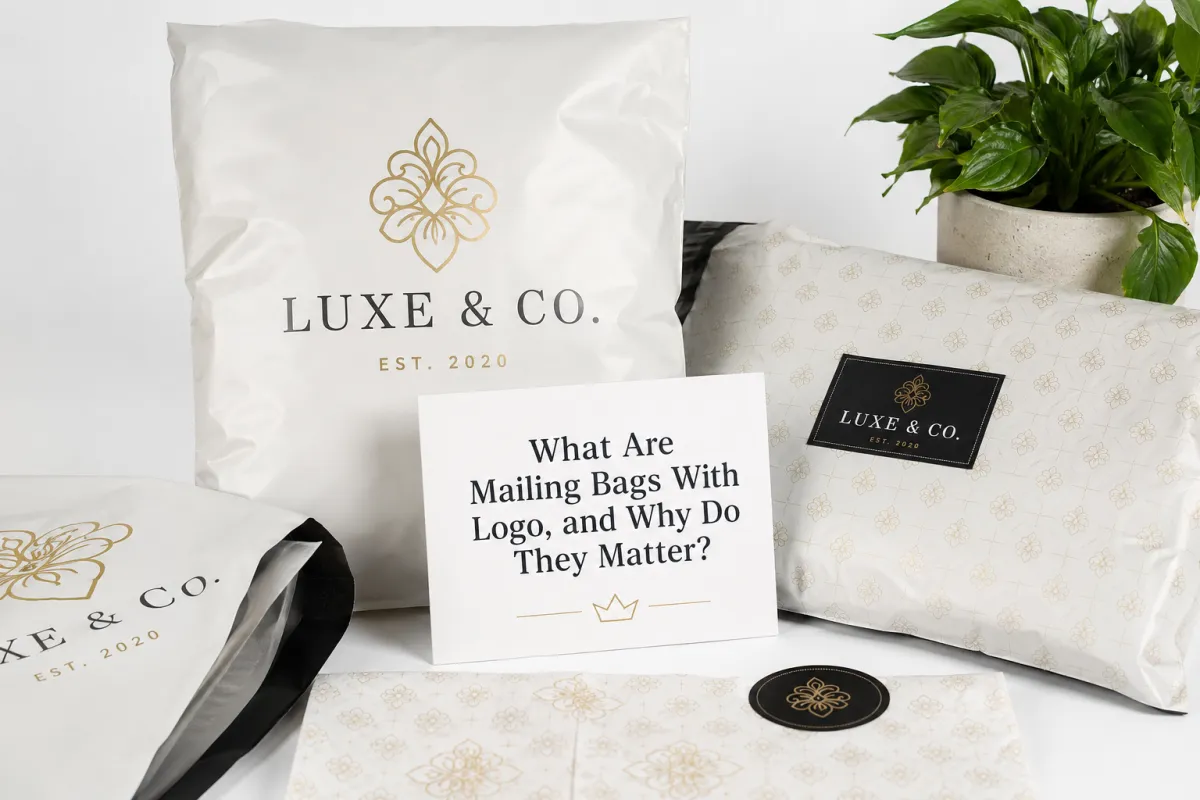
Mailing Bags With Logo are lightweight shipping bags printed with a company name, mark, or visual identity. They are common for apparel, accessories, soft goods, and anything else that does not need a rigid carton. The format is simple by design: quick to pack, light to ship, and durable enough for normal parcel handling. Branding adds a second layer, turning a basic shipping item into part of the brand itself.
Many buyers underestimate how visible the outer package becomes. A plain poly mailer disappears once it leaves the warehouse. A branded outer layer keeps working through pickup, transit, doorstep delivery, and often the return journey, while a sticker or label usually loses its effect once the package reaches the customer’s hands. For a smaller brand, repeated exposure can matter more than the narrow price gap between printed and unprinted stock.
There is a psychological edge here as well. A customer opening a parcel in mailing Bags with Logo usually reads the shipment as more intentional than one packed in a generic bag. That does not change the product inside, but it does change the first impression. People make rapid judgments about packaging. If the outside feels deliberate, the order often feels more valuable, even when the basket total is modest.
Plain mailers still have a place. They cost less up front, they are easy to source in a pinch, and they suit low-visibility shipments that do not need a branded finish. What they rarely do is support recall. They almost never end up in unboxing content. They do not help a customer spot a parcel quickly in a crowded mailroom. For that reason, mailing Bags With Logo often become the better choice once a brand wants each shipment to reinforce identity instead of simply completing a delivery.
- Protection: Keeps soft goods enclosed and protected during shipment.
- Presentation: Gives the order a more deliberate, branded finish.
- Recognition: Makes the parcel identifiable before it is opened.
- Efficiency: Keeps fulfillment simple compared with heavier carton options.
From a packaging buyer’s point of view, mailing bags with logo sit between logistics and marketing. That is why they show up so often in e-commerce brands that want to stay light on freight while still looking polished at the door.
Compare the mailer with a box and the trade-off becomes obvious. A carton offers structure, but it adds weight, storage pressure, and assembly time. Mailing bags with logo are quieter in cost and handling, yet they often match the economics of apparel and accessories much better. If the product is soft, flat, and not fragile, the mailer usually wins on speed and transport cost.
“A branded mailer should survive the trip first and market the brand second.”
How Are Mailing Bags With Logo Used in Real Fulfillment?
Real fulfillment is where mailing bags with logo prove useful. A picker pulls the order, the packer checks the item, the product slides into the bag, the adhesive strip closes it, and the shipping label goes on top. The process sounds straightforward because it usually is. The catch is simple: the bag has to fit the warehouse workflow, not just the mockup.
On the production side, mailing bags with logo are usually printed with flexographic or gravure methods for larger runs, or digital printing when the order is smaller or the artwork changes more often. Flexo suits bold logos, spot colors, and repeat patterns. Digital printing can be safer for short runs and changing campaigns. Both can produce excellent results, but quantity, color count, and budget decide which route makes sense.
Artwork placement matters more than many buyers expect. A centered logo sends a different message than an all-over print. A one-color mark can feel restrained and clean. A full-bleed design reads louder and more promotional. With logo-printed mailers, the layout has to respect seams, folds, and closure zones. Put graphics too close to an edge and the final print can distort once packed.
Closures and opening features deserve attention too. Adhesive strips need enough tack to stay shut in transit. Tear strips can improve the unboxing experience, especially for customers who dislike fighting with tape. Opaque film helps with privacy and prevents the product from showing through the bag. These details are not decorative extras; they affect shipping speed, returns handling, and customer perception at the same time.
In a live operation, mailing bags with logo also need to fit different packout styles. Some brands hand-pack every order. Others use auto-bagging equipment or semi-automated stations. Some care mostly about outbound shipping. Others care a great deal about returns handling. A bag with a reliable adhesive strip and a little extra fill tolerance can reduce bottlenecks. A bag that looks beautiful but slows the line creates a cost that shows up every shift.
For brands shipping apparel or soft accessories, Custom Poly Mailers are often the closest practical match because they balance weight, printability, and warehouse speed. Mailing bags with logo in this format are especially common where order volume is stable and parcel size stays predictable.
Transit testing is worth a look if the product has any risk of puncture, seam stress, or moisture exposure. The ISTA resources are useful for understanding how packages are evaluated during handling and shipment. That guidance does not pick the bag for you, but it does remind buyers that mailing bags with logo belong to a shipping system, not just a branding exercise.
The best printed mailer is the one that keeps pace with packing labor, label placement, and shipping volume. If a bag is too fussy, staff work around it. If it is too flimsy, the order gets re-packed. If the print looks sharp but the seal fails, the brand pays twice. Mailing bags with logo only deliver value when the visual side and the operational side support each other.
Choosing Mailing Bags With Logo: Materials, Size, and Print Quality
Material choice is where a lot of buying decisions get made too quickly. Mailing bags with logo are commonly made from LDPE, recycled LDPE, or co-extruded films. LDPE is popular because it is lightweight, flexible, and easy to print on. Recycled LDPE can reduce virgin content while still performing well. Co-extruded film brings added toughness because different layers can be engineered for strength, opacity, or surface quality.
Thickness matters more than many buyers expect. For lighter apparel, a bag in the 50–70 micron range may be enough. For heavier garments, jeans, hoodies, or items with sharp hardware, 75–100 micron gives more room for error. Too thin and the bag can split at the seam or puncture during transit. Too thick and material cost rises without much practical gain. mailing bags with logo should match the item, not the mood board.
Size is another place where small mistakes become expensive. A bag that is too large wastes material and can make the shipment look loose or underpacked. A bag that is too small forces the packer to compress the product, which can wrinkle garments and strain the seal. The best approach is to test with the actual folded item, then leave space for the adhesive flap and a little packing tolerance.
Print quality depends on both the artwork and the substrate. A one-color logo can be crisp and durable. A two-color design often still prints cleanly if the artwork stays simple. Full-color work looks stronger on smooth films, but it needs careful proofing because gradients, small text, and fine outlines can disappear on a flexible surface. In practice, logo placement should fit the way the bag folds once the seal is closed.
Finish changes perception, too. Matte finishes feel calmer and more contemporary. Gloss finish gives stronger color contrast and can make the package pop under store lighting or warehouse fluorescents. Textured surfaces are less common, but they can add a tactile cue that makes the bag feel more considered. None of these options are automatically better; they just create different reactions. For some brands, mailing bags with logo should blend into the shipping flow. For others, they should act as the first visual statement.
Artwork restraint helps more than buyers often realize. Large logos, bold color blocks, and repeat patterns usually print more reliably than dense text and tiny icons. Small legal copy, QR codes, or fine-line artwork can still work, but they need a proof check and, ideally, a sample. A buyer expecting a photographic finish from a low-cost mailer may be disappointed. mailing bags with logo reward clear design more than crowded design.
If your team wants a supplier benchmark for packaging fundamentals, the Packaging Industry Association resources are a useful reference point for general material and packaging education. That background helps buyers ask sharper questions before they order shipping bags with logo.
Mailing Bags With Logo Pricing: What Changes the Cost?
Price is usually the first number buyers ask for, and that makes sense. Mailing bags with logo can range from a small premium over stock mailers to a noticeable jump in cost, depending on the spec. The main drivers are material thickness, bag size, print coverage, color count, and order volume. Larger quantities spread setup costs across more units, while detailed artwork and special finishes push the quote upward.
Plain mailers are inexpensive because they are simple, standardized, and already in production. Branded Mailing Bags add artwork preparation, plate or setup charges, proofing time, and tighter quality checks. That does not make them overpriced. It means they are doing more work per shipment.
| Option | Typical Unit Cost at 5,000 Pieces | Best For | Notes |
|---|---|---|---|
| Plain stock poly mailer | $0.07-$0.15 | Low-visibility shipments, internal use, short-term needs | Lowest upfront cost, but no branding value |
| Single-color custom mailer | $0.14-$0.24 | Most e-commerce brands, clean logo presentation | Often the best balance for mailing bags with logo |
| Full-color custom mailer | $0.22-$0.42 | Retail-ready presentation, louder branding, campaign launches | Artwork and proofing need more care |
| Recycled-content custom mailer | $0.16-$0.30 | Brands with sustainability targets | Ask for the exact recycled percentage and film performance data |
That table only tells part of the story. Setup charges can add another layer. Depending on the supplier and print method, artwork setup or plate charges may run from roughly $80 to $300 per design or color. Freight, cartonization, and storage can matter more than buyers expect, especially if the order arrives on a large pallet that needs dry, secure warehouse space. Mailing bags with logo should be priced as landed inventory, not as a single unit number on a quote.
There is a hidden cost on the fulfillment side as well. If a bag tears, jams in packing, or fails to protect the product, someone has to re-pack it. That labor can erase the savings from a cheaper mailer very quickly. A buyer who only compares unit price may end up with a more expensive shipped order. Mailing bags with logo are worth evaluating on damage risk, labor time, and visual payoff together.
Minimum order quantities shape the economics too. Smaller quantities usually cost more per unit because setup is spread over fewer pieces. Larger quantities can improve pricing, but they also increase inventory holding and raise the risk of sitting on the wrong size or artwork if the brand changes direction. A first run of mailing bags with logo is often best kept to a manageable quantity unless volume is already stable.
Cheaper is not always cheaper. If a lower-cost bag saves three cents but increases return rate, slows pack time, or makes the shipment more fragile, the math changes quickly. The strongest quotes for mailing bags with logo show unit cost, setup cost, freight, and realistic usage assumptions side by side so the buyer can see the whole picture.
Mailing Bags With Logo: Process, Lead Times, and Timeline
The ordering process is usually straightforward, but it works best when the buyer is organized. Mailing bags with logo typically move from brief to artwork, then proof, then production, then inspection, then shipment. If any step slips, the timeline moves with it. The fastest projects are the ones where the logo files are ready, the target size is known, and proof approval is prompt.
A practical timeline for standard custom orders is often 12-15 business days from proof approval to dispatch. Larger runs, special finishes, or complex artwork can stretch that to 20-30 business days. Rush orders are possible in some cases, but they usually cost more and are not always available when the print schedule is already full. Mailing bags with logo reward planning more than panic buying.
Artwork preparation is one of the most common delay points. Vector files such as AI, EPS, or PDF with outlined fonts are usually the safest starting point. Brand colors should be identified clearly, ideally with PMS references if exact matching matters. Placement notes help too. If the logo needs a specific distance from the seal, the edge, or a tear strip, say so early.
Color approval can take longer than expected because flexible film does not always show color the same way a screen does. Dark backgrounds, gloss finishes, and translucent films can all shift appearance. That is why proofing matters. A digital proof is useful, but a physical sample is better whenever the budget and timeline allow it. Mailing bags with logo are too visible to leave to guesswork.
Inventory planning is another detail that separates smooth launches from awkward ones. Branded mailers should arrive before a product drop, not after sales start. A buffer of two to three weeks is sensible if the order depends on custom print. For seasonal peaks, the buffer should be wider. A warehouse with 20,000 orders waiting and no stock of logo-printed mailers is not a pleasant place to discover a delay.
From a process standpoint, the cleanest buying sequence looks like this:
- Confirm product dimensions and weight.
- Choose material, thickness, and closure style.
- Prepare vector artwork and brand color references.
- Request a written quote with setup and freight included.
- Review a digital proof and, if possible, a sample.
- Approve production only after the fit is tested with the real product.
- Build in inventory buffer before the launch date.
That sequence may sound obvious, but it prevents the most common timeline mistakes. A buyer who waits until the last minute to order mailing bags with logo often has to accept a higher price, a simpler print, or a rushed shipment. None of those outcomes is ideal.
Common Mistakes When Buying Mailing Bags With Logo
The most frequent error is choosing a bag because it looks good on screen and ignoring how the actual product fits inside it. Mailing bags with logo need to match real dimensions, not idealized ones. A garment that folds awkwardly or a product with a bulky accessory may need more space than the team guessed during the quote stage. One sample can save a lot of rework.
Another common mistake is overcomplicating the design. Small text, thin lines, gradients, and too many colors can all create trouble on a flexible shipping bag. Simple artwork usually travels better from proof to print. A strong logo mark, a clear wordmark, and one or two supporting colors often outperform a crowded layout. Mailing bags with logo are most effective when the design reads in a second, not a minute.
Thickness gets underspecified often as well. If the goods have sharp corners, zippers, hang tags, metal trims, or dense folds, a light-gauge bag can fail in transit. That failure may show up as a split seam, a puncture, or a customer complaint about scuffed packaging. The right spec should account for the product’s worst edge, not only its average shape.
Another issue is forgetting how the bag will be used beyond the first shipment. Returns, exchange orders, and multi-channel selling can all change the ideal format. If a brand expects more returns, a stronger adhesive or dual-seal layout may be worth the extra cost. If the operation ships through different channels, the bag should be easy for staff to identify and pack consistently. Branded shipping bags should support the full order cycle.
Skipping a sample is one of the most expensive shortcuts. A proof on a computer screen can hide color shifts, print registration issues, and texture problems. A real sample tells the truth about seal strength, opacity, and how the bag looks when folded and labeled. The most useful comparison is a packed sample alongside the actual product. For brands ordering mailing bags with logo, that is when sizing mistakes usually reveal themselves.
There is also a sourcing mistake that shows up often: buying too many sizes at once. If the product catalog is still changing, order one or two core sizes first. Once shipping data is clear, expand the range. That keeps the warehouse simpler and avoids being stuck with the wrong inventory. The same logic applies to Custom Poly Mailers and other mailing bags with logo formats. Start with what the operation can actually use.
Expert Tips and Next Steps for Mailing Bags With Logo
If there is one rule that saves buyers time, it is this: test the bag with the real product before giving final approval. Mailing bags with logo should be checked with the actual packed item, not just a mockup made from paper or foam. That test answers questions that a proof cannot, such as whether the seal closes flat, whether the print remains visible after folding, and whether the packed weight is still comfortable for transit.
It also helps to compare at least two suppliers. Not every quote is built the same way, and not every factory defines quality in the same language. Ask for print clarity, material thickness, seal strength, and lead time side by side. If one supplier can show a better sample but a slightly higher price, that may be the better business decision. A strong supplier relationship on branded shipping bags is often worth more than one-off savings.
A good next step is to keep the initial order focused. One or two core sizes are usually enough for a young or mid-stage catalog. That keeps purchasing simpler and makes replenishment easier. Once order data shows which SKUs ship most often, the packaging line can expand with more confidence. Brands That Sell apparel through mailing bags with logo often discover that a small size range covers most of their volume.
For brands that care about performance testing, ask whether the supplier can discuss methods aligned with standards such as ASTM film testing or ISTA-style transit checks. That does not mean every order needs lab validation, but it does mean the packaging conversation gets more useful when people talk about strength, puncture resistance, and shipping conditions instead of vague adjectives. A supplier who can explain why a seam fails under load is usually more trustworthy than one who only talks about color and gloss.
I have watched brands chase a lower quote and then spend the difference again in labor, complaints, and emergency reorders. That lesson is usually learned the hard way, kinda annoyingly, but it sticks. The smarter move is to compare total landed cost, warehouse fit, and how the package behaves after it leaves the dock.
One practical tip: keep a simple approval checklist on hand.
- Confirm finished dimensions and product fit.
- Verify material type and thickness.
- Check print area, logo placement, and color references.
- Ask for unit price, setup cost, freight, and minimum order quantity.
- Review the proof slowly, then test a sample if possible.
- Set the reorder point before stock gets tight.
The cheapest quote is not always the smartest buy. For mailing bags with logo, the better question is whether the bag protects the product, supports packing speed, and leaves the customer with a cleaner impression.
Can Mailing Bags With Logo Improve Repeat Orders?
Mailing bags with logo can help repeat business when they are paired with reliable service and honest messaging. The interesting part is that the effect is less about vanity and more about memory. A good branded mailer makes the brand feel familiar, and familiarity reduces friction at the moment of second purchase. It is not the bag itself that creates loyalty. It is the consistency: same quality, same fit, same level of care.
Brands that pair clear presentation with fast fulfillment often see stronger behavior at the doorstep. Customers who trust the packout process, including the mailer condition, are less likely to pause in the “is this right?” part of the reorder journey. In that sense, mailing bags with logo are part logistics control, part reassurance signal. The connection is less obvious than ad reach, but it is measurable over time in return rate and customer comments.
Track this carefully with shipping feedback and post-purchase notes. If a branded mailer repeatedly gets positive remarks and the package is still arriving undamaged, that is a sign the formula is working. If comments complain about torn seams or hard-to-open features, the investment is only half-delivered. For packaging strategy, that distinction matters more than one-off color matching.
There is also a simple truth from the warehouse floor: if a package feels cheap, customers assume the brand cut corners somewhere else. That assumption may not be fair, but it is real. A solid printed mailer helps remove that doubt before it starts. That’s one reason mailing bags with logo keep showing up in apparel, beauty, and accessory brands that rely on repeat purchase behavior.
What is the best material for mailing bags with logo?
For most e-commerce shipments, mailing bags with logo made from LDPE or recycled LDPE work well because they are lightweight, durable, and easy to print on. If the product is heavier or has sharp edges, a thicker gauge or a co-extruded film is often the safer choice. Match the material to the shipping risk, not just the visual style.
How long do they usually take to produce?
Simple orders can move quickly if the artwork is ready and the size is standard, but custom production still needs proofing time. For mailing bags with logo, a normal lead time is often 12-15 business days after proof approval, with longer timelines for special finishes or larger quantities. Build in buffer time before launch dates.
Are mailing bags with logo more expensive than plain mailers?
Yes, branded bags usually cost more per unit because of printing, setup, and design work. The gap often narrows at higher quantities, where the branding cost is spread across more units. The real question is whether the added value shows up in perceived quality, repeat orders, or customer sharing.
Can I use recycled or eco-friendly options for mailing bags with logo?
Yes, many suppliers offer recycled-content films and other lower-impact options that still support custom printing. Ask for the exact recycled percentage and check whether the material meets your strength needs. Eco-friendly should still mean functional, because damaged shipments create waste too. That principle matters just as much for mailing bags with logo as it does for any other shipping format.
What files do I need to order mailing bags with logo?
Vector artwork is usually best, such as AI, EPS, or PDF files with outlined fonts and clean logo edges. Share brand color references and placement notes so the supplier can proof the layout accurately. If the design is complex, request a digital proof and a physical sample before full production. That extra step is especially useful for custom mailers because flexible film can change how art appears once it is sealed and packed.
How should I decide if the bag size is right?
Pack the actual product, seal the mailer, and see how it behaves after the adhesive closes. The right size leaves enough room for a clean fold without rattling around or forcing the contents to compress awkwardly. If you are unsure, test two sizes side by side and compare how they look once labeled.
The clearest takeaway is this: order mailing bags with logo only after the product fit, print method, and fulfillment flow have all been checked together. If those three pieces line up, the bag does more than carry an order; it becomes part of the brand memory that follows the parcel all the way to the door.


