Buyer Fit Snapshot
| Best fit | offset printing setup costs breakdown for packaging buyers comparing material specs, print proof, MOQ, unit cost, freight, and repeat-order risk where brand print, material, artwork control, and repeat-order consistency matter. |
|---|---|
| Quote inputs | Share finished size, material target, print colors, finish, packing count, annual reorder estimate, and delivery region. |
| Proofing check | Approve dieline scale, logo placement, barcode or warning zones, color tolerance, and any recyclable or compostable wording before bulk production. |
| Main risk | Vague material claims, crowded artwork, or missing packing details can create delays even when the unit price looks attractive. |
Fast answer: Offset printing setup costs breakdown: pricing factors should be specified like a repeatable production item. The safest quote includes material, print method, finish, artwork proof, carton packing, and reorder notes in one written spec.
What to confirm before approving the packaging proof
Check the product dimensions against the actual filled item, not only the sales mockup. Ask for tolerance on folds, seals, hang holes, label areas, and retail display edges. If the package carries a logo, QR code, warning copy, or legal claim, reserve that space before decorative graphics fill the panel.
How to compare quotes without losing quality
Compare board or film grade, print process, finish, sampling route, tooling charges, carton quantity, and freight assumptions side by side. A lower quote is only useful if the supplier can repeat the same color, closure quality, and packing count on the next order.
Offset printing setup costs breakdown: pricing factors
Offset printing setup costs breakdown is usually the moment a packaging buyer realizes the quote is doing actual math, not sales theater. The first batch often costs more to start than to run because plates, prepress, proofing, color calibration, and press makeready are fixed jobs that happen before a single carton leaves the press.
That is not a flaw. It is just how offset works. A small folding carton order can look expensive per piece until the setup cost gets spread across enough units to make sense, which is exactly why the offset printing setup costs breakdown matters more than the shiny unit price sitting on the quote.
Custom Logo Things works with buyers who want plain answers, not print-industry fog. I have sat through enough press checks to know where costs hide, where they are justified, and where a quote is kinda trying to sneak around the corner. What follows is a practical offset printing setup costs breakdown that shows which charges belong on the invoice, which ones deserve scrutiny, and where short-run quotes quietly get expensive.
What is included in an offset printing setup costs breakdown?
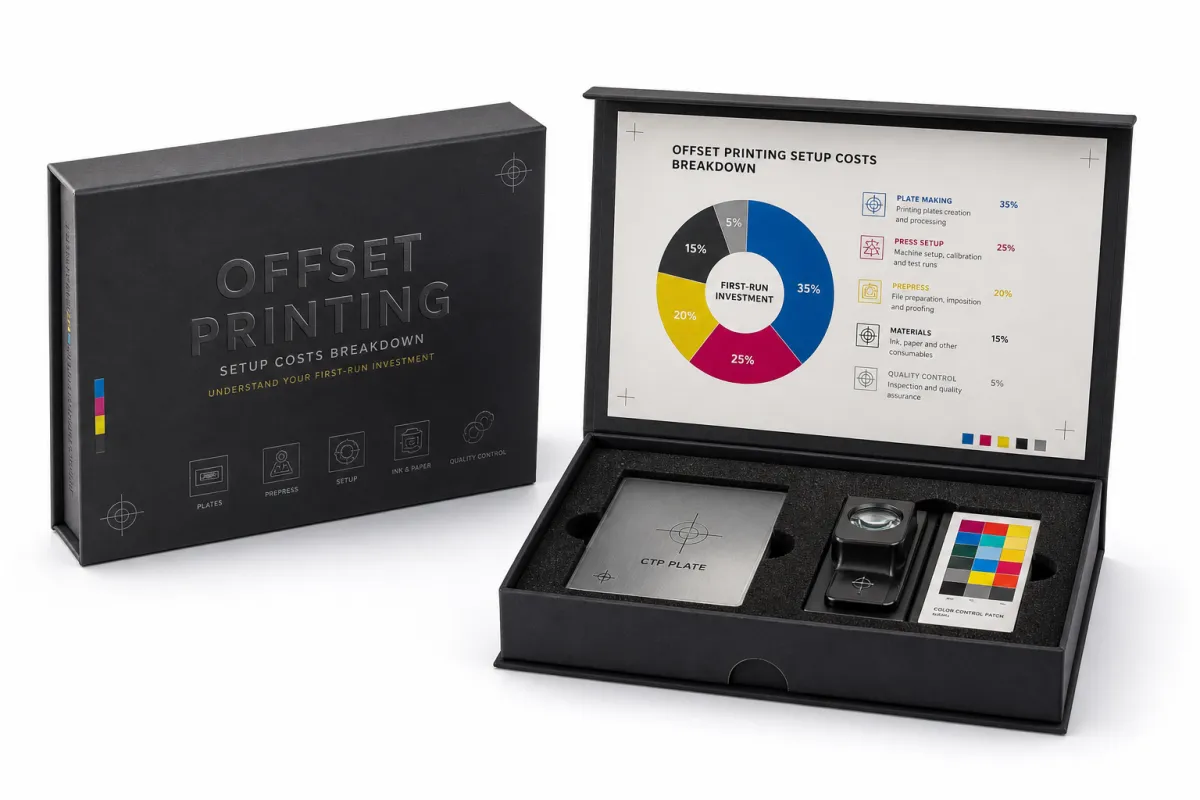
An offset printing setup costs breakdown usually includes the fixed jobs that happen before production starts: plate making, prepress checks, proofing, press calibration, and the initial waste from makeready. Those costs show up early because offset printing needs the press, the files, and the color target to line up before the run can begin.
For a packaging buyer, the first run carries the weight of all that setup. A simple carton job with a plain 4/0 CMYK exterior might carry a setup charge in the low hundreds. A more complex carton with spot color matching, coating, and die cutting can move into the mid-hundreds or higher before unit production even begins. Add foil or embossing, and the offset printing setup costs breakdown climbs again because every extra process adds prep, testing, and approval time.
Offset printing is rarely the cheapest route for tiny quantities. Digital printing usually wins there because it skips plate making and shortens setup. Once the run gets large enough, offset printing starts looking smarter, especially if sharp detail, repeatability, and stable color matter from one order to the next. Quantity and setup belong in the same conversation. Separate them, and the quote can fool you.
The first run is also where waste shows up. Press crews need to hit color, registration, and folding accuracy. Some sheets get used while the machine is dialed in. On a simple job, makeready waste may stay modest. On a color-sensitive packaging job, it is a different story. Nobody likes paying for spoilage, but that is the price of reaching a sellable result.
A straight offset printing setup costs breakdown should call out these pieces:
- Plates for each color or pass.
- Prepress checks for file readiness, bleed, traps, and dieline alignment.
- Proofing so the artwork gets approved before full production.
- Makeready time for press calibration and registration.
- Waste allowance for startup sheets and color tuning.
If a quote leaves those pieces blended together, ask for a line-item view. Otherwise the offset printing setup costs breakdown turns into guesswork, and guesswork is how buyers end up paying for surprises they never signed off on.
"If the first quote looks cheap, check what got left out. Presses do not work on wishful thinking."
The real takeaway is simple. Offset printing setup costs breakdown is not about chasing the lowest number on paper. It is about understanding why the first batch carries more cost and whether that cost fits the product, the quantity, and the quality target.
Offset printing setup costs breakdown by product type
Product type changes the bill fast. The offset printing setup costs breakdown for a folding carton is not the same as the setup for an insert, a label, a hang tag, or a rigid box. Different formats need different dies, different registration control, and different finishing steps. Buyers who treat them as interchangeable usually end up confused, then irritated, then late to the approval call.
A simple insert is the easiest place to start. One or two print sides, a straightforward trim size, no coating drama, no complex folds. The offset printing setup costs breakdown stays relatively tame because there are fewer variables to manage. A carton, by contrast, needs exact panel alignment, glue areas, fold scores, barcode placement, and often more than one finishing step. Add a window patch or specialty coating, and the setup bill grows because the press and finishing line both need more attention.
Rigid packaging is a different animal. Even when the printed outer wrap looks simple, the board construction, wrapped corners, and finishing tolerances make the setup more involved. Labels and sleeves have their own quirks too. A sleeve might need careful seam placement and consistent tension. A label might need tight die cutting and controlled slip. The offset printing setup costs breakdown changes with every one of those details.
Complexity is the real cost driver. More folds mean more chance for misalignment. More cut lines mean more tooling precision. More coatings mean more handling. A multi-panel carton with two spot colors, a matte coating, and foil stamping will always carry a heavier offset printing setup costs breakdown than a one-color insert. That is not a vendor being clever. That is the job asking for more steps.
Buyers get tripped up because the artwork looks simple on screen. On a monitor, a clean carton design can read like a basic rectangle with a logo. On press, that same design becomes separate plates, separate passes, and separate finishing sequences. The offset printing setup costs breakdown reflects the real production path, not the visual simplicity of the mockup.
These are the details that move the number:
- Dielines that need review and correction before print.
- Glue areas that must stay free of ink or coating in the right spots.
- Bleeds that are too tight, which trigger prepress corrections.
- Barcode placement that affects panel layout and carton orientation.
- Approval rounds that repeat because the art was not final.
Digital printing can work well for prototype cartons or very small campaign runs because the setup burden is lighter. Flexographic printing often fits long-running roll work, labels, and some corrugated applications better. Offset printing still holds a sweet spot for detail, controlled color, and repeatable carton production. The offset printing setup costs breakdown helps you decide whether your job belongs there or not.
For a deeper look at production options, our Manufacturing Capabilities page shows how different print methods fit different packaging builds.
And if your packaging has to survive distribution testing, standards matter. The ISTA shipping test standards are a useful reference for performance expectations, especially when packaging needs to travel before it reaches a shelf or customer.
Specifications that change the quote
Most price confusion starts before the quote is even written. The offset printing setup costs breakdown depends on specs, and vague specs create vague pricing. If the buyer has not locked size, stock, color count, finish, and quantity, the estimate is basically a polite guess. Polite, yes. Useful, not really.
Size comes first. Finished dimensions affect sheet layout, material yield, and how many items fit on a press sheet. Stock comes next. A 350gsm C1S artboard behaves differently from a 400gsm SBS board or a lighter paperboard used for inserts. Paper thickness changes folding behavior, ink absorption, and finishing pressure, all of which move the offset printing setup costs breakdown.
Color count is another blunt cost lever. A 4/0 job is not the same as a 4/1 or 4/4 job. Once you move from process-only CMYK to added spot color, the setup work increases because the press has more plates to install and more color targets to hold. Spot color is useful when brand matching matters, but it usually adds more setup than a CMYK-only job. That is not a theory. That is a pressroom fact.
Finishes are where the quote can jump fast. Gloss coating, matte coating, soft-touch lamination, spot UV, foil, embossing, and complex die cutting all add setup steps. Each one creates another checkpoint, another machine adjustment, or another drying and handling stage. The offset printing setup costs breakdown gets heavier because print finishing is never just decoration. It is a production sequence.
Artwork readiness matters too. Clean files with correct bleed, safe zones, and approved dielines reduce prepress time and reduce the chance of reproofs. If the PDF is sloppy, the quote may still look low at first, then gain extra charges later. That is a classic way the offset printing setup costs breakdown quietly expands after the buyer has already mentally spent the budget.
Quality requirements also influence pricing. If color tolerance is tight, if registration has to be exact, or if the waste allowance is small, the press crew needs to work more carefully. Careful work takes longer. Longer setup takes money. The offset printing setup costs breakdown should reflect that, because rushing a color-sensitive carton is how you end up with a decent-looking box that still misses the brand standard.
A useful way to think about it is this: every specification either simplifies the job or adds control points. The offset printing setup costs breakdown is basically a map of those control points.
These are the specs that should be finalized before asking for a price:
- Finished size and dieline version.
- Stock type and thickness.
- Color count, including spot colors.
- Coating or lamination requirements.
- Special finishes such as foil, emboss, or spot UV.
- Quantity and target delivery date.
If sustainability is part of the brief, ask for FSC-certified board or verified recycled content. That affects sourcing and sometimes the available stock options. The certification standard itself is worth reviewing at FSC if brand claims need to be clean and defensible.
For buyers, the lesson is simple. The offset printing setup costs breakdown is not random. It follows the specs, and the specs decide whether the job is a clean fit or a headache with ink on top.
Offset printing setup costs breakdown: pricing, MOQ, and waste
Now we get to the part everyone wants first and should probably ask later: money. The offset printing setup costs breakdown is made of fixed costs and variable costs, and mixing the two is how quotes get misread. Fixed costs include plates, prepress, proofing, and makeready. Variable costs include paper, ink, finishing, and shipping. Once those buckets are separated, the pricing starts making sense.
Minimum order quantity matters because offset printing needs enough volume to spread setup across the run. A short run can look expensive because the setup cost is sitting on too few units. A larger run looks better because the same setup is diluted across more cartons or inserts. That is why a run of 500 can feel painful while 5,000 starts to look practical. The offset printing setup costs breakdown is doing the same work in both cases; only the quantity changes the outcome.
Realistic ranges help. A simple packaging job may carry setup in the low hundreds. A more involved carton with multiple colors and finishing may sit in the several-hundred-to-low-thousand range before unit production costs. If the job needs specialty plates, extra proof rounds, or complex print finishing, the offset printing setup costs breakdown can climb further. Buyers should not treat that as a scam. They should treat it as a reminder that complexity always has a price tag.
Waste is another line item that deserves attention. A vendor may include a waste allowance, and that allowance is there for a reason. On short runs, even a small amount of spoilage changes the effective unit cost. On tighter color-critical jobs, more waste may be needed for calibration. If someone promises almost no waste on a job that requires exact color control, I would be skeptical. A suspiciously low offset printing setup costs breakdown often means the quote is optimistic in ways that will not survive press setup.
Here is a practical comparison of common production paths:
| Method | Typical setup burden | Best fit | What buyers should watch |
|---|---|---|---|
| Digital printing | Low to moderate, often little or no plate cost | Very short runs, fast turns, variable data | Higher unit cost at scale, fewer finishing options on some jobs |
| Offset printing | Moderate to high because of plates and press setup | Mid to large runs, sharp detail, repeatable packaging | Setup costs must be spread across enough units to make sense |
| Flexographic printing | Tooling and plate prep can be significant | Labels, film, corrugated, long-running roll work | Best for the right format, not a replacement for everything else |
That table is why the offset printing setup costs breakdown should never be compared against digital printing without checking the whole spec. Same with flexographic printing. Same size is not enough. Same finish is not enough. Same quantity is not enough. You need the same stock, same colors, same waste allowance, same freight terms, or the comparison is junk.
One more trap: some quotes leave out setup-adjacent charges and only reveal them later. Watch for reproofs, file corrections, rush scheduling, special inks, extra spoilage, and second-stage finishing. If a quote is too tidy, the offset printing setup costs breakdown may be incomplete. Clean-looking quotes can be useful. Incomplete quotes are just future arguments.
Packaging buyers should think in landed cost, not vanity unit price. That means setup, unit print cost, finishing, freight, and any likely add-ons all belong in the math. A quote that looks cheap on the unit line can end up expensive once the offset printing setup costs breakdown is fully loaded.
That is why we always recommend asking for at least two scenarios: the quantity you think you need and the quantity where the setup starts to spread efficiently. Seeing both side by side makes the break-even point obvious. Once you know that point, you are no longer guessing. You are buying with a calculator, which is usually a better habit.
In short, the offset printing setup costs breakdown tells you where the money goes, why the first run feels heavy, and how much quantity you need before offset starts acting like the sensible choice instead of the expensive one.
Offset printing setup costs breakdown by process and timeline
Process drives cost, and timeline drives process. That is the clean version. The offset printing setup costs breakdown begins with file review and prepress checks, moves into proofing, then plate making, press setup, color approval, production, finishing, and final inspection. Each step adds time. Each delay adds cost. The press run itself can end up being the quick part.
Files that are not ready are the biggest time thief. Artwork corrections, dieline revisions, missing fonts, low-resolution images, and incorrect bleed can all push the schedule back. Buyers often assume the machine is slow. More often, the machine is waiting on an approval. The offset printing setup costs breakdown grows when the job needs another proof or another round of file cleanup.
Typical timelines depend on complexity. A repeat job with approved files may move through production quickly once the schedule opens up. A new custom carton with foil, spot color matching, and a special coating needs more lead time because every stage has more to verify. If a project has multiple SKUs, the offset printing setup costs breakdown also includes the time needed to switch versions and check each one for accuracy.
Rush charges are predictable. They are not mysterious. If a job cuts into the production queue, interrupts other work, or requires after-hours handling, the cost goes up. That is not a penalty for being impatient. It is a scheduling reality. A fair offset printing setup costs breakdown should show that clearly instead of hiding it inside a vague line called "expedite."
Here is how buyers can shorten turnaround without making a mess of the job:
- Send final artwork with fonts outlined or embedded and images in print-ready resolution.
- Approve the dieline first so the structural layout is locked before design changes spread everywhere.
- Choose stock early so paper sourcing does not hold the job hostage.
- Pick one decision-maker to avoid approval-by-committee delays.
- Limit late edits after proofing unless the change is truly necessary.
That last point matters more than people admit. A tiny artwork change after proof approval can reopen the offset printing setup costs breakdown because the plate set, registration, or finishing sequence may need adjustment. There is no hidden shortcut that keeps a changed job unchanged.
Packaging teams that care about sustainability and transit performance should also think beyond print setup. If a shipper wants lower packaging impact or verified material claims, EPA guidance can help frame the conversation around materials and disposal. The EPA recycling guidance is a useful starting point for buyers who need packaging choices that still make sense after the box leaves the plant.
In practice, the offset printing setup costs breakdown and the timeline are tied together. Faster jobs need fewer surprises. Fewer surprises need cleaner files. Cleaner files save money. It is not glamorous, but it works.
From the buyer side, the safest rule is this: if the schedule is tight, lock the design early. If the design is still moving, expect the offset printing setup costs breakdown to grow, because every last-minute change adds friction somewhere in the chain.
Why choose us for offset printing setup costs breakdown
Buyers do not need more hype. They need a vendor who can explain the offset printing setup costs breakdown without turning it into a magic trick. That is the service standard here: clear line-item quotes, practical advice on whether offset is the right fit, and fewer surprise charges after the job is already moving.
We look at the actual packaging brief, not just the art file. That includes structure, material, finish, quantity, deadline, and repeat-order potential. If digital printing is the better buy for a tiny pilot run, we should say so. If offset printing makes more sense because the order will repeat, the artwork is detailed, and the color expectations are strict, we should say that too. A good offset printing setup costs breakdown should guide the decision, not just justify the invoice.
Packaging buyers care about consistency. They also care about not wasting money on the wrong method. That is why the offset printing setup costs breakdown matters so much in carton work. A clean prepress review can catch file issues before they become expensive reproofs. Better spec confirmation reduces wasted plates and wasted time. That usually saves money, which is nice because nobody enjoys paying to discover what should have been checked earlier.
We also watch repeat-order logic. Once plates, stock, and specifications are set, reprints can become much more efficient than the first run. Multi-SKU programs benefit even more because the setup is no longer being rebuilt from scratch every time. The offset printing setup costs breakdown on a second or third run often looks far better than the first, provided nothing meaningful has changed.
There is also a quality angle that gets ignored too often. Good packaging is not just ink on paper. It is color control, structural accuracy, finishing consistency, and repeatability across lots. Offset printing still earns its keep because it handles those needs well on the right projects. A proper offset printing setup costs breakdown should reflect the cost of getting those details right, not pretend they are free.
That is the difference between a cheap quote and a usable quote. Cheap can be useful in exactly one situation: if you enjoy surprises. Most buyers do not.
If you want a practical starting point, bring us the finished size, artwork files, stock preference, color count, finish requirements, quantity, and delivery target. We will turn that into a more honest offset printing setup costs breakdown and tell you where the quote is tight, where it is soft, and where the real break-even sits.
Next steps for an offset printing setup costs breakdown quote
If you want a quote That Actually Helps, start by locking the basics. The offset printing setup costs breakdown gets much cleaner when the buyer sends finished size, artwork files, stock choice, color count, finish requirements, quantity, and delivery target in one complete package. Half the pricing chaos in this industry comes from half-finished requests.
Ask every vendor to separate setup from unit production. Plates, prepress, proofing, makeready, finishing, freight, and any likely add-ons should be shown individually. If a quote lumps everything together, you cannot compare it properly. That is not a quote. That is a blob.
Then request two scenarios. One at your current quantity. One at a higher break-even quantity. That single comparison often reveals whether offset printing setup costs breakdown is working in your favor or fighting you. If the unit price falls hard at the higher quantity, you have found the range where offset starts to pay back the setup.
Compare landed cost, not just sticker price. Freight can erase a nice-looking deal. Waste allowance can erase it faster. Finishing can erase it fastest of all. The best quote is not the cheapest-looking one. It is the one that survives the full offset printing setup costs breakdown without sneaking in extra cost later.
Here is the practical move list:
- Lock the spec before asking for pricing.
- Request line items for every setup charge.
- Compare identical specs across vendors.
- Test two quantities to find the break-even point.
- Check the landed cost before saying yes.
That is the whole point of an offset printing setup costs breakdown. It is not a mystery bill. It is a decision tool. Use it that way, and the numbers make sense. Ignore it, and you will keep paying to learn the same lesson in different fonts.
For buyers at Custom Logo Things, the smart move is simple: get the specs locked, ask for a clear line-item breakdown, and use offset printing setup costs breakdown to Choose the Right production path instead of chasing a low number that will not hold up under scrutiny.
Frequently asked questions
What drives the biggest offset printing setup costs breakdown?
Plates, prepress work, proofing, press calibration, and waste during makeready are the biggest fixed costs. The offset printing setup costs breakdown climbs fast when the job adds more colors, more finishes, or more complex packaging shapes. Artwork problems and last-minute changes can add more cost than the actual press run, which is why clean files matter so much.
When does offset printing setup costs breakdown start to make sense?
It usually makes more sense once the setup cost can be spread across enough units to lower the per-piece price. Small runs can look expensive because the fixed setup is not diluted. If you are planning repeats or multiple SKUs, offset often becomes more economical, especially for jobs that need stable color and better finishing control.
Which charges are often missing from an offset printing setup costs quote?
Watch for reproofs, file corrections, rush fees, waste allowance, special inks, finishing, and shipping. Some vendors quote only the print run and leave out plates or prepress until later. Ask for a line-item breakdown so you can compare quotes without guessing, and so the offset printing setup costs breakdown is complete from the start.
Does a reprint reduce offset printing setup costs?
Usually yes, because the file structure, plates, and specs may already be approved or reusable. If nothing changes, the second run is often cheaper than the first. Any artwork revision, stock change, or finish change can bring back setup charges, so the offset printing setup costs breakdown improves most when the repeat order is truly repeatable.
How do I compare offset printing setup costs across vendors?
Make sure the size, stock, colors, finishes, quantity, and waste allowance are identical. Compare total landed cost, not just the base unit price. If one quote looks far cheaper, check what it left out before assuming it is the better deal. A fair offset printing setup costs breakdown should let you compare vendors on the same terms, not on wishful thinking.


