Buyer Fit Snapshot
| Best fit | Order Branded Recycled Mailers With Your Logo Fast projects where brand print, material claims, artwork control, MOQ, and repeat-order consistency need to be specified before quoting. |
|---|---|
| Quote inputs | Share finished size, material target, print colors, finish, packing count, annual reorder estimate, ship-to region, and any compliance wording. |
| Proofing check | Approve dieline scale, logo placement, barcode or warning zones, color tolerance, closure strength, and carton packing before bulk production. |
| Main risk | Vague material claims, crowded artwork, missing packing details, or unclear freight terms can make a low unit price expensive after revisions. |
Fast answer: Order Branded Recycled Mailers With Your Logo Fast should be specified like a repeatable production item. The safest quote records material, print method, finish, artwork proof, packing count, and reorder notes in one written spec.
Production checks before approval
Compare the actual filled-product size with the drawing, then confirm tolerance on folds, seals, hang holes, label areas, and retail display edges. Reserve space for logos, QR codes, warning copy, and material claims before decorative graphics fill the panel.
Quote comparison points
Review material grade, print process, finish, sampling route, tooling charges, carton quantity, and freight assumptions side by side. A quote is only useful when the supplier can repeat the same color, closure quality, and packing count on the next order.
If the outer parcel has to do the talking, the smart move is to Order Branded Recycled Mailers with logo that can handle sortation belts, final-mile vans, and the not-so-gentle drop onto a porch after a long delivery route. I still remember standing beside a packing table in a Dallas, Texas fulfillment center where the insert card got skipped, the thank-you note stayed buried in the carton, and the only thing the customer truly noticed was the mailer itself. That outer surface became the brand moment, whether anybody planned it that way or not. A little frustrating? Sure. Also useful. A printed mailer with a 10 x 13 inch face area gives you more visual influence than a postcard tucked inside a sleeve, and that reality has a way of showing up fast once the first thousand parcels start moving.
The business case is pretty direct, and that is part of why brands keep coming back to this format. When you order branded recycled mailers with logo, you get a cleaner first impression, steadier shipping presentation, and a packaging format that can signal responsible sourcing without acting like it is trying too hard. Brands that order branded recycled mailers with logo often see more consistency across shipments, and consistency matters just as much as the artwork once the parcel leaves the packing bench. I have watched apparel labels in Los Angeles, California, subscription programs in Austin, Texas, and accessory sellers in Nashville, Tennessee gain better repeat recognition after moving away from plain bags and into a recycled mailer with a logo where people can actually see it. The shift is not subtle after 5,000 parcels pass through a warehouse, a carrier hub, and onto a doorstep.
This piece covers the practical side of the decision: materials, print choices, Pricing, Lead Times, and the production details that save time on the factory floor in places like Dongguan, Guangdong, and Ningbo, Zhejiang. If you are ready to order branded recycled mailers with logo, the goal is simple: choose a mailer that matches the product, the budget, and the packing line without guesswork or crossed fingers. For teams comparing sustainable packaging options, the right recycled mailer should feel like a working tool first and a brand asset second, because that is usually how the better programs hold up in the real world.
Why should businesses order branded recycled mailers with logo?
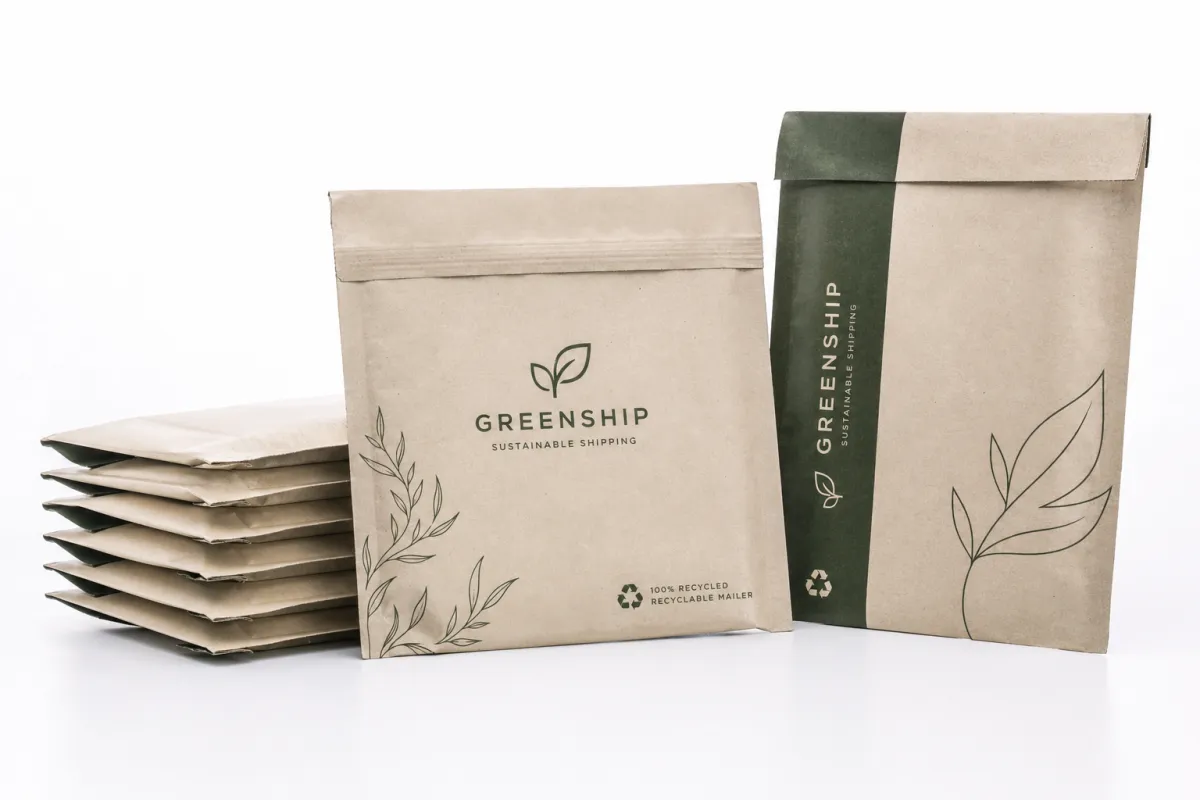
I learned this the hard way on a 7,500-unit subscription clothing run where the insert looked polished, the photography was strong, and the outer mailer was plain kraft with a crooked shipping label. The customer saw the parcel before the insert, and the reaction had nothing to do with fit, fabric, or color. It was about the package. That is why so many brands order branded recycled mailers with logo early in the growth cycle, because the shipping skin becomes the first surface people touch, photograph, complain about, or remember. And yes, sometimes all four.
The commercial logic is stronger than many buyers expect. A branded recycled mailer gives a brand the same visual tone across 500 shipments or 50,000, which matters once parcels move through a warehouse in Richmond, California, a carrier hub in Memphis, Tennessee, and then onto a doorstep. When brands order branded recycled mailers with logo, they are buying more than paper or film; they are buying a repeatable visual system that can carry a logo, a return address, and a clear brand voice in one flat, lightweight format. I like that part because it is boring in the best way: predictable, repeatable, and easy to trust.
Some of the strongest-performing brands treat packaging as part of operations instead of decoration. On a factory floor in Suzhou, Jiangsu, or Ho Chi Minh City, the right outer mailer lowers packing errors, resists moisture, and still looks deliberate when a shipping label covers part of the face area. That balance matters for apparel, cosmetics, small hard goods, and subscription kits that pass through several hands before opening. Nobody wants a beautiful mailer that fights the line like it has a personal vendetta against the packing team, especially when the line is running 900 parcels a shift.
Here is where recycled mailers fit especially well for brands that need a clean, practical shipping format:
- Apparel such as folded tees, hoodies, socks, and activewear shipped in one or two units per parcel.
- Accessories like belts, scarves, hats, small leather goods, and bundled gift sets.
- Subscription shipments where the outer pack sets the tone before the box is opened.
- Light hard goods that do not need a rigid carton but still need moisture and tear protection.
- Fulfillment programs with repeated daily volume and a need for fast, consistent sealing.
I also like that a recycled mailer lets a brand make a responsible sourcing statement without overselling it. If the film or paper content is documented properly, and the print specification is clear, you can talk about durability and reduced material use in the same breath. For sourcing language, I usually sanity-check claims against the EPA's waste guidance and the material story against FSC where relevant; the details matter, and vague green language tends to backfire. The EPA's hierarchy is a useful reference at EPA reducing and reusing basics, and FSC's certification framework is explained at fsc.org.
If you want a practical proof point, browse our Case Studies and you will see how different shipping formats affected customer perception and packing speed in programs ranging from 2,000-piece launches to 25,000-piece replenishment runs. I have seen a plain 10 x 13 mailer turn into a branded asset simply by adding a one-color logo in the right spot with the right seal margin. It is not glamorous work, but it pays off in chargeback reductions and cleaner unboxing photos.
What You Get When You Order Branded Recycled Mailers With Logo
When buyers order branded recycled mailers with logo, they usually start with one of three structures: Recycled Poly Mailers, kraft paper mailers with recycled content, or reinforced shipping mailers made for heavier e-commerce dispatch. The differences sound small on paper, yet on a line running 800 parcels a day in Rotterdam, Liverpool, or Shenzhen, the feel of the material, the static level, and the way the adhesive grabs can change packing speed by real minutes. I have watched an operator lose time to a stiff liner while everybody in the room pretended it was no big deal. It was a big deal.
Recycled poly mailers are the most common option for apparel and soft goods because they are light, tear-resistant, and easy to print. A typical spec might be 60 to 80 micron film with a self-seal adhesive strip, which gives enough body for parcel handling without adding unnecessary weight. If the artwork is simple, the logo stays crisp even on a matte recycled surface, and the unit cost stays predictable at volume, often around $0.15 per unit for 5,000 pieces on a standard one-color run. That predictability is one of those unexciting things I have come to value. Brands that order branded recycled mailers with logo for high-volume apparel shipments usually appreciate that consistency more than any flashy finish.
Kraft paper mailers with recycled content are a strong Choice for Brands that want a more tactile look. I have seen them used in buyer meetings where the client wanted a natural finish, a subdued logo, and an obvious sustainability story. The feel is different from poly, and that matters: paper mailers often communicate craft and restraint, while recycled poly communicates resilience and a sharper print edge. Both have their place, and pretending they are interchangeable usually ends in rework, especially if the mailer is specified at 95 gsm instead of 120 gsm.
Reinforced shipping mailers are a better fit when the parcel has sharp corners, mixed contents, or a higher risk of scuffing in transit. I once walked a line for a client shipping small boxed electronics in Chicago, Illinois, and the switch from a thin bag to a reinforced recycled mailer cut damage claims because the seam area held up better under pressure from stacked cartons. That was one of those rare moments where the warehouse supervisor smiled before noon, which felt like a small miracle after a 6 a.m. pallet drop.
Branding options are usually more flexible than buyers expect. When you order branded recycled mailers with logo, you can often choose one-color logo printing, full-color artwork, repeat patterns, return-address placement, or a simple front-and-back layout that still reads clearly after the shipping label lands on top. For most production runs, I favor a clean layout with one strong logo zone and a secondary message area, because too many elements disappear once the carrier label, barcode, and tape are added. A mailer is not a billboard; it is a working surface, and it should act like one.
Here is a quick overview of the common format choices:
- One-color print for a lean, sharp logo that keeps setup simple.
- Two-color print for brands that need a stronger visual hierarchy without moving to full process color.
- Full-color graphics for launches, influencer kits, and high-visibility retail shipping.
- Front-only layouts for speed and lower cost.
- Front-and-back layouts when you want both branding and operational info, such as a return address or QR code.
Substrate details matter too. Recycled content percentages vary, opacity changes with film thickness, and a matte finish can mute bright inks while a gloss finish can make black or deep blue pop harder. Adhesive type matters as well, because a weak seal costs more than a slightly higher unit price ever will. In production, I check seal pull, edge curl, and whether the logo stays readable after the film is folded and stacked in cartons of 500 or 1,000. It is not the romantic part of the job, but it is the part that keeps complaints away.
"The first time we switched from generic mailers to branded recycled packs, the warehouse team complained for exactly one day. After that, they liked the easier labeling and the better stack appearance, and our customer support tickets about crushed packaging dropped fast after the first 3,000-piece run."
That kind of feedback comes up often. The package becomes part of the fulfillment process, not just the marketing layer, and that is why a brand should not order branded recycled mailers with logo blindly from a picture catalog without checking the actual substrate and print method first. Pictures are useful, but they are also very good at lying in a polite, expensive way.
Order Branded Recycled Mailers With Logo: Key Specifications
If you want to order branded recycled mailers with logo without reworking the job later, think in terms of dimensions, print spec, performance, and packing efficiency. The fastest quote starts with the product size, the weight range, and the shipping environment, because those three details tell us most of what we need to know about the right mailer. The vague version of a brief is how projects drift; the specific version is how production actually gets done, whether the factory is in Guangzhou, Guangdong, or Incheon, Gyeonggi-do.
Sizing should always follow the packed product, not the raw product. A flat apparel order might fit in a 10 x 13 inch mailer, while a folded hoodie or a multi-item kit may need 12 x 15.5 inches with a wider seal margin. Oversized shipments need extra headroom so the top seam is not stressed, and gusseted formats help when the product stack has uneven edges or a box inside the bag. I have seen a perfectly nice design fail simply because the customer measured the garment and forgot the tag card, the polybag, and the extra 0.5 inch that was not actually extra. For brands that order branded recycled mailers with logo regularly, this sizing step is usually where the cleanest savings start.
As a working rule, I like to map the use case like this:
- Flat apparel: 9 x 12, 10 x 13, or 10 x 15 inches.
- Folded textiles: 10 x 13.5 or 12 x 15.5 inches.
- Small boxed items: 12 x 16 inches with a stronger side seal.
- Multi-item kits: 14 x 19 inches or gusseted options.
- Oversized soft goods: custom dimensions with a wider top seal and more film coverage.
Print specifications matter just as much as size. If the artwork uses spot colors, I want the PMS values confirmed before anything goes to plate or digital setup, because a warm black on screen can turn dull on recycled film if the ink density is not tuned properly. For most runs, vector artwork in AI, EPS, or press-ready PDF format is the cleanest starting point, and a safe zone of at least 0.25 inch keeps critical copy away from the seal and edge trimming. When you order branded recycled mailers with logo, that file prep can save an entire proof cycle, which is why I insist on it early instead of cleaning it up later.
For full-color work, I tell buyers to keep expectations realistic. Recycled substrates, especially kraft-based ones, can soften very saturated colors, so the final appearance is often best when the design is built around strong contrasts rather than delicate gradients. A logo with one bold shape, one supporting line, and enough negative space usually looks better in the hand than a busy layout that depends on tiny color shifts. Honestly, I think simplified graphics age better too, especially on a 350gsm C1S artboard-backed insert paired with a recycled mailer sleeve.
Performance specs should be reviewed with the carrier network in mind. A mailer can look excellent on a desk and still fail if it punctures under conveyor pressure or loses seal integrity after a temperature swing. If the parcel will move through rough distribution, I like to check moisture resistance, puncture resistance, and whether the mailer has passed a distribution test aligned with ISTA guidelines, especially for apparel and accessory shipments that still need to arrive crisp and intact.
There is also a factory-side reality that buyers rarely see. On an Automated Packing Line in Hanoi, Vietnam, stack height, carton pack-out, and opening orientation can slow operators down if the mailer sticks together or curls too much. A mailer that runs smoothly saves more money than a lower quote with poor handling characteristics. I have watched a 5,000-piece run become a headache because the adhesive liner was too hard to peel at speed; the material spec was fine, but the pack-out behavior was not. That sort of thing makes a perfectly normal Tuesday feel like a personal attack.
For buyers comparing substrates and finishes, the table below gives a simple starting point. These numbers are directional, and they depend on print count, artwork area, and order volume, but they are a solid basis for an initial conversation. For a standard one-color logo on a 10 x 13 inch recycled poly mailer, a quote in the $0.15 to $0.18 range at 5,000 pieces is realistic; a two-color kraft version often moves closer to $0.24 to $0.31.
| Mailer Type | Typical Material | MOQ | Sample Unit Price at 5,000 pcs | Lead Time After Proof Approval | Best Fit |
|---|---|---|---|---|---|
| Recycled Poly Mailer | 60-80 micron recycled film, self-seal adhesive | 1,000-3,000 pcs | $0.18-$0.32 | 12-15 business days | Apparel, soft goods, subscription parcels |
| Kraft Paper Mailer | 95-120 gsm kraft with recycled content | 2,000-5,000 pcs | $0.24-$0.41 | 15-18 business days | Natural finish, boutique branding, lighter kits |
| Reinforced Shipping Mailer | Multi-layer recycled structure with stronger seams | 3,000-5,000 pcs | $0.29-$0.48 | 15-20 business days | Higher handling stress, mixed contents, boxed goods |
| Custom Size Mailer | Specified to product dimensions | 5,000 pcs+ | $0.33-$0.62 | 18-25 business days | Unique pack-out needs, fixed branded program |
If you want a benchmark before you request a full quote, our Custom Poly Mailers page is a useful starting point, and our broader Custom Packaging Products catalog shows how the mailer line fits into a larger shipping system. I usually tell buyers to compare not just the look, but the seal behavior and the way the stack behaves in the carton. The carton test is boring, but it saves regrets later.
Order Branded Recycled Mailers With Logo: Pricing, MOQ, and Value
Pricing is where many buyers get tripped up, because the cheapest quote on paper is not always the cheapest package in use. When you order branded recycled mailers with logo, the real cost depends on material choice, size, print count, order volume, and whether the format is a standard stock dimension or a custom die-cut shape. A one-color print on a stock recycled poly mailer will almost always land below a custom kraft format with two-color artwork and a wider seal zone. That part is predictable; the tricky part is remembering that "cheap" can get expensive after the second reprint.
Minimum order quantities usually start lower for stock sizes and rise for custom dimensions. I have seen 1,000-piece entry points for simple recycled poly runs, while custom mailers often start at 5,000 pieces because setup, tooling, and print calibration need enough volume to make sense. If a brand is testing a new SKU or a seasonal drop, a pilot order of 1,000 or 2,000 pieces can be a smart way to validate the artwork and the pack-out without tying up too much cash. It also gives the warehouse team a chance to tell you, very honestly, whether the mailer is pleasant to use or a tiny daily punishment. That is especially helpful when a brand plans to order branded recycled mailers with logo again for the next refill cycle.
The best way to compare quotes is to calculate total landed cost, not just unit price. Ask whether proofing, setup, freight, cartons, and any plate or cylinder charges are included. A quote that looks $0.03 cheaper per unit can become more expensive once shipping and packaging are added. I have watched finance teams save a few hundred dollars on paper only to lose that difference through a rushed freight charge or a reprint caused by unclear proof approval. The spreadsheet may look heroic; the invoice usually tells a different story.
For a clearer comparison, here is how I usually break the value equation down:
- Lower quantity helps test the market, but the unit price will be higher.
- Higher quantity reduces per-piece cost and often gives cleaner print consistency.
- Simple artwork keeps setup light and speeds approval.
- Standard sizes reduce tooling expense and shorten lead time.
- Custom sizes improve fit and can lower damage risk, but they increase startup cost.
One negotiation that stuck with me involved a mid-sized apparel client in Brooklyn, New York, who wanted to order branded recycled mailers with logo in a custom 11 x 14.5 inch size with a full-panel design. The layout looked great, but the first quote was heavy because the size was non-standard and the artwork required two print passes. We trimmed the design to one strong logo zone, moved to a stock dimension, and cut the unit price enough to make the launch viable. That sort of adjustment happens often, and it is usually better to simplify than to chase a perfect rendering that breaks the budget. I know that sounds less glamorous than a glossy mockup, but real margins do not care about mockup feelings.
I also advise brands to plan around reorder behavior. If you know you will repeat every 6 to 8 weeks, do not split the order into too many micro-runs. Consolidating demand lowers freight pain and keeps print registration more consistent across cartons. For retailers and volume sellers, our Wholesale Programs can help structure repeat orders in a way that fits real warehouse usage instead of a spreadsheet fantasy.
From a value standpoint, the question is not, "Is this the least expensive mailer?" The better question is, "Does this mailer protect the product, reinforce the brand, and keep the fulfillment line moving at a reasonable cost per shipment?" If the answer is yes, you are usually buying well, especially when the landed cost stays under $0.30 per unit for a 5,000-piece replenishment order.
How to Order Branded Recycled Mailers With Logo From Quote to Delivery
The cleanest way to order branded recycled mailers with logo is to treat the process like a production brief rather than a casual inquiry. Start with a request for quote, confirm the mailer dimensions, send artwork, review the proof, approve production, and then line up shipping. That sequence keeps the job moving and cuts down the back-and-forth that slows factory scheduling in places like Dongguan, Guangdong, or Ho Chi Minh City. It also keeps everybody honest, which I appreciate more than I can say.
Before you request samples or pricing, gather four things: estimated monthly volume, target mailer size, product weight range, and logo files. If you have vector artwork, send AI, EPS, or a press-ready PDF. If you only have a PNG, we can still work with it in some cases, but a vector file is better for sharp edges and precise logo placement. Anyone who wants to order branded recycled mailers with logo cleanly should send that information up front, because a strong brief usually saves at least one proof round, and sometimes that one round is the difference between a calm launch and a mildly cursed one.
The timeline depends on format. Standard stock-based runs can move in 12 to 15 business days from proof approval, while custom sizes or multi-color jobs often take 18 to 25 business days. If you need a rush, say it early. I have seen orders delayed not because the factory was slow, but because the buyer waited until artwork approval day to mention a launch date that was already too close. That is the kind of surprise that makes everyone inhale sharply and open a second calendar tab.
Here is the sequence I recommend:
- Send product dimensions and your estimated monthly quantity.
- Choose a mailer style: recycled poly, kraft paper, or reinforced shipping.
- Share logo files, color references, and any copy that must appear on the mailer.
- Review the digital proof for logo size, placement, seal margin, and return-address layout.
- Approve the proof and confirm carton counts, shipping address, and delivery window.
- Schedule production and reserve freight if the launch date is fixed.
Three review points prevent most delays. First, check logo placement against the seal area so no critical text gets hidden by the adhesive flap. Second, confirm the proof color against the actual substrate, because a brand blue can shift on recycled kraft or matte film. Third, verify the address and carton count before production starts; changing those details after print setup is an avoidable cost. I have seen one missing digit turn into a freight reroute from Chicago to Charlotte, and nobody on the call was thrilled.
I also advise checking your sustainability language against real-world claims. If the program includes recycled content or source reduction messaging, use language that you can support with documentation. The EPA's material and reuse guidance is a useful baseline at EPA recycling guidance. That does not replace legal review, of course, but it keeps the conversation grounded in verifiable language instead of marketing noise.
If you want a shortcut, send the quote request in this format: "10 x 13 recycled poly mailer, 60 micron, one-color black logo, 5,000 pieces, shipping to Dallas, proof needed before production." That kind of brief gets a useful response fast because it covers the variables that actually drive cost and lead time. I wish every inquiry arrived that clearly, but I would probably get suspicious if the universe got that organized.
Why Choose Us for Recycled Mailers With Logo
We built our approach around the realities I have seen on factory floors in Dongguan, in packaging meetings in London, and during supplier reviews where a 2 mm shift in print position could make a run acceptable or send it back for correction. If you want to order branded recycled mailers with logo from a team that understands how the material behaves after printing, how seals hold in transit, and how cartons are packed for warehouse speed, that perspective matters more than polished sales language. Fancy language does not rescue a bad seal, and I have never seen a brochure peel a liner in a hurry.
What buyers tend to value most is straightforward support: responsive quoting, practical size guidance, proofing that catches issues early, and manufacturing coordination that does not disappear once the deposit is paid. A good packaging partner should tell you when a two-color layout is too much for a rough recycled surface, or when a stock size will save you four days and a chunk of tooling cost. That kind of honesty is what keeps repeat programs healthy, and frankly it is what saves everybody from awkward emails later. It also matters when a brand plans to order branded recycled mailers with logo on a repeat schedule and needs the next run to match the first one closely.
I remember one supplier negotiation where the client wanted a glossy finish, a full-color background, and a recycled film with high opacity, all in the same spec. The request made sense on paper, but the production reality was ugly. We walked the job back to a matte recycled surface, a single bold logo, and a stronger adhesive strip, and the run came out cleaner than the original concept would have allowed. Guidance like that is why brands come back after the first order. Nobody remembers the prettiest impossible idea; they remember the package that actually shipped well.
"We were trying to make the mailer do too much. Once we simplified the spec, the pack looked better, the line moved faster, and the customer feedback actually improved on the next 8,000-piece reorder."
We also care about repeatability. A brand should not have to relearn its package every time it reorders. That is why we pay attention to print registration, material consistency, and the way the finished mailer stacks in cartons of 500 or 1,000. Small variations can create big problems in fulfillment, especially when a warehouse team is opening cases all day and needs the mailer to feed cleanly. I have seen people get irrationally excited about a mailer that stacks straight, and honestly, I get it.
If you are still comparing formats, our Case Studies show how different artwork approaches performed in live programs, and the wider Custom Packaging Products catalog can help you see where mailers fit alongside cartons, labels, and other shipping formats. For teams that want volume pricing and repeat ordering, our Wholesale Programs can support a steadier replenishment rhythm without overcomplicating procurement.
In practical terms, the value is simple: better fit, clearer branding, fewer reprints, and fewer packing surprises. If you want to order branded recycled mailers with logo with confidence, the safest route is a quote built from your real dimensions, real volume, and real artwork rather than a generic template. That is usually how brands in New York, Rotterdam, and Melbourne keep the shipping operation predictable.
Next Steps After You Order Branded Recycled Mailers With Logo
Once you decide to order branded recycled mailers with logo, the best next step is to narrow the choice set. Pick one mailer style, one or two practical sizes, and one artwork direction that fits your shipping pattern. Brands often move faster when they compare two realistic options instead of ten speculative ones, because the proof cycle becomes sharper and the production brief becomes easier to approve. Less noise, fewer surprises, better outcomes.
Before you send files, make sure you have the following ready:
- Exact product dimensions including any folded thickness or boxed inserts.
- Estimated order quantity for the first run and the next reorder.
- Artwork files in vector format when possible.
- Color references using PMS, CMYK, or a clear visual sample.
- Shipping details including destination city and whether the order needs palletizing.
If this is a new launch, I strongly recommend asking for a sample or printed proof before the full run. That becomes even more useful if you are changing recycled substrate, moving from plain to printed packaging, or introducing a new color palette. A one-piece sample does not tell you everything, but it can reveal seal feel, logo size, and how the material behaves under warehouse light. I have made good decisions off a sample and saved myself from a much less pleasant surprise later, which is a bargain in my book.
My advice is to keep the first order disciplined: start with a 5,000-piece run if the volume is stable, or use a smaller pilot if the product line is still proving itself. Either way, lock the spec before production and avoid "small" changes after approval, because tiny changes are rarely small once plates, print settings, and shipping plans are already in motion. Production has a talent for turning minor edits into full-scale drama, especially if the freight is already booked for a Wednesday pickup in Savannah or Singapore.
Send the size, artwork, and target volume, and we will build the quote around those facts instead of around assumptions. That is the cleanest way to order branded recycled mailers with logo with the right look, the right fit, and a timeline that matches your launch rather than slowing it down.
FAQ
How do I order branded recycled mailers with logo for a first run?
Start with your product size, your estimated shipment volume, and the mailer style you want, because those three details usually determine the quote structure. Send vector logo files if you have them, then review a proof for placement, color, and seal area before production starts so the first run reflects the real pack-out conditions. I always suggest treating the first run like a test flight, because it is one, especially if you want to order branded recycled mailers with logo for a new launch and keep the rollout controlled.
What is the typical MOQ for recycled logo mailers?
MOQ depends on the material and print method, but standard stock sizes usually allow lower entry quantities than fully custom formats. If you are testing a new SKU, ask for a pilot run of 1,000 to 2,000 pieces; larger repeat orders, such as 5,000 pieces and above, usually bring the unit price down. The tradeoff is simple enough: more flexibility at smaller volumes, better economics at larger ones, and fewer surprises when the next reorder lands in the warehouse.
Can I print full-color branding on recycled mailers?
Yes, many recycled mailers can carry full-color artwork, but the substrate and ink system decide how sharp and saturated the final image will look. Simple logos often produce the cleanest result, especially on darker or more textured recycled materials where fine gradients can soften in print. If you want the art to sing, you usually have to let the substrate have a voice too, especially on kraft stock in the 95 to 120 gsm range.
How long does it take to get branded recycled mailers after approval?
Most timelines depend on proof approval, material availability, and order size, with stock-based mailers moving faster than custom dimensions. A standard run often lands in 12 to 15 business days after proof approval, while custom or multi-color orders may need 18 to 25 business days. If the launch date matters, say so early; otherwise the schedule has a way of becoming mysteriously optimistic, and nobody enjoys a last-minute freight upgrade.
What should I check before I place the order?
Confirm the mailer size against your packaged product, the seal strength you need, and the print area available for the logo. Also ask about recycled content, thickness, freight cost, and whether the quote includes proofing and delivery to your facility so the total landed cost is clear before you approve the run. That little checklist has saved more than a few headaches, especially when the shipment is going to a fulfillment center in Texas or a retail warehouse in New Jersey.
If you are ready to order branded recycled mailers with logo, send over your dimensions, artwork, and target volume, and we will turn that into a practical quote with the right substrate, the right print method, and a production schedule that fits the shipment window you actually have.