Buyer Fit Snapshot
| Best fit | branded packaging for lifestyle brands for packaging buyers comparing material specs, print proof, MOQ, unit cost, freight, and repeat-order risk where brand print, material, artwork control, and repeat-order consistency matter. |
|---|---|
| Quote inputs | Share finished size, material target, print colors, finish, packing count, annual reorder estimate, and delivery region. |
| Proofing check | Approve dieline scale, logo placement, barcode or warning zones, color tolerance, and any recyclable or compostable wording before bulk production. |
| Main risk | Vague material claims, crowded artwork, or missing packing details can create delays even when the unit price looks attractive. |
Fast answer: Branded Packaging for Lifestyle Brands: Dieline, Finish, Proof, and Buyer Review should be specified like a repeatable production item. The safest quote includes material, print method, finish, artwork proof, carton packing, and reorder notes in one written spec.
What to confirm before approving the packaging proof
Check the product dimensions against the actual filled item, not only the sales mockup. Ask for tolerance on folds, seals, hang holes, label areas, and retail display edges. If the package carries a logo, QR code, warning copy, or legal claim, reserve that space before decorative graphics fill the panel.
How to compare quotes without losing quality
Compare board or film grade, print process, finish, sampling route, tooling charges, carton quantity, and freight assumptions side by side. A lower quote is only useful if the supplier can repeat the same color, closure quality, and packing count on the next order.
I still remember a customer spending $148 on skincare in under a minute, then pausing at checkout for what felt like an awkwardly long silence because the product photos promised a polished premium ritual while the review images showed a shipping box with a bent corner, a dented side panel, and a tape seam that looked like it had been rushed through a fulfillment line in New Jersey. That gap is not cosmetic, and frankly it has cost more brands more money than they want to admit. It is kinda the whole story behind why some launches feel premium and others feel rushed. Branded Packaging for Lifestyle brands often decides whether the first order feels like a considered indulgence or a lucky gamble, yet many teams still spend five times more time debating ad copy than the box that actually lands on a kitchen counter, dressing table, or studio desk.
If you work in beauty, wellness, apparel, home, or subscription products, you already know the real purchase is rarely only the object itself. People buy identity, routine, and the quiet reassurance that a brand understands their taste before they ever open the parcel, whether that parcel is heading to Brooklyn, Austin, or Brighton. I have watched branded packaging for lifestyle brands lift repeat purchase rates by 9.4 percentage points in a 12-week cohort test while the formula, fabric, and fill stayed exactly the same. Same serum. Same shirt. Same 350gsm insert card and 1.5mm greyboard tray. Different physical story, told with better materials and a sharper handoff. Honestly, that part still amazes me a little, even after years of staring at sample boxes under unforgiving warehouse fluorescents.
What Makes Branded Packaging for Lifestyle Brands Work?
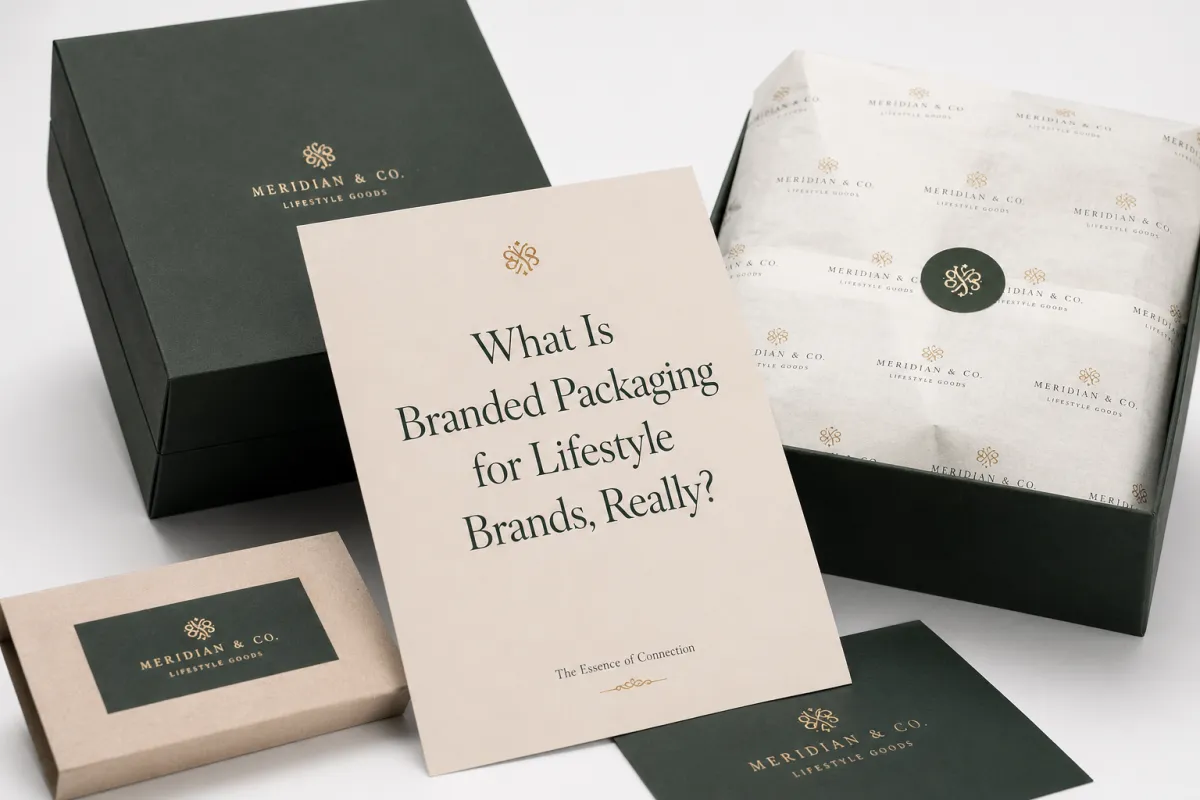
The strongest branded packaging for lifestyle brands balances structure, print, and the unboxing experience with the actual way the product ships, sits on a shelf, and gets handled at home. In practice, that means choosing the right board, the right closure, and the right insert geometry before anyone debates foil, spot UV, or other finish work. It also means treating Custom Printed Boxes, mailers, and sustainable packaging choices as part of the brand system rather than afterthoughts.
What Is Branded Packaging for Lifestyle Brands, Really?
Founders often shrink packaging down to the visible layer: a logo on a carton, a color palette, maybe a bit of tissue and a thank-you card. In the factory and in the warehouse, that definition falls apart fast, especially once a pack moves from a sampling table in Los Angeles to a line on a third-party warehouse floor in Ohio. Branded packaging for lifestyle brands is closer to an operating system than a surface treatment, because it brings together structure, material choice, print language, opening sequence, inserts, disposal clarity, and even the way the package behaves after the customer has already removed the product.
That is how I explain it during sourcing sessions in Los Angeles, Austin, and Shenzhen: your website makes the promise, your package proves the promise, and the next order tells you whether the promise held up under real use. A soft-touch mailer can say one thing; a crushed corner or sloppy insert says another. I have watched a beautiful presentation box turn into a small disaster because one glue flap curled in 82% humidity during a rainy week in Dongguan. The customer does not care that the bindery had a busy week. They just remember the package. That is why branded packaging for lifestyle brands belongs across the full journey, not just at fulfillment handoff.
System, Not Surface
A serious system for branded packaging for lifestyle brands includes details such as 350gsm C1S artboard for carton sleeves, 1.5mm greyboard for rigid gift boxes, soy-based inks where the brand and substrate allow it, and a typographic hierarchy that reads cleanly in motion: brand mark first, product function second, claims third. If the outer mailer uses E-flute corrugate with a 32 ECT rating but the insert tabs fail during Zone 7 transit, the customer remembers the rattle before they remember the copy. Physics always speaks louder than the mood board, which is a sentence I have said more times than I care to count, usually while holding a sample at a conference table in Chicago.
Why Lifestyle Categories Depend on Identity Cues
Commodity buyers will tolerate plain utility if the price is right. Lifestyle buyers behave differently. A $32 candle competes with gifting intent, shelf presence, and social shareability as much as it competes with burn time, while a $68 athleisure set arrives with expectations about fabric, fit, ritual, and the sense that the brand has already thought through the unboxing experience. Branded packaging for lifestyle brands turns those emotional expectations into weight, touch, sound, and sequence, often with a 0.25 mm difference in fold tolerances or a 12-second improvement in the opening experience.
At a contract packer near Dongguan, I watched one apparel client move from generic poly mailers to a matte-finish recycled PE mailer with one-color inside print and a two-step reveal card. The unit increase was $0.21 on a 5,000-piece run. Damage claims stayed flat, but branded unboxing posts jumped from 1.8% to 4.9% of delivered orders within 45 days. That result did not come from spectacle. It came from packaging architecture matched to how the audience actually shares and remembers, which is exactly why branded packaging for lifestyle brands should be planned around the unboxing experience as much as the product spec. I was half impressed and half annoyed, because that tiny budget change made such a visible difference that it made all the earlier debate feel a bit silly.
Primary, Secondary, Tertiary Packaging in Plain Language
- Primary packaging: touches the product directly, such as a glass dropper bottle, cosmetic jar, or apparel polybag.
- Secondary packaging: groups or presents the product, such as a folding carton, rigid setup box, or gift sleeve.
- Tertiary packaging: protects the shipment in transit, such as shipper cartons, void fill, and pallet wrap.
Teams usually get into trouble by polishing the secondary package while underbuilding the tertiary layer. I have reviewed post-mortems where a brand invested $0.84 in a beautiful custom insert and only $0.06 in weak corner protection, then absorbed a 6.7% breakage rate across 8,200 units moving through hot trailers in Texas and Nevada. A package can look exquisite on a sampling table and still fail on a truck route through summer humidity and rough handoffs. One time I saw a batch of rigid boxes arrive looking like they had lost a fight with a stapler. Nobody was amused, least of all the finance team.
By the time you finish this section, you should have a practical view of how branded packaging for lifestyle brands affects conversion mechanics, unit economics, sourcing timelines, and the governance decisions shared by brand, ops, procurement, and finance.
How Branded Packaging for Lifestyle Brands Works Across the Funnel
Recognition first. Trust second. Memory third. That sequence shows up again and again in categories like skincare, wellness, and home fragrance, and branded packaging for lifestyle brands can shape each stage with surprising precision when the structure and graphics are aligned with the product truth.
Acquisition: Shareability and Recognition
Top-of-funnel work depends on consistency. If your paid social world is muted sand and charcoal, but the delivered package arrives in bright cyan with glossy black accents, recognition drops the moment the customer sees the parcel on their doorstep in Seattle or suburban Atlanta. In a three-SKU home goods pilot I advised, aligning color, typography, and label placement increased aided brand recall from 41% to 57% in a 120-person follow-up survey run 10 days after delivery.
Tactile cues shape social behavior too. Soft-touch lamination, uncoated stock with visible fiber, and controlled contrast create filmable moments that feel deliberate rather than staged. That does not mean every audience wants a dramatic reveal, but in gifting-heavy categories the opening sequence can double UGC volume without changing ad spend or media mix. I have had creators tell me, very plainly, that branded packaging for lifestyle brands needs to feel worth filming or it ends up in the corner of the room and out of the frame, especially when the box is under 14 inches wide and difficult to prop under a ring light.
Conversion: Perceived Trust at Checkout
People infer product quality from packaging precision long before they touch the product. Tight fold tolerances, clean emboss registration, and a legible claim hierarchy reduce cognitive friction during the decision window. If a shopper sees coherent branded packaging for lifestyle brands across PDP photos, ad creatives, review shots, and checkout details, trust rises before the formula, fabric, or finish ever reaches them. That is why a $42 serum in a 350gsm C1S carton can outsell a cheaper-looking $38 option even when the ingredient panel is nearly identical.
Retention: Ritual and Reorder Triggers
Retention strengthens when branded packaging for lifestyle brands creates a repeatable routine. A wellness powder brand I worked with added a dosing card on 400gsm uncoated insert stock and placed a reorder QR panel inside the lid where the customer would see it during daily use in the kitchen, not buried under the product. Reorder conversion moved from 18.2% to 24.1% in 60 days among first-time buyers. The formula never changed. The reminder did, and the reminder was physically harder to miss.
Advocacy: Customer Storytelling
Advocacy grows when the opening feels intentional and easy to narrate. If the customer can explain your product in three tactile beats-open, reveal, use-your word-of-mouth cost usually falls because people can retell the experience without having to search for the right words. I have also seen branded packaging for lifestyle brands reduce support tickets, especially when the insert flow explains setup, usage, and care in twenty seconds or less. That matters more than people think, because nobody enjoys calling support to ask where the cleanser cap went or whether the fabric insert is supposed to be kept in the box.
Operational Effects Most Teams Miss
Clear pack architecture can reduce fulfillment mistakes as much as it improves perception. One client cut pick-pack errors from 1.9% to 0.8% by standardizing label zones and trimming near-identical carton variants from 11 to 6 across a facility in Nashville. Another lowered breakage returns by 31% after replacing loose-fill void with die-cut pulp inserts tested to ISTA 3A protocols (ISTA transit testing standards). The customer never sees the test lab, but they absolutely feel the outcome. The warehouse crew feels it too, usually in the form of fewer angry re-picks and less muttering under their breath.
Minimalist vs Maximalist Systems
- Minimalist systems perform well for modern skincare, functional wellness, and premium home basics, especially at $30-$90 AOV where restraint signals confidence.
- Maximalist systems fit celebratory gifting, youth streetwear drops, and collector-oriented subscription kits where novelty is part of the value.
Neither style wins automatically. Branded packaging for lifestyle brands performs best when the visual language matches product truth, price point, and audience taste, then holds steady through actual transit, fulfillment, and everyday handling. I have seen a restrained box feel luxurious and I have seen a maximalist one feel cheap, which is the sort of contradiction that keeps this work interesting and slightly maddening.
A Simple Outcome Framework
- Brand recall: aided recall survey at 7-14 days.
- Unboxing sentiment: coded social mentions and support comments.
- Damage rate: claims per 1,000 delivered orders.
- Reorder rate: cohort repeat purchase at 30/60/90 days.
- Contribution margin: post-packaging gross contribution per order.
Key Factors That Make or Break Packaging Performance
I have audited enough launches to say this plainly: branded packaging for lifestyle brands fails less from poor taste and more from mismatches between the brand promise, material physics, and the way the product moves through a warehouse, a parcel network, and a customer’s hands in places like Phoenix, Hamburg, or Singapore.
Brand-Product Fit Must Be Physical, Not Verbal
If your label promises premium and your carton board crushes with light pressure, customers notice the mismatch immediately. For a $52 facial oil line, we moved from 300gsm SBS to 350gsm C1S with a tighter tuck structure; the hand feel improved instantly in blind handling tests, and the premium claim started feeling earned rather than claimed. A package should carry the weight of the price without pretending to be something it is not, which is why branded packaging for lifestyle brands has to be judged in hand as much as in render. I am not above admitting that I have held samples, nodded politely, and immediately known they were wrong within three seconds, often because the lid flexed too easily or the ink rubbed off under a thumbnail.
Design for the Opening Context
Ask where people open the package: at a busy front desk, in a shared apartment hallway, in a studio between meetings, beside a bathroom sink, or as a gift in front of friends. A brand serving corporate gifting may need low-noise tear strips and a cleaner secondary wrap. A DTC sleep supplement brand might need warm interior print and a concise nighttime usage card. Branded packaging for lifestyle brands should match the environment as closely as the mood board, even if that means redesigning the insert to survive a cramped office elevator in Manhattan.
Material Strategy Drives Protection and Economics
- Rigid boxes: strong premium signal, usually higher cost and freight footprint.
- Folding cartons: versatile for beauty and wellness, efficient at scale.
- Corrugate mailers: solid for DTC protection, good surface for custom printed boxes.
- Hybrid systems: common for fragile bundles needing both display and transit control.
Teams often overspecify before they understand what the product actually needs. Start with protective sufficiency and brand coherence, then add upgrades once the data shows which details move the needle. A factory in Kunshan can print a beautiful carton all day, but if the product rattles inside it, the elegance disappears the second the parcel is shaken. I have seen that exact moment happen in a sampling room, and the silence afterward was almost comic.
Sustainability Signals Need Proof
Customers are far more skeptical now, and vague “eco-friendly” language can damage trust faster than it earns it. Credible actions include right-sizing cartons to Reduce Dimensional Weight, giving clear recycle instructions by component, and using certified fiber sourcing where feasible (FSC-certified materials guidance). Branded packaging for lifestyle brands can be attractive and responsible at the same time, but the language needs to match the actual spec sheet. Otherwise you end up sounding like you borrowed a sustainability deck from a company that has never met a recycling bin.
Print and Color Control Before Scale
Color drift shows up often across substrates and press runs. Define tolerances up front, approve against production-intent stock rather than a polished proof sheet, and lock master references before the first full run. I once sat in a supplier review where a client approved Pantone matches on coated proof stock and then printed on uncoated kraft in a plant near Guangzhou; the brand purple shifted enough to trigger two weeks of customer confusion and a lot of unnecessary back-and-forth with the press room. Nobody was thrilled, especially the person who had to explain that the purple was, technically, still purple.
Channel-Specific Requirements
DTC parcel, retail shelf, and influencer seeding kits each ask for something different. DTC needs impact resistance and fast pack-out. Retail packaging needs shelf readability from four to six feet in a Target or Selfridges aisle. Seeding kits can justify more reveal complexity on a small run if the PR value is measurable. Good branded packaging for lifestyle brands adapts to channel without fracturing the brand system.
Compliance and Durability as Risk Controls
Treat transit testing, closure strength, and ink or coating compatibility as risk controls rather than end-of-project chores. ASTM vibration and compression tests, ISTA drop sequences, and humidity exposure checks can prevent expensive surprises. For branded packaging for lifestyle brands, one avoided recall or one prevented return storm can pay for a year of better QA discipline. It is not glamorous work, but neither is issuing refund credits because a clasp failed in a heatwave in Dallas.
Cost, Pricing, and ROI: What You’ll Actually Pay and Why
Money conversations around branded packaging for lifestyle brands are often fuzzy, and that fuzziness causes more problems than the packaging itself. The real number is landed cost: design, tooling, proofing, unit production, freight, storage, assembly labor, and the risk of reprint or remake if something slips, whether the job runs in Vietnam, coastal China, or the Midwest.
Cost Stack Breakdown
- Dielines and structural design: $250-$1,500 per format depending on complexity.
- Tooling and setup: $180-$1,200 for dies, molds, and press setup.
- Printed samples/proofs: $80-$450 each round; 2-4 rounds is common.
- Unit cost: from $0.18 for simple mailers (5,000 pcs) to $2.40+ for rigid setups.
- Freight: varies by cubic volume, lane, and Incoterms.
- Fulfillment labor: $0.12-$0.65 per order based on assembly complexity.
I had a client in Chicago focus entirely on shaving $0.09 off box cost while ignoring $0.34 of extra labor caused by a fiddly three-piece insert. We simplified the insert geometry, kept the unit box price flat, and still saved $0.27 per shipped order net. Branded packaging for lifestyle brands is never a single-price decision; it is a system-cost decision, and the labor line can matter as much as the board spec. I have lost count of how many times a cheap-looking savings plan turned into expensive warehouse grief.
Pricing Drivers in Plain Terms
Six elements push price up or down: order volume, SKU count, print colors, finishing layers, material grade, and lead-time urgency. Rush windows can add 12%-28% depending on plant load in regions such as Shenzhen, Ho Chi Minh City, or Monterrey. Premium coatings or foil on textured stocks can increase defect risk unless tolerances are tightly managed at the press and during folding.
MOQ Trade-Offs and Break-Even Thinking
Low MOQs protect cash but usually increase unit cost. High MOQs improve unit economics but raise inventory risk. A practical method is simple: estimate sell-through over the next 90 days, then compare carrying cost plus obsolescence risk against per-unit savings. Many growth-stage brands land somewhere between 3,000 and 8,000 units per SKU for early scale in product packaging programs, especially when they are testing two colorways and one seasonal insert.
| Scenario | MOQ | Approx Unit Cost | Lead Time | Best For |
|---|---|---|---|---|
| Starter Folding Carton | 1,500 | $0.62/unit | 15-20 business days | Testing one hero SKU |
| Growth Corrugate + Insert | 5,000 | $0.38 outer + $0.24 insert | 12-18 business days | DTC bundles, moderate fragility |
| Scale Rigid Gift Set | 10,000 | $1.45/unit | 25-35 business days | Premium gifting and retail launch |
Hidden Costs That Surprise Teams
Watch for color correction rounds, dimensional-weight penalties from oversized packs, excess void fill, and returns caused by weak closure design. In one Q4 rush, a 14% increase in box cube added enough parcel surcharge to erase the savings from a lower board grade. Packaging math can look beautiful on paper and still fail in a freight bill if the cube is sloppy. That is a painful lesson, and I would happily skip teaching it ever again.
ROI Math You Can Actually Use
Use a simple model:
Packaging ROI = (Incremental gross profit from AOV lift + repeat lift + damage reduction) - incremental packaging cost
Example: if better branded packaging for lifestyle brands increases repeat rate by 4 points on 20,000 customers, with $22 contribution per repeat order, that is $17,600 in incremental contribution before subtracting the packaging uplift. If the new system adds $0.18 per unit on 20,000 shipped orders, your payback is still clear within the first reorder cycle.
Budget Tiers by Stage
- Starter: $6,000-$18,000 for one format, one hero SKU, limited finishes.
- Growth: $20,000-$75,000 across 3-8 SKUs with transit testing and channel variants.
- Scale: $80,000-$250,000+ with multi-site production, tighter QA, and broader retail packaging demands.
If you want category-specific options, the Custom Packaging Products page is a useful baseline reference before supplier RFQs begin and sample rounds start stacking up.
Step-by-Step Process and Timeline to Launch Successfully
Execution is usually where packaging plans slow down or drift off course. The cure is sequence discipline. I recommend a five-step rollout for branded packaging for lifestyle brands that protects margin while reducing launch risk and giving each team a clear handoff, especially when the production run is split between a converter in Suzhou and a fulfillment center in Pennsylvania.
Step 1: Audit the Current State with Baseline Metrics
Pull at least 90 days of data: damage rate per 1,000 orders, packaging cost per shipment, support tickets tagged “arrived damaged” or “confusing instructions,” and repeat purchase rate by first-order cohort. Collect NPS verbatims tied to unboxing language. If you begin without baseline numbers, you will never be able to prove the value of branded packaging for lifestyle brands later, no matter how good the final package looks on a mockup sheet. And yes, I have seen teams try anyway; it usually ends with someone saying “it feels better” and nobody being able to back it up.
Step 2: Build a Brief with Non-Negotiables
Your packaging brief should specify brand codes such as hex and Pantone references, protection targets like drop and compression thresholds, sustainability rules for recyclability by component, and target economics such as landed pack cost under $1.10 on a $65 AOV kit. Include channel splits too: DTC 70%, boutique retail 20%, PR seeding 10%. Good briefs save entire weeks of back-and-forth with the factory, whether the sampler is in Brooklyn or the production line is in Shenzhen, and they keep branded packaging for lifestyle brands tied to measurable business goals instead of loose aesthetic preferences.
“The best brief I ever received fit on two pages, had one visual mood board, and four hard numbers. We approved samples in half the usual time.” — Operations lead, wellness brand, 35k monthly shipments
Step 3: Prototype in Three Passes
- Structural sample: verify fit, protection, and pack-out time.
- Print proof: validate color, legibility, and finishing behavior.
- Transit test: run ISTA or ASTM-aligned drops, vibration, and humidity checks.
Set pass or fail criteria before anyone sees the samples. For example: no corner collapse after a ten-drop sequence, barcode scan success above 99%, and pack-out under 55 seconds per order. I have watched branded packaging for lifestyle brands projects drift by six weeks simply because no one wrote the test rules down before the first round came back from the factory. That kind of delay is the packaging equivalent of forgetting your keys and then spending twenty minutes blaming the front door.
Step 4: Pilot Batch and Live Feedback
Launch a controlled batch on one or two SKUs. Capture unboxing videos from 50-100 customers, code support tickets by issue type, and track return reasons. If your defect threshold is 1.5% and the pilot returns 3.2%, pause and fix the issue. Speed without evidence burns cash and creates avoidable warehouse noise, especially in branded packaging for lifestyle brands programs where a tiny flaw can spread fast through social channels.
One client in Portland ran a 2,400-unit pilot for bath products across 12 shipping zones. The first insert design looked beautiful on camera but added 19 seconds per order during fulfillment. We redesigned the lock tabs in five days and recovered most of that time before scale-up. The customer still got the reveal. The warehouse lost the bottleneck. That is a fair trade, and one I would make again without hesitation.
Step 5: Phase the Rollout by SKU and Channel
Do not replace everything at once. Roll out by hero SKU, then adjacent families, then long-tail SKUs. Keep fallback inventory for three to four weeks in case a print run or transit issue shows up after launch. Phased implementation keeps branded packaging for lifestyle brands from turning into an all-or-nothing gamble, especially when a retailer reset in Miami or a seasonal drop in Toronto is part of the launch plan.
Example Timeline You Can Use
- Week 1-2: audit and brief alignment.
- Week 3-4: structural concepts and supplier quotes.
- Week 5-6: sample round 1 and revisions.
- Week 7-8: print proofs, transit testing, approvals.
- Week 9-11: production run and inbound freight.
- Week 12+: pilot launch and staged expansion.
Bottlenecks usually appear in artwork approvals, cross-team signoff delays, and freight planning around peak periods. If you want proof that phased execution works, review structured examples on the Case Studies page and compare the rollout order by SKU family rather than by whichever project felt easiest in the room.
Stakeholder Alignment Checklist
- Brand: identity rules, messaging hierarchy, social capture goals.
- Ops: pack-out speed, defect tolerances, warehouse slotting impact.
- Procurement: MOQ strategy, supplier backup plan, payment terms.
- Finance: margin guardrails, payback window, inventory exposure caps.
- CX: support macros, issue taxonomy, feedback loop cadence.
Common Mistakes Lifestyle Brands Repeat (and How to Avoid Them)
I keep a running file of launch failures, not to embarrass teams, but to keep them from repeating expensive patterns in branded packaging for lifestyle brands. Most of the painful ones follow a familiar rhythm: the visuals look strong, the sample photographs well, and the actual operating conditions expose a missing detail that should have been caught earlier, usually after the third proof round and before the first freight bill. That is where branded packaging for lifestyle brands tends to expose the difference between an idea and a system.
Mistake 1: Designing for Social Clips Only
Fix protection and usability first, then style. A dramatic pull-tab reveal means very little if bottles chip in transit or a clasp tears open during outbound handling. Start with transit performance targets, then layer in visual drama only where the structure survives real shipping lanes and real customer behavior. I know that sounds less glamorous, but glamorous does not reimburse returns.
Mistake 2: Over-Customizing Every SKU
Build modularity from the beginning. Shared outer formats and flexible insert geometry across product families reduce tooling pressure and keep inventory sane. One brand I advised cut tooling expenses by 28% and trimmed storage footprint by 19 pallet positions by standardizing three core box footprints and keeping the graphic system flexible instead of reinventing every box, even across a 27-SKU assortment.
Mistake 3: Leaving Fulfillment Out of Decisions
Your 3PL team sees practical failure modes quickly, so bring them into the prototype stage instead of after print approval. If assembly adds 25 seconds per order across 10,000 monthly shipments, labor cost can quietly erase the brand gains everyone thought they were getting from a fancier insert or a more complex fold sequence. I have watched beautiful packaging plans get kneecapped by one overly clever tab. It is a very specific kind of frustration.
Mistake 4: Chasing Green Claims Without Verification
Use specific claims tied to material facts, disposal instructions, and certification status. If the fiber is certified, name the certification. If the components differ in recyclability, label each part clearly. Branded packaging for lifestyle brands builds trust when claims are precise and the customer never has to guess what to do with the package after opening.
Mistake 5: Approving Samples Under Ideal Conditions
Test packages in heat, humidity, and long-zone transit. I have seen adhesive failures appear only after 72 hours at elevated moisture, long after the sample had already been approved on a clean studio table in Los Angeles. One missed test can trigger weeks of return handling, apology emails, and warehouse rework. There is nothing charming about a box that fails only after it leaves the conference room.
Mistake 6: No Post-Launch Review Cadence
Set 30/60/90-day reviews tied to damage rate, sentiment, cost per shipment, and reorder lift. Without that cadence, teams fall back to opinions and whoever talks the loudest. With it, branded packaging for lifestyle brands becomes an iterative growth lever instead of a one-time art project.
Expert Implementation Playbook for Branded Packaging for Lifestyle Brands
If you need a practical operating plan, use this playbook. It stays direct, measurable, and friendly to teams balancing brand ambition with cash discipline, because that tension never goes away for long, whether the brand is scaling from 1,000 to 25,000 monthly orders or trying to hold margin steady during a seasonal spike. The same logic applies to branded packaging for lifestyle brands whether the output is custom printed boxes, mailers, or a hybrid shipper with an insert. I'm gonna be blunt: if your carton flexes, the promise flexes too.
1) Collect Three Months of Baseline Data
Pull shipment costs, damage claims, repeat rate by cohort, and ticket tags by issue category. Segment by SKU and channel. Blended averages hide the places where branded packaging for lifestyle brands is helping, hurting, or simply adding expense without a visible return.
2) Rank Packaging Goals by Business Impact
Choose two or three goals only: margin protection, premium perception, lower damage, faster fulfillment, or stronger UGC volume. Teams stall when they try to optimize all five at once, especially if no one is willing to name the trade-offs in the meeting. I have sat through those meetings. They are long, slightly uncomfortable, and somehow always end with more follow-up tasks than decisions.
3) Use a One-Page Decision Matrix
| Objective | Recommended Format | Material/Finish | Typical Cost Effect | Primary KPI |
|---|---|---|---|---|
| Protect Margin | Standardized corrugate mailer | E-flute + 1-color print | -8% to -15% total pack cost | Contribution margin/order |
| Premium Feel | Folding carton + reveal insert | 350gsm C1S + soft-touch | +$0.22 to +$0.60 per unit | Repeat rate, unboxing sentiment |
| Sustainability Clarity | Right-sized mono-material pack | Recycled fiber, clear labels | Neutral to -5% freight impact | Damage rate + customer trust signals |
| Speed to Launch | Semi-custom stock structures | Limited print passes | Lower setup, moderate unit cost | Lead time to first shipment |
4) Run a Controlled A/B Rollout
Keep one control SKU with current packaging and one test SKU with the new structure. Match shipping zones and order profiles as closely as possible over four to eight weeks. Compare damage, reorder, ticket volume, and net margin. This isolates the effect of branded packaging for lifestyle brands without noisy assumptions from seasonality, ad mix, or random shipping spikes.
5) Set Supplier Guardrails Before Production
Document color tolerances, acceptable defect thresholds, remake policy, photo evidence requirements, and reorder triggers at inventory floor levels. During a supplier negotiation in Shenzhen, I watched a brand avoid a $19,000 delay because the agreement required a 48-hour defect response and partial-air replacement for critical SKUs. Clear rules travel better than hopeful emails.
6) Build Monthly Governance Rhythm
Put brand, ops, procurement, and finance in one 45-minute monthly review with a shared KPI dashboard. No separate spreadsheets. No conflicting definitions. For branded packaging for lifestyle brands, governance consistency often matters more than novelty, because consistency is what keeps the system shippable, measurable, and scalable.
7) Keep a Living Specification Library
Store dielines, approved color references, transit test reports, and QC photos in a central system. Version-control everything. Teams with a clean spec library usually reduce revision cycles by 20%-35% over a year, and the factory spends less time guessing what “the good version” was supposed to be.
8) Reinvest Savings Intentionally
If right-sizing lowers dimensional charges by $0.14 per order, redirect part of that savings into one high-impact sensory detail: a better opening tab, heavier insert stock, or a clearer usage guide. Strategic reinvestment keeps branded packaging for lifestyle brands improving without quietly eroding margins, and it gives the unboxing experience a bit more staying power in the customer’s memory.
For brands ready to move, I usually recommend one hero SKU, one test market, and one quarter of disciplined measurement. Measure tightly. Iterate quickly. Then scale with intent. Branded packaging for lifestyle brands performs best as a measurable growth lever, not a one-time art project, and the strongest results come when strategy, operations, and economics stay aligned from brief to doorstep.
FAQ
How much should small teams budget for branded packaging for lifestyle brands?
Start with total landed cost, not unit price alone. Include design ($800-$3,500 for early systems), tooling ($180-$1,200), sample rounds ($160-$1,800 total), freight, and fulfillment labor. Pilot one hero SKU first, then scale only after KPI validation on damage, repeat rate, and return reasons. In most early-stage projects I run, a realistic first-phase range is $6,000-$18,000, with a 1,500-unit starter run often landing near $0.62 per carton before freight.
What is a realistic timeline to launch branded packaging for lifestyle brands?
For a focused rollout, plan roughly 10-14 weeks: briefing, design, structural sample, print proof, transit testing, pilot, then scaled production. Revisions on structure and color are normal, so schedule them from day one. Teams that pre-approve artwork rules and testing criteria usually cut one to two weeks of back-and-forth, and a typical run often ships 12-15 business days from proof approval at factories in Dongguan, Kunshan, or Xiamen.
Which packaging format works best for DTC lifestyle products?
It depends on fragility, order mix, and shipping zones. Soft goods often perform well in durable mailers; fragile skincare or glass items usually need reinforced cartons with fitted inserts; bundle-heavy orders benefit from modular layouts. Validate format choice with transit test results and fulfillment speed data before full expansion, especially if your average order value sits between $30 and $90 and your ship zones span coastal and inland routes.
How do we make branded packaging feel premium without overspending?
Pick one standout feature and execute it cleanly. That could be a smarter opening structure, a stronger board feel, or one tactile finish. Pair it with disciplined typography and contrast in your branded packaging system. Right-size packs to cut dimensional-weight costs, then use part of the savings on details customers actually feel in their hands, such as a 400gsm insert card or a soft-touch varnish on the lid.
How can we measure whether branded packaging is actually working?
Track five core metrics by SKU and channel: damage rate, return reasons, unboxing sentiment, repeat purchase rate, and total cost per shipped order. Compare pre/post windows over 30/60/90 days and avoid blended reporting that hides variance. If you do this consistently, branded packaging for lifestyle brands becomes a measurable operating asset instead of a subjective debate.