What Custom Bicycle Stickers Really Need to Survive
A bicycle sticker has a harder life than a retail label sitting on a box. Custom bicycle stickers have to grip curved tubes, fork legs, helmets, bottles, rims, tool cases, and molded plastic accessories while dealing with UV exposure, road grit, chain lube, sweat, rain, degreaser, frame bags, cable rub, roof racks, and repeated handling.
That last detail matters more than buyers expect. Riders tend to lift a bike by the same tube, lean it against the same wall, strap it to the same rack, and wipe the same spots after a wet ride. A decal placed in that traffic zone needs a different construction than a giveaway sticker stuck to a notebook.
Bike decals can serve many jobs: frame branding, fork graphics, helmet marks, event packs, race numbers, shop promotions, service labels, club kits, water bottle decals, repair kit labels, warning marks, reflective safety accents, or retail merchandise. Each use changes the spec. A temporary race sticker needs fast application and clean readability. A long-wear frame decal needs edge adhesion and abrasion resistance. A premium badge-style graphic may call for metallic film, foil, domed resin, or a tightly controlled kiss-cut shape.
The artwork is only one variable. Good decals depend on face film, adhesive chemistry, print method, laminate, cutting accuracy, and surface preparation. Miss one, and a sharp logo can lift at the edge, fade early, wrinkle across a compound curve, or disappear visually on a dark frame.
Think of bicycle stickers as small outdoor product graphics. They are closer to durable equipment labeling than basic promotional print. The same discipline used in packaging design applies here: define the surface, the handling conditions, the expected lifespan, the finish, and the final presentation before production begins.
How Bike Decal Materials, Adhesives, and Finishes Work
Most bicycle decals start with a pressure-sensitive film. White vinyl is the dependable workhorse because it gives strong color, predictable opacity, and broad compatibility with digital printing. Clear vinyl is useful when the frame color should show through, although it can flatten colors on black, navy, forest green, raw carbon, or deep metallic paint unless white ink is printed under the design.
Metallic film gives a frame-badge effect. Holographic film reads more promotional and energetic. Reflective film is useful for commuter kits, fleet identification, night-riding accents, and safety labels. Textured specialty films can look expensive, but they should be tested before a full order because texture, stiffness, and adhesive flow all influence how the decal behaves on curved tubing.
Flexible vinyl usually makes the most sense for frames and forks. Round tubes, tapered fork legs, and helmet shells ask the decal to bend slightly during application. Paper labels are a poor choice for true outdoor bike use; they absorb moisture, tear, and break down quickly. Rigid plastic films can work on flat accessories, but they may bridge over curves and lift along the edge when applied to a frame tube.
Adhesive deserves the same attention as the face stock. Permanent acrylic adhesive is common for long-wear branding, shop decals, and product labels. Removable adhesive may suit demo bikes, temporary events, rental fleets, or race-day markings where clean removal matters. High-tack adhesive can help on textured powder coating, molded plastic, or slightly lower-energy surfaces, but it allows less repositioning during installation.
Finish controls appearance and wear. Gloss laminate sharpens color and sheds dirt well. Matte laminate gives a quieter factory-style look, especially on low-glare modern frames. Satin sits between them and often works for premium merchandise. A clear laminate or coating commonly adds about 2 to 4 mils of protection, depending on the construction, which helps shield ink from UV, water, degreaser, mild abrasion, shipping scuffs, and storage wear.
Practical rule: if the decal will live outdoors on a frame, fork, helmet, rim, bottle, or commuter accessory, specify outdoor film with a protective laminate unless the use is clearly short-term.
Printing method changes the result too. Digital printing is efficient for short runs, full-color art, gradients, and several designs grouped on one sheet. Screen printing can make sense for larger quantities with bold spot colors, especially where ink density and repeatability matter. Foil, metallic bases, and specialty finishes raise perceived value for retail packs and branded merchandise, but they add setup time and usually require cleaner vector artwork.
Material claims should stay precise. Resources from FSC and the EPA can help buyers think about sourcing, waste, and environmental language, but bicycle decals are normally specified around durability first. If sustainability is part of the buying brief, ask for actual material details rather than broad green language.
Key Specs to Decide Before You Order Bike Stickers
Start with size. Not the size that looks good on a screen, and not the size estimated from a product photo. Measure the actual frame tube, fork leg, helmet panel, rim section, bottle, pouch, or case where the decal will sit. A 90 mm logo may look modest on a laptop mockup and oversized on a narrow seat stay. On small tubes, even 5 mm can decide whether an edge lays cleanly or wraps into a difficult curve.
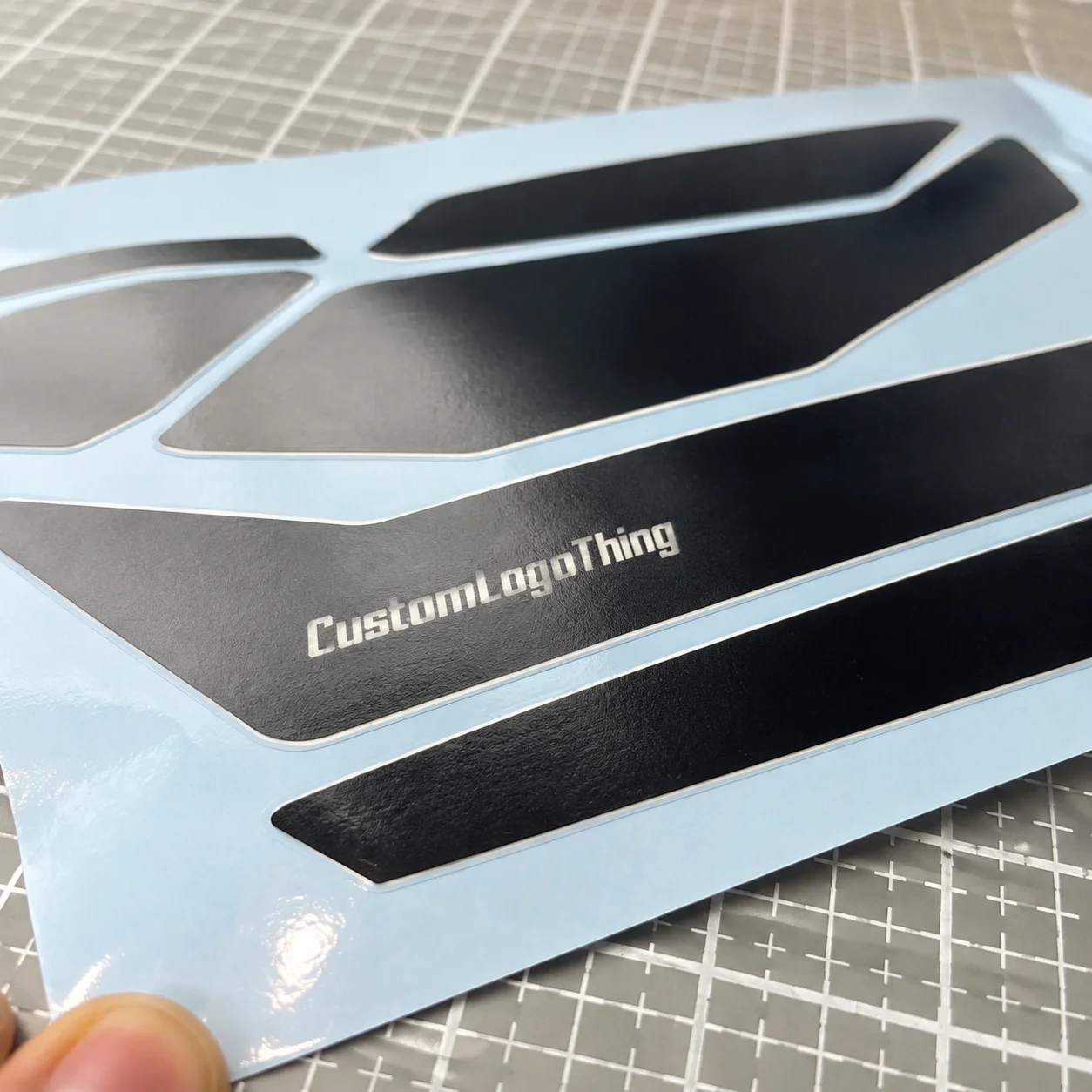
Shape comes next. Rectangles and ovals are economical and easy to apply. Die-cut logos feel more custom but need clean cut paths, enough material around fine details, and realistic minimum stroke widths. Kiss-cut sheets are efficient for decal kits because the backing stays together while each sticker peels off. Transfer decals suit one-color lettering or separate logo elements that need exact spacing. Wraparound tube labels require careful sizing because overlap, seam position, and tube diameter all matter.
Color needs production thinking. Bright colors look strongest on white film because the white base reflects light. Clear film allows the frame color to become part of the design, which can look refined on light paint and nearly vanish on darker finishes. Metallic and holographic bases shift color in ways that may not match brand guidelines. If the design goes on clear, metallic, or dark material, a white ink layer may be needed behind the art.
Durability should be stated plainly. Is the decal for a one-day charity ride, a seasonal shop promotion, long-term frame branding, outdoor commuting, a retail sticker pack, or a bikepacking setup that will rub against bags for months? A temporary event label does not need the same build as a frame graphic exposed to weather, washing, and abrasion.
Surface compatibility also changes the choice. Glossy paint, matte clear coat, raw carbon, aluminum, steel, powder coating, helmets, bottles, and molded plastic accessories do not all behave the same. Low-energy plastics and textured powder coatings may need a stronger adhesive or a material test. Fresh paint can create adhesion problems too; many coatings need time to cure before stickers are applied.
Safety and visibility can be built into the spec. Reflective material works well for commuter accents and fleet identification. Warning labels near batteries, chainrings, suspension parts, brakes, or moving components need clear contrast at the final printed size. Race and club identification should be readable from a practical distance, not only crisp in a zoomed PDF.
Before requesting quotes, build a short spec sheet: finished size, quantity, material, finish, adhesive type, cut style, color requirements, intended placement, number of artwork versions, packing format, and target date. That simple document prevents half the usual back-and-forth.
Cost, Pricing, and MOQ Factors for Bicycle Sticker Orders
Pricing is driven by material, finished size, total quantity, artwork versions, print method, laminate, cutting complexity, packing format, and shipping. A simple one-color white vinyl logo is not priced like a laminated reflective decal with a fine die-cut border and three design versions.
Small runs cost more per piece because setup work does not shrink much. File prep, proofing, press calibration, material loading, color checks, lamination, cutting setup, inspection, and packing still happen whether the order is 100 pieces or 5,000. For small outdoor vinyl decals, short runs may land around $0.70 to $2.50 per piece. Larger runs of simpler laminated shapes can fall into the $0.12 to $0.45 range. Reflective, metallic, holographic, domed, or individually packed decals usually sit higher because raw material, finishing time, and handling increase.
| Sticker Type | Typical Best Use | Common Cost Behavior | Buyer Watchout |
|---|---|---|---|
| Simple one-color vinyl decal | Club logos, shop marks, small frame IDs | Lowest cost at medium to large quantities | Fine lettering may weed or cut poorly if too small |
| Full-color laminated outdoor decal | Frame graphics, helmets, bottles, event packs | Moderate cost; efficient for mixed designs | Skipping laminate can shorten outdoor life |
| Reflective sticker | Commuter accents, safety kits, fleet ID | Higher material cost than standard vinyl | Confirm reflectivity and color expectations |
| Metallic or holographic sticker | Premium branding, retail packs, badge-style graphics | Higher cost due to specialty film and setup | Brand colors may shift on reflective bases |
| Intricate die-cut decal | Logo silhouettes and custom shape kits | Cost rises with cut time and complexity | Tiny points and narrow bridges can lift early |
MOQ means minimum order quantity, but in practice it is the lowest quantity that still makes sense for the material and process. Digital jobs often support lower minimums than screen-printed, specialty film, or custom die-cut work. Separate artwork versions, custom cutting dies, retail bagging, or multiple packing groups can raise the practical minimum.
If the same project also needs Custom Labels & Tags for bags, boxes, repair kits, or hang cards, ask whether the decal and label work can be planned together. Shared artwork review, coordinated color targets, and smarter sheet layouts may reduce waste or at least reduce avoidable rework.
A useful quote request includes quantity, dimensions, material preference, indoor or outdoor use, finish, artwork files, number of designs, delivery location, packing needs, and target date. Hidden cost areas include artwork cleanup, rush charges, split designs, custom packaging, individually cut pieces instead of sheets, and upgraded shipping. Compare total delivered value, not unit price alone. A cheaper unlaminated decal that scuffs after a few rides has simply moved the cost somewhere else.
Process and Timeline from Artwork to Finished Decals
The normal production flow is quote, specs, artwork, proof, approval, print, laminate or finish, cut, inspect, pack, and ship. It sounds linear. The problems usually appear earlier than buyers expect: vague sizing, missing cut paths, low-resolution art, unclear placement, or a last-minute change after proof approval.
Artwork review is not just opening the file and checking whether it looks attractive. Production needs to verify resolution, vector paths, color mode, bleed, cut lines, white ink layers, spelling, orientation, and layout count. For sticker sheets, spacing between decals matters because operators need enough room for clean cutting and easy peeling. For singles, backing size, corner radius, and packing method affect both usability and cost.
A digital proof is the buyer’s chance to confirm size, color intent, cut shape, layout, and design count before production. It is not a perfect color match on every monitor, but it should show final construction clearly enough to catch errors. If color, fit, opacity, or surface compatibility is critical, ask about a material swatch, pre-production sample, or press proof. A paper mockup confirms size. A real material test shows edge adhesion, finish, stiffness, and opacity.
Lead time depends on order size, material availability, specialty finishes, custom cutting, proof approval speed, lamination cure time, inspection needs, and shipping distance. A clean digital job using stocked white vinyl and standard laminate may run about 7 to 12 business days after proof approval. More complex work with reflective film, metallic film, sampling, multiple versions, or retail packing may need 15 to 25 business days. Rush production may be possible when artwork is production-ready, materials are stocked, and approvals happen quickly.
Plan backward from the race, shop event, club kit release, bike build, retail drop, or product launch. If decals are part of a broader set of Custom Packaging Products, such as hang tags, insert cards, printed boxes, or display-ready packaging, build in enough time for all pieces to arrive together. Stickers are small, but they can still become the final bottleneck if proof approval sits idle for three days.
Common Mistakes That Make Bicycle Decals Fail Early
The most common failure is using cheap indoor stock on an outdoor bicycle. Paper and low-grade films can lift, fade, wrinkle, or absorb moisture quickly. They may be fine for a one-day handout. They are not built for rain, UV, degreaser, grit, and repeated washing.
Skipping laminate is another risky shortcut. Bare ink can look good fresh off the printer, then scuff faster than expected under frame bags, cable rub, car racks, trail dust, shoe contact, and wash mitts. Laminate is not armor. It does, however, give the print a practical layer of defense. For high-rub zones, move the decal, reduce its size, or pair it with clear protective film.
Designing too small creates problems that no press operator can fully fix. Thin lettering, tiny QR codes, delicate strokes, and detailed badges may become unreadable or hard to cut cleanly. Keep small text readable at arm’s length. Avoid hairline strokes below what the print-and-cut process can hold. Test QR codes at final size with an actual phone rather than trusting a zoomed screen preview.
Surface preparation decides adhesion. Stickers should not be applied over wax, dust, oil, silicone polish, wet paint, or textured contamination. Clean the area, let it dry fully, and apply at a moderate temperature. Cold vinyl can feel stiff and less forgiving. Touching the adhesive with fingers, stretching the film, repositioning too often, or washing the bike too soon after application can all shorten the decal’s life.
Clear stickers on dark frames are a classic disappointment. The art may look sharp on a white proof and dull on black paint. White ink backing or a white film base solves many of these issues. Tight curves and compound surfaces create another challenge; one large stiff graphic may wrinkle where two smaller decals or segmented artwork would lay flat.
Removal is worth considering before installation. Permanent adhesives can leave residue, especially after heat, sun exposure, and long service. Removable adhesives reduce that risk but may not survive as long in punishing conditions. Valuable carbon frames, matte finishes, and custom paint should be tested in a discreet area before a large decal kit is applied.
Next Steps to Prepare Artwork and Order with Confidence
Good ordering starts before the quote form. Measure the placement area with a ruler or caliper, photograph the surface, choose the durability level, decide on gloss, matte, or satin finish, estimate quantity, and confirm the date needed. If the sticker is part of retail packaging, a club launch, or a shop promotion, plan the related pieces together so the visual system stays consistent.
Prepare vector artwork when possible. AI, EPS, or production-ready PDF files are preferred for logos, lettering, die cuts, and clean edges. Outline fonts. Keep cut lines on a separate layer. Add bleed where color runs to the edge, often around 1.5 to 3 mm depending on supplier requirements. Label brand colors clearly, and call out white ink instructions for clear, metallic, or holographic materials.
Raster files can work for illustrated or photographic designs if they are high enough resolution at final print size. A 300 dpi file at actual size is a common target for detailed print. Large simple graphics may tolerate less depending on viewing distance and art style, but enlarging a tiny web PNG rarely ends well. The file may open. The edges will tell the truth.
Test fit with a paper mockup on the actual frame, helmet, bottle, or accessory. Cut the shape roughly, tape it in place, and view it from normal riding and retail distances. Rotate the handlebars. Check cable paths. Think about knees, shoes, frame bags, bottle cages, repair stands, roof racks, and cleaning habits. A decal that looks perfect on a flat proof may need to shrink by 10 percent to fit a real tube.
Ask direct production questions: What film suits this surface? Is the adhesive permanent, removable, or high tack? How thick is the laminate? Is the build suitable for outdoor use? Will the design work better as singles or sheets? Can the proof show cut lines, white ink, and finished size? These are normal questions, not special requests.
The strongest orders usually arrive with measurements, artwork, quantity, material preference, finish choice, intended placement, packing format, and deadline already defined. That preparation helps the finished decals fit better, last longer, and carry the same care expected from well-planned product packaging.
FAQ
What material is best for custom bike decals used outdoors?
Flexible vinyl with a weather-resistant adhesive is usually the safest starting point for outdoor bicycle use. Add gloss, matte, or satin laminate to protect the print from UV exposure, abrasion, water, chain lube, and cleaning products. Reflective, metallic, and clear films can also work, but they should be matched to the frame color, surface texture, and expected wear.
How long do custom bicycle stickers usually last on a frame?
Durability depends on film quality, adhesive, laminate, surface preparation, placement, and riding conditions. A laminated outdoor vinyl decal can last far longer than an unlaminated promotional sticker, especially on glossy painted metal or carbon surfaces. High-rub areas near cables, shoes, frame bags, or chain slap will wear faster and may need extra protection or a different placement.
Can bicycle stickers be applied to matte, carbon, or powder-coated frames?
Yes, but testing is smart because matte coatings, carbon clear coats, and powder-coated textures can affect adhesion and removal. The surface should be clean, dry, and free of wax, polish, silicone, oil, and dust before application. For valuable frames, ask about removable adhesives, sample testing, and compatibility with the specific finish.
What files should I send when ordering custom cycle stickers?
Vector files such as AI, EPS, or PDF are preferred for logos, lettering, die cuts, and clean production edges. Include outlined fonts, separate cut lines, bleed, color notes, and any white ink instructions for clear or metallic materials. High-resolution PNG, TIFF, or PSD files may work for full-color artwork if they are sized correctly for the final print.
Are custom bicycle stickers better as singles or sticker sheets?
Individual stickers are convenient for retail packs, giveaways, service counters, and event handouts. Sticker sheets are efficient when you need several small decals, multiple logo sizes, warning labels, or accessory stickers in one kit. Sheets can reduce handling and packing time, while singles may feel more premium when each decal is handed out or sold separately.