Buyer Fit Snapshot
| Best fit | black friday carton packaging strategy for shipping for packaging buyers comparing material specs, print proof, MOQ, unit cost, freight, and repeat-order risk where brand print, material, artwork control, and repeat-order consistency matter. |
|---|---|
| Quote inputs | Share finished size, material target, print colors, finish, packing count, annual reorder estimate, and delivery region. |
| Proofing check | Approve dieline scale, logo placement, barcode or warning zones, color tolerance, and any recyclable or compostable wording before bulk production. |
| Main risk | Vague material claims, crowded artwork, or missing packing details can create delays even when the unit price looks attractive. |
Fast answer: Black Friday Carton Packaging Strategy for Shipping should be specified like a repeatable production item. The safest quote includes material, print method, finish, artwork proof, carton packing, and reorder notes in one written spec.
What to confirm before approving the packaging proof
Check the product dimensions against the actual filled item, not only the sales mockup. Ask for tolerance on folds, seals, hang holes, label areas, and retail display edges. If the package carries a logo, QR code, warning copy, or legal claim, reserve that space before decorative graphics fill the panel.
How to compare quotes without losing quality
Compare board or film grade, print process, finish, sampling route, tooling charges, carton quantity, and freight assumptions side by side. A lower quote is only useful if the supplier can repeat the same color, closure quality, and packing count on the next order.
Black Friday carton packaging strategy sounds neat on a planning deck, right up until the tape guns start stuttering, the pick lanes clog, and a tired dock crew realizes cardboard dust sticks to damp gloves like burrs to denim. I have spent enough time around packing floors in Joliet, Illinois, and along the I-75 corridor outside Atlanta to know the trouble rarely begins with the carrier. It starts in those last rushed minutes at the pack station, where an associate is folding a 12 x 9 x 4 RSC, sealing it with 2-inch hot-melt tape, slapping on a label, and trying to keep pace with a queue that seems to grow every time someone blinks. I still remember one November shift in a 220,000-square-foot 3PL where the tape machine was so loud it felt like the building itself was annoyed.
A serious Black Friday carton packaging strategy is not just picking a box and hoping for the best. It is a working plan for carton sizing, board grade, label placement, print instructions, pack-out rules, and shipping lane choices, all tuned to survive peak pressure without falling apart. Once one piece slips, the whole operation starts to grind: more repacks, more kraft paper filler, more crushed corners, more carrier adjustments, and more customer complaints before the weekend is even over. In practical terms, that can mean the difference between a carton spec that clears 1,800 outbound orders a day and one that jams the line when the 43rd pallet of the morning reaches staging. Honestly, the carton is one of the most underestimated parts of the fulfillment system.
I learned that lesson years ago while helping a fulfillment team outside Chicago that had strong demand forecasts and a terrible carton mix. They had stocked six box sizes for nearly 140 SKUs, but nobody had matched those cartons to the real order profile, which was averaging 1.7 units per order and shifting hard toward bundles on Thursday nights. By the second weekend of peak, workers were stuffing void fill into oversized cartons just to keep the closure line moving, and the line rate dropped by 18 percent. The product itself was fine. The process was not. That is why a Black Friday carton packaging strategy has to be built around real warehouse behavior, not a polished spreadsheet fantasy that looks pretty and then melts on contact with reality.
What Does a Black Friday Carton Packaging Strategy Really Mean?
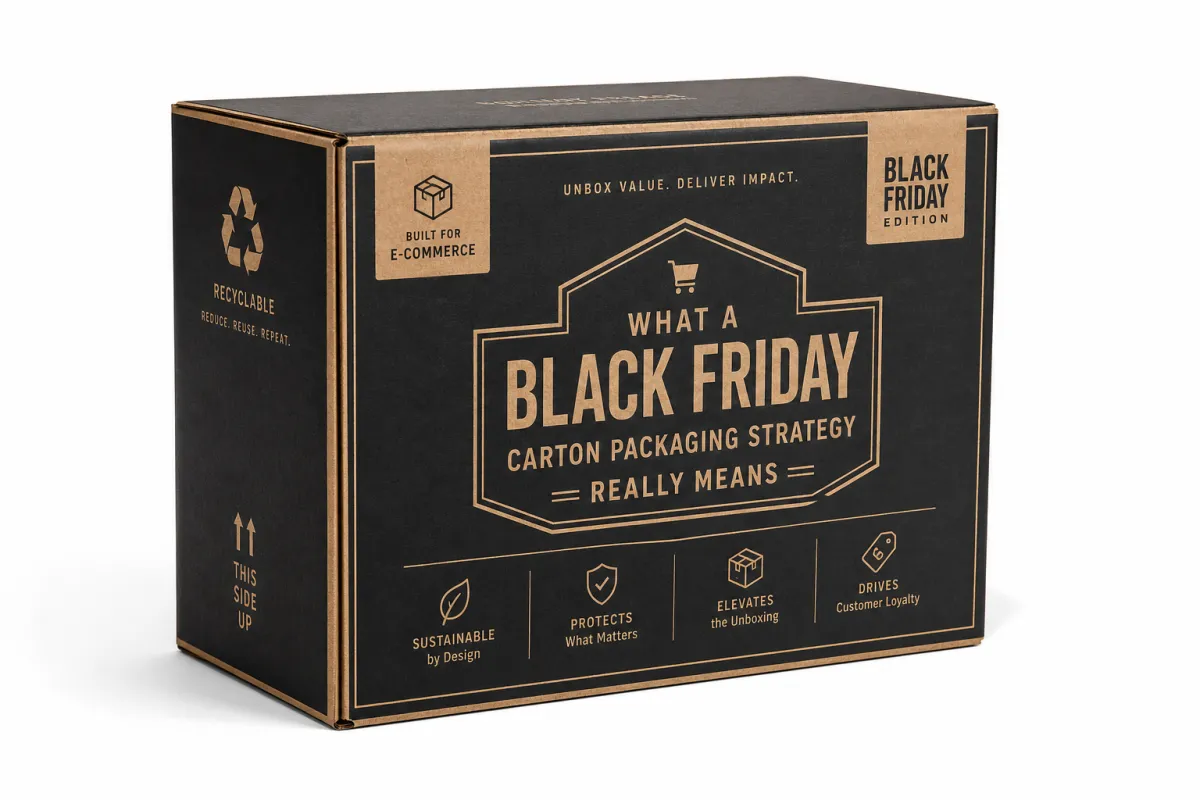
At floor level, a Black Friday carton packaging strategy means making repeatable decisions before the rush begins. It means choosing which carton sizes belong at each station, which board grades can carry your heaviest parcels, which labels go where, and how packers handle orders that do not fit the standard case pack. Ad hoc carton choice, the kind where someone grabs whatever is within reach, may survive a slow Tuesday with 300 orders. It falls apart quickly when the queue doubles, temporary labor arrives, and every second starts to matter. I have seen people reach for the nearest carton like it was the last chair on a crowded subway, which is basically how peak season feels when the dock door is open and the heat is running.
The difference between a strategy and a reaction shows up in the details. A reaction says, "Use a bigger carton and add filler." A strategy says, "This SKU family ships in a 10 x 8 x 6 RSC, 32 ECT, with two inches of top clearance, one die-cut insert, and a preprinted orientation label on the long panel." The second version sounds stricter because it is, but it also keeps the line moving because nobody has to improvise under pressure. A good Black Friday carton packaging strategy lowers decision fatigue, and that is one of the sneakiest enemies of peak season. People do not just get busy; they get mentally tired after the fifth hour on the line, and then the little judgment calls start to wobble.
Black Friday changes the rules because volume spikes, SKU mix gets messier, and orders that usually leave as neat singles suddenly show up as mixed bundles, gifts, or add-on purchases. I have watched a cosmetics client move from 60 percent single-item orders to 43 percent mixed-SKU orders in less than a week, with the shift centered on a promotion that ran from Chicago to Phoenix and hit hardest after 8:00 p.m. The carton plan fell apart because the box count had been sized for the wrong behavior. The smartest Black Friday carton packaging strategy expects that shift and leaves room for the messier orders that always arrive once promotions go live. If the promo bundle drops and the cartons do not fit the new shape of demand, the whole line starts acting like it was surprised by the calendar, which is never a flattering look.
There is also a real difference between protecting product and protecting throughput. The best Black Friday carton packaging strategy does both. It keeps the box strong enough to survive stacking, conveyor transfers, and carrier handling, while also keeping packers from wrestling with oversized cartons, awkward closures, or extra tape passes. In my experience, the strongest programs are the boring ones: standard carton depths, clean print marks, simple pack rules, and a tight approval loop with operations, procurement, and the corrugated supplier. Boring is underrated. Boring is what keeps your Friday from turning into a mess of broken seals and annoyed supervisors.
"We stopped treating cartons like a commodity and started treating them like part of the line design," a fulfillment supervisor told me after a brutal November shift in Louisville, Kentucky. "That one change cut our repacks almost in half."
If you want a practical definition, here it is: a Black Friday carton packaging strategy is the system that keeps shipping intact while order volume rises, labor gets stretched, and carrier service comes under pressure. It protects the product, reduces friction at the table, and keeps damage claims from becoming the loudest cost in the building. It also saves a surprising amount of sanity, which I do not usually put on a budget sheet, though maybe I should when the dock is running 14 trailers behind schedule.
How Does a Black Friday Carton Packaging Strategy Work on the Floor?
The easiest way to understand a Black Friday carton packaging strategy is to follow one carton from receiving to dock staging. A corrugated case is more than a container; it is a working tool. It moves through kitting, picking, packing, sealing, labeling, sortation, and palletization, and every handoff opens the door to either speed or trouble. If the carton is the wrong size, the packer burns time hunting for void fill. If the label panel is too small, scanning slows. If the closure is weak, the box gives out during stacking. I have watched all three happen in the same hour at a facility outside Indianapolis, and nobody enjoyed the experience.
On a well-run line, carton assortment matches the order profile. Single-SKU parcels usually need compact cartons with a tight fit and minimal void fill. Mixed-item gift orders need enough depth for inserts, tissue, or dividers without crushing the contents. Bulk replenishment cartons, especially those carrying nested product or club-sized items, often need stronger board and better compression resistance. A Black Friday carton packaging strategy is really a matching exercise: the carton should fit the order pattern, the order pattern should fit the labor model, and the labor model should fit the lane volume. If those three things are out of sync, somebody is going to pay for it in overtime or damage claims.
Pack-out standards matter because they remove guesswork. A good floor guide says exactly when to use paper void fill, when to use Molded Pulp Inserts, when to switch to double-wall, and when to reject a carton that looks technically correct but behaves badly on the line. I once worked with a retailer in Dallas that printed a simple four-color pack matrix and posted it at every station, with carton images, SKU family names, and a one-line note for each exception. Their temporary staff picked it up in one shift, and the entire Black Friday carton packaging strategy became easier because people stopped improvising with every order. That little poster probably saved me three headaches a night.
Carton design also affects downstream handling. Compression strength matters on pallets, especially when the bottom layer sits under 35 to 45 inches of stacked product. Barcode visibility matters when the carton passes under a scan tunnel. Print legibility matters when a sorter reads orientation marks or route codes at speed. If the carton flexes too much, the label wrinkles and scanners start missing. If the panel is too glossy or the print is crowded, the system slows. A Black Friday carton packaging strategy is never only about the box; it is about the whole handling path from the first touch to the last mile.
That is why the fastest line is not always the one with the most aggressive carton reduction. I have seen warehouses try to save corrugate by trimming dimensions too tightly, only to create an avalanche of repacks because workers could not close the carton without crushing the product. The better answer is usually a balanced one: a carton that fits the SKU family, closes cleanly, survives movement, and still leaves enough room for the team to work at speed. That balance is the heart of a Black Friday carton packaging strategy. It is less flashy than a dramatic cost cut, but it saves far more headaches and usually reduces tape use by a full wrap per case.
Key Factors That Decide Carton Performance
Carton dimensions come first. Oversized cartons waste corrugate, tape, and void fill, and they often push dimensional weight charges upward. Undersized cartons create product movement, crushed corners, and closure problems. The sweet spot is usually tighter than most teams expect, but not so tight that the product has to be forced into the case. In a strong Black Friday carton packaging strategy, fit is measured against the actual item, the protective insert, and the transit lane, not against what happens to be sitting in the storeroom. I always trust the measurement tape more than the memory of the person who swears that box worked last year.
Board strength and flute selection come next. For lighter e-commerce parcels, a 32 ECT single-wall box may be enough. For heavier kits, mixed SKUs, or anything with meaningful crush risk, 44 ECT or double-wall construction may be the better choice. Flute choice changes the behavior too: B-flute can print cleanly and stack neatly, while C-flute gives more cushioning and better vertical strength. I have watched a supplier in Foshan, Guangdong, move a client from a weak single-wall spec to a better-balanced B/C combination and reduce corner failures without adding much labor. That kind of adjustment belongs in a Black Friday carton packaging strategy, not in a last-minute fire drill where everyone is muttering at the pallet jack.
Print and label requirements deserve more attention than they usually get. Clear orientation marks, scannable barcodes, route panels, and compliance information can make a measurable difference when cartons move across multiple touchpoints. If you sell through retail channels as well as direct-to-consumer, retail packaging marks may need to line up with fulfillment labels, or the sortation team will slow down to resolve conflicts. The cleanest Black Friday carton packaging strategy is the one that reduces ambiguity for both humans and machines. Confusion is expensive, and nothing exposes it faster than a full dock at 6:15 p.m. on a Thursday with three trailers waiting at the gate.
Product fragility changes everything. Electronics need impact control and precise fit. Cosmetics need closure integrity and protection against leakage or crushed presentation. Food-adjacent goods may need extra care around temperature swings, humidity, and odor transfer. Mixed kits often need dividers or inserts to keep components from colliding. The same carton that works for apparel can fail badly for glass jars. A Black Friday carton packaging strategy should group products by handling risk, not just by dimensions. If I sound a little defensive about this, it is because I have seen too many teams assume "it ships fine in summer" means "it will ship fine in peak season." Spoiler: it often does not, especially once the dock starts seeing 38-degree mornings and 74-degree afternoons.
Sustainability matters too, but honest sustainability is the goal, not the kind that sounds good in a presentation and falls apart on the dock. Right-sizing, better board use, and fewer reworks all reduce waste. That is cleaner than swapping in thinner material and hoping the carrier network stays kind. If your program needs certification support, both the Forest Stewardship Council and the packaging standards resources at ISTA can be useful references for material and transit guidance. A thoughtful Black Friday carton packaging strategy should protect product and avoid unnecessary corrugate at the same time, whether the board is coming from a converter in Ohio or a plant in Nuevo Laredo.
One more detail gets overlooked constantly: board performance changes with humidity and storage conditions. I have seen cartons staged near a dock door in Savannah pick up enough moisture to soften crush resistance by the time the second shift started, especially on rainy November afternoons. That kind of failure stays invisible until a pallet leans or a top layer caves. For that reason, a Black Friday carton packaging strategy should include storage rules, not just carton specs. I know that sounds unglamorous, but peak season loves to punish whatever nobody bothered to write down.
Cost and Pricing: What the Strategy Changes in Your Packaging Budget
A good Black Friday carton packaging strategy changes the budget conversation because the carton unit price is only one part of the cost. Void fill, tape, labor minutes, repacks, damage claims, and dimensional weight charges often add more than the box itself. I have seen teams chase a $0.04/unit carton saving and then lose it back on the first wave of replacements because the box could not survive the carrier network. That kind of math makes a finance team wince in exactly the way it should, especially when the claims line hits five figures by Monday morning.
Here is a simple truth from a supplier negotiation I handled for a cosmetics client in New Jersey: the cheapest carton on paper was not the cheapest carton in the building. Their original stock box ran about $0.39/unit, but it drove extra filler and slowed closure. A custom-sized option made in Dongguan, Guangdong, came in at $0.54/unit for 5,000 pieces, yet it cut packing time by 11 seconds per order and reduced damages enough to justify the switch. The spec used a 32 ECT board with water-based flexo print, and the approval cycle took 14 business days from proof signoff to factory release. That is the kind of math a Black Friday carton packaging strategy should use. I would rather pay a few cents more for a carton that behaves than spend the next six weeks rescuing failed shipments.
| Option | Best For | Example Unit Cost | Typical Lead Time | Tradeoffs |
|---|---|---|---|---|
| Stock cartons | Stable SKU mix and predictable parcel sizes | $0.15 per unit for 5,000 pieces | 2-5 business days | Lowest planning effort, weaker branding, more filler risk |
| Custom printed boxes | Branded packaging and tighter fit control | $0.54 per unit for 5,000 pieces | 12-15 business days from proof approval | Better presentation and fit, needs earlier approval |
| Hybrid program | Top sellers plus a few overflow sizes | $0.33-$0.67 per unit at 5,000 pieces | 7-12 business days | Good balance of control and flexibility, needs clear stocking rules |
The table above is not a quote, but it does show how the Black Friday carton packaging strategy changes the cost structure. A hybrid setup often makes sense when the top three carton sizes cover 70 to 85 percent of orders, especially if one of those sizes is a 10 x 8 x 6 RSC and another is a 12 x 9 x 4 mailer. That lets you keep a branded, controlled pack experience without overcommitting storage space to cartons that may barely move. I like that approach because it leaves room for the oddball orders without turning the whole inventory plan into a guessing game.
Storage and forecasting matter too. Minimum order quantities can look fine until they start taking over a mezzanine or crowding a pick path. I once visited a warehouse in Texas where unused carton pallets blocked two emergency aisles because purchasing had doubled down on an optimistic forecast. The team saved on carton price, then lost time every day moving inventory out of the way. That is not a good trade. A Black Friday carton packaging strategy should include carrying cost, not just box cost, because the hidden costs usually show up wearing steel-toe boots and a bad attitude.
There is also the question of shipping cost. Right-sized cartons can cut dimensional weight charges, and even a small reduction adds up across thousands of orders. If a carton change trims average billable weight by 0.6 lb across 1,000 daily shipments, the savings can show up fast, especially in higher-cost zones like Zone 5 to Zone 8. Your finance team will notice, but only if the Black Friday carton packaging strategy has enough discipline to measure it. I am a big fan of actual numbers here, because vibes do not pay freight invoices.
If your team is also evaluating Custom Packaging Products, this is the moment to compare carton options against inserts, labels, tape, and any printed branding elements. I like to look at the full pack cost per order, because product packaging decisions made in isolation often hide extra labor somewhere else in the process. A box can look inexpensive right up until it starts demanding more tape, more filler, and more patience than anyone on the floor has left. If you are adding a branded sleeve, a 350gsm C1S artboard wrap can be a better fit than a heavier rigid insert, especially for gift sets that ship from a converter in Monterrey rather than a boutique shop with tiny run lengths.
Process and Timeline: From Spec Sheet to Peak-Season Readiness
A proper Black Friday carton packaging strategy starts with a carton audit. Pull the top-selling SKUs, the heaviest SKUs, the highest-return SKUs, and the mixed-order profiles. Measure the actual fill, not the ideal fill. Then map carton sizes against those orders and flag the gaps. That audit should happen before sample development, because no carton supplier can solve a fuzzy brief very well. I have sat in enough kickoff calls in Milwaukee and Charlotte to know that "we need something better" is not a brief; it is a cry for help with a deadline attached.
After the audit, the timeline usually moves through prototype approval, print proofing, fit checks, transit testing, production release, inbound receiving, and line-side deployment. If you want a realistic window, allow 3 to 5 business days for sampling, 2 business days for proof signoff, and 12 to 15 business days from proof approval to finished cartons when the work is running through a domestic converter in Ohio or a regional plant in northern Mexico. Add another 3 to 7 days if you need a reprint or a change to the die line. A Black Friday carton packaging strategy that gets approved too quickly often fails in the exact places it was rushed through. Fast approvals feel efficient right up until the first box collapses under real load.
Here is how I like to break the ownership up: operations defines the pack flow, procurement secures the supply, QA reviews performance, fulfillment supervisors validate daily use, and the corrugated supplier translates all of that into specs. If one group is missing, the carton often ends up solving the wrong problem. I have seen procurement pick the cheapest spec, only to have operations reject it because the flap geometry made the tape head misfire on a Pregis line at 42 cartons a minute. That is a classic process failure, not a material failure. A strong Black Friday carton packaging strategy keeps the team in the same room early, before everyone starts defending their own corner.
Mock runs are worth their weight in freight charges. A carton can look perfect on a drawing and still feel terrible on the line. Test it with temporary staff, not just the packaging engineer. Test it at the same pace you expect on the rush shift. Test the labels under the same lighting and the same scanning setup. If you can, do a half-day pilot with real order mix, real tape, and real dock staging. That is the fastest way to discover whether the Black Friday carton packaging strategy actually works where it matters. A desk can lie to you. A packed tote usually cannot.
One client in the Midwest held a two-hour pilot with the top five order profiles, and they found that one "ideal" carton created a closure problem because the inner pack shifted during tote transfer. The fix was tiny: a slightly different insert, a 3 mm change in box depth, and a switch from standard acrylic tape to hot-melt. That adjustment saved them from a much larger mess later and kept them on schedule for a November 14 go-live. Good Black Friday carton packaging strategy work is often like that: small changes, real relief. The glamorous version is rare; the useful version is precise.
Build a contingency window into the calendar. Forecasts shift, SKUs get substituted, and a promotional bundle may sell far faster than the merchant team expected. Keep spare inventory staged at the warehouse or co-packer, and define a fallback carton set before the pressure starts. A Black Friday carton packaging strategy is stronger when it assumes there will be at least one surprise and plans for it in advance. If you plan for perfection, the first surprise will feel like a disaster. If you plan for disruption, it just feels like Tuesday with louder music.
Common Mistakes That Derail Peak-Season Cartons
The first mistake I see constantly is trying to use one carton size for too many products. It looks efficient on a procurement sheet, but it usually creates a mess on the floor. Workers need extra filler, the closure takes longer, and the carton has too much empty space or too little protection. A Black Friday carton packaging strategy that relies on one-size-fits-all thinking will usually pay for that choice in labor and damage. I get why teams try it, but it is a little like bringing one wrench to fix every machine in the building, including the strapping equipment and the label applicator.
The second mistake is waiting until the rush is underway to test board strength, tape performance, or label placement. By then, any fix costs more because labor is already stretched and the dock is already full. I remember a supplier meeting in Los Angeles where the client asked for a stronger spec after three days of damage claims. The problem was not the suggestion; it was the timing. A Black Friday carton packaging strategy needs validation before volume peaks, not after the first wave of failures. Once a carton starts failing in production, every delay feels more expensive than the last one.
Third, procurement and operations often talk past each other. Procurement may buy based on cost per thousand, while operations cares about line speed and pack consistency. If those two views do not line up, the warehouse ends up with cartons that are technically on spec but operationally wrong. I have seen mixed carton pallets arrive with two similar sizes that were one inch apart in width, and the team spent the day sorting them by hand near aisle 14 just to keep the line alive. That is a weak Black Friday carton packaging strategy and an avoidable one. Nobody wants to spend peak season becoming an amateur carton sorter.
Fourth, over-optimizing for cost can backfire. A carton that saves a few cents can cost dollars in replacements, service credits, and customer frustration. A better decision is usually the one that balances unit cost against packing speed, claim rate, and shipping efficiency. The smartest Black Friday carton packaging strategy does not worship the lowest number; it protects the total margin. There is a difference between being careful and being penny-wise in the most expensive way possible, especially when the carrier surcharge table gets updated on a Friday afternoon.
Fifth, people underestimate handling conditions. Wet storage, dirty pallets, crushed stack loads, and weak sealing habits can ruin a strong design. I once watched a perfectly good carton program fail because boxes were stored on the floor near a loading bay where condensation built up overnight and the bottom tier wicked moisture from the concrete. The spec was fine. The handling was not. A Black Friday carton packaging strategy should include storage discipline, pallet wrap rules, and tape standards that everyone follows. Otherwise the nicest carton in the world gets treated like a disposable napkin.
"We thought the box was the problem," a client told me after a spike in claims at a site in Pennsylvania. "Turns out we were storing it wrong, sealing it fast, and stacking it badly. The carton was only part of the story."
Expert Tips and Next Steps for Peak-Season Execution
If I had to give one practical rule from years around converters, co-packers, and busy fulfillment floors, it would be this: standardize the top three carton sizes and make the rest of the line as simple as possible. That one change can remove a surprising amount of friction. A focused Black Friday carton packaging strategy works better than a complicated one with too many corner cases. Simplicity is not lazy here; it is disciplined, especially when the top three sizes cover 78 percent of outbound orders.
Another habit that pays off is pre-taping critical SKUs or staging assemblies near the pack line before the rush starts. A cosmetics or electronics order that always uses the same insert, the same carton, and the same closure sequence should not require six decisions. Remove those choices, and the team gains speed without giving up control. That is one of the cleanest wins in a Black Friday carton packaging strategy. It also reduces the little moments of frustration that add up by hour four of a shift, when even a missing roll of tape can feel personal.
I also recommend one short weekly review during the build-up period. Look at damage counts, pack times, carton usage, and any line stoppages tied to packaging. You do not need a giant meeting. Fifteen minutes can be enough if the data is honest and the team is ready to act. Small issues become big only when nobody watches them. A disciplined Black Friday carton packaging strategy uses feedback while there is still time to respond. I have seen a tiny label issue snowball into a full-throttle repack headache because nobody wanted to interrupt the schedule. That kind of "we'll deal with it later" thinking is how later becomes expensive.
Before the rush starts, run a checklist that includes carton inventory, print accuracy, label placement, seal strength, and temporary staff training. Temporary workers can be excellent, but they need simple rules and clear examples. If they are expected to guess, they will slow down or make mistakes. A Black Friday carton packaging strategy should feel teachable in one shift and dependable over a long weekend. If the training takes more than one coffee break to explain, it probably needs another pass.
From there, assign one owner, lock the carton spec set, run one live pilot shift, and write down the fallback plan for stockouts or SKU changes. That last part matters more than people think. The cleanest systems still need a backup carton, a backup label roll, and a backup way to get product out the door if something shifts overnight. In my experience, the most dependable Black Friday carton packaging strategy is the one built early, tested once on the floor, and protected by clear ownership. It is also the one that has a named backup contact at the converting plant, whether that plant sits in Monterrey, Dongguan, or just down the road in the next industrial park.
Honestly, I think the biggest mistake teams make is believing peak season will reward improvisation. It usually does the opposite. The warehouses that hold up best are the ones that did the dull, careful work ahead of time: measured the packs, checked the closures, confirmed the board grade, and trained the staff on the simple version first. That is how a Black Friday carton packaging strategy keeps orders moving without turning every carton into a problem to solve. There is a real kind of pride in watching a line run cleanly because someone bothered to sweat the details before the crowd showed up.
For Custom Logo Things, the next move is straightforward: pull your actual order mix, compare it against your carton set, and decide which three sizes deserve the most attention. Once that is clear, the rest of the packaging design gets a lot easier to manage, whether you are building branded packaging, Custom Printed Boxes, or a cleaner product packaging system for the busiest shipping window of the year. If you need a printed insert or belly band, a 350gsm C1S artboard spec is a practical place to start, and a regional converter in Guadalajara or Charlotte can usually turn that around faster than a large offshore plant. A strong Black Friday carton packaging strategy is not a last-minute rescue plan; it is a quiet advantage built long before the dock gets crowded. The takeaway is simple: lock the top three carton specs, pilot them on the real line, and keep a fallback size on hand so peak week does not force your team to improvise under pressure.
FAQ
How do I choose the right carton size for Black Friday packaging?
Start with your top-selling order profiles and size cartons to the most common pack scenarios, not the rare outliers. Leave enough room for protection materials without creating excessive void space that increases movement and shipping cost. Test the carton on the actual packing line so you know it is fast to fill, close, and label, ideally with the same 2-inch tape and scan setup used on the night shift. That approach keeps your Black Friday carton packaging strategy grounded in real operations instead of guesswork. I like to compare the carton against the messiest real order, not the neat sample order everyone hopes will show up.
What board strength should a Black Friday carton packaging strategy use?
Use the lightest board grade that still survives handling, stacking, and carrier movement for the product weight and fragility level. Move to stronger single-wall or double-wall construction when cartons carry heavier items, mixed SKUs, or higher crush risk. Validate the spec with drop, compression, and transit checks before peak volume starts, and keep an eye on humidity if the cartons are staged in a dock area in places like Savannah or Houston. A Black Friday carton packaging strategy that ignores board strength usually pays for it later in damage claims, and nobody enjoys explaining why the "cheap" box was not cheap at all.
How can carton packaging reduce Black Friday shipping costs?
Right-sized cartons Reduce Dimensional Weight Charges and cut down on unnecessary filler and tape. A stable carton spec lowers repacks, labor time, and damage-related replacements that quietly add up. Standardizing carton sizes also helps purchasing negotiate better rates and forecast inventory more accurately, especially when a 5,000-piece order from a converter in Monterrey or Dongguan can be timed against your sales calendar. That is why a Black Friday carton packaging strategy affects far more than box spend alone. The carton decision reaches into labor, freight, and customer service whether people want it to or not.
When should a Black Friday carton packaging strategy be finalized?
Finalize the core carton specs well before peak season so there is time for samples, testing, and line trials. Keep a short contingency window for forecast changes, but avoid redesigning cartons during the rush. If you wait until order volume spikes, there may not be enough time to correct fit, strength, or supply issues. A Black Friday carton packaging strategy works best when the hard decisions are made early, before everyone is exhausted and the dock is full of good intentions. For most teams, that means locking the spec 6 to 8 weeks before the first major promotional drop.
What are the best first steps if our cartons are causing damage?
Audit the top damage SKUs first and inspect where the failure happens: fit, closure, stacking, or handling. Compare carton size, board grade, and void fill against the actual product weight and transit path. Run a small pilot correction on the worst offenders before changing the whole packaging program, and keep the test to one shift so the team can see whether the fix holds under real throughput. That focused method keeps your Black Friday carton packaging strategy from becoming a broad, expensive guess. And if the root cause turns out to be storage or sealing behavior, well, that is annoying, but at least it is fixable.


