Buyer Fit Snapshot
| Best fit | Order Recycled Paper Hang Tags projects where brand print, material claims, artwork control, MOQ, and repeat-order consistency need to be specified before quoting. |
|---|---|
| Quote inputs | Share finished size, material target, print colors, finish, packing count, annual reorder estimate, ship-to region, and any compliance wording. |
| Proofing check | Approve dieline scale, logo placement, barcode or warning zones, color tolerance, closure strength, and carton packing before bulk production. |
| Main risk | Vague material claims, crowded artwork, missing packing details, or unclear freight terms can make a low unit price expensive after revisions. |
Fast answer: Order Recycled Paper Hang Tags: Sustainable Branding should be specified like a repeatable production item. The safest quote records material, print method, finish, artwork proof, packing count, and reorder notes in one written spec.
Production checks before approval
Compare the actual filled-product size with the drawing, then confirm tolerance on folds, seals, hang holes, label areas, and retail display edges. Reserve space for logos, QR codes, warning copy, and material claims before decorative graphics fill the panel.
Quote comparison points
Review material grade, print process, finish, sampling route, tooling charges, carton quantity, and freight assumptions side by side. A quote is only useful when the supplier can repeat the same color, closure quality, and packing count on the next order.
Order Recycled Paper Hang Tags: Sustainable Branding
If you need to order recycled paper hang tags, the first thing most people notice is how far the material has moved from the old “brown and scratchy” stereotype. A well-built tag often starts with a 320gsm to 350gsm recycled board, then moves through sharp die-cutting, one-color or two-color offset printing, and a trim that feels deliberate in the hand rather than thrown together at the last minute. I still remember a press visit in Dongguan, Guangdong, where a sample pack included recycled board that felt closer to specialty stationery from Shanghai than to packaging filler, and that moment changed the room. The tag is small, yes, but it carries the brand story right at the handoff point, which is exactly where shoppers decide whether the product feels credible. For brands that want to order recycled paper hang tags with real commercial value, that moment matters as much as the sheet itself.
I have watched a retailer pick up a sample, read the fiber note, scan the QR code, and go from skeptical to interested in under 20 seconds. That is why brands that order recycled paper hang tags are buying a practical sales tool, not just paper and string. A tag can hold price, SKU, batch number, material content, care symbols, and a short origin line without forcing the carton or garment label to carry all the weight. For clothing, beauty, snacks, stationery, and handmade goods, that little panel can hold the information a buyer needs while keeping the product itself visually clean. On a sales floor in Shenzhen or at a trade show in Ningbo, that kind of compact clarity is worth real money, especially when the tag is built from FSC-certified recycled board and printed with crisp typography.
Too many buyers compare recycled stock with ordinary commodity board and stop there, which misses the part that changes the outcome. A good recycled tag can reduce virgin fiber use, print cleanly, and still hang straight on a retail peg after a long freight run from eastern China to a warehouse in California. A weak board, by contrast, curls under humidity, feathers at the edge, or makes a premium product look rushed. I have seen that problem in a July showroom in Guangzhou, where tags began to warp after three hours under warm lights and 65% humidity. The spec sheet, the finish, and the punch placement matter more than the slogan printed on the front, and that is why experienced buyers order recycled paper hang tags with the same care they give to garment labels or carton board.
Why order recycled paper hang tags instead of standard stock?
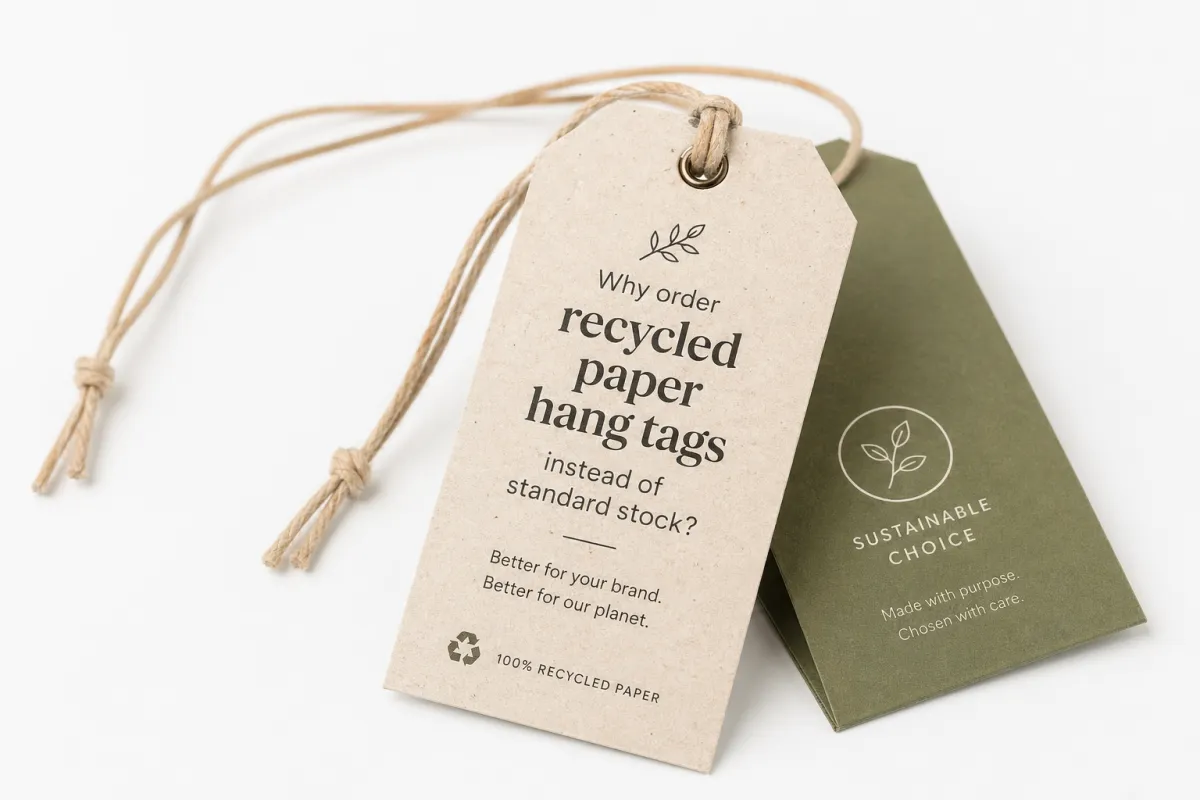
I still remember a denim buyer who walked into a press check in Zhongshan expecting recycled stock to look dull and heavily textured. We showed her a warm white recycled board at 330gsm with a blind deboss and black one-color printing, and she stopped mid-sentence to ask where the paper came from. That is the practical reason brands order recycled paper hang tags: the sustainability story lands, but the presentation still feels premium enough for a boutique rack. The board in that run cost about $0.19 per unit at 5,000 pieces, and the buyer told me later that the tag made the jeans feel more expensive than the previous season’s coated stock. That kind of reaction is not accidental; it comes from paper choice, ink density, and a finish that respects the material instead of hiding it. It also helps when the tag uses post-consumer recycled content and a clean die-cut that feels intentional in the hand.
There is also a commercial reason that shows up in real stores. At arm's length, the hang tag is often the first piece of copy a customer actually reads. A sewn label or carton back panel may never get the same attention, especially if the shopper is moving quickly through a rack in a 900-square-meter retail floor in Melbourne or Toronto. So when buyers order recycled paper hang tags, they are making the sustainability claim visible at the moment of decision, which matters for a launch, a seasonal refresh, or a premium collection that needs a cleaner material narrative. I have seen a customer read the hang tag longer than the packaging insert, and the store associate just stood there smiling because the product had already started selling itself. That small physical pause is often what a brand pays for.
From a cost perspective, recycled tags are not always cheaper than virgin stock, and I would not pretend otherwise. A heavier recycled board can cost more per sheet, especially when the mill is supplying a tighter fiber mix or an FSC-certified blend from a plant in Zhejiang or Jiangsu. The return shows up in smaller ways that add up: fewer extra insert cards, cleaner merchandising, less verbal explanation from staff, and a more unified shelf presentation. A client who spends $0.21 per tag instead of $0.16 may still save money if the tag replaces a separate booklet or a second label. I have always thought the smarter savings target is the full retail workflow, not the first line on a quote, and that is especially true when the team needs to order recycled paper hang tags across a whole product family.
“I thought recycled would mean compromise. Instead, the 330gsm sample felt more premium than the coated tag we ran last spring.”
That came from a beauty brand manager after we compared three options in one meeting: 280gsm uncoated recycled, 330gsm FSC-certified recycled blend, and a brighter white recycled board with a soft matte varnish. She chose the middle option because it gave the best balance of stiffness, print clarity, and hand feel for a product line launching in Singapore and Hong Kong. When you order recycled paper hang tags with that sort of comparison in mind, you stop guessing and start choosing based on measurable tradeoffs such as caliper, opacity, and edge cleanliness. That is the part I enjoy most, because it turns taste into a spec the factory in Dongguan or Wenzhou can actually build against.
For clothing, candles, grooming products, snacks, and handmade goods, the tag also has a merchandising job. Price, SKU, origin, batch, and care symbols all need a stable surface that survives packing, transit, and shelf handling. I have seen a 55mm x 90mm tag outperform a larger format because the smaller size made a denim jacket feel cleaner on the peg hook and kept the collar area from looking crowded. So yes, recycled stock is a sustainability choice. It is also a display choice, and a very practical one when a store manager in London or Sydney is sorting 400 units onto a rack before opening. If you plan to order recycled paper hang tags for a retail rollout, that balance between clarity and restraint is worth protecting.
Order recycled paper hang tags: sizes, shapes, and finishes
When clients order recycled paper hang tags, the first design decision is usually shape, not print. A rectangle works for most products because it gives enough room for a logo, a price, a barcode, and a short material statement in a 45mm x 90mm or 50mm x 100mm format. A square feels more editorial and is often used for boutique candles, gift boxes, and artisanal food lines that want a calmer layout. Rounded corners are common for fashion and beauty because they resist edge wear during shipping from factories in Shenzhen or Ningbo. Custom die-cuts can be memorable, but they need a cleaner prepress file, tighter tolerance control, and a cutting plan that the finishing team can follow without guesswork. I like a shape with personality, but only when it helps the product and does not turn the tag into a little sculpture with no job. For buyers who want to order recycled paper hang tags that still feel efficient, shape should always serve function first.
Size changes the way a tag behaves on the shelf and in the hand. A 45mm x 90mm tag is compact and tidy for minimalist branding, while a 60mm x 120mm or 70mm x 140mm tag gives room for QR codes, ingredient notes, care icons, or bilingual copy in English and Spanish. If a client wants to order recycled paper hang tags for a premium knitwear line, I usually suggest a slightly larger format on 320gsm or 350gsm board with balanced margins, because the whitespace makes the logo breathe and keeps the QR code scannable at 25 to 30 cm. Tiny tags can be charming, but only if you are not trying to fit a legal statement, a barcode, and a brand story into the same 8 square centimeters. A smarter proportion can make recycled paper hang tags feel calmer and more expensive without adding much cost.
Finish choice shifts the tone immediately. Uncoated recycled stock gives a tactile, natural feel and suits earthy branding or handmade goods sold in Portland, Bristol, or Copenhagen. Matte finishes soften the color and keep the tag from looking glossy or overprocessed. A light water-based varnish can add abrasion resistance without burying the recycled-paper story under a plastic-looking film. Heavy lamination can make the piece look polished, yet it also complicates recycling and weakens the environmental message. Buyers should weigh that tradeoff before artwork is locked and the quote is already on the table. I have had more than one client fall in love with a high-gloss finish and then wince when the sustainability team asked how the tag would be recycled after store use. That is why the best recycled paper hang tags usually look honest rather than overly finished.
Shapes that fit the product
I have seen folded tags work especially well for products that need more copy than a flat front allows. A two-panel fold can hold a logo on the front, then list care, origin, and QR content inside, often on a 300gsm recycled board that still folds cleanly without cracking if the grain direction is set correctly. Multi-panel tags are even better for handmade brands that want a brand story on one side and compliance text on the other, especially in categories like tea, soap, and specialty apparel. If you want to order recycled paper hang tags for food gifts or beauty sets, a fold can keep the visible front clean while preserving room for legal text, batch details, and the small notes buyers expect before they commit. A folded tag feels like it has manners, which is not a bad trait for something that hangs from a bottle neck or a coat sleeve.
Print and add-on choices
One-color black on a kraft-style recycled board can look very high-end if the letterforms are strong and the type is set with care. Two-color print works well when a brand wants a second accent tone without losing the paper texture, and a spot PMS color can keep a logo consistent across 3,000-piece and 10,000-piece reorders. Full-color process is best for lifestyle imagery, but it needs a smoother recycled stock to keep small text readable at 6 pt or 7 pt. White ink on darker recycled paper can be effective, though it must be tested because coverage varies by press and substrate, especially on lines running through Dongguan or Suzhou. Buyers who order recycled paper hang tags for retail use often also ask for pre-punched holes, cotton string, twine, loop fasteners, or sequential numbering so the tags arrive ready to apply. I am a fan of anything that saves a packing team from having to untangle a box of string right before a shipment leaves at 6:30 p.m.
On a factory floor in Guangzhou, I once watched a batch of tags fail a handling test because the hole sat 1.5mm too close to the edge. The board was fine. The artwork was fine. The problem was the punch location, and it would have become a tear point after only a few store interactions. That is why good specs matter. If the tag will hang from thin cord, I prefer a 3mm hole with at least 4mm of safe margin from the trim edge. If the product is heavy, a 4mm hole and a reinforced punch area can save you from tearing at the peg hook, which is the sort of failure a buyer usually discovers only after the product is already on the shelf. It is a tiny detail that can become a very expensive one, and it is one more reason brands order recycled paper hang tags with a proper finishing plan.
Paper, print, and finishing specifications to compare
Before you order recycled paper hang tags, compare the paper constructions with the same discipline you would use for garment trim, carton board, or a product label. The main options usually include post-consumer recycled content, FSC-certified recycled blends, kraft-style recycled boards, and brighter white recycled stocks that suit premium labels. I have handled all four on press in factories across Zhejiang, Guangdong, and Jiangsu, and the visible difference is not subtle once typography, barcode contrast, and brand color are placed side by side. A board that looks fine in a studio mockup can behave very differently once ink, pressure, and finishing are added. Paper has a habit of telling the truth right when you wish it would stay quiet. That is why clients who want to order recycled paper hang tags for a serious retail program should look past the sample image and into the sheet structure.
Surface texture is the first technical variable to check. A rougher board gives a more natural aesthetic, but tiny text can break apart if the fibers are too open or the print screen is too fine. A smoother recycled sheet improves line sharpness and can hold fine logos, small legal copy, and QR codes more reliably, especially on 320gsm to 350gsm recycled artboard or a similarly tight recycled sheet. If a client wants to order recycled paper hang tags with a lot of information, I usually point them toward a smoother recycled board in that range. It is thick enough to feel substantial, but not so heavy that the tag becomes stubborn on the hang rail or awkward in hand. If you have ever tried to clip a stiff tag onto a wool coat while standing under retail lights in winter, you know exactly why I care about that balance.
I also ask for three measurements every time: basis weight, caliper, and opacity. Basis weight tells you the rough mass of the sheet; caliper tells you thickness in practical terms; opacity matters when you print both sides. A tag with weak opacity can show ghosting through the back, especially if you are running dark type or a barcode on one side and a full-color logo on the other. Small details, yes. They are also the details That Make Buyers reorder and make a packaging program feel steady across seasons. The first time a reorder matches the original run from a plant in Shenzhen or Wenzhou, everyone suddenly becomes a believer in apparently boring technical data. That kind of repeatability is one of the quiet advantages of choosing to order recycled paper hang tags from a controlled production line.
- Hole diameter: 3mm for light garments, 4mm for heavier items or thicker twine.
- Corner radius: 3mm to 5mm for a cleaner retail finish and less edge wear.
- Safe margin: Keep key text and logos at least 2.5mm from the trim edge.
- Print-safe area: Allow more room on uncoated stock because ink gain can be slightly higher.
- Barcode zone: Reserve a flat, low-contrast area so scanners read reliably at checkout.
For sustainability claims, I prefer plain language backed by documentation. FSC certification matters because it helps buyers trace the paper source and chain of custody from the mill to the converter. The EPA's recycled content guidance is also useful for teams that want a simple benchmark for what recycled content means in a packaging context: EPA recycling guidance. If you want a second check on material sourcing and certification language, the FSC site is a reliable reference: FSC certification information. That is the kind of confirmation I want before I order recycled paper hang tags for a brand that plans to make a public sustainability claim in New York, Berlin, or Tokyo. If the paper story is going to live on a shelf, it should hold up when somebody actually reads it.
One thing buyers often miss: heavier does not always mean better. A 400gsm recycled board can feel premium, but it also uses more fiber and can create more waste if the design is overbuilt. A 280gsm or 300gsm recycled stock may be the smarter choice for beauty products, soft accessories, or small-batch goods where the tag only needs to carry a logo and a QR code. I have seen brands spend extra on thickness they never actually used, and the result was a tag that looked a little overconfident. The smarter move is to match structure to function and let the product determine the board, not the other way around. That approach makes it easier to order recycled paper hang tags that feel elegant without becoming excessive.
Pricing, quantity breaks, and MOQ expectations
Pricing for order recycled paper hang tags is shaped by five things: paper grade, print coverage, die-cut complexity, finishing steps, and how much manual assembly you want done before shipment. If you choose a stock rectangle with one-color print and no stringing, your price can stay relatively tight. If you add custom shape cutting, white ink, foil, and tied cotton loops, the quote changes quickly. That is not a mystery. It is the reality of production, whether the job is being made in Dongguan, Ningbo, or a smaller converter outside Suzhou. A clean brief saves more money than a last-minute negotiation, and a factory can usually quote faster when the spec includes exact size, board thickness, and packing method rather than a vague request for “something nicer.” When buyers order recycled paper hang tags with fixed specifications, pricing becomes easier to compare and easier to defend internally.
Minimum order quantity depends on setup. Stock sizes can often run lower because the die is already there, while custom die-cut tags usually need a higher MOQ to justify tooling and press setup. At the factory level, I have seen buyers try to push a one-off run of 300 custom tags through a line designed for 5,000, and it rarely ends well. If you need to order recycled paper hang tags in a small quantity, ask for stock shapes first and save the custom dies for the next production cycle, when the volume can support the tooling and setup time. The lower-volume request is not the problem; the problem is asking a large-scale workflow to behave like a craft bench. In most cases, a standard shape gives enough flexibility without turning the project into a tooling exercise.
| Option | Typical MOQ | Typical quote at 5,000 | Best use |
|---|---|---|---|
| Stock rectangle, one-color print | 500-1,000 pieces | $0.15-$0.22 per tag | Fast retail launches and reorder programs |
| Custom size, double-sided print | 1,000-3,000 pieces | $0.21-$0.34 per tag | Branded product stories and multi-language copy |
| Custom die-cut, white ink or foil | 3,000-5,000 pieces | $0.29-$0.46 per tag | Premium fashion, gift, and beauty packaging |
| Tagged, stringed, and sorted by SKU | 5,000+ pieces | $0.35-$0.58 per tag | Wholesale programs and multi-store rollouts |
The table above is a working guide, not a promise. Freight, proof rounds, and raw material timing can shift the final quote by 8% to 15% depending on the job. I once negotiated with a paper mill in Zhejiang that wanted to price a recycled blend almost at virgin-fiber levels, and the deal changed only after we compared the exact 10,000-piece run and proved that the brand could absorb a 2-cent increase per tag if it got FSC documentation and better print stability. That is what good buying looks like: not the cheapest number, but the best number for the launch and the least risky number for the timeline. Some people want the lowest line item; I prefer the number that does not come back to haunt the production calendar in two weeks. That is especially true when teams order recycled paper hang tags for a launch that has already been announced to sales.
If you want to order recycled paper hang tags accurately, send a complete brief. Include the final size, paper preference, number of print colors, front-only or double-sided print, hole type, stringing needs, and the shipping date. The cleaner the brief, the fewer surprises in the quote. I would rather see a client ask for three pricing tiers than guess at one number and spend a week revising the spec after approval, especially once artwork and carton counts are already moving through the pipeline. A precise brief saves a lot of awkward “just one more revision” emails that everybody secretly dislikes.
For larger programs, the economics improve quickly. A 10,000-piece run often cuts the unit cost enough to justify better paper, tighter proofing, or a more premium finishing step, and in some cases the unit price drops to the low $0.10s when the design is simple and the paper is already in stock. That is why many brands move into our Wholesale Programs after the first successful order. The reorder math becomes much easier once the core tag spec is locked, and the production team no longer has to solve the same questions from scratch. There is a real relief in that, both for the buyer and for the factory crew who would rather spend the day cutting clean stacks than decoding a brand-new shape. It is one more reason to order recycled paper hang tags in a way that supports future reorders, not just the first shipment.
Production process and timeline for custom hang tags
The production path for order recycled paper hang tags is straightforward, but every stage has a timing variable. It usually starts with inquiry, moves to specification review, then artwork proofing, approval, production, quality check, packing, and shipment. The fastest jobs are the ones where the buyer has already chosen paper, size, and artwork files before the quote is approved. The slowest jobs are the ones that change one major detail after another, especially after the dieline has already been checked and the paper has been reserved. I have seen a project lose two days because someone realized, right after approval, that the logo should be 6% larger. That sort of change looks tiny on a screen and behaves like a time thief in the schedule. If you want to order recycled paper hang tags without delay, file discipline matters as much as the paper choice.
In a typical run, digital proofing can happen within 24 to 48 hours, especially if the dieline is already available. Once approved, standard stock hang tags may take 8 to 10 business days to produce. Custom die-cut orders, especially with foil, spot varnish, or special threading, often sit in the 12 to 18 business day range from proof approval. If freight is part of the schedule, build in another 3 to 7 days for handoff and transit, depending on whether the shipment is moving by air out of Shenzhen or by ocean freight through Yantian or Ningbo Port. Buyers who order recycled paper hang tags for a fixed launch date need that buffer more than they need optimism, because launch calendars leave very little room for a second round of corrections. The launch date is not impressed by hope.
I learned that the hard way during a client meeting for a seasonal apparel line in Los Angeles. The brand wanted tags tied by hand, each with a small paper loop and a variable SKU number, and the artwork was approved late on a Friday while the launch was scheduled for the Monday two weeks later. We made it, but only because the client already had the final vector logo, exact copy, and SKU list in hand. Without those files, the schedule would have slipped by at least three days. That is a small delay on paper and a serious problem in retail, where cartons, store set dates, and freight bookings all depend on the tag arriving on time. I still remember the merchandiser staring at the carton count sheet and realizing how much of the launch depended on a piece of paper the size of a postcard. That kind of pressure is common when teams order recycled paper hang tags for a hard launch window.
What to prepare before approval
If you want to order recycled paper hang tags without back-and-forth, gather the essentials early: vector artwork, Pantone references if color accuracy matters, barcode data, exact product copy, hole placement preference, string type, and ship-to address. I also recommend reviewing the proof on both desktop and mobile. A barcode that looks crisp on a 27-inch monitor can still be too small when you view the tag the way a shopper does, at arm’s length and under 3500K store lighting. That quick check catches problems before they become expensive. I have had more than one designer tell me the type “looked fine,” only for the mobile view to expose a barcode that would have made the scanner hesitate at checkout. It is a simple habit, but one that helps keep recycled paper hang tags functional after they leave the studio.
Physical proofs are worth the extra time when the project is color-sensitive or texture-sensitive. A digital proof will tell you if the copy is correct and the layout is balanced. A wet proof or press sample tells you how the recycled board actually behaves, how the ink sits on the surface, and whether the hole placement interferes with the logo. I have seen more than one tag design look elegant on screen and feel awkward in hand because the tactile finish was too rough for the brand story, or because the paper grain fought the art instead of supporting it. That is the sort of thing you only catch by touching the paper and admitting, with some humility, that the screen was not showing the whole truth. For tactile brands, that physical check is part of how you order recycled paper hang tags responsibly.
Fast-track buyers should also understand freight timing. Air shipping can help when a launch date is fixed, but the cost can overtake the savings from a small tag order, especially on a 2,000- or 3,000-piece run. Ocean freight is more economical on larger runs, yet it needs a wider schedule window and usually works better for 5,000 pieces or more. If the launch date is fixed, I always advise clients to build in a minimum 5-day buffer for approvals and a 3- to 7-day buffer for transit issues. That is not caution for its own sake; it is what keeps a launch from becoming a rescue operation three days before a sales meeting. Nobody wants to spend Thursday night chasing a truck because a carton got held up at port. That applies just as much when the only thing missing is a box of recycled paper hang tags.
Why buyers choose us for recycled paper hang tags
When brands order recycled paper hang tags from Custom Logo Things, they are usually looking for more than a recycled-paper claim. They want a tag that cuts accurately, hangs straight, and matches the brand color from the first sample to the final carton. That kind of consistency protects a launch whether the run is 1,000 tags or 20,000 tags. I have seen pretty samples fail in production because the hole location drifted by 2mm or the paper batch changed mid-run, and buyers remember those mistakes long after they have forgotten the quote number. Packaging has a long memory, even if the spreadsheet does not. For that reason, we treat recycled paper hang tags like a finished retail component, not a loose stationery item.
We focus on practical manufacturing control: material consistency, clean cutting, readable print, and predictable assembly. That matters because a hang tag is a retail object, not a brochure. It has to survive packing, shipping, and store handling in temperatures that might swing from 8°C in a freight container to 26°C on a sales floor. A strong tag can also reduce the need for separate insert cards or extra stickers, which simplifies fulfillment. When a brand can do more with one well-built tag, the line becomes easier to count, pack, and replenish, and the team spends less time fixing small failures at the end of the process. That efficiency is not flashy, but operations teams in factories and warehouses know exactly how much it is worth. It also makes the decision to order recycled paper hang tags easier to justify across merchandising, sustainability, and operations.
One of the clearest advantages is specification clarity. If you want to order recycled paper hang tags with a specific texture, a custom shape, or a particular string type, we can narrow the options without making the process confusing. That saves time in proofing, and it makes reorder planning easier later. I prefer a simple spec sheet with four or five locked items over a vague brief full of adjectives. “Elegant” is not a production instruction. “320gsm FSC recycled board, matte front, 3mm hole, black one-color print” is, and that kind of language helps everyone on the job move faster. It also prevents the classic packaging headache where everyone thinks they agreed on the same thing and nobody actually did. Clear specs keep recycled paper hang tags aligned with the rest of the packaging system.
Our product range also connects neatly with other packaging formats. If your line needs a matching label set, the Custom Labels & Tags page shows related options that can keep the same brand look across hang tags, stickers, and insert pieces. That matters because mixed packaging looks accidental when the paper tone or print finish is off by even a small amount, and shoppers can spot that mismatch faster than most teams expect. I have watched one slightly warmer paper tone make an entire product family feel like it had been assembled from two different production runs in two different cities. Keeping recycled paper hang tags aligned with labels and inserts avoids that drift.
“The tag did half the selling before the garment ever reached the fitting room.”
That line came from a wholesale buyer who compared three suppliers in one afternoon. The lowest quote lost because the recycled board felt thin and the print looked washed out. The highest quote lost because it included more finish than the brand needed. The middle quote won because it balanced material, price, and presentation. That is usually how the best decisions are made in packaging: not by chasing the lowest number, but by choosing the option that fits the product, the channel, and the margin. I wish more buying decisions were that calm, but I suppose the occasional panic keeps everyone honest. It also reminds teams that the right time to order recycled paper hang tags is before the launch pressure starts to distort the spec.
What to do after you order recycled paper hang tags
Once you order recycled paper hang tags, the real work is making sure the final pieces match the product setup in your warehouse or store. Start with the approved proof and confirm size, stock, print side, finish, and quantity. Then check the artwork files one more time against the product line. If you are running multiple SKUs, a numbering error on tags can create packing confusion that costs more to fix than the print run itself, and that kind of mistake tends to surface only after the boxes are already moving through a fulfillment center in Nevada, Ontario, or Rotterdam. I have seen that scramble before, and it is the packaging equivalent of stepping on a rake.
My advice is simple: keep a single spec sheet and store it with the dieline, the print reference, and the final PDF proof. That file set should include the hole position, string type, barcode size, and the exact Pantone or CMYK callout. If you need to reorder later, that package of documents will save you hours. I have seen reorders go from four days of back-and-forth to one clean approval because the original specification was complete and nobody had to guess at the details. The organized brands are not lucky; they are just less chaotic. They also tend to order recycled paper hang tags again with fewer errors, because the system is already in place.
If the tags will be used across wholesale and direct-to-consumer channels, check the edge cases now. Will the tag still scan after being tied to a thick knit? Does the care copy remain readable under warm retail lighting in a 2,500-lumen display? Does the recycled paper surface show fingerprints if the finish is too soft? These are small questions, but they make the difference between a tidy launch and a messy one. For practical help on common pre-order questions, our FAQ page covers basic file and shipping topics in one place.
Here is the checklist I give buyers before a final release:
- Confirm the final size and die-line, down to the millimeter.
- Approve the paper grade, thickness, and finish with a sample if possible.
- Verify barcode data, SKU numbers, and product copy against the sales sheet.
- Check hole placement, string choice, and quantity by SKU.
- Save the approved proof, the quote, and the reorder notes together.
When you are ready to order recycled paper hang tags again, the fastest path is the one with the least ambiguity. Clean files. Locked specs. A realistic timeline. That combination usually beats a rushed job every time. I have seen it on the factory floor in Guangdong, in client meetings in New York, and across supplier negotiations in Zhejiang. The brands that plan that way do not just receive better tags; they also reorder faster, compare quotes more intelligently, and keep their packaging story consistent from season to season. That consistency has a quiet kind of power, and it is one of the reasons I keep coming back to this work. If the first run performs well, the next order recycled paper hang tags becomes easier to approve, easier to budget, and easier to trust.
How do I order recycled paper hang tags in the right quantity?
Start with your launch volume, then add a buffer of 5% to 10% for samples, spoilage, and unexpected rework. If you are unsure, ask for pricing at two or three quantity tiers, such as 1,000, 3,000, and 5,000 pieces, so you can compare unit cost against storage and cash flow. A 5,000-piece run in a stock shape often comes in at a lower per-unit cost than a 1,000-piece custom job, and the difference can be large enough to change your finishing choice. That is the safest way to order recycled paper hang tags without overcommitting to a size that may change after the first sell-through. It also gives you room to test how the tags perform on the floor before a larger reorder.
What recycled paper stock works best for hang tags?
Choose an uncoated recycled stock when you want a natural, tactile look and a strong sustainability message. Choose a smoother recycled board when your logo has fine text, detailed linework, or full-color photography. If durability matters, ask for a stock that balances stiffness and surface quality without relying on heavy plastic lamination. A 320gsm or 350gsm recycled board is a common sweet spot for clothing and beauty tags made in factories around Dongguan or Suzhou. My personal preference is usually the smoother board unless the brand truly wants a raw, handmade feel. That balance helps recycled paper hang tags read clearly while still feeling authentic.
Can I order recycled paper hang tags with custom shapes?
Yes, custom die-cut shapes are common, but they usually need a dedicated cutting tool and a clearer production plan. Simple shapes are more cost-efficient, while complex outlines can increase setup time and price, especially on smaller runs under 3,000 pieces. Always confirm hole placement and minimum line thickness so the final cut stays clean and usable. A shape that looks clever on screen can become expensive if it is hard to manufacture, and I have definitely seen a few “brilliant” ideas become very ordinary once the cutter got involved. If the shape supports the product story, Custom Recycled Paper hang tags can be worth the extra setup.
How long does it take to order recycled paper hang tags?
Lead time depends on artwork approval, stock availability, and finishing complexity. Digital proofing is usually the fastest step, while custom cutting or special finishes add more production time. Standard stock runs may ship in 8 to 10 business days from proof approval, while custom die-cut or foil jobs usually take 12 to 18 business days, not counting freight. If you have a fixed launch date, build in a buffer for proof changes and transit so the schedule stays realistic. That buffer is the difference between a calm launch and a late-night rescue effort.
What files do I need to get an accurate quote for recycled paper hang tags?
Send the final size, quantity, material preference, print sides, and any finishing requirements. Include vector artwork, exact text, barcode data, and any Pantone or brand color references. If you want a fast estimate, also share the needed ship date and whether you need stringing or assembly. A complete file set lets the factory quote based on actual specifications, such as 320gsm recycled board, one-color print, and 3mm hole placement, instead of filling in the blanks. It also keeps the project from turning into a scavenger hunt, which nobody in packaging enjoys. The more complete the files, the faster you can move from quote to order recycled paper hang tags with confidence.
For buyers who want a packaging choice that supports the product story and still performs at retail, order recycled paper hang tags with the same discipline you would apply to any sellable component: clear specs, realistic pricing, and proof approval that checks the details line by line. Before you place the next run, lock four things in writing: paper grade, finished size, hole and string setup, and ship date. That one habit prevents most of the friction I see in production, and it usually gets you a tag that looks right, reads right, and keeps the launch moving without a bunch of last-minute drama. When the cartons arrive, the brand should feel like the brand you meant to build, not a rough draft that got lucky.

