Buyer Fit Snapshot
| Best fit | Order Branded Carton Sleeves projects where brand print, material claims, artwork control, MOQ, and repeat-order consistency need to be specified before quoting. |
|---|---|
| Quote inputs | Share finished size, material target, print colors, finish, packing count, annual reorder estimate, ship-to region, and any compliance wording. |
| Proofing check | Approve dieline scale, logo placement, barcode or warning zones, color tolerance, closure strength, and carton packing before bulk production. |
| Main risk | Vague material claims, crowded artwork, missing packing details, or unclear freight terms can make a low unit price expensive after revisions. |
Fast answer: Order Branded Carton Sleeves: Specs, Pricing, Timelines should be specified like a repeatable production item. The safest quote records material, print method, finish, artwork proof, packing count, and reorder notes in one written spec.
Production checks before approval
Compare the actual filled-product size with the drawing, then confirm tolerance on folds, seals, hang holes, label areas, and retail display edges. Reserve space for logos, QR codes, warning copy, and material claims before decorative graphics fill the panel.
Quote comparison points
Review material grade, print process, finish, sampling route, tooling charges, carton quantity, and freight assumptions side by side. A quote is only useful when the supplier can repeat the same color, closure quality, and packing count on the next order.
When brands order branded carton sleeves, they are usually buying a first impression, not just a printed wrap. Some teams call them printed sleeves, a carton wrap, or packaging sleeves, but the goal is the same: make the pack read faster and feel more deliberate on the shelf. I remember standing on a retail aisle with a client in Chicago and watching their plain carton disappear beside louder competitors, and honestly, the fix was not a dramatic rebuild of the whole pack. A 1.2 mm shift in sleeve width, a stronger logo panel, and a calmer matte finish on a 350gsm C1S artboard changed the shelf read immediately. I have also seen the opposite: a beautiful high-gloss finish looked perfect on the screen, then went flat and slightly sad under fluorescent store lights (which is a rude thing for lighting to do, but there we are). That is why order branded carton sleeves is a business decision as much as a design one.
The appeal is practical. A printed sleeve can refresh a line in 12 to 15 business days from proof approval, while a full carton redesign can wander into tooling, fresh board approvals, and a long trail of sign-offs that seems to multiply every time someone says, “Just one more tweak.” Seasonal drops, compliance updates, limited editions, and test markets all benefit from that shorter path. In plain terms, the brands that move quickly are not always the ones spending more; they are the ones that know exactly what has to change and what can stay stable. That is kinda the whole point behind why teams order branded carton sleeves instead of rebuilding a package from scratch.
There is also a management reason that shows up again and again. A carton sleeve lets you protect the structural carton, keep the base pack standardized, and update the messaging at the graphic layer. If your SKU family has 18 variants, one carton format can often carry the range while the printed wrap does the heavy lifting. Procurement sees the savings, sales sees the presentation, and operations sees fewer surprises on the line in plants near Dongguan or Ningbo. That combination is hard to argue with. For that reason, many teams order branded carton sleeves as the lowest-friction way to make a pack look new without creating unnecessary complexity, especially when they need a repeatable sleeve packaging system across multiple variants.
Why Brands Order Branded Carton Sleeves After a Shelf Audit
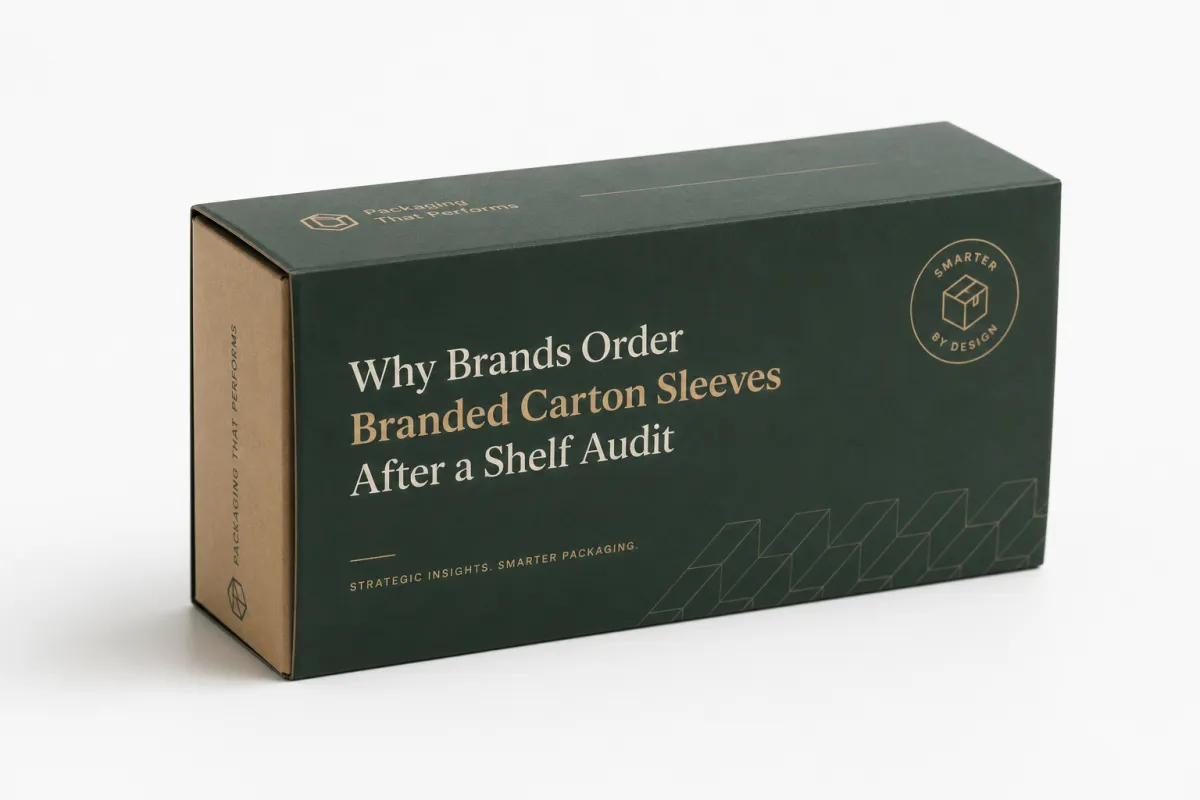
A shelf audit changes the discussion very quickly. In one audit I reviewed for a personal care client in Toronto, the carton shape was perfectly serviceable, yet the brand block was getting swallowed by 14 neighboring facings and a row of white competitor packs that all seemed determined to blend into the same sad blur. The answer was not a new carton. It was a stronger wrap with a larger logo panel, a deeper edge band, and a matte finish that gave us better contrast under store LEDs at 4,000K. That kind of adjustment is why so many teams order branded carton sleeves after seeing the product in context, not on a mockup file they have stared at too long.
The thing that surprises many buyers is how often the sleeve becomes the first printed surface a shopper actually reads. The carton underneath may be plain kraft, recycled board, or an existing stock structure, but the sleeve carries the message that gets the sale moving. I have seen that in supplements, cosmetics, gourmet food, and electronics accessories, where the outer carton looked ordinary until the sleeve brought hierarchy, a clear claim panel, and a barcode zone that no longer fought the design. That is a practical reason to order branded carton sleeves instead of waiting for a full redesign cycle that may not be necessary in the first place.
Speed matters too. A full carton retool can pull in new dies, fresh board approvals, and a longer pilot cycle that eats up calendar time like nobody's business. A sleeve can be updated for a holiday line, a retailer exclusivity, or a reformulated product without disturbing the carton line already in production. I have watched teams save 3 to 6 weeks simply by keeping the substrate stable and changing the printed sleeve, especially on runs that needed a move from Hong Kong prepress to a factory in Guangzhou. If the launch window is tied to a chain reset, that difference can decide whether the product lands on time or becomes one of those “next quarter” stories that everybody quietly resents. That is why brands order branded carton sleeves for time-sensitive programs.
Many companies still overvalue structural change and undervalue consistency. On the floor, the sleeve is what the picker sees, the merchandiser touches, and the distributor stacks. A carton's base geometry may stay identical across three SKUs, but the sleeve can add color coding, batch messaging, and retailer-specific details in one print run. The smartest teams order branded carton sleeves for launches, line extensions, and compliance updates instead of paying for a package rebuild they do not need (and then wondering why the budget looks like it lost a fight).
Testing is another place where sleeves earn their keep. If you want to trial a 2,000-unit run in two regions, the sleeve lets you isolate the design change without changing the production carton. The risk profile is smaller, inventory exposure is lower, and the commercial signal is clearer. You can compare sell-through on the sleeve version against the baseline carton and decide whether to scale. For brands that need data before committing, to order branded carton sleeves is a measured move rather than a cosmetic one, especially when the trial is split between Seattle and Dallas.
Where sleeves win fastest
- Seasonal launches: a single sleeve change can support a 6- to 10-week retail window without new carton tooling.
- Limited editions: short runs of 1,000 to 3,000 units often justify sleeve economics better than a new carton spec.
- Compliance updates: ingredient panels, claims, and warning copy can be refreshed while the carton stays unchanged.
- Test markets: smaller regional rollouts reduce inventory risk if the shelf response is mixed.
What You Get When You Order Branded Carton Sleeves
A carton sleeve is a printed wrap or band that fits over an existing carton to add branding, product messaging, and shelf presence. Some sleeves slide on from one end, some lock with tabs, and some use a glued seam for better holding power. When buyers order branded carton sleeves, they are not only buying print; they are buying fit, folding behavior, and the right amount of structure for the carton it will live on. I have had clients treat the sleeve like a fancy sticker, and then get surprised when a fold line matters on a 180 mm x 110 mm x 40 mm carton. It matters. A lot.
The core parts are easy to name and easy to get wrong if nobody checks the actual measurements. Board stock, print surface, dieline, score positions, glue area, and any locking features all affect whether the sleeve stays square during application. A sleeve for a 120 mm x 80 mm x 35 mm carton behaves differently from one made for a 180 mm x 110 mm x 40 mm carton, even when the artwork idea is identical. That is why I always tell buyers to order branded carton sleeves only after the carton dimensions are confirmed on a physical sample. A PDF is helpful, yes, but a ruler and a real carton are what save you from those annoying “why is the corner crushing?” emails.
The design space is broader than many teams expect. A sleeve can carry a full-wrap graphic, a partial band, a front-panel hero image, a window cutout, a tamper-evident tear strip, a barcode zone, and a regulatory panel in one format. I have worked with teams that wanted a premium emboss on the front panel, a matte back, and a narrow window revealing a 25 ml bottle color through the carton. That level of control is one reason brands order branded carton sleeves instead of settling for a sticker or a basic insert. Personally, I think that control is the whole point; otherwise, you are just paying for a slightly fancier afterthought.
Compared with alternatives, sleeves sit in a useful middle ground. A pressure-sensitive label is faster, though usually smaller and less architectural. An insert can add information, but it does not transform the exterior. A fully printed carton can look excellent, yet it carries higher structural and inventory commitment. For many projects, the sleeve is the better balance of appearance, speed, and cost. When teams need to order branded carton sleeves for multiple SKUs, that balance keeps the program commercially sane.
| Format | Best Use | Typical Cost at 5,000 Units | Setup Complexity | Speed |
|---|---|---|---|---|
| Carton sleeve | Shelf refresh, SKU family updates, seasonal graphics | $0.15 to $0.42 per unit | Moderate; dieline and fit need confirmation | Fast to medium |
| Pressure-sensitive label | Small branding panels, variable data, low-coverage updates | $0.05 to $0.18 per unit | Low; label size and adhesion matter | Fast |
| Insert or wrap card | Promotional messaging, instructions, bundle support | $0.10 to $0.28 per unit | Low to moderate | Fast |
| Fully printed carton | Premium launch packaging, long-term retail programs | $0.30 to $0.70 per unit | Higher; structural and print tooling required | Medium to slow |
I would not treat those numbers as fixed. A 1-color kraft sleeve and a 4-color SBS sleeve with spot UV are not the same job, and neither is a simple open-end wrap versus a locking sleeve with perforation. Even so, the comparison makes it clear why so many teams order branded carton sleeves instead of moving straight to a full carton redesign. The economics often make more sense once the real application is on the table.
One client meeting still stays with me. A food brand in Philadelphia had been debating a new carton for six weeks, but the factory line in Suzhou was already set up for a standard tray. We shifted the plan to a sleeve, kept the tray unchanged, and saved 9 days of approvals. That change also cut the risk of mis-packing because the operators were already comfortable with the base carton. That is the sort of practical outcome people want when they order branded carton sleeves. Nobody wants to spend a month polishing a decision that could have been solved with a better wrap and a little common sense.
Branded Carton Sleeves Specifications That Affect Performance
Specs decide whether the sleeve looks sharp or sloppy. Board weight, caliper, print method, finish, and scoring all affect how the pack behaves on the shelf and on the line. For most retail programs, I look closely at 300gsm to 400gsm SBS or coated kraft, and a 350gsm C1S artboard is often the sweet spot for moderate-size cartons because it gives enough body without becoming stubborn during folding. If you order branded carton sleeves on a lighter stock, the sleeve may buckle. If you go too heavy, the tabs can crack or the carton can feel overbuilt. I have seen both failures, and neither one inspires confidence in a production room in Kuala Lumpur or Ohio.
Dimensional tolerance matters more than most design teams expect. A sleeve that is 1 mm too tight on width can scrape corners, while a sleeve that is 1.5 mm too loose can wander when the carton is handled at speed. I prefer to confirm length, width, depth, closure style, and any tuck flap interference before approval. On one nutraceutical project, a carton caliper change of 0.2 mm forced a score adjustment and would have delayed the line if we had not caught it before print. That is why buyers who order branded carton sleeves need measurement discipline, not just artwork approval. The artwork is the glamorous part; the measurements are the part that keeps everybody calm.
Color accuracy deserves real attention as well. A matte surface softens contrast; a gloss surface lifts saturation; soft-touch lamination can mute fine type if the font is too light. For critical brand colors, I ask for Pantone references or approved drawdowns and, where the schedule allows, a target delta E under 3 on the key panels. I have watched a blue logo fail in store because the stock absorbed too much ink and nobody checked it under retail lighting. If you order branded carton sleeves, test the color where customers will actually see it, not under the flattering glow of a designer's monitor.
Finishing can help or hurt. Spot UV can sharpen a hero mark, but it can also create blocking issues in stacked packs. Foil can sell premium, yet it usually raises cost and can complicate recyclability conversations. Soft-touch lamination feels expensive, though it can be fingerprint-prone if the line is dusty. My rule is simple: use a finish for a commercial reason, not because it sounds attractive in a proposal. Brands that order branded carton sleeves with unnecessary finishes usually pay twice, once in cost and once in production friction. I have the gray hairs to prove that one.
Sustainability should stay practical, not theatrical. FSC-certified board gives you a cleaner chain-of-custody story, and recycled content can be a real advantage if the pack still prints well and folds cleanly. The FSC system is widely recognized in packaging procurement, and it matters because buyers often need documentation as much as they need good print. It is also wise to check whether varnish, foil, or heavy lamination complicates curbside recyclability. If you order branded carton sleeves for a retail program with sustainability claims, the material story has to survive scrutiny from buyers, retailers, and anybody else who likes asking inconvenient questions.
Transit testing is another filter. A sleeve that looks perfect on a table can still scuff, crease, or open during distribution. Standards matter here, and so does common sense. I have seen teams reference ISTA protocols and then skip a basic drop test on the packed master case, which is usually where the mistake appears. The best programs connect the art file to the route, not just the render. For a deeper reference point, the ISTA organization publishes testing approaches that many packaging teams use as a baseline.
Specs worth locking before approval
- Board: 300gsm, 350gsm C1S artboard, or 400gsm, depending on the carton size and handle feel.
- Finish: matte varnish, gloss varnish, soft-touch lamination, or spot UV where the budget allows.
- Print: CMYK, Pantone spot colors, or a mixed approach for brand-critical panels.
- Tolerance: keep the dieline within about 0.5 mm on critical width and depth points.
- Conversion: confirm score, perforation, window cutouts, and glue area before release.
Branded Carton Sleeves Pricing, MOQ, and Cost Drivers
Pricing follows a few predictable levers. Quantity is the biggest one, then board selection, then print coverage, then finishing. When buyers order branded carton sleeves for 1,000 pieces, the setup cost lands hard on each unit. At 5,000 pieces, the same setup spreads out and the per-sleeve price usually drops. At 20,000 pieces, the program starts showing real economies, especially if the die line and artwork stay stable across reorders.
For a simple single-color kraft sleeve, I have seen pricing land around $0.15 per unit for 5,000 pieces when the dieline is standard and the finish is a basic matte varnish. For a four-color SBS sleeve with matte varnish and a die-cut window, $0.28 to $0.48 per unit is more realistic. Add soft-touch lamination, foil, or perforation, and the number climbs again. Those are not promises; they are working ranges. The point is to compare the cost against the value of a line that looks current without forcing a full carton replacement. That is the math behind why many teams order branded carton sleeves.
MOQ varies by supplier and by tooling. A short run of 500 may be possible for a sample market, but the unit cost is usually high because make-ready time, plate setup, and die cutting are spread across too few pieces. I usually advise clients to ask for quotes at 1,000, 3,000, 5,000, and 10,000 units so the breakpoints are obvious. If you order branded carton sleeves without checking those tiers, you can end up paying more for a tiny reduction in working capital risk than the sleeve is worth.
There are clear ways to control cost without weakening the result. Standardize the carton size where possible. Reduce the number of finishes from three to one. Avoid full-bleed artwork if a strong 80% coverage panel will do the job. Keep the same dieline across product families and vary only the print layer. I have negotiated with board suppliers in Shenzhen and Dongguan who could shave 8% off the material price if we accepted a standard sheet size and slightly adjusted the artwork. That kind of trade-off is common when brands order branded carton sleeves across multiple SKUs.
To request a quote cleanly, send the carton dimensions, the target quantity, the application method, the finish preference, the destination, and the file status. If the artwork is not final, say so. If the sleeve must fit an existing carton, include a sample or photos with a ruler in frame. Small clarifications can save days of back-and-forth. I have seen a quote cycle shrink from five emails to one because a buyer attached a simple photo with the flap orientation marked in pen. That level of detail helps when you order branded carton sleeves under a tight launch schedule.
One thing most people get wrong: they compare unit price without comparing total program cost. A sleeve that is $0.03 cheaper but needs a slower approval cycle can cost more in missed shelf dates, emergency freight, and extra internal review time. I would rather see a buyer choose a slightly higher unit price with a 12-business-day production window than chase the cheapest quote and miss a retail reset. I am not gonna pretend the cheapest quote is always the best one. The best teams order branded carton sleeves with the calendar in hand, not just the spreadsheet.
What changes the quote fastest
- Board choice: 300gsm kraft and 400gsm SBS do not price the same.
- Coverage: heavy ink coverage raises cost more than a restrained two-panel design.
- Finish count: each added finish, from foil to lamination, adds time and money.
- Die complexity: windows, perforations, and locks need more setup attention.
- Carton fit: if the sleeve must tolerate a 0.5 mm variation, prep work increases.
How Do You Order Branded Carton Sleeves Without Delays?
The process is straightforward if the inputs are clean. First comes the inquiry, then the spec review, then dieline confirmation, artwork check, proof approval, production, finishing, and shipping. That sequence sounds ordinary, but most delays happen because one piece is missing. If you order branded carton sleeves with the carton measurements verified and the artwork close to final, the schedule usually stays on track. That matters even more for die-cut sleeves with locking tabs or tear strips, because the structure has less room for guesswork.
Timeline bottlenecks tend to repeat. Late artwork is one. Unclear color references is another. The biggest problem I see, though, is structural change after proof approval. A buyer approves a sleeve for a 350gsm board, then swaps to a 400gsm board because procurement found a cheaper lot. That 0.2 mm or 0.3 mm difference can force a new score or a new fit check. I have lived through that on a factory floor in Shenzhen, where a production manager stopped the line for 45 minutes because a lock tab looked tight by just a few millimeters. If you want to order branded carton sleeves without the scramble, freeze the structure before print. Your future self will thank you, and your production contact may even stop sighing into the phone.
A realistic timeline looks different by job type. Repeat orders with an approved dieline can move in 8 to 12 business days after proof sign-off, depending on quantity and finishing. First-time production usually takes 12 to 18 business days because the prepress team needs to validate fit and artwork alignment. If sampling or custom tooling is needed, add another 3 to 7 business days. Faster approvals help more than rush fees do. Buyers who order branded carton sleeves and answer proof questions the same day usually beat buyers who pay extra but wait two days to respond.
I also recommend confirming the shipping lane before production starts. Domestic freight, air freight, and ocean freight have very different implications for a 1,500-unit or 8,000-unit order. If the sleeves are part of a launch tied to retailer delivery dates, ask for the production end date and the transit estimate in the same line item. That prevents a common mistake: celebrating a factory completion date that still misses the store window by a week. If you order branded carton sleeves for a time-sensitive launch, the transit plan matters as much as the print plan, especially when the packaging sleeves must arrive flat, clean, and ready for the line.
Another client story stands out. A skincare brand sent us artwork with a beautiful front panel and no barcode quiet zone. The design looked polished, but the scanner rejected the code at two pilot stores. We moved the barcode 8 mm, increased the white box, and issued a revised proof the same day. They still made the launch window because they had built in a 48-hour review buffer. That is the level of planning I want to see when people order branded carton sleeves. I would much rather fix a quiet zone on Tuesday than hear about a failed scan on Friday afternoon.
"We did not need a new carton. We needed a better sleeve and a cleaner proof cycle. Moving to one dieline cut our launch risk in half in our plant outside Shanghai."
That line came from an operations lead at a food brand I worked with, and it still holds up. Clear inputs reduce friction. Clean files reduce revision loops. A confirmed carton sample reduces fit risk. None of that sounds glamorous, but it is exactly how teams get sleeves through production without losing a week to avoidable corrections. If your team wants to order branded carton sleeves efficiently, treat proofing like a production step, not a design opinion poll. Otherwise, the project turns into a very expensive conversation about tiny millimeters.
Why Choose Us for Custom Carton Sleeves
Buyers do not need flashy language. They need sleeves that fit, print consistently, and arrive when promised. At Custom Logo Things, the value is in the details: fit checks, prepress review, carton compatibility, and clear communication across every revision. That matters because a sleeve that is off by 1 mm is not a small problem; it is a line-speed problem. When brands order branded carton sleeves, the supplier should think like an operations partner, not just a print broker.
What clients value most is predictability. A reliable supplier keeps artwork aligned across multiple SKUs, holds color targets steady, and flags problems before approval rather than after production. I have seen too many vendors promise speed and then introduce a structural surprise in the proof stage. The better model is boring in the best way: one clear contact, one confirmed dieline, one tracked revision, and one production plan. That is how you build trust when buyers order branded carton sleeves for repeat replenishment.
We also understand the difference between a launch order and a replenishment order. A launch can tolerate more prepress attention and a longer review cycle if it avoids a mistake. A replenishment run needs continuity, not reinvention. That is why a good supplier keeps material notes, finishing notes, and carton dimensions organized from the first order. If you want to order branded carton sleeves again next quarter, the paperwork should already be doing some of the work.
There is a commercial advantage in working with a team that knows packaging language. A buyer should not have to translate between gloss, varnish, lamination, caliper, and score depth. They should be able to ask for a 350gsm board, a matte finish, a 0.5 mm fit tolerance, and a 12-business-day schedule and get a coherent answer back. That kind of clarity shortens approval loops. It also helps when comparing programs across our Case Studies, reviewing the practical details in our FAQ, or planning larger recurring volumes through our Wholesale Programs.
I will say this plainly: not every supplier is good at branded carton sleeves. Some are excellent at labels and weak on structural fit. Some are fast on small runs but struggle when a brand needs six SKUs held to the same visual standard. The right partner should show you material options, prepress notes, sample logic, and real production discipline. If you order branded carton sleeves from a team that understands both print and carton behavior, the process gets easier and the result gets better. That is not fluff; it is the difference between a calm launch and a week of scrambling.
What a dependable supplier should provide
- Fit validation: measured checks against the live carton or a verified sample.
- Prepress support: artwork review for barcodes, bleeds, safe zones, and fold placement.
- Production notes: board, finish, and score settings documented for reorders.
- Consistency: same color targets and dieline control across multiple SKU versions.
Next Steps to Order Branded Carton Sleeves Confidently
If you are close to a decision, gather the carton measurements, quantity target, artwork files, finish preference, and shipping destination before you request a quote. Include the carton width, depth, and closure style, and note whether the sleeve must work on an existing carton that is already in circulation. That level of preparation makes it much easier to order branded carton sleeves without a round of avoidable corrections.
If the fit is tight, ask for a dieline or a sample fit check. That is especially useful when the sleeve wraps over a carton with a tuck flap, a window, or a raised closure. A 2 mm error can be invisible on a PDF and obvious on the shelf. I have seen teams save an entire reprint by spending one extra day on fit validation. That is a good trade every time you order branded carton sleeves for a live launch.
Compare quotes on more than unit price. Look at setup costs, proofing time, lead time, and whether the supplier can support reorders on the same dieline. Ask for pricing at 1,000, 3,000, 5,000, and 10,000 units so you can see where the real breakpoints sit. A quote that is $0.02 cheaper but misses the retailer date is not really cheaper. The best buying decisions happen when teams order branded carton sleeves with both finance and operations in the same conversation.
There is a final practical checkpoint. Confirm the shelf goal before you approve the artwork. Is the sleeve meant to sharpen visibility, support a compliance update, or refresh an existing carton family? Each goal changes the panel hierarchy, copy density, and finish choice. I have learned that the best projects are the ones where the brand can say, in one sentence, why it wants the sleeve and when the shipment has to land. If you can answer those two questions, you are ready to order branded carton sleeves with confidence.
For most brands, the right moment is simple: after the specs are confirmed, after the proof is approved, and after the delivery window is locked. That is the point where order branded carton sleeves turns from a packaging idea into a controlled production order. Do that, and the sleeve becomes what it should be: a focused, cost-aware way to improve visibility, speed, and brand consistency without overcomplicating the carton underneath.
Frequently Asked Questions
How long does it take to order branded carton sleeves after artwork approval?
Simple repeat runs can move faster than first-time orders because the dieline and specs are already approved. In many cases, a repeat run lands in 8 to 12 business days after proof sign-off, while a new job may need 12 to 18 business days if the carton fit or finish needs verification. The exact timeline depends on board availability, finishing complexity, and whether sampling is required before you order branded carton sleeves for production.
What do I need to request a quote for branded carton sleeves?
Provide carton dimensions, target quantity, sleeve application method, print coverage, finish preferences, and delivery location. If artwork is ready, attach the file; if not, say whether design support is needed so the pricing reflects prepress work. When the sleeve must fit an existing carton, add photos or a sample with measurements. That reduces risk and helps the supplier quote accurately when you order branded carton sleeves.
What is the minimum order quantity for branded carton sleeves?
MOQ varies by board choice, print method, and whether the order uses standard tooling or Custom Die Cutting. Small runs of 500 to 1,000 are possible in some cases, but the unit cost often rises because setup costs are spread across fewer pieces. The most useful approach is to ask for pricing at multiple quantities, because that shows where the breakpoints sit before you order branded carton sleeves in volume.
Can I order branded carton sleeves on recycled board?
Yes, recycled or FSC-sourced board options are common, but finish and print choices should be checked for compatibility. If recyclability matters, confirm whether lamination, foil, or heavy coating affects end-of-life processing in your channel. The right answer depends on both shelf presentation and the recycling rules of the market where you plan to order branded carton sleeves.
Do branded carton sleeves work for different carton sizes?
They can work across multiple carton sizes, but each format needs its own measured fit and dieline confirmation. If you have a family of SKUs, standardizing carton dimensions can lower cost and simplify replenishment. For mixed sizes, ask whether the supplier can adapt the same design system across several sleeve variants before you order branded carton sleeves at scale.
The practical takeaway is simple: lock the carton measurements, confirm the dieline against a real sample, choose finishes for shelf performance rather than decoration, and line up freight before print starts. If those four pieces are in place, you can order branded carton sleeves with far less risk, and the sleeve will do its job in the one place that matters most: in front of a shopper, under real light, moving through a real store.