Buyer Fit Snapshot
| Best fit | Pallet Boxes with Lids Wholesale projects where brand print, material claims, artwork control, MOQ, and repeat-order consistency need to be specified before quoting. |
|---|---|
| Quote inputs | Share finished size, material target, print colors, finish, packing count, annual reorder estimate, ship-to region, and any compliance wording. |
| Proofing check | Approve dieline scale, logo placement, barcode or warning zones, color tolerance, closure strength, and carton packing before bulk production. |
| Main risk | Vague material claims, crowded artwork, missing packing details, or unclear freight terms can make a low unit price expensive after revisions. |
Fast answer: Pallet Boxes with Lids Wholesale: Specs, Pricing, Lead Time should be specified like a repeatable production item. The safest quote records material, print method, finish, artwork proof, packing count, and reorder notes in one written spec.
Production checks before approval
Compare the actual filled-product size with the drawing, then confirm tolerance on folds, seals, hang holes, label areas, and retail display edges. Reserve space for logos, QR codes, warning copy, and material claims before decorative graphics fill the panel.
Quote comparison points
Review material grade, print process, finish, sampling route, tooling charges, carton quantity, and freight assumptions side by side. A quote is only useful when the supplier can repeat the same color, closure quality, and packing count on the next order.
Pallet boxes with lids wholesale sit in a pretty practical corner of packaging, right where product protection, warehouse handling, and shipping discipline all have to work together. A lid that fits loosely, a wall that gives way under stack pressure, or a base that shifts under wrap tension can turn a tidy pallet into a mess that eats time and money. I have seen loads that looked fine on the dock, then arrived with crushed corners, rubbed labels, or lids that popped open somewhere between the truck and the receiver. That kind of damage is annoying at first, then expensive, then somehow it gets blamed on everybody.
The weak point is not always the product itself. More often, the trouble starts with exposure, vibration, compression, or handling that the container was never really designed to survive. That is why pallet boxes with lids wholesale are such a useful option for parts, mixed SKUs, returnable containers, export freight, and any shipment that has to move more than once before it reaches its final stop. The lid is not a decorative piece. It is part of the structure that keeps the load together.
Custom Logo Things works with packaging buyers who need a box that performs in the real world, not just in a product sheet. The target is simple enough: fewer repacks, better top containment, less dust intrusion, and a unit load that behaves predictably during transit and storage. Pallet boxes with lids wholesale become especially valuable once freight has to sit, stack, and move again. Weak packaging tends to show its flaws right there, usually at the worst possible time.
Pallet Boxes with Lids Wholesale: Why These Containers Cut Damage Fast
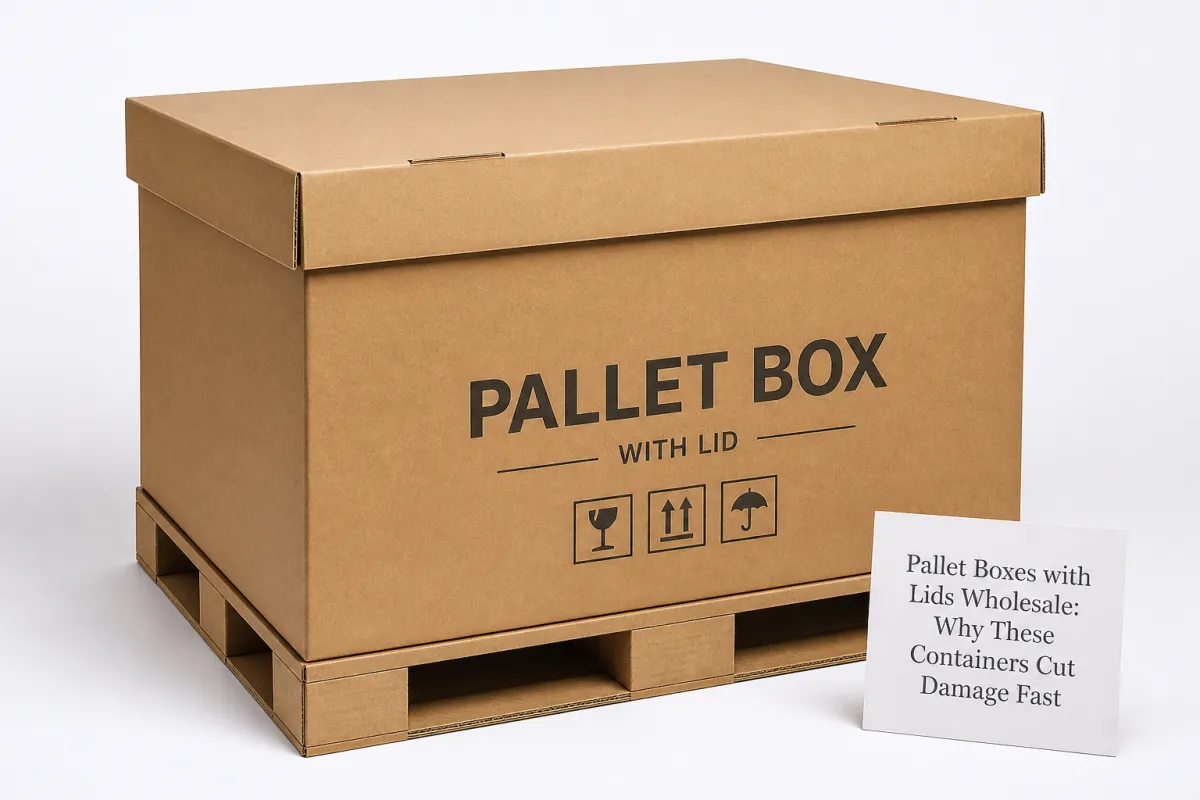
Picture a shipment leaving the plant looking tight and organized. Somewhere along the route, the top layer settles a bit, a forklift nicks a corner, or a lid flexes just enough for wrap tension to lose its grip. The pallet is still there, but the containment has already started to slip. Pallet boxes with lids wholesale help stop that chain reaction by adding structure at the top, instead of asking the side walls and stretch wrap to carry the whole job on their own.
Damage usually creeps in little by little, which is why it can be so frustrating to track down. A bit of movement in transit. A little dust during storage. A little extra compression in a warm trailer. None of those things sounds dramatic in isolation, but together they can wreck the condition of the freight by the time it reaches the receiving dock. Solid pallet boxes with lids wholesale packaging gives the load a better chance of staying square and controlled through the whole trip.
That matters in the budget, not just in the packaging line item. Better containment means fewer returns, fewer claims, fewer open-dock inspections, and fewer hours spent sorting out damaged freight after it arrives. It also helps the warehouse crew move more confidently because the container behaves in a repeatable way. Buyers often start by comparing unit price, but the more honest comparison is total handling cost. Under that lens, pallet boxes with lids wholesale can be the lower-risk choice even when the quote is not the cheapest one on the page.
"If the top of the load is weak, the whole pallet starts acting like a guess." That is the kind of reality check that explains why pallet boxes with lids wholesale often outperform loose-top cartons in industrial shipping.
These containers are a strong fit for mixed-SKU distribution, automotive and appliance parts, e-commerce replenishment, export shipments that need cleaner dust protection, and returnable logistics loops where the same unit may be opened and closed several times. In a closed-loop system, the lid has to stay aligned through multiple cycles, which is harder than it sounds. A box that holds up once but gets sloppy on the second or third trip is not much help.
There is a dock-side benefit too. A pallet box with a defined lid is easier to label, easier to inspect, and easier to spot in a crowded storage zone. Teams move faster when they can recognize a container at a glance. That sounds small, but on a busy floor, small things add up quickly. Once people know how the box behaves, handling gets cleaner and the whole process slows down less.
The better question is not whether a lid is useful. The better question is whether the freight needs protection plus access. If the answer is yes, pallet boxes with lids wholesale deserve a hard look because they work like a transport system, not a disposable shell.
Product Details: What You Get in a Pallet Box with Lid
A practical pallet box starts at the base. That might be a dedicated pallet, a corrugated pallet-style base, a plastic skid, or a wood platform, depending on load weight and whether the container is meant to return. Side walls come next, and the wall structure affects more than most buyers expect: stack behavior, crush resistance, and how comfortably a forklift can handle the unit without tearing the lower edge. The lid comes last, and in pallet boxes with lids wholesale programs, that lid often makes the difference between a shipment that stays organized and one that drifts out of spec in transit.
There are several formats buyers run into again and again. Collapsible boxes make sense when return freight matters and empty cube needs to be kept down. Rigid stackable boxes suit repeat handling and tighter warehouse systems. Reuse-focused designs work well in closed-loop operations where the same container cycles through multiple trips. Each one solves a slightly different problem. A buyer shipping one-way freight may lean toward a lighter corrugated build, while a buyer running returnables may need plastic or hybrid construction that survives repeated use. That is why pallet boxes with lids wholesale should be matched to the handling path, not just to the weight on the label.
Lid style changes the workflow more than many teams expect. A friction-fit lid is quick, but it depends on tight dimensions and stable board performance. A hinged lid can speed access in picking areas. A removable lid is simple and easy to replace. Dust-cover lids work well where protection matters more than tamper control. Tamper-evident versions add a clear seal point for higher-value or regulated goods. In every case, pallet boxes with lids wholesale should be specified with the receiving team in mind. If the lid is awkward to remove, the box slows everybody down, and nobody needs that headache.
Material choice also shapes the economics in a very real way. Corrugated is common for lighter and more cost-sensitive freight. Options such as 32 ECT, 44 ECT, or double-wall BC flute can improve compression strength when the load needs more support. Plastic, usually HDPE or a similar resin, fits moisture-sensitive or reuse-heavy programs. Wood-based or hybrid systems are often chosen for heavier industrial freight where durability matters more than keeping unit weight low. Buyers asking for pallet boxes with lids wholesale should think about humidity, washdown exposure, export lanes, and whether the container is single-use or returnable. That context matters a lot.
Several practical features deserve a spot on the checklist:
- Fork access so the unit can be lifted without tearing the lower edge.
- Pallet jack entry that does not snag during floor handling.
- Label zones for barcodes, lot data, and routing information.
- Print surfaces for instructions, graphics, or compliance text.
- Lift points that reduce awkward manual handling.
Those details matter because they affect labor, not just appearance. A box can look polished and still be a poor buy if it slows scanning, stacking, or inspection. Good pallet boxes with lids wholesale programs solve for movement, identification, and protection at the same time.
Custom Logo Things can help translate those requirements into a manufacturable package through our Custom Packaging Products range. Decoration alone does not justify the design work. The point is to build a container that fits the freight, the handling method, and the storage space available.
One more detail carries more weight than it gets credit for: if the product has sharp corners, an uneven center of gravity, or a high stack load, ask for reinforcement near the corners and along the lid edge. That small adjustment often improves real-world performance more than adding another layer of wrap. In many pallet boxes with lids wholesale programs, corner reinforcement is the least expensive protection step on the table.
Pallet Boxes with Lids Wholesale: Key Specifications to Compare
Buyers often ask for quotes before the spec sheet is settled, and that usually creates pricing noise. A useful comparison for pallet boxes with lids wholesale starts with the dimensions that actually affect the shipment: internal dimensions, external footprint, usable height, and pallet compatibility. A container can fit on paper and still fail in the warehouse if fork pockets do not clear or if the lid adds too much height for a rack opening. That kind of miss is common enough that it is worth slowing down for a minute and checking it properly.
Load performance comes next. Static load, dynamic load, and stacking strength are not the same thing. Static load tells you how much weight the unit can hold while sitting still. Dynamic load covers what it can survive during movement or transit. Stacking strength matters when the lid has to carry top pressure or when units sit one above another in storage. In pallet boxes with lids wholesale, the lid design affects all three. A stronger lid overlap can improve compression resistance and help the box stay square under pressure.
Environmental conditions matter too. Humidity can soften some corrugated builds. Temperature swings can change fit. Long dwell times can reduce board performance, especially if the shipment sits in a humid dock or an unconditioned warehouse. For that reason, pallet boxes with lids wholesale should be specified for the actual lane, not just for the catalog image. Export freight and domestic warehouse freight do not ask the same things of a container, and the packaging should not pretend they do.
Other specs should sit on the comparison sheet as well:
- Wall thickness and flute type, especially for corrugated units.
- Corner reinforcement for crush-prone loads.
- Lid overlap and fit tolerance.
- Compression resistance if units stack in storage.
- Collapsibility if empty return volume matters.
- Humidity tolerance for warehouse and export exposure.
There is a meaningful difference between a container built for one trip and a container built for repeated cycles. If the operation will reuse the same unit many times, ask for durability data and cleaning assumptions. If the unit is single-use, focus more on cost, cube efficiency, and product protection. Either way, pallet boxes with lids wholesale should be evaluated across the complete handling loop, not just the first shipment.
For companies that want to align procurement with recognized packaging tests, it helps to review the procedures used by organizations such as ISTA. Their methods frame the real challenge: vibration, drop, compression, and environmental exposure. A load that seems stable in the plant can behave very differently after a few hours in transit, and that is exactly why pallet boxes with lids wholesale should be matched to performance expectations rather than assumptions.
| Option | Typical Use | Relative Price Behavior | What to Watch |
|---|---|---|---|
| Single-wall corrugated with lid | Lightweight, lower-cost distribution | Lowest starting point | Lower compression strength, humidity sensitivity |
| Double-wall corrugated with reinforced lid | Mixed-SKU, higher stack pressure, export cartons | Mid-range | Board grade, lid overlap, print coverage |
| Plastic reusable box with lid | Closed-loop logistics, washdown, moisture exposure | Higher upfront cost | Return cycle economics, storage cube, repairability |
| Wood or hybrid pallet box with lid | Heavy industrial freight, durable handling | Upper mid to high range | Weight, compliance needs, handling safety |
That table is only a starting point, but it gives buyers a better way to talk to suppliers. Once the spec is set clearly, pallet boxes with lids wholesale pricing becomes easier to compare because you are comparing the same class of product instead of several different structures wearing the same label.
Pallet Boxes with Lids Wholesale Pricing and MOQ
Price gets attention first, though it should not carry the whole decision. In pallet boxes with lids wholesale, cost depends on material choice, dimensions, print coverage, reinforcement, lid design, and whether the unit collapses flat or stays rigid. A simple corrugated version may sit in a low unit-cost range, while a reusable plastic or hybrid system can cost several times more. That gap makes sense once service life and handling intensity enter the picture.
As a rough planning range, buyers often see standard corrugated pallet boxes with lids wholesale pricing starting in the low double digits per unit at higher volumes, with heavy-duty builds moving higher depending on board grade and size. Reusable plastic systems usually carry a much larger upfront spend, yet they can pay back over multiple cycles. Wood-based structures also move upward once durability, custom dimensions, or export requirements enter the spec. The better question is not "what is the cheapest box?" It is "what is the best cost per successful shipment?"
MOQ follows the same logic. Standard sizes often allow smaller opening orders because tooling and setup are simpler. Custom-printed or fully custom-sized pallet boxes with lids wholesale runs generally need a larger first order to justify production setup, print plates, or mold work. Buyers sometimes push for a low MOQ on a highly custom design and then wonder why the per-unit price climbs. The reason is setup math, plain and simple.
Here is the cleanest way to think about total cost:
- Unit cost is only one part of the picture.
- Freight changes fast with cube, weight, and pallet count.
- Storage savings matter if the box stacks efficiently or collapses flat.
- Damage reduction often delivers more value than the packaging spend itself.
- Labor reduction can be meaningful if the lid is easy to place and remove.
That is why pallet boxes with lids wholesale should be quoted with landed cost in mind. A quote that looks low can become expensive once freight, receiving labor, and replacement claims are added. A slightly higher quote may lower total operating cost if the box performs better across the lane. Buyers shipping into retail DCs or export channels usually see that difference pretty quickly.
To get a useful quote, send exact dimensions, quantity tiers, product weight, destination, stacking requirements, and any certification needs. If the load must support a particular compression level or fit a warehouse rack height, say so early. It is much easier to design correctly at the front end than to rework a run after approval. That is one reason experienced buyers prefer pallet boxes with lids wholesale sourcing through suppliers who ask detailed questions, not only price questions.
If you need broader purchasing support, our Wholesale Programs can help structure pricing tiers so you can compare pilot quantities, repeat runs, and higher-volume commitments side by side. That comparison matters because a better volume break is only useful if the box still fits the freight and the process.
Use a simple rule when comparing suppliers: review at least three outcomes before deciding. First, the cheapest acceptable build. Second, the build that best matches handling risk. Third, the build that balances price and long-term performance. Buyers who order pallet boxes with lids wholesale at scale usually save more by removing hidden costs than by chasing the lowest line item.
Process and Timeline: From Quote to Production Steps
A clean production process saves more time than any rush request ever will. The usual path for pallet boxes with lids wholesale starts with inquiry, then spec review, then quote approval, then drawing or sample confirmation, then production, inspection, and dispatch. When each step is documented, the order moves faster and the receiving team sees fewer surprises. That is the kind of discipline that keeps packaging from turning into a fire drill later.
Standard stock runs usually move faster than fully custom builds. That pattern holds across most packaging categories, and pallet boxes with lids wholesale is no exception. If the container uses standard board, a familiar footprint, and limited print, lead time can stay fairly short. Add custom dimensions, reinforced corners, special lid geometry, or detailed branding, and the timeline stretches. The job is still manageable. It just needs better planning and a little patience.
Delays tend to show up in the same places: missing dimensions, unclear artwork, late sample approval, and last-minute changes after production starts. Each one sounds small, yet in packaging manufacturing small changes often ripple into multiple downstream steps. In practice, the fastest pallet boxes with lids wholesale orders are the ones with complete specs and one person assigned to final sign-off. That simple setup saves a surprising amount of back-and-forth.
Here is a realistic example of how a pilot order can move:
- Day 1-2: buyer sends dimensions, load weight, quantity tiers, and handling notes.
- Day 3-4: supplier confirms structure, material, and pricing.
- Day 5-7: artwork or drawing approval is finalized.
- Day 8-15: production runs, then inspection or packing verification is completed.
- Day 16+: freight is booked and shipment leaves according to destination and mode.
That schedule is not universal. Material availability, seasonal demand, and approval speed all affect the lead time. Even so, it shows the main point: a precise spec sheet shortens the cycle more than most buyers expect. That is especially true in pallet boxes with lids wholesale, where lid fit and carton dimensions have to work together if the load is going to behave the way you want.
A good supplier should also document tolerances, stack limits, and handling notes before production begins. That makes sign-off easier and reduces disputes later. Buyers shipping into multiple warehouses should ask for consistent label placement too, so receiving teams can scan and sort the boxes the same way every time. Consistency saves labor and prevents confusion, which is a quiet win that people usually notice only after it is missing.
A useful yardstick helps here: if the project is simple, a pilot run often makes sense before a larger reorder. If the shipment is high-value, temperature-sensitive, or subject to rough handling, a pilot becomes even more valuable. That is because pallet boxes with lids wholesale performance is best confirmed under your actual route conditions, not just in a sample room. A small test can expose a weak lid fit, a tight fork entry, or a stacking issue before it becomes expensive at scale.
Why Choose Us for Pallet Boxes with Lids Wholesale
Buyers need more than a box vendor. They need a packaging partner that can turn shipping problems into a manufacturable answer. That is where Custom Logo Things stands apart. We focus on consistent dimensions, repeatable build quality, and practical guidance that helps buyers reduce damage without overbuying material. For pallet boxes with lids wholesale, that consistency matters because a small shift in fit can affect the entire pallet load.
Manufacturing control carries a lot of value. A good wholesale program should give you predictable results across multiple runs, not a different box every time the order repeats. That means clear specs, checked tolerances, and straightforward communication about what the packaging can and cannot do. In a wholesale environment, those details are worth real money because they reduce receiving friction and limit surprises across sites. Pallet boxes with lids wholesale buyers usually notice that difference pretty quickly after the first reorder.
Customization support matters too. Some shipments need a slightly taller profile. Others need a stronger lid overlap or a more visible print zone. Some teams need a box that stacks in a warehouse rack without wasting height. Others need easy-open access for frequent picking. We help buyers match those operational needs to a box that can actually be produced consistently. That approach is more useful than trying to force freight into a generic packaging template, which is a trap people fall into more often than they admit.
Quote clarity also shapes the buying experience. Many suppliers will price a box and leave out the assumptions that make the number true. That creates problems later. A better approach is to spell out quantity tiers, material assumptions, printing needs, and freight expectations upfront. That is how pallet boxes with lids wholesale purchasing should work. Straight pricing. Clear constraints. Fewer surprises.
From a packaging buyer's point of view, there is a real difference between buying a carton and buying a shipping system. The first behaves like a commodity. The second protects margin. If your load is delicate, valuable, or heavily handled, the second option is usually the smarter one. That is why buyers who start with the cheapest option often come back for a stronger structure later, sometimes after one rough route teaches the lesson for them.
For brands that want function and presentation to work together, custom graphics and labeling zones can help keep the load identifiable without making the design harder to use. If your operation needs more than one format, our Custom Packaging Products lineup makes it easier to compare options without losing sight of handling requirements. That comparison is useful in pallet boxes with lids wholesale programs because the right answer usually depends on the product, the lane, and the reuse plan.
One final point deserves mention: if your packaging needs to support responsible sourcing goals, look for board and fiber claims that can be documented. For paper-based systems, certification references such as FSC can help support procurement policies and customer requirements. That does not solve performance by itself, but it does add trust to the sourcing conversation, and trust still matters a great deal in procurement.
Next Steps: Order Pallet Boxes with Lids Wholesale the Right Way
The fastest path to a solid order is not a long brief. It is a complete one. Measure the product load. Confirm the pallet footprint. Decide whether the lid should be friction-fit, removable, hinged, or tamper-evident. Set the minimum acceptable load rating before the quote goes out. Once those details are clear, pallet boxes with lids wholesale pricing becomes easier to interpret and easier to defend internally.
Request written tier pricing so you can see the difference between pilot quantity and repeat-run volume. That helps you decide whether the first order should validate the design or move directly into production. If the load is high-value or sensitive, start with a pilot. If the process is already well known and the specs are standard, a larger wholesale commitment may make sense right away. Either way, pallet boxes with lids wholesale should be treated as a supply strategy, not a one-off purchase.
Before approval, verify lead time, freight assumptions, and packaging expectations. Ask whether the quote includes the exact structure you want, not just a close match. Confirm how the units will be packed for shipping so receiving does not lose time unpacking or sorting. These checks may sound basic, but they are where many packaging budgets drift off course. A disciplined buying process keeps that under control.
If you need a practical shortlist, use this:
- Confirm dimensions and pallet footprint.
- Define the lid style and closure method.
- Set static and dynamic load expectations.
- Ask for MOQ and tiered pricing in writing.
- Check lead time from approval, not from first contact.
- Review freight, storage, and damage-cost assumptions.
That process turns evaluation into action. It also lowers the risk of buying a container that looks suitable on a screen but fails under real handling conditions. If your freight needs protection, stack control, and repeatability, pallet boxes with lids wholesale is a category worth taking seriously. The best orders protect product, save labor, and keep the load intact all the way through the lane.
The practical takeaway is simple: define the load, lock the lid style, verify the handling path, and then compare quotes on the same spec instead of three different ones. Do that, and pallet boxes with lids wholesale stops being a guess and starts acting like a controlled part of your shipping system.
What is the usual MOQ for pallet boxes with lids wholesale orders?
MOQ depends on material, size, and whether the structure is standard or fully custom. Stock or near-standard pallet boxes with lids wholesale options usually allow lower first orders than custom-printed or reinforced units. Ask for tiered pricing so you can compare pilot quantities against repeat-run savings and decide whether the first order should test the design or scale production. If you are trying to move fast, a standard footprint can keep things much easier on the first round.
Are pallet boxes with lids wholesale options stackable when loaded?
Many are stackable, but the safe stack height depends on wall strength, lid design, and the actual load weight. Always confirm static and dynamic load ratings before stacking in transit or storage. If the contents are compressible, ask for reinforced corners or a stronger lid overlap. With pallet boxes with lids wholesale, stackability should be documented, not assumed. A box that stacks in theory can behave differently once it is warm, humid, or sitting under a heavier pallet.
Which material is best for pallet boxes with lids wholesale shipping?
Corrugated works well for lightweight or cost-sensitive freight, especially when the load is stable and dry. Plastic or hybrid builds are better when moisture resistance, reuse, or washdown handling matters. Wood-based options are common for heavier industrial freight where durability is the priority. The best material for pallet boxes with lids wholesale depends on the route, the handling cycle, and whether the box is single-use or returnable. There is no magic material that wins every lane, and that honesty saves a lot of bad purchasing decisions.
How long does production usually take for pallet boxes with lids wholesale?
Standard runs are typically faster than fully custom builds. Lead time depends on material availability, print requirements, sample approval, and freight booking. A clear spec sheet can shorten the timeline more than most buyers expect. If you are ordering pallet boxes with lids wholesale for a new lane, allow extra time for sample sign-off and any corrections to dimensions or lid fit. Rushing that step usually costs more later.
Can pallet boxes with lids wholesale be custom sized or printed?
Yes, most suppliers can adjust dimensions, lid fit, graphics, and labeling zones. Custom sizing is useful when the product has unusual height, fragile edges, or a dense pallet pattern. Printed branding helps with identification, handling instructions, and warehouse organization. In pallet boxes with lids wholesale programs, customization should support handling first and branding second, so the final box works in real shipping conditions. That order of priority tends to keep the purchase useful instead of merely pretty.


