Personalized garment labels are often the first brand detail a customer touches. Not the hangtag. Not the mailer. The label. That small strip of woven polyester, satin, cotton, or heat-applied film can change how a garment feels in the hand, how it reads on a rack, and how it performs after the first wash.
The effect is bigger than the size suggests. A clean label makes a product feel finished, credible, and worth keeping. A rough edge, poor contrast, or scratchy backing can make an otherwise strong garment feel unfinished. For brands trying to move from “good sample” to “repeat purchase,” the label is part of the product, not an accessory added at the end.
There is also a practical reason buyers spend time on labels. A custom neck label or side-seam tab carries care text, fiber content, size, and branding in a very tight space. If the design is poorly planned, it turns into clutter. If it is planned well, it supports the garment without calling attention to itself unless it needs to.
Why personalized garment labels change the way products feel
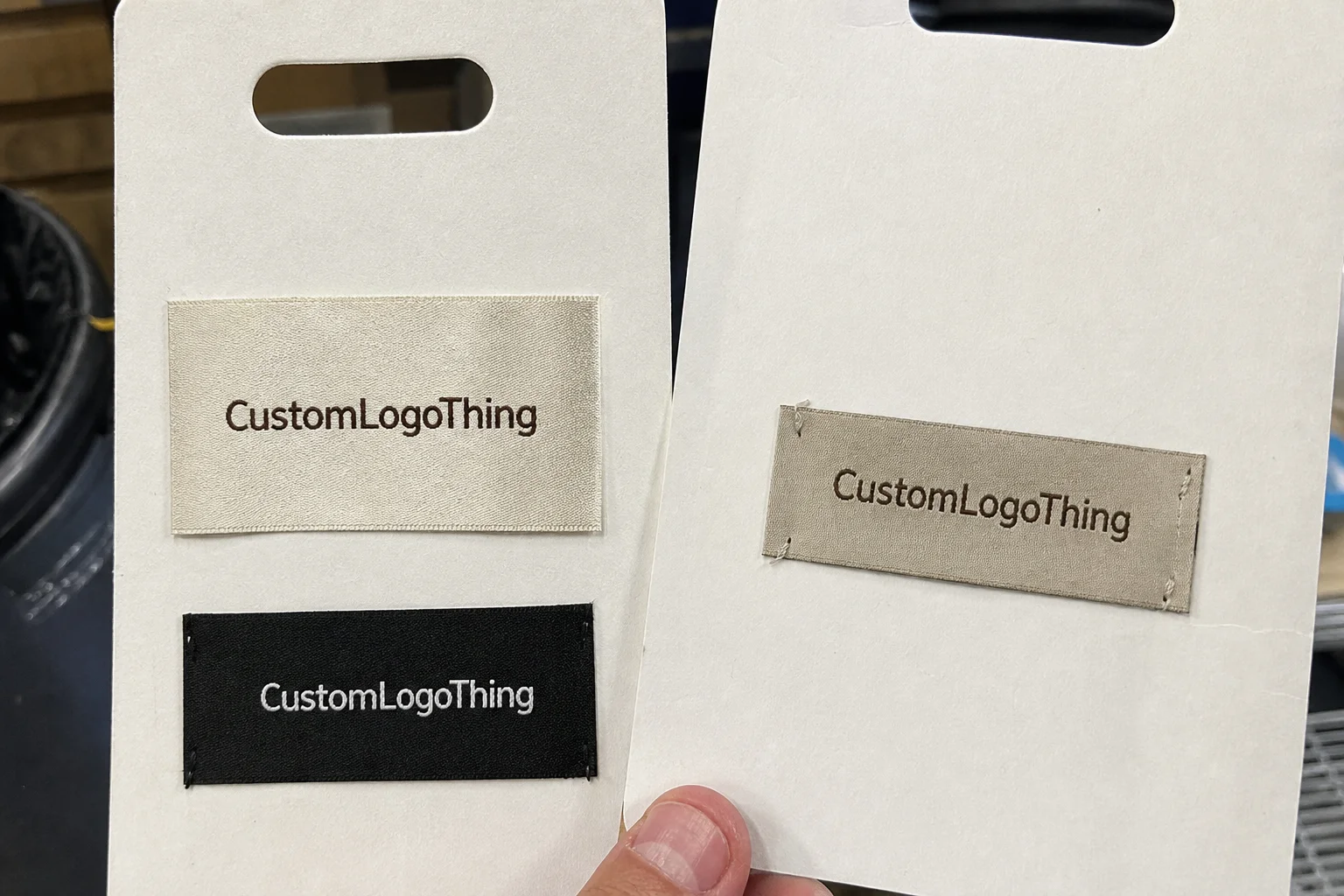
Wholesale buyers rarely talk about stitch density first. They notice presentation. They notice whether the garment feels complete. Personalized garment labels help create that impression because they sit at the point where function and branding overlap. They are small, but they do several jobs at once: identification, care guidance, compliance information, and brand memory.
That matters across categories. A private-label hoodie with a dense woven neck label reads differently from one with a generic stock tag. The first looks intentional. The second looks temporary. That difference can affect sell-through, especially for smaller brands that do not have the visual volume of a national retailer behind them.
Different label types solve different problems. A woven label can carry crisp detail and withstand repeated laundering. A satin label feels smoother against skin and suits garments where comfort matters more than a raised texture. A printed label is often the right answer for no-tag programs, children’s wear, and athletic apparel because it reduces bulk at the neckline. Heat-applied labels work well too, but only if the fabric can handle the application temperature and the finished bond is tested on the actual garment body.
There is a reason seasoned buyers talk about label placement as much as label design. A label at the center back neck behaves differently from a side seam tab or waistband insert. It rubs differently. It folds differently. It is seen differently in photos. The same artwork can feel premium in one location and awkward in another.
Consistency matters as much as appearance. If the label changes between size runs, colorways, or reorder batches, the product starts to feel less stable. That is a quiet problem, but it shows up in returns, in customer comments, and in the way a line is judged by retail buyers who handle multiple samples in one sitting.
If you are building a broader branding system, it makes more sense to think of labels alongside your Custom Labels & Tags program, not as a one-off purchase. That shift affects how you spec the product, how you quote it, and how you manage future reorders.
How the process and timeline work from artwork to delivery
The production flow for personalized garment labels is usually simple on paper. In practice, the timing depends on how complete the brief is. A standard run starts with the essentials: label type, dimensions, quantities by SKU, attachment method, artwork files, and any required care copy. Then comes proofing, sample approval if needed, manufacturing, finishing, and shipping.
Most delays happen before a machine starts running. Low-resolution artwork is the classic issue, especially when a logo uses tiny lettering or thin strokes. Missing care information creates another round of back-and-forth. So does changing the fold style after the proof is already approved. Those changes look minor in email and expensive on the production floor.
For timing, the biggest drivers are quantity, construction complexity, and where the work is being made. A simple woven label with a stock base can move faster than a custom-dyed satin label with multiple folds and edge finishing. A domestic run is often quoted at 7 to 12 business days after proof approval. Offshore production more often lands in the 12 to 20 business day range before freight. Rush jobs can shorten that window, but they usually carry a premium and narrow the room for error.
If a physical sample is required, add time for sample making, shipping, and review. Brands launching seasonal lines should also build in freight buffer. One late carton of labels can stall sewing, packing, and fulfillment. That is one of the most common timing mistakes, and once cut-and-sew production has started, the schedule gets much harder to recover.
Holiday peaks and trade-shifted freight are another practical concern. Label jobs that would normally clear in two weeks can slip when factories are balancing bulk orders, or when shipping lanes slow down. Buyers who plan from the garment pack-out date rather than the marketing date usually avoid the worst of it.
What a realistic schedule looks like
- Day 1-2: submit artwork, dimensions, and label specs.
- Day 2-4: supplier prepares the digital proof and checks file readiness.
- Day 4-6: buyer reviews the proof and requests changes or approves it.
- Day 6-10: sample approval if the project requires a strike-off or physical sample.
- Production window: often 1-3 weeks depending on material, quantity, and finish.
- Freight: add several days for domestic shipping, longer for international freight and customs clearance.
A clean file package saves time. So does a buyer who knows whether the label is meant to be sewn in, heat applied, or used only for sampling. The easiest schedules are the ones that do not need interpretation.
Material and attachment choices that decide comfort and durability
Material choice is where buyers often fixate on appearance and underweight wear performance. A label can look excellent on screen and still irritate skin, curl at the edge, or fade after a few wash cycles. The right spec depends on the garment category, the customer, and how close the label sits to the body.
Woven polyester is one of the workhorse options. It is durable, stable, and capable of holding fine detail when the weave is dense enough. In higher-end woven construction, the weave count matters because small text can blur if the structure is too loose. Satin feels smoother and softer, which is why it is common for premium fashion, sleepwear, and lingerie. Cotton brings a natural look and a softer hand, though it is not always the best choice for aggressive washing or heavy abrasion. Printed heat-transfer stock is attractive for no-tag comfort, especially in athletic wear and children’s garments.
Attachment method matters just as much as base material. Sew-in labels are still the default for many brands because they are reliable and easy to standardize across a production run. Heat seal works well when the fabric can tolerate the temperature, dwell time, and pressure required for a clean bond. Peel-and-stick labels are useful in sampling, packaging, or short-term identification, but they are not a substitute for wash durability. Fold-over tabs can improve comfort and help reduce irritation when the label sits at a collar edge or seam.
The tradeoff is straightforward: the softest label is not always the most durable one, and the toughest label is not always the most comfortable. A label can feel good in the hand and still fail if the ink, weave density, adhesive, or backing is wrong. For buyers, the real question is not “Which option looks best in a mockup?” It is “Which option still performs after 20 washes, a few dryer cycles, and ordinary consumer handling?”
That is where testing discipline matters. Brands selling into retail or ecommerce channels should think about wash performance, abrasion, and transit stress as part of the spec. For packaging and supply-chain thinking, ISTA testing practices are a useful reference point for how products behave under movement and pressure; the same mindset applies to labels, even though the label itself is small. See ISTA for those practices.
Material pairing also affects the garment surface. A heat-applied label that works well on a smooth performance knit may fail on a fleece with more loft. A dense woven label can sit cleanly on a jacket lining but feel too structured inside a lightweight tee. Those details are where good buyers earn their margin: by matching the label to the fabric instead of forcing one spec across the whole line.
Practical spec decisions include edge finish, fold style, color count, and the way the label sits against skin. A two-color woven label may cost less than a five-color version, but if the mark becomes muddy or the type loses legibility, the savings disappear fast.
| Label option | Comfort | Durability | Typical use |
|---|---|---|---|
| Woven polyester | Moderate to good | High | Basics, outerwear, uniforms |
| Satin | Very good | Moderate to high | Premium fashion, sleepwear |
| Cotton | Very good | Moderate | Natural, soft-feel garments |
| Heat-transfer print | Excellent | Good to very good | Athleisure, kidswear, no-tag products |
For brands that also care about sustainable packaging cues, FSC-certified paper hangtags or inserts can complement label programs and support a cleaner sourcing story. The label and the surrounding packaging do not need to match perfectly, but they should feel intentional together. See FSC for that context.
Cost, pricing, MOQ, and what drives your unit cost
Pricing for personalized garment labels is not just a material story. It is a setup story, a quantity story, and a finishing story. Small orders usually carry a higher unit cost because prepress, file preparation, and machine setup get spread across fewer pieces. That is why MOQ exists.
For many custom label programs, the practical breakpoint is somewhere between 250 and 1,000 units per design, depending on material and production method. A simple woven label in volume may land around $0.08-$0.18 per unit at higher quantities. Small runs with multiple colors, custom folds, or specialty finishing can move closer to $0.20-$0.45 or more. Those are realistic quoting ranges, not fixed prices, because the structure of the order changes the math quickly.
The main pricing levers are easy to identify once you know what to ask for:
- Quantity — bigger runs reduce unit cost after setup fees are absorbed.
- Material — woven, satin, cotton, and heat-transfer stocks do not cost the same.
- Color count — more colors usually mean more production steps and longer setup.
- Size and shape — oversized labels or unusual dimensions use more material or tooling.
- Finish — folds, cut-and-fold edges, specialty adhesives, and sewn tabs can raise price.
- SKU count — multiple sizes or care variations can multiply setup work.
- Sampling — strike-offs, revisions, and overnight freight can add real cost before production starts.
It helps to compare quotes on identical specs. Too many buyers ask three suppliers for “a label quote” and then compare three different products. That comparison is not useful. One supplier may be quoting a folded woven label, another a printed satin version, and a third a heat-applied transfer. Those are different processes with different risk points.
If I were buying for a brand, I would define the garment, define the label’s role, and then choose the lowest-cost option that still survives the product’s life cycle. If you are selling premium outerwear, a label that pills, frays, or peels is a brand problem. If you are selling a seasonal promotional tee, the tolerance is different. Context sets the budget more than most buyers admit.
For broader production benchmarking, trade groups such as the Packaging Machinery Manufacturers Institute are useful references for thinking about repeatability, materials, and process control. The lesson carries over cleanly: a slightly higher quote that reduces rejects, rework, or delays is usually the better buy.
Step-by-step ordering checklist for first-time buyers
If this is your first order, start with the basics. Gather the logo files, the label dimensions, the garment placement, the exact care text, and the quantity by SKU. That sounds obvious, but incomplete briefs are the fastest way to slow down a custom run.
What to send your supplier
- Vector artwork, ideally AI, EPS, or PDF.
- Exact label dimensions, including any fold allowance.
- Color targets, preferably Pantone references where possible.
- Care instructions, fiber content, and country-of-origin text if required.
- Placement notes: neck, side seam, hem, waistband, or external branding location.
- Quantities by SKU and any reorder assumptions.
- Any compliance language required for the sales channel you are using.
Vector files matter because small text can disappear fast when a label is only a few centimeters wide. If you send raster art, make sure it is high resolution and that typography remains crisp at actual size. Tiny details on a screen are not the same as legible details on a finished label.
Approving a proof is not just a yes or no exercise. Check trim size. Check fold direction. Check whether the logo reads correctly after folding. Check contrast. Check whether the care copy is readable without squinting. If the label sits close to skin or against a premium fabric, ask for a sample or a mockup that shows placement on the garment, not just on a flat white background.
For Brands That Need packaging and garment identifiers to work together, it helps to build the order around Custom Labels & Tags as a system. That way the neck label, size tab, hangtag, and carton cues all speak the same visual language.
One more practical point: if the garment uses sensitive fabric, test the attachment method. Heat seal on a performance knit is not the same as heat seal on a heavy sweatshirt fleece. The fabric decides part of the outcome, and a supplier who ignores that is not helping you spec the job correctly.
If the brand plans a reorder, ask for a saved spec sheet and version control on the approved art. A label run that cannot be reproduced cleanly six months later creates needless variation between shipments. That issue is common, and it is usually avoidable.
Common mistakes that create wash issues, delays, or reprints
The most expensive mistake is approving artwork without confirming the garment constraints. A label that looks fine at full-page size can become unreadable once it is trimmed, folded, and sewn into a collar seam. That is how tiny text, weak contrast, and busy layouts turn into reprints.
Another common issue is assuming every supplier works to the same standard. They do not. Some will accept looser tolerances on color matching or fold placement; others will hold a tighter check on finished size and registration. Ask about acceptable variance before you approve the run, especially if the label sits on a premium product.
Timeline errors are just as damaging. Skipping proof review saves a day and costs a week later. Changing quantities late can trigger a new setup charge. Assuming the order will ship the day production ends ignores packing, internal QC, and freight handoff. Those gaps add up quickly.
Another avoidable mistake is choosing a design that looks good on a screen but fails in the wash. Metallic threads can lose clarity faster than plain yarns. Very thin lettering can fill in or break apart. A label with too much detail may pass in a PDF and fail in a collar test. The screen is not the wash cycle.
Here is a simple quality-control checklist:
- Confirm file format and resolution before submission.
- Spell-check every line, including fiber content and care copy.
- Set Pantone expectations early if brand color accuracy matters.
- Verify the final attachment method before approving production.
- Review label placement on the actual garment style, not just a flat mockup.
- Ask for a wash-test reference if the label will be used on high-laundering products.
If the brand sells children’s wear, athletic apparel, or anything washed frequently, quality control should be stricter. The label has to survive the product’s real life, not the proof’s ideal conditions. That means thinking about abrasion, repeated laundering, sweat, storage, and consumer handling before the order is placed.
The label also needs to survive the point where product meets customer. If it scratches, peels, or curls, people notice. Some will cut it out. Others will return the item. A label is a small component, but it can create a disproportionately large complaint trail.
What to do next before you place an order
Before You Buy, do three things. First, collect the artwork and exact text. Second, measure the label area on the garment or pattern piece. Third, decide which material matches the product position and the customer’s expectations. Those three actions eliminate a surprising amount of back-and-forth.
Then compare at least two quotes using the same specs. Same dimensions. Same fold. Same color count. Same attachment method. That is the only way to see whether a supplier is truly more expensive or simply quoting a different construction.
It is also smart to order a sample or proof when the label will be close to skin, part of a premium line, or used across multiple SKUs. If the label will be seen every day, tested in wash cycles, or evaluated by retail buyers, that extra step is cheap insurance. The smaller the label, the more expensive a mistake becomes.
Build the order around a clean spec sheet and a realistic timeline. Leave room for proof revisions, sample approval, shipping, and a small buffer before the goods need to hit the line. Brands that treat labels as a last-minute line item usually pay for it later in schedule pressure or rework.
Personalized garment labels do more than identify a product. They reinforce the brand every time someone touches the garment, wears it, washes it, or recommends it. For a buyer trying to make a line feel more established, that small detail can carry more weight than people expect.
What should I check before approving personalized garment labels?
Confirm the final size, fold, and placement on the garment, not just the artwork on screen. Check spelling, care instructions, color contrast, and logo clarity at the actual size. Ask for a digital proof or physical sample if the label will be visible on premium or sensitive garments.
How long do personalized garment labels usually take to make?
Timing depends on proof approval, material choice, quantity, and whether the order is stock-based or custom-dyed. Simple runs move faster; specialty finishes, multiple SKUs, or sample approvals add time. Build in shipping time and a buffer before launch so label delays do not hold up production.
What affects personalized garment labels pricing the most?
Quantity is the biggest driver of unit cost, especially for small orders with setup fees. Material, color count, label size, folds, and attachment method all change the quote. Rush production, custom finishes, and multi-SKU orders usually raise the final price.
Which material works best for durable garment labels?
Woven and high-quality printed polyester are common choices when wash durability matters most. Softer materials can improve comfort, but they still need the right ink or weave density to hold up. Match the material to the garment category: loungewear, children’s wear, and outerwear often need different specs.
What artwork file format is best for personalized garment labels?
Vector files are usually best because they scale cleanly and keep text sharp at small sizes. Send clear brand colors, exact text, and any special placement notes so the proof is accurate. If the supplier only accepts raster art, export it at high resolution and verify readability before approval.


