Personalized groomsmen boxes do a job that the gift itself usually cannot do alone. They gather a few separate items, set the tone, and turn a simple set of objects into something that feels considered from the first glance. A flask in a plain mailer looks practical. The same flask, placed with a note, socks, or a cigar accessory in a custom box with names or initials, feels like a deliberate part of the wedding story.
That difference matters because most groomsmen gifts sit in a strange middle ground. They are useful, but they are also symbolic. They need to look polished enough for the proposal moment, the wedding party handoff, or the keepsake photo without becoming so ornate that they feel detached from the rest of the event. The box is the structure that keeps those goals aligned.
Buyers also use these boxes because they solve a very practical problem: how to present several small items without making the whole gift look scattered. A well-planned insert keeps glass, metal, fabric, and paper from shifting around in transit. It also makes the final opening cleaner, which is usually what people remember most after the event has passed.
For anyone comparing options, the key question is not simply how the box looks in a mockup. It is whether the materials, insert, and print method fit the contents, the budget, and the deadline. If you need a broader baseline across packaging formats, it can help to compare related Custom Packaging Products before locking the final size and finish.
What personalized groomsmen boxes actually do and why they matter
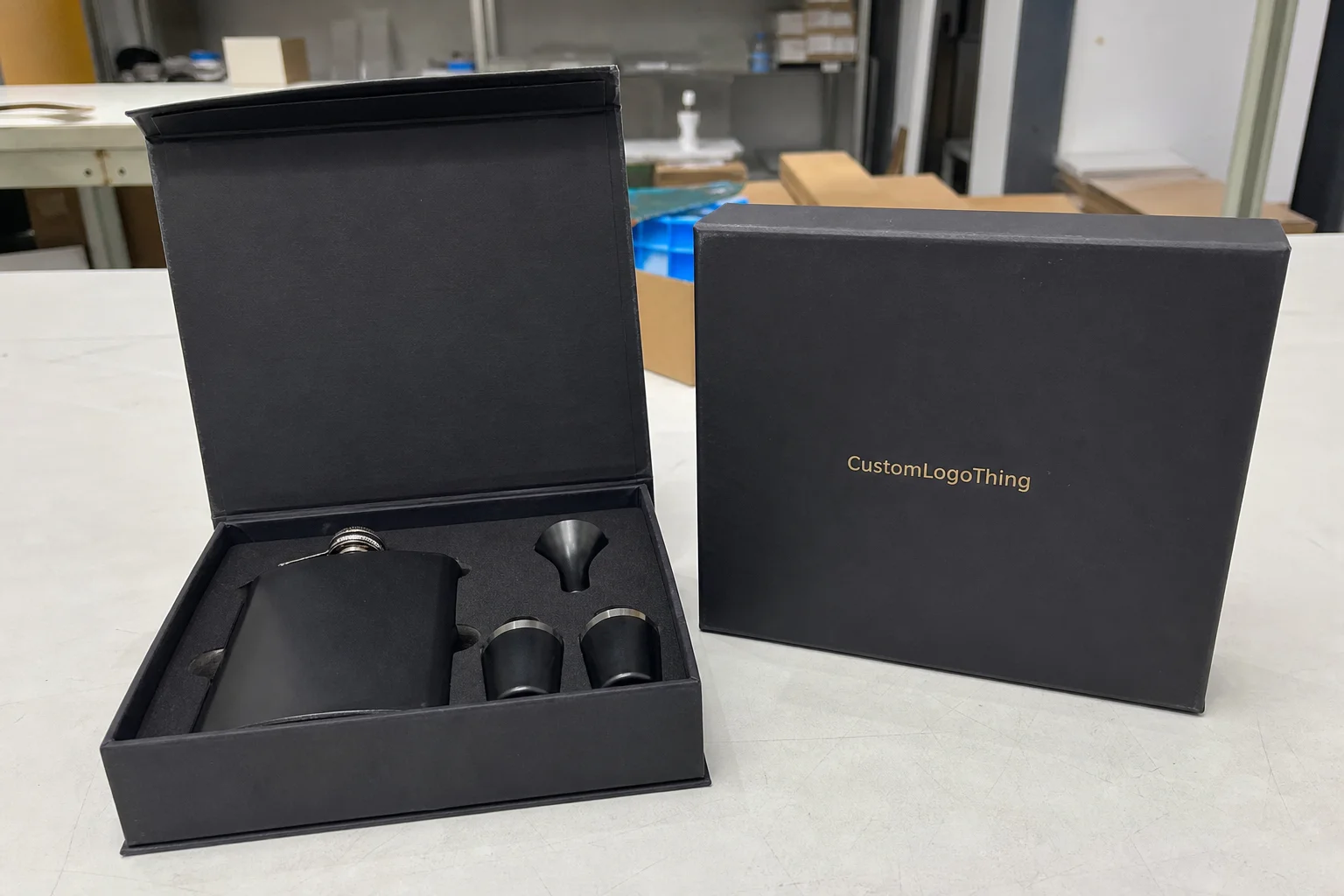
A good gift box does more than hide the contents. It gives the contents a frame. That is especially important for groomsmen gifts, which are often a mix of practical pieces and sentimental ones. Left loose, those items can feel oddly generic. Organized inside a personalized box, they feel like part of one complete gesture.
The most common use cases are easy to recognize. Proposal boxes need to make the ask feel specific and memorable. Wedding party thank-you boxes usually carry a few coordinated pieces, such as a note card, a small drink item, socks, cufflinks, or a cigar accessory. Keepsake boxes serve a slightly different role, holding items that the recipient might save after the event, so the structure has to feel sturdy enough to keep rather than discard.
That is where personalization matters. A name, initials, role, date, or short line of custom artwork turns the packaging into part of the gift rather than a generic shell around it. The detail does not have to be loud. In many cases, a restrained monogram or one foil-stamped line is stronger than a full-panel graphic because it lets the materials do the speaking.
There is also a coordination benefit that gets overlooked. If you are preparing several boxes at once, each one can be labeled and packed so the contents stay matched to the right person. That sounds simple, but it avoids the kind of small mix-up that becomes obvious the moment the boxes are opened. The more recipients you have, the more useful that structure becomes.
Personalized groomsmen boxes are often judged by the unboxing moment, but the real value shows up before that. They organize the contents, protect the items, and keep the presentation consistent across a group. That combination is what makes the gift feel finished.
“A box that fits the contents well usually looks more expensive than a box with extra decoration and a loose insert.”
How the boxes are built: materials, inserts, and print methods
Most custom groomsmen boxes are built from four decisions: the outer structure, the closure style, the insert, and the decoration method. Each choice affects cost, presentation, and shipping performance. Buyers often think they are quoting a single item, but they are really specifying a packaging system.
Material choice is the first major decision. Rigid board is the premium option. It holds shape well, gives the box weight in hand, and usually delivers the strongest presentation for proposals or keepsake sets. Folding carton is lighter and more economical, which makes sense for softer contents, flatter contents, or smaller budgets. Kraft stock gives a more relaxed, natural feel and works well for rustic or understated wedding themes. Specialty wraps, such as linen-texture paper, soft-touch lamination, or textured paper over board, add a more finished appearance without relying on heavy graphics.
Insert selection matters just as much as the shell. Foam inserts hold glass and metal securely, but they can add cost and sometimes read as too technical if the cutout design is not handled well. Paperboard dividers are lighter, easier to recycle in many cases, and well suited to socks, notes, cigar accessories, or smaller accessories. Molded trays are less common in gift packaging, but they can be useful when repeatable placement and tighter protection matter. If the contents are soft or already packaged individually, an insert may not be necessary at all.
Print method changes the look, the lead time, and the quote. Digital printing works well for full-color graphics, short runs, and artwork that needs flexibility. Foil stamping gives names, initials, or logos a sharper premium finish. Embossing and debossing add tactile depth and are often most effective when the artwork is simple. Labels and sleeves remain the most flexible option for variable personalization, especially if each recipient needs a different name or role.
Small production details matter more than people expect. A strong hinge line, a clean corner wrap, and a lid that closes without forcing the insert all affect how finished the box feels. If the contents can move inside the box, the presentation tends to feel cheaper no matter how good the artwork is. Fit is not a minor issue; it is part of the design.
For items that can scuff, leak, or rub against each other, a protective inner bag or sleeve can make the order look much cleaner. That is a practical move, not a decorative one. It keeps the contents from marking the inside of the box and gives the unboxing a cleaner reveal.
Packaging buyers who care about transit performance often think in the same terms as drop and vibration testing, even if they are not running a formal certification program. That mindset is useful. A box that looks strong in a mockup but crushes easily in shipping is not a finished product. For sustainability questions, ask whether paper components are FSC-certified and whether the supplier can document chain of custody rather than just claiming eco-friendliness. For reference, see ISTA and FSC.
Cost, pricing, and MOQ factors that change the quote
Price is driven by more than box size. The final number depends on board thickness, print coverage, insert type, finish, order quantity, and freight. Two boxes that look similar in a product photo can land in very different price bands once the actual materials and production steps are counted.
These are the rough ranges buyers typically see for common configurations:
| Box Type | Typical Use | Approx. Unit Cost | What Affects It Most |
|---|---|---|---|
| Printed folding carton | Light gifts, socks, notes, simple sets | $1.20-$2.80 | Print coverage, quantity, dieline complexity |
| Rigid box with basic insert | Proposal boxes, mid-range keepsakes | $4.00-$8.00 | Board thickness, wrap material, insert style |
| Rigid box with foil or embossing | Premium presentation and photo moments | $8.00-$18.00+ | Finish complexity, setup, small-run pricing |
Those numbers are only starting points. Small orders usually carry a higher unit price because artwork setup, die cutting, insert tooling, and proofing are spread across fewer pieces. A run of 12 custom boxes can cost much more per unit than 200 simple sleeves, even if the smaller order looks more modest on paper. MOQ works that way for most packaging, and the economics do not soften just because the order is for a wedding rather than retail.
There are also add-ons that buyers sometimes miss until late in the quote process. Extra proof rounds can add time, and in some cases cost. Rush production often carries a fee. Separate shipping to multiple addresses can be useful for groomsmen in different cities, but it raises logistics complexity. Custom inserts are another common surprise. People budget for the outer box, then realize the insert is doing most of the protective work and deserves its own line item.
The cleanest way to budget is to decide whether the order is primarily a proposal presentation box or a group gift box. Those are close in appearance, but they behave differently in production. One is usually judged by finish and first impression. The other depends more on repeatability, speed, and cost control. If the goal is to compare several structures on the same terms, use the same size, same insert style, and same finish assumptions before making cost comparisons.
Process and timeline: from artwork approval to delivery
The production path is usually straightforward, but each handoff carries risk if it is rushed. The typical sequence is quote, dieline confirmation, artwork submission, proof review, approval, production, packing, and shipment. Nothing here is mysterious. The challenge is keeping the details stable long enough for them to turn into finished boxes.
Simple printed cartons can often move fairly quickly after approval, sometimes within 7-10 business days depending on the workload and the complexity of the artwork. Rigid boxes, foil stamping, embossing, or custom inserts usually need more time, commonly 12-18 business days or longer if the construction is unusual. Shipping time sits on top of that, and that last leg can be the most unpredictable part of the schedule.
The same delays show up again and again. Artwork is sized incorrectly. Names are misspelled. Someone decides the initials should be in a different order. A proof sits waiting for approval because multiple people need to sign off. Quantities change after the quote. A “small” revision to the layout turns out to require a different die line. These are ordinary packaging delays, but they are costly when the deadline is a wedding weekend.
A practical rule is to work backward from the delivery date rather than forward from approval. Add time for proof changes, production slack, and shipping buffer. If the event is fixed, leave at least one extra week beyond the estimated transit time. That margin usually feels unnecessary until a carrier delay, a revised proof, or a backordered paper wrap uses up the calendar faster than expected.
Production quality checks also matter here. A solid supplier will verify print registration, confirm that the lid closes correctly, check insert fit, inspect corner wrap consistency, and review the final count before shipment. Those checks are not formalities. They are the difference between a gift box that looks custom and one that feels hurried.
Custom packaging usually fails at the proof stage long before it fails on the press or in transit.
Step-by-step ordering checklist for a cleaner custom result
The easiest way to avoid mistakes is to treat the order like a small production project. Start with the contents, then build the box around them. That sequence matters because the box size, insert layout, and finish all depend on what is actually going inside.
- Measure the contents first. Include sleeves, wrappers, and any protective packaging. A tie, a flask, and a cigar cutter may all be small, but they do not share the same footprint.
- Choose the box style that fits the event. Rustic kraft, clean rigid board, soft-touch premium, or simple printed carton each signal something different. Match the packaging to the tone of the wedding rather than to whatever looks busiest in a mockup.
- Prepare the artwork carefully. Check names, titles, initials, wedding date, and spelling. One typo can turn a personalized order into a batch of expensive corrections.
- Request a proof or sample. Confirm print placement, color balance, closure fit, and insert spacing. A physical sample is especially useful if the contents are fragile, valuable, or unusually shaped.
- Lock the logistics early. Finalize the shipping address, delivery window, and exact quantity before production begins. Changes after approval usually cost time and reduce control.
If the order includes several recipients, standardizing the structure is usually the smart move. Use one shell size and one insert format, then personalize only the top panel, lid, or sleeve. That keeps the order easier to quote, easier to proof, and easier to reorder if the guest count changes by a box or two. It also keeps the look consistent across the group, which is the whole point of custom packaging in this setting.
A simple spec sheet helps more than people expect. Include box dimensions, insert type, closure style, print method, quantity, finish, deadline, and delivery address. A one-page spec keeps everyone aligned and reduces the back-and-forth that usually slows down custom orders.
Common mistakes buyers make with personalized gift packaging
The most common mistake is ordering the box before measuring the contents. It happens often. The mockup looks right, but the actual items sit too high, rattle inside the insert, or press into the lid. A box that is even slightly off can make the entire gift feel unfinished.
Another frequent problem is overdesign. Too many fonts, too many colors, too many decorative elements. Premium packaging usually works better with restraint. One strong focal point, such as a foil monogram or a clean name treatment, usually reads better than a crowded layout that tries to use every available surface.
Buyers also underestimate the difference between a display box and a shipping-capable box. If the contents include glass, metal, or heavier accessories, the structure needs enough strength to survive handling without crushing corners or compressing the insert. A thin board with a pretty graphic can still fail if the package is carrying weight.
Names and titles deserve extra attention. If each recipient gets a different version, every file needs to be checked line by line. Best man, groomsman, usher, father of the groom, and groom all belong in their correct places. Those labels are small, but the error is immediately visible if they are wrong.
Cost surprises usually come from reading the quote too quickly. Some suppliers quote only the shell. Others exclude insert tooling, proof revisions, freight, or packaging assembly. A low starting price can become a poor value once the missing pieces are added back in. The safest quote is not always the cheapest one; it is the one that shows the full structure of the order.
Expert tips for a better-looking box without overspending
The best-looking packaging usually has one clear focal point. That could be a foil-stamped monogram, a personalized lid, or a custom liner inside the box. Pick one feature to carry the design and let the rest stay quiet. When everything is trying to stand out, the result starts to feel promotional rather than gift-worthy.
Matte finishes tend to work well in this category. They feel more refined in hand, reduce glare in photographs, and hide fingerprints better than glossy coatings. If the boxes will be handled before the event, that small practical advantage matters. A lid that smudges easily never looks as fresh as the person ordering it imagined.
Standardizing the shell and personalizing the top panel or sleeve only is one of the best ways to control cost. It preserves the custom feel while reducing production complexity. It also lowers the risk of artwork errors because the core structure stays the same from box to box. That is often the difference between a clean order and one that creates avoidable revisions.
These tradeoffs are worth keeping in mind:
- Foil stamping gives the strongest premium signal for initials and names.
- Digital print is usually better for color, short runs, and tighter schedules.
- Embossing or debossing works best with simple artwork and stronger paper stocks.
- Soft-touch lamination feels upscale, though it can show wear if the box is handled repeatedly.
If the order is for a proposal set or a photo-heavy wedding moment, ask for a sample or swatch before committing to the full run. A digital rendering cannot show how the paper texture feels, how the lid closes, or how the finish reacts under actual lighting. Material samples answer more questions than mockups usually do.
Next steps: finalize specs, request samples, and place the order
Before placing the order, build a short spec sheet and keep it consistent across every quote. Include the size, insert type, quantity, print method, finish, deadline, and delivery address. That makes the pricing useful instead of merely different.
Ask for a proof or sample before final approval, especially if the order includes names, dates, or customized artwork. It is much easier to correct a proof than to explain a misspelled name across a full production run. That sounds obvious because it is, but custom orders still go wrong here more often than anywhere else.
Once the proof is approved, keep tracking the timeline. Do not assume the order is safe just because production has started. Check the shipping status, confirm the count, and make sure the delivery window still works for the event. Personalized groomsmen boxes reward the same discipline as any other custom packaging job: clear specs, clean approval, realistic timing.
When the structure is right, the artwork is simple, and the schedule has enough room, the box does what it should. It holds the contents, elevates the gift, and makes the whole presentation feel deliberate without overcomplicating it.
FAQ
What are personalized groomsmen boxes used for?
They package groomsmen gifts in a way that feels coordinated and intentional. They are commonly used for proposal sets, wedding party thank-you gifts, and keepsake packaging. They also help keep multiple items organized so the final presentation looks clean.
How much do personalized groomsmen boxes usually cost?
Cost depends on size, material, finish, quantity, and insert style. Simple printed cartons are usually the lowest-cost option, while rigid boxes with foil, embossing, or custom inserts cost more. Smaller orders tend to have higher unit pricing because setup is spread across fewer pieces.
How long does production usually take?
Simple printed boxes often move faster than rigid boxes with specialty finishes. After artwork approval, production can take roughly 7-10 business days for simpler jobs and 12-18 business days or more for more complex builds. Shipping time should be added on top of that.
What should I put inside a personalized groomsmen box?
Common items include a flask, socks, a note card, cufflinks, cigar accessories, a tie, or a small bottle. The contents should match the box size and insert layout so nothing shifts in transit. Matching the items to the box style usually improves the final look.
Can I order personalized groomsmen boxes in a small quantity?
Yes. Small runs are common for proposal boxes and tight wedding party counts. The tradeoff is that low quantities usually cost more per unit because production setup is divided across fewer boxes. If you need several versions, compare pricing at multiple quantities before deciding.
What should I check before approving the proof?
Check spelling, names, initials, dates, print placement, box size, insert fit, and the overall color balance. If the order includes multiple recipients, verify each version separately. A careful proof review prevents the most common production errors.