Buyer Fit Snapshot
| Best fit | Personalized Mailer Boxes Bulk projects where brand print, material claims, artwork control, MOQ, and repeat-order consistency need to be specified before quoting. |
|---|---|
| Quote inputs | Share finished size, material target, print colors, finish, packing count, annual reorder estimate, ship-to region, and any compliance wording. |
| Proofing check | Approve dieline scale, logo placement, barcode or warning zones, color tolerance, closure strength, and carton packing before bulk production. |
| Main risk | Vague material claims, crowded artwork, missing packing details, or unclear freight terms can make a low unit price expensive after revisions. |
Fast answer: Personalized Mailer Boxes Bulk: Pricing, Specs & Process should be specified like a repeatable production item. The safest quote records material, print method, finish, artwork proof, packing count, and reorder notes in one written spec.
Production checks before approval
Compare the actual filled-product size with the drawing, then confirm tolerance on folds, seals, hang holes, label areas, and retail display edges. Reserve space for logos, QR codes, warning copy, and material claims before decorative graphics fill the panel.
Quote comparison points
Review material grade, print process, finish, sampling route, tooling charges, carton quantity, and freight assumptions side by side. A quote is only useful when the supplier can repeat the same color, closure quality, and packing count on the next order.
A one-eighth-inch mistake can vanish in a mockup and then show up in the warehouse like a bad invoice. A personalized Mailer Boxes Bulk order with a sizing error that small can chew through margin through extra board usage, weak closure performance, and fit problems that repeat across thousands of parcels. Buyers usually notice only after the pilot box passes the desk test and the real run starts returning crushed corners, loose fills, or graphics that looked fine on screen and tired in carrier circulation. Personalized mailer boxes bulk magnifies operational mistakes that would otherwise stay small.
That is why this guide stays practical. Packaging should be treated as a production system, not as a decorative exercise. The sections below break down what actually changes the price in personalized mailer boxes bulk runs, which specifications tend to fail first, and where schedule risk hides before the boxes ever reach the dock.
The goal is simple: fewer surprises, stronger protection, and a cleaner match between what your customers receive and what your operations team can forecast at scale. A well-structured personalized mailer box program behaves less like marketing theater and more like an engineered part of your fulfillment chain. That’s the bar, and honestly it should be.
Personalized Mailer Boxes Bulk: Why Volume Changes the Math
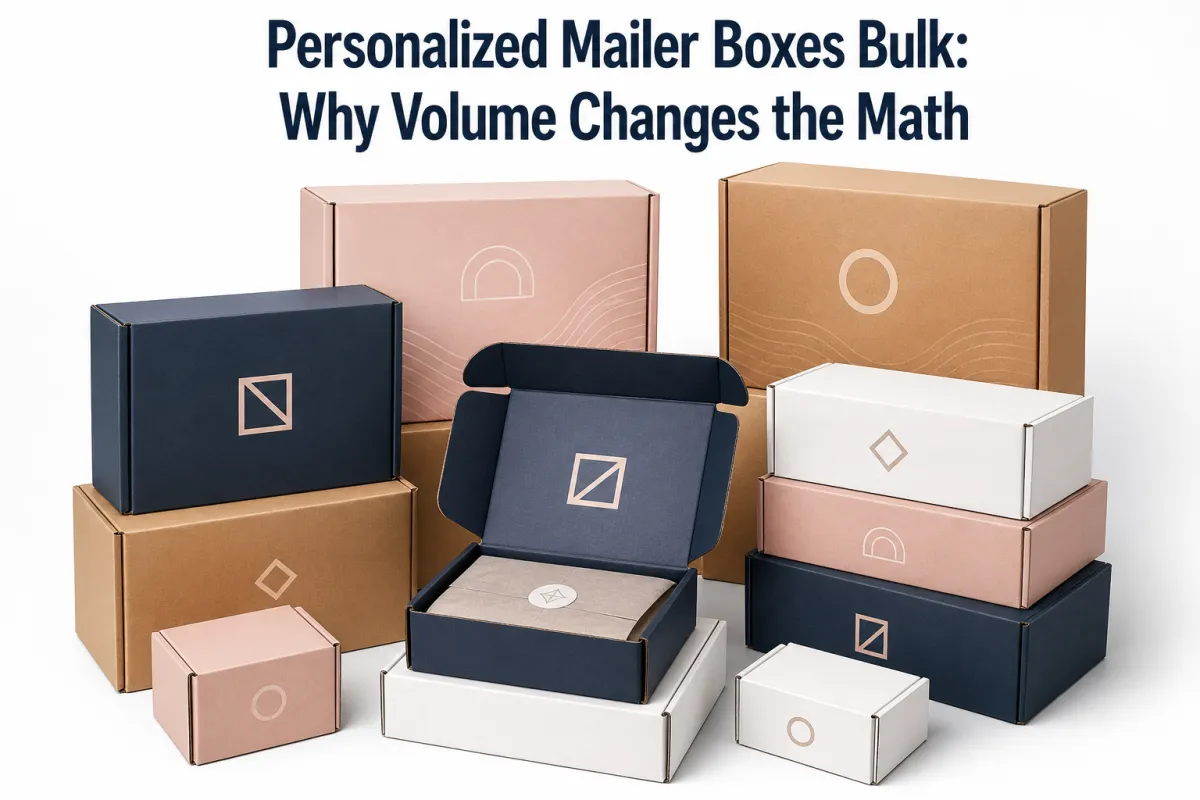
Small orders invite sticker-price thinking. Large orders expose system thinking. I have watched teams chase the lowest per-box quote and still spend more because they ignored setup time, packing behavior, and freight structure. In personalized mailer boxes bulk programs, unit price is only one column in the spreadsheet; the rest decide whether the order helps margin or quietly drains it.
Setup costs are fixed, which changes everything
Die tooling, prepress work, plate setup, and structural calibration behave like fixed costs from the first unit onward. Whether the order is 500 boxes or 5,000, those steps still happen. A custom setup block at $600 and board preparation at $450 adds $1,050 before the first printed panel ships. At 500 units, that is $2.10 per box. At 2,500 units, the same fixed cost falls to $0.42. That gap explains why bulk ordering exists.
From a buyer's angle, the real question is not whether the quote looks low. The real question is where the next leak starts. A quote at $0.90 can still become a $1.10 job if each shipment needs $0.20 in extra void fill because the cavity is too loose. In many personalized mailer boxes bulk runs, margin rewards process control more than bargain hunting. This is especially true in custom printed packaging, where tiny process breaks show up in real time.
Tiny dimensional errors become expensive operationally
A 1/8-inch sizing error sounds harmless until it affects trim waste, internal fit, and outbound carton planning. Oversize the box by a few millimeters and the product may need extra dunnage, which pushes freight volume higher and can force a larger shipper carton. Undersize it and the closure starts fighting the contents, which shows up as corner deformation, returns, and unhappy fulfillment teams during peak season.
Automation magnifies the issue. Machines do not negotiate with inconsistent dimensions. Mixed tolerances send work back to people, and manual correction slows every station it touches. Consistent personalized mailer boxes bulk dimensions reduce picker mistakes and shorten fill time. Teams that standardize spec accuracy often reclaim 5 to 10 minutes per 100 lines per shift; one operations lead told me that was enough to wipe out an apparent $0.07 price advantage on a high-volume run.
Brand perception gets more repeatable with volume
Volume affects more than cost. It shapes how reliable the brand feels. A branded shipping box that always lands with the same size, closure feel, and print quality reads as intentional. A run that shifts between batches, even slightly, feels off. The artwork may be identical, but the experience is not. Repeat commerce is built on pattern recognition. Customers notice when the box arrives the same way twice.
The shipping moment has become a small but visible brand test. The packaging is doing two jobs at once: protecting the product and confirming the brand has standards. With personalized mailer boxes bulk, that effect compounds. Repeat buyers start connecting unboxing with consistency, and consistency is one of the few marketing claims a parcel can prove without saying a word.
That is why personalized mailer boxes bulk planning usually starts with an operational hypothesis, then checks visual quality. In this sequence, the best print and the best fold are never separate conversations.
Strong sourcing teams treat the first sample run as a systems test. They measure fit before they admire the print, then lock the structure before a reorder even gets discussed.
Can Personalized Mailer Boxes Bulk Protect Your Shipments Better?
Personalized mailer boxes bulk can protect better, but only when the structure matches the product logic. People assume material and print are the main variables. In practice, interior geometry and closure strategy explain most field failures. I have seen premium finishes with weak edge compression outperform glossy paper glamour if the cavity and lock profile are right.
For teams managing bulk fulfillment operations, this question is never theoretical. The packaging answer affects labor pacing, damage ratio, and outbound speed. A box that is right by spec creates predictable handoffs; a box that is almost right creates recurring exceptions. Neither is obvious in static mockups. Both are obvious at volume.
So the right answer is yes, personalized mailer boxes bulk can significantly improve protection, but not by aesthetics. They improve when the build spec is treated as a control system, not a branding afterthought.
Product Details That Affect Personalized Mailer Boxes Bulk
Structure speaks before pricing does. Different styles exist for practical reasons, not just visual ones. Product weight, shape, and launch cadence all point toward different box decisions, and the wrong choice can cost more than the print.
Style family and closure behavior
Roll-end tuck front mailers work well when speed matters and the closure needs to feel familiar. They are a dependable default for regular-shaped goods and shelf-ready presentation. Self-locking mailers cut down on tape and are common in fulfillment environments where minutes matter more than presentation flourishes; they also tolerate different packing habits better than many closure styles. Auto-lock bottoms bring more structure and are useful for heavier goods or transport with higher vibration. Display-style mailers stretch the surface area and can turn the box into part of the retail story.
Subscription kits and multi-item bundle drops often benefit from display-style packaging because the box itself carries more of the presentation load. That choice comes with a larger footprint. If the goal is ship protection first, extra volume only earns its keep when the product story truly needs it. For personalized mailer boxes bulk, it is worth testing both styles with live SKUs before locking art.
Material and flute choices: the part buyers overlook is the part they depend on
Kraft stocks fit natural branding and craft-oriented positioning, but they are less forgiving when rich color coverage matters. White-lined corrugated and clay-coated liner options give cleaner registration and steadier print color, especially when humidity or heat swings during production. The decision should come down to whether the box needs a premium print result or a raw, tactile feel.
Corrugated structure deserves more attention than it usually gets. Buyers ask too much about price and too little about flute profile. Those options are not decorative. They are engineering choices. E-flute gives a thinner wall and a tighter visual profile, which suits lighter goods and cleaner edges. B-flute and C-flute add crush resistance, which helps on longer transit routes, higher drop risk, and heavier SKUs. For heavier launches, ask for edge-compression and stacking simulation, not vague promises. A route with multiple sort points needs more safety margin than a single local shipment.
In personalized mailer boxes bulk projects, this is where custom printed packaging either behaves like a production asset or becomes a silent cost center.
Finish and print change how the box behaves after launch
Matte, gloss, and soft-touch each alter perception and durability. Matte looks refined and keeps glare down in photography; it also hides minor handling scuffs better than many glossy finishes. Gloss delivers brightness and high contrast, though it can show rub marks sooner. Soft-touch feels premium in hand, yet it can collect dirt more readily if the boxes are handled heavily in bulk. Uncoated kraft-like surfaces signal an eco-aware, natural look, but dense color usually suffers compared with coated stock.
That choice is less about style than about what the box must survive. A campaign shipping 2,000 samples with a lot of social sharing may benefit from gloss because color reads stronger on camera. A run that sits in warm storage for days often looks cleaner in matte or uncoated stock. For personalized mailer boxes bulk in a premium lane, the finish should be locked early, not treated as a last-minute aesthetic tweak.
The same applies to coating strategy. A soft-touch finish on one line and a matte varnish on another can create odd differences in perceived quality, even when the logo is identical. That inconsistency is measurable in repeat purchase behavior when customers compare boxes side by side.
Inserts and accessories: invisible margins made visible
Every custom pack carries hidden architecture costs. Tissue paper and foam are not just cushioning; they are damage controls that can reduce replacement rates. Paper dividers and die-cut partitions stabilize multi-item bundles and speed up pick-pack work. A fragile item with one well-fitted foam insert will usually outperform a loose cavity that lets the product wander during transit.
Accessory tolerance gets ignored more often than it should. If the insert runs 2 mm short on each side, the product shifts. If it is 2 mm too large, assembly slows down and sometimes jams. Prototype measurements should be taken against real SKUs, not mock labels. Paper cradles can cost less than foam at medium quantities, but they need tight tolerances to avoid compression marks and collapsed edges.
When planners speak about personalized mailer boxes bulk, they should include insert stack-up, because that detail drives both cartonization and labor time. A better insert design can sometimes save more than a second print layer.
Specifications to Lock Before You Order
Most expensive revisions start with “close enough.” That phrase is expensive in custom packaging. personalized mailer boxes bulk orders reward exactness and punish assumptions. Freeze the inputs before quoting, then protect them from casual changes.
What to freeze on day one
- Internal dimensions (width, height, depth) with tolerance bands; include closure clearance if the style affects clearance.
- Board grade and flute profile matched to product weight and route fragility.
- Print method and color model, including spot colors, CMYK, varnish layers, or mixed systems.
- Finish such as matte, gloss, soft-touch, or uncoated, plus any coating requirement.
- Closure style and lock strength requirements tied to vibration and stack pressure.
- Insert dimensions, partition count, and any accessory stack-up details.
- Corrugated mailer construction tolerance and any handling test criteria for the route.
Each measurement affects at least three cost lines at once: material usage, shipping safety, and fulfillment speed. A box that is too large drives up dunnage and dimensional freight charges. A box that is too tight raises damage rates and returns. Neither problem appears in an art review, and both appear after launch in the KPIs that matter.
Use a spec sheet like a contract
For day-to-day operations, attach these items to every quote request:
- SKU weight in grams, exact outer dimensions, and any seasonal size variant.
- Whether the shipment is direct-to-consumer or palletized to store channels.
- Stackability and layer count during transport.
- Carrier profile: express, ground, regional hub, or mixed.
- Brand handling rules: no resealable adhesives, no heat exposure, clean surface requirements.
This is not paperwork for its own sake. It separates a nice-looking concept from a production result that actually holds up. The teams that treat this as a baseline for personalized mailer boxes bulk orders spend less time arguing and more time shipping.
File prep: get this right, avoid avoidable rework
Print-file quality often decides whether the schedule stays calm or gets noisy. Confirm dieline alignment and include bleed and safe zones. A clean workflow usually includes a PDF and a source file in vector format, with text outlined and image resolution above production standard. Mixed print elements need color targets locked before approval, and those targets should match the selected stock's CMYK behavior.
A common mistake is building artwork against the wrong template. A mockup can look perfect on screen and fail once folded. The template has to be production-ready, not approximate. Ask for the preflight report where available, and do not approve production without a proof that respects structural constraints.
Teams handling multiple lines should bring shipping standards into the structure rather than bolting them on later. ISTA-informed handling assumptions and shipping mock scenarios should shape the box, not become a complaint after launch. Sustainability-minded programs should confirm board source and chain-of-custody documentation with FSC-aligned options before the quote is locked.
Personalized Mailer Boxes Bulk Pricing and MOQ
Pricing has more than one lever. In personalized mailer boxes bulk sourcing, unit price reflects several variables working at once. Tiered quotes reveal the shape of the cost curve better than a single number ever will.
Main pricing drivers, with actual ranges
Price shifts tend to come from these variables:
- Size and fit: larger cavities add board, shipping volume, and freight.
- Board grade and flute: stronger structures cost more per square meter.
- Print coverage: full-color coverage on coated stock is usually the most expensive path.
- Number of colors and finishing: spot varnish and texture coating add setup and print complexity.
- Insert complexity: die-cut pieces, pre-assembly, and accessory packing increase handling time.
- Quantity tier: setup spread becomes meaningful as the run gets larger.
Planning ranges help before quotes arrive. A simple 3-color stock build may land near $1.25–$1.95 at 500 units, while 3,000 units can fall to $0.70–$1.05 depending on finish and board strength. Heavier custom structures with inserts usually start higher and compress less dramatically, which is why the cheapest tier is not always the smartest buy.
For personalized mailer boxes bulk, total landed cost matters more than a single unit figure. Freight, sample runs, and packaging waste often outrun the visible discount between 1,000 and 2,000 units if density worsens or handling gets awkward.
MOQ is not a wall; it is a volume decision point
Most providers can support smaller initial runs. The real question is where your cost curve crosses your reorder confidence point. Ask for quotes at four points if you can: 500, 1,000, 2,000, and 5,000. That turns a pricing discussion into evidence. If 2,000 units cuts per-box cost by 18% but storage and demand cannot absorb it, you are buying risk. If 1,000 units still looks expensive and 2,000 fits the calendar, the middle point may be the better answer.
For personalized mailer boxes bulk campaigns tied to seasonal launches, forecast bands work better than wishful thinking. Ask a blunt question: what is the highest realistic sell-through by week four? That answer should shape MOQ, not campaign enthusiasm.
The right MOQ is often the one that keeps both margin and operational resilience within the same lane. In other words, the right order size is usually where a personalized mailer boxes bulk run stops looking like marketing debt and starts acting like a repeatable fulfillment engine.
Hidden costs you should price before purchase
These charges often arrive late, but they belong in the estimate from the start:
- Physical sampling and courier cost for approved proofs.
- Freight from factory to warehouse and from warehouse to fulfillment center.
- Rush handling if revisions happen after proofing.
- Special finishing operations and post-print coating checks.
Many teams celebrate a low per-unit quote and then discover sample and freight costs consuming 8 to 15 percent of the declared budget. Real value is the number your team can forecast and absorb without scrambling.
| Run Type | Typical Spec Example | 500 Units | 1,500 Units | 4,000 Units | Lead Time |
|---|---|---|---|---|---|
| Starter | Kraft, roll-end tuck front, 1-2 colors, no insert | $1.75 / unit | $1.35 / unit | $0.95 / unit | 12–17 business days |
| Brand Standard | White-lined corrugated, 4-color, matte varnish, auto-lock | $2.25 / unit | $1.70 / unit | $1.20 / unit | 14–20 business days |
| Premium Protection | B-flute, reinforced lock, partition inserts | $2.90 / unit | $2.20 / unit | $1.65 / unit | 16–24 business days |
| Display-Ready | Retail style, high coverage print, soft-touch | $3.30 / unit | $2.55 / unit | $1.90 / unit | 18–28 business days |
Production Process and Timeline for Bulk Orders
Production succeeds when the timeline is treated as a real schedule, not a guess. Many teams assume manufacturing is the slowest step. Proofing and approvals often take longer.
Full production flow you should expect
- Quote request with finalized quantity range and preliminary spec sheet.
- Spec review and structural feasibility check.
- Dieline development and test-fit simulation.
- Artwork proof generation and color match review.
- Sample production for structural and print verification.
- Sample approval and final correction pass.
- Manufacturing run and in-line QC checks.
- Finished packing, palletization, and freight handoff.
A first-time run with custom structure usually needs two review cycles. A repeat order can move faster because the template and calibration are already proven. For personalized mailer boxes bulk, this is where most teams either secure reliability or accumulate avoidable waste.
Where delays usually happen
The same three issues appear again and again. Artwork changes after proof. Unclear interior measurements when products shift by version or seasonal trim. Late feedback from approval teams working around campaign calendars. Any one of those can turn a 12-day print window into 18 or 21 days with very little warning.
For personalized mailer boxes bulk runs with inserts, final mechanical tests catch a surprising number of issues. One extra minute at sample stage can prevent ten times the rework later. Fragile products should not rely on goodwill or luck.
Time-to-market decisions should include these checkpoints like non-negotiables: preflight, test-fit, lockout window, and a final mechanical sign-off. Skipping one step is usually cheaper than the quote suggests, more expensive than the process should be.
Keep the schedule tight without over-pressuring vendors
Ask for a production date tied to a specific proof and a specific internal sign-off date. Build a change freeze at least 48 hours before proof release. One common trap is launching a campaign before the packaging team, logistics team, and operations team have all validated the quote. If a target launch slips, it only stays recoverable when freight planning and outbound planning remain separate in your calendar.
A practical cadence works better than a heroic one: Monday spec lock, Wednesday sample review, Friday final approval where possible, then production starts by week two. Repeat orders can shrink this considerably. First builds deserve an extra 10 to 15 percent buffer for correction and transit variance.
Teams managing personalized mailer boxes bulk who maintain this cadence typically show lower variance in both cost and delivery, especially when they treat custom printed packaging as a recurring system, not a one-off purchase.
"A clean approval loop beats a faster printer. If internal feedback takes five days, a vendor switch will not recover that loss."
Why Choose Us for Personalized Mailer Boxes Bulk
Large packaging orders expose the difference between a supplier and a partner. At scale, slogans disappear. Process control stays visible. So does the speed at which a vendor absorbs risk that does not show up in a screenshot.
Consistency and rework reduction
For high-volume packaging, reproducibility is the core value. A reliable partner checks board thickness, color consistency, and dimensional accuracy before the press run reaches full speed. That usually means less manual correction, fewer rushed changes, and smoother campaign cycles for recurring orders.
Ask for proof protocol details when comparing providers. Do they run batch checks on each pallet lot? Do they measure tolerances and track drift? A vendor that skips those steps can let an order drift out of spec before anyone notices, and the first clue may be return volume.
In personalized mailer boxes bulk procurement, quality becomes easier to defend when the partner can prove process discipline without you asking for daily intervention.
Quality gates that matter on the receiving dock
The checkpoints worth documenting are the ones that reveal real process discipline:
- Incoming raw material inspection for board moisture, strength, and surface defects.
- Dieline-to-flatten consistency check before the full run starts.
- Preflight of color, bleeds, and registration marks.
- Dimensional audit on first-off sample and end-of-run sample.
- Closure strength spot-check for lock and auto-lock failures.
That matters even more when a product family includes items with 20 to 30 percent weight variation inside the same SKU block. Good teams account for that in planning rather than trying to solve it after the cartons hit the dock.
Support that scales across models
Operationally, the same packaging partner should be able to support direct-to-consumer kits, subscription loops, and wholesale replenishment without changing the logic of the quote. Personalized mailer boxes bulk is not just a printing category. It is a fulfillment interface.
Subscription programs and seasonal launches may need one structure for retention shipments and another for promotional spikes. Wholesale scaling can need one design and two weights. The better partners handle that complexity without rebuilding the process from zero.
If you want to compare options, start with the full range in Custom Packaging Products, then see whether your mailer needs line up with Custom Poly Mailers for complementary categories or whether your workflow fits better in Wholesale Programs for staged volume planning.
Next Steps for Personalized Mailer Boxes Bulk Orders
Most buyers reach the same bottleneck: they know the look they want, but the file, spec, and timing do not yet live in one place. The fix is shorter than the delay makes it seem.
Step-by-step checklist before requesting a quote
- Confirm exact internal size and maximum product weight, including inserts and sleeves.
- Choose stock family (kraft, white-coated, clay-coated) and test finish.
- Pick a quantity plan by campaign, not by emotion.
- Define closure type and expected shelf conditions.
- Gather approved vector artwork, dieline, and branding assets in print-ready format.
- Set a target delivery window with a 10 percent buffer for revisions.
Requests often fail because this list gets assembled after the first email instead of before it. Build it first. The quote process becomes faster, clearer, and less political.
Sample-first for first-time buyers
If this is your first production cycle, skip the urge to leap straight into volume. Sampling gives answers that a screen cannot: whether the fold line holds under load, whether the closure closes evenly, whether the print still looks correct under warehouse lighting. If inserts are involved, test them with real units.
Validate fit tolerance on at least one extreme SKU and one heavy SKU. Product weight variation can make one version pass and another fail. One full production failure can erase the value of the entire prelaunch campaign, which is a painful lesson most teams only want once.
Compare intelligently, not greedily
Review these numbers together: unit price, sample cost, freight to the warehouse, lead time, and insert support. The cheapest quote can become the most expensive if it forces a different freight lane or higher dunnage. Hidden losses rarely show up in the headline number.
For the final decision, treat the order as a total package. If personalized mailer boxes bulk quality stays consistent and the lead time is credible, you are buying reliability and execution control, not cardboard alone. That kind of clarity is gonna save you a lot of headaches later.
Actionable close
Send a finalized spec sheet, your quantity range, and the exact artwork package in one clean request. That single packet determines whether the quote is a meaningful baseline or a rough guess. Do that well and personalized mailer boxes bulk planning becomes predictable instead of turning into a monthly scramble. The payoff shows up in fewer fulfillment exceptions, fewer budget shocks, and a cleaner brand moment for the customer.
Frequently Asked Questions
What is the minimum order for personalized mailer boxes bulk?
MOQ depends on box size, print complexity, and whether the run uses standard or custom tooling. Ask for quotes at several volume levels and compare where the next cost break appears. Smaller runs are often possible, but pricing usually improves once setup costs are spread across enough units to absorb prepress and structural validation.
How long do personalized mailer boxes bulk orders usually take?
Allow for proofing and sample approval before production starts, especially on first-time designs or structure changes. Repeat orders can move faster because the template and calibration already exist. Freight and final delivery planning should stay separate from press time so campaigns do not run into avoidable launch pressure.
Which material is best for personalized mailer boxes bulk shipping?
Match the material to the product load and shipment distance. Kraft works well for lightweight or craft-forward positioning, while coated white stocks usually improve print sharpness. Heavier or fragile loads often need stronger corrugated box construction, and many teams add die-cut inserts or partitions when vibration and drop risk are high.
Can I add inserts to personalized mailer boxes bulk orders?
Yes. Inserts are common for single-item and multi-item shipments, including tissue, paper dividers, and die-cut cradles. Fragile goods usually need tested insert dimensions and tolerances so items cannot shift. The extra cost is often justified by lower return risk and a cleaner unpacking experience.
What artwork files do you need for personalized mailer boxes bulk?
Use vector-based files such as PDF, AI, or EPS with linked images embedded and fonts outlined. Include a correctly aligned dieline, bleed, and safe area, and confirm color targets before final approval. High-resolution assets and clear layer naming reduce revision churn and keep the schedule closer to target.