Buyer Fit Snapshot
| Best fit | Compare Compostable vs Reusable Mailers projects where brand print, material claims, artwork control, MOQ, and repeat-order consistency need to be specified before quoting. |
|---|---|
| Quote inputs | Share finished size, material target, print colors, finish, packing count, annual reorder estimate, ship-to region, and any compliance wording. |
| Proofing check | Approve dieline scale, logo placement, barcode or warning zones, color tolerance, closure strength, and carton packing before bulk production. |
| Main risk | Vague material claims, crowded artwork, missing packing details, or unclear freight terms can make a low unit price expensive after revisions. |
Fast answer: Compare Compostable vs Reusable Mailers: Film, Print, MOQ, and Carton Packing should be specified like a repeatable production item. The safest quote records material, print method, finish, artwork proof, packing count, and reorder notes in one written spec.
Production checks before approval
Compare the actual filled-product size with the drawing, then confirm tolerance on folds, seals, hang holes, label areas, and retail display edges. Reserve space for logos, QR codes, warning copy, and material claims before decorative graphics fill the panel.
Quote comparison points
Review material grade, print process, finish, sampling route, tooling charges, carton quantity, and freight assumptions side by side. A quote is only useful when the supplier can repeat the same color, closure quality, and packing count on the next order.
If you Compare Compostable vs reusable mailers long enough, the sales language starts to outrun the logistics. Compostable is not automatically cleaner. Reusable is not automatically smarter just because it sounds like the packaging equivalent of a policy memo. Shipping has a way of stripping away the polish and showing you what actually works.
The practical split is clearer than the branding. For one-way direct-to-consumer shipments, compostable mailers usually win on simplicity and customer disposal. For return loops, rental programs, and controlled internal circulation, reusable mailers can win by a wide margin on waste reduction and carbon footprint. That advantage only shows up if the mailer comes back, survives, and gets sent out again.
Packaging decisions get messy where the product, the route, and the customer all collide. Weight matters. Moisture matters. Carrier handling matters. So does whether your team can support the process without turning sustainable packaging into a paperwork hobby. Compare Compostable vs reusable mailers through that lens, and the answer usually gets less emotional fast.
Buyer rule: if the package has to come back, the system has to come back too. A reusable mailer with no recovery plan is just a thicker single-use mailer wearing a better label.
Quick Answer: Compare Compostable vs Reusable Mailers
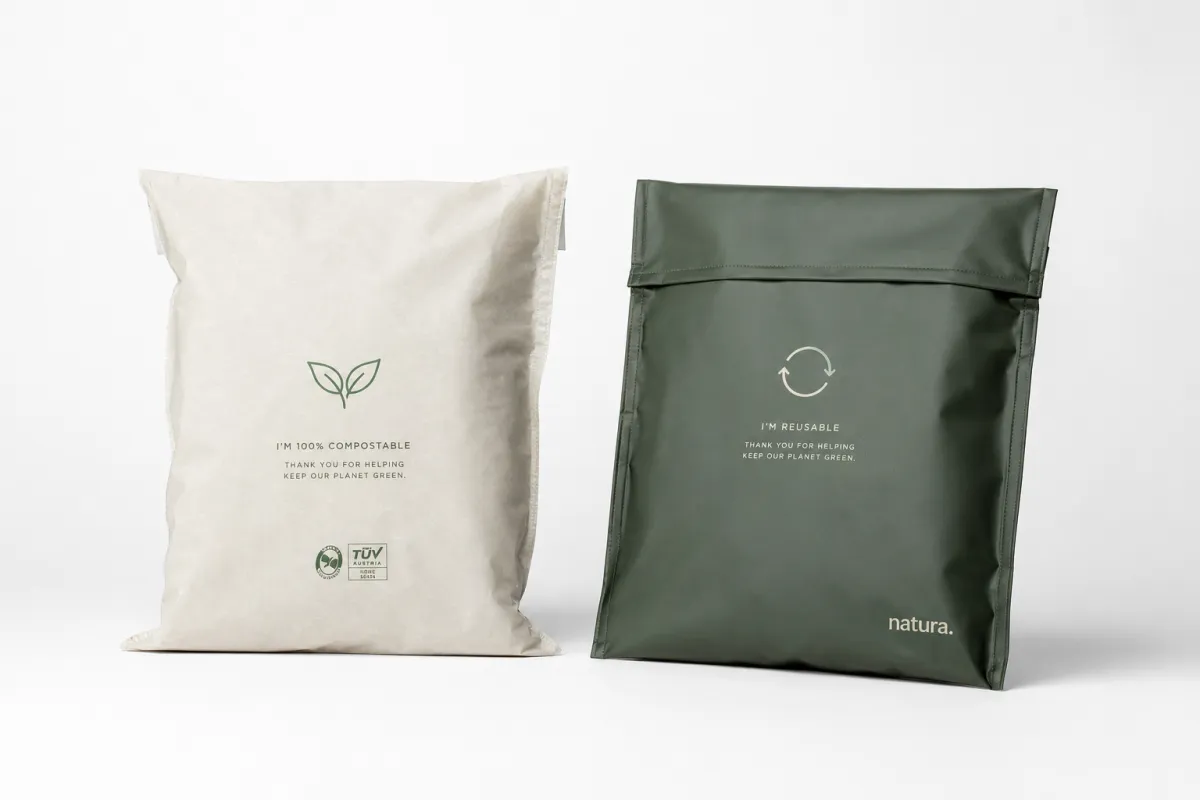
Here is the plain answer when you compare compostable vs reusable mailers: compostable mailers usually win for simple, one-way shipments, and reusable mailers win when the same mailer can circulate multiple times or handle returns with real discipline. The distinction sounds basic. It is also where a lot of packaging programs go wrong.
Compostable mailers are easier for most customers to understand. Open the package, remove the product, dispose of the mailer in the proper stream if the local facility accepts it, and move on. Reusable mailers demand more from both brand and customer. A return path has to exist. Sorting has to happen. Inspection or cleaning has to happen. Volume has to justify the labor. If any part of that chain breaks, the circular packaging story starts costing money instead of saving it.
For a brand shipping a sweater, a sample pack, or a small accessory once, compostable often makes the cleaner operational choice. For a rental kit, a subscription refill, or a returns-heavy category, reusable starts looking stronger very quickly. Same keyword. Very different logistics.
The rest of the decision comes down to product shape, shipping lane, damage risk, disposal reality, and customer behavior. Packaging is not decoration. It has to survive warehouse hands, conveyor belts, and the occasional odd move from a customer who has not read the insert.
There is a hidden tradeoff that matters more than most teams admit. Compostable can be easier for the buyer to throw away correctly. Reusable can cut waste harder over time, but only if reverse logistics are real. That single difference decides more projects than the marketing deck ever will when teams compare compostable vs reusable mailers.
Which Is Better: Compostable or Reusable Mailers?
If you want the shortest featured-snippet answer, this is it: compare compostable vs reusable mailers based on the direction of the shipment. Compostable mailers are usually better for one-way fulfillment. Reusable mailers are usually better for controlled loops, returns, and repeated shipping cycles.
That answer holds up because the two formats solve different problems. Compostable packaging reduces friction at the customer end, especially when disposal instructions need to stay simple. Reusable mailers reduce material use over time, but only after the system proves it can recover the mailer, inspect it, and send it back into circulation.
So the real question is not which material sounds greener. It is which one matches your shipping model, your return rate, and your ability to manage the process without creating extra waste in another part of the chain. Compare compostable vs reusable mailers honestly, and the better choice often becomes obvious.
I have sat in more than one packaging review where the team wanted the environmentally pure answer, and then procurement, ops, and customer service all looked at each other like, "Are we actually set up for that?" That pause says a lot. The right mailer is usually the one your team can run every day, not the one that wins the slide deck.
Top Options Compared: Compare Compostable vs Reusable Mailers at a Glance
To compare compostable vs reusable mailers without getting pulled into slogans, look at the material, durability, moisture resistance, branding surface, disposal route, and best-fit use case. Once those are lined up side by side, the answer gets less emotional and more usable.
Compostable mailers show up in a few different forms. Some use PLA or PBAT blends. Some rely on paper-based constructions with compostable coatings. The better versions feel crisp, seal cleanly, and take custom printing without looking cheap. Reusable mailers are usually built from woven polypropylene, recycled film, or textile-style structures with reinforced seams and closures meant to survive repeated trips. Both can sound responsible. They solve different problems.
| Factor | Compostable Mailers | Reusable Mailers | Best Fit |
|---|---|---|---|
| Material | PLA, PBAT blends, or paper-based formats with compostable coatings | Woven PP, recycled film, or textile-style returnable constructions | Depends on disposal path and reuse plan |
| Durability | Works well for one trip, light-to-medium loads, and careful packing | Built for stronger seam life and abrasion resistance across multiple uses | Reusable for repeated loops; compostable for one-way shipping |
| Moisture resistance | Usually solid, though some films soften or scuff in humidity | Often better against wear, but closure design still decides a lot | Reusable in rough or wet shipping lanes |
| Branding surface | Clean print surface, especially for bold logo work | Can look premium, but print specs vary by construction | Both can work for custom logo packaging |
| Disposal route | Industrial composting or proper compost stream, if available | Recovery, inspection, reuse, or circular return logistics | Compostable for easier customer disposal; reusable for controlled loops |
| Best use case | Apparel, accessories, documents, lightweight kits, low-return orders | Subscription programs, rentals, internal transfers, returns-heavy shipping | Choose by actual workflow, not brand fantasy |
For apparel, the choice often turns on weight and return frequency. A hoodie in a compostable mailer is one scenario. A high-churn returns program is a different business entirely. Beauty, supplements, and small consumer goods bring customer experience into the frame. Compostable feels familiar and disposable. Reusable feels more premium, but only if the customer knows exactly what to do with it.
There is a blunt reality that packaging brochures rarely mention. Some reusable mailers are durable enough to justify the name. Others are just heavy single-use mailers with a cleaner reputation. If the seam fails after one round, if the closure weakens, or if the surface looks tired after a few touches, the reuse plan was never real. It was branding with a shipping label.
For buyers who want to compare compostable vs reusable mailers on something sturdier than vibes, the technical paperwork matters. Ask for material thickness, seal type, print method, and transit test references. For drop and compression testing, published test families from ISTA help frame the conversation. For paper-heavy structures, FSC certification still matters when fiber content is part of the build.
Detailed Reviews: Compostable Mailers Under Real Shipping Conditions
For one-way shipping, compostable mailers usually feel like the cleaner operational choice. They are easier to explain, easier to stock, and easier for customers to dispose of without a novel-length instruction card. That matters. Packaging that asks for a seminar tends to end up in the wrong bin.
Under normal shipping conditions, compostable mailers perform best with light to moderate product loads, especially soft goods and flat items. A 2.5 to 3 mil compostable film, or a paper-based format with the right coating, can handle typical carrier treatment if the product has decent internal protection. Once sharp edges, corner pressure, or heavy abrasion enter the picture, the limits show up. Corners poke. Seals take a beating. Humidity can make the material feel fatigued before the parcel reaches the customer.
That is where compare compostable vs reusable mailers becomes more than a sustainability debate. Compostable mailers need a cleaner use case. They Work Best when the shipment is not fighting the package from the inside. A folded tee, a sample kit, a document set, or a lightweight accessory pack is a good match. A metal tool, a box with hard corners, or a product that shifts around too much is not.
Print quality is another detail that gets overlooked. Custom logo work on compostable material can look excellent if the film or paper is chosen well. Matte white compostable mailers take bold branding cleanly. Kraft-style paper compostables create a more natural look, which many customers read as premium and aligned with eco-friendly packaging. If the finish is weak or the ink sits unevenly, the package can look expensive in the wrong way. Cheap. And that is usually not what the brand wanted.
Disposal is the make-or-break issue. A compostable mailer only supports a lower carbon footprint if it reaches the right disposal stream. Many consumers do not have access to industrial composting. Some local systems accept paper and organics separately, some do not, and some customers toss everything into general waste because that is what people do when the instructions get too clever. If your brand chooses compostable, the disposal message has to be short, honest, and realistic.
That is why I do not like overpromising zero waste. It sounds clean. It also collapses fast when someone asks for the actual path. Better to say what the package is designed to do, what it is not designed to do, and what customers should expect in the real world. Honesty travels better than a circular economy slogan.
Standards matter too. Compostable claims should be backed by the right testing and certification language, not just a marketing line. Ask suppliers about ASTM D6400 or D6868 where relevant, and ask which part of the package is certified. Is it the film, the full structure, the print ink, the adhesive, or just one layer? That detail matters every time you compare compostable vs reusable mailers because the label alone tells you almost nothing.
One more practical point: the best compostable mailers are the ones that reduce both waste and customer confusion. If the disposal note needs three paragraphs, the system is already too complicated. Keep it short. Keep it real. Most buyers are not gonna read a materials dissertation before they toss the mailer.
My practical view: if the package is going one way, compostable mailers are often the better tradeoff. They keep the process simpler, they usually cost less to launch, and they avoid the operational mess that comes from pretending every customer wants to participate in a return loop.
Detailed Reviews: Reusable Mailers for Repeat Shipping and Returns
For repeat shipping, reusable mailers take an early lead on durability. Better versions are designed for multiple open-close cycles, repeated carrier handling, and the kind of abuse warehouse staff never document but everybody sees. That is not glamorous. It is useful.
The strongest case for reusable mailers appears when the loop is real. Subscription brands, rental programs, internal transfers between facilities, or return workflows with prepaid recovery all give reusable packaging a chance to prove itself. If the mailer comes back regularly, gets inspected, and goes back out without a pile of manual drama, the per-use cost can fall fast. That is the core appeal. Not virtue. Math.
Closure design matters more than most buyers expect. Hook-and-loop, zipper-style seals, reinforced peel-and-stick closures, and tamper-evident options behave very differently after repeat use. A strong closure keeps the mailer looking fresh on the second or third trip. A weak one makes the whole system feel improvised. Once the closure goes soft, the reuse story goes soft with it.
Every time brands compare compostable vs reusable mailers, I remind them of one thing: the sustainability case for reusable mailers weakens every time a package fails to return. If half your mailers disappear into customer discard, carrier mishandling, or warehouse mis-sorts, the upfront cost no longer looks clever. It looks expensive. Reusable only wins when recovery is disciplined.
That is why reusable mailers make the most sense in controlled environments. Internal distribution between stores and fulfillment centers. Rental programs with high return rates. Subscription fulfillment where the outer pack is part of a known loop. Returns-heavy apparel can work too, but only if the return process is easy and the sizing holds up without tearing at the corners on the way back.
What do they feel like in hand? Better reusable mailers usually feel sturdier and more premium. They resist scuffing. They hold shape better. They can tolerate label removal and replacement more than once. That matters because the customer sees the outer package before they see the product. If the mailer still looks fresh on its second run, the brand looks organized. If it looks crumpled and dirty, the concept falls apart.
There is a cost tradeoff, and it is not small. Reusable mailers often cost more upfront, sometimes far more. So when you compare compostable vs reusable mailers, do not stop at purchase price. Count the labor to recover, sort, clean, and reissue them. Count the customer education. Count the storage space. Count the losses. Reuse is not free just because the material survives more than one trip.
One thing I have seen in pilot programs: teams often overestimate how polite the real world is. Mailers get left behind in lobbies, tossed by busy customers, or stuck in the wrong return bag. That does not mean reusable mailers are a bad idea. It means the loop needs guardrails, and maybe a backup plan if the return rate dips.
My blunt take: reusable mailers are excellent when the loop is real. They are mediocre when the loop is theoretical. If your team cannot track mailers back into the system, then the package is not part of a circular economy. It is just a heavier envelope with a recycled story attached.
Price Comparison and Process Timeline
People always ask which option is cheaper, so let us compare compostable vs reusable mailers on actual cost instead of fantasy cost. Compostable mailers usually win on launch price. Reusable mailers usually win only after enough reuse cycles to spread the upfront cost across multiple shipments. That sounds obvious. Plenty of buyers still get trapped by the first quote they see.
For custom-printed compostable mailers, a realistic range at moderate volume is often around $0.14 to $0.32 per unit at 5,000 pieces, depending on size, film or paper construction, print coverage, and whether you are using one or two colors. Smaller orders can cost more. Heavier print coverage can raise the price. Freight pushes it again. No spreadsheet gets to ignore physics or shipping lanes.
Reusable mailers usually start higher. A well-made reusable mailer can land anywhere from about $0.55 to $1.40 each, sometimes more if you want reinforced closures, premium print, or a specific structure. That can look painful until you spread the cost across five, eight, or ten uses. Then the per-use number starts to look more reasonable. That only works if the recovery rate is real. A reusable mailer that disappears after one trip is not saving money. It is generating a budget issue.
One detail gets missed again and again: total landed cost is not just the unit price. Freight, customs if relevant, warehouse handling, repacking labor, and the customer-support burden all matter. When you compare compostable vs reusable mailers, the operational side can erase the savings quickly. A cheaper mailer with a painful rollout is not really cheaper.
Lead time matters too. Custom-printed compostable mailers are often faster to spec because the structure is simpler. Depending on the supplier and artwork complexity, production can land around 12 to 18 business days after proof approval, plus transit. Reusable mailers often need a longer planning window, sometimes 18 to 30 business days or more, because the structure, closure, size, and reuse flow all need to be set before production starts.
Sampling and artwork approval are not box-checking exercises. They are the point where mistakes show up before the full order lands. I always recommend sample packs, seal-strength checks, and a look at print legibility under normal warehouse lighting. Ask for a proof with the actual logo and the actual copy. A blank sample looks nice. It tells you almost nothing.
If your team is planning custom branding, the process should include a small pilot, not just a purchase order. One SKU. One shipping lane. One return path if reuse is part of the plan. Then measure damage rate, customer confusion, and labor time. That is how you compare compostable vs reusable mailers without pretending the first quote is the whole story.
For brands building a wider packaging system, this is also the point where the mailer choice should be checked against the rest of the stack. A custom mailer might be the right move, or a broader packaging refresh may work better. If you need a starting point, look at Custom Packaging Products and see how the mailer fits the rest of the shipment.
How to Choose the Right Mailer for Your Product and Customers
The cleanest way to compare compostable vs reusable mailers is to start with the product itself. Is it light or heavy? Soft or sharp-edged? Sensitive to moisture? Going one way or coming back? Those questions decide more than the branding does. Packaging teams love the design. Operations teams pay for the mistakes.
For apparel, compostable mailers are usually the easier fit for direct-to-consumer orders with low return friction. A simple garment shipment does not need a dramatic outer pack, and customers generally understand how to dispose of compostable packaging if the instructions are clear. Reusable mailers can work for returns-heavy apparel, but only if the return process is easy enough that people actually use it.
For beauty and supplements, the product often benefits from a clean, premium presentation. Compostable mailers do well here if the items are small, protected, and not prone to crushing. Reusable can be attractive for subscription or refill models where the customer sees the outer package regularly. The loop still has to exist. Pretty packaging is not a logistics strategy.
Books, paper goods, and documents are usually friendly to compostable formats unless the shipment is large or the delivery environment is rough. Small parts, sample kits, and mixed product bundles are more situation-dependent. If sharp corners or loose items can puncture the outer layer, reusable mailers gain ground because they tolerate abrasion and rehandling better.
Customer behavior matters more than many teams want to admit. Some customers read compostable packaging as thoughtful, modern, and aligned with green packaging values. Others read reusable as more premium and more operationally serious. If the instructions are unclear, both options can fail. A compostable mailer tossed into landfill does little for the carbon footprint. A reusable mailer that never comes back does little for the circular economy.
I also like to ask a practical question: what is the most likely failure? If the failure is damage in transit, reusable may be worth the extra spend. If the failure is customer confusion over disposal, compostable may be the safer route because it is easier to explain. If the failure is a team that does not want to manage a return system, reusable should probably stay on the shelf.
That is why packaging theater is a bad habit. It is easy to buy the idea of zero waste. It is much harder to build the process around it. Brands should choose the option that matches their actual order flow, not the one that looks best in a meeting deck.
If you are testing Custom Logo Packaging and want a separate baseline option while you compare compostable vs reusable mailers, take a look at Custom Poly Mailers. Sometimes the smartest move is not the most ideological one. Sometimes it is the one that ships cleanly, protects the product, and keeps your team sane.
For brands that want a sourcing check, I would also verify paper content, resin claims, and disposal language before placing a big run. FSC is useful for fiber-based structures. Compostable claims need the right certification language. If the supplier gets vague about the material stack, that is usually a clue worth paying attention to.
Our Recommendation and Actionable Next Steps
If you compare compostable vs reusable mailers for a normal direct-to-consumer brand, my recommendation is straightforward: choose compostable when simplicity, customer clarity, and first-run cost matter most. Choose reusable when you can reliably recover, inspect, and circulate the mailer enough times to justify the extra complexity. That is the honest split.
For most brands, compostable mailers are the safer launch choice. They are easier to explain, easier to stock, and easier to fit into a standard fulfillment flow. If your product is light, not sharp, and not unusually fragile, they can do the job well without forcing your team to train every customer. That is a pretty good sign in packaging. Fancy is optional. Functional is not.
Reusable mailers deserve serious attention only if you have a real loop. That means you know where the mailer goes after use, who sorts it, who checks it, and how often it gets sent back out. If you cannot answer those questions, the system is probably too weak to support the promise. You can still compare compostable vs reusable mailers. Just do it with your eyes open.
Here is the pilot I would run: test one SKU, one shipping lane, and one return path. Track damage rate, landed cost per shipment, customer complaints, and reuse count if you are testing reusable. Ask for samples. Ask for print proofs. Ask for thickness, closure life, and minimum order quantities. Do not buy on a nice sample photo and a vague sustainability pitch. That is how companies end up with expensive clutter.
Metrics matter because packaging decisions create ripple effects. A mailer that saves three cents but adds two minutes of labor is not a win. A mailer that looks beautiful but damages a product is not a win. A reusable system that comes back half the time is not a win. The only real win is the one that protects the product, matches the workflow, and does not require heroic effort every week.
So yes, compare compostable vs reusable mailers. Then compare them again against your own operations instead of the marketing copy. That second comparison is the one that usually decides the outcome, and it is the one most brands should trust.
If you want a Packaging Choice That survives actual shipping instead of marketing fantasy, start there. Compare compostable vs reusable mailers on your products, your return rate, and your disposal reality, then buy the option that fits how your business really runs.
FAQ
Which is cheaper when you compare compostable vs reusable mailers?
Compostable mailers usually cost less upfront and are easier to budget for a first run. Reusable mailers can cost more at purchase, but the per-use cost drops only if they actually get reused several times. When you compare compostable vs reusable mailers, include freight, labor, and return handling before calling either one cheap.
How many uses do reusable mailers need to beat compostable mailers?
There is no universal number. It depends on the mailer price, return rate, and how much damage each loop causes. If the mailer comes back clean and intact several times, reusable can start to look much better on waste and cost. If returns are unreliable, the math falls apart fast when you compare compostable vs reusable mailers.
Do compostable mailers protect products as well as reusable mailers?
For light, non-sharp shipments, compostable mailers can be perfectly adequate. Reusable mailers usually win on abrasion resistance and repeated handling. Wet weather, sharp corners, and rough carrier routes are where compostable options need the most testing. That is why product shape matters so much when you compare compostable vs reusable mailers.
Can I get custom printing on compostable or reusable mailers without huge minimums?
Yes, but minimum order quantities vary a lot by material and print method. Compostable mailers sometimes have simpler setup needs, while reusable mailers can require more planning for closures, sizing, and reuse systems. Ask for sample packs and printed proofs before committing when you compare compostable vs reusable mailers.
Which mailer is better for subscription boxes or returns-heavy orders?
Reusable mailers are the better candidate when you can collect them back and keep the loop moving. Compostable mailers are usually better when the customer receives the shipment and the package is done. If returns are frequent but recovery is messy, compostable may still be the safer operational choice when you compare compostable vs reusable mailers.