Buyer Fit Snapshot
| Best fit | Lip Balm Packaging Boxes Custom projects where brand print, material claims, artwork control, MOQ, and repeat-order consistency need to be specified before quoting. |
|---|---|
| Quote inputs | Share finished size, material target, print colors, finish, packing count, annual reorder estimate, ship-to region, and any compliance wording. |
| Proofing check | Approve dieline scale, logo placement, barcode or warning zones, color tolerance, closure strength, and carton packing before bulk production. |
| Main risk | Vague material claims, crowded artwork, missing packing details, or unclear freight terms can make a low unit price expensive after revisions. |
Fast answer: Lip Balm Packaging Boxes Custom: Retail Fit, Compliance Space, Print, and Cost should be specified like a repeatable production item. The safest quote records material, print method, finish, artwork proof, packing count, and reorder notes in one written spec.
Production checks before approval
Compare the actual filled-product size with the drawing, then confirm tolerance on folds, seals, hang holes, label areas, and retail display edges. Reserve space for logos, QR codes, warning copy, and material claims before decorative graphics fill the panel.
Quote comparison points
Review material grade, print process, finish, sampling route, tooling charges, carton quantity, and freight assumptions side by side. A quote is only useful when the supplier can repeat the same color, closure quality, and packing count on the next order.
Lip Balm Packaging Boxes Custom: What Smart Brands Choose
One or two millimeters can quietly turn a launch into an expensive rerun. I have watched a lip balm launch in a regional beauty chain get delayed for six days because a flange sat tight on a batch of tube lids, and what looked like a neat finish in review became a full rework queue overnight. I have seen lip balm Packaging Boxes Custom protect margin, strengthen shelf presence, and make a brand feel intentional, and I have watched the same style fail because structure was assumed instead of tested.
That is where Lip Balm Packaging Boxes custom stop being “small cartons” and become part of the supply chain system. In programs I have handled, they show up as folding cartons, sleeves, tuck-end shells, or compact display packs built for a very specific profile, print expectation, and finishing route. They sit between primary product packaging and retail-ready packaging, so they carry more than “pretty” duty; they protect, present, encode legal requirements, and survive the logistics game. If they get this wrong, the product usually still reaches store shelves, but in a much slower, costlier form.
For a brand with momentum, Lip Balm Packaging Boxes custom affect far more than first impressions. They influence facing behavior, barcode read rates, ingredient legibility, and trust before a customer even decides on price. A glossy-looking box that rubs, binds, or misreads text can erase design advantage before the buyer reaches the price tag.
Most teams still treat this as branding first, then engineering. I get it—that’s where people live and breathe. But in manufacturing, that order gets expensive fast. The practical goal is not to make your art department happy; it is to make packaging decisions that survive press run, line handling, and real shipment stress. That’s the place margin compounds or evaporates.
Detail depth matters because microscopic choices trigger the biggest downstream costs. Board thickness, coating chemistry, fold profile, and die tolerance are not glamorous line items, but they decide whether a carton performs like a precision instrument or like a lottery ticket. If you are planning Lip Balm Packaging Boxes Custom for a launch, rebrand, or multi-SKU buildout, skipping micro-decisions is where projects slip.
How do lip balm packaging boxes custom protect margin and shelf performance?
Lip balm packaging boxes custom protect margin by reducing rework, keeping units inside tolerance, and lowering the odds of damage during packing and transit. They protect shelf performance by making the product easier to display, scan, stack, and interpret. In a category where the product itself is compact, the box does the heavy lifting: presentation, compliance, protection, and speed-to-shelf all at once.
The math is less cinematic than a brand shoot, but it is ruthless. A carton that avoids one return, one approval loop, or one damaged shipment often earns back its tooling cost faster than a more decorative concept that fails in fulfillment. That is why lip balm packaging boxes custom deserve engineering attention before the first decorative mockup goes to art review.
One useful comparison: a tube in a loose outer sleeve may survive if you barely glance at it, while the same sleeve can drift on shelf, dent in transit, or create a sloppy opening motion in hand. A properly tuned carton behaves more like a fitted instrument case than a decorative wrapper. The difference is visible to shoppers as trust, and visible in operations as fewer exceptions.
For launches, the best-performing outcome is not the loudest design. It is the design that does not ask for intervention at the wrong moments. If the carton can travel from sample table to retail fixture with predictable behavior, margin stays healthier and the launch team spends less time firefighting.
There is also a brand message angle here: consistency in fit and feel builds repeatability. A shopper may not describe “dimensional repeatability,” but they do remember a package that always opens cleanly and always looks square on shelf. That repetition is where brands become reliable instead of opportunistic.
Lip Balm Packaging Boxes Custom: The Hidden Cost of a Tiny Size Error
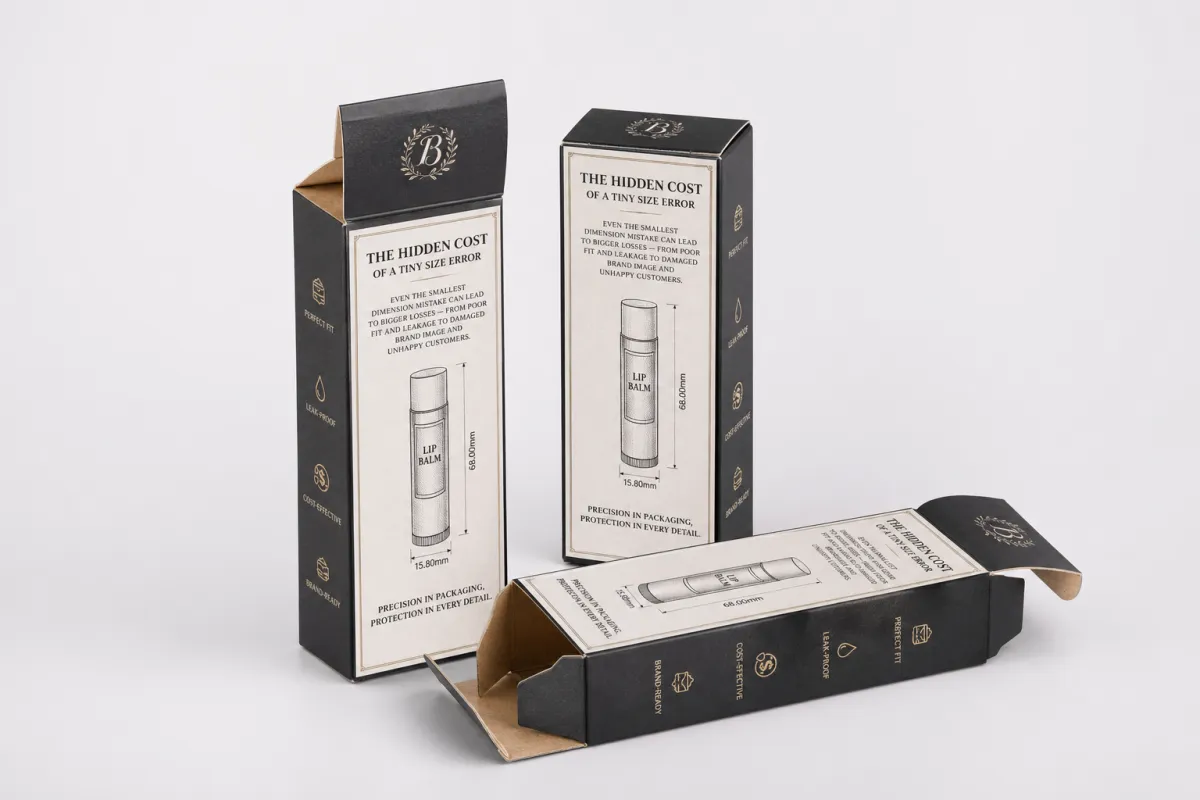
The highest-cost issue in lip balm packaging boxes custom often starts as a harmless number in a PDF. A box that drifts by 1 mm or 2 mm may close at mockup review, and everyone may nod along. The product, however, may rub against a cap edge, shift during insertion, or feel loose enough to sound cheap in hand. Lipstick-profile closures and tight tuck flaps punish that mistake quickly, and cost shows up as rework, delayed approval, and margin compression.
One subtle trap is treating size as a product-only metric. In production, fit becomes a system output: board caliper, score depth, glue flap tolerance, print gain, and actual insertion behavior all stack together. A tiny adjustment in one element can destabilize assembly, and suddenly everyone is arguing about “visual quality” while throughput is collapsing. Lip balm packaging boxes custom should be engineered around the product first, then dressed with branding.
From a practical viewpoint, lip balm packaging boxes custom are expected to do four functions at once: protect against abrasion and light, carry legal and ingredient text clearly, signal brand identity, and fit channel constraints without adding shipping waste. If any one function weakens, the package can pass inspection and still fail commercially.
The first move in fit planning is still measurement discipline. Record finished length, cap height, shoulder profile, widest body diameter, and any label texture that changes friction. Then design around those numbers, not around an assumption that the tube will stay perfectly static in production. CAD geometry behaves differently after board is coated, ink is cured, and labels add micro-edges that catch.
The most expensive cosmetic package is the one that looks perfect on a render and fails at the first fit check.
Because hidden size issues surface late, structured early testing pays for itself. Even with lean launches, build a physical sample before artwork finalization. A sample reveals if flap springs are stable, whether glue seams bow, whether the tube centers correctly, and whether repeated opening starts corner fatigue. Each of these is “small” until it multiplies by thousands.
Launch calendars are often set before physical validation starts, which is risky. Teams can optimize colors and pricing while overlooking transit and shelf handling behavior. Lip balm packaging boxes custom only start delivering value when structure is confirmed before art lock and before irreversible tooling commitments.
A size tolerance miss can move from “minor variance” to “finance escalation” in under 24 hours. It can create waste, delay freight, upset retail planning, and create a timeline conversation that has no single culprit because the issue was never isolated early. That is why serious teams treat lip balm packaging boxes custom as an engineering decision, then a visual one.
How Lip Balm Packaging Boxes Custom Are Made: Materials, Structure, and Finish
Most lip balm packaging boxes custom start with board selection. In practical programs, the sweet spot is often 300 to 400 gsm SBS, C1S coated board, or recycled-fiber alternatives in that same structural range, adjusted for print style and channel handling. Higher grammage improves stiffness, but over-rigid scoring or brittle stock can still produce fold cracks. Material, structure, and printing must cooperate, not compete.
Box anatomy is not abstract, even if it looks simple in a drawing: die line, fold lines, glue flap, panel depth, score depth, locking style, and finish layer. A tube format behaves differently from compact or jar formats, and closure type can flip the choice entirely. A tight tuck end can be perfect for one line and painful for another. Lip balm packaging boxes custom should cradle the product, avoid pinching, and open with a controlled motion, not a random jerk.
Manufacturing route drives schedule and consistency more than many teams expect. Digital short-run printing works well for prototypes, tests, influencer kits, and speed experiments. Offset print is still usually better for stable larger runs when consistency and coverage matter. A hybrid approach often works best: digital for prototyping and proofing, offset for volume after structure sign-off. This path avoids overcommitting to one process too early.
Finishes are not decoration only; they are performance behavior. Matte tends to be forgiving and tactile, gloss increases visual contrast, and soft-touch lamination adds premium feel but can mark in rough fulfillment environments. Spot UV highlights logos well, while embossing or debossing adds a physical cue to the hand-feel. Foil stamping creates immediate premium contrast, but setup, die alignment, and consistency controls become tighter. It is not “pretty” or “premium” versus “not pretty”; it is “appropriate for intended stress.”
Compatibility testing is too often bolted on too late. Strong fragrance formulas, wax-heavy compositions, and solvent-sensitive blends can stress inks and topcoats over time. Not every formula demands barrier layers, but some do require stricter ink systems and coating choices to avoid odor transfer, tack, and surface pickup. If packaging is going straight to warm climates or long shelf windows, that risk compounds.
Quality control has to happen in press and post-press gates, not in an email chain of corrected PDFs. Teams should monitor color drift against approved targets, verify registration and text clarity, and run fold tests for score cracking before full production. Edge-crush and compression tests are practical early warnings for stacking damage. Programs with significant e-commerce flow often align checks with ISTA guidance so cartons face real parcel stress, not brochure assumptions.
The common mistake is to call a carton “done” when print finishes are approved. A lip balm packaging boxes custom system is truly production-ready when structure, finish, and print behave the same on the first sample and the 10,000th piece. In manufacturing, repeatability is the actual finish quality metric.
In multi-SKU lines, a disciplined sequence helps: finalize fit structure, lock board grade, then finalize finish and decoration. A weak base cannot be repaired by stronger visuals. I have seen teams spend more than the artwork fee trying to “fix” a flawed base with laminate changes and still lose margin in the same cycle.
Key Factors to Consider for Lip Balm Packaging Boxes Custom Selection
Structure should lead every decision, every time. Before color palettes and varnish stacks, the carton must hold the product with enough clearance to avoid chip risk, squeeze, and uneven closure. For lip balm packaging boxes custom, interior dimensions, panel depth, and joint width are what decide whether your package feels premium, improvised, or just plain wrong in the customer hand.
Once structure is validated, design can carry the brand promise. A clinical line may call for restrained graphics and crisp typography; a playful line may prefer contrast and expression. But design intent only works when it respects board absorbency, ink behavior, and final reproduction. Print plans that ignore production constraints can fail despite excellent mockups.
Retail readability matters more than most launch teams admit at first. Ingredient declarations need to be legible at glance distance. Warnings must be placed for real viewing conditions. Barcodes should scan under humid, bright, and lower-contrast light. Soft-touch and deep matte surfaces can reduce contrast, so physical mockups should approve placement and contrast after coating, not before.
Shelf logistics can become your winner or your hidden cost center. Buyers optimize for facing, depth, and stacking behavior even more than your design team realizes. A carton that is “just a little wider” can reduce facing density and push replenishment cycles out of rhythm. Across multiple flavors or scents, structure standardization often outperforms design reinvention, because every geometry change multiplies tooling, QC, and fulfillment variance.
Sustainability is meaningful when it is measured against handling reality. Recycled board is often the right move, but recycled content alone does not guarantee moisture resistance or crush tolerance. If distribution includes humid regions or high-transit routes, ask for durability testing—not just marketing claims. FSC documentation can simplify sourcing conversations, and in teams where traceability matters, FSC can help align internal and external confidence, especially if your buyers ask the question.
For procurement teams, the most useful opening question is practical: which structure, board, and finish will survive the actual sales path? DTC, boutique retail, and national chains reward different compromises. E-commerce punishes weak corner geometry and poor tear resistance; in-store display punishes awkward depth and poor shelf scanning. The same artwork does not produce the same performance everywhere.
One internal sequence helps keep decisions anchored: lock product fit, then print fit, then channel fit. Reversing this usually produces beautiful prototypes that underperform where it counts—fulfillment and point-of-sale handling. It is a sequence that sounds procedural, but it keeps teams from arguing aesthetics against performance in a circle.
Cost of Lip Balm Packaging Boxes Custom: What Really Drives Price
Costs usually hide in decisions teams skip during planning. Die complexity, special ink sets, foil accents, finish stack, and manufacturing steps often move the number more than “base board.” A simple decorative look can become expensive at low volume because setup dominates, while richer finishes may become cost-efficient once volume smooths fixed costs. That is why lip balm packaging boxes custom pricing feels non-linear.
MOQ changes everything because setup costs are sticky. Sample development, dieline engineering, proofing, plate or data preparation, and die-cut setup sit in place before unit economics normalize. Small initial runs absorb more setup per piece, so first lots look costly even if raw material costs are stable. The first production batch of lip balm packaging boxes custom usually costs more per unit than steady-state volume.
Here is a practical framework many teams use:
| Production Route | Typical MOQ | Typical Unit Range | Best Fit |
|---|---|---|---|
| Digital short-run | 50-1,000 units | $0.80-$2.20 | Launch tests, influencer kits, fast sampling |
| Offset standard run | 1,000-10,000 units | $0.22-$0.75 | Retail programs, repeat SKUs, stable artwork |
| Offset with premium finish | 2,500+ units | $0.35-$1.10 | Foil, embossing, soft-touch, stronger shelf presence |
That table shows a familiar pattern: higher setup raises per-unit cost in small runs, while scale lowers it. Premium finishes add cost, but they can still be right when shelf position and positioning demand them. A simpler finish can outperform a complex one when branding is already carried by the tube color, hero graphic, and channel context.
Board choice influences cost, but not always the way teams expect. Increased thickness can improve stiffness and reduce compression damage, yet poor die tuning can still create excess waste. If formula sensitivity, heat exposure, or transport risk are high, protective coatings may be a better spend than adding more weight to board. That trade-off is where technical teams and design teams need to negotiate early.
Negotiating price often comes down to controllable process choices. Limit print color count, standardize dimensions across SKUs, keep finishing within one family, and avoid unnecessary insert complexity. Multi-scent or multi-variant programs save quickly when die and changeover cycles are reduced through shared geometry and shared coating standards.
Ask your partner for a clean quote with clear line items: setup, die, materials, printing, lamination, finishing, freight, and inspection. When line items are visible, discussions become solvable. A foil edge may look like the issue until you see that extra proofing rounds or expedited schedule changes drove the bigger increase.
Good cost transparency is not just a purchasing exercise. It is an internal confidence move; it lets teams make informed revisions before the next quarter’s finance review becomes a blame session.
Process and Timeline for Lip Balm Packaging Boxes Custom From Brief to Shipment
A realistic workflow sounds longer than a marketing pitch but it is closer to reality. A practical schedule often runs: 1-2 days for brief intake, 5-10 days for concept and mockups, 1-2 weeks for engineering and structural proof, about 1 week for pre-production sample, 1-4 weeks for production booking, and 3-14 days for fulfillment and shipping depending on route. The length is real because there are quality gates between idea and shipment, not just revisions.
The first delay is often missing inputs. If exact dimensions, SKU counts, finish expectations, barcode placement, and legal text are incomplete, the first die line usually comes back for correction. A missing legal line can trigger the same delay as a missing dimension. In either case, everyone pays in speed and calm.
A clean gate sequence keeps teams aligned: approve CAD, confirm structural clearance, sign structural sample, correct proof only for real edits, then release for production. Skip one gate and issues move from design stage to production stage, where fixes are slower and more expensive.
Art approval is not project completion, and I say this because I see teams treat it that way all the time. A print file can pass appearance checks and still fail later if fold lines are too tight or if finish changes reduce barcode contrast. Proof tells you what it looks like. Sample tells you how it behaves.
Speed can still be achieved with planning. If material and finish are stable, schedule compression may work. But unresolved structural uncertainty plus rush instructions creates a false economy. Each extra round consumes the same labor and setup cost while asking questions that were never fully answered.
For shipment readiness, many teams compare practical stress scenarios with ISTA-style thinking. Full certification is not always needed for every launch, but handling assumptions should be tested against expected parcel transfer, warehouse handling, and shelf movement. Route planning that ignores those phases usually gets expensive, quietly.
Revision cycles should be explicit and bounded. One to three rounds is common for first launches, especially when registration, embossing, or finish sensitivity are involved. Additional rounds can happen, but each should target one issue only: dimension, color, coating behavior, or assembly performance. Open-ended changes stretch timelines and weaken confidence in the final package.
Milestone clarity reduces conflict between design, operations, and retail teams. Lip balm packaging boxes custom often sit at the center of seasonal and promotion calendars, so timing discipline protects your launch date and avoids knock-on delays.
Step-by-Step Guide to Specifying Lip Balm Packaging Boxes Custom for First-Time Launches
First-time launch teams win by treating style as a consequence of structure, not the starting point. A technical brief is the real accelerator. Include finished unit dimensions, SKU counts, MOQ, channel path, expected shelf exposure, and whether closure and weight vary across variants.
- Build the brief. Record finished dimensions, net weight, fragrance variants, and distribution path in one technical document. DTC and in-store routes have different stress points, and suppliers need that distinction before die creation.
- Define design constraints. Set logo minimum sizes, approved color standards, language requirements, and legal hierarchy before files move into prepress. Changes after prepress start are where schedules and budgets usually get bruised.
- Send engineering data. Share formula behavior under heat, lid rebound behavior, and expected shipping stress. Those are not optional details; they are fit multipliers that reduce late surprises.
- Request staged samples. Ask for a digital soft proof and a physical prototype. Test fit with real units, then check transport behavior if your route goes through corrugated warehousing and parcel transfer.
- Approve with a measurable checklist. Confirm tolerance, tear resistance, text readability, barcode scan reliability, and rub resistance before release. A measurable gate prevents teams from arguing over subjective “good enough.”
That sequence sounds procedural because it is. It prevents the expensive pattern where visual design is approved fully, then structural failures emerge only after tooling. I have seen teams recover from that scenario, but not without higher cost and stress.
Use multiple real units per SKU when measuring. One sample is a snapshot; three gives variance. Capture closure geometry, seams, and texture interference from embossing, labels, and coatings. Waxy exteriors and glossy labels are common friction multipliers inside tight fit conditions.
If you are already using options from Custom Packaging Products, keep the structure fixed first and then shape the final artwork to that framework. The carton should begin with product behavior and channel requirements, then express the brand.
Keep approval simple and accountable: one owner for technical fit, one for brand, one for operations. Broad collaboration is useful, but too many final approvers can create version drift. Focused ownership is often a surprisingly strong quality-control move on tight launch calendars.
If this all sounds like a lot, it is. You are gonna feel the pressure to go faster, especially in first launches, but speed without structure creates expensive “rework loops.” A little discipline here usually saves weeks later.
Common Mistakes with Lip Balm Packaging Boxes Custom That Cause Wasted Money
The most expensive packaging mistake remains treating artwork as the whole package. A polished design cannot repair a weak score layout, binding flap, or folding crack. Lip balm packaging boxes custom must be engineered for function first; decoration works only when the base system behaves in the hands of real users and handlers.
Skipping tolerance checks is a repeat offense. Teams may approve a die line assuming the product fits, then discover mismatch after tooling commitments are already in place. That late change causes new tooling, schedule delay, and stranded inventory for a reason: narrow tolerances were never validated in physical form.
One-box-fits-all thinking across SKUs is another classic cost sink. A slim balm tube and a wider jar differ in load and corner pressure, so opening force and fit behavior can diverge dramatically. Trying to force one geometry across variants usually leads to some units loose and some constrained. Consistency should mean repeatable quality, not one-size-fits-all geometry.
Shipping performance is often underestimated until the first returns report lands. Matte coatings can scuff more than expected, low-profile embossing can disappear after movement, and thin coating can mark in transit. The photos on launch day may look flawless and still fail in distribution where handling is less kind.
“The carton was approved on screen, then the first pallet exposed the real issue.” That line returns repeatedly because the screen does not fold, rub, or stack.
Defect criteria are another silent cost driver. Without written acceptance standards, teams debate “acceptable” color drift, “reasonable” score quality, and “okay” tolerances. Lip balm packaging boxes custom need predefined acceptance levels for print, registration, glue, scuff resistance, and dimensional fit before production starts. That turns disagreements into process checks.
Complexity creep is expensive and sneaky. Bundle size changes, coating changes, and artwork updates all in one round blur root causes and expand budgets. A cleaner method is to adjust one element at a time: structure, then finish, then decoration. It slows approvals on paper, but often lowers total cycle cost.
Waste rarely arrives as one dramatic failure. It accumulates through repeated, avoidable decisions and compounds in manufacturing and logistics. Lip balm packaging boxes custom perform best when teams cut the compounding pattern off at the start.
One more practical lesson from the field: keep legal text and regulatory language in a single source file. Even a minor typo in an ingredient statement can force recoloring, re-proofing, and repacking. It is not glamorous, but it is where trust gets lost or protected.
Expert Tips and Actionable Next Steps for Lip Balm Packaging Boxes Custom
If your launch goal is stability, start with one master structure and scale artwork across your top-selling SKUs before branching into custom forms. A stable core reduces engineering load, improves QA consistency, and keeps supplier performance predictable as your line grows. That is how teams turn packaging from a one-off project into a repeatable system.
This week, do one practical step: pull three real units per SKU, measure everything, and photograph labels, closures, and surface textures that influence fit. Then create a concise spec sheet with five constraints: exact dimensions, tolerance window, material grade, finish, and test standard. Suppliers become significantly more precise once constraints are fixed and visible.
Next, request both digital proof and physical prototype, then run the same stress checks in parallel: drop resistance, crush resistance, and rub resistance against your intended shipping path. A desk review can pass everything visually; a pallet route usually reveals the hidden failures.
Before production starts, finalize an approval ladder with named owners and explicit remake rules. Define who approves art, who approves structure, and what “late changes” cost in both time and money. That written ladder keeps teams aligned when a revision appears after proofing and avoids last-minute arguments.
SKU discipline quietly protects margin. Standardizing board grade, coating profile, and die architecture across variants usually improves unit pricing and visual consistency at once. Nothing shouts “chaotic launch execution” like wildly different structures with similar art. Disciplined structure says “we run this program like a professional operation.”
Inside a broader packaging program, the Custom Packaging Products collection can still be useful for early direction. Use it to compare structure behavior, then narrow finish and decoration after fit constraints are locked. It speeds decision-making without turning everything into improvisation.
For sustainability goals, prefer practical moves over broad claims. Recycled board helps when it still meets handling and scuff needs. Water-based coatings can deliver cleaner aesthetics with better process alignment. FSC-certified board can simplify sourcing documentation, especially for retail customers who ask about chain-of-custody. But none of these choices replaces fit; a carton that fails early creates more waste than a plain but reliable box.
One final trust note: verify any compliance claims, safety statements, and legal copy with your regulatory or legal team, because packaging standards change by market and channel. Technical discipline and honest documentation are the real trust builders here, not just marketing language.
The final test for lip balm packaging boxes custom is simple and hard: is the structure stable, does the print support brand intent, and does the carton move through production and shipping with no recurring intervention? If all three hold, the package is finished. If not, it is still a draft, regardless of how polished the render looks.
Frequently Asked Questions
How long does lip balm packaging boxes custom usually take for a first production lot?
Typical timing is about 3 to 8 weeks, depending on complexity, sample rounds, and finishing complexity. Simple digital short-run jobs can move faster, but structural sign-off and proof approvals still need to happen first. Foil, embossing, or specialized recycled stocks usually add setup load and queue time, so schedules stretch.
How much do lip balm packaging boxes custom cost for a 500-unit launch batch?
Small-batch programs almost always show higher unit costs because setup and tooling are spread over fewer pieces. For a 500-unit launch, board selection, printing method, and finish create wide variation. Ask for a cost breakup with setup, sample development, die, printing, lamination, finishing, and freight so you can identify true pressure points before approval.
What is the cheapest way to keep lip balm packaging boxes custom within budget without losing quality?
The safest route is to reduce one variable at a time. Teams often gain the quickest savings by holding dimensions constant, simplifying decoration, or reducing finish complexity. Shared SKUs with matching dimensions and coating families can reduce changeover time and improve pricing while preserving brand clarity.
How can I avoid delays in lip balm packaging boxes custom approval?
Start with one complete technical package: dieline, finished measurements, legal copy, barcode position, and mandatory checkpoints. Keep versions in a single controlled folder, and define one final approver per decision type. Long email chains and scattered file versions are a dependable way to lose days.
Do lip balm packaging boxes custom need any specific pre-shipment testing?
At minimum, run fit checks, edge crush or compression checks, and print/finish rub tests matching your handling route. Add a short condition test if fragrance oils are present or heat exposure is likely. These checks reduce production claims, damaged stock, and return events.
For brands that want lip balm packaging boxes custom to hold their promise in real use, the approach is direct: treat packaging as part of the product system. The carton should fit the unit, survive handling, communicate clearly, and remain dependable in every shipment.