Buyer Fit Snapshot
| Best fit | personalized packaging for artisan candles for packaging buyers comparing material specs, print proof, MOQ, unit cost, freight, and repeat-order risk where brand print, material, artwork control, and repeat-order consistency matter. |
|---|---|
| Quote inputs | Share finished size, material target, print colors, finish, packing count, annual reorder estimate, and delivery region. |
| Proofing check | Approve dieline scale, logo placement, barcode or warning zones, color tolerance, and any recyclable or compostable wording before bulk production. |
| Main risk | Vague material claims, crowded artwork, or missing packing details can create delays even when the unit price looks attractive. |
Fast answer: Personalized Packaging for Artisan Candles: Material, Print, MOQ, and Cost should be specified like a repeatable production item. The safest quote includes material, print method, finish, artwork proof, carton packing, and reorder notes in one written spec.
What to confirm before approving the packaging proof
Check the product dimensions against the actual filled item, not only the sales mockup. Ask for tolerance on folds, seals, hang holes, label areas, and retail display edges. If the package carries a logo, QR code, warning copy, or legal claim, reserve that space before decorative graphics fill the panel.
How to compare quotes without losing quality
Compare board or film grade, print process, finish, sampling route, tooling charges, carton quantity, and freight assumptions side by side. A lower quote is only useful if the supplier can repeat the same color, closure quality, and packing count on the next order.
Personalized Packaging for Artisan Candles That Sells
The first time I watched Personalized Packaging for Artisan candles change a buyer's reaction, it was because of a $0.18 paperboard insert made from 350gsm C1S artboard. That small piece of board turned a candle from "nice little jar" into a gift that looked like it belonged on a $28 shelf, not a clearance table. I remember standing on a factory floor in Shenzhen with a production sample in my hand, thinking, really, this is what does it? Then I saw the same thing again in a boutique meeting in Chicago, where the buyer picked up the box, nodded once, and said, "Now it feels finished." The same logic applies to custom candle boxes and gift packaging: tiny changes in structure can shift perception much more than a louder logo ever will.
Candle makers already know scent matters, but packaging makes the first sale in under five seconds. It sets the tone before anyone smells the wax or reads the burn time. Good Personalized Packaging for Artisan candles is not a logo slapped on a carton and called a day. It is structure, messaging, finish, insert design, and unboxing sequence working together so the brand feels deliberate, not accidental. That is where Custom Packaging Products earns its keep: not by shouting, but by making the whole product look like it belongs at its price point, whether that price is $16 or $42.
Most artisan candle brands are not losing sales because the fragrance is weak. They are losing them because the packaging says "homemade" while the price says "premium," or because the box looks beautiful online and then fails in transit from Dongguan to Dallas. I have seen a $12 candle packaged so badly that it arrived with cracked lids, scuffed labels, and a loose insert rattling around like a coin in a dryer. That is not branding. That is a return label waiting to happen, and honestly, I can still hear the glass tapping against the board.
What Personalized Packaging for Artisan Candles Really Means
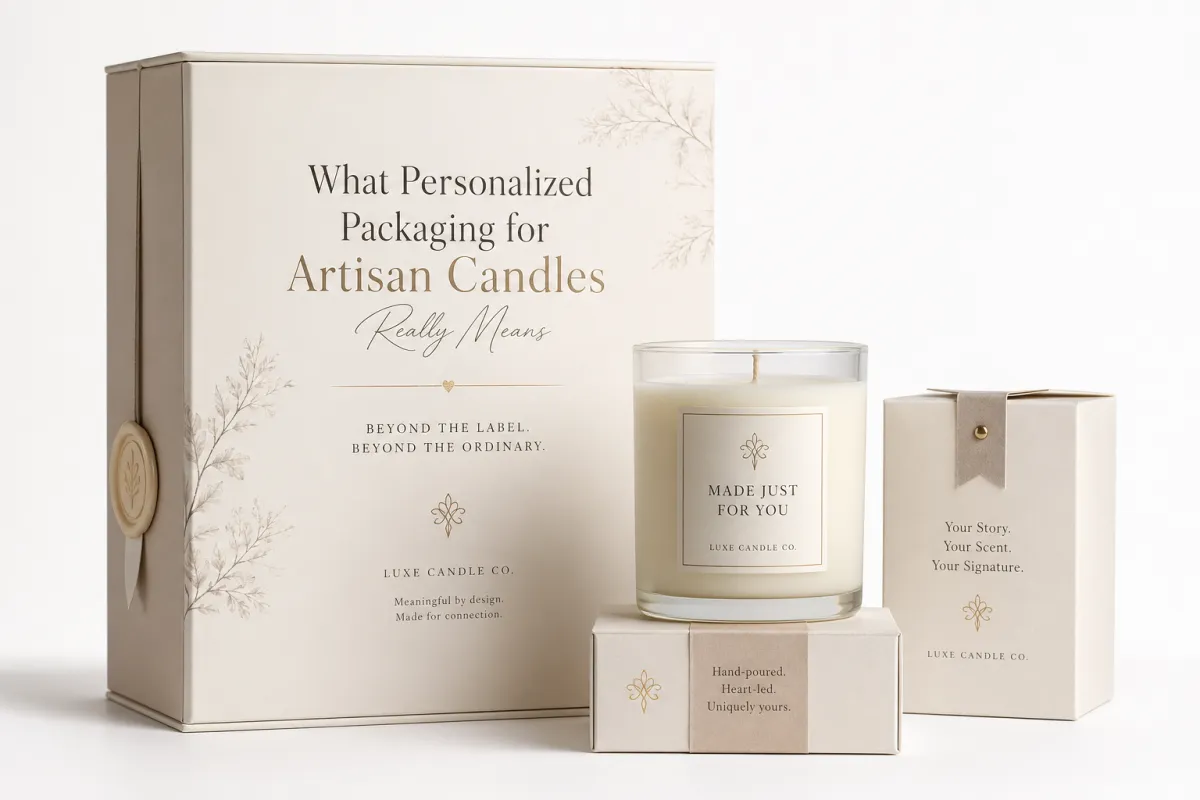
Strip away the jargon and the idea gets clearer. Personalized Packaging for Artisan candles means the packaging is built around the specific candle, the specific brand, and the specific buying moment. It is not a generic white carton with a sticker in the middle. It is a package that understands jar size, lid shape, scent family, shipping method, and how the customer will experience the product in the first 10 seconds after opening it, whether that is at a kitchen counter in Austin or a boutique shelf in Portland.
The best Personalized Packaging for Artisan candles starts with a story that can survive production. Is the candle eucalyptus and mint, smoked vanilla, cedar, or linen? Is the vessel frosted glass, amber glass, or painted ceramic? Is the brand quiet and minimal, warm and handmade, or bold and giftable? Those answers should show up in color, texture, copy hierarchy, and finish. Many brands miss that part. They treat packaging like a container. It is really a sales tool, and a surprisingly emotional one at that, especially when the order is a $34 gift set for a holiday market in November.
At a small factory in Dongguan, I watched a client debate whether to add a simple kraft paper insert. The insert cost $0.15 per unit at 5,000 pieces, with a quoted lead time of 12-15 business days from proof approval. That was the entire argument. Fifteen cents. The client almost skipped it to "save money." Then we set the candle in the box without the insert, shook the shipper, and heard the jar knock side to side. Suddenly the insert looked very cheap next to breakage. That is what personalized Packaging for Artisan candles really is: one small decision that protects the product and lifts perceived value at the same time.
The package also has practical work to do. Glass jars need cushion, lids need to stay tight, and labels need to survive abrasion from shipping and shelf handling. If the candle ships in a corrugated outer shipper from Ningbo, the inner carton still has to keep everything snug so the customer does not open a box and find a chipped rim or a wax surface smeared from movement. Good personalized Packaging for Artisan candles handles that without making the order feel overbuilt. There is a sweet spot, and it is narrower than most people think.
Many brands also underestimate scent storytelling. Buyers do not just want "lavender." They want top notes, wax type, burn time, vessel dimensions, and whether the candle fits a calm bathroom shelf or a holiday gift basket. That information belongs in the packaging hierarchy, ideally on a front panel plus one side panel, not buried across four surfaces. The package should answer the practical questions without shouting over the aesthetic. I have seen packaging that looked gorgeous but made me work too hard to figure out the basics, and that is a terrible first impression for a product priced at $26.
The simplest way I explain it to clients is this: personalized packaging is not the logo. It is the entire first impression, from the outer box to the inside reveal. That includes branded packaging, package branding, and the details people touch, like the texture of a 350gsm C1S artboard sleeve or the way a tuck flap closes. If those parts agree with one another, the candle feels more expensive. If they fight each other, the customer feels the mismatch immediately. People notice faster than brands like to admit.
"The box is not there to decorate the candle. It is there to justify the price, protect the product, and make the brand feel intentional."
That is why I push brands to think beyond decoration. Personalized Packaging for Artisan candles should protect the glass, support the margin, and make the brand easier to gift, especially when the order ships 300 miles or 3,000 miles. If it cannot do those three jobs, it is probably too much design and not enough packaging. I say that with love, and with the mild irritation of someone who has seen too many pretty boxes fail in real life.
How Does Personalized Packaging for Artisan Candles Work?
The workflow for personalized packaging for artisan candles is usually more ordinary than people expect, which is exactly why it works. First comes the brief. Then the dieline. Then copy, proof, sample, production, and packing. Skip steps because you are in a rush, and the packaging will remind you later, usually with a typo, a misfit insert, or a box that arrives two millimeters too tight when you are trying to pack 3,000 units on a Friday afternoon. The same sequence holds whether you are building custom candle boxes, labels, or a gift-ready mailer.
The division of labor matters. The founder or brand manager should own the brief. The designer should own the layout and print-ready files. The supplier should own structure checks, material options, and production guidance. If a retailer is involved, they should approve shelf dimensions, barcode placement, and any display requirements before print. I have seen a team lose 10 business days because everyone assumed someone else had confirmed the jar diameter. Nobody had. Of course nobody had. That kind of silence is expensive.
Personalized packaging for artisan candles also depends on timeline discipline. A simple label job can move quickly, often in 7 to 10 business days after proof approval if the artwork is clean and the quantity is reasonable. A printed folding carton may need 12 to 15 business days in Shenzhen or Guangzhou because of setup, die-cutting, and finish. A rigid gift box with inserts can take 20 to 30 business days, especially if you need foil, embossing, or a specialty paper wrap sourced through Dongguan production lines. Every finish adds a step, and every step adds a chance to slow things down.
I learned that during a negotiation with a carton supplier who quoted me an aggressive price on 3,000 units, then quietly explained that the quote only worked because the board was a standard size and the print was one-color black. The moment the client wanted a custom insert and soft-touch lamination, the pricing moved. Not because the supplier was being difficult. Because the structure changed. That is normal. Personalized packaging for artisan candles is inexpensive only when the spec stays simple, and the factory can run it on a standard 2-up layout without extra tooling.
Small brands should ask for the right information first. Send jar dimensions, lid clearance, fragrance lineup, net weight, shipping method, and any retail display rules. If the candle is going in a mailer, the outer packaging matters as much as the shelf box. If it is going into a boutique, the face panel and barcode placement matter more than the shipping carton. If it is a gift set, you need to think about the unboxing order before you think about the print finish. I know that sounds basic, but basic is where the expensive mistakes hide, especially when the minimum order is 1,000 pieces.
Sample approval saves money. A physical sample beats three long email threads and a dozen screenshot annotations. Every time. The screen mockup never shows the texture of the stock, the stiffness of the board, or the way the insert grips the jar. That is why I insist on a sample round for personalized packaging for artisan candles whenever the budget allows. It catches problems before they become expensive complaints, and before anyone has to apologize to a customer over a broken jar that traveled through two distribution centers.
For brands that want a deeper framework, I often point them toward industry references from the International Safe Transit Association. If your candle is shipping in glass from Shenzhen to a warehouse in Los Angeles, ISTA-style testing thinking is not optional fluff. It is the difference between a box that looks pretty on a table and a package that survives a real transit route across multiple carrier handoffs.
Cost, Materials, and Print Choices That Change the Price
The biggest cost drivers in personalized packaging for artisan candles are board stock, print method, size, finish, insert complexity, and total quantity. That sounds obvious, but I still see buyers compare two quotes that are not even close to the same structure. A flat label and a rigid gift box are not substitutes. They are different products with different economics. It is a little like comparing a paper plate to a ceramic one and pretending the price difference is a mystery.
Numbers make the picture cleaner. A simple custom label might land around $0.15 to $0.38 per unit at 5,000 pieces, depending on size, stock, and finish. A printed folding carton for a single candle often lands around $0.78 to $1.72 per unit at 3,000 pieces. A rigid gift box with an insert can run $2.35 to $6.20 per unit at 1,000 pieces if you add foil, specialty paper, or a magnetic closure. Shipping, freight, and packing labor are separate. They always are, even if buyers keep hoping otherwise. And yes, those ranges vary by supplier, lane, and season; a peak fourth-quarter freight quote can make a tidy spec look less tidy very quickly.
The cheapest option is not always the cheapest once damage enters the picture. I once reviewed a candle line that used thin decorative sleeves because the unit cost looked attractive. Then the brand started paying for replacement jars, customer service time, and a pile of negative reviews about broken shipments. The sleeve was not cheap. It was a hidden tax. Good personalized packaging for artisan candles should lower total cost by reducing breakage and return rates. If it does the opposite, something is off.
Material choice matters too. Kraft board gives a natural, earthy look, but it needs the right print contrast or the artwork disappears. SBS board is smoother and cleaner, which helps with crisp graphics and retail presentation. Textured stock can feel warmer and more premium, but it can also mute small type. Soft-touch lamination adds a velvet feel, though it is easy to overuse. A lot of brands now use 350gsm C1S artboard for sleeves and inner cartons because it balances stiffness and print quality without driving the cost up into rigid-box territory. If every brand decision screams "premium," nothing feels premium anymore.
Here is a clean comparison I use in supplier reviews for personalized packaging for artisan candles:
| Packaging Option | Typical Unit Cost | Best Use | Main Tradeoff |
|---|---|---|---|
| Custom label | $0.15-$0.38 | Low-MOQ launches, simple branding, fast turns | Less protection and less shelf presence |
| Printed folding carton | $0.78-$1.72 | Retail packaging, boutique display, better storytelling | Needs accurate sizing and die lines |
| Mailer box with insert | $1.08-$3.05 | Ecommerce shipping, subscription boxes, gift orders | More board, more freight, more setup |
| Rigid gift box | $2.35-$6.20 | Premium gifting, sets, higher ticket products | Higher MOQ pressure and more assembly labor |
Finish upgrades deserve real scrutiny. Foil stamping can look elegant on a scent name or logo, especially on darker art. Embossing adds tactile interest. Spot UV can highlight a brand mark or scent icon. Specialty inks can create a moody, tactile feel. Each one adds setup, and each one should earn its place. If you cannot explain why a finish is there, you probably do not need it. That rule has saved me from a lot of decorative nonsense.
I also tell candle brands to think in landed cost, not just unit cost. If a $1.08 carton prevents even 2 percent of breakage on a $24 candle, the math changes fast. If the package lets the brand hold a higher shelf price, that matters too. Packaging should support margin, not eat it alive. That is the whole point of personalized packaging for artisan candles, especially for lines sold into stores in Chicago, Seattle, and Atlanta.
For brands focused on responsible sourcing, FSC is worth knowing. If the board or paperboard is FSC-certified, that gives buyers a cleaner sustainability story without fake virtue signaling. Real certification beats vague green language that collapses under a simple question from a retailer.
Step-by-Step: Building a Packaging Spec That Prints Well
The cleanest personalized packaging for artisan candles projects I have handled started with a spec sheet, not a mood board. Mood boards are fine for direction. Specs are what keep you from paying for corrections. Start with the candle itself: jar diameter, height, lid clearance, net weight, and shipping weight. If the candle has a thick base or a tall wooden wick lid, measure it all to the nearest millimeter. Half a millimeter can matter once a die line is cut, especially on a carton produced in Guangzhou.
Build the content hierarchy next. The top line is the candle name or scent family. The next line can handle fragrance notes, burn time, and brand name. The lower panel should carry warning text, ingredients where applicable, and barcode placement if the candle is headed to retail. I have watched founders try to cram the brand story, usage instructions, and five design badges onto one face panel. The result looked busy and cheap. Not because the art was bad, but because there was no hierarchy. The package was trying to talk over itself.
Use the dieline early. Do not wait until the final week. Dielines tell you where folds sit, where glue tabs live, and how much room the insert actually has. I once visited a small contract packer who had already printed 2,400 cartons before discovering the top flap would crush the wick label on a tall jar. That mistake came from designing without the structure in front of them. It was a painful but expensive lesson in personalized packaging for artisan candles, and the kind of lesson nobody wants twice.
- Measure the candle - jar, lid, vessel finish, and shipping weight.
- Write the copy - scent notes, warnings, net weight, barcode, and brand story.
- Place the structure - choose carton, mailer, rigid box, or label system.
- Check artwork - resolution, color builds, rich black, and text sizes.
- Review the sample - verify fit, finish, insert tension, and opening feel.
- Approve pre-press - bleed, folds, cut lines, and final text.
Artwork problems are common. Low-resolution images blur. Fine type can vanish on textured stock. Rich black can print differently depending on the board and press setup. I have seen dark artwork drift from cool black to muddy brown because nobody checked the ink values against the chosen stock. That is why a physical proof matters. The first sample tells you things a PDF will never tell you, and yes, that sometimes means admitting the beautiful mockup was lying.
Pre-press checks should be boring. That is the goal. Confirm bleed. Confirm cut lines. Confirm fold panels. Confirm that the barcode scans cleanly and sits in the right place for retail packaging. Confirm the warning text is readable. Then sign off once, cleanly, and move into production. Drama belongs in fragrance naming, not in print approval.
If you need a starting point for box formats, labels, or mailers, it helps to review Custom Packaging Products before you lock in a direction. Seeing structure options side by side makes the spec conversation faster, and it keeps teams from trying to force one candle into the wrong box style.
Common Mistakes When Designing Personalized Packaging for Artisan Candles
The first mistake is overdesign. People fill every panel with patterns, badges, botanical art, and three paragraphs of brand poetry, then wonder why the scent name disappears. Personalized packaging for artisan candles works best when one thing leads. Usually that thing is the scent, the vessel, or the tactile finish. Everything else should support it, not drown it. I know the temptation, though. You make a beautiful candle and suddenly every surface feels like it deserves a speech.
The second mistake is size denial. Too much empty space looks cheap. Too little space crushes the product. I have seen brands order boxes that looked elegant in renderings and arrived with the lid pressing hard against the jar shoulder. That is not elegance. That is a cracked-glass incident waiting for a shipping label. A good structural fit is a basic requirement, not a nice-to-have. And the worst part is, the render never warns you.
The third mistake is ignoring the shipping environment. A candle that sits beautifully on a shelf may fail inside a corrugated shipper if the insert is weak or the outer box is too loose. I have toured facilities where the outer master carton was strong enough, but the inner retail box had no resistance, so the candle moved during transit and scuffed the label edge. Strong personalized packaging for artisan candles has to survive the full route, not just the photo shoot. Transit does not care about your mood board.
The fourth mistake is mixed signals. A rustic wax blend with linen fragrance notes should not be dressed in glossy black foil and a hyper-minimal typeface unless the whole brand language supports that choice. Likewise, a luxury candle line should not look like a farmers market tag if the price is $46. Packaging design should match the product promise. If the visual language and the price point argue with each other, shoppers feel the tension immediately. They may not explain why, but they still feel it.
The fifth mistake is ignoring legal and safety text. Burn instructions, warning copy, ingredient or CLP requirements where applicable, and barcode placement all need space. I have had buyers try to shrink the warning text so the front panel could stay "clean." That is a bad trade. Retailers notice. Compliance matters. And once the package is printed, there is no elegant way to hide missing copy. There is only a reprint, which is a very expensive way to learn humility.
The sixth mistake is skipping sample testing because the quote looked good. Paper does not pay for breakage. Paper does not deal with a retailer's return policy either. If you want proof that a design works, test it with real jars, real packing speed, and real shipping conditions. That is how personalized packaging for artisan candles earns its cost, especially when the candle line is moving through fulfillment in New Jersey or Ontario.
For real transit expectations, I point teams back to ISTA testing standards and guidance. Even if you do not run a full lab test, the thinking behind those standards makes you ask better questions about drop resistance, vibration, compression, and orientation. That saves money before the first complaint shows up.
Expert Tips for Better Shelf Appeal and Gifting Value
If you want personalized packaging for artisan candles to sell faster, stop trying to make every panel interesting. Pick one strong focal point. It might be the scent name. It might be the vessel silhouette. It might be a tactile finish that makes people want to touch the box. One clear idea beats six half-finished ones. Every time. People respond to confidence, not clutter, especially on a shelf where they have 12 seconds to choose between three similar candles.
Match the tone to the fragrance family. Calm scents do well with softer neutrals, muted greens, or warm ivory. Seasonal or celebratory candles can carry stronger contrast, darker type, or a brighter accent. I once worked with a candle maker whose best-selling scent was "Rain & Cedar." We shifted the pack from a loud botanical pattern to a restrained textured stock with a single silver foil line. Sell-through improved because the packaging finally felt as composed as the scent. That change still makes me smile because it was so obviously right once we saw it.
Small premium cues matter. A neat reveal. A snug insert. A clean tuck. A lid that closes without slop. Those details make personalized packaging for artisan candles feel more expensive than it is. I am not talking about fake luxury. I am talking about honest finish choices that show care. A $0.24 insert can do more for perceived value than a splashy graphic that adds no function. My opinion? The tactile stuff wins more often than the flashy stuff, and it does so without adding a single extra sentence.
Giftability is another underused advantage. If the box opens easily, closes neatly, and looks good on a shelf after opening, people keep it longer. That matters for candle brands because candles are often purchased as gifts, not just as self-purchases. Good personalized packaging for artisan candles should make the recipient feel like the gift was considered from the first glance to the last lift of the lid. If the package feels worth keeping, you get a second impression for free. That is the quiet advantage of true gift-ready packaging.
One merchandising trick I learned from a retailer in Austin: packaging that faces out cleanly and stacks well on a shelf moves faster because staff will actually stock it properly. If the box is awkward, they shove it sideways. If it is tidy, they face it out. That tiny operational detail changes sell-through more than most brands realize. Retail packaging has to help the retailer do the right thing with less effort, especially when a store manager is stocking 60 units before opening at 9:00 a.m.
Keep scent storytelling concise. People buy candles with their nose, but they remember the package with their eyes. A short scent note stack, a clear brand voice, and a tactile finish do more than a long poem on the side panel. I have seen elegant packaging fail because the brand tried to sound literary instead of clear. A smart buyer should be able to read the box in one glance and know what kind of candle it is. If they need a seminar, the packaging has already lost.
What to Do Next Before You Order Personalized Candle Packaging
Before you request quotes for personalized packaging for artisan candles, gather the details that suppliers actually need. That means jar specs, fragrance count, target retail price, order quantity, shipping method, and whether the product is for direct-to-consumer shipping, boutique display, or both. If you send a supplier a vague request, you will get a vague price. Then everyone will pretend to be surprised when the final quote changes. I have watched that movie too many times.
Ask for at least two or three material options. Compare them on appearance, durability, and cost. A kraft carton can feel earthy and handmade. An SBS carton can feel cleaner and more retail-ready. A rigid box may be the right call for a gift set, but it will also affect labor, freight, and storage. I would rather see a brand choose based on clear tradeoffs than on a single sample that looked pretty under studio lights in a factory showroom in Guangzhou.
Order a sample or a short pilot run before committing to a full production line. Then gather real feedback. Did the candle arrive undamaged? Did customers mention the unboxing? Did the packaging help justify the price? Did the insert slow packing labor? This is where smart brands save money. They measure the result instead of guessing. The numbers may not be glamorous, but they are honest, which is more useful anyway.
Document the numbers that matter: breakage rate, sell-through, customer comments, and whether the packaging supported the price point. If your packaging raises the perceived value but the returns remain high, something is still off. If customers keep the box for gifting, that is a signal you are doing something right. That is the real test for personalized packaging for artisan candles. Pretty is nice. Repeat behavior is better, and repeat behavior usually shows up in the first 30 days after launch.
Here is the action plan I give clients who want to move this week:
- Audit the current box, label, or mailer and find one weak point.
- Measure the candle precisely and write down the real shipping weight.
- Request quotes with full specs instead of rough guesses.
- Compare two packaging structures, not ten half-thought-out ideas.
- Approve one sample only after the fit, print, and insert all check out.
If you are building a new line, or fixing a package that never quite matched the product, start with the structure and work outward. That approach keeps Custom Packaging Products focused on the candle instead of forcing the candle to adapt to a random box size. It is a lot easier to sell something when the package looks like it belongs to the product, whether the run is 500 units or 15,000.
Honestly, I think that is the part most people get wrong. They treat packaging like decoration after the candle is finished. In practice, personalized packaging for artisan candles is part of the product itself. It affects pricing, damage rates, shelf presence, and gifting appeal. Get that right, and the brand feels easier to buy, easier to gift, and harder to forget. That is exactly what personalized packaging for artisan candles should do.
How much does personalized packaging for artisan candles cost per unit?
Simple labels can land under a dollar per candle, often around $0.15 to $0.38 per unit at 5,000 pieces, while printed cartons usually fall around $0.78 to $1.72 depending on board, size, and finish. Rigid gift boxes, inserts, foil, and specialty coatings push the number up fast. I always tell brands to look at landed cost, not just unit price, because breakage, freight, and packing labor can change the real math on personalized packaging for artisan candles. That hidden math is where the headaches live.
What should I put on personalized packaging for artisan candles?
At minimum, include the candle name, fragrance notes, brand name, net weight, burn or safety instructions, and any required warning copy. If the box is headed into retail packaging, leave room for the barcode and SKU so you do not end up with clumsy relabeling later. The cleanest personalized packaging for artisan candles puts scent first, legal copy second, and brand story where it helps instead of hogging the whole front panel.
How long does personalized packaging for artisan candles usually take?
Basic label projects may move in 7 to 10 business days once proofing is approved, while fully custom boxes with inserts usually take 12 to 15 business days for a printed carton and 20 to 30 business days for rigid structures. I budget extra time for revisions, because the first proof is rarely the last. Seasonal demand slows everything down, so brands that lock in personalized packaging for artisan candles early usually avoid the panic that shows up when everyone else is asking for a miracle.
What is the best material for personalized packaging for artisan candles?
For shipping, corrugated mailers or sturdy folding cartons protect glass better than thin wraps. For retail display, SBS board or a clean textured paperboard often prints well and looks polished. Kraft can work beautifully for a handmade or earthy brand, but it needs strong contrast and a print plan that respects the texture. The best material for personalized packaging for artisan candles depends on whether the candle is being shipped, shelved, or gifted, and whether the stock can handle a 350gsm or heavier board spec.
Can I order personalized packaging for artisan candles in small quantities?
Yes, but small runs usually cost more per unit because setup charges get spread across fewer boxes. Digital print and label-based formats are often the easiest entry point when you are testing a scent or launching a small batch. If the first version sells well, scale it after you have real feedback. That is the safer way to grow personalized packaging for artisan candles without paying to learn expensive lessons, especially when your first order is only 250 or 500 units.
Final takeaway: measure the jar, choose the structure that matches the selling channel, and approve a physical sample before you print a full run. That one sequence protects the candle, keeps the price honest, and gives personalized packaging for artisan candles the best shot at doing what it is supposed to do in the real world.


