Buyer Fit Snapshot
| Best fit | Personalized Packaging for Candle Makers projects where brand print, material claims, artwork control, MOQ, and repeat-order consistency need to be specified before quoting. |
|---|---|
| Quote inputs | Share finished size, material target, print colors, finish, packing count, annual reorder estimate, ship-to region, and any compliance wording. |
| Proofing check | Approve dieline scale, logo placement, barcode or warning zones, color tolerance, closure strength, and carton packing before bulk production. |
| Main risk | Vague material claims, crowded artwork, missing packing details, or unclear freight terms can make a low unit price expensive after revisions. |
Fast answer: Personalized Packaging for Candle Makers: Artwork Proof, Packing Count, and Landed Cost should be specified like a repeatable production item. The safest quote records material, print method, finish, artwork proof, packing count, and reorder notes in one written spec.
Production checks before approval
Compare the actual filled-product size with the drawing, then confirm tolerance on folds, seals, hang holes, label areas, and retail display edges. Reserve space for logos, QR codes, warning copy, and material claims before decorative graphics fill the panel.
Quote comparison points
Review material grade, print process, finish, sampling route, tooling charges, carton quantity, and freight assumptions side by side. A quote is only useful when the supplier can repeat the same color, closure quality, and packing count on the next order.
Personalized Packaging for Candle Makers: Brand Guide — I have watched shoppers size up a candle in under four seconds, usually from about two meters away, and the box often wins or loses that moment before anyone gets close enough to smell the wax. That is why personalized packaging for candle makers is not just surface polish; it shapes how someone reads price, scent quality, and gift value the second the product enters view, whether the jar is 8 oz, 9 oz, or a 12 oz three-wick. Personalized packaging for candle makers can do the work of a quiet salesperson, and it does it before anyone lifts a lid. Honestly, a lot of candle brands undercount the box in their own mental math, then wonder why the shelf story feels flat once the product lands in a boutique, a market stall, or a fulfillment carton headed out the door.
The idea is more practical than poetic. Personalized packaging for candle makers means packaging built around the brand’s jar size, scent range, sales channel, and unboxing goal, whether the candle is sold in a shop on Melrose Avenue, shipped direct from a fulfillment center in New Jersey, or packed into a seasonal gift set for a holiday market in London. A 9 oz jar in a plain tuck-end carton can feel handmade and friendly; put that same candle inside a 1.5 mm grayboard rigid box with soft-touch lamination and a foil-stamped logo, and the perceived tier moves up fast. I have seen the candle stay identical while the packaging did nearly all the selling. Which is a little unfair, sure, but also exactly how retail works.
That matters because candle packaging is carrying three jobs at once. It has to protect a fragile vessel, support brand presentation, and make the product feel ready to give as a present, all while surviving warehouse stacking up to six cartons high and parcel drops from around one meter. Personalized packaging for candle makers turns those jobs into one system instead of three separate headaches. Brands that treat it as a real business asset usually end up with a cleaner shelf story, better retail packaging performance, and fewer shipping problems than brands that treat the box as leftover budget. I have yet to meet a founder who enjoys replacing broken jars after a rough transit run in July, especially when the fragrance oil bill is already sitting at $1.20 to $2.80 per unit.
Personalized Packaging for Candle Makers: Why It Changes the Sale
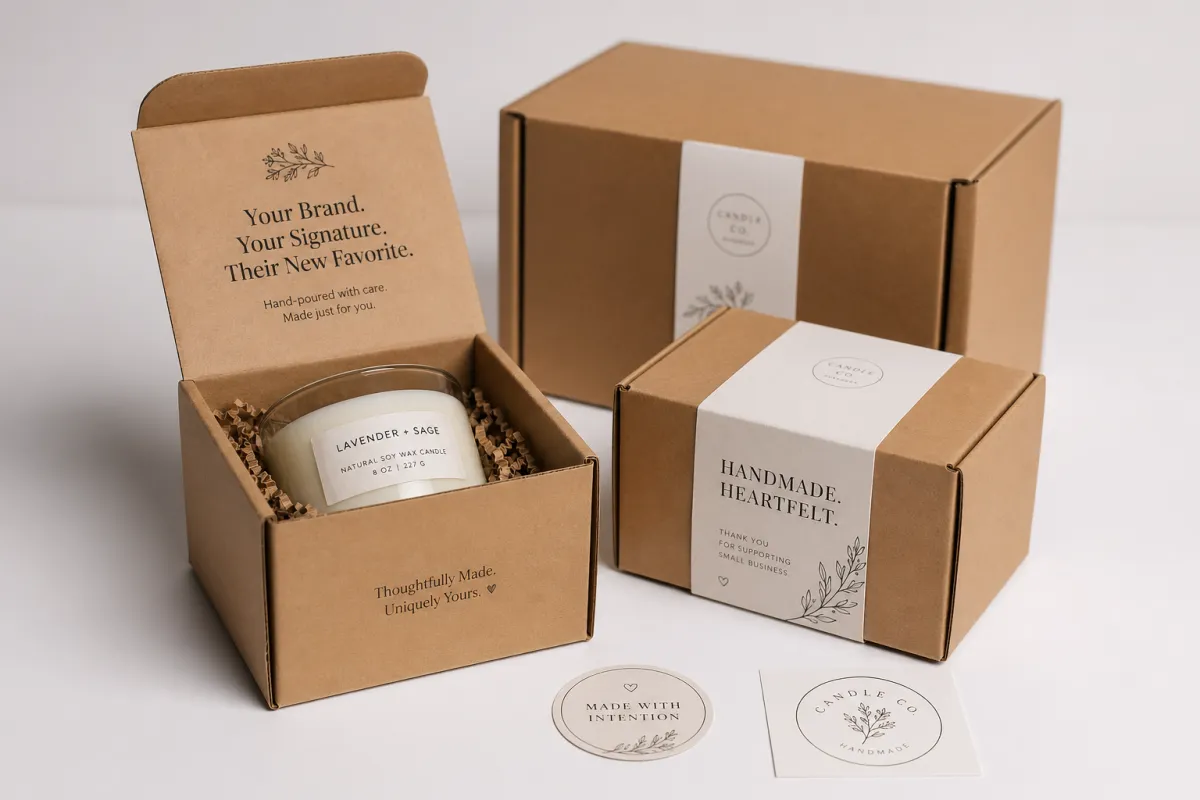
The first thing I learned on a candle line had nothing to do with wax. A retailer in North Carolina placed two identical soy candles on the counter, one in a plain mailer and one in a printed rigid carton, and customers kept reaching for the boxed version even though both were poured in the same 8 oz amber vessel. That is the quiet force behind personalized packaging for candle makers: it reshapes the story before anyone smells the product, sometimes in less than 10 seconds of shelf contact. I remember thinking, “Well, there goes the theory that scent alone is king.” It turns out the box gets a vote too.
There is a hard-nosed side to it as well. Candles are fragile, and the vessel is often the most expensive part of the unit after the fragrance blend itself; in many runs, the glass jar alone can account for $0.90 to $2.40 of landed cost. Personalized packaging for candle makers helps signal the price tier, reduce breakage, and support a more polished retail presentation. If a candle is meant to sit beside luxury bath products in a 24-inch retail bay, the box needs to carry that weight; if the brand is rustic and artisanal, kraft board, uncoated stock, and restrained ink coverage may make more sense. I honestly think too many brands copy luxury cues without checking whether they still fit the scent story or the margin target.
People often miss the real function of the box. It is not just a container. Personalized packaging for candle makers does merchandising work, too, especially when a 7 oz candle can look like a $28 gift item instead of a $16 impulse buy. That difference often matters more than a 10 percent shift in print coverage or a 0.3 mm change in board thickness. I have seen founders underestimate how quickly branded packaging changes average order value, then get pleasantly annoyed when the numbers start behaving better than expected. That is one reason Custom Candle Boxes keep showing up in the strongest product lines.
I still remember a meeting with a maker who sold lavender candles at farmers markets in Asheville and Raleigh. She used plain white labels and recycled kraft shippers, which worked until a boutique buyer asked for something “more giftable” for a $34 retail point. We changed the structure to a folding carton with a 350 gsm C1S artboard insert, kept the earth-toned palette, and added a blind emboss on the logo. The candle itself stayed the same, yet personalized packaging for candle makers gave it a stronger retail identity and a higher perceived value. The buyer nodded, smiled, and basically said, “Yes, now it looks like a gift instead of a project.” Ouch, but fair.
That is the real shift. Personalized packaging for candle makers is a branding decision and a logistics decision, and the strongest projects respect both. If you want a quick way to compare structures, inserts, and finishes early in the process, our Custom Packaging Products page is a useful starting point for that kind of planning, especially if you are balancing a 1,000-unit launch against a 5,000-unit reorder.
How Personalized Packaging for Candle Makers Works From Brief to Box
The process usually starts with a one-page brief. Good personalized packaging for candle makers begins with the candle’s exact dimensions, the vessel material, the fill weight, the lid height, the retail channel, plus the target quantity and ship-to region. A 10.5 cm glass jar with a metal lid needs a different cavity than a 10.5 cm jar with a wooden top, and that difference can shift the insert depth by several millimeters. Those small numbers matter. Three millimeters of extra movement can mean chipped glass after a run through transit vibration, and I have seen that tiny error create a very large mess.
From there, a packaging partner usually recommends a dieline or structural template. Personalized packaging for candle makers often uses stock-style carton dimensions for speed and cost control, but the artwork and finish can still be highly customized. In a fully bespoke project, the entire structure is engineered around the candle; in a more economical project, the brand chooses from an existing carton or mailer size and customizes the graphics, coatings, and inserts around it. That split is usually the difference between “nice idea” and “actually feasible this quarter.”
Then comes artwork setup. Packaging design gets real at that stage: barcode placement, warning copy, fragrance name hierarchy, and logo scale all have to fit within the printable area. I have seen a founder approve a beautiful concept board, only to discover during proofing that the regulatory text covered the scent note panel and pushed the barcode 12 mm too close to the fold. Personalized packaging for candle makers works best when the graphic layout follows the actual template, not a mood board alone. Mood boards are great for vibes; they are less helpful for not blocking the barcode.
Next is proofing and sampling. A digital proof confirms color relationships, while a physical sample checks fit, closure, and insert tolerance. For fragile retail packaging, I like to see a real sample before production because a box that looks perfect on screen can still let a jar rattle inside by 4 to 6 mm. If the candle is shipping through parcel networks, I also want transit testing aligned to ISTA transit test standards, because guesswork gets expensive fast. And yes, I have had people tell me “it’ll probably be fine” after a $700 proof run and a 72-hour turnaround. Probably is not a shipping strategy.
Finally comes production and delivery. Personalized packaging for candle makers should be built around real handling conditions: warehouse stacking, courier drops, shelf display, and even humid storage if the brand sells in warmer regions like Florida, Singapore, or coastal Guangdong. A box that looks elegant in a mockup but warps in a 35 percent humidity warehouse is not a win. Good packaging is judged by the trip it survives, not just the render that sold it. I know that sounds slightly brutal, but so is a pallet of crushed lids.
What Does Personalized Packaging for Candle Makers Need to Do?
It needs to do three things at once: protect the candle, support the brand, and make the product feel worth the price. For personalized packaging for candle makers, the main options are folding cartons, rigid boxes, corrugated mailers, kraft board sleeves, and hybrid structures that pair a display box with a shipping shipper. A lightweight 6 oz candle in a boutique setting may only need a 350 gsm C1S artboard carton, while a 3-wick candle with a heavier vessel could justify a corrugated insert or a rigid set-up box with 1.5 mm board. I have seen more than one brand try to force a heavy jar into a dainty carton, and the result was basically packaging doing a bad impression of a trampoline.
Protection is not optional. Glass jars, tin candles, wooden lids, ceramic vessels, and accessory bundles all carry different risk profiles. Personalized packaging for candle makers should account for lid height, shoulder shape, and whether the candle has a dust cover, wood wick, or matchbook add-on. I once saw a client lose an entire launch batch because the jar fit beautifully but the lid sat 8 mm proud of the cavity, which crushed the top corners during stack compression after a 2,400-mile freight move. The box looked gorgeous. The reality looked like a small defeat.
Appearance matters just as much. Color palette, typography, texture, foil, embossing, debossing, and matte versus gloss finish all shape how personalized packaging for candle makers feels in a customer’s hand. A matte black rigid box with silver foil suggests a different price bracket than an uncoated kraft carton with one-color soy ink, even if both contain the same 12 oz coconut wax candle. Brand presentation has to match the product story from the start. Otherwise the candle is speaking in one accent and the box is muttering in another.
Brand fit is another filter. Minimalist candle lines tend to work well with clean typography and wide negative space. Botanical brands often benefit from illustrated florals or leaf motifs, while rustic collections may lean into kraft textures and rougher paper stocks. Personalized packaging for candle makers also needs to support seasonal extensions, because holiday SKUs, spring launches, and limited-edition scents should look related without becoming identical across a 12-month calendar. I prefer a system that feels like a family reunion instead of a costume party.
Compliance is easy to overlook until the proof stage. Warning text, barcode placement, product name hierarchy, and fragrance differentiation all need room. If a line has three scent families, I like to standardize the back panel so every unit follows the same logic on a 95 mm by 120 mm panel. That keeps the retail packaging readable and reduces confusion when a store has to restock quickly. It also keeps your team from hunting for the right version at 9:40 p.m. the night before a shipment leaves, which, speaking from experience, is not a fun game.
There is also the sourcing conversation. Brands asking about responsible material choices should look at FSC-certified paperboard and verified fiber sources, not just recycled claims printed in large type. The details matter because many retailers now ask whether a package supports forest stewardship, especially in California, the UK, and parts of Germany. For that side of the supply chain, FSC-certified paper and board guidance is worth reviewing before artwork is locked, particularly if your cartons are being printed in Dongguan or Ningbo.
- Folding cartons work well for lighter candles and broader print flexibility.
- Rigid boxes suit giftable, higher-ticket candle lines where unboxing matters.
- Corrugated mailers are the safer choice for direct-to-consumer shipping.
- Kraft board systems help brands that want a natural, understated look.
- Custom inserts keep vessels centered and reduce movement during transit.
Personalized Packaging for Candle Makers Cost and Pricing Drivers
Money talks louder than mood boards, and this is where many candle brands start guessing instead of calculating. Personalized packaging for candle makers can vary widely depending on material grade, print coverage, finish, structure, and quantity. A simple folding carton with one-color print might land around $0.15 per unit for 5,000 pieces, while the same style at 1,000 pieces could jump to $0.42 per unit because setup costs are spread across fewer boxes. That is the part nobody likes to hear, but it is usually the part that saves a launch from a spreadsheet disaster later.
That pattern shows up across Custom Printed Boxes. Higher quantities usually bring the unit price down, but not always as much as founders expect, especially if the project includes custom inserts, foil stamping, or a special coating. Personalized packaging for candle makers often looks inexpensive in concept and expensive in execution because every extra detail adds press time, tooling, or a more complex die-cut setup. I have watched people fall in love with a gold foil accent and then stare at the quote like it personally offended them, especially when the factory in Shenzhen adds a $120 tooling charge for the stamp.
Here is a practical way to compare common options.
| Packaging option | Typical use | Approx. unit cost at 1,000 | Approx. unit cost at 5,000 | Best value when... |
|---|---|---|---|---|
| Folding carton, CMYK, matte varnish | Retail shelves, entry to mid-tier candles | $0.42 | $0.15 | You need strong brand presence without luxury box pricing. |
| Rigid setup box, soft-touch finish, foil logo | Gift sets, premium launches, seasonal drops | $2.10 | $1.15 | The candle price supports a higher unboxing expectation. |
| Corrugated mailer with custom insert | Direct-to-consumer shipping | $0.88 | $0.53 | You need protection first, with branding still visible on arrival. |
| Kraft sleeve plus inner carton | Minimalist or eco-minded candle lines | $0.36 | $0.21 | You want a natural look and a lower ink load. |
Premium finishes matter, though they are not always the biggest cost driver. Foil stamping, spot UV, embossing, and custom coatings can increase perceived value more than they increase cost, especially on smaller accents like a logo mark or scent band. I once negotiated a supplier quote where a 14 mm foil logo added less than a penny relative to the total box cost at volume, yet the retail buyer treated it like a major leap in quality. Go figure. Tiny detail, big reaction.
Design changes are the hidden budget killer. If a brand changes the jar height after proofs, the insert has to be revised, and that can trigger a new sample, a new dieline, and a new production schedule. Personalized packaging for candle makers works best when the structure is finalized before artwork starts, not after. Otherwise the team ends up paying for avoidable revisions that eat into launch margin. I have seen a “small tweak” turn into three rounds of rework, 11 extra emails, and a very quiet thread between a buyer in Brooklyn and a factory in Dongguan.
My rule of thumb is to budget separately for core line packaging, seasonal packaging, and launch packaging. Core product lines should be optimized for repeat orders and stable margins. Seasonal lines can tolerate more decorative packaging because they carry urgency and higher gift value. Launch kits often need the strongest visual presentation, but they should still be priced with a path to scale so the brand is not trapped by beautiful packaging that cannot be reordered profitably. Pretty is lovely. Profitable is better.
Step-by-Step Process and Timeline for Candle Packaging Orders
A realistic candle packaging timeline keeps everyone calmer. Personalized packaging for candle makers usually moves through briefing, structural sampling, artwork setup, proof approval, production, and transit. For a straightforward carton project with final artwork ready, I would expect about 12 to 15 business days after proof approval for production, plus shipping time from the factory in Guangdong or Zhejiang. If the project involves a fully Custom Rigid Box, the schedule often stretches to 18 to 25 business days because sampling and board assembly take more steps. That extra time is not bureaucracy; it is usually the difference between “looks good” and “survives in the wild.”
The fastest projects are the ones with clean inputs. If you can provide exact dimensions, fill weight, vessel material, lid height, target quantity, compliance copy, and finish preferences in one document, the production team can move without chasing missing details. Personalized packaging for candle makers becomes much slower when the candle maker is still deciding whether the jar is 78 mm or 82 mm wide. I say this with affection, but also with the memory of too many back-and-forth messages that could have been avoided by one ruler, one caliper, and five uninterrupted minutes.
Artwork setup usually takes 2 to 5 business days once the dieline is approved. Proof review may take 1 to 3 rounds, and that is where delay tends to appear. The most common slowdown I see is not technical; it is approval drift. One person likes the serif font, another wants the fragrance notes moved lower, and a third asks for an extra QR code after the proof is already in circulation. Suddenly a simple approval becomes a small committee drama, especially when the printer in Suzhou is waiting on final sign-off. I have been in those threads. They age you.
Sampling adds another layer. A structural sample for personalized packaging for candle makers can reveal a loose fit, a crooked insert, or a box flap that does not close cleanly. Those issues are much cheaper to fix before production, where a bad tolerance can affect hundreds or thousands of units. I have watched brands lose two weeks because a sample was never ordered, and the first full run arrived with a lid rattle that could have been solved with a 2 mm insert adjustment. Two millimeters. That is smaller than a fingernail, and still enough to cause a headache.
Seasonal collections need extra buffer. Holiday candle drops compete with other brands for press time, board inventory, and freight capacity, so a project that looks simple on paper can still get squeezed in the queue. If your launch depends on personalized packaging for candle makers arriving before a retail window opens, build in a cushion of at least one to two weeks beyond the “ideal” schedule, especially for shipments into New York, Toronto, or Munich. That buffer is cheaper than rushing. Rushing also tends to make everyone grumpy, which is a hidden line item nobody budgets for.
Common Mistakes Candle Makers Make With Custom Packaging
The most expensive mistake is designing only for the photo. A box can look beautiful on a studio table and still fail in a warehouse or on a courier belt. Personalized packaging for candle makers has to survive stacking, vibration, humidity, and repeated handling by retail staff, not just the Instagram shot that launches the collection. I am not against pretty packaging, of course, but if the box folds in the wrong place after one drop test from 90 cm, the beauty is doing very little work.
Oversizing is another trap. If the box is too large, the candle shifts, the insert needs more material, and the customer notices the extra air. That can weaken the unboxing experience and increase shipping cost because dimensional weight climbs fast. I worked with one brand that wanted a “luxury feel” through oversized packaging, but the result was a 28 percent jump in freight cost and a jar that bounced inside the cavity on every test drop. Nothing says “premium” quite like paying more to ship empty space.
Underestimating weight and fragility causes a different kind of damage. Multi-wick candles and ceramic vessels can be heavier than they look, and lid height can create pressure points that crush corners. Personalized packaging for candle makers should be sized around the full product, including any dust cap, sticker seal, or accessory bundle, not just the wax-and-glass core. I have seen teams forget a wooden lid in the measurements, which is a bit like ordering a suit and ignoring the shoulders.
Brand inconsistency also hurts repeat sales. If every scent line uses a different box style, shoppers have to relearn the brand on each purchase. That weakens brand presentation. I prefer to see one system with a shared grid, then small scent-specific changes in color band, illustration, or name treatment, especially when the line includes 6 scents and 2 seasonal extensions. That keeps the line cohesive while still giving each fragrance a distinct identity. It also makes reorders less annoying, which is a quality I value more than I probably should.
Skipping samples is the quiet mistake that causes the loudest damage. Even a small tolerance issue can become a production nightmare if 3,000 boxes are already printed. In my experience, personalized packaging for candle makers should never go to volume without a physical check, even if the schedule feels tight. A one-day delay for a sample is usually far cheaper than a recall, a reprint, or a pile of damaged jars. I would rather be the person who delayed a launch by 24 hours than the person explaining why 800 candles arrived looking like they lost a fight with gravity.
- Do not ignore shelf stacking pressure if the box will sit in retail.
- Do not choose finishes that flake on edges or crease lines.
- Do not place warning copy where tape or seals will cover it.
- Do not assume one box size fits every vessel in the line.
Expert Tips to Improve Shelf Impact and Shipping Performance
The strongest packaging projects begin with a priority ranking. Pick the single most important goal first: protection, shelf appeal, giftability, or cost efficiency. Personalized packaging for candle makers gets much easier to design when the team agrees on what the box must do well. A direct-to-consumer line may need protection to lead; a boutique holiday candle may need giftability to lead. I often ask clients to pick the one thing they want a customer to feel first, because that answer cuts through a lot of design noise.
Test the design in more than one light source. I always want to see the box under daylight, warm retail lighting, and on a phone camera, because shoppers do all three. Personalized packaging for candle makers that looks rich under studio lights can flatten under a store’s 3000K bulbs or a phone flash at 11 p.m. That is especially true for dark inks, soft-touch laminates, and matte black stock, which can swallow detail if the contrast is too low. I have literally watched a gorgeous black box turn into a very expensive dark rectangle under fluorescent lights. Not ideal.
Standardize insert dimensions wherever possible. If three scent lines use jars with the same 78 mm diameter, they can often share a packaging system with minor artwork changes. That reduces tooling complexity, lowers reorder friction, and makes personalized packaging for candle makers easier to scale. It also helps when one scent suddenly outsells the others and needs a faster replenishment cycle, especially if the reorder has to ship from a plant in Ningbo within 10 days. Shared structure, fewer headaches — a rare and beautiful phrase.
Layer the branding instead of shouting from every surface. Strong outer box branding, restrained interior messaging, and one memorable tactile detail usually beat a crowded design with too many claims. A blind emboss, a foil accent, or a textured paper stock can do more work than another block of copy. I think that restraint is what makes premium retail packaging feel calm rather than busy. There is a quiet confidence in a box that knows exactly what it is doing.
Keep the back end in view. A good packaging system should support repeat orders, not just a first launch. If the box can be reprinted in 2,500-unit runs, stored flat, and updated with seasonal artwork without rebuilding the structure, it will serve the business much better. Personalized packaging for candle makers should grow with the line, not force the line to grow around a fragile packaging decision. A packaging system that is hard to reorder is basically a fancy obstacle. The smarter version supports both custom candle boxes and candle gift boxes without requiring a new structural gamble every time the scent changes.
“We stopped treating the box like a cost center,” one candle founder told me after a retail reset in Denver, “and our average ticket went up within two months because shoppers started buying the candle as a gift instead of a refill.”
That kind of shift keeps bringing me back to this topic. Personalized packaging for candle makers can be the difference between a product that competes on scent alone and a product that competes on presentation, shelf confidence, and repeatability. I have seen the numbers move on the retail floor, and I have also seen the opposite when the packaging system was an afterthought. The candle can be great and still underperform if the box whispers when it should be carrying weight.
Actionable Next Steps for Personalized Packaging for Candle Makers
Start with a one-page packaging brief. List the candle dimensions, vessel type, target retail price, shipping method, fragrance family, and brand personality. Personalized packaging for candle makers becomes easier to price, sample, and approve once everyone is working from the same sheet. If you need a practical reference point, pair that brief with the right Custom Packaging Products options so the structure and budget are aligned early, not after the first quote from a factory in Dongguan.
Gather three reference images before you ask for a quote: one for structure, one for finish, and one for mood. That combination is more useful than a generic mood board with 20 unrelated screenshots. It helps the packaging team see whether you want a rigid gift box, a kraft retail carton, or a shipping-forward mailer. Personalized packaging for candle makers is far easier to evaluate when the visual target is specific. I like specific because it saves everyone from guessing what “premium but approachable” is supposed to mean, which can otherwise turn into a 45-minute call that produces zero usable decisions.
Request a prototype before committing to volume. Test the fit, stackability, shelf presence, and drop performance with the actual candle inside, not a stand-in. I like to ask clients to simulate one full customer journey: warehouse handling, retail shelf display, and a single shipment drop test. If the box survives all three, the packaging is usually ready to move forward. If it does not, good — you just found the weak point before it turned into a customer complaint.
Build a launch checklist that includes barcode placement, warning copy, scent line naming, and seasonal inventory needs. If the candle is heading into gift retail, add space for a sticker seal or ribbon attachment. If it is going direct-to-consumer, confirm the inner structure supports mailer abrasion and corner compression. Personalized packaging for candle makers gets much stronger when the checklist is practical rather than purely aesthetic. A pretty concept is nice; a package that still looks good after shipping is better.
The smartest next move is straightforward: turn the brief into a prototype plan, approve the sample, and scale only after the fit and finish are confirmed. That sequence protects margin and keeps the brand story intact. If you want personalized packaging for candle makers that can be approved, tested, and reordered without drama, this is the path I would take. It is a little less glamorous than rushing to print, but it saves far more pain later.
FAQ
How much does personalized packaging for candle makers usually cost?
Pricing depends on material grade, print coverage, box structure, insert complexity, and order quantity. Small runs always cost more per unit because setup and proofing are spread across fewer boxes, so a 1,000-unit run will usually carry a much higher per-box cost than a 5,000-unit run. For example, a folding carton printed on 350 gsm C1S artboard might land near $0.42 at 1,000 pieces and about $0.15 to $0.18 at 5,000 pieces, depending on the press in Guangdong or Jiangsu. Premium finishes such as foil, embossing, or custom coatings raise the price too, but they can also improve perceived value enough to justify the spend. I have seen a small finish upgrade do more for sell-through than a much larger advertising push, which is a little annoying if you are the person who spent the ad budget.
What is the best material for personalized candle packaging?
The best material depends on how the candle will be sold. Folding cartons are a smart fit for lightweight retail presentation, corrugated packaging works better for direct shipping, and rigid boxes are usually reserved for higher-ticket gift items. If the candle line is fragile or includes a heavy vessel, the structure should be chosen around protection first and shelf appeal second. That order matters more than most people want it to, but the broken-glass alternative is worse.
How long does personalized packaging for candle makers take to produce?
The timeline usually includes briefing, proofing, sampling, production, and shipping, so the schedule depends on how complete the inputs are. A simple carton project can move quickly when artwork is final and dimensions are confirmed early, while a custom structure with multiple revisions may need extra lead time. A typical production window is 12 to 15 business days from proof approval for a standard folding carton order, plus 3 to 7 business days for freight depending on whether the boxes are shipping from Shenzhen, Dongguan, or Ningbo. Seasonal demand can also stretch the calendar because press time and freight space fill up fast. If you have a holiday launch, I would build in slack rather than optimism — optimism is lovely, but it does not move pallets.
Do small candle brands need custom inserts or dividers?
Yes, if the candle can shift, chip, or break in transit, an insert is often worth the added cost. Inserts also keep the product centered so the unboxing feels deliberate rather than loose. For sets that include matches, tools, or multiple vessels, dividers help protect each item while keeping the presentation tidy and easy to restock. I have never had a customer complain that a candle was too securely packed.
Can personalized packaging for candle makers handle shipping and retail display at the same time?
Yes, but the structure has to balance both jobs instead of optimizing for only one channel. A hybrid approach can use a stronger outer shipper with a branded inner carton, which keeps the candle protected during transit and attractive on the shelf. The best practice is to test the package in real shipping conditions before finalizing the retail version, because the strongest-looking box is not always the one that survives the trip. That distinction has saved more than one launch from a very embarrassing unboxing video.