Buyer Fit Snapshot
| Best fit | Reducing Packaging Waste Without Sacrificing Value projects where brand print, material claims, artwork control, MOQ, and repeat-order consistency need to be specified before quoting. |
|---|---|
| Quote inputs | Share finished size, material target, print colors, finish, packing count, annual reorder estimate, ship-to region, and any compliance wording. |
| Proofing check | Approve dieline scale, logo placement, barcode or warning zones, color tolerance, closure strength, and carton packing before bulk production. |
| Main risk | Vague material claims, crowded artwork, missing packing details, or unclear freight terms can make a low unit price expensive after revisions. |
Fast answer: Reducing Packaging Waste Without Sacrificing Value: Material, Print, Proofing, and Reorder Risk should be specified like a repeatable production item. The safest quote records material, print method, finish, artwork proof, packing count, and reorder notes in one written spec.
Production checks before approval
Compare the actual filled-product size with the drawing, then confirm tolerance on folds, seals, hang holes, label areas, and retail display edges. Reserve space for logos, QR codes, warning copy, and material claims before decorative graphics fill the panel.
Quote comparison points
Review material grade, print process, finish, sampling route, tooling charges, carton quantity, and freight assumptions side by side. A quote is only useful when the supplier can repeat the same color, closure quality, and packing count on the next order.
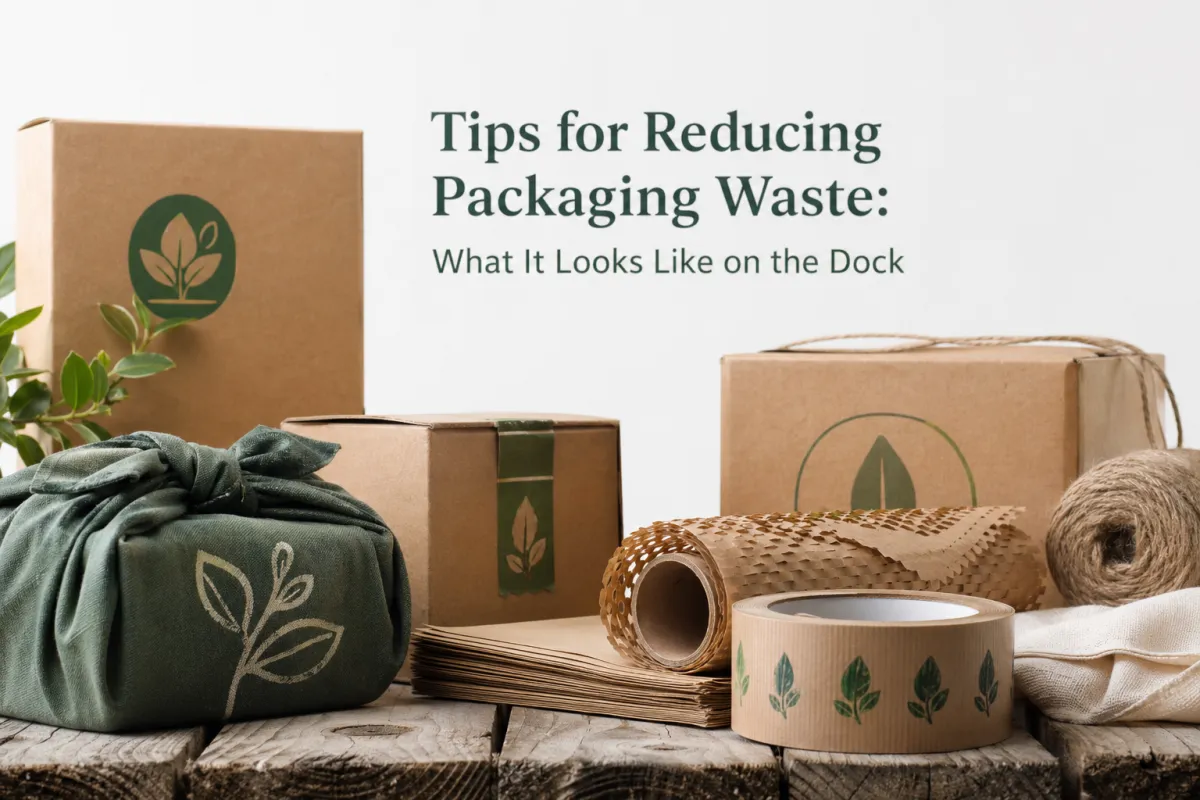
Tips for Reducing Packaging Waste: What It Looks Like on the Dock
The first time I stepped onto a busy fulfillment dock outside Columbus, Ohio, I stopped in front of the trash line and had the same thought a lot of operations leaders eventually have: the waste was not only damaged returns. It was oversized cartons, air pillows, torn corrugate, crushed corners, and half-used rolls of kraft paper that looked as if they had survived a storm in a 53-foot trailer. That is the blind spot in many conversations about Tips for Reducing packaging waste. The problem is not confined to what gets tossed after a breakage. It begins earlier, in the extra board, the void fill, the repacking, and the labor minutes that disappear each time a box arrives too big, too loose, or too awkward for the bench. A two-inch mismatch on a carton can sound minor until you watch it repeat 7,500 times in a week. The best tips for reducing packaging waste are rarely dramatic; they are the quiet adjustments that shave seconds, inches, and cents off every order.
In plain terms, packaging waste includes excess material, unnecessary void fill, repeated repacking, damage caused by a poor fit, and the hidden time spent correcting avoidable mistakes. I once watched a cosmetics co-packer in Edison, New Jersey lose nearly 14 seconds per order because packers had to stuff and restuff a bottle kit that should have fit inside a single custom insert made from 350gsm C1S artboard. Fourteen seconds does not sound dramatic until you stretch it across 9,000 orders a week. Then it starts to feel like somebody is quietly stealing your afternoon, every afternoon. Tips for reducing packaging waste matter because every extra inch of packaging has a cost attached to it: someone bought it, stored it, handled it, shipped it, and eventually disposed of it. That is a lot of action for something that was supposed to be "just a box."
That is why I treat waste as both a sustainability issue and an operating-cost issue. A carton that uses 20% more board than needed does more than add fiber to the waste stream; it can raise dimensional weight, consume trailer cube, and trigger customer complaints when the unboxing feels sloppy or improvised. A 14 x 10 x 8 inch mailer and a 12 x 9 x 6 inch mailer can look close on a spec sheet, but on a parcel invoice they can land in different charge bands. The strongest tips for reducing packaging waste do not simply strip materials away. They improve protection, fit, workflow, and shipping efficiency together. That combination is what separates a good idea from a change that survives peak season without the whole team muttering under its breath.
"We thought our packaging problem was damage. It turned out our bigger problem was paying to ship empty space." I heard that from a distribution manager in Dallas after we audited 11 carton sizes and found that 4 of them accounted for 78% of the order volume. The same exercise gave us a practical path for tips for reducing packaging waste without making the product any more fragile. I still remember the pause in the room when the numbers landed. Nobody likes discovering they've been paying premium rates to move air, especially when the rate card already includes a $0.12 surcharge for oversized parcels.
I keep coming back to one simple question: what is the smallest package that still protects the product, supports the brand, and works on the line? That question opens the door to better packaging design, tighter product packaging specs, and cleaner workflows for retail packaging and branded packaging alike. It also saves teams from the chaos of "we'll fix it in the warehouse," which, in my experience, is usually code for "we will create three new problems and call it a solution." If the approved spec says 3.2 mm flute and the team is using a 5 mm filler pad just to make the box feel right, the waste is already baked in.
How Tips for Reducing Packaging Waste Work Across the Supply Chain
The most useful tips for reducing packaging waste begin with source reduction: use only the packaging the product, route, and customer experience actually require. I have sat through enough supplier meetings to hear the same instinctive answer again and again: make the carton stronger or add another layer. More material is not the same thing as better packaging. It is just more material. A clean, controlled route with palletized freight and short dwell times may do fine with a 32 ECT box; a cross-border parcel lane with rough handling and four touches may need a different structure entirely. The real task is matching design to the actual journey, not to the worst thing anyone can imagine after two cups of coffee in a conference room in Atlanta.
Right-sizing ranks high among tips for reducing packaging waste because it trims material use and shipping cube at the same time. A carton that drops from 14 x 10 x 8 inches to 12 x 9 x 6 inches can cut void space, reduce fill consumption, and improve pallet utilization in a measurable way, especially when the order mix repeats. I have seen freight invoices where a half-inch reduction in height shaved enough dimensional weight to save about $0.40 to $0.85 per parcel. That looks modest until you are moving 40,000 units a month out of a distribution center in Reno, Nevada or Toledo, Ohio. Then it stops looking modest very quickly. In manufacturing and fulfillment, small numbers become large only when volume does the multiplying.
Waste shows up at every handoff. Purchasing buys too many options. Warehousing stores cartons that have not moved in six months. Pick-and-pack teams improvise with whatever is closest. Transport punishes loose loads. The customer opens the package and either feels impressed or annoyed, and the annoyed ones tend to be louder on social media than the impressed ones are in private. Good tips for reducing packaging waste treat the supply chain as one connected system instead of a stack of unrelated decisions. A change that looks tiny in the sample room can become a major improvement on the line if it removes one fold, one tape pass, or one filler step. A five-second change on paper can become a 5,000-minute gain over a quarter.
Standardization is another quiet win. A small set of proven cartons, mailers, inserts, and wraps usually performs better than a sprawling catalog of one-off packaging choices. I worked with a subscription brand in Charlotte, North Carolina that had 23 carton variants for 61 SKUs. After we trimmed that down to 7 tested formats, the warehouse stopped hoarding leftovers, training got easier, and the team stopped using oversized Boxes for Small kits just because those boxes sat at eye level on the top rack. That is one of my favorite tips for reducing packaging waste because it improves both order accuracy and floor discipline. Also, nobody misses the box scavenger hunt on a Monday morning.
Recyclability matters, and I would never dismiss it. Still, the cleanest package is the one you never had to use in the first place. The U.S. Environmental Protection Agency has a useful overview of source reduction and the recycling hierarchy at epa.gov, and that logic lines up with what I see in plants every week: prevent waste first, recover what remains second. That keeps tips for reducing packaging waste grounded in the real world instead of slogans that sound polished and accomplish very little. A box that never gets built does not need to be sorted, baled, or trucked to a recovery facility in the first place.
For teams buying Custom Printed Boxes or tightening package branding, the commercial side and the sustainability side meet in the same decision. A well-designed printed carton can carry the brand, protect the product, and remove the need for a separate insert or outer shipper. That is the kind of packaging design choice that saves money while making the unboxing feel deliberate. If you are comparing options, our Custom Packaging Products page is a practical place to review structures, materials, and finishing choices, including runs starting at 5,000 pieces with pricing that can land near $0.15 per unit for simple single-color mailers depending on board grade and print coverage.
Key Factors That Drive Waste, Damage, and Repackaging
The most useful tips for reducing packaging waste begin with the product itself. Fragility, dimensions, weight, and surface finish all change the answer. Glass bottles need a different protection strategy than printed mailers. Cosmetics with soft-touch coating scuff differently than bare corrugate. Electronics care about static, corner compression, and vibration, while retail packaging for apparel usually cares more about presentation and fit. I have seen a matte black carton pick up rub marks after a single conveyor pass because the ink system and board choice were not matched carefully enough. That was not a theory; that was a Monday-morning reprint in a plant outside St. Louis, Missouri, and nobody was smiling when the scrap bin filled up.
SKU variability adds another layer of pressure. A brand with 12 bottle sizes, 4 seasonal bundles, and 3 promotional kits can end up overpacking simply because the team wants one package that fits every scenario. That usually backfires. Good tips for reducing packaging waste accept that a family of packages, not one universal size, is often the smarter answer. A 6-ounce jar, a two-piece skincare set, and a holiday gift kit do not need the same protection strategy, even if the marketing team wants them to look related on the shelf. I understand the temptation, but reality is usually less cooperative than the mood board, especially once a 9 oz jar and a 2.5 oz serum bottle share the same insert cavity.
Shipping mode matters as well. Parcel shipping punishes empty cube. LTL freight punishes sloppy pallet build. Local delivery can tolerate more carton variety, but it may demand cleaner presentation. International shipping adds another layer because humidity, customs handling, and longer dwell times all raise the risk of repacking. On a visit to a specialty foods plant in Minneapolis, Minnesota, I saw the same inner pack used for domestic and export orders even though the export route ran through two transload points and a 45-day ocean leg to Rotterdam. Their tips for reducing packaging waste had to include route-specific packaging, not just material reduction. Otherwise, the package looked fine on the bench and fell apart in the real world after three handoffs and a week in a humid port.
Warehouse equipment changes the answer more than people expect. If a line has a carton erector, a tape machine, a label applicator, and only 28 inches of bench space, a beautifully engineered package that takes five extra hand motions will still create waste. People make fast choices based on what the station can handle comfortably. That is why tips for reducing packaging waste need to respect the packing bench, operator fatigue, and the speed a shift can maintain without slipping on quality. No one wants to hear, "the new spec is elegant," while also watching the floor team wrestle with a carton that only closes properly after the third crease.
Brand standards can create excess too. I have seen teams add a belly band, tissue wrap, a shipper, a thank-you card, and a printed sleeve to a product that already had strong retail packaging. The result looked polished, but the extra layers added about 11 cents per unit, plus another 6 to 8 seconds of labor. Good branded packaging does not need to be heavy or fussy. Often, the stronger move is to let the box do more work, then use one well-placed print hit or one custom insert instead of three decorative extras. There is a point where "premium" starts to look like "please stop making the warehouse assemble a gift basket" in the middle of a 3 p.m. shift.
For teams that want a more technical framework, ISTA has shipping test standards that help validate whether a design can survive compression, vibration, and drop hazards without overbuilding the package. You can review those standards at ista.org. That kind of validation ranks among the most practical tips for reducing packaging waste because it replaces guesswork with evidence, which is a lovely change from arguing based on whoever has the loudest opinion in the room. A test report with a 30-inch drop height and a 24-hour compression result beats a hunch every time.
How to Compare Packaging Costs Before You Change Materials
One of the most common mistakes is chasing the lowest unit price without checking full landed cost. A carton that costs $0.03 less may still lose money if it increases dimensional weight, causes more damage, or slows pack-out by 4 seconds. I have watched procurement teams celebrate a cheaper mailer while freight and labor quietly erased the savings within two shipping cycles. There is nothing quite like a "cost-saving" move that ends up costing more. That is why tips for reducing packaging waste need a cost model that includes materials, freight, labor, storage, and loss, ideally all in the same sheet with a 12-month volume forecast.
Start with the whole stack. Material cost is obvious, but the rest matters just as much: inserts, printing, die tooling, warehouse cube, assembly time, and any write-off from obsolete inventory. If a design uses custom printed boxes with a more efficient structure, the print cost may rise by a few cents while the total order cost falls because you eliminate filler or a separate sleeve. That is not a theoretical tradeoff. I negotiated a run of 5,000 cartons for a client in Grand Rapids, Michigan where the per-unit box price rose from $0.41 to $0.48, but they removed a $0.09 insert and cut pack time by 6 seconds. The net result was better margin and cleaner packaging design. The math was less dramatic than the spreadsheet hype, but a lot more useful.
Dimensional weight is often the silent killer. A package that is one inch too tall or two inches too wide can shift to the next billing tier, and that can matter more than a small paperboard price change. I like to build a comparison around three numbers: unit cost, ship cost, and damage cost. If one format saves $0.05 in board but adds $0.22 in parcel charges and $0.03 in labor, it is not a savings. It is just a more expensive mistake wearing a friendlier label. That is one of the clearest tips for reducing packaging waste for anyone running an e-commerce or retail fulfillment operation from Phoenix, Arizona to Nashville, Tennessee.
A simple pilot sheet keeps everybody honest. I usually compare current packaging against one or two alternatives and track the following over 200 to 500 orders:
- Material use per order, measured in grams or square inches of board
- Freight cost per shipment, including dimensional weight
- Packing time per order, recorded in seconds
- Damage or return rate, with reason codes
- Obsolete inventory exposure, especially if an old format will be retired
That table can save months of debate because it turns opinions into numbers. It also keeps tips for reducing packaging waste connected to actual shipments instead of sample-room assumptions. If a design only works when packed slowly by the most experienced operator, it is probably not ready for rollout. I say that with affection, but also with a little frustration, because everyone seems surprised when "works on paper" does not equal "works on the floor." A format that passes a bench trial in 7 minutes can still fail after the first 700 orders if the hand motion is awkward.
| Packaging Option | Sample Unit Cost at 5,000 Units | Typical Waste Profile | Best Use Case |
|---|---|---|---|
| Oversized stock carton with void fill | $0.34 carton + $0.06 fill | High cube waste, more tape, more disposal volume | Low-value items with wide size variation |
| Right-sized corrugated carton | $0.42 carton | Lower void space, less filler, better freight efficiency | Stable SKUs with repeatable dimensions |
| Paper mailer with internal support | $0.18 mailer + $0.05 insert | Low material weight, limited crush protection | Soft goods, apparel, flat products |
| Molded pulp insert in printed carton | $0.27 insert + $0.39 carton | Higher tooling needs, less plastic filler | Cosmetics, small appliances, gift kits |
| Paper-based void fill system | $0.04 per packed order | Better than plastic pillows, but still labor-dependent | Mixed-SKU orders with modest fill gaps |
The numbers above are examples, not a universal quote, because resin prices, board grades, print coverage, and order volume change the answer quickly. Still, the comparison shows why tips for reducing packaging waste have to be evaluated on total cost rather than board price alone. In many factories, the cheapest packaging is the one that removes an entire packaging step. I know that sounds almost too simple, but simple is often where the savings hide. A carton made from 32 ECT corrugate in Ontario, California may beat a prettier spec from a farther plant if it cuts a tape pass and one filler handoff.
Step-by-Step Timeline for Reducing Packaging Waste
I like a timeline because it forces movement. The most effective tips for reducing packaging waste are not abstract; they move through audit, baseline, pilot, and review. In week one or two, gather the carton sizes, fill materials, damage reports, freight invoices, and labor notes that show how the current system behaves. If nobody can find the actual specs, that usually means the plant has been running on habit for too long. One beverage client I worked with had three different carton libraries in circulation across two sites in Wisconsin and Tennessee, and none of them matched the purchasing file. That kind of drift is exactly what the first audit should expose.
Next, build a baseline. Measure packaging material per order, the SKUs that generate the most waste, and the points where repacking happens. I usually ask for 30 days of shipping data and sort it by product family, route, and pack station. That tells you whether the problem is a fragile item, a bad box size, or a process issue. Good tips for reducing packaging waste always start with a picture of the current state, because guessing from memory is how teams end up arguing over symptoms instead of causes. And yes, somebody usually says, "but we've always done it this way," which is one of my least favorite phrases in operations because it can hide 18 months of avoidable waste.
Then move into a pilot. Keep it narrow enough that the team can pay attention. Test one product family, one region, or one packing line, and compare the old and new format in parallel. I have seen pilots fail simply because they were too broad; nobody knew which SKU caused the damage spike or which shift created the repacking problem. If you want the change to stick, the pilot has to be narrow, measurable, and long enough to catch real handling conditions. For many operations, 200 to 500 shipped units is enough to spot the trend, and 2 weeks is enough to see whether operators can live with the change. If the new spec still looks good after 300 parcels and a Saturday shift, you are probably on the right track.
Validation should include real shipping checks, not just bench fit. That means drop tests, vibration checks, compression checks, and a review of how the package behaves after being stacked, sorted, and transferred. In technical terms, that is where ASTM methods and ISTA protocols earn their keep. It is also where tips for reducing packaging waste prove themselves, because a package that removes material but fails in transit is not a savings plan. It is a future claims report with a nice font. I would rather see a slightly heavier carton pass a 36-inch drop than a fragile one that saves half a cent and fails on the first lane to Chicago.
Once the pilot passes, set a rollout rhythm. I like 30-, 60-, and 90-day reviews. At 30 days, confirm pack speed and operator feedback. At 60 days, check damage, freight, and fill consumption. At 90 days, review write-offs, leftover inventory, and whether the new spec is actually being followed on every shift. The best tips for reducing packaging waste do not end when the box changes; they continue until the new standard becomes the normal way the line runs. Otherwise the old habits creep back in, and then everyone acts surprised when the waste numbers drift upward again. A clean rollout in Kansas City can unravel in 10 days if the receiving team keeps pulling the retired carton from the wrong rack.
Common Mistakes That Increase Packaging Waste Instead of Cutting It
Over-engineering is the first trap. Teams design for the worst possible scenario they can imagine, then pay for extra board, extra fillers, and extra labor on every order. I understand the instinct; nobody wants a broken product. But if the damage event is rare, building every package for that rare event creates more waste than it prevents. One of the most honest tips for reducing packaging waste is learning where good enough is actually correct, especially after the product has passed real route testing from Seattle to Salt Lake City and back through a hub in Spokane. A package does not earn medals for surviving a scenario that never happens.
The second trap is focusing on unit price alone. A box that saves $0.04 can still cost more once freight cube, labor time, and damaged goods are counted. I have seen purchasing teams defend a low-cost liner while the warehouse complained that it needed two extra folds and one extra tape strip on every order. That is not efficiency. That is hidden cost wearing a cheap label. If your tips for reducing packaging waste do not include freight and labor, they are incomplete, and they may be actively misleading. A spec that looks attractive at $0.31 per unit can turn into $0.57 once repack labor and disposal are added.
Skipping line testing causes a third kind of failure. A package can look smart in a mock-up and still fail in practice if it is hard to fold, awkward to load, or unstable on the bench. The people packing it are the ones who will tell you whether it works. I still remember a Seattle client who approved a sleek insert that required perfect alignment on every placement. On paper it looked elegant. On the line it caused a 12% slowdown and a stack of rejected pieces because the tolerance stack was too tight for daily production. Good tips for reducing packaging waste respect the person who has to run the system for eight hours straight, not just the person approving the mock-up at a desk in a glass-walled conference room.
Reverse logistics is another area that gets overlooked. Returns, replacements, and exchanges generate a second wave of packaging waste, and that wave can be as large as the outbound stream for some categories. Apparel, cosmetics, and electronics all see it. If the return path needs a second box, extra tape, or a new label sleeve, design for that now instead of treating it like an afterthought. In a meeting with a retail brand in Atlanta, I watched them realize that 17% of their packaging waste came from return labels, damaged sleeves, and reship kits. That changed the spec immediately, because nobody wanted to keep paying for the same mistake twice, especially on a channel with a 9% return rate.
Changing materials without training staff is a quiet way to lose savings. If one shift keeps using the old filler, or if the new carton is stored in the wrong location, the operation creates mixed inventory and inconsistent pack quality. I have seen a plant lose a month of savings because the receiving team did not know that the new carton had a different fold pattern. Training, spec sheets, and clear visuals matter. They keep tips for reducing packaging waste from fading after the first reorder. Otherwise the shiny new plan becomes a dusty pallet of unused cartons and a lot of confused expressions in a warehouse in Louisville, Kentucky.
What Are the Best Tips for Reducing Packaging Waste Without Sacrificing Protection?
The strongest tips for reducing packaging waste are the ones that protect the product and reduce the material count at the same time. Right-sizing tools and fit templates are a good place to begin. If the package matches the product closely, it usually needs less filler, travels more efficiently, and looks more polished at the customer’s doorstep. That matters even more for custom printed boxes, where the exterior already carries the story and the structure should not rely on extra paper to hold itself together. Nobody opens a premium package hoping to find a nest of air pillows and regret, especially after paying $8.95 for shipping.
Consolidate materials wherever you can without creating risk. A plant running 14 carton styles, 6 insert types, and 3 void-fill formats is usually carrying more complexity than it needs. I would rather see a small set of strong, well-tested options than a giant catalog of one-off fixes. That is one of my favorite tips for reducing packaging waste because it lowers purchasing noise, reduces leftovers, and makes training easier. A packing floor with fewer choices tends to make fewer mistakes, and it moves faster because nobody has to stop and ask, "Which one do we use for this SKU again?" A clean lineup is easier to buy, easier to store, and easier to explain to a new hire on day one.
Replace redundant layers with smarter structure. Sometimes the answer is a stronger corrugate profile, a more thoughtful insert, or an engineered paper-based alternative that protects corners without stuffing the box with extra material. I have seen 200 lb test board solve a problem that three layers of filler could not, simply because the product needed stiffness rather than more fluff. That kind of decision improves product packaging and keeps the package from feeling overbuilt. It also supports better package branding because the customer sees a cleaner, more intentional presentation. Less clutter usually looks more expensive, which is a funny little contradiction the packaging world never seems to outgrow.
Use a packaging spec library. Every approved carton, mailer, insert, and wrap should have a simple drawing, material callout, print note, and an approved substitution list. I have watched operations drift back into wasteful habits because one shift used a legacy spec and another shift used the updated one. A clean library stops that drift. It is one of the most practical tips for reducing packaging waste because it keeps the standard visible when the room gets busy and the orders start stacking up. If people have to hunt for the right spec, they will eventually grab the nearest thing and call it good enough. That is how waste sneaks back in, usually after the first labor shortage or holiday rush.
For brands that care about presentation, remember that branded packaging does not have to mean more layers. A well-designed exterior, one smart insert, and a clean opening experience often do more for perceived value than tissue wrap, a sleeve, and a sticker bundle. That balance matters in retail packaging, subscription kits, and DTC shipments where the box itself is part of the customer’s first impression. Better packaging design can make the package feel premium while still following strong tips for reducing packaging waste. A 350gsm C1S artboard mailer with a single-color inside print can often outperform a busier, heavier setup in both cost and presentation.
If you want a practical next move, start with one high-volume SKU, change one packaging element, and measure damage, freight, and labor before and after. Then expand the winning format to similar products. That process is slower than guesswork, but it is far safer and usually cheaper. If you need help choosing materials, structures, or print formats, our Custom Packaging Products catalog can help you compare options without starting from zero, with typical lead times often landing around 12-15 business days after proof approval for standard printed cartons, depending on volume, finishes, and plant location.
Here is the plain version: the smartest package is rarely the fanciest one, and it is not always the cheapest one either. It is the package that protects the product, keeps the line moving, and leaves less to throw away. That is the heart of tips for reducing packaging waste, and it is the standard I have used on factory floors from corrugated converting plants in the Midwest to contract packers on the Gulf Coast. I wish every project were clean and elegant. They are not. But the good ones still leave you with fewer scraps on the floor and fewer headaches in the invoice.
In one negotiation with a supplier in Shenzhen, we narrowed a carton spec from three board grades to two, removed an unnecessary printed insert, and shortened pack time by 5 seconds per unit. The client did not just save money; they also cut the mixed-material stream that had been clogging their recycling bins. Another time, at a snack-food co-packer in York, Pennsylvania, we replaced an oversized display shipper with a tighter retail-ready format and reduced pallet waste enough to reclaim a full trailer slot each week. Those are the kinds of outcomes I look for. They are measurable, and they come from tips for reducing packaging waste that respect the product, the crew, and the customer. No drama, no miracle claims, just better decisions stacking up.
If I had to compress the whole matter into one sentence, it would be this: tips for reducing packaging waste work best when they improve fit, reduce handling, and keep protection strong enough for the route. Do that well, and you cut cost without making the package feel cheaper. Do it badly, and the savings vanish in freight bills, claims, and rework. The most reliable tips for reducing packaging waste usually begin with fit, then move to freight, labor, and claims. A supplier who can show board grades, insert options, and print methods side by side can help you get there faster, but the real decision is still the same: choose the package that does the job with the fewest unnecessary pieces.
FAQ
What are the best tips for reducing packaging waste in e-commerce?
Start with right-sizing cartons and mailers so you are not shipping empty air. Then standardize a small set of proven formats for your highest-volume SKUs, because that usually reduces confusion on the packing line and keeps leftover inventory from piling up. The strongest tips for reducing packaging waste also track damage rates and freight costs together, so savings do not come from weaker protection. I have seen too many "cheap" boxes turn into expensive returns, especially on categories shipping from warehouses in Columbus, Indianapolis, and Dallas where parcel volume changes by the hour.
How can I reduce packaging waste without increasing product damage?
Test packaging on real shipments instead of guessing from sample fit alone. Use structural protection, such as better inserts or stronger corrugate, in place of excess filler whenever possible. Before rollout, validate the change against drop, vibration, and compression risks, because tips for reducing packaging waste only work if the product still arrives intact. Protection first, then elegance, then savings. A carton that survives a 30-inch drop from a conveyor in Memphis is worth more than one that looks perfect and fails on the first truck transfer.
Which packaging materials usually create the most waste?
Oversized corrugated cartons with too much void space are a common source of waste, especially when they are paired with plastic pillows or excess paper fill. Mixed-material packs are harder to recover and often create more disposal friction, so they deserve a close review. In my experience, the fastest tips for reducing packaging waste usually start with the biggest box on the rack. That one is often the obvious troublemaker, particularly if it costs $0.38 per unit and requires $0.07 of filler to keep the product from rattling.
How long does it take to see results from reducing packaging waste?
Simple wins, like carton right-sizing or filler reduction, can show results within a few shipping cycles. Material changes that need testing, supplier updates, or new tooling usually take longer, especially if you are changing print specs or inserts. A 30- to 90-day review window is practical for comparing waste, damage, and cost trends, which is why many tips for reducing packaging waste use that cadence. I like that window because it gives the numbers enough time to stop lying, and it is long enough to catch weekdays, weekends, and one annoying peak-volume surge.
What should I track to measure packaging waste reduction?
Track material usage per order, freight cost per shipment, and product damage or return rates. Add labor time for packing and repacking so efficiency gains are visible, and monitor how much obsolete inventory or leftover packaging gets written off after changes. Those numbers show whether your tips for reducing packaging waste are delivering real savings or just shifting the problem somewhere else. If the waste moved from the trash can to the spreadsheet, that is not progress; if a 5,000-piece run in Pittsburgh cuts filler by 40%, that is a result you can actually bank.
Start with one high-volume SKU this week. Measure material use, dimensional weight, pack time, and damage for 30 days, then remove one unnecessary layer and test the result before you touch the next format. That single change is usually the cleanest entry point for tips for reducing packaging waste, and it gives you a real baseline instead of a hunch.


