Buyer Fit Snapshot
| Best fit | Poly Mailer Sizing for Retailers projects where brand print, material claims, artwork control, MOQ, and repeat-order consistency need to be specified before quoting. |
|---|---|
| Quote inputs | Share finished size, material target, print colors, finish, packing count, annual reorder estimate, ship-to region, and any compliance wording. |
| Proofing check | Approve dieline scale, logo placement, barcode or warning zones, color tolerance, closure strength, and carton packing before bulk production. |
| Main risk | Vague material claims, crowded artwork, missing packing details, or unclear freight terms can make a low unit price expensive after revisions. |
Fast answer: Poly Mailer Sizing for Retailers: Production Review should be specified like a repeatable production item. The safest quote records material, print method, finish, artwork proof, packing count, and reorder notes in one written spec.
Production checks before approval
Compare the actual filled-product size with the drawing, then confirm tolerance on folds, seals, hang holes, label areas, and retail display edges. Reserve space for logos, QR codes, warning copy, and material claims before decorative graphics fill the panel.
Quote comparison points
Review material grade, print process, finish, sampling route, tooling charges, carton quantity, and freight assumptions side by side. A quote is only useful when the supplier can repeat the same color, closure quality, and packing count on the next order.
A poly mailer that is only a little too large can quietly push postage higher, eat up shelf space, and make a carefully packed order feel less polished the moment it lands on the customer’s doorstep. I have seen teams blame shipping rates, then discover the real leak was packaging drift: one extra inch here, a looser fold there, and suddenly the numbers stop lining up. A good poly Mailer Sizing Guide for Retailers keeps those small losses from piling up, especially when the same package choice has to work across dozens of SKUs, multiple packers, and a busy outbound line.
What a Poly Mailer Sizing Guide for Retailers Solves
Retail packaging has a habit of turning tiny mismatches into real money. A bag that is a touch oversized may look harmless in isolation, then show up again and again as extra postage, awkward shelf use, and a sloppy first impression at delivery. That is why a poly mailer sizing guide for retailers is not just a chart. It is a control system for postage, pack speed, and presentation.
Packaging teams feel the problem first. One packer pulls a bag that is too loose, another chooses a size that presses hard against the seal, and suddenly the bench starts behaving like a guessing game. A strong poly mailer sizing guide for retailers removes that uncertainty. It gives the team a repeatable answer for the same item, the same fold, and the same shipping path.
Product fit is only part of the story. The real question is how the item travels once it leaves the warehouse. Folded garments, tissue, inserts, return cards, barcode labels, and care sheets all change the footprint. A tee may look tiny on a rack and occupy far more room once it has been folded the way the packing team actually ships it. A hoodie can seem manageable until the hood, cuffs, and ribbing add thickness in the wrong places. A poly mailer sizing guide for retailers has to follow the packed version, not the display version.
Standardization matters because most retail operations do better with a short list of approved sizes than with a pile of near-duplicates. Three well-chosen mailers often outperform six guesswork options. The line moves faster. Training gets easier. Inventory becomes less chaotic. A poly mailer sizing guide for retailers turns those gains into a policy instead of a lucky accident.
How Does a Poly Mailer Sizing Guide for Retailers Work?
A mailer’s nominal size printed on a spec sheet is only the starting point. What matters on the floor is the space left after the product is folded, inserted, sealed, and labeled. That gap between the label and the usable interior is where many sizing mistakes begin. A poly mailer sizing guide for retailers should begin with the way the parcel ships, not the way the item looks in merchandising photos.
Length and width give useful information, but they do not tell the whole truth. Expansion depth, gusset behavior, and the give in the film determine whether the top seal closes without strain. A parcel that is too thick for the chosen bag can bulge at the seam, making the package look overstuffed and making the adhesive work harder than it should. A parcel that is too small for the product disappears into a tight fit that can wrinkle the corners or weaken the seal. A practical poly mailer sizing guide for retailers keeps both problems in view.
Closure design changes the math too. Peel-and-seal strips are common, but their width, glue tack, and placement all matter. If the item sits close to the closure line, the adhesive may need extra pressure to hold. That pressure is not free; it slows packing and can create a weak edge where the package opens during transit. A retail team that expects returns also needs enough room for re-sealing or for a fresh label to sit cleanly on the same package. A poly mailer sizing guide for retailers should account for outbound use and likely return use at the same time.
Carrier rules add another layer. Light but bulky parcels can trigger dimensional pricing in ways that surprise teams who only look at weight. Sorting systems, conveyor handling, and manual handling all prefer packages that stay flatter and easier to stack. A slightly larger bag may cost more not because it weighs more, but because it claims more physical space. That is another reason a poly mailer sizing guide for retailers belongs beside shipping policy, not after it.
Transit testing gives the sizing decision its final check. Industry methods such as ISTA testing show how parcels behave under drop, vibration, and compression. Bench fit can be deceptive. A mailer that looks perfect on a packing table may fail once it has been sorted, stacked, and handled by a carrier network. A poly mailer sizing guide for retailers gets much stronger once the chosen sizes survive real conditions.
Key Factors That Shape Poly Mailer Sizes
Product dimensions are the first filter, but they have to be measured in shipping form. Length, width, and thickness after folding matter far more than shelf dimensions. A scarf, a T-shirt, a pair of socks, and a rigid accessory may share a similar flat size, then behave completely differently once they are packed. A reliable poly mailer sizing guide for retailers groups items by packed behavior, not by how they are listed in a catalog.
Material behavior changes the choice again. Soft goods compress easily, which usually means less extra room is needed. A cotton hoodie can be folded and pressed into a mailer with a modest allowance, while an accessory with a sharp edge or hard insert may need more space to keep the film from snagging at the seal. That difference can be small at the bench and large at scale. Over thousands of orders, it decides whether the packing station runs cleanly or turns into a stop-and-start operation. That is the kind of detail a poly mailer sizing guide for retailers should capture.
Total cost matters more than sticker price. A cheaper mailer can become the expensive one if it increases postage, slows the line, or leads to claims and reships. Storage footprint counts too. A retailer that stocks too many near-identical sizes can lose pallet space to packaging that never needed to exist in the first place. A focused poly mailer sizing guide for retailers keeps the range tight enough to manage without forcing bad fits.
Order mix changes the answer as well. A retailer shipping mostly single-item orders can standardize differently from one shipping bundles, gifts, or multi-unit apparel packs. One size may work beautifully for a folded shirt, then fail when the same order also includes an insert card and a return slip. A second size can save money if it prevents overstuffing and rework. A thoughtful poly mailer sizing guide for retailers looks at the order pattern, not just the SKU count.
Brand presentation has a role too. A mailer that arrives flat, well sealed, and proportioned to the product can feel more premium without changing the shipping class. That is not decoration for decoration’s sake. It is a signal that the retailer paid attention. A parcel packed in a bag that fits the item properly looks intentional. A parcel packed in a bag that swims around the product looks improvised. A poly mailer sizing guide for retailers should protect that visual cue as carefully as it protects the item inside.
Step-by-Step Poly Mailer Sizing Guide for Retailers
The most reliable sizing process starts with top-selling SKUs and measures them the way they are actually shipped. Fold, insert, wrap, and label the product exactly as the packing team does on a normal order. If a garment leaves with tissue and a thank-you card, measure it that way. If an accessory includes a barcode label and a return insert, include those pieces too. A poly mailer sizing guide for retailers only works when it reflects the real pack configuration.
- Measure the packed item. Record the folded length, width, and thickness that the shipping team actually handles.
- Add practical allowance. Leave room for insertion, a clean seal, and slight movement so the adhesive is not under strain.
- Match to stock mailer sizes. Compare the packed footprint to the mailer’s usable opening and working space, not just the name on the box.
- Group similar SKUs. Place related items into a small number of approved sizes so packers do not have to improvise.
- Test with real materials. Use actual closures, labels, inserts, and handling conditions before approving a size for production.
- Check shipping results. Review cost, damage rate, and pack speed after launch, then adjust if the data points to a better fit.
That sequence sounds plain, yet it prevents a lot of expensive guesswork. A poly mailer sizing guide for retailers becomes more dependable when everyone follows the same order: measure, allow, test, approve, and monitor. Many packaging problems begin with a short cut, where someone jumps from product dimensions to mailer choice without checking the packed version of the item. That shortcut is where hidden cost lives.
A fit sheet helps. The sheet can list which SKUs belong in each mailer, how the item should be folded, whether inserts are allowed, and what a proper seal should look like. Even a short fit sheet reduces training time and keeps one packer from making a different call than another. A poly mailer sizing guide for retailers should make the line easier to run, not just easier to buy from.
Label placement deserves the same attention. A parcel may fit perfectly and still fail if the label lands across a seam or on a heavily flexed area. Scanning gets harder. The package can look wrinkled. The result is small but real friction at the dock and in the carrier network. A poly mailer sizing guide for retailers should treat the label zone as part of the usable surface, especially on small parcels where every inch matters.
Retailers building a broader packaging program often compare mailers with other formats in Custom Packaging Products before they settle on a standard. That is a sensible move. If the same brand also ships cartons, inserts, or branded outer packaging, the mailer choice should fit the whole system rather than one product line in isolation. Once the fit is proven, moving into Custom Poly Mailers becomes easier and far less risky.
Poly Mailer Sizing Guide for Retailers: Cost and Pricing
Pricing becomes clearer when the retailer looks past unit cost. A mailer that costs less on paper can end up costing more if it increases postage, slows packing, or creates more damage claims. A solid poly mailer sizing guide for retailers should treat cost as a system: material, freight, labor, storage, postage, and risk all belong in the same calculation once shipping volume climbs.
Stock mailers in common apparel sizes are often the least expensive starting point, especially at higher quantities. Custom printed options usually carry a higher price, yet the brand value can justify that premium when the package is part of the customer experience. Thickness upgrades, tamper-evident features, and stronger adhesives also change the price. Each of those upgrades should be judged against the product and the shipping conditions, not against a generic packaging wish list. A practical poly mailer sizing guide for retailers keeps those tradeoffs visible.
Oversized mailers create indirect costs that are easy to miss. They use more film, occupy more shelf space, and can slow the line because packers have to manage more loose material. Bigger mailers can also force changes downstream if the final parcel no longer fits a normal workflow or carrier preference. A few cents per unit can look trivial until the season ends and the total cost shows up in one line. A poly mailer sizing guide for retailers should be judged by total landed cost, not by one price line on a quote sheet.
Minimum order quantities matter as well. A retailer that wants several custom sizes may be forced into a higher cash outlay and more storage pressure than expected, especially when some of those sizes move slowly. Size rationalization solves that problem. The strongest programs choose the smallest number of mailers that still covers the widest range of orders cleanly. That keeps inventory easier to forecast and reorders easier to place. A poly mailer sizing guide for retailers is as much an inventory strategy as it is a fit strategy.
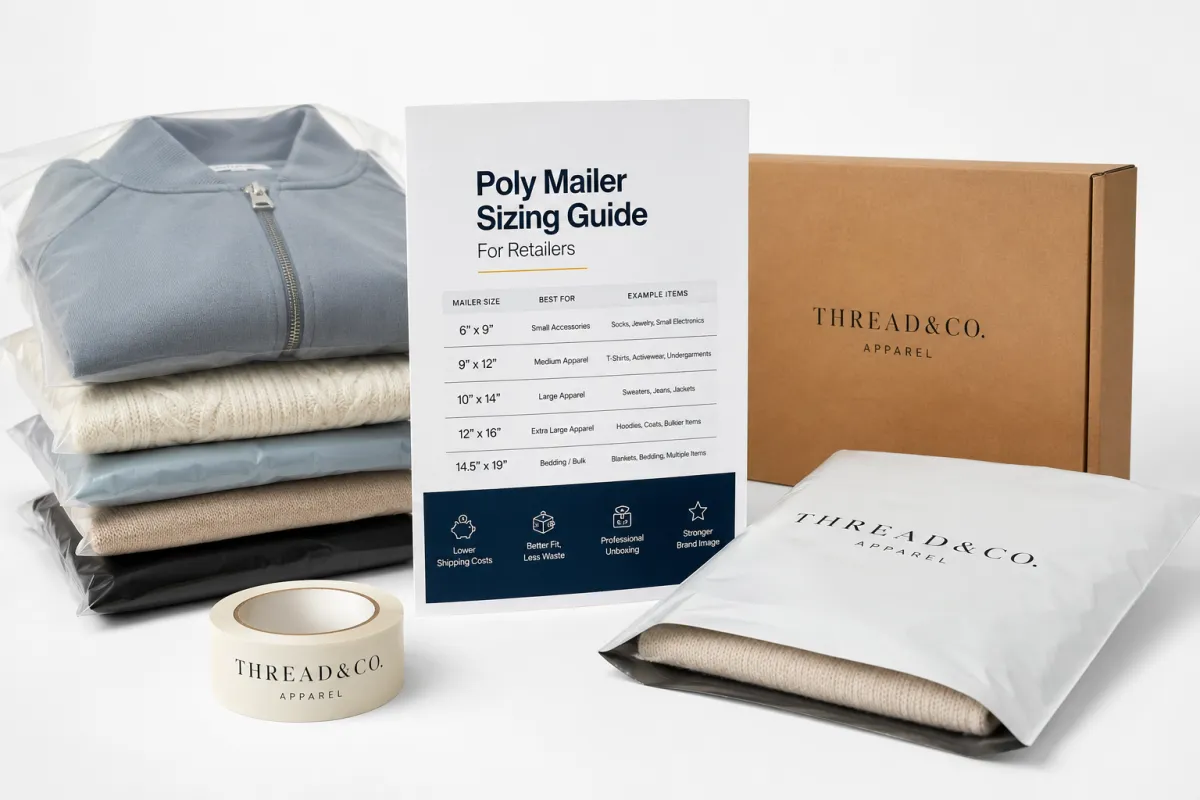
| Mailer Size Example | Best For | Typical Construction | Approx. Unit Range | Fit Notes |
|---|---|---|---|---|
| 6 x 9 or 7 x 10 inches | Small accessories, jewelry, socks | 2.5 mil stock or light custom print | $0.08 - $0.18 | Efficient for flat items; watch seal space if inserts are added |
| 9 x 12 inches | Folded tees, light apparel, soft goods | 2.5 - 3 mil stock or custom print | $0.10 - $0.24 | Common retail standard; often the easiest all-purpose choice |
| 10 x 13 or 10.5 x 16 inches | Hoodies, denim, bundled orders | 3 mil or heavier custom printed | $0.14 - $0.32 | Useful when thickness builds up and a standard apparel bag feels tight |
| 14 x 19 inches and up | Bulkier apparel, multi-item packs | 3 - 4 mil heavy-duty options | $0.20 - $0.45 | Good for volume, but review postage and storage before standardizing |
The table is not a rulebook. It shows how fit, product type, and price move together. A poly mailer sizing guide for retailers works best when the smallest practical size is chosen for each order family, then checked against real pack-out and shipping data. That is usually where the savings appear.
Sustainability sits in the same conversation. The EPA guidance on reducing waste is a blunt reminder that less excess material usually means less waste downstream. A right-sized mailer does not fix every environmental issue, yet it does reduce unnecessary film use and keeps the package closer to the product load. For many retailers, that is a practical improvement that also supports the brand story. A poly mailer sizing guide for retailers can serve efficiency and waste reduction at the same time.
Common Poly Mailer Sizing Mistakes Retailers Make
The biggest mistake is choosing by eye. A mailer can look close on a desk and still fail once the product is folded, flattened, labeled, and sealed. Apparel makes this worse because the item on the rack rarely matches the item on the line. A poly mailer sizing guide for retailers blocks that kind of guesswork by forcing the decision to start with the shipped version of the product.
Sizing for the uncompressed item causes trouble too. A bulky hoodie often shrinks dramatically once it is folded with a consistent method, and a bag chosen from the original garment dimensions may be far too large. The reverse happens with rigid accessories, which may not compress much at all. A tight-looking bag can turn into a seal problem fast. Measure the way the item ships. A strong poly mailer sizing guide for retailers makes that rule hard to ignore.
Return handling gets missed more often than it should. If the retailer expects the same mailer to serve the return trip, the size has to allow for resealing, extra labels, and repackaging after the parcel is opened. A bag that works beautifully on outbound shipment can be too small for the return path. That can cost more in service time than it does in packaging. A practical poly mailer sizing guide for retailers should ask whether the package has to work twice.
Too many size variations create their own mess. Every extra SKU adds receiving complexity, more training, more pick confusion, and more storage pressure. Too few sizes force the line into overstuffing, underfilling, or using a bag that is technically close but operationally awkward. Most retailers do better with a lean set of sizes that fits the real order mix cleanly. That balance sits at the center of any useful poly mailer sizing guide for retailers.
Label behavior can break a package even after the fit looks right. Some mailers scan well before labeling, then become difficult to read once the closure wrinkles or the bag flexes under load. That is why test packs need a full label application, not just a product drop-in. A poly mailer sizing guide for retailers should treat the label as part of the finished parcel, because that is exactly how the carrier sees it.
Expert Tips, Testing Timeline, and Next Steps
If I were setting up a new program, I would start with the top-selling SKUs rather than the long tail. Pick the products that move most often, pack them exactly the way the line would, and order a small set of samples in the likely sizes. Then check closure pressure, product movement, label placement, and how the parcel feels in the hand after sealing. A poly mailer sizing guide for retailers becomes far more useful when it comes from actual sample packs instead of spreadsheet guesses.
A realistic timeline usually runs like this: one to three days for internal measurement and sample selection, a few days for sample arrival and in-house testing, then proof approval and production once the final size is set. Depending on print coverage, construction, and supplier load, production and delivery can often take around 12 to 20 business days after approval. Exact timing depends on the specification and the quantity. Planning ahead matters because a bad deadline can force a retailer into a temporary size that never should have become permanent. A poly mailer sizing guide for retailers should be used early enough to support launch windows and seasonal shifts.
A mailer size is not right because it fits once. It is right when it fits the same way on the fifth order, the fiftieth order, and the five-hundredth order without slowing the line or stressing the seal.
Keep a fit sheet for every approved size. Note the SKU group, the fold method, the expected inserts, the label placement, and any caution points for the packing team. That small bit of documentation pays for itself quickly because it reduces variation between packers and cuts down on training questions. A poly mailer sizing guide for retailers is much easier to maintain when the knowledge lives on paper, not only in one experienced person’s head.
After the first order wave, review shipping data. Look at postage, damage rate, void fill use, pack time, and any returns or complaints tied to packaging. If a size is working, keep it. If it is creating waste or slowing the line, adjust it before the problem gets baked into the next reorder. That feedback loop is where a poly mailer sizing guide for retailers stops being a document and starts becoming an operating tool.
Retailers building out their packaging mix usually get the best result by standardizing the most common sizes, validating them with real shipments, and only then expanding if the order mix truly needs it. That keeps the program lean and easier to manage while still leaving room for branded presentation and product protection. Treat the poly mailer sizing guide for retailers as a living process, and the pack-out stays efficient even as products, promotions, and order patterns change. The practical takeaway is simple: lock in a small set of tested sizes, write the fit rules down, and review the numbers after launch so the packaging choice keeps earning its place.
How do I choose the right poly mailer sizing guide for retailers for apparel?
Measure the garment exactly as it is folded for shipment, not as it hangs on the rack. Add room for seams, tissue, inserts, and the seal area so the closure is not strained, then test one sample pack before standardizing the size in your poly mailer sizing guide for retailers.
What size poly mailer do I need for multiple retail SKUs?
Group products by packed thickness and common order pattern, then choose the smallest shared size that fits the group cleanly. Keep the number of standard sizes short so packing stays fast and inventory stays manageable, which is usually the best approach in a poly mailer sizing guide for retailers.
Does a bigger poly mailer always increase shipping cost?
Not always, but a larger mailer can raise cost through extra material, bulkier packing, and dimensional pricing rules on some services. Compare the total landed cost, including postage, labor, and damage risk, before deciding which size belongs in the poly mailer sizing guide for retailers.
Can one poly mailer size work for both outbound orders and returns?
Yes, if the mailer is large enough to fit the product after use and still close securely for the return trip. Plan for return labels, reseal strips, and repackaging needs before approving the size in your poly mailer sizing guide for retailers.
How much testing should retailers do before ordering custom mailers?
Test several sample sizes with real products, real closures, and realistic handling conditions. Check seal strength, label adhesion, abrasion resistance, and how the package behaves in transit so the final approval is grounded in actual performance, not just the poly mailer sizing guide for retailers on paper.