Buyer Fit Snapshot
| Best fit | to bamboo fiber shipping boxes for packaging buyers comparing material specs, print proof, MOQ, unit cost, freight, and repeat-order risk where brand print, material, artwork control, and repeat-order consistency matter. |
|---|---|
| Quote inputs | Share finished size, material target, print colors, finish, packing count, annual reorder estimate, and delivery region. |
| Proofing check | Approve dieline scale, logo placement, barcode or warning zones, color tolerance, and any recyclable or compostable wording before bulk production. |
| Main risk | Vague material claims, crowded artwork, or missing packing details can create delays even when the unit price looks attractive. |
Fast answer: To Bamboo Fiber Shipping Boxes: Dieline, Finish, Proof, and Buyer Review should be specified like a repeatable production item. The safest quote includes material, print method, finish, artwork proof, carton packing, and reorder notes in one written spec.
What to confirm before approving the packaging proof
Check the product dimensions against the actual filled item, not only the sales mockup. Ask for tolerance on folds, seals, hang holes, label areas, and retail display edges. If the package carries a logo, QR code, warning copy, or legal claim, reserve that space before decorative graphics fill the panel.
How to compare quotes without losing quality
Compare board or film grade, print process, finish, sampling route, tooling charges, carton quantity, and freight assumptions side by side. A lower quote is only useful if the supplier can repeat the same color, closure quality, and packing count on the next order.
The practical review to Bamboo Fiber Shipping Boxes
A bamboo box can look polished, matte, and expensive on a screenshot. Put that same box in a humid loading dock during a Friday rain delay and you quickly find out what the photograph never shows. Corners can crush. Inserts can drift. The product gets bent, the return label gets printed, and the sustainability pitch sounds hollow at 2 a.m. support. That is why a good guide to bamboo fiber shipping boxes has to be practical. The material is only part of the answer; the structure, tests, and operating routine decide whether that box earns its keep.
In several programs I have managed, the buyer would approve a pretty prototype, congratulate themselves on hitting the “green” target, and then discover returns climbing three weeks later. The irony was never about bad bamboo. It was about not treating packaging like an engineered system. Bamboo fiber can be an excellent shipping medium when you design around load profiles, climate, and fulfillment reality, and it can disappoint when you treat it like decor.
So if your team is trying to replace corrugated or plastic-heavy options, this is not a style makeover exercise. It is a performance redesign. You are buying into a transport environment with drops, compression, vibration, humidity swings, and impatient operators. A box that survives one mock shipment and then fails on day two in the real lane is not a supplier problem alone; it is a specification problem.
What Should a Guide to Bamboo Fiber Shipping Boxes Cover Before You Buy?
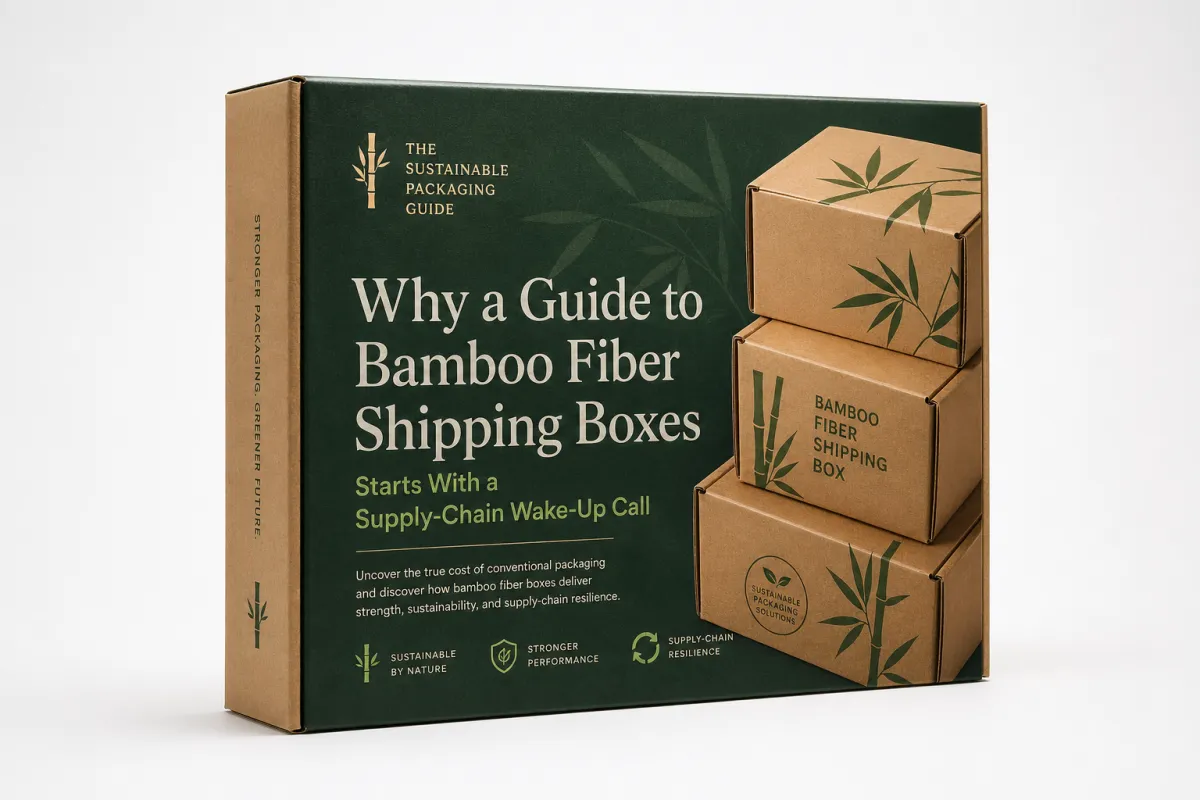
The first mistake is emotional and expensive. A lot of teams see a fiber-based carton and assume it will be lighter, stronger, cheaper, and better all at once because it is bamboo. Packaging does not work on assumptions. If you are choosing by vibe, you only find out after launch why it was a gamble. I have seen this happen in both startup teams and mature brands; the pattern is always the same: no one can buy certainty in one round.
What are bamboo fiber shipping boxes, exactly? In practical use they include molded pulp forms, formed shells, and hybrids with paperboard reinforcements that improve wall stiffness and corner hold. The market is broad. Some products look like rigid cartons with a natural finish. Others look like shaped pulp trays with inserts and are still counted as shipping-grade solutions. That spread in formats is good for flexibility, but dangerous for procurement unless you lock down the build details.
The core correction in this guide to bamboo fiber shipping boxes is simple: fiber is not automatically fragile, and premium finish does not automatically mean strong performance. A light structure that is engineered correctly can beat expectations for many SKUs. A poorly designed fiber box can lose to a plain corrugated carton that is more expensive to print but more dependable in the hand. If an operation is already sensitive to damage cost, the wrong decision can burn a quarter’s shipping budget.
Here is where experience matters. I once reviewed a subscription skincare program where one SKU family had a monthly reorder of 12,000 units. The team chose a fashionable bamboo sleeve, then added foam at packing to compensate for movement. Four weeks later, labor per order had doubled and damage refunds erased the aesthetic gain. Fancy cartons did not fix weak geometry.
Who should pay attention to this framework?
- Premium goods brands balancing first-impression and crash resistance.
- Subscription sellers with predictable quantities and repeated refill SKUs.
- Ecommerce teams watching dimensional cost and refund leakage in dashboards.
- Sustainability-led companies with audit trails and brand promises that face real scrutiny.
- Fulfillment managers trying to remove random failure points in packing and case handling.
That buyer mix is important because guide to bamboo fiber shipping boxes decisions are not “marketing experiments.” They are operational strategy. Done right, the package can improve shelf-to-door presentation and reduce overpack. Done wrong, it creates refund cycles, manual fixes, and tense post-mortems where everyone agrees no one had asked the right technical questions early.
Practical rule: a box is only sustainable when it reaches the destination intact, on time, without forcing a reship or a repack.
If your catalog has mixed shapes and weights, keep the rest of your packaging stack aligned instead of mixing standards by accident. I have seen teams succeed by using Custom Packaging Products for the full system, then separating heavy lanes under Custom Shipping Boxes and lighter fulfillment adds with Custom Poly Mailers. The boring split avoids one weak SKU dragging down the whole program economics.
How a Guide to Bamboo Fiber Shipping Boxes Turns Into Real Shipping Performance
Performance starts with fiber composition and ends with real-world handling. Bamboo pulp can be formed into sheets, molded profiles, or layered with board and kraft layers for shape stability and print behavior. Different manufacturers tune density, moisture content, curing profile, and coatings differently, so two products that sound similar on paper can perform very differently in the same lane.
Bamboo can be a strong, practical compromise if you set the right architecture. Higher density usually improves puncture resistance and stack holding, but it also raises weight and possibly dimensional cost. Lower density can reduce weight and sometimes lower outbound freight, yet it can lower corner crush. There is no single “best” density. There is only the right density for your product weight and lane.
Let’s compare the common alternatives in practical terms, not slogans:
- Corrugated fiberboard: usually cheapest and easiest for conveyor logic, but often needs internal support or custom inserts for premium presentation.
- Molded pulp: excellent for cushioning odd shapes, yet moisture uptake can become a real issue in humid transit windows.
- Rigid plastic: stable dimensions and strong resistance to moisture, with predictable feel on the line, but the disposal and recycled-stream story is harder to defend.
- Bamboo fiber shipping boxes: designed as a middle layer between visual quality and structural protection, provided the structure matches your process.
In bamboo packaging, wall architecture is usually the silent winner. Ribbing, flute orientation, corner profile, and lid-to-base interface decide whether the box tolerates parcel sorting, pallet stacking, and forklift contact. A material that looks premium can still fail in transit from sloppy geometry. A lighter material with intentional geometry can stay intact through surprisingly rough handling.
That is why buyers should ask for evidence, not just photos and one-off samples. Request edge crush strength, static drop behavior, and damp-panel response on your size and weight class. Ask for the supplier’s test method: own protocol, then confirm compatibility with your carrier expectations or a recognized framework like ISTA distribution testing. If the response is vague, do not treat that as normal procurement friction; treat it as a sign to slow down.
A lot of teams still ask, “Is bamboo strong?” which is not useful enough. The right question is, “Is this exact design and wall specification strong enough for my worst-case load, warehouse dwell, and delivery route?” The answer is specific, and it can and should be measured.
If your organization ships to coastal cities, mountain hubs, and hot interior climates, ask for test conditions that match those realities. I once compared two prototypes that were separated only by coating chemistry; one stayed flat at 85% humidity, the other started to edge-buckle by week two. Same label, different result, different operational pain.
Key Factors Beyond Green Branding: Strength, Moisture, and Legal Fit
If you are moving from concept to procurement, start with the load case, fragility class, warehouse process, climate variability, and fulfillment setup. That order matters. A package that looks brilliant in a render and still looks good in a marketing campaign can fail in the one handoff you least expect.
Strength is a bundle, not a single score. Compression resistance, puncture tolerance, edge stability, corner crush, and post-drop deformation all matter. A box can pass short-distance drop testing but fail when a carton stack gets pushed sideways on a loading bay. For this reason, bamboo fiber shipping boxes need a complete test slice, not a marketing proof video.
Moisture is the quiet cost center for most operators. Bamboo fibers absorb and release moisture, so dry-room samples can be misleading. If your lanes include damp seasons, long transit, or storage outside climate control, define expected relative humidity and request behavior data by range, not just “normal conditions.” Teams often skip this and then add desiccants, extra wraps, or extra tape at the last minute. That is not a sustainable workflow.
Legal fit is another point where procurement teams get burned. “Compostable,” “recyclable,” and “FSC-certified” need documentation tied to exact composition. A supplier quote sheet is not a compliance package. Ask for chain-of-custody evidence and clear material declarations for every layer that carries a claim. If bamboo fiber shipping boxes include mixed adhesives or laminates, You Need to Know where that claim boundary sits before launch.
FSC chain-of-custody guidance helps teams who combine multiple fiber sources and component structures. It is not a magic compliance shield, but it improves your chance of defending claims in audits and marketplace checks. My practical view: claims are only as good as the paperwork behind them.
Dimensional control often gets lost in aesthetic reviews. Too much void is movement damage. Too little void is stress around seams and seal failure. For this reason, internal package fit matters as much as wall gauge. You can spec a high-quality box and still lose when item mass shifts in the middle of a carrier transfer.
Automation compatibility can wreck a beautiful concept if ignored. If your box has uneven tolerances, too much stiffness, or odd flute geometry, operators and equipment will fight it. Jams at cartoners, awkward taping, and extra manual handling are not just labor nuisances. They are hidden cost spikes.
In other words, a high-performing packaging system treats bamboo fiber shipping boxes as part of the full physical chain. Supplier, carrier, pallet, climate, and fulfillment method are part of one decision, not three separate projects.
Cost of Bamboo Fiber Shipping Boxes: What Drives Unit Price in Real Quotations
Cost conversations get misleading quickly. Many teams compare two quotes and call one “cheaper” without normalizing structure, finish, or test scope. With bamboo fiber shipping boxes, total cost includes pulp and board materials, die complexity, coating, print treatment, tooling, quality verification, inserts, and logistics overhead. Ignore any item and your estimate is fiction dressed as a spreadsheet.
Price mechanics are usually straightforward once you strip out noise:
- Short runs carry fixed setup costs, so tooling and approvals spread across a small quantity.
- Mid-volume programs often improve unit economics once conversion is stable and testing passes repeat.
- Higher-volume orders drive better economics, but only if design complexity stays controllable and manual rework is limited.
For many commercial programs, these bands are common at around 5,000 units depending on design and handling requirements:
| Box Build | Typical Use | Indicative Unit Cost at 5,000 pcs | Main Tradeoff |
|---|---|---|---|
| Light formed-fiber sleeve | Small, low-to-moderate weight SKUs | $0.42-$0.68 | Lower weight, less stack strength |
| Standard hybrid shell | Premium ecommerce shipping cartons | $0.68-$1.10 | Balanced protection, moderate tooling effort |
| Reinforced rigid transit box | Heavier or fragile products | $1.10-$1.85 | Highest protection, larger material and freight cost |
Those ranges are directional, not promises. Full-color print, tighter tolerances, special coatings, and complex insert geometry can all lift unit pricing. So can schedule pressure. A design that looks fine at sample stage can still trigger two design cycles and erase margin. This is exactly how teams who overbooked launches lose budget while still arguing about “free samples.”
Hidden costs are usually the real budget killers. Sample validation, reproofing, extra tooling, and failed compliance retests all cost time and money. If the chosen supplier keeps “low unit pricing” but no fixed revision policy, the math can collapse. A guide to bamboo fiber shipping boxes should insist on sample limits and test acceptance criteria before purchase order release.
Delivered cost is the better metric for executives, finance, and operations managers. If your box is heavier than a baseline corrugated option, outbound freight goes up. If any segment ships by air, weight penalty can jump quickly. Bamboo can still win, but only when you compare door-to-door landed cost: unit cost plus insert strategy plus freight plus packing labor plus anticipated damage exposure.
Before you sign, compare three suppliers on identical test methods, identical dimensions, identical print level, and identical batch acceptance standards. This is where a lot of teams accidentally compare apples, pears, and a smoothie. Then they wonder why their procurement decision has no consistency across quarters.
Step-by-Step Guide and Timeline: Ordering Bamboo Fiber Shipping Boxes Without Guesswork
Buying starts before supplier outreach, whether teams admit it or not. If your internal spec is fuzzy, your first call will be expensive. I remember one team that asked for “a quote by Friday,” got it, approved an attractive sample, and then spent the next six weeks chasing corrections. That one line in the spec deck would have prevented 80% of the chaos.
-
Build a complete internal specification first.
Capture SKU dimensions, gross weight, fragility profile, stack target, expected handling, branding constraints, and an explicit landed-cost ceiling. If those six inputs are not documented, the program is not ready to brief suppliers.
-
Issue standardized CAD and dimensional data.
Ask for 2 to 3 structural variants: light, standard, and reinforced. Put the same target geometry in each request. You should compare alternatives based on data, not on who designs a prettier visual package.
-
Structure sample review as gates.
Use engineering sample, then production sample, then pilot lot. At each stage run drop, stack, humidity, and seam-seal checks before approving coatings and artwork. In my teams, that sequence cuts “surprise failures” by a lot.
-
Set a realistic timeline.
Many programs take 7 to 10 business days for full spec review and quoting, then 10 to 14 days for engineering samples, plus roughly 7 days for internal approvals. Pilot tooling and launch readiness can then run 2 to 6 weeks based on volume and print. Faster timelines happen, but usually with compressed quality gates.
-
Lock production controls before go-live.
Before bulk shipping, define incoming inspection method, batch documentation, traceability rules, and carrier compliance evidence. A launch should not depend on a chain of forwarded emails and informal notes.
For brands with multiple carton and mailer formats, system hygiene matters. Keep the product family organized through Custom Packaging Products and split by ship mode. Heavier SKUs can stay with Custom Shipping Boxes, while smaller add-ons use Custom Poly Mailers. This may sound procedural, but when it lands in the packroom, labor and touch times stabilize fast.
Useful mindset: if a sample looks right but ships wrong, it is not a success. It is an expensive decoration that failed the only test that matters.
When bamboo fiber shipping boxes enter full production, run the pilot assumptions against actual orders as quickly as possible. If the same SKU starts needing extra padding or label changes after launch, the design review is incomplete. In that case, pause and adjust before the next volume wave. Do not hide a bad spec behind optimistic sales forecasts.
A lot of schedule delay comes from internal response lag, not supplier delay. If your team waits 10 days to approve one test report, no amount of supplier speed will fix that timeline. A guide to bamboo fiber shipping boxes has to include decision governance because timing is usually a process issue disguised as a manufacturing issue.
Common Mistakes That Waste Time and Cost on Bamboo Fiber Shipping Boxes
Most of the expensive mistakes are predictable. That is part of the frustration and part of the opportunity. If teams can ask the right questions early, they can avoid most of the recurring failures that keep recurring.
- Underestimating internal depth and cushioning strategy. Excess void creates movement. In transit studies, once movement exceeds 8 to 15 mm for fragile goods, secondary damage risk climbs quickly, especially with glass, ceramics, and precision kits.
- Ignoring moisture behavior. A sample room is not a shipping lane. If no one tests humidity, boxes can bow, soften, or split adhesion at exactly the point your network becomes most exposed.
- Using environmental messaging as copy only. Vague wording around recyclability and compostability often triggers corrections later, especially on marketplaces and during distributor audits.
- Buying on urgency and skipping pilot verification. Early over-ordering of an unproven design usually creates expensive redesigns, reroutes, and one-quarter surprises.
- Choosing print complexity before structural validation. Dense inks and advanced finishes can look weak or uneven when substrate movement differs across humidity and stacking.
There is also a structural comparison mistake: teams Compare Bamboo Fiber shipping boxes to corrugated cartons without keeping variables constant. Same SKU, different wall gauge, different insert system, different print coverage, and suddenly you are not comparing package systems anymore. That is not analysis. That is a shopping cart version of bookkeeping optimism.
Warehouse handling is where weak designs get exposed fastest. Too rigid to pass through carton erectors, or too soft for automatic pick-and-pack, and everyone notices. Operators will not file a formal engineering report saying “noncompliant geometry.” They will simply call it a pain point, which is often the clearest signal you can get.
In ecommerce operations, those few millimeters matter more than brand teams often admit. Your box has to protect, survive route stress, and fit the throughput model. Bamboo fiber shipping boxes can do all three when geometry, closure, and fill pattern align. If one element breaks, the whole packaging system behaves like a weak link and becomes expensive fast.
One line that helps me in reviews: if your claims sound polished but your return data looks messy, do not confuse narrative quality with execution quality.
Expert Tips to Improve Protection, Margins, and Packaging Credibility
If I had to hand this down as the shortest useful rule, I would say this: use three tests at minimum and repeat them after launch. Shock handling, stack compression, and fill ratio do most of the heavy lifting before live fulfillment. If those three are weak, no amount of visual polish will rescue the program.
1. Apply design-for-packaging logic. Reduce overhang. Remove sharp edges with internal fixtures. Add anti-slip features where product geometry tends to shift in transit. The goal is not visual flair; the goal is to reduce rotational movement during sorting. A product should feel stable, not improvisational.
2. Split print strategy by channel. Use full-color where direct consumer unboxing is the main lever. In bulk warehouse channels, many teams use controlled monochrome to reduce setup risk and lot variation. In practice, this can reduce waste and speed approvals while keeping your premium look where it counts.
3. Ask for transparent data. Ask for moisture-conditioning notes, tensile results, compression limits, and written packline guidance. If the supplier can explain how it is tested, trained, and controlled, confidence goes up. If they cannot describe it clearly, be careful.
4. Review performance on a cycle, not a memory. Damage rates usually trend up quietly before teams notice. Customer complaints, return reasons, and seasonality all drift. Re-check claims and damage behavior at least quarterly so the design can be adjusted before the next cycle amplifies losses.
5. Compare against the full packaging system. Bamboo fiber shipping boxes are one element, not a religion. Sometimes a corrected mailer does the job better. Sometimes a hybrid carton is worth the premium. This decision should follow weight, fragility, and handling load, not emotional preference.
My practical takeaway from building these programs: credibility is not won in sustainability copy, it is won in repeat performance. When the box lands intact, the insert fits, and the claim language matches actual material behavior, buyers trust it. Trust compounds quietly, line by line.
A lot of buyers ask if they should push for maximum natural look. The honest answer: maybe, but only if the structure still works. A premium appearance without field reliability is not premium packaging; it is expensive brand drama.
For teams who want guide to bamboo fiber shipping boxes recommendations that survive audits and operations, the rule is simple: measure what matters, then measure it continuously. Good packaging teams do not pick a box and forget it.
FAQ and Action Plan for the Guide to Bamboo Fiber Shipping Boxes
Here is the practical sequence if this is your first bamboo transition. Start with the spec, then test hard, then evaluate landed cost, then pilot in controlled lanes. That keeps complexity visible and keeps finance, operations, and marketing aligned from week one.
- Lock target dimensions, gross weight, fragility tier, and landed-cost limit.
- Request 2 to 3 structural variants from at least two qualified suppliers.
- Run drop, stack, and humidity checks against your worst-case handling profile.
- Track damage rates, labor drag, and freight weight impact before scale.
- Approve only the design that performs in a real lane, not in a showroom.
What is the best bamboo fiber shipping box strength for heavy or awkward products?
Ask for edge-crush and stack data at your actual shipping stack height and drop conditions. For heavy and asymmetrical SKUs, reinforced wall profiles plus corner and edge inserts usually perform better than thickness increases alone. If your worst-case damage rates stay above internal tolerance, do not scale. Repeat pilot runs and only scale when behavior is stable across route variation.
How should I compare a guide to bamboo fiber shipping boxes versus corrugated pricing?
Compare total landed cost: material unit, insert strategy, freight burden, expected returns, and fulfillment labor. Keep all bids on matched structural inputs. A direct side-by-side can be done with corrected dimensions, identical coatings, and aligned test criteria. You should also include at least two pilot lanes because climate and parcel network behavior can shift economics quickly.
What is a realistic timeline before first production run of bamboo fiber shipping boxes?
For most commercial programs, 4 to 8 weeks is realistic when samples and pre-production testing are included. Faster programs exist, but they usually reduce test confidence and increase approval noise. Lock artwork approval, handling specs, and revision policy early. If those are unclear, the schedule will drift.
Can I print full-color logos on bamboo fiber shipping boxes with sharp brand consistency?
Yes, with limits. Bamboo-based substrates can handle full-color when ink profile, coating, and drying are selected correctly. Demand a pre-production sample tied to approved color profiles before volume. If consistency is critical, reduce heavy full-bleed areas and simplify effects to prevent lot-to-lot variation in humidity and handling.
Are bamboo fiber shipping boxes truly recyclable in normal local waste systems?
Recyclability depends on destination-specific collection and whether adhesives, films, or composite layers are part of the final structure. Some materials recycle well in one region and not another. Demand market-specific evidence and keep claims to what the destination systems can process. A guide to bamboo fiber shipping boxes should treat end-of-life as regional, not global.
If you keep the decision framework clean, a guide to bamboo fiber shipping boxes becomes a durable operating playbook, not a branding experiment. The right spec can reduce damage, support a cleaner brand narrative, and keep your team from chasing avoidable rework. In short: define the structure, test the real lanes, and enforce the same criteria on every order cycle. Do that, and these boxes stop being a gamble and start being repeatable packaging infrastructure.
Most teams I work with discover the same thing after one hard quarter: if the process is disciplined and the claims are honest, you can run a sustainable package program that is both premium and practical. If process quality is fuzzy, the best material choice in the room still falls apart. That is a hard truth, and it is also the easiest lesson to act on, no hype needed.


