Buyer Fit Snapshot
| Best fit | Poly Mailers Supplier for Boutiques projects where brand print, material claims, artwork control, MOQ, and repeat-order consistency need to be specified before quoting. |
|---|---|
| Quote inputs | Share finished size, material target, print colors, finish, packing count, annual reorder estimate, ship-to region, and any compliance wording. |
| Proofing check | Approve dieline scale, logo placement, barcode or warning zones, color tolerance, closure strength, and carton packing before bulk production. |
| Main risk | Vague material claims, crowded artwork, missing packing details, or unclear freight terms can make a low unit price expensive after revisions. |
Fast answer: Poly Mailers Supplier for Boutiques: Film, Print, MOQ, and Carton Packing should be specified like a repeatable production item. The safest quote records material, print method, finish, artwork proof, packing count, and reorder notes in one written spec.
Production checks before approval
Compare the actual filled-product size with the drawing, then confirm tolerance on folds, seals, hang holes, label areas, and retail display edges. Reserve space for logos, QR codes, warning copy, and material claims before decorative graphics fill the panel.
Quote comparison points
Review material grade, print process, finish, sampling route, tooling charges, carton quantity, and freight assumptions side by side. A quote is only useful when the supplier can repeat the same color, closure quality, and packing count on the next order.
Poly Mailers Supplier for Boutiques: How to Choose
A poly mailers supplier for boutiques does more than ship plastic envelopes and call it a day. The right partner protects apparel, accessories, and gift items, then turns each parcel into a branded touchpoint customers actually remember. For a boutique, that matters because the mailer shows up before the product does. First impressions travel fast. A mailer that feels considered can lift perceived value before the customer has even opened the package. A generic one does the opposite. Shocking, really.
If you are comparing packaging options at Custom Logo Things, start with the whole shipping system, not just the bag. The broader range of Custom Packaging Products gives you a useful baseline, and Custom Poly Mailers becomes the next stop once you know your size, print, and volume needs. The decision sits at the intersection of branding, logistics, and cash flow. Cute packaging is nice. Paying for the wrong cute packaging is not.
Many boutique owners make the same mistake: they obsess over the mockup and barely think about the buying process. The better question is not "What looks cute?" It is: does the mailer fit the product, hold up in transit, keep postage sane, and arrive before the next drop? That is the frame a smart poly mailers supplier for boutiques should help you use. If they cannot talk through those four points without blinking, keep shopping.
What a Poly Mailers Supplier for Boutiques Really Does
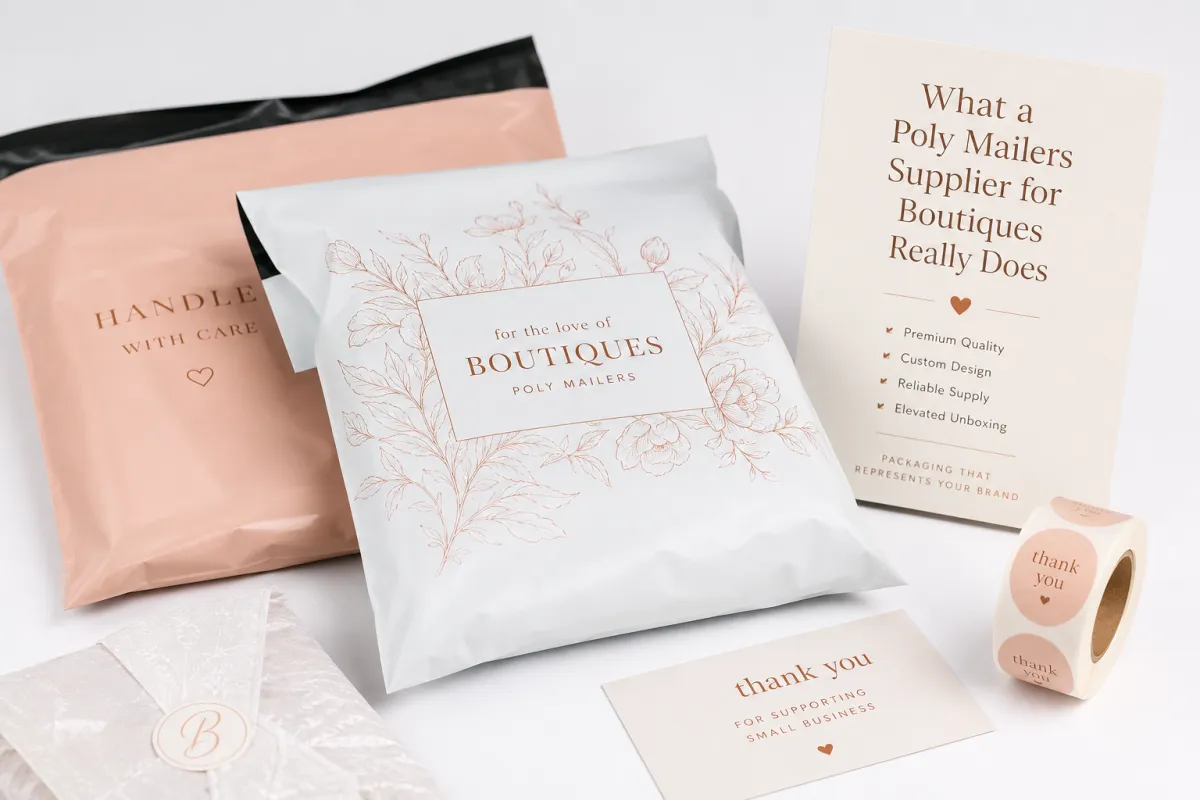
A boutique mailer is usually the first physical touchpoint after checkout. That means the package starts doing brand work before the customer has touched the product. A strong poly mailers supplier for boutiques understands that the mailer is not just a shipping item. It is a presentation layer, a protective layer, and a quiet marketing asset rolled into one.
In practice, suppliers offer stock sizes, custom printing, thickness options, closure styles, and guidance on what fits different product types. Apparel needs a different setup than jewelry boxes, candles, or soft gift items. A supplier that actually knows boutiques should talk through dimensions, seal strength, and print layout without turning the process into a technical hostage situation. You want plain answers, not jargon with a nice font.
There is a real difference between a boutique and a mass e-commerce brand. Boutiques usually care more about perceived value per parcel, and they often ship at lower volumes. That changes the math. A larger seller can get away with a plain shipper because the economics dominate. A boutique usually cannot. A slightly better print, a cleaner fit, or a thicker film can change how the customer remembers the brand.
That is why a poly mailers supplier for boutiques affects operations and marketing at the same time. If the mailer tears, the customer notices the risk. If the size is wrong, postage and presentation both suffer. If the print is sharp and the seal holds, the parcel feels intentional. Small detail. Big effect. And yes, customers do notice when you cheap out on the thing holding their order together.
From a packaging buyer's point of view, the decision usually comes down to four things: fit, cost, reliability, and turnaround. Design matters, but it sits inside those four. A good supplier should help the boutique balance them instead of pushing a glossy-looking option that creates postage waste or inventory headaches later. That part is kind of the whole job.
How a Poly Mailers Supplier for Boutiques Works
The normal order flow is predictable enough, even if the details vary by supplier. First comes the inquiry, where the boutique shares product type, estimated volume, mailer size, and branding needs. Then the supplier gives sizing guidance and pricing. After that comes artwork prep, proof approval, sample review if requested, production, packing, and delivery. A capable poly mailers supplier for boutiques should explain each step clearly, because delays usually show up when one of those handoffs gets vague.
Stock mailers and custom mailers serve different jobs. Stock inventory can make sense if a boutique is testing a new product line, launching with uncertain order volume, or trying to keep upfront spend tight. Custom mailers start to make more sense once the brand wants packaging to work harder as a repeatable asset. If every parcel is leaving the fulfillment table anyway, custom branding often pays back faster than owners expect, especially for accessories, apparel, and giftable items.
MOQ, or minimum order quantity, is another practical checkpoint. Many suppliers price by quantity, and the threshold may change based on size, thickness, or the number of print colors involved. A one-color print on a standard size can be much easier to buy than a full-coverage design across multiple bag dimensions. This is where a seasoned poly mailers supplier for boutiques adds value: they should help you choose the least expensive spec that still looks right and performs the job.
Communication matters more than most people think. The supplier needs clean artwork files, approximate monthly volume, product dimensions, and any shipping constraints you already know. If you use a thermal label printer, need a specific flat area for labels, or want the mailer to fit inside a retail box or insert, say so early. The best production runs are usually the ones where the buyer gives the supplier enough facts to quote accurately the first time.
Seasonal launches make the process more interesting. A holiday drop, a Valentine's collection, or a spring refresh can change not only artwork but also lead time and volume. A poly mailers supplier for boutiques should be part of that planning calendar, because packaging often needs to be ordered before the merch is fully final. That feels backward until you do it once and stop pretending time waits for mood boards.
Poly Mailers Supplier for Boutiques Pricing Factors
Price is where many buyers get tripped up. A quote can look friendly until the details show up. Material thickness, bag size, print coverage, number of colors, finish, setup charges, freight, and artwork adjustments all shape the final spend. A poly mailers supplier for boutiques may quote a unit price that sounds low, but landed cost is the number that actually touches margin. That is the number worth staring at.
Thicker film usually costs more because it uses more material and tends to perform better in transit. Common boutique mailers might sit around 2.5 mil to 4 mil depending on the product profile, though the right spec depends on what is inside the bag. A light tee is not the same as a set of leather accessories. If the mailer has full-surface print, the cost rises again because the production setup and ink coverage increase.
Volume also changes the picture. The per-bag price usually drops as quantity increases, but a boutique has to balance that savings against storage space and cash tied up in inventory. Ordering 10,000 units may lower the unit cost, yet that is not a win if the mailers sit in a back room for a year. A practical poly mailers supplier for boutiques should be willing to quote multiple breaks so you can compare inventory risk against unit economics.
| Mailers Option | Typical Use | Relative Cost | Best Fit For |
|---|---|---|---|
| Plain stock mailers | Basic shipping with no print | Lowest | Testing products, temporary needs, tight budgets |
| One-color custom mailers | Simple logo or pattern branding | Moderate | Most boutiques wanting a polished look without high setup complexity |
| Full-coverage printed mailers | Bold branded packaging across the surface | Higher | Launches, campaigns, and brands that treat packaging as part of the product |
| Premium finish mailers | Matte, glossy, or special visual effects | Highest | High-value purchases and brand-forward unboxing |
The table above shows why the cheapest option is not always the smartest. A plain bag may save a few cents, but a weak seal can create product damage or replacement shipments. That turns the bargain into a loss. Oversized bags do their own damage by pushing postage higher and making the parcel look less refined. A good poly mailers supplier for boutiques helps you compare unit price against total operating cost, not just the number at the top of the quote.
Printed versus unprinted mailers is a useful comparison. If your boutique ships small order volumes and is still testing product-market fit, plain inventory may be enough for now. If repeat customers are already strong, branding can justify the premium sooner than a spreadsheet alone suggests. The packaging becomes part of customer memory. That matters in apparel, accessories, and gift categories where presentation drives perception.
For standards-minded buyers, packaging performance and sustainability claims deserve a careful look. If a supplier references recycled content or recyclable material, ask what the claim actually means and whether it matches your workflow. The U.S. EPA's packaging and waste guidance is a useful neutral reference point: EPA recycling guidance. If you are evaluating fiber-based accessories alongside poly packaging, the Forest Stewardship Council also publishes useful sourcing information at fsc.org.
Process and Timeline With a Poly Mailers Supplier for Boutiques
A realistic timeline starts with the quote and ends with freight arrival. The gap between those two points is usually longer than buyers expect. A typical flow with a poly mailers supplier for boutiques includes artwork review, proof approval, production, packing, and transit. Each step is simple on paper. In real production, one slow approval can move the whole schedule.
Sample approval is worth the effort because it catches mistakes that digital proofs tend to hide. Bag size can feel fine on screen and still be awkward for folded apparel or boxed items. Color contrast may look stronger or weaker than expected on the actual substrate. Seal behavior matters too. A sample lets you see whether the closure feels dependable or whether the lip is too short for comfortable use. For a boutique, one bad batch can create unnecessary customer service work.
"We thought the design was the main decision. It turned out the size and seal were the real decision."
That pattern shows up all the time. The design is visible, so it grabs attention. The execution details are what protect margin. A good poly mailers supplier for boutiques should make those details part of the proofing conversation instead of treating them like footnotes nobody asked for.
Most delays happen for predictable reasons. Artwork files arrive in the wrong format. Approval cycles drag because multiple people want a say. The boutique changes bag size after seeing a sample. Freight gets slower during peak shipping periods. None of that is unusual. It just means you should work backward from the launch date instead of from the order date. If a product drop is tied to social promotion, a two- or three-day delay can have a real revenue cost.
Domestic versus overseas sourcing changes the equation. Domestic production may move faster and communicate more directly, while overseas options can offer more customization or lower unit costs at scale. The tradeoff is rarely just price versus speed. It is usually a balance of lead time, consistency, freight, and the amount of brand control you want over the final bag. A strong poly mailers supplier for boutiques should explain that tradeoff in plain language.
Common Mistakes When Choosing a Poly Mailers Supplier for Boutiques
The biggest mistake is picking a supplier on unit price alone. A low quote can hide thin material, high freight, extra setup fees, or inconsistent print quality. If the mailer fails in transit, the real cost shows up later as replacements, refunds, and customer frustration. A reliable poly mailers supplier for boutiques should be evaluated on landed cost plus service quality, not the cheapest line item on page one.
Sizing errors are another expensive problem. Too-small mailers create friction in packing and can force a product into a shape it should not have. Too-large mailers waste space, often increase postage, and make the shipment look less polished. If the boutique ships a mix of tees, knits, small boxes, and accessory bundles, it may need a small size system rather than one universal bag. That simple planning step can save money and reduce packing mistakes.
Skipping samples is risky, especially for boutiques with delicate, premium, or texture-rich products. A sample tells you more than a proof does. It shows how the bag feels, whether the seal is strong enough, and how the printed design behaves on the actual material. It also reveals whether the mailer fits your fulfillment flow, which is easy to overlook when everyone is staring at mockups. A careful poly mailers supplier for boutiques will welcome the sample conversation instead of dodging it.
Brand fit is easy to underestimate. A bag can be technically correct and still feel off-brand if the color palette, typography, or logo placement clashes with the rest of the packaging. A boutique that uses elegant tissue, handwritten inserts, or premium tags should not pair them with a loud, generic-looking mailer. The package should feel like one system. That is what turns a shipment into an experience.
Reorder timing is another frequent miss. Many boutiques wait until they are nearly out before reordering. That works once. It fails during launches, holiday peaks, or shipping delays. If your packaging runs dry at the same time sales jump, the whole operation gets strained. A dependable poly mailers supplier for boutiques should help you think in reorder windows, not emergency replenishment. If they do not ask about your run rate, that is a tell.
Expert Tips for Working With a Poly Mailers Supplier for Boutiques
Start with a small size system. Three or four well-chosen dimensions usually cover most boutique shipments better than a pile of random inventory. A compact bag for jewelry or small accessories, a mid-size option for folded apparel, and a larger format for bundled items can keep packing simple. A smart poly mailers supplier for boutiques should help you build that system instead of pushing unnecessary variety.
Test the mailer with real products, not just empty samples. Folded garments behave differently from rigid boxes. Jewelry pouches, soft goods, and bundled items all place different demands on the seal and film. A bag that looks great empty may feel awkward once it is packed. If you ship a lot of mixed SKUs, test the exact worst-case combination, not only the easiest one. That is the difference between a nice mockup and an order that ships cleanly every time.
Branding works best when it is disciplined. Repeated logos, strong color blocks, a signature pattern, or a clean icon can do more than an overcrowded layout full of copy. The mailer has limited surface area. Treat it like a billboard seen for a few seconds, not a brochure. A thoughtful poly mailers supplier for boutiques will usually steer you toward clarity over clutter.
Seasonal planning pays off. Core mailers can be ordered in larger quantities, while limited-run versions can support campaigns, gifting periods, or collection launches. That mix gives the boutique consistency without making every package look identical all year. It also reduces design fatigue. Customers notice repetition when it goes stale, but they appreciate variation when it feels tied to a new drop.
Sustainability claims deserve nuance. Recycled-content or reusable options can be useful, but only if they still protect the item and fit the shipping workflow. A weaker bag that needs to be replaced is not a win. A "green" choice that raises damage rates may increase waste overall. The practical question is simple: does the material perform in your actual lane? A grounded poly mailers supplier for boutiques should answer that honestly.
For buyers who want a packaging yardstick, the Packaging Machinery Manufacturers Institute offers industry context on packaging systems and standards at packaging.org. If you are shipping items that must survive rough handling, the International Safe Transit Association is also a useful reference for distribution testing concepts at ista.org. Not every boutique needs formal lab testing, but the logic behind it is useful: packaging should be judged in transit, not only in a mockup.
Next Steps for Choosing a Poly Mailers Supplier for Boutiques
Before requesting quotes, build a one-page spec sheet. Include product type, estimated monthly volume, preferred mailer size, print goals, shipping method, and any special fit requirements. If you already know the thickness range you want, note that too. A clear brief helps a poly mailers supplier for boutiques respond with useful pricing instead of generic estimates.
Then ask at least three suppliers for apples-to-apples quotes. Make sure the quotes include setup, shipping, lead time, and minimum order requirements. If one supplier gives a lower unit price but a higher freight charge, compare landed cost instead of stopping at the first number that looks good. The best quote is not always the cheapest one on paper.
- Order samples and test them with real products.
- Check seal strength, thickness, print clarity, and size fit.
- Compare turnaround times against your launch calendar.
- Score cost, support, and reorder flexibility with the same criteria.
If you like a decision matrix, keep it simple. Give each supplier a score for price, turnaround, quality, and communication. That approach removes some of the emotional pull of design proofs, which can be misleading when the sample looks great but the commercial terms are weak. A trustworthy poly mailers supplier for boutiques should win on repeatable criteria, not on one flashy mockup.
For many boutiques, the smartest move is a test order with enough lead time to review the result before scaling. That allows you to check how the mailer behaves in actual fulfillment, how customers react, and whether the final artwork needs a small correction. A controlled first run is usually cheaper than discovering a flaw after thousands of bags are already in use. If you are comparing options now, start with a shortlist, request samples, and measure landed cost before you commit to volume with a poly mailers supplier for boutiques. That is the boring answer, and boring usually keeps the margin intact.
How do I choose a poly mailers supplier for boutiques?
Start with fit: check sizes, thickness, and whether the supplier understands apparel, accessories, or mixed-product orders. Compare landed cost, not just unit price, so freight, setup fees, and reorders are part of the decision. Ask for samples and proof approval to verify print quality, seal strength, and brand presentation before you commit to a run with a poly mailers supplier for boutiques.
What should a boutique pay for custom poly mailers from a supplier?
Pricing depends on quantity, print coverage, thickness, and whether you choose stock or fully custom bags. A one-color mailer will usually cost less than a full-coverage design, and larger orders generally lower the per-unit price. Add shipping and setup charges to the quote so you can compare suppliers on a true total-cost basis before choosing a poly mailers supplier for boutiques.
How long does a poly mailers supplier for boutiques usually take?
A simple stock order can move much faster than a fully printed custom run. Artwork approval and sample sign-off are usually the biggest timeline variables, not the bag itself. Build extra time for peak seasons, freight delays, and revision rounds if you want the first shipment to arrive on schedule from a poly mailers supplier for boutiques.
Are custom poly mailers worth it for a small boutique?
They are worth it when packaging is part of the brand story and repeat purchase matters. A custom mailer can elevate perception, but only if the design, size, and material quality match the products. If your order volume is still unpredictable, start with a limited custom run or a stock option that leaves room to scale with a poly mailers supplier for boutiques.
What details should I send to a poly mailers supplier for boutiques?
Send product dimensions, estimated order volume, preferred mailer size, and whether you need custom printing. Include any brand files, color references, and shipping method details so the supplier can quote accurately. Mention whether the mailer must fit inside a shipping label workflow, a retail insert, or a specific fulfillment setup, because that is often what separates a good fit from a costly mismatch. If you want the first order to run smoothly, the right poly mailers supplier for boutiques should be able to work from that brief without chasing basic information.