Printed Cotton Labels for Apparel: Buyer's Ordering Guide
Printed cotton labels are a small part of a garment, but they carry more weight than most buyers expect. They sit against skin, survive repeated washing, and quietly shape how a customer judges the rest of the product. A label that curls, scratches, or fades after a few cycles tells a story the brand probably did not intend.
That is why buyers tend to evaluate labels on three separate tracks: comfort, cost, and durability. The best option is rarely the cheapest line item on a quote sheet. It is the one that fits the garment, the wash routine, the available application method, and the brand's visual language without forcing compromises elsewhere. If the label is going onto babywear, premium basics, or relaxed apparel, the handfeel matters almost as much as the artwork.
For teams comparing options across Custom Labels & Tags, the practical question is simple. Does the label add value, or does it create friction in production and wear? The answer depends on material, print method, finishing, and how much information the label has to carry without becoming cluttered.
What Printed Cotton Labels Are and Why Brands Use Them
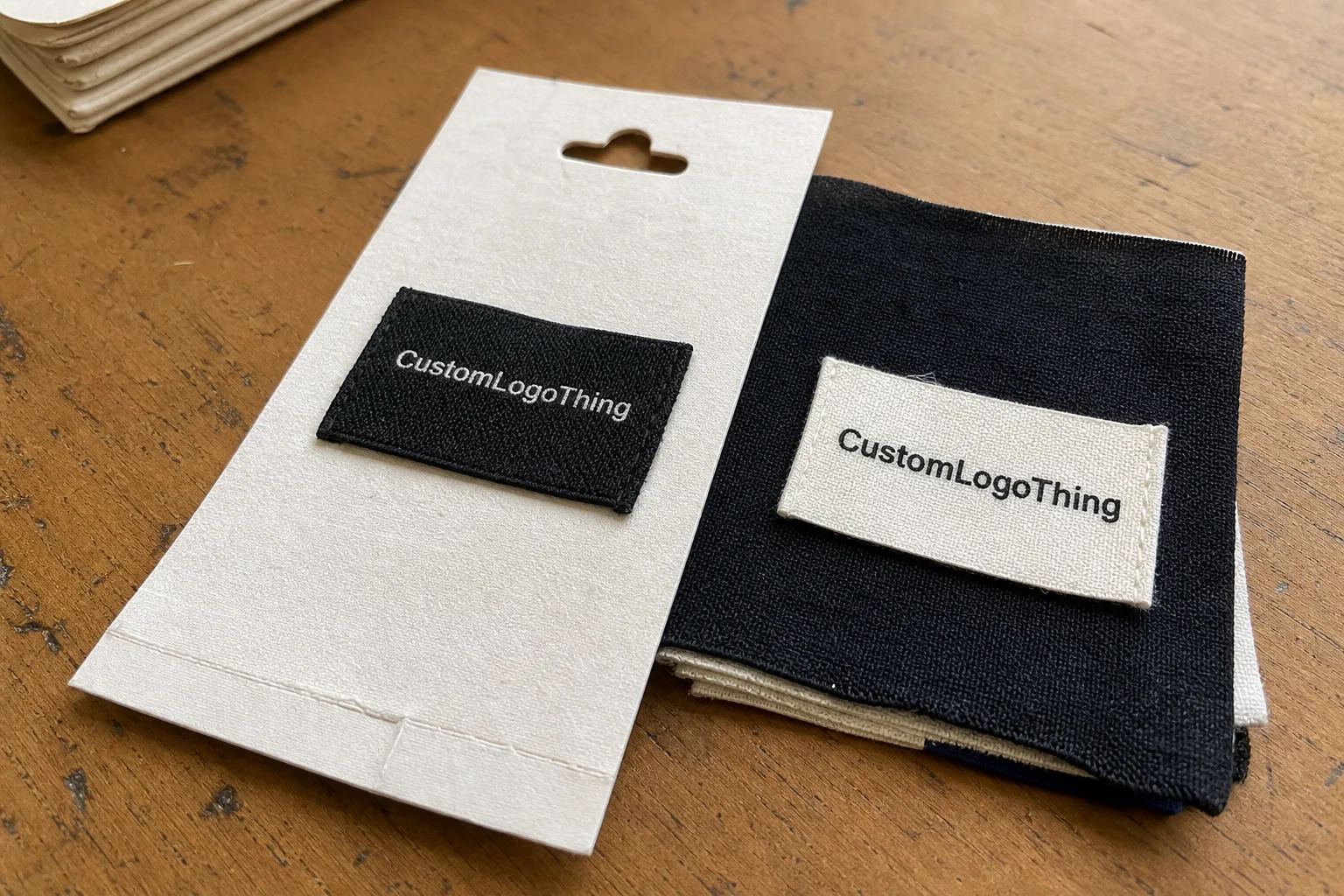
A printed cotton label uses a cotton base cloth with brand or care information applied by printing rather than weaving. That distinction affects more than appearance. Woven labels are built from threads; printed labels rely on ink sitting on or into the fabric surface. The result is usually flatter, softer, and less textured. For buyers who want the label to disappear into the garment instead of announcing itself, that softer finish is often the point.
Printed cotton labels are common in babywear, lounge sets, sleepwear, artisan apparel, and minimalist collections. Those categories have one thing in common: skin contact matters. A scratchy label is not a minor defect in those markets. It can become the first reason a customer returns a garment, trims a label out, or leaves a review that focuses on comfort instead of fit.
There is also a practical reason brands choose cotton. The base fabric reads as more natural than glossy polyester or satin, which helps when the brand wants a matte, understated look. Cotton can also be easier to pair with garment fabrics that are themselves natural or brushed. That said, "natural" does not automatically mean "better." Cotton can fray more easily than synthetic options if the edge finish is weak, and it can shift slightly in wash if the base cloth is not stabilized well enough.
The right label spec depends on the job the label has to do. A boutique tee might only need a compact logo and size mark. A children’s garment may need room for brand, size, fiber content, care symbols, and origin details. A label can look elegant in a design proof and still fail the practical test if the text is too small, the contrast is too low, or the fold cuts through the information field.
There is a middle ground here that many buyers value. Printed cotton labels are not as rigid as woven labels, not as glossy as satin, and not as synthetic-looking as some heat-transfer solutions. That makes them useful when the brand wants a soft finish without sacrificing readable copy. The tradeoff is that the supplier has to get the base cloth, print system, and finishing right. If one of those pieces is off, the label quickly looks underbuilt.
How the Production Process Works
The process starts with the artwork, but the first real production decision is usually not about design. It is about format. Suppliers want to know whether the label will be supplied on a roll, cut into individual pieces, center-folded, end-folded, or left flat for sewing. Those choices affect not only appearance, but also how the label will sit inside the seam and how much labor it takes to attach at the factory.
Artwork should be submitted in a clean vector format whenever possible. If the logo is built from raster files or low-resolution exports, small text and fine lines can soften or break up once printed onto cotton. Brand colors also deserve a careful check. Pantone references help, but buyers should not assume a fabric print will behave like paper stock or screen display. Cotton absorbs and reflects ink differently, and tiny shifts in weave density can change how the color reads.
The supplier then creates a proof or mockup. This stage is not a formality. It is the last inexpensive place to catch problems that become expensive once the run is underway. The common misses are predictable: text too close to the edge, a fold line running through the logo, care copy that no longer fits after a size change, or contrast that disappears once the label is sewn into a dark garment.
After proof approval, the production method matters. Screen printing is usually favored for simple graphics, strong coverage, and more durable color on cotton. Digital printing can make sense for shorter runs or more complex artwork, but the finish depends on the ink system, curing process, and the quality of the fabric surface. A tighter weave generally gives finer details a better chance of staying sharp. A looser weave can feel softer, but it can also blur microtype or make edges look less precise.
Most suppliers will also run some kind of quality check before packing. Buyers should ask what is actually inspected, not just whether inspection exists. The useful checks are basic but specific: registration accuracy, print density, edge finish, fold alignment, cut consistency, and visible smearing or ink transfer. If labels are intended for frequent washing, ask whether the supplier has done wash or rub testing on the finished construction, not just on a sample print.
- Artwork review and file cleanup
- Proof or mockup approval
- Material and print method selection
- Printing and ink curing
- Cutting, folding, or roll finishing
- Inspection, bundling, and packing
One small production detail is easy to overlook: edge behavior. Even a good print can be undermined by a poor cut. Frayed edges, curling, or inconsistent cut widths make a label feel less finished than the rest of the garment. In practical terms, the finishing method often affects customer perception as much as the artwork itself.
The cheapest mistake in label buying is the one caught before production starts. After the run begins, every small issue becomes a unit cost.
Transit and packing deserve attention too, especially for brands that ship finished garments through several handoffs before retail or fulfillment. Labels are small, but a crushed carton or moisture exposure can still cause problems if they are packed loosely. Standards from organizations such as ISTA are more useful here than many apparel teams realize because they frame how packaging performs under real distribution stress, not just on a warehouse shelf.
Cost, Pricing, and MOQ for Custom Orders
Pricing for printed cotton labels is driven by a small number of variables, but each one has an outsized effect. Quantity is the obvious one. A run of 300 pieces absorbs setup costs very differently than a run of 5,000. That is why the same design can come back with a quote that looks surprisingly high at low volume and much more reasonable once the run size increases.
Print complexity matters next. One-color labels are usually easier to price and more consistent to produce. Multiple ink passes, fine line work, small type, or exact color matching can increase setup time and raise the chance of rejection if the proof is not tightly controlled. Folding style, cut style, and whether the labels are supplied on a roll or in cut pieces also affect labor.
Typical cost components include:
- One-time setup, screen, or plate fees
- Unit cost based on quantity
- Finish fees for folding, cutting, or roll preparation
- Rush charges if the schedule is compressed
- Shipping, duty, or local delivery charges
MOQ is where buyers often get misled. A supplier may accept a lower minimum, but the unit price will usually rise because the setup cost is spread across fewer labels. That does not make a small order bad. It just means the buyer should know what the order is for. A test run, a sample release, and a seasonal core style should not be judged by the same pricing logic.
| Order Profile | Typical MOQ | Estimated Unit Cost | Typical Lead Time |
|---|---|---|---|
| Small custom run | 300-500 pieces | $0.22-$0.40 each | 10-15 business days |
| Mid-size production run | 1,000-2,500 pieces | $0.10-$0.22 each | 8-12 business days |
| Higher-volume run | 5,000+ pieces | $0.05-$0.14 each | 7-10 business days |
Those numbers are broad, not universal. A simple one-color label on a standard cotton base can land near the low end. A small run with fold finishing, custom color matching, and expedited shipping can land well above it. Buyers should compare quotes on a landed basis: one-time fees, unit cost, freight, and the number of acceptable rejects included in the supplier’s tolerance.
There are a few reliable ways to keep costs in check Without Cutting Quality in the wrong place. Standard dimensions reduce setup complexity. Fewer print colors reduce risk and time. Repeating the same label spec across several SKUs lowers waste and makes reorders easier to forecast. Brands that treat the label as a shared component across a product family usually get better pricing than brands that redesign it every season for no functional reason.
For teams managing multiple styles, Custom Labels & Tags is often useful as a reference point because it helps anchor the cost conversation around format, finish, and order size rather than a single price number.
Artwork, Sizing, and Material Choices That Affect Performance
A design that looks crisp on screen can fail once it is printed on cotton. Thin strokes, tiny text, and low-contrast color combinations are the common culprits. Hairline fonts and narrow serif details may disappear into the weave or fill in during printing. If the label includes care content, the practical readability threshold matters more than the aesthetic preference of the designer. A beautiful label that no one can read is a weak label.
Size should be driven by content load and garment use. A minimal logo mark can fit on a relatively compact strip. A children’s label with brand, size, fiber content, care instructions, and origin details needs more room to avoid a crowded appearance. Once the copy gets compressed, legibility drops and the label starts to feel improvised. That is especially noticeable after sewing, when the seam and garment fold take away a little more of the visible area.
The cotton base itself deserves attention. A lighter-weight cotton can feel softer and more flexible, but it may fray sooner if the finishing is weak or if the garment sees heavy laundering. A slightly heavier base tends to stay flatter and hold printed detail better. The tradeoff is handfeel. If the label gets stiff, the comfort advantage starts to disappear. Buyers should ask what base weights are available and whether the supplier pre-treats or stabilizes the cloth before printing.
Edge finish is part of performance, not decoration. Clean cuts, controlled folds, and enough clearance around the artwork reduce the chance of curling and edge wear. If the label will sit at a neck seam or waistband, the edge treatment becomes even more important because those areas see friction every time the garment is worn. A label can pass visual inspection and still fail in use if the edges scratch or start to unravel.
For brands that are sensitive to sustainability claims, the safest approach is to keep the discussion concrete. Cotton may fit a natural-material story better than a synthetic base, but the full package still matters: waste from reprints, shipping distance, over-ordering, and how often labels need to be replaced. The EPA's textile guidance is useful background when a team is trying to make cleaner decisions across the supply chain rather than treating the label in isolation.
Lead Time and Turnaround: What the Ordering Timeline Looks Like
Lead time depends on two things more than anything else: how fast the artwork gets approved, and whether the supplier already has the correct base material on hand. A clean order with no revisions moves quickly. A spec that changes three times before approval will stretch even a well-run schedule. Buyers often think production is the bottleneck. In practice, it is usually the approval loop.
A realistic timeline for printed cotton labels usually looks like this:
- Quote and layout proof: 1-3 business days
- Revisions and approval: 1-5 business days, longer if multiple teams sign off
- Production and curing: 5-10 business days for standard runs
- Finishing and packing: 1-3 business days
- Transit: 3-7 business days depending on carrier and destination
That is the ordinary case. Rush orders compress the margin for error and often cost more than buyers expect. They also make production less forgiving. If the artwork still needs debate, a rush schedule usually turns a small design problem into a real delay. The safest rush order is the one built on a locked spec, not the one still under discussion.
Pre-production samples help, but only if the sample matches the intended use. A label that looks fine flat on a sample card may behave differently once sewn into a stretch knit, brushed cotton, or a garment with an aggressive wash cycle. If the order is for a product line that will be reordered, it is worth capturing the approved file, final dimensions, and wash-test notes as internal reference data. That record saves time later and reduces the chance that a reorder drifts from the original standard.
One practical reorder rule is simple: do not wait until stock is almost gone. For core styles, many brands reorder when 30 to 40 percent of inventory remains. That buffer protects against proof delays, transit variability, and demand spikes. It also reduces the chance of paying rush fees because the last carton disappeared faster than expected. For apparel operations, the label is small, but the planning mistake around it can create a much larger inventory problem.
Common Mistakes That Cause Reprints or Weak Brand Perception
The most common mistake is trying to force too much content onto too little space. Brand name, size, fiber content, care symbols, origin information, and a slogan can fit only up to a point. Once the layout becomes crowded, the label starts to look provisional. That is true before it is sewn in and more obvious after it is attached to a garment seam.
A close second is ignoring how the label behaves in wear. A sample can look good on the table and still fail once it rubs against skin, stitching, or a waistband. Labels for children’s garments and everyday basics take more abrasion than buyers often expect. If a label curls or frays after a few washes, the issue is not only durability. It is also trust. Customers tend to notice small quality failures very quickly when they happen in a place they touch every day.
Proof review is another weak point. Teams often check the logo and skim everything else. That is a mistake. The support text, orientation, fold placement, color consistency, and edge padding matter just as much. A label with the right logo but poor spacing still reads as poorly controlled. In apparel, small inconsistencies feel larger because they repeat across every garment in the line.
Under-ordering creates a different kind of damage. A buyer cuts the initial quantity to save cash, the style sells better than expected, and the reorder arrives late or at a higher price. The extra cost is not just the label unit price. It is the stockout, the missed replenishment window, and the impression that the line is less stable than it should be. Reprints are expensive, but so is ordering too tightly.
There is a quieter problem that deserves mention: changing specs too often. A new fold style, a different label width, or a revised logo lockup may seem minor, but it breaks consistency across the product family. Customers may not articulate the difference, but they notice when the garment looks less coherent than the last one they bought.
Expert Tips for Better Durability and Easier Installation
Match the label spec to actual use, not to the most flattering description of the product. A premium lounge item may tolerate a softer, lighter finish. A kids’ garment, workout item, or high-wash basic needs stronger construction and clearer print retention. If the label touches skin directly, smooth edges and a low-profile handfeel should outrank decorative detail.
Standardizing label templates across SKUs makes the purchasing process easier and the production result more consistent. When the size, fold, artwork placement, and copy stay fixed, teams spend less time re-approving basic details and less time correcting preventable mismatches. It also makes reordering simpler because the exact spec is already locked down. The label becomes part of the product system instead of a one-off decision.
Ask for a physical sample or a test strip if the order is anything beyond a short test run. Then test it on the actual garment fabric, not on a separate scrap that behaves differently. Cotton knit, brushed fleece, and woven shirting can all treat the same label differently. If the label is going near a seam allowance, test that exact location. A result that passes in one placement may fail in another.
Use one spec sheet every time you request quotes. Include dimensions, quantity, fold style, application method, brand colors, and delivery date. That keeps supplier comparisons honest. If one quote assumes a flat label and another assumes a center fold, the numbers are not comparable. For buyers building a repeatable procurement process, this is where discipline matters more than speed.
There is also value in keeping a record of what worked. Save the approved file version, the supplier response, the exact dimensions, the finished construction, and any wash-test notes. Reorders are faster when the proof history already exists. More important, the team avoids the slow drift that happens when everyone assumes the next order will somehow match the last one without checking.
For brands that want softness, a natural look, and a pricing structure that scales with volume, printed cotton labels make sense when the specification is clear and the testing is real. The best results usually come from simple decisions made early: Choose the Right size, keep the artwork legible, confirm the edge finish, and compare quotes using the same spec. Small products reward careful buying.
How long do printed cotton labels usually last in the wash?
They should hold up through repeated laundering if the print method, cotton weight, edge finish, and curing process are matched to the garment's care cycle. Durability improves when the label is tested on the actual fabric it will be sewn into, not just on a standalone sample card.
Are printed cotton labels better than woven labels for soft garments?
Often yes, if the priority is a softer handfeel and a matte, textile-like appearance. Woven labels usually make more sense when the brand wants a textured thread look or a sharper woven structure. The better choice depends on whether the label needs to disappear into the garment or stand out as part of the brand presentation.
What is a normal MOQ for printed cotton labels?
MOQ varies by supplier and construction, but smaller custom runs commonly start around a few hundred pieces. The unit cost usually drops as the run size increases because setup fees are spread across more labels. Standard dimensions and simpler finishing often make small orders more affordable.
Can I get color matching on printed cotton labels?
Yes, though the match depends on the print system, the cotton base, and the supplier's color control process. Buyers should provide brand references and ask for a proof or sample before approving a full run if color accuracy matters. Cotton can shift the final appearance slightly compared with paper or synthetic substrates.
What should I prepare before requesting printed cotton labels quotes?
Have the label size, quantity, artwork file, fold or cut style, color references, and target delivery date ready. If the label will touch skin often or be washed heavily, mention that upfront so the supplier can recommend the right construction. The more complete the spec sheet, the easier it is to compare quotes without hidden assumptions.
Printed cotton labels work best when they are treated as a production component, not an afterthought. The best versions are quiet, durable, and easy to sew. The weak ones are usually overdesigned, under-tested, or quoted without enough detail to compare properly.


