Custom business Return Address Labels for apparel brands
For apparel companies, custom business Return Address Labels do more than identify the sender. They sit at the point where branding and logistics meet, so the label has to look clean, stay readable, and survive real warehouse handling. A good return panel makes a carton or mailer feel intentional and keeps the shipping process consistent across seasonal packaging changes, exchange orders, and retail programs.
The best label is not the one with the most design work. It is the one that stays readable on recycled corrugate, coated mailers, poly bags, and inserts without slowing the packing line. That is why experienced packaging buyers treat the return label as a working spec, not an afterthought.
Why custom business return address labels matter for apparel shipments
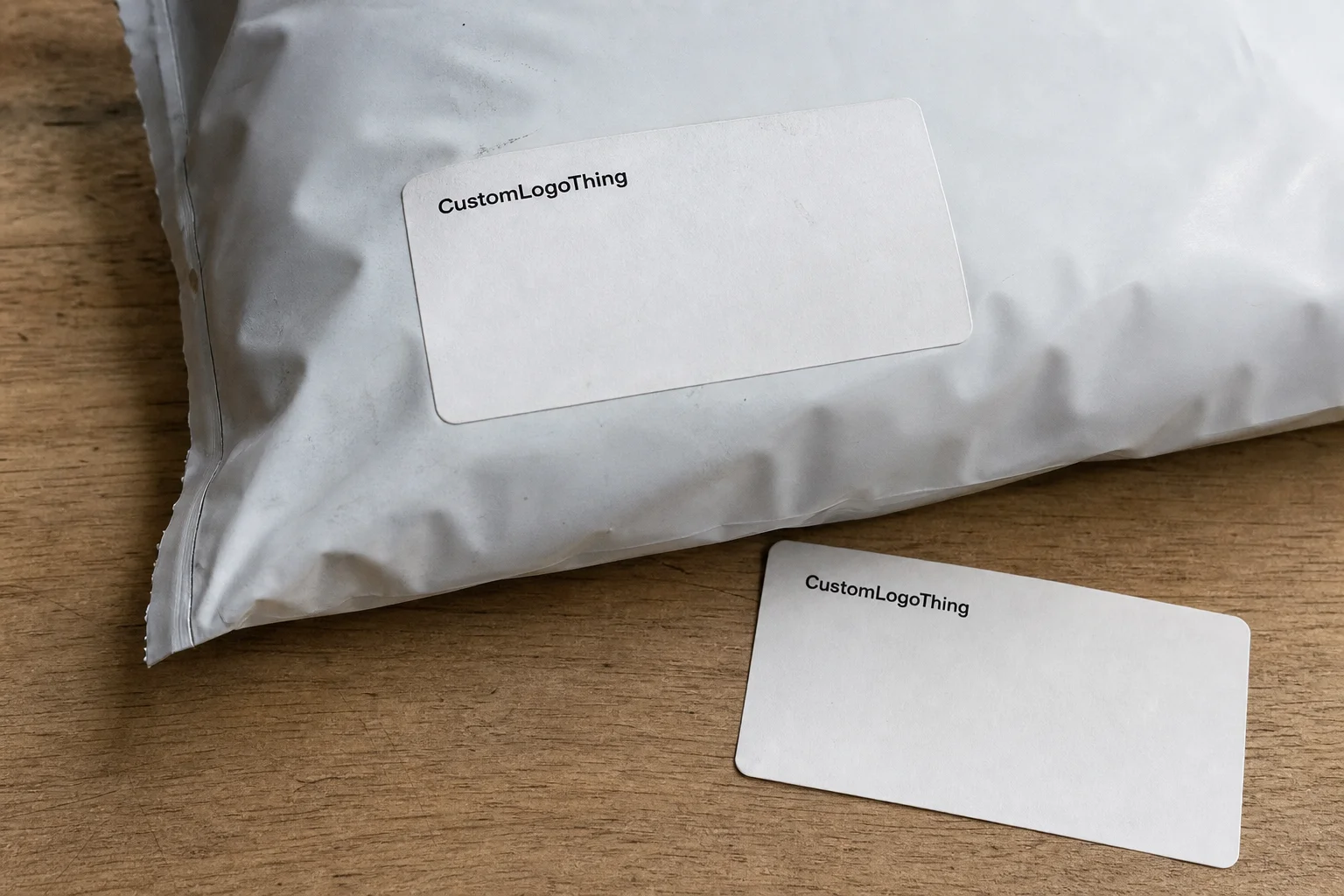
Apparel is unusually sensitive to presentation because customers are judging the brand before they even open the box. The return label sits alongside the logo, postage, and packing slip, so it becomes part of the package design whether anyone planned for it or not. A tidy address block can make a plain mailer feel deliberate. A handwritten or poorly aligned label can make the same package feel improvised.
There is also a practical reason to standardize the label. Clothing brands handle exchanges, size swaps, wholesale replenishment, and returns, often across different package types. The sender information should stay consistent even when the packaging changes. A stable label spec reduces rework because the same artwork can move across cartons, mailers, and inserts without being rebuilt for every order stream.
Legibility matters more than decoration. Return information needs enough contrast to be read quickly, with spacing that survives print and carrier handling. It should not compete with barcodes or postage. If a label is crowded or low contrast, the package may still move, but the risk of misreading rises and the operation loses time to preventable friction.
"A return label is routing information first and brand expression second. If the routing fails, the branding does not matter."
That is why I treat custom business Return Address Labels as a small operational tool with a measurable effect. They connect the brand story on the outside of the package to the fulfillment work behind the scenes. They also fit neatly into a broader system of custom labels & tags, which matters when a team wants the same standard across packaging, inserts, and shipping materials.
How the process and turnaround work from proof to delivery
The production flow is usually simple: artwork setup, proofing, material selection, printing, finishing, trimming, packing, and shipment. Most delays come from the input side. Unclear artwork, a missing zip code, or a late copy change will slow things down faster than the press itself.
Suppliers usually need a vector logo, exact return address text, size preference, finish preference, and notes about any routing marks or internal references. A proof should confirm the logo placement, spacing, address format, and contrast, not just the look of the design. Once approved, those details are locked in for the run.
Turnaround depends on proof approval, material availability, and order size. A standard range is 7 to 12 business days after approval, plus transit time. Rush production can shorten the print window, but shipping still adds time. Repeat orders usually move faster because the artwork file, layout, and material settings are already in the system.
It helps to treat the return label as part of the packaging system, not a separate purchase. A vendor that already handles Custom Labels & Tags or other Custom Packaging Products can often keep repeat orders cleaner because the artwork history and prior material choices are already organized. That reduces avoidable back-and-forth even when the order still needs a final review.
Materials, finishes, and sizing that hold up in transit
Material choice is where a lot of buyers make avoidable mistakes. Paper labels are usually the most economical option and work well for dry indoor handling, carton applications, and short dwell times. They give a clean matte look and are easy to read. BOPP handles moisture better and holds up more reliably on mailers that may see abrasion, condensation, or rougher freight handling.
Finish changes both appearance and readability. Matte is usually the most practical choice because it cuts glare and keeps the address easy to scan at a glance. Satin sits in the middle: a little more polished, still readable, not overly reflective. Gloss can look sharp in retail packaging, but it is not always the best choice for a return address panel under warehouse lighting.
Size should be driven by the surface, not by aesthetics. A return label that is too small becomes difficult to read. One that is too large can crowd postage, barcodes, or window placement. For apparel shipments, a compact rectangle is often enough for a logo, full return address, and a small routing note if needed.
Adhesive is the variable many buyers only think about after a failure. Cold storage, recycled corrugate, coated mailers, and plastic surfaces all behave differently. A standard permanent adhesive may work on smooth mailers, but rough cartons and lower temperatures often call for stronger tack. If the package surface is unusual, ask for a sample sheet and test it on the actual shipper, not on a desk or release liner.
For sustainability-minded teams, stock sourcing matters as much as print quality. If your packaging standards call for FSC-certified materials, ask whether the stock is available with that certification and whether it changes the lead time. For transit stress, ISTA testing guidance is useful context even when you are not running a full lab program. For paper sourcing, FSC remains the reference point many packaging teams use.
If the return label is part of a premium unboxing system, writable space or sequential numbering may also matter. That can help with returns processing, sample control, and pack-out audits, while keeping the label aligned with the rest of the product packaging program.
Cost, pricing, and MOQ factors that shape the quote
Pricing usually comes down to quantity, stock type, color count, size, shape, finish, and special handling. For custom business Return Address Labels, the most useful number is not the lowest unit price. It is the combination of total spend, fit for the packaging, and how often the team will reorder. A cheap label that peels in transit is not cheap; it is waste with a lower entry price.
Minimum order quantities vary, but the logic behind them is consistent. Higher volumes lower unit cost because setup is spread across more pieces. That does not mean a larger order is always the better buy. If the brand ships in seasonal bursts, over-ordering can tie up cash and leave older artwork sitting in inventory longer than planned. Request pricing at several tiers instead of only at one volume.
| Option | Best For | Typical Unit Range | Notes |
|---|---|---|---|
| Paper matte labels | Dry carton applications and high-volume outbound orders | $0.03-$0.07 | Readable and economical |
| Paper satin labels | Brands wanting a slightly richer finish without major cost increase | $0.04-$0.09 | Good balance of appearance and legibility |
| BOPP labels | Mailers, humid environments, and rougher shipping surfaces | $0.06-$0.14 | Better moisture resistance and durability |
| Special shapes or premium finishes | Higher-end branded packaging or limited-run launches | $0.08-$0.18 | Useful when presentation matters more than pure unit cost |
These ranges are directional. A 5,000-piece run with one-color print will price very differently from a short run with multiple colors, custom backing, or a premium stock. Ask every supplier to quote the same assumptions: setup, proofing, shipping, and reorder pricing. Without that consistency, comparisons are mostly noise.
One useful comparison method is to request quotes at 1,000, 5,000, and 10,000 units, then see what changes if the label size is standardized. Often, a small reduction in waste on the sheet improves pricing more than shaving a color off the design. The savings are not dramatic in isolation, but they show up clearly when the order repeats.
Step-by-step ordering guide for custom label buyers
If this is the first order, keep the process practical. Start with the use case, not the artwork. Is the label going on outbound orders, return mailers, warehouse bins, or exchange packaging? The answer determines the surface, and the surface determines the adhesive and stock.
- Gather the exact return address, brand name, logo files, and any compliance text.
- Identify the packaging surface: corrugate, coated mailer, poly bag, or mixed-use carton.
- Choose the label size based on the smallest surface it must fit.
- Select the stock and finish based on storage conditions and shipping abrasion.
- Review the proof for contrast, line breaks, spacing, and postal readability.
- Order enough for one known sales window, then evaluate performance before scaling.
The proof review deserves more attention than it usually gets. Do not just confirm the logo. Check the margin around the address block, the contrast between type and background, and whether any line breaks make the address harder to read. If the label will sit on a busy package, clarity beats ornament every time.
For apparel teams, timing matters. If a new collection is launching, the label should be approved early enough to test against the actual pack-out materials. That includes mailers, tissue wrap, inserts, and any custom printed boxes used for higher-value orders.
Common mistakes that make return labels less effective
The first mistake is using a font that looks stylish but reads poorly from a distance. Return information is functional copy, not a design contest. Thin letterforms, condensed faces, and tiny type all create friction for carriers and warehouse staff, especially on textured surfaces or fast-moving pack lines.
The second mistake is overfitting the label to the brand palette. A label can support package branding while staying high-contrast and easy to read. If the background is busy or the logo is reversed out in a weak color, the result may look refined in a mockup and messy on a real carton.
The third mistake is assuming one adhesive works everywhere. It does not. Recycled cartons, cold storage, coated mailers, and plastic surfaces all change the equation. If the application is not the usual one, ask for a test sheet and apply it to the actual shipper. That small test can save an entire reprint.
Another common failure is skipping the proof check on the return address itself. Teams focus on the logo and miss a digit, a zip code, or a line break that looks fine on screen but becomes awkward in print. That kind of error affects every package in the run. A simple cross-check against the approved master address is a low-cost safeguard.
These mistakes sound minor until they show up on the shipping floor. Then they become missed mail, unnecessary relabeling, and customer service issues that have nothing to do with the product. That is why custom business return address labels belong in the operating system, not in the category of finishing touches.
Practical next steps for choosing the right label setup
Start with a short audit of one month of shipping and return activity. Look at the surfaces the label has to survive, how often exchange shipments happen, and whether the team uses one shipper or several carton styles. That tells you where the label needs to perform and prevents overbuilding a spec for a use case that rarely happens.
Next, choose the label spec for the worst-case surface, not the easiest one. If the label has to stick to rough corrugate in a cold room, that should shape the adhesive and stock even if half the orders leave in smooth mailers. A single consistent spec is usually easier to manage than a stack of special versions.
Then ask for one proof and one small production run if the application is new. Compare adhesion after 24 hours, print sharpness, scan readability, and how the label looks next to the rest of the branded packaging. If the result feels off, adjust before scaling. That is much cheaper than discovering the problem after a seasonal drop has already shipped.
Set a reorder threshold based on actual use. If the team scrambles for labels every time sales spike, the issue is usually not procurement discipline. It is a missing planning rule. Keep the standard spec documented with the other packaging SKUs so operations and purchasing can reorder without decoding a design file from scratch.
For teams building a broader packaging system, the label should sit in the same playbook as mailers, inserts, and custom labels & tags. That keeps the brand consistent across channels, improves speed at the packing table, and makes vendor management easier. The strongest setups are often the least dramatic: standard, legible, and easy to repeat.
That is the real value of custom business return address labels for apparel brands. They reduce friction, reinforce package branding, and keep the shipping operation from looking improvised. If the size, stock, finish, and adhesive are chosen with the actual shipper in mind, the label disappears into the process, which is exactly what a good operational detail should do.
What makes custom business return address labels better than handwriting labels for apparel orders?
They provide consistent readability, which matters when orders move through packing, carrier handling, and returns processing. They also reduce errors when temporary staff or multiple pack stations are involved. Because the address is already formatted, the team saves time on repeated outbound and return mailings.
What size should business return address labels be for clothing packaging?
Choose the size based on the smallest surface the label must fit, such as a mailer flap or carton panel. Leave enough room for the full address, a logo if needed, and any internal marking. Before committing to volume, test a sample on the actual packaging so you can see how it reads in real use.
How do I estimate pricing for custom return address labels?
Compare quotes using the same quantity, stock, finish, and number of print colors. Ask whether there are setup charges, proofing fees, or shipping costs that change the total. Then look at unit cost and total spend together, because the lowest per-label number is not always the lowest actual bill.
What turnaround should I expect for custom business return address labels?
Standard production depends on proof approval, material availability, and order size. Repeat orders usually move faster because the artwork and print settings are already approved. Rush options may be available, but shipping time still needs to be added to production time.
Which mistakes cause custom business return address labels to fail in transit?
Poor contrast, weak adhesive, and the wrong label stock for the packaging surface are the most common problems. Skipped proof checks can also create address errors that are expensive to correct. Testing one sample on the real mailer or carton is the simplest way to avoid a bad run.