Printed plastic grocery bags: what they are and why they matter at checkout
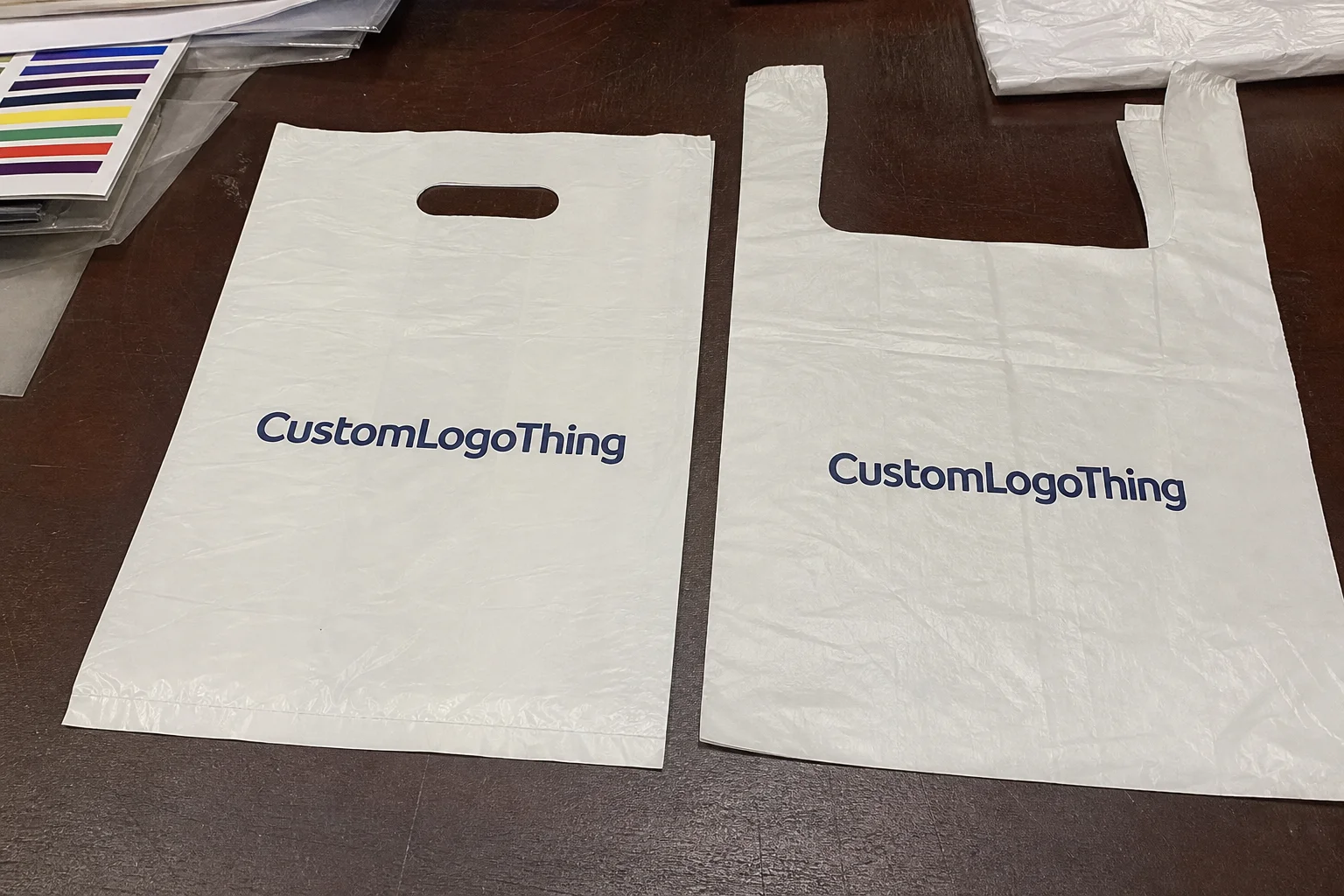
At checkout, the bag is often the last physical item a customer handles before leaving the store. That gives printed Plastic Grocery Bags a job that goes beyond carrying products out the door. They have to hold weight, move quickly through the lane, and present a clean piece of branding in a moment that is usually rushed. If the bag feels flimsy or the print looks sloppy, that impression sticks longer than most buyers expect.
In practical terms, printed plastic grocery bags are polyethylene carry bags with a logo, slogan, seasonal design, or store message printed directly on the film. HDPE and LDPE are the most common base materials, and each behaves differently on the press and in the hand. HDPE is usually lighter, crisper, and more economical at volume. LDPE is softer, stretches more, and often feels more premium. The right choice depends on load, price target, and the tone the store wants to project.
Most grocery programs use T-shirt bags, die-Cut Handle Bags, loop-handle bags, or flat gusseted styles. That may sound like a small detail, but the shape influences everything from dispensing speed to customer comfort to how well cartons sit in the bag. A bag that opens easily and carries a standard grocery mix without twisting or digging into the hand tends to perform better than one that looks good in a mockup but fails in use.
The construction variables are straightforward, but they carry real consequences. Gauge, sometimes called thickness, affects strength and drape. Gusset width changes internal volume and product stability. Handle style affects how the bag feels when loaded. Print coverage affects both appearance and cost. Buyers often focus on the logo first, then discover later that the bag itself is carrying most of the burden.
How the printing process works from artwork to finished bag
The production flow usually starts with artwork review and ends with converted, packed bags ready for shipping. Between those points sit a series of steps that can help or hurt the final result: file preparation, color separation, plate or screen creation, printing, drying or curing, converting, inspection, and packing. If one stage is rushed, the problem usually shows up later as a color shift, poor registration, or ink that rubs off during handling.
For high-volume grocery orders, flexographic printing is common because it runs efficiently and handles simple branding well. It is a strong fit for bold logos, spot colors, and repeat patterns. Fine gradients, tiny text, and photo-style images are possible in some cases, but they raise the risk of inconsistent results and often increase setup time. On plastic film, the best artwork is usually direct and legible rather than busy.
Registration matters more than many buyers realize. If the colors do not line up correctly, even a well-designed logo can look off-center or fuzzy. Ink adhesion is another checkpoint. It has to survive packing, transit, and day-to-day handling without smearing. Drying or curing also needs to be complete, because undercured ink can cause blocking in cartons. Once bags stick together, distribution becomes a problem before they ever reach a checkout lane.
The film surface plays a role too. Smoother substrates usually produce cleaner edges, while darker films and dense solid fills can soften the appearance of fine details. In some packaging systems, buyers refer to broader converting and print standards from organizations such as the Institute of Packaging Professionals when they need a baseline for process control, color consistency, or packaging performance. The standards conversation matters because grocery bags are not just print pieces; they are working packaging.
Key factors that affect quality, durability, and shelf appeal
Material choice is usually the first decision that shapes performance. HDPE is a common choice for grocery carry bags because it is light, stiff, and cost-efficient at scale. LDPE feels softer and more flexible, with more stretch and a smoother hand. Neither one is universally better. The decision should follow the store’s most common load, the level of perceived quality you want, and the budget available for the bag program.
Thickness matters just as much. A thinner bag can lower material cost, but if it stretches too much around milk, canned goods, or a bundled order, the customer notices the weakness immediately. A thicker film improves confidence and reduces the odds of a torn handle or split seam, although it also increases material usage. In practice, buyers often discuss gauges such as 12 micron, 15 micron, or 18 micron, depending on the resin type and the conventions used in their market. There is no one correct number. The right spec is the one that survives the heaviest routine load without becoming wasteful.
Handle style is a separate decision, not an afterthought. T-shirt bags remain popular because they dispense quickly and are familiar to staff and shoppers. Die-cut handles create a cleaner retail look and work well for smaller carryouts or promotions. Loop handles are more premium and usually feel sturdier on heavier items. If the bag is too narrow or the handle placement is off, the load shifts awkwardly and the customer feels it in the hand. That is the kind of problem that a glossy mockup will never reveal.
Gusset width also deserves attention. A wider gusset helps the bag open properly and gives boxier products room to sit flat. If the gusset is too narrow, cartons and containers can force the sidewalls out of shape, which makes the bag look overstressed even when it has not failed. This is a common mismatch in early buying conversations: the printed design looks right, but the structure does not match the merchandise.
Print design choices affect both appearance and cost. A strong one-color logo on a light bag often works better than a crowded multicolor layout that tries to do too much. High contrast usually reads more cleanly than subtle tone-on-tone artwork, especially under store lighting and at a distance. Type that is too thin, too small, or too close to the seal area can distort during converting. Buyers sometimes ask for full coverage because it feels more branded, but heavy ink coverage can add complexity, reduce visual clarity, and increase price without improving the bag’s actual performance.
Compliance and sustainability are part of the spec as well. Some programs use recycled content; others need recyclable resin options or must meet local carry-bag rules. Thickness requirements, labeling, and allowable resin types can vary by state or municipality, so a bag that works in one market may not be acceptable in another. General environmental guidance from the EPA can help frame waste-reduction decisions, but the final compliance check still needs to happen at the local level.
| Bag style | Typical feel | Best for | Common tradeoff |
|---|---|---|---|
| HDPE T-shirt | Light, crisp, economical | High-volume checkout use | Less premium feel |
| LDPE die-cut handle | Softer, smoother | Retail carryout, promotions | Usually higher material cost |
| Loop-handle | More premium, sturdy hand feel | Heavier items, branded retail programs | Higher unit cost and more setup sensitivity |
| Recycled-content film | Varies by blend | Sustainability-focused programs | Appearance and consistency can vary more |
Cost and pricing: what drives your quote
Pricing for printed plastic grocery bags is driven by a small number of variables, and the largest ones are usually bag size, material, thickness, number of print colors, total coverage, quantity, and packing format. If a quote seems unusually low, the first question should be what was reduced to get there. Often the answer is thinner film, fewer colors, smaller dimensions, or freight that is not included in the number shown.
Setup cost has the biggest impact on smaller runs because prepress, plates, proofs, and scheduling have to be spread across fewer pieces. A 5,000-bag order will almost always carry a higher unit price than a 50,000-bag order because the fixed costs do not disappear. That is not a pricing trick; it is simply how converting jobs are built. Larger runs absorb setup more efficiently.
Special features raise the quote quickly. Reinforced handles, wider gussets, venting, premium film blends, and heavy print coverage all add cost. Multi-color jobs also become more sensitive to registration and ink usage. Buyers sometimes compare only the printed price per thousand, but that misses the real number. Delivered cost, packaging count, pallet configuration, and freight can shift the actual budget more than a few cents on the unit price.
There is also the issue of reorder behavior. A bag that is cheap but breaks down in use can cost more in complaints, replacements, or emergency rebuys. A slightly higher quote can be the better option if it reduces waste, lowers failure rates at checkout, and holds up through distribution.
| Cost driver | What it changes | Buyer tip |
|---|---|---|
| Quantity | Per-unit pricing and setup spread | Compare pricing at realistic reorder volumes |
| Thickness / gauge | Strength, feel, material usage | Match the bag to the heaviest common load |
| Print colors | Setup, ink usage, complexity | Use fewer colors if the logo still reads clearly |
| Freight and packing | Total landed cost | Ask for delivered pricing, not just factory pricing |
Process, timeline, and production steps from approval to delivery
A normal order usually moves through quote request, artwork review, proof approval, scheduling, printing, converting, inspection, and shipment. Repeat orders move faster because the bag size and print layout already exist. New sizes, unusual handle styles, recycled blends, or special print effects add time because each one creates another point where approval or adjustment may be needed.
Artwork quality matters more than most first-time buyers expect. Vector files are the safest starting point because they stay sharp at any size and separate cleanly into print colors. If a logo arrives as a low-resolution file, the proof process slows down while someone rebuilds or cleans it up. Missing font outlines, unclear color references, and vague sizing instructions create the same problem. The less guessing involved, the faster the job moves.
Timeline planning should separate production time from transit time. Bags may be finished on schedule, but shipping can still shift the arrival date depending on distance, carrier mode, warehouse timing, and season. That matters more than it sounds. A store can approve a job on time and still end up short if the bags are scheduled too close to a holiday rush or a weekend promotion.
A good spec sheet prevents most of the common confusion. Include bag style, dimensions, gauge, handle type, print count, packaging count per case, and any special notes about labeling or palletizing. That document becomes the shared reference point between buyer, prepress, and production. It is one of the simplest ways to reduce rework.
Common mistakes buyers make when ordering store bags
The first mistake is choosing a bag that looks fine on paper but is too thin for actual grocery loads. That usually shows up as stretching, uncomfortable handles, or seam stress once heavier items go in. A checkout bag that fails in the lane creates service issues fast, and customers tend to remember those moments.
The second mistake is sending artwork that is not ready for print. Low-resolution logos, missing outlines, poor spacing, and unclear color references delay proofs and can blur the final result. The best way to avoid that problem is to treat the file as production artwork, not a rough idea. The press does not correct weak design decisions.
Another oversight is forgetting the customer’s hand feel. If the bag is awkward to grip, too narrow for common cartons, or easy to tear at the handle, the branding does not rescue it. A clean logo on a poorly built bag still leaves a poor impression. The product has to work before it can advertise.
Price shopping without checking the full spec is another frequent mistake. Two quotes can look close and still represent very different bags once thickness, print coverage, freight, and pack counts are compared. Some buyers also order too much of a design that will change soon, while others order too little and lose pricing efficiency on the next run. Both errors usually come from treating inventory as an afterthought.
Expert tips for better printing, better margins, and fewer surprises
Keep the design bold enough to read from several feet away. Grocery bags are seen in motion, under fluorescent lights, and often from across a parking lot. Fine lines, delicate gradients, and tiny copy can disappear on plastic film faster than they would on paper. Strong letterforms and simple shapes tend to survive the conversion process better.
Contrast helps more than most brands realize. Dark print on a light bag is usually cleaner than a subtle treatment with low separation between ink and film color. If precise color matters, ask for a proof that reflects the intended finish as closely as possible. A logo that looks correct in a digital file can shift once it is printed on film, especially if the substrate is tinted or the art uses small details.
Standardizing a few proven sizes can make the program easier to manage. Once a store settles on bag dimensions that work, reorder planning becomes cleaner, freight estimates are easier to predict, and storage is simpler. A stable bag line is often more valuable than chasing a small unit-price difference on every order.
Build a cushion into inventory planning. Popular bag styles can run out at exactly the wrong time, and rush orders usually carry higher costs. A modest buffer protects service levels and avoids rushed decisions that lead to spec changes, higher freight, or compromised print quality.
A grocery bag is small, but it carries real operational weight. If the print is clean, the handle feels right, and the bag performs under load, the store gets a quiet piece of branding that does its job without drawing attention for the wrong reasons.
Next steps for ordering the right custom bag for your store
Start with the load, not the artwork. Measure the typical basket size, average checkout mix, and the heaviest items staff regularly pack together. That tells you more about the right dimensions and thickness than a guess ever will. A bag that fits the real basket pattern will usually perform better than one chosen only because it looks attractive in a mockup.
Once the load is defined, gather logo files, preferred colors, and a target quantity. Ask for a spec confirmation that spells out bag style, gauge, handle type, dimensions, print coverage, and packaging count per case. That one sheet reduces confusion later and gives everyone a common reference point.
Then review the proof with the production reality in mind. Make sure the print stays within safe margins, the colors are called out clearly, and the layout works on the actual bag size, not just on a screen. If the quote changes because freight, packaging, or setup differs from the first assumption, compare the landed cost rather than the headline unit price.
After the first run, pay attention to what happens in the store. Do the bags open well at the lane? Do the handles feel comfortable under load? Does the print stay intact after handling and transport? That feedback improves the next order. Printed plastic grocery bags perform best when material choice, structure, and print design are aligned before production starts.
FAQ
What should I know before ordering printed plastic grocery bags?
Confirm the bag style, size, thickness, and handle type before requesting a quote. Make sure your logo is in a print-ready format, and decide whether your priority is the lowest unit cost, stronger durability, or stronger branding impact.
How do printed plastic grocery bags get made?
The process usually includes artwork prep, plate or screen creation, printing, drying or curing, and then converting the film into finished bags. Bag material and print method influence how sharp the logo looks and how quickly the job can run. Proof approval timing also affects when production starts.
What affects the cost of custom printed grocery bags the most?
Quantity, bag size, material thickness, and number of ink colors are usually the biggest price drivers. Setup charges matter more on smaller orders, while larger runs lower the per-unit cost. Freight and special features can change the final landed cost significantly.
How long does the production timeline usually take for printed plastic grocery bags?
Simple repeat jobs tend to move faster than new custom designs or special constructions. Artwork approval, proof revisions, and scheduling capacity all affect turnaround time. Shipping time should be added separately to the production schedule so the delivery date stays realistic.
What is the best way to avoid mistakes when ordering printed plastic grocery bags?
Start with real usage: the weight, volume, and shopping pattern of the items being carried. Use clear, high-resolution artwork and confirm all bag specs in writing before approval. Review samples or proofs closely so you catch size, color, or layout issues early.

