Custom Plastic Grocery Bags with Logo: Buyer’s Guide
What branded grocery bags change at checkout
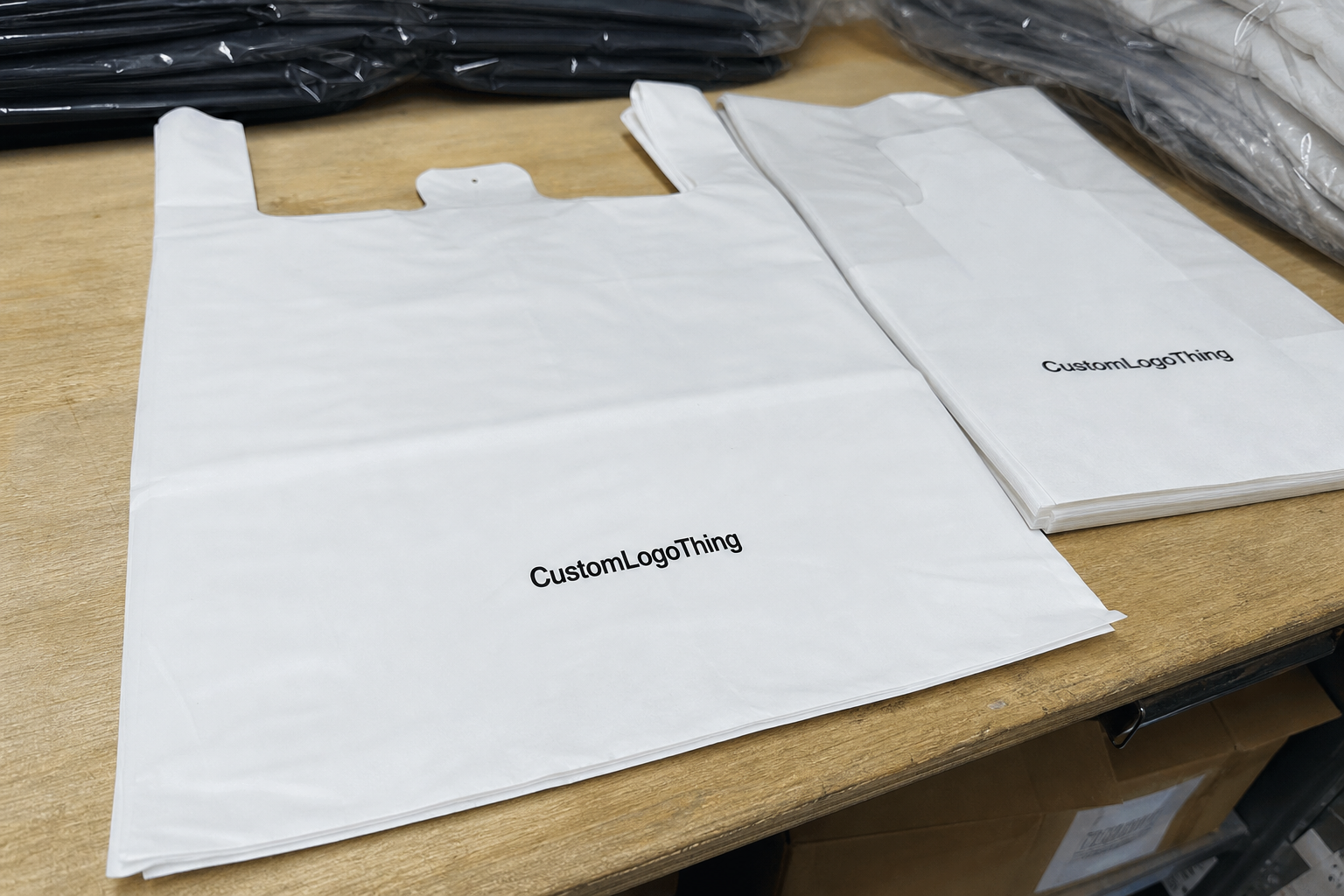
The cheapest retail media spend is often sitting right at the register. A bag leaves the store with the customer, rides through the parking lot, lands in the kitchen, and gets seen by a few more people before it gets tossed or reused. That is a short life for packaging, but it still does work.
Custom plastic grocery Bags With Logo turn a disposable utility item into a brand carrier. Not a glamorous one. Just an effective one. The real value is repetition: every checkout becomes another impression, and the bag keeps doing its job without requiring the customer to opt in or click anything.
From a buyer’s point of view, this is not a simple logo exercise. It is a small production spec with real consequences. Bag type, thickness, handle style, print method, and load capacity all need to line up. If one piece is off, the bag may still look fine in a proof and fail once it’s filled with actual groceries.
The mistake I see most often is treating the bag as decoration instead of equipment. The right question is not “Does the logo look nice?” It is “Will this bag hold the load, print cleanly, and survive the trip home?” That shift saves money and avoids embarrassment. Packaging is funny like that.
For store teams, these bags also support basic operational consistency. They fit checkout flow, carry store identity, and help standardize the customer handoff. That matters more than a lot of people want to admit.
“If the bag fails before the customer gets to the car, the branding message is already broken.”
That’s why it helps to compare this product with other Custom Packaging Products in the same program. A grocery bag may not carry the premium feel of a printed carton, but it does something those packages don’t: it travels.
How printing and bag construction work together
Most plastic grocery bags are made from either high-density polyethylene (HDPE) or low-density polyethylene (LDPE). HDPE is thinner, stiffer, and very common for fast checkout use because bags open and dispense quickly. LDPE is softer and more flexible, with a heavier hand feel and better puncture resistance in many applications. Neither material is automatically superior. The right choice depends on the load, the store format, and the look you want customers to associate with the brand.
Construction details matter just as much as film choice. Gussets give the bag more usable volume. Handles affect comfort, speed of packing, and how the bag hangs from a rack. Bottom seals determine whether the bag handles canned goods, produce, or boxed items without splitting under stress. On paper, these details sound small. In use, they decide whether the bag feels reliable or flimsy.
Artwork placement is another place where good intentions get wrecked by physics. A logo that sits too close to the handle area or gusset fold can distort once the bag is full. That is especially true on narrow panels. The printable area may look generous in a mockup, then suddenly shrink after the film folds and the handles are punched.
Print coverage versus real-world durability
More ink is not always better. Heavy coverage can make a bag look more branded, but it also adds complexity. On thinner film, large solid areas can make the material feel stiffer in certain spots. If the design pushes too far into stress zones, the bag may not handle repeated flexing as well.
Flexographic printing is the standard method for most high-volume grocery bags because it runs efficiently and keeps unit cost manageable. Spot colors are usually easier to control than complex process builds. Simple shapes, bold type, and clear spacing tend to print better than gradients, hairline rules, or tiny reversed text. That is not a stylistic opinion. It is a production reality.
Good print depends on the proof reflecting the real bag, not a polished screen rendering. Ink gain, film color, and registration tolerance all affect the final result. A crisp logo on a PDF can soften quickly on flexible film, especially if the artwork was built too small or with weak line weights. Buyers who want clean output should ask for a proof based on the actual substrate and print method.
That is why custom plastic grocery bags with logo work best when they are treated as packaging specification projects, not just artwork approvals. The bag has to function first. Branding works because the bag survives use, not because the mockup looked pretty.
Cost, MOQ, and unit pricing for custom bags
Pricing depends on quantity, gauge, dimensions, number of print colors, and freight. The biggest surprise for new buyers is usually setup cost. A run of 25,000 bags can look inexpensive on a unit basis, while a 3,000-bag order can feel oddly expensive even if the material is identical. That happens because plates, ink matching, proofing, and press setup do not shrink much when the order gets smaller.
MOQ exists for a reason. The press needs setup time, the artwork needs approval, and the supplier has to produce enough volume to justify the run. Small orders can be done, but they usually carry a higher per-bag cost. Buyers sometimes try to offset that by reducing thickness or cutting colors. That works only if the bag still meets the actual load requirement. A lighter bag that tears early is not a bargain.
| Order profile | Typical unit range | Common setup reality | Best fit |
|---|---|---|---|
| 3,000 to 5,000 bags | $0.18-$0.32 | Higher share of plate and proof costs | Pilot programs, store refreshes, test markets |
| 10,000 bags | $0.11-$0.20 | Setup costs start to normalize | Standard replenishment and seasonal programs |
| 25,000+ bags | $0.07-$0.13 | Better spread of fixed costs | Multi-store programs and ongoing carryout supply |
These are planning ranges, not quotes. Bag size, film choice, and print coverage can move pricing faster than buyers expect. A thicker gauge, more ink, or a specialty handle punch will push the number up. Freight can also change the math, especially if one supplier is close to your distribution point and another is not.
When comparing bids, insist on identical specs. Same dimensions. Same material. Same thickness. Same number of colors. Same delivery address. Otherwise you are comparing different products and pretending the quotes are directly equivalent.
Watch for charges that hide in the back half of the estimate: artwork cleanup, plate fees, color matching, rush production, split shipments, pallet rework, and surprise freight. A low quote that grows later is not a low quote. It is just a delayed one.
For larger packaging programs, it can also help to compare the bag against other Custom Packaging Products in the same purchasing cycle. That makes it easier to keep artwork, compliance language, and timing aligned instead of patching them together one purchase order at a time.
Production steps and timeline from proof to delivery
The process is simple in theory: request the quote, review the artwork, approve the proof, produce the bags, inspect the run, pack cartons, and ship. The delays usually happen before production starts. Missing dimensions, unclear art files, or vague notes about color and placement can add days before the first bag reaches the press.
A realistic timeline for standard custom runs is often 12 to 15 business days after proof approval. Larger orders, heavier print coverage, or special material requests can take longer. Freight adds its own timing, and that part is easy to underestimate. If the bags are tied to a store opening or seasonal rollout, the approval window needs to be short and the spec needs to be complete from the start.
Three things usually speed things up: a finished dieline, confirmed colors, and a locked quantity. Once those are set, the supplier can confirm print readiness, estimate carton counts, and schedule production with less back-and-forth. If those details keep changing, the schedule slips. Not because anyone is being dramatic. Because the job keeps changing.
Quality control should be part of the conversation, not an afterthought. Ask how the supplier checks print registration, seal consistency, and carton counts before release. If the order is going across several stores or franchises, consistency matters more than shaving a few cents off the unit price.
Buyers sometimes assume the press is the bottleneck. Usually it isn’t. Artwork approval is the bottleneck. A clean spec saves time. A vague one creates expensive email threads.
Key specs that determine strength, finish, and compliance
Strength starts with thickness, but thickness alone does not tell the whole story. Seam quality, handle reinforcement, gusset depth, and puncture resistance all affect how the bag behaves under load. A bag can look sturdy on paper and still fail if the seal area is weak or the handle stretches too much during carry.
For grocery use, the most useful specs are the ones tied to real handling. Can the bag carry canned goods without splitting? Does it hold chilled bottles without stretching awkwardly? Does it still feel stable after the customer has picked it up, set it down, and picked it up again? Those are the questions that matter more than generic strength claims.
Finish changes how the bag is perceived. Gloss tends to look cleaner and more retail-friendly. Matte feels softer and slightly more premium. Translucent film usually signals utility and cost efficiency. None of these finishes is wrong. They just send different messages about the store and the merchandise inside.
Compliance deserves attention before the order is locked. State and local bag rules can affect material choice, printed language, recycled-content expectations, or whether the store can use a certain style at all. If a chain operates in multiple regions, that gets complicated fast. Check the rules early. Reprinting bags because the compliance language is wrong is a very expensive way to learn geography.
For broader environmental context, the EPA’s waste reduction guidance is a useful reference, and FSC certification matters if your packaging mix includes paper alternatives or hybrid programs: EPA recycling guidance and FSC certification.
Buyers should also ask for the actual load case. A bag intended for folded apparel is not the same thing as one used for canned food, sharp boxed goods, or wet produce. That sounds obvious, but a lot of failures happen because someone approved a spec based on the nicest scenario instead of the real one.
Common ordering mistakes and the expert fixes
The most expensive mistake is buying on price alone. A cheaper bag can still be the wrong bag. If it tears with damp produce, loses strength around the handle, or splits on a rough carton edge, the savings disappear immediately. With custom plastic grocery bags with logo, that failure is visible to the customer and anyone nearby. Branding should not announce a packaging mistake.
Artwork placement is another frequent problem. Logos set too close to handles, folds, or gussets can distort once the bag is filled. Tiny type is risky too. A clean PDF does not guarantee a clean print. On film, thin strokes and reversed type need more care than many teams expect. Ask for a proof that shows exact scale and placement, not just a nice-looking mockup.
Storage and logistics get ignored more often than they should. Carton counts, pallet configuration, and backroom space all affect how the order fits into the store system. A larger run can save money per bag and create a receiving problem if nobody planned where the cartons are going to live. That kind of issue shows up at the worst time, usually right before launch.
- Request samples before approving a new gauge or handle style.
- Confirm the exact bag dimensions, including gusset depth.
- Ask how the supplier checks print adhesion and seal strength.
- Verify whether the quote includes freight, cartons, plates, and setup.
- Match the spec to the actual grocery load, not the ideal one.
These checks sound basic because they are basic. They also save real money. A well-planned order is easier to approve, easier to receive, and less likely to create a last-minute production scramble.
Buyers who slow down long enough to compare samples and spec details usually get better results than buyers who only compare price. Amazing how that works.
Next steps: build a quote-ready bag spec
Before asking for pricing, gather the full spec in one place. Include bag style, dimensions, material, thickness, handle type, print colors, quantity, delivery destination, and any compliance notes. Attach the logo file in a format the supplier can actually use. Vector artwork is best. A low-resolution JPEG usually leads to cleanup work, delays, or both.
If the order supports a store opening, seasonal reset, or brand refresh, ask for a sample or digital proof before production begins. That extra step is cheap compared with redoing a run after the fact. It is also the moment to check whether the color, line weight, and logo placement still work once the artwork is sitting on film instead of on a screen.
The cleanest buying process is usually the simplest: get two or three quotes based on the same spec sheet, then compare cost, timing, and durability side by side. That approach strips out noise and makes it much easier to judge whether the bag is actually fit for purpose. It also keeps the conversation grounded in real tradeoffs instead of vague promises.
For grocery buyers, the goal is not just a low unit price. It is a bag that holds what it should hold, prints cleanly, arrives on time, and reinforces the store every time a customer walks out with it. That is where custom plastic grocery bags with logo earn their keep.
How much do custom plastic grocery bags with logo usually cost?
Pricing depends on quantity, film thickness, bag size, and the number of print colors. For planning purposes, smaller runs often land around $0.18-$0.32 per bag, while larger volumes can drop closer to $0.07-$0.13. Setup, plates, and artwork work are common on custom print runs, so the final quote can move quickly if the spec changes.
What information do I need to request a quote for logo grocery bags?
Provide the bag dimensions, material preference, thickness, handle style, print colors, quantity, shipping destination, and any compliance notes. Include the logo file format up front so the supplier can confirm whether the artwork is ready for print or needs cleanup.
How long does production take for printed grocery bags?
Standard orders often take 12 to 15 business days after proof approval. The timeline can stretch if the order is large, the artwork needs revisions, or the material is harder to source. Most delays happen before production starts, not during the run.
What bag style works best for grocery use?
HDPE bags are common for lighter carryout and fast checkout handling. LDPE usually feels thicker and can be a better fit for heavier or sharper items. The right choice depends on what shoppers actually carry and how the bag will be used at the store.
Can I order custom plastic grocery bags with logo in a small quantity?
Yes, but smaller orders usually carry higher unit pricing because setup costs are spread across fewer bags. Some suppliers also have minimum order quantities that make very small runs inefficient. If the volume is limited, ask whether a stock bag with a custom imprint is available.