Die Cut Handle Bags for coffee brands material comparison sounds like a narrow spec-sheet exercise. It is not. The material changes how the bag carries, how it survives handling, how it protects roast quality, and how premium the brand looks the second somebody picks it up. Two bags can share the same size, the same die cut, and the same artwork. One still feels solid. The other feels like it was negotiated down to the last micron.
Coffee is a rough product for packaging. Beans can be oily. Bags get stacked, shipped, lifted, dropped, and dragged across shelves. Retail buyers notice whether the pack stands upright and keeps its shape. Subscription customers notice dents, scuffs, and seal failures. If the bag is built wrong, the brand pays for it later in returns, complaints, or a second production run nobody budgeted for.
The real decision is not paper versus plastic in the abstract. It is which structure fits the channel, fill weight, print method, and sustainability claim without creating problems downstream. Some programs need the natural look of kraft paper. Others need film-based durability and a stronger barrier. A few can support compostable materials, but only if the shelf life, certification, and end-of-life path are real. Good packaging choices are specific. Vague ones are expensive.
Why Material Choice Changes the Whole Coffee Bag
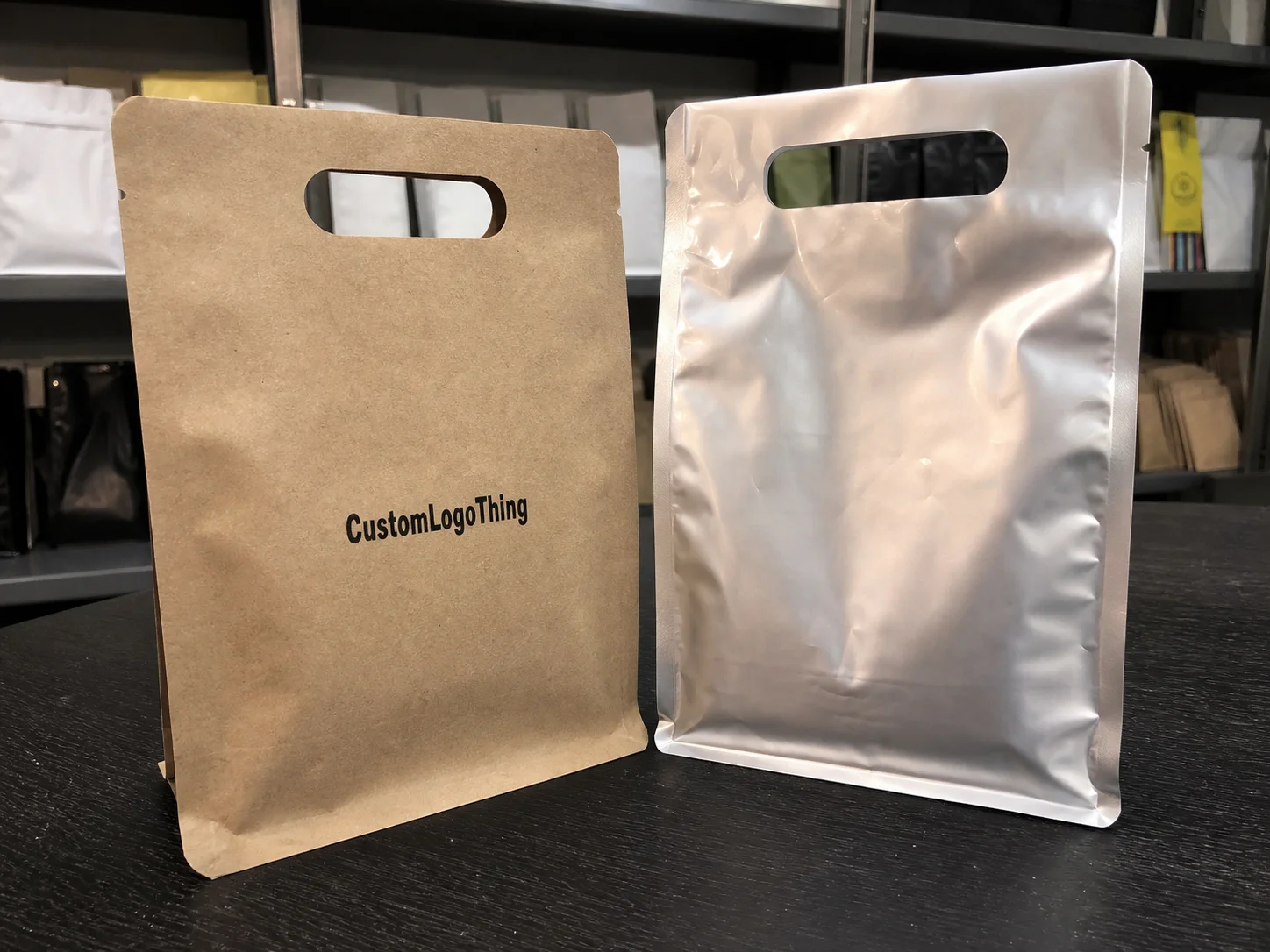
With Die Cut Handle Bags for coffee brands material comparison, material is not a cosmetic decision. It determines stiffness, moisture resistance, puncture tolerance, and how much confidence the bag gives the person carrying it. A pack that looks expensive in a render can still feel flimsy if the film gauge is too light or the paper stock has too little body.
Coffee brands care about more than appearance because the bag has to do several jobs at once. It has to protect aroma and keep out humidity. It has to hold a shape that reads well on shelf. It has to move comfortably through retail, wholesale, or event use without tearing at the handle. One format cannot do all of that equally well in every material.
Channel matters more than most buyers admit. A roastery refill program can tolerate a softer pack because the bag is handled in a controlled environment. A retail display needs cleaner shelf memory and a front panel that still looks tidy after people have touched it ten times. E-commerce adds another layer. The bag may look fine at the store but fail inside a carton if the outer shipper and inner pack are not matched properly. Packaging is a system, not a single item pretending to be one.
That is why the material conversation should start with the job. Paper, PE, PP, laminated structures, and compostable films each solve different problems. A brand chasing a craft-forward look may want kraft paper or a paper-faced laminate. A brand focused on barrier and durability may be better off with a film structure. Sustainability can support the story, but only if the material and the claim line up.
A bag that is 10 percent prettier but 30 percent weaker is not an upgrade. It is a complaint with better branding.
Before approving anything, compare the bag against the real use case: fill weight, handling frequency, shelf conditions, transit time, and reorder pattern. A program for 12 oz retail bags is not the same as a one-pound wholesale refill pack. The best suppliers do that filtering early. The lazy ones wait until after the quote.
How Die Cut Handle Bags Are Built and Printed
A Die Cut Handle bag looks simple because the shape is simple. The construction is not. At minimum, the bag includes a substrate, side seals, a bottom seal, and a die cut handle area. That handle area is where failure likes to start. The opening concentrates stress, especially when the pack is carrying dense coffee instead of a lightweight promo item.
The substrate can be paper, film, or a laminate stack. Paper-based bags often need a coating or liner to resist grease and moisture. Film-based bags rely more heavily on gauge, seal integrity, and puncture resistance. Multi-layer structures split the work: one layer for print, one for barrier, one for strength, and sometimes an inner sealant layer. It is rarely “just paper” or “just plastic,” no matter what the sales deck says.
Handle reinforcement matters. A clean cutout without reinforcement can be fine for light loads and short carry distances. Put heavier coffee into the same structure and the opening starts to stretch. The bag may not fail immediately. It just starts looking tired earlier than it should. That is usually enough to damage perception at retail.
Printing changes the outcome more than many buyers expect. Flexographic printing works well for larger runs and gives solid consistency once the plates are dialed in. Gravure supports strong image quality and fine detail, but the economics make more sense at scale. Digital printing helps with short runs, test markets, and seasonal artwork, though color control must be checked carefully if brand standards are strict.
Surface finish also changes the story. Matte kraft sends a different signal than gloss film. Clean black type on a bright white laminate will not behave the same way as the same artwork on natural paper. Paper tends to soften edges a bit because of absorbency and grain. Film usually gives sharper print and stronger color contrast. That can look premium. It can also look too polished if the brand wants something quieter and more restrained.
Barrier is the part buyers ignore until it bites them. Coffee is sensitive to humidity, oxygen, and aroma loss. Coated paper can help, but it is not always enough for long transit or oily beans. Laminated films usually do better on moisture and odor protection. That matters because flavor retention is not an abstract technical point. It is the product.
Ask suppliers how the handle is reinforced, what seal strength they target, and how they validate the structure against the fill weight. If the answer stays vague, the spec is not complete yet.
Case studies help buyers see how the same format behaves under different retail and fulfillment conditions. The useful examples are not the flashy ones. They are the packs that survived shelf handling, carton movement, and repeat orders without needing a redesign.
Material Comparison for Strength, Barrier, and Shelf Appeal
die cut handle bags for coffee brands material comparison gets clearer when the materials are judged on the same criteria: strength, barrier, shelf appearance, and sourcing consistency. There is no universal winner. The best option depends on the brand, the channel, and the budget ceiling that nobody likes to admit exists.
| Material | Strength and handle feel | Barrier performance | Shelf appeal | Typical buyer fit |
|---|---|---|---|---|
| Kraft paper | Good body, but can feel soft under load unless reinforced | Moderate unless coated or lined | Natural, earthy, craft-forward | Specialty roasters, FSC-positioned programs, lower-plastic branding |
| PE / LDPE film | Flexible and tear resistant, practical for carry use | Good moisture resistance | Clean, though less tactile than paper | High-volume retail, value programs, refill packs |
| PP film | Stiffer feel and decent puncture resistance | Good for light-to-moderate barrier needs | Sharp print registration, bright graphics | Brands that want form stability and crisp visuals |
| Laminated structure | Strong and stable, better for heavier coffee packs | Excellent moisture and aroma protection | Premium look, especially with matte or soft-touch finishes | Premium retail, longer distribution chains, high graphic requirements |
| Compostable or bio-based film | Varies widely, needs testing before approval | Can be good, but performance differs by structure | Useful for sustainability messaging if verified | Brands with a documented end-of-life path and clear claims |
Kraft paper is easy to like. It looks warm, it supports an origin-driven story, and it fits brands that want to feel less industrial. The tradeoff is performance. Unless it is coated or combined with a liner, it may not handle humidity or oily coffee as well as a film-based option. For lightweight retail packs, that can still be acceptable. For more demanding distribution, the risk rises fast.
PE and LDPE structures are usually the practical choice. They are flexible, cost-effective, and hold up well in high-volume programs where the bag gets handled a lot. PP gives a slightly stiffer, cleaner feel, which some buyers prefer for shelf presence. Both work when consistency matters more than a paper-forward visual language.
Laminates often sit at the top end of performance. They generally improve print sharpness, barrier, and dimensional stability, which is why premium coffee brands use them so often. The downside is complexity. More layers can mean more sourcing variables and more recycling questions. If the brand wants to talk about recyclability, the claim needs to be precise and backed by the local collection stream, not a hopeful sentence on the back panel.
Compostable and bio-based materials need the most scrutiny. The marketing story may be attractive, but the real questions are certification, shelf-life performance, and whether the material actually suits the distribution model. A biodegradable claim without context can create more problems than it solves. Ask for barrier data, certification details, and the exact standard used. If those documents are missing, the material is not ready for approval.
The better question is usually not which material is most sustainable. It is which material gives the best balance of performance, sourcing confidence, and end-of-life credibility for this specific coffee program. That answer changes from brand to brand. Pretending otherwise just wastes time.
Cost, Pricing, and MOQ Variables That Move the Quote
Price in die cut handle bags is driven by several decisions at once. Material choice matters. Print coverage matters. Coatings and lamination matter. Handle reinforcement matters. Order quantity matters a lot. A small run with heavy artwork can cost much more per unit than a larger, simpler order, even when the bag size stays the same.
For a working range, many Custom Die Cut handle bag programs land somewhere around $0.18 to $0.45 per unit at moderate volumes. That is a practical reference point, not a promise. More complex laminated structures, specialty finishes, and lower MOQs can push above that. Simpler film builds and larger runs can bring the unit price down. The important thing is to see what is driving the number.
| Quote driver | How it changes cost | What to ask |
|---|---|---|
| Material type | Paper, film, and laminate each have different base costs | What is the gauge, layer stack, and barrier target? |
| Print method | Setup, color count, and plate cost affect the unit price | How many print stations are being used? |
| MOQ | Lower quantities spread setup costs across fewer bags | What is the price at 5,000, 10,000, and 25,000 units? |
| Finishing | Matte, soft-touch, metallic, and spot effects add cost and time | Which finishes are functional and which are purely decorative? |
| Freight and cartonization | Pack format affects shipping volume and storage footprint | How many cartons per pallet, and what is the landed cost? |
MOQ is where a lot of coffee brands make bad decisions. They optimize for a low entry price, then discover the unit cost rises because the order is too small to absorb setup. That does not mean every brand should chase a huge run. It means the quote has to be read alongside the forecast. If the program is seasonal, still in testing, or likely to change, a smaller run may be the right move even at a higher unit cost. If the design is stable, larger volumes usually improve economics.
The hidden costs matter too. Storage space matters. Carton size matters. Freight dimensions matter. A bag that looks cheaper on paper can become expensive if it ships badly or takes up too much warehouse room. Reordering in small batches because artwork keeps changing also raises the annual cost. The cheapest unit price often becomes the most expensive program.
Split every quote into structure, decoration, tooling, and freight. That makes it obvious which supplier is actually cheaper and which one just moved the cost into a different bucket. Sometimes the real difference is a thinner material or a lower-spec print process that will not survive in the market.
Transparency is a quality signal. A quote that clearly states the material spec, print method, MOQ, and freight assumptions is worth more than a one-line unit price with no context.
our packaging case studies are useful for seeing how a lower starting price can turn into a higher total cost after reprints, damaged stock, or unplanned packaging changes.
Process and Timeline: From Spec Sheet to Delivery
The production path is simple on paper: brief, structure selection, artwork prep, proofing, tooling approval, sampling, production, inspection, shipment. The delays show up where decisions are fuzzy. Artwork revisions, material sourcing, and approval lag usually slow things down more than the machine run itself.
For standard custom programs, lead time often lands around 12 to 20 business days after proof approval, depending on the supplier and structure. Special finishes, nonstandard sizes, and compostable materials can add time. If the bag uses an unusual laminate or requires a specific barrier target, plan for a longer runway. The machine is rarely the problem. The setup is.
Fill weight should be confirmed before approval. That sounds basic because it is basic, and yet it causes a surprising amount of rework. A bag sized for 12 oz coffee may behave differently with a denser roast, a valve, or a slightly different fill line. Once the tooling is approved, changing the geometry usually means resetting the process. That costs time and money.
Good suppliers ask about the final use case early. Retail shelf display, wholesale refill, and e-commerce fulfillment are not the same thing. A bag that gets carried often needs better tear resistance. A pack that sits in humid stores needs better moisture protection. A pack that ships inside cartons needs enough dimensional stability to avoid scuffing and crease damage. The right structure depends on where the bag lives before the consumer opens it.
Proofing deserves more attention than it gets. Artwork can look perfect on screen and still shift once it lands on kraft paper or laminated film. Fine type, pale copy, rich black fills, and origin labels all react differently depending on substrate and print method. Ask for a proof or sample that matches the intended material. A generic mockup is decoration, not verification.
For seasonal launches, work backward from the in-store date and build in time for sampling, corrections, and freight. Coffee promotions are not forgiving. Miss the window and the inventory may still be fine, but the campaign timing is dead.
Common Mistakes Coffee Brands Make When Specifying Bags
The biggest mistake is choosing by appearance alone. A bag can look polished in a render and still feel too soft, too slick, or too thin in hand. Coffee packs get picked up over and over, so tactile performance matters just as much as shelf impact. If the handle area flexes too much, people notice immediately. They may not say anything. They just stop trusting the pack.
Another common error is underestimating moisture and aroma protection. Coffee may be dry at fill, but the supply chain is not dry enough to ignore barrier requirements. Paper-forward packaging can look beautiful and still fail if the coating or liner is not strong enough. That does not mean paper is a bad choice. It means the structure needs to match the environment.
Sustainability language causes plenty of avoidable trouble. Recyclable, recycled, compostable, biodegradable, and bio-based are not interchangeable. If the pack uses mixed layers or a laminate, the end-of-life story has to be specific. If recycled materials or post-consumer waste content are part of the claim, the percentage and the basis of calculation should be documented. Loose claims are not a strategy. They are a liability.
Handle geometry gets overlooked too. A cutout that feels fine on a light sample can become uncomfortable when the bag is fuller or when customers carry it a longer distance. Sharp edges, thin reinforcement, or poor seal placement around the handle area can create a rough user experience. That issue usually shows up after launch, which is the expensive time to learn it.
Color approval can also go sideways. If artwork is signed off before the print process is locked, brand colors may drift. Kraft paper will never match a high-gloss film, even with the same artwork files. That is normal. What is not normal is finding out after inventory has landed and nobody wants to take responsibility for the mismatch.
The result of these mistakes is predictable: reprints, damaged stock, inconsistent branding, and a launch that looks less controlled than it should. Packaging errors are rarely subtle. They are just expensive.
Expert Tips for Selecting the Right Coffee Bag Material
Start with a basic decision matrix: channel, fill weight, brand positioning, and handling frequency. Price matters, but it should not be the first filter. A cheaper structure that fails in retail or transit is not cheap. A slightly more expensive laminate can reduce damage, improve presentation, and cut revision cycles enough to pay for itself.
Compare at least two structures side by side. One should reflect the performance ceiling you want. The other should reflect the cost baseline you are willing to accept. If possible, put real product weight into the samples. A spec sheet can tell you gauge and layer stack. It cannot fully tell you how the bag feels after being lifted, set down, and moved around a workspace.
Test the bag under real conditions. Use the target fill weight. Use the likely shelf environment. Use the actual shipping method. If the pack will travel inside cartons, check the outer shipper too. A strong inner bag can still get crushed or scuffed if the cartonization is weak. Packaging works as a system. Corrugated cardboard, inner structure, and palletizing all affect the final result.
Ask for barrier data and certification documents if sustainability is part of the brief. For FSC-certified paper, confirm which part of the structure is certified. For compostable or biodegradable packaging, request the actual standard or certification, not just a claim sheet. If recycled materials or post-consumer waste content are involved, ask for the percentage and the calculation method. Specific documents make internal approvals easier and external claims less risky.
Supplier quality matters as much as material choice. A good supplier does more than manufacture. It will flag a gauge that is too light, suggest a better print method, or recommend a different reinforcement approach that reduces waste. That kind of input usually saves more than a small price cut ever could.
- Choose the structure against the channel, not against the mood board.
- Test the bag with actual coffee weight before final approval.
- Confirm barrier and certification data if sustainability claims are part of the brief.
- Separate material, decoration, tooling, and freight when reviewing quotes.
- Use case studies to compare what worked in similar programs, not just what looked good in samples.
Think about lifecycle, too. The bag is purchased, shipped, displayed, carried, and eventually discarded or recycled. Good packaging decisions account for all of those stages. Bad ones only optimize the first one.
Next Steps for Coffee Brands Comparing Materials
If you are building a specification, start with a one-page brief: bag size, fill weight, print coverage, retail or shipping use, expected order quantity, and the sustainability claim that actually needs support. That brief narrows the material field quickly and prevents expensive backtracking later.
Then request two or three sample structures. Ask for the actual substrate, not a visual mockup. Compare stiffness, handle comfort, print clarity, and how each option behaves after a few minutes of handling. The differences are usually clearer in hand than in a PDF.
Ask each supplier for a quote that separates material, print, tooling, and freight. If the quote is bundled, the buying team cannot see what is driving the price. A transparent quote also makes it easier to negotiate the right variable. Sometimes the savings come from changing print coverage or standardizing carton configuration, not from changing the whole structure.
Build a short approval checklist before sign-off. Cover artwork, barrier requirements, sustainability claims, and delivery timing. That one step reduces the odds of a late correction that forces a reprint or delays launch. If the pack will be used in both retail and e-commerce, test both modes. They do not punish the bag in the same way.
For coffee brands, the question is not whether die cut handle bags can look good. They can. The question is whether the material performs across the route to market without forcing compromises later. That is why material comparison should end in a specification decision, not a guess.
What is the best material for die cut handle bags for coffee brands?
The best material depends on the job. Laminated film usually performs best for barrier and print quality, while kraft paper suits a natural brand look if it is properly coated or lined. Fill weight, handling, and shelf environment decide the final answer.
How does material choice affect the price of die cut handle bags for coffee brands?
Heavier or multi-layer structures usually cost more, and custom print, coatings, and handle reinforcement add to the total. MOQ matters as well, because setup costs are spread across the run. Smaller orders generally raise the unit price.
Which material gives the strongest handle performance?
Film-based structures often offer better tear resistance and handle durability than uncoated paper. Even so, reinforcement around the die cut opening is still essential, especially for heavier coffee packs or bags that will be carried often.
Can sustainable materials still work for coffee packaging?
Yes, but only if the material matches the brand’s barrier, shelf-life, and handling requirements. Verify certifications and real-world performance before relying on sustainability claims in marketing. If recycled materials or post-consumer waste content are part of the brief, ask for the documentation behind the claim.
How long does production usually take for custom die cut handle bags?
Lead time depends on artwork approval, material sourcing, print setup, and whether the bag uses special finishes or nonstandard materials. Standard programs move faster, while highly customized structures usually need extra time for sampling and approvals. In many cases, 12 to 20 business days after proof approval is a realistic working range.


