Buyer Fit Snapshot
| Best fit | Printed Sustainable Retail Boxes Cmyk projects where brand print, material claims, artwork control, MOQ, and repeat-order consistency need to be specified before quoting. |
|---|---|
| Quote inputs | Share finished size, material target, print colors, finish, packing count, annual reorder estimate, ship-to region, and any compliance wording. |
| Proofing check | Approve dieline scale, logo placement, barcode or warning zones, color tolerance, closure strength, and carton packing before bulk production. |
| Main risk | Vague material claims, crowded artwork, missing packing details, or unclear freight terms can make a low unit price expensive after revisions. |
Fast answer: Printed Sustainable Retail Boxes Cmyk: Board, Finish, Dieline, and Unit Cost should be specified like a repeatable production item. The safest quote records material, print method, finish, artwork proof, packing count, and reorder notes in one written spec.
Production checks before approval
Compare the actual filled-product size with the drawing, then confirm tolerance on folds, seals, hang holes, label areas, and retail display edges. Reserve space for logos, QR codes, warning copy, and material claims before decorative graphics fill the panel.
Quote comparison points
Review material grade, print process, finish, sampling route, tooling charges, carton quantity, and freight assumptions side by side. A quote is only useful when the supplier can repeat the same color, closure quality, and packing count on the next order.
Printed Sustainable Retail Boxes CMYK: Smart Brand Guide
Printed sustainable retail boxes cmyk can look polished on a screen and still fall short on press when the board drinks ink too quickly, the blacks build weakly, or the finish fights the substrate. That tension sits at the heart of modern retail packaging: sustainability, shelf appeal, and print fidelity rarely land together by chance. A carton can be recyclable and still feel underpowered; a box can look premium and still carry the wrong waste profile. The better approach is to treat the box as both a disposal decision and a sales tool, because it has to do both jobs at once.
From a packaging buyer's point of view, printed sustainable retail boxes cmyk sit at the meeting point of brand design and production reality. Sustainable retail boxes usually mean paper-based cartons, recycled board, or certified paperboard that can move through established recycling streams. CMYK is the four-color process used to build full-color artwork from cyan, magenta, yellow, and black. Put those two ideas together, and you get a box that needs to look good, ship well, and make sense after the customer opens it. That sounds simple. It rarely is.
I have seen more than one job where the mockup looked fantastic, the team approved it quickly, and then the first physical sample came back with muddy shadows and a black that read more charcoal than rich black. That is usually where the real conversation starts.
What printed sustainable retail boxes cmyk mean for brands
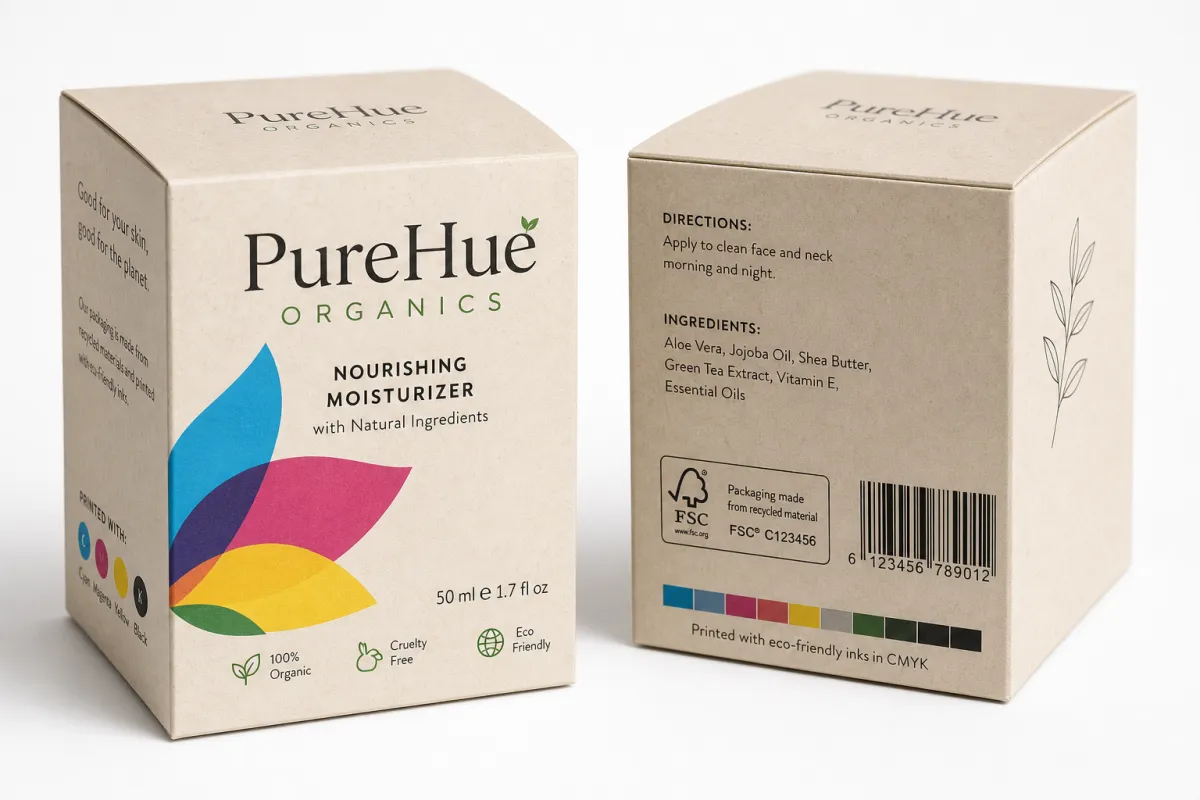
Printed sustainable retail boxes cmyk are not a niche packaging trend. They answer a very ordinary retail problem: how do you keep the box recyclable while still giving it enough color, contrast, and brand presence to earn shelf space? The question matters because buyers often judge the package before they judge the product. A dull carton can lower perceived value without saying a word, even when the item inside is excellent. A strong carton can do the opposite and create confidence before the seal is even broken.
Here is the definition in plain language. Sustainable retail boxes are paper-based cartons or folding boxes made from recyclable board, recycled content, or certified fiber. CMYK is the standard four-color printing process used to reproduce photos, gradients, logos, and illustrations. Printed sustainable retail boxes cmyk bring those two pieces together, and the challenge appears as soon as the substrate changes the way ink behaves. On porous kraft or recycled board, colors may print flatter, darker, or a little muted compared with coated white board.
That difference is why the phrase matters. A buyer who thinks only about disposal may end up with a box that looks weak. A buyer who thinks only about visual drama may end up with a package that uses too much ink, invites extra coating complexity, or pushes the job toward less recyclable finishes. The stronger mindset keeps both sides in view. Printed sustainable retail boxes cmyk should support the brand story, yet they also need to fit the product weight, shipping route, and retail environment.
A carton can be recyclable and still fail on shelf if the color reads muddy, the board feels flimsy, or the finish scuffs before the customer reaches checkout.
In real packaging work, teams often split into two camps. One camp wants plain eco packaging with almost no print. The other wants a full-color carton that behaves like a billboard. Printed sustainable retail boxes cmyk live between those extremes. They allow vivid visuals, but they reward discipline. When the file is built well and the structure matches the board, the result feels intentional rather than generic. When the spec sheet is vague, the box usually tells on the brand very quickly.
The commercial side matters too. Packaging is not only a container; it is a form of retail media that has to survive handling, scanning, stacking, and the occasional wet cart or rough transit lane. A carton that is fully recyclable yet visually confused does less for the brand than a cleaner, smarter design with controlled ink coverage and a good finish. Printed sustainable retail boxes cmyk deserve the same level of care as a product page or a store display.
How printed sustainable retail boxes cmyk work in production
The production path starts long before ink touches board. Printed sustainable retail boxes cmyk begin as artwork files, and those files need separation, trapping, bleed, and dieline alignment before they can become a press-ready job. A designer may see one image on screen; the press sees four separate channels, each with its own dot pattern and density. Once those separations hit the substrate, small errors become visible fast. A weak black can turn gray. A rich red can drift brown if the magenta and yellow balance slips.
That is where the difference between CMYK and spot color becomes important. CMYK works well for photography, gradients, and multi-color graphics. Spot color uses a premixed ink for a specific hue. For a brand that depends on one exact red or blue, a spot ink or a Pantone match may be the safer route. For a box with images or layered illustrations, CMYK usually makes more sense. Many printed sustainable retail boxes cmyk jobs use a hybrid approach: CMYK for the artwork, then a spot color for a critical logo or a deep black panel.
Press method changes the result as well. Offset printing is common for medium and larger runs because it gives strong consistency and clean detail once setup is complete. Digital printing works well for short runs, fast changes, test launches, and versioned artwork. Flexographic printing is often used on simpler packaging structures or corrugated applications, especially where large quantities justify setup and the design does not need photographic detail. Printed sustainable retail boxes cmyk can be produced by any of these methods, yet the economics and finish quality will differ.
Proofing is the checkpoint that saves money. A digital mockup can show layout, but it cannot fully predict how ink will behave on kraft, recycled paperboard, or coated stock. A press proof or production sample gives a far better read on color shift, solid coverage, and text legibility. On recycled stock, a deep navy may need a richer black build. On smoother board, fine type can hold better. Printed sustainable retail boxes cmyk reward teams that proof early, because the biggest surprises usually show up before the full run starts.
Here is the production flow in the order that matters:
- Artwork is checked against the dieline and print area.
- Colors are separated into CMYK channels and any spot color requirements are marked.
- Press setup is dialed in for board type, ink density, and drying conditions.
- A proof or sample is reviewed for color, registration, and folding fit.
- The approved job is printed, cut, creased, glued, and packed.
That sequence looks ordinary. It is not. Each step can change how printed sustainable retail boxes cmyk perform in the market, and each one can either protect or weaken the final impression.
Material, finish, and color factors that change the result
Material choice is where printed sustainable retail boxes cmyk begin to separate in a meaningful way. A 16 pt white folding carton prints differently from a heavier recycled paperboard, and both behave differently from kraft. Board thickness shapes structure, but the surface shapes color. Smooth, coated surfaces hold more detail and stronger saturation. Rough or absorbent surfaces pull in more ink and often mute saturation. If a brand wants to preserve a precise visual identity, that difference is not cosmetic. It changes how the package feels before anyone opens it.
For many retail applications, recycled paperboard, FSC-certified SBS, and kraft are the leading choices. The right material depends on product weight, handling, and brand style. A beauty item that sits on a boutique shelf may justify a smoother white board with controlled ink coverage. An apparel accessory or natural product may suit kraft, especially when the brand wants an earthy look. Printed sustainable retail boxes cmyk do not force one aesthetic. They simply make the tradeoffs easier to see than plain unprinted packaging does.
Finish matters almost as much as the board itself. Aqueous coating can improve scuff resistance while keeping the package closer to a recyclable profile than many plastic-heavy alternatives. A matte varnish can reduce glare and help copy read better under store lighting. Soft-touch lamination feels premium, yet it can complicate recyclability and add cost. Printed sustainable retail boxes cmyk often look more expensive with a restrained finish than with extra ink coverage. One of packaging's quieter truths is simple: polish does not always come from more color. Sometimes it comes from less visual noise.
Heavy ink coverage is another variable brands underestimate. Large solids across multiple panels can extend drying time, show roller marks on rough stock, and increase the chance of rub-off in packing or transit. When the box carries dark backgrounds, gradients, or full-wrap graphics, the printer may need tighter control of ink laydown and drying. That can affect lead time and unit cost. It also affects color consistency from one batch to the next. Printed sustainable retail boxes cmyk stay steadier when the design respects the substrate instead of trying to overpower it.
In my own reviews, the jobs that look cleanest on press are rarely the ones with the most ink. They are the ones where the white space, the coating, and the board choice all agree with the artwork. That can sound kinda boring on paper, but it is usually what makes the carton feel expensive.
Sustainability claims need real specifications behind them. A carton labeled "eco-friendly" means little without details such as FSC certification, recycled content percentage, or curbside recyclability guidance. Industry references from packaging.org can help frame broader material decisions, while FSC's certification framework at fsc.org helps clarify fiber sourcing claims. For transport testing, many teams still look at ISTA or ASTM D4169 because retail packaging has to survive more than a shelf photo shoot. Printed sustainable retail boxes cmyk perform well only when the sustainability story is traceable and the structure survives the supply chain.
One more connection is easy to miss. A subtle finish can improve perception more efficiently than adding more color. A controlled matte coat on printed sustainable retail boxes cmyk may make typography feel sharper and the overall package feel calmer, which can read as premium. That helps brands that want a high-end look without loading the carton with extra ink or mixed materials.
Cost and pricing for printed sustainable retail boxes cmyk
Price usually comes down to four things first: board grade, box size, print coverage, and run length. Printed sustainable retail boxes cmyk can look inexpensive in a quote and still become costly once the real variables appear. A larger carton uses more board. A heavier product may need stronger corrugate or thicker folding carton stock. Full-wrap artwork uses more ink and usually more press attention. Short runs spread setup costs across fewer units, which raises the per-box number quickly.
Setup costs deserve close attention. Dieline prep, plates for offset printing, proofing, finishing adjustments, and freight all affect the final bill. With digital printing, plate costs may disappear, but the unit price can rise on larger runs. With offset printing, setup is often higher upfront, yet the per-unit cost can improve as volume rises. Printed sustainable retail boxes cmyk are rarely cheapest on a single line item basis. The question is whether the total job cost matches the launch risk and the shelf effect the brand wants.
| Option | Best fit | Typical unit price at 5,000 units | Notes |
|---|---|---|---|
| FSC-certified SBS with offset printing | Sharp retail graphics, consistent branding | $0.22-$0.38 | Good for stronger color and cleaner detail |
| Kraft board with digital printing | Short runs, test launches, variable artwork | $0.30-$0.55 | Faster changes, but the surface can mute saturation |
| Corrugated retail box with flexographic printing | Heavier products and shipping-led retail formats | $0.35-$0.70 | Efficient for simple artwork and larger volumes |
| Premium paperboard with special print finishing | Higher-end presentation packaging | $0.40-$0.90 | Coatings, embossing, or foil can raise both cost and complexity |
Those numbers are directional, not a promise. A logo-only carton can cost less than a full-coverage design, but a premium finish can erase that gap quickly. Printed sustainable retail boxes cmyk with tight color matching, windows, inserts, or unusual structural folds can climb in price faster than many teams expect. If the supplier quote does not separate prepress, tooling, print finishing, packing, and freight, the comparison is not really apples to apples.
If the package is part of a branded launch, the cheapest quote is not automatically the least risky. A lower unit price can hide weaker board, a looser color tolerance, or a slower response to revisions. A slightly higher quote may include better proofing and more reliable folding accuracy. That matters when the box sits in a retail channel and every visible defect becomes a brand problem. Printed sustainable retail boxes cmyk are one of those places where a small cost difference can buy a large reduction in stress.
For teams comparing options, it often helps to request quotes tied to one quantity, one board spec, and one finish. Then the differences become easier to read. The best numbers are transparent enough that the buyer can see where the dollars are going, rather than guessing whether the packaging supplier padded the total with hidden setup charges. If you need a benchmark structure, start with a quote request through Custom Packaging Products and ask for a separate line on board, print, and finish.
Step-by-step ordering and timeline for printed sustainable retail boxes cmyk
The best orders start with clean inputs. Before asking for a quote, gather the product dimensions, weight, retail channel, sustainability requirements, and any hard constraints such as shelf height or shipment count. Printed sustainable retail boxes cmyk become much easier to price once the supplier knows whether the box must support display use, shipping use, or both. A folding carton for a lightweight accessory is a different job from a carton that has to survive pallet handling and display in a high-traffic store.
The first inquiry should include dieline dimensions, artwork files, preferred board type, finish preference, target quantity, and any brand color tolerance notes. If the logo must stay within a tight visual range, say so. If a warm recycled look is acceptable, say that too. The more the supplier understands upfront, the fewer revision cycles the job usually needs. Printed sustainable retail boxes cmyk move faster when the spec is clear enough to remove guesswork from the early stage.
Approval usually runs through three checkpoints: digital mockup, physical sample or press proof, and final sign-off. A digital proof checks layout and copy. A sample reveals structure and color behavior. Final sign-off locks the job before mass production starts. Once that approval is given, changing artwork late in the process can be expensive because it affects plates, file prep, and scheduling. Printed sustainable retail boxes cmyk are not difficult to order, but they do punish indecision.
A realistic timeline often breaks down like this:
- Prepress and file review: 1-3 business days.
- Proofing or sampling: 2-7 business days, depending on complexity.
- Production: often 7-15 business days after approval.
- Finishing, packing, and shipping: 2-5 business days, sometimes longer for freight.
That timeline can stretch if the job needs special die cutting, inserts, or a complex coating. Printed sustainable retail boxes cmyk also slow down when late artwork changes arrive after the proof has already been approved. In many cases, the bottleneck is not the press run. It is the chain of sign-offs around it. A supplier can print quickly; they cannot print around missing data or delayed approvals.
For brands that need both speed and a lower-risk rollout, a pilot run is often the smartest move. A smaller quantity reveals color drift, fold accuracy, barcode readability, and how the board behaves under store handling. If the design is new, pilot runs protect the larger launch. That is especially true for printed sustainable retail boxes cmyk using recycled board, where texture and ink absorption can shift the final tone more than expected.
Supplying the wrong file format causes more delays than most teams expect. Use the correct dieline, keep the bleed consistent, and keep rich blacks intentional rather than accidental. Ask the supplier whether they want layered files, outlined text, or a specific PDF standard. Those details sound minor. They often determine whether printed sustainable retail boxes cmyk move from proof to production without friction.
Common mistakes that waste time and budget
The most common mistake is assuming a screen color equals a print color. It does not. Printed sustainable retail boxes cmyk built on recycled or uncoated stock often look softer than the same file on a glossy monitor. That gap can be dramatic with blues, reds, and dark neutrals. If the brand expects a Pantone-level match from process ink alone, disappointment is almost guaranteed. A proof is the best reality check, not the mockup.
Another mistake is choosing a box only for the eco label. A carton can sound responsible and still be wrong for the product. If the board is too light, the box may crush in transit. If it is too rough, fine text can lose clarity. If the finish is too heavy, the package may no longer fit the recycling target. Printed sustainable retail boxes cmyk work best when sustainability supports performance instead of replacing it.
Skipping samples is expensive. A small shift in hue can make a product line look inconsistent across SKUs, especially if the same artwork is printed on both kraft and white board. One batch can feel warm; the next can feel dull. That kind of drift is subtle on a spreadsheet and obvious on a shelf. Printed sustainable retail boxes cmyk reward teams that insist on a sample before volume production.
Rushed timelines create a different kind of cost. When a launch date is already tight, teams often compress approval windows, skip review rounds, or accept weaker finishes just to keep moving. That can save a week and cost a lot more later through reprints or launch-day inconsistency. Add missed bleeds, unclear dieline notes, and too much solid coverage, and the schedule can slip fast. The safest jobs are usually the ones with the least drama before the press starts.
A short list of avoidable errors is worth keeping handy:
- Assuming CMYK will match a bright screen exactly.
- Using a board that is too rough for the intended artwork.
- Leaving too much solid ink coverage on absorbent stock.
- Skipping bleed and safe-zone checks on the dieline.
- Ignoring how the box will be stacked, shipped, and handled in-store.
Those are the errors that quietly eat margin. Printed sustainable retail boxes cmyk are not complicated because they are trendy. They are complicated because every visible decision on the box has a material, financial, and operational consequence.
What to do next with printed sustainable retail boxes cmyk
Start with the product itself. Confirm the dimensions, weight, retail environment, and the level of protection the box must provide. Then decide what sustainability means for the job. Is the priority recycled content, FSC certification, curbside recyclability, or a lower-ink design? Printed sustainable retail boxes cmyk become much easier to specify once the team knows which target matters most. Without that order of operations, the conversation tends to drift toward vague language and inflated expectations.
Next, request a proof or sample and ask for a written note on board type, finish, estimated color tolerance, and lead time. If the supplier cannot explain how the artwork will behave on the chosen substrate, that is a useful warning. Printed sustainable retail boxes cmyk should be judged on measurable details, not on a promise that the final result will "look close enough." Ask for the specific board name, the finish type, and the likely print method, whether that is offset printing, digital printing, or flexographic printing.
If the design is new, a pilot run usually pays for itself. A small test reveals whether the typography stays readable, whether the logo sits correctly on the fold, and whether the package holds up in real handling. That is especially useful for brands planning a broader family of cartons. A test run of printed sustainable retail boxes cmyk can expose a structural problem before it becomes a warehouse problem.
For supplier comparisons, keep the cost categories separate. Unit price is only one line in the story. Setup, tooling, sampling, freight, and revision charges can matter just as much. A supplier with a slightly higher per-unit quote may deliver a cleaner proof process and fewer surprises. That can be worth more than a superficial discount. If you need a place to start gathering packaging options, Custom Packaging Products can help you frame the request in a way that makes the quote easier to compare.
Printed sustainable retail boxes cmyk work best when the team locks the specs first, then approves the color, structure, and timeline in that order. That sequence keeps the job grounded. It also keeps the box honest: sustainable enough to make sense, colorful enough to sell, and precise enough to feel deliberate in the customer's hands.
Are printed sustainable retail boxes cmyk recyclable?
Usually yes, if the base board is recyclable and the finish does not add a non-recyclable layer. Printed sustainable retail boxes cmyk are easiest to recycle when they use paper-based board, minimal plastic content, and finishes that local curbside programs accept. Heavy plastic windows or mixed-material wraps can complicate that picture.
Can printed sustainable retail boxes cmyk match Pantone colors exactly?
CMYK can get close, but it will not always match a Pantone shade exactly, especially for vivid or fluorescent colors. Printed sustainable retail boxes cmyk often need proofing and a stated color tolerance so everyone agrees on what counts as an acceptable match before the run starts.
What affects the price of printed sustainable retail boxes cmyk the most?
Material grade, run length, print coverage, finishing, and box complexity usually drive the biggest price swings. Printed sustainable retail boxes cmyk also carry setup costs for dielines, plates, samples, and freight, and those items can matter more than many brands expect.
How long do printed sustainable retail boxes cmyk usually take to produce?
The timeline depends on approval speed, sample requests, and whether the job is digital or offset printed. Printed sustainable retail boxes cmyk often move in 1-3 days for prepress, 2-7 days for proofing, and roughly 7-15 business days for production after sign-off, though revisions can add time.
Which materials work best for printed sustainable retail boxes cmyk?
FSC-certified paperboard, recycled paperboard, kraft, and corrugate are common choices, depending on product weight and shelf goals. Printed sustainable retail boxes cmyk work best on the board that fits the product, the print expectation, and the retail setting, not just the board that sounds greenest.
Practical takeaway
Before you approve printed sustainable retail boxes cmyk, lock four things in writing: the board spec, the finish, the acceptable color range, and a proof or sample that was judged on the actual substrate. If those four pieces are clear, the box is far more likely to feel intentional on shelf, hold up in transit, and still make sense when it reaches the recycling stream. That is the real win, and it is usually decided long before the first carton gets folded.


