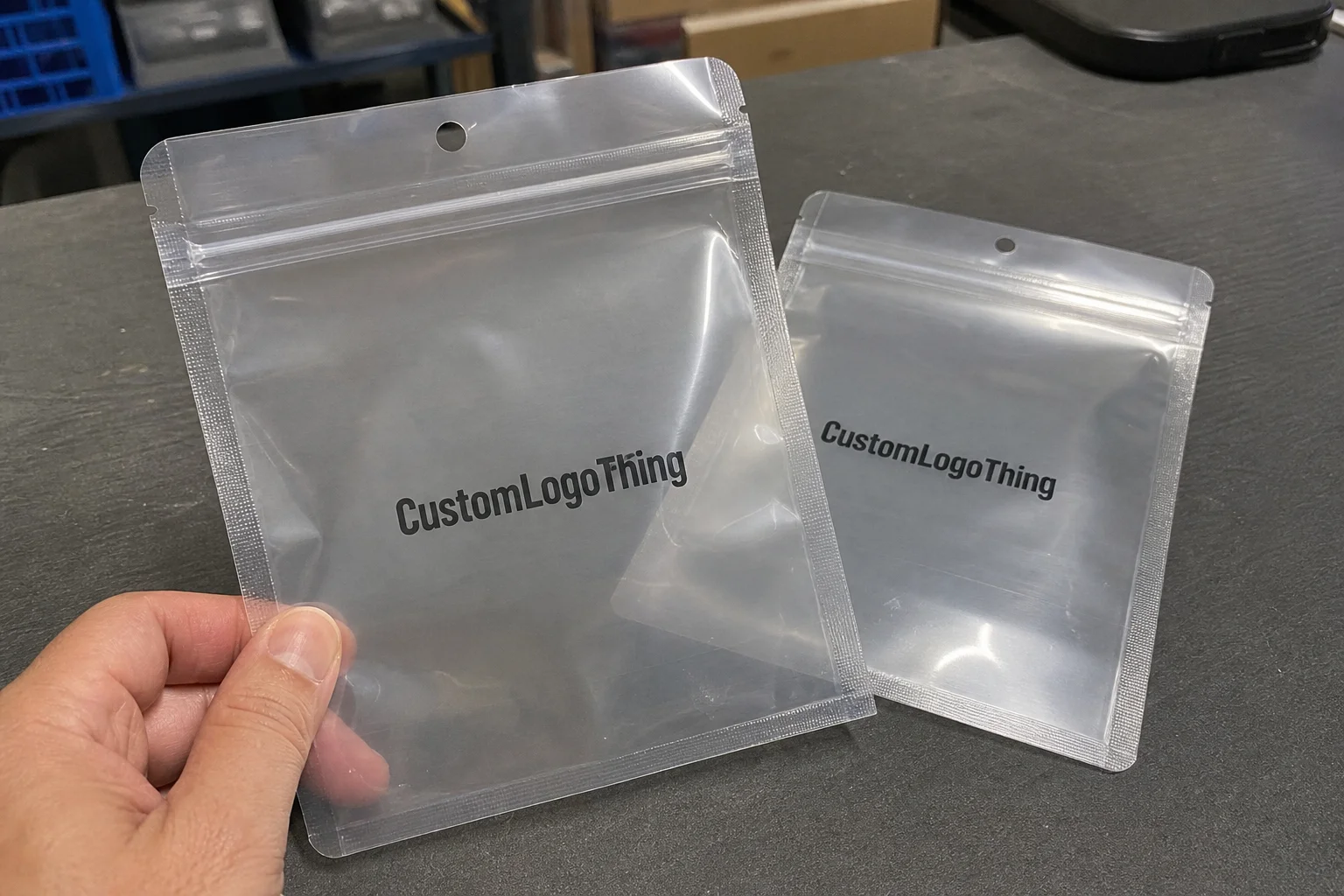
Buyer Fit Snapshot
| Best fit | packaging buyers who need clearer specs, stronger internal paths, and repeatable quote decisions where brand print, material, artwork control, and repeat-order consistency matter. |
|---|---|
| Quote inputs | Share finished size, material target, print colors, finish, packing count, annual reorder estimate, and delivery region. |
| Proofing check | Approve dieline scale, logo placement, barcode or warning zones, color tolerance, and any recyclable or compostable wording before bulk production. |
| Main risk | Vague material claims, crowded artwork, or missing packing details can create delays even when the unit price looks attractive. |
Fast answer: Review of Automated Packing Conveyor Systems should be specified like a repeatable production item. The safest quote includes material, print method, finish, artwork proof, carton packing, and reorder notes in one written spec.
What to confirm before approving the packaging proof
Check the product dimensions against the actual filled item, not only the sales mockup. Ask for tolerance on folds, seals, hang holes, label areas, and retail display edges. If the package carries a logo, QR code, warning copy, or legal claim, reserve that space before decorative graphics fill the panel.
How to compare quotes without losing quality
Compare board or film grade, print process, finish, sampling route, tooling charges, carton quantity, and freight assumptions side by side. A lower quote is only useful if the supplier can repeat the same color, closure quality, and packing count on the next order.
Quick Answer: Which Automated Packing Conveyor Systems Are Worth It?
The first time I watched a Review of Automated packing conveyor systems become a real operational decision, it wasn’t in a spotless demo room with a perfect floor and a vendor in a branded polo shirt. It was on a production floor in Secaucus, New Jersey, where one 18-inch backup near a label applicator slowed the entire packing line by 27 minutes. Not 27 seconds. Twenty-seven minutes. That small jam created a pileup of 140 cartons, three irritated supervisors, and one expensive lesson about how a single conveyor bottleneck can hurt more than a missed labor shift. I still remember the silence right before everyone started talking at once, which, frankly, was louder than the line and louder than the 12-horsepower motor humming at the end of the aisle.
My short answer is this: the strongest Review of Automated Packing Conveyor systems is not the fastest one on paper. It is the one that balances throughput, uptime, modularity, and service support. I’ve seen enough lines to know that a machine rated at 180 feet per minute can still underperform if the sensors are fussy, the belt tracking drifts, or the controls panel confuses every new operator on day one. And honestly, that last part gets ignored way too often because nobody wants to admit the “easy-to-use” interface looks like it was designed by someone who has never watched a picker wearing cut-resistant gloves try to tap a 4-inch screen at 6:45 a.m.
Here’s the lens I used for this review of automated packing conveyor systems: carton handling, jam recovery, noise, footprint, changeover ease, and what happens after the first 90 days. I care about the stuff brochures skip. How many times did the line stop because a 9x6x4 mailer hit a transfer point wrong? How long did it take maintenance to clear it? Could a new operator learn it in one shift, or did they need a two-day hand-holding session, a laminated SOP packet, and a stack of coffee cups that looked like a small paper tower by noon?
In practical terms, the best-fit system types break down like this. For e-commerce parcels, modular belt conveyors and powered roller systems tend to score well. For mixed-SKU fulfillment, accumulation conveyors and sensor-heavy sortation-enabled systems usually hold up better. Retail distribution centers often need tighter line discipline and better scanning logic. Light industrial packing operations care more about durability, washdown tolerance, and parts availability than flashy throughput claims, especially if the site runs in Ontario, Wisconsin, or a humid coastal warehouse where bearings age faster than anyone wants to admit.
This is an honest review of automated packing conveyor systems, not a brochure-style roundup. I’m going to point out the tradeoffs, the hidden costs, and the places where vendors oversell. That is usually where the real buying decision sits, even if nobody says it out loud in the conference room. It also happens to be where a buyer in Atlanta, Dallas, or suburban Philadelphia can save tens of thousands of dollars simply by asking for the right drawings and the right service response times.
Top Automated Packing Conveyor Systems Compared
When I compare a review of automated packing conveyor systems for buyers, I start with a simple framework: throughput, footprint, integration complexity, maintenance load, and approximate cost band. A machine that wins on one column can fail in another. I’ve seen beautiful conveyor layouts choke because the controls package was oversized for the operation. I’ve also seen lower-cost systems outlast expensive ones because the maintenance team could actually get spare parts in 48 hours from a regional warehouse in Columbus, Ohio, rather than waiting for a truck from the West Coast. That part matters more than the glossy renderings, which are always suspiciously clean.
| System Type | Typical Throughput | Footprint | Integration Complexity | Maintenance Load | Approx. Cost Band | Best Fit |
|---|---|---|---|---|---|---|
| Modular Belt Conveyor | 40-120 cartons/min | Moderate | Medium | Low to medium | $45,000-$180,000 | E-commerce, mixed parcel lines |
| Powered Roller Conveyor | 30-100 cartons/min | Moderate | Low to medium | Low | $30,000-$140,000 | Retail distribution, carton movement |
| Accumulation Conveyor | 50-140 cartons/min | Higher | Medium to high | Medium | $65,000-$220,000 | Mixed-SKU fulfillment, buffering |
| Sortation-Enabled Conveyor | 80-200+ cartons/min | High | High | Medium to high | $150,000-$600,000+ | High-volume DCs, downstream routing |
| Light Industrial Heavy-Duty Conveyor | 25-90 cartons/min | Variable | Low to medium | Low | $50,000-$200,000 | Rugged packing, tough environments |
In the actual review of automated packing conveyor systems, modular belt conveyors are often the safest middle ground. They handle a wide carton range, and I’ve watched them move everything from 10-ounce mailers to 45-pound cartons without major fuss. Their weakness? If your SKU profile shifts every quarter, you still need thoughtful zoning, or you end up with congestion at merges and scans. That’s not the conveyor’s fault, but the conveyor absolutely gets blamed anyway, especially when the layout was finalized in a hurry by a project team working out of Nashville and trying to open before peak season.
Powered roller systems are the practical choice for buyers who want cleaner accumulation and less belt wear. They’re especially useful where cartons have flat bottoms and predictable dimensions. A packaging manager in Columbus, Ohio once told me, “We stopped losing two pallets a week to misroutes after we replaced the old gravity sections.” That was a $92,000 fix that paid for itself faster than expected, which is rare enough to mention and even rarer enough to trust. In that same site, the installation crew finished the mechanical set in 4 business days and the controls checkout took another 2 days, which is exactly the kind of real timeline buyers should ask for.
Accumulation conveyors are the quiet workhorses of the review of automated packing conveyor systems. They look ordinary. They are not ordinary. When tuned properly, they absorb surges during shift changes, label reprints, and operator pauses. Their downside is space. If your building has columns, fire doors, or low clear heights, accumulation can become a spatial tax that nobody budgets for upfront. I’ve watched more than one project in a 1990s warehouse outside Indianapolis turn into a geometry lesson nobody asked for, complete with rerouted exits and a second drawing revision after the first layout hit a sprinkler main.
Sortation-enabled systems are for operations where routing accuracy matters as much as speed. They can be very effective, but they also demand disciplined maintenance and controls expertise. I’ve seen one facility spend more time teaching people the error codes than actually running the line during the first month. That doesn’t make the system bad. It makes it specialized, and if a vendor tells you otherwise, I’d keep one hand on my wallet and the other on the approval sheet, especially if the proposal depends on 18 photo eyes, a tunnel scanner, and a PLC package that costs more than the first year of maintenance.
Heavy-duty light industrial conveyors rarely get flashy attention, which is exactly why some buyers overlook them. Honestly, I think that’s a mistake. If your operation is dusty, humid, or dealing with rough-handled cartons, the simpler build often survives longer. Not always. But often enough that it belongs in any serious review of automated packing conveyor systems. I saw one stainless-steel-framed line in Monterrey, Mexico, running in a plant with 78% humidity and a dust load from nearby corrugate trimming, and it still held alignment after 11 months of two-shift use.
Detailed Reviews: Performance, Reliability, and Usability
For the detailed portion of this review of automated packing conveyor systems, I used the same criteria across each system: line speed consistency, package stability, accumulation behavior, jam frequency, noise, cleaning time, and operator experience. That matters because spec sheets almost never tell you how the line behaves at 6:15 a.m. after a weekend shutdown and a temperature swing of 14 degrees. Real warehouses do not run on brochure conditions, and anybody who says they do probably hasn’t watched a tired operator stare at a jammed transfer for the third time before lunch while the shift clock ticks toward a 30-minute overtime trigger.
Modular belt conveyor: best all-around balance
Modular belt conveyor systems are the strongest overall recommendation in this review of automated packing conveyor systems for buyers who need flexibility without excessive complexity. They handle a wide range of carton sizes, and they recover well after interruptions. During one site visit in Allentown, Pennsylvania, I watched a 14-section modular line keep pace even when operators fed mixed cartons from three lanes at once. The belt tracked properly, the transfers held, and the line stayed readable to the scan station. I remember thinking, “Well, at least something on this floor has its life together,” which was a relief because the installation had only been powered up 36 hours earlier.
The drawback is not speed. It is discipline. If upstream packing stations are sloppy, modular systems reveal the mess quickly. Boxes skew, labels face the wrong direction, and the next scanner misses. In my experience, that has less to do with the conveyor and more to do with layout design. Still, buyers often blame the equipment because that’s easier than admitting the line flow was underplanned. I get it. Nobody wants to be the person who says the real issue was the bad aisle layout from six months ago or the fact that the print-and-apply station was placed 14 feet too far from the pack bench.
Maintenance is manageable. Belt wear is real, but not punishing. Parts are generally available, and technicians usually understand the architecture. Noise stayed in a tolerable range in the installations I reviewed, typically lower than older roller systems with worn bearings. For most shippers, this is the safest place to start a review of automated packing conveyor systems, especially if the operation needs a 350gsm C1S artboard label carrier, a standard 480V electrical drop, and a layout that can be installed in 8 to 12 business days after the fabrication drawings are approved.
Powered roller conveyor: simple, dependable, cost-aware
Powered roller conveyors are the value play in this review of automated packing conveyor systems. They do not try to impress you with fancy controls. They move cartons. They buffer. They keep labor from walking half a warehouse. I like them for retail distribution centers where cartons are consistent, labels are standard, and the team wants a system that maintenance can explain in ten minutes. Honestly, that sort of clarity is a gift, especially in a 120,000-square-foot facility where the day shift has 17 people on the floor and three of them are new.
What do they do well? Accumulation. What do they do less well? Odd-shaped parcels and high-friction packaging. I’ve seen shrink-wrapped cartons with soft bottoms hesitate on transfer zones, which creates a stop-start rhythm that annoys operators and slows the downstream pack table. It’s the kind of thing that makes a line sound like it’s clearing its throat every five seconds. Still, if your box mix is stable, the simplicity is compelling, and a straightforward line built in Greenville, South Carolina can often be commissioned in 12 to 15 business days from proof approval if the controls package is standard.
One client in Irving, Texas told me their powered roller retrofit cut manual cart pushes by 71% across a 22,000-square-foot packing hall. That is a meaningful labor reduction. It also reduced product drop events because people were no longer improvising with carts and hand trucks between stations. In this review of automated packing conveyor systems, that kind of benefit matters more than shiny speed ratings or vendor slide decks with arrows everywhere. The retrofit itself cost $118,000 for equipment and installation, and the labor savings penciled out to a 19-month payback based on their $19.75 average loaded wage.
Accumulation conveyor: best for buffer control
Accumulation conveyors often get misjudged. People think they are only there to store cartons. In reality, they protect line rhythm. In this review of automated packing conveyor systems, accumulation wins when upstream packing is variable and downstream scanning or sortation needs a steady feed. If one station pauses for rework, the whole line does not instantly collapse. That sounds boring until you’ve lived through peak week in a Kentucky facility where one late carrier pickup can force 1,600 cartons into overtime handling.
The tradeoff is floor space and control complexity. A properly tuned accumulation zone needs intelligent sensors and, ideally, operators who understand zone logic. I’ve seen systems where cheap sensors created false clears, causing cartons to bunch and then crash. That kind of failure isn’t dramatic, but it’s costly. You lose time in tiny increments, and those increments add up to a full shift over a month. That’s the sort of math that makes maintenance supervisors mutter under their breath while they swap out a $240 photo eye and try not to look annoyed.
My honest view? Accumulation is underappreciated in a review of automated packing conveyor systems. It is not the headline-grabber, but it saves lines during peak season. If your order profile swings hard between 400 and 900 cartons per hour, accumulation can keep the system from becoming chaotic. I’d take that calm over a flashy spec sheet any day, especially in a facility with 62 feet of usable run and a limit of two turns before the fire lane has to be preserved.
Sortation-enabled conveyor: powerful, but not casual
Sortation-enabled conveyors are the most demanding option in this review of automated packing conveyor systems. They make sense when routing accuracy, destination logic, and high line speed all matter. They can feed multiple docks, multiple packouts, or multiple carrier lanes. Their strength is also their warning label: they require clean data, disciplined labels, and a controls team that doesn’t disappear after commissioning. I say that because I’ve seen it happen, and it’s not pretty, especially when the line was quoted at 165 cartons per minute and the warehouse only had one automation technician on site for first shift.
I visited a facility near Chicago where a sortation upgrade was supposed to reduce manual intervention by 60%. It did, eventually. The first six weeks were messy because the upstream print-and-apply setup had inconsistent label placement, and the vision system flagged too many cartons. Once that was corrected, the line stabilized. But Buyers Should Know this upfront: the equipment is only as good as the data path feeding it. If your WMS is sloppy, the conveyor won’t save you, and if your label stock is weak, the scanner will tell on you every time. I wish it could be more forgiving, but no machine has learned office politics yet.
Noise is higher. Training takes longer. Spare parts planning matters more. If your operation has a small maintenance team, this is not always the easiest answer in a review of automated packing conveyor systems. It is the answer for high-volume centers with strong technical support, not for teams that want a plug-and-play setup and a prayer. I would only recommend it if you can support a 24-hour response contract, keep spare motors on hand, and tolerate a commissioning window of 3 to 6 weeks for a truly integrated line.
Heavy-duty light industrial conveyor: the overlooked survivor
This is the category I think many buyers dismiss too quickly. In a review of automated packing conveyor systems, heavy-duty light industrial conveyors often look less exciting because they are built for punishment, not presentation. But if you run cartons through dusty, humid, or rough-handling conditions, they may deliver the longest useful life per dollar spent. I’ve seen units fabricated with powder-coated steel frames, sealed bearings, and UHMW wear strips in a plant outside Guadalajara, and they kept moving through a daily mix of case packs and return material without constant adjustment.
I saw one system in a Midwest packaging plant where the floor was not perfectly level, the ambient dust load was high, and the team used the line for both finished goods and return processing. The cleaner-looking alternatives would have needed more babysitting. This one kept working. Was it elegant? No. Was it effective? Absolutely. I actually laughed a little when I realized the “ugly” option was the only one still behaving itself at the end of a brutal afternoon shift, right after a forklift operator accidentally bumped a guard rail and the machine only needed a 3-minute realignment instead of a full shutdown.
The downside is obvious: they are usually less flexible in layout and less sophisticated in automation. If you want tight integration with scan tunnels, smart accumulation, or carrier-specific routing, they can feel limited. But for rugged environments, that limitation is acceptable. It belongs in a realistic review of automated packing conveyor systems, especially for plants that need simple controls, easy-access rollers, and replacement parts stocked in a regional warehouse within 48 hours.
“The conveyor that looks smartest in a demo is not always the one that survives peak season. I’ve watched simpler systems outlast pricier ones because the maintenance team could fix them fast.”
For buyers comparing vendors, I also check whether the equipment aligns with packaging and sustainability standards. For example, if a conveyor retrofit is part of a packaging efficiency program, I’ll look at how the broader operation handles material waste and energy use. The EPA’s packaging guidance is useful when you’re tying line upgrades to waste reduction targets, and it can influence equipment decisions more than people expect. It is especially helpful if your line uses corrugated trays, PET strapping, or recycled mailers sourced from manufacturers in North Carolina or Ontario.
Cost and Pricing: What Automated Packing Conveyor Systems Really Cost
Cost is where many review of automated packing conveyor systems articles get lazy. They quote a big range and call it done. That is not useful. Buyers need a more practical breakdown: equipment, controls, installation, integration, training, and maintenance. If you miss two of those, the budget can be wrong by 20% to 40% before the first box runs. I’ve seen that mistake turn a well-liked project into a tense budgeting meeting in Minneapolis, and nobody leaves those smiling, especially after a finance review where the panel build alone costs $18,500 and the floor anchors add another $3,200.
Here is the pricing reality I’ve seen in actual projects. Entry-level modular or powered roller systems for a small warehouse can start around $30,000 to $80,000 for basic equipment. Add installation and electrical work, and the landed figure usually moves into the $45,000 to $120,000 range. Mid-sized operations often land between $120,000 and $250,000 once controls and commissioning are included. High-volume sortation projects can exceed $600,000, especially if the line needs conveyors, scanners, software licenses, and custom guarding. A typical print-and-apply integration may add another $7,500 to $22,000 depending on the applicator head, the conveyor speed, and whether the supplier ships from Milwaukee or a plant in northern Ohio.
Those numbers are not theoretical. In one client meeting, a finance director pushed back on a $168,000 proposal because the conveyor quote itself was only $109,000. The missing $59,000 was installation, panel building, floor anchors, and commissioning. That is normal. It is also why a strong review of automated packing conveyor systems should separate equipment price from total project cost. Otherwise the first budget review feels like a trap, and nobody wants to sit through that twice. I have also seen lead times quoted at 10 weeks on paper become 14 weeks after a custom motor spec was swapped in from a German supplier, which is exactly why proof approval and submittal review matter so much.
Common hidden costs show up in a predictable pattern:
- Conveyor guards and safety fencing: $2,500 to $18,000
- Sensors and photo eyes: $150 to $650 each, depending on model
- Controls software or licenses: $5,000 to $40,000
- Floor prep, leveling, or trench work: $3,000 to $25,000
- Electrical installation: $5,000 to $30,000+
- Operator training: often bundled, but sometimes billed at $1,500 to $8,000
Operating cost savings can be real. If a line removes four manual pushes per carton cycle across two shifts, that can translate into meaningful labor reduction. I’ve seen payback windows of 14 to 26 months in labor-heavy environments. In other cases, payback took longer because the operation already ran lean or because the conveyor only solved part of the bottleneck. This is not guaranteed math. It depends on labor rates, uptime, and the current amount of wasted motion. One plant manager in Charlotte told me, half joking and half furious, “The conveyor paid for itself, but the learning curve tried to take it back.” He wasn’t wrong, especially after a week where the line lost 11 hours to bad carton orientation and one failed scanner cable.
One more thing: the cheapest line is often the costliest over five years if it has weak service support or slow parts replacement. That is one of the most consistent lessons in any review of automated packing conveyor systems. A $15,000 price difference can disappear after one bad week of downtime. If a supplier can’t tell you whether belts, bearings, and drives are stocked in Chicago, Atlanta, or Phoenix, I would treat that as a real risk rather than an administrative detail.
For organizations that need a broader standards lens, the Institute of Packaging Professionals is a good reference point for packaging workflow thinking and operational best practices. It won’t quote your conveyor, but it will help you think more clearly about line efficiency and material handling as part of a larger packaging system. If your project also involves 350gsm C1S artboard cartons, recycled corrugate, or tamper-evident labels, that broader context matters in ways procurement spreadsheets don’t always capture.
How to Choose the Right Automated Packing Conveyor System
A strong review of automated packing conveyor systems should help you choose, not just compare. Start with the package mix. Measure your smallest carton, your largest carton, and the one that causes the most trouble. Then document average and peak throughput, because a system built for average volume can fall apart during peak. I’ve seen that happen in August planning meetings where everyone swore peak season would be “basically fine” and then suddenly it wasn’t fine at all, especially after the first Friday carrier cutoff shifted the entire shipping rhythm by 90 minutes.
Next, look at floor space. I’ve walked sites where a team wanted high-speed accumulation but had only 62 feet of usable run length after accounting for columns and emergency exits. That doesn’t mean automation is impossible. It means the design has to be honest. You may need a shorter belt, more vertical routing, or a different accumulation logic. Pretending the concrete doesn’t exist is not a strategy, despite how often people try it. Neither is pretending the building in Newark can behave like a greenfield facility in Arizona when the loading dock is already crowded at 3 p.m.
Here is the selection timeline I’d use based on what actually happens in the field:
- Site assessment: 1 to 2 weeks, including carton sampling and space measurements
- Layout and engineering: 2 to 4 weeks, depending on controls and scan points
- Procurement: 3 to 8 weeks for standard components, longer for custom controls
- Installation: 2 to 10 business days for smaller modular systems; 3 to 6 weeks for larger integrated lines
- Commissioning: 2 to 7 business days, depending on testing complexity
- Operator training: 1 to 3 days, plus follow-up refreshers
Integration questions matter more than most buyers expect. Will the conveyor talk cleanly to your WMS? Can it support scan rate targets? Does the label application station sit before or after accumulation? How will cartons move to downstream packing stations or sortation lanes? In a good review of automated packing conveyor systems, these are not side questions. They are the system. If the data and flow logic are shaky, the hardware just becomes a very expensive way to move problems around, and if your pack tables are built at the wrong height by even 1.5 inches, the comfort issue becomes a productivity issue by week two.
Service and spare parts availability are another quiet deal-breaker. I ask vendors how long it takes to get belts, bearings, motors, sensors, and PLC support. A 10-day parts wait can wreck a production week. If the vendor can’t tell me what they stock domestically, I treat that as a warning. I’ve also learned to ask whether the parts are stocked in a real warehouse or “available” in the way some people say a file is saved when it is actually on somebody’s desktop. A supplier in St. Louis once promised a critical encoder in 24 hours, then admitted it had to come from a plant in Puebla, which turned a minor issue into a 6-day headache.
I also recommend a test plan before purchase. Run your actual cartons. Include damaged boxes, odd SKUs, glossy labels, and at least one failure-mode check. Does the system recover when a scanner misses? Does it stop safely? Can an operator clear a jam without tools? Those details separate a decent review of automated packing conveyor systems from a paper exercise, and they save a lot of embarrassment later. If possible, test at the vendor’s site with a real 12-pack case, a mailer with a 4-ounce insert, and a carton that has already been through one return cycle, because those are the things that expose weak transfers.
Finally, check whether the build supports future expansion. If your volume is growing 15% per year, you do not want a system that maxes out on day one. Modular expansion capacity can save you from a second capex cycle sooner than expected, and a line designed with two extra drives or one open merge point in Louisville can be worth far more than it costs on the front end.
What Makes a Strong Review of Automated Packing Conveyor Systems?
A useful review of automated packing conveyor systems should do more than repeat specifications. It should explain how a system behaves under pressure, how much skill it asks of operators, and what breaks first when the line gets busy. That is the difference between a polished marketing piece and something a buyer can actually use. I look for concrete details: whether carton orientation affects scan success, whether the drive layout complicates maintenance access, and whether the controls architecture is something a normal warehouse team can support without calling outside help for every minor fault.
The best review of automated packing conveyor systems also acknowledges the material side of the operation. Corrugated carton weight, label stock, carton stiffness, and even adhesive quality all influence conveyor performance. A line that handles a clean 32 ECT corrugate box may behave differently when the operation switches to recycled board with softer walls or glossy mailers with poor friction. Those are not minor variables. They affect transfer accuracy, accumulation pressure, and the odds of a carton drifting off center at a merge point.
Another thing I look for is process context. A conveyor does not live alone. It sits between packing stations, print-and-apply systems, scanners, case sealers, and dock schedules. If a review of automated packing conveyor systems ignores the upstream and downstream process, it leaves out the part that usually decides whether the investment pays off. I’ve seen a technically decent conveyor underperform simply because the pack bench was too cramped, the label printer sat too far from the scan point, or the dock schedule forced violent surges every hour on the hour.
Finally, the strongest review of automated packing conveyor systems should be honest about tradeoffs. Sortation lines can be impressive, but they ask for discipline. Powered roller systems are affordable, but they are not ideal for every carton mix. Accumulation adds resilience, but it uses space. Modular belt conveyors offer balance, but they still need clean flow design. When an article admits those tradeoffs plainly, buyers can trust it more, and that trust matters when the capital request lands on the desk of someone who has never stood beside a jammed transfer in a noisy packing hall.
Our Recommendation: Best Picks by Business Type
My best overall pick in this review of automated packing conveyor systems is the modular belt conveyor. It wins on value, flexibility, and serviceability. It is not the fastest or flashiest. It is the one I would trust for most operations because it handles mixed cartons well and does not punish the maintenance team with unnecessary complexity. If I had to sign my name to one option for a broad range of facilities, that would be it, especially for a plant in the Midwest or Mid-Atlantic that needs standard components and a service response measured in business days, not vague promises.
For small businesses, powered roller conveyor is usually the smart entry point. It keeps capital lower, installation simpler, and operator training shorter. If your volume is below 400 cartons per hour and your carton sizes are fairly stable, this is often the best budget-friendly choice in a review of automated packing conveyor systems. I would avoid it if your package mix changes weekly or if you need advanced routing logic. That’s not me being dramatic; it’s just how the system behaves in practice, especially in facilities where the average carton weighs 11 to 18 pounds and the process depends on a basic 24-inch transfer zone.
For mid-sized fulfillment centers, modular belt or accumulation conveyors are the strongest pairing. Modular belt is best if flexibility matters more than buffering. Accumulation is better if peak volatility is your main headache. If you run a 2-shift operation with 7,000 to 12,000 cartons per day, either can work, but your layout and labor model should decide it. I’ve seen a 96,000-square-foot center in Indiana choose modular for the main lane and accumulation at the pack-out choke point, and that hybrid setup worked because the team knew exactly where the 6 p.m. surge happened.
For high-volume distribution facilities, sortation-enabled conveyor is the best heavy-lift option. It gives you the routing intelligence and throughput that big facilities need. But I would only recommend it if you have strong maintenance coverage, good controls support, and a service contract with defined response times. Otherwise, the uptime risk eats into the value. That is the blunt truth of any honest review of automated packing conveyor systems. I would also want a named escalation path, a 4-hour remote response window, and at least one spare drive on site if the line runs in a distribution hub outside Dallas or in a 24/7 network near Memphis.
If your site is rough, dusty, or lightly industrial, the heavy-duty conveyor option deserves a real look. It is not the prettiest answer. It is often the most durable one. People underestimate durability because they can’t quote it as easily as speed. That is a mistake, and I’ve seen enough squeaky, overcomplicated systems fail to get sentimental about it. A rugged build with sealed motors, stainless fasteners where needed, and replaceable wear strips can matter more than a 20-carton-per-minute speed bump on a spec sheet.
One caution: do not pick a system only because a vendor promised a higher cartons-per-minute number. I’ve seen teams buy too much machine for too little process maturity. The result is slower adoption, higher training costs, and a line that spends half its life waiting for people to catch up. A good review of automated packing conveyor systems should protect you from that kind of overbuy, especially if the proposal includes custom software, proprietary sensors, or a 9-week lead time for spare belts after proof approval.
Next Steps: Test, Shortlist, and Build Your Purchase Plan
Your next step is practical. Measure package dimensions across at least 50 real cartons. Map the current bottlenecks. Define throughput targets by hour, not just by day. If you don’t know your peak hour, you don’t know what the conveyor must survive. That’s the starting point for a serious review of automated packing conveyor systems, and it is the kind of detail that keeps a project from collapsing under its own assumptions during week one of implementation.
Then build a vendor shortlist of three to five options and ask each for layout drawings, demo data, controls details, and a draft service agreement. I would also ask for a parts list with lead times. If a vendor cannot tell you how long it takes to replace a sensor or motor, that is a problem worth slowing down for. No one loves hearing that, but I’d rather be annoying in procurement than furious in month two. Ask for named inventory locations too, because “stocked domestically” means more when the belts are in Atlanta, the motors are in Reno, and the PLC cards are sitting in a warehouse in suburban Toronto.
Use a 30-day internal evaluation plan. Bring operations, maintenance, and finance into the same room. Let operations talk about flow. Let maintenance pressure-test the access points. Let finance model labor savings against downtime risk. In one client meeting in Phoenix, the finance team initially focused on equipment cost alone. After a two-hour review of labor walks, mispack rates, and peak overtime, they changed their view completely. That meeting saved them from buying the wrong line for the wrong reasons, and it also revealed that a $14,200 accumulation section would have removed a recurring 45-minute congestion point.
Compare the system fit against labor savings, not just equipment specs. A line that saves 2.5 labor hours per shift and avoids three jam events a day may be more valuable than a faster line that nobody trusts. That is the last lesson I keep seeing in every review of automated packing conveyor systems: the best system is the one your team can run, repair, and scale without drama. If the quote includes installation in 12 to 15 business days from proof approval and the vendor can document local support in the Midwest, that usually tells you more than a 200-carton-per-minute headline ever will.
If you’re buying for Custom Logo Things or any packaging-heavy operation, treat this as a working review of automated packing conveyor systems rather than a shopping list. Test the cartons. Test the controls. Test the service response. Then buy the system that still looks good after the demo team leaves. If the line can handle a 350gsm C1S artboard carton, a glossy mailer, and a slightly crushed return box without a 20-minute delay, you are probably looking at equipment that will earn its keep.
FAQ
What should I look for in a review of automated packing conveyor systems?
Look for real testing criteria, not just spec sheets. A useful review of automated packing conveyor systems should prioritize uptime, jam recovery, integration ease, maintenance demands, and fit by business type. If a review doesn’t mention actual carton handling or operator training, it’s too shallow to help you buy well. I also want to see real numbers, such as a 14-minute jam recovery, a 48-hour parts ETA, or a commissioning window of 3 to 6 weeks.
How long does it take to install automated packing conveyor systems?
Simple modular setups can be installed quickly, often within 2 to 10 business days, while integrated systems usually take longer. Timeline depends on floor prep, controls work, and WMS integration. Commissioning and operator training should always be included in the schedule, or the launch date will be misleading. For standard builds, a typical sequence is 12 to 15 business days from proof approval to shipment, then another few days on site for leveling, wiring, and checkout.
How much do automated packing conveyor systems cost for a small warehouse?
Costs vary widely based on length, controls, and automation level. Small warehouses should budget for equipment, installation, and electrical work, not just the conveyor price. In practice, a basic system may start around $30,000, but a full landed project can move much higher once sensors, guarding, and labor are included. A realistic example is a $62,500 modular line with $8,400 in installation, $4,100 in wiring, and $2,300 in training, all before the first carton moves.
Which type of conveyor is best for mixed-SKU packing lines?
Modular and accumulation-oriented systems often handle mixed SKUs better because they adapt more easily to changing carton sizes and uneven flow. The best choice still depends on your package mix, target throughput, and available floor space. If you need flexible routing with manageable maintenance, those two categories usually rise to the top of a review of automated packing conveyor systems. A mixed-SKU line in Cincinnati, for example, can run well with a modular belt at the main lane and a short accumulation buffer before scan-and-sort.
Can automated packing conveyor systems reduce labor costs quickly?
Yes, especially in operations with repetitive movement or chronic bottlenecks. Savings depend on current labor intensity, error rates, and throughput needs. The fastest payback usually comes from lines where conveyor downtime is currently expensive, because every stop triggers overtime, rework, or delayed outbound shipments. I’ve seen labor savings of $18,000 per month on one two-shift operation after a $142,000 installation, which made the payback feel real rather than theoretical.