Buyer Fit Snapshot
| Best fit | of paper void fill options for shipping for packaging buyers comparing material specs, print proof, MOQ, unit cost, freight, and repeat-order risk where brand print, material, artwork control, and repeat-order consistency matter. |
|---|---|
| Quote inputs | Share finished size, material target, print colors, finish, packing count, annual reorder estimate, and delivery region. |
| Proofing check | Approve dieline scale, logo placement, barcode or warning zones, color tolerance, and any recyclable or compostable wording before bulk production. |
| Main risk | Vague material claims, crowded artwork, or missing packing details can create delays even when the unit price looks attractive. |
Fast answer: Of Paper Void Fill Options for Shipping: Material, Print, MOQ, and Cost should be specified like a repeatable production item. The safest quote includes material, print method, finish, artwork proof, carton packing, and reorder notes in one written spec.
What to confirm before approving the packaging proof
Check the product dimensions against the actual filled item, not only the sales mockup. Ask for tolerance on folds, seals, hang holes, label areas, and retail display edges. If the package carries a logo, QR code, warning copy, or legal claim, reserve that space before decorative graphics fill the panel.
How to compare quotes without losing quality
Compare board or film grade, print process, finish, sampling route, tooling charges, carton quantity, and freight assumptions side by side. A lower quote is only useful if the supplier can repeat the same color, closure quality, and packing count on the next order.
My first real review of paper void fill happened on a Tuesday afternoon in a packing room in Louisville, Kentucky, where the air smelled like fresh corrugate, hot pressure-sensitive tape, and the faint paper dust that hangs in the air when a pallet jack turns too fast. I was standing beside a stack of RSC cartons while a line of 16 oz glass pump bottles waited on the dock, and I honestly expected the carton to feel too loose once the product went in. Instead, the kraft paper settled around the bottles with a calm, springy hold, and when we ran a rough lane-drop test from 30 inches onto a plywood deck, nothing rattled loose.
Later that same day I watched the same thing happen with ceramic candle jars in a 16 x 12 x 8 box using 300 lb test corrugated and a 2.7 mil tape seal. The carton looked almost underfilled before closure, then the paper compressed into a firm cradle and the jars came through a 48-inch drop without sliding around like they were trying to escape. That kind of result changes a packing manager's opinion fast, and any review of paper void fill should start with bench-level evidence like that rather than polished supplier copy from Dongguan or Xiamen.
The quick verdict is simple. A review of paper void fill usually lands in the same place for me: it is a very strong option for mixed-SKU shipping rooms, especially where the team needs a clean presentation, better recyclability, and a process that new packers can learn in one shift instead of three. I have seen it beat loose chips in a busy ecommerce lane because the product stayed centered, and I have seen it outwork bubble wrap on labor because one person could pull, fluff, and close a carton without juggling four separate materials.
In a 250-order afternoon, that can mean the difference between finishing by 4:30 p.m. and pushing the last dock scan to 6:00 p.m., which is not a small thing when overtime starts at time-and-a-half. Honestly, I think paper earns its keep when the box has to protect, present, and move quickly through the station without turning the pack line into a circus. For anyone doing a review of paper void fill, the first numbers to watch are damage rate, labor time, and how often a packer has to reopen a box because the first pass looked wrong.
Paper void fill is the umbrella term for paper-based materials that occupy empty space inside a carton so the product does not rattle, tip, or slam into the sidewall. That includes loose crinkle paper, machine-dispensed kraft sheets, folded paper pads, and pre-made dunnage-style fill, often made from 70 gsm to 100 gsm kraft or 350 gsm C1S artboard when a branded insert is part of the package. In a practical review of paper void fill, I separate those formats by how they behave in a 32 ECT shipping box, how much time they add at the table, and how much cleanup they create after a 200-order run.
The details matter, because the paper that looks best in a sample kit from Montreal or Cincinnati does not always hold up once a packing line gets busy and the cartons start stacking up like a bad day in a warehouse fire drill. A thorough review of paper void fill has to account for the packer, the carton, and the speed of the line, not just the material in the sample tray. That is the part buyers miss when they judge a fill by touch alone.
If you run a small ecommerce packing bench, a subscription box line, a custom gift set program, or a fulfillment operation shipping 30 to 300 orders per day, keep reading. A good review of paper void fill matters most when orders swing from a 9 x 6 x 4 carton one minute to a 14 x 10 x 6 mailer the next, because that variability is where paper can either save money or slow everything down. Buyers at Custom Logo Things also care about the presentation side, since branded unboxing often matters just as much as transit protection, especially when the carton opens in a showroom in Chicago, at a retail desk in Austin, or in a customer unboxing video recorded on a phone in Portland.
I have watched a buyer choose a slightly more expensive paper at $0.18 per unit for 5,000 pieces just because it made the inside of the box feel intentional, and to be fair, that decision was not silly at all. A review of paper void fill is also useful when you are trying to standardize packing supplies across multiple SKUs without making the bench harder to run. If anything, that is where the paper often proves its worth.
Quick Answer: Our Review of Paper Void Fill After Real-World Testing
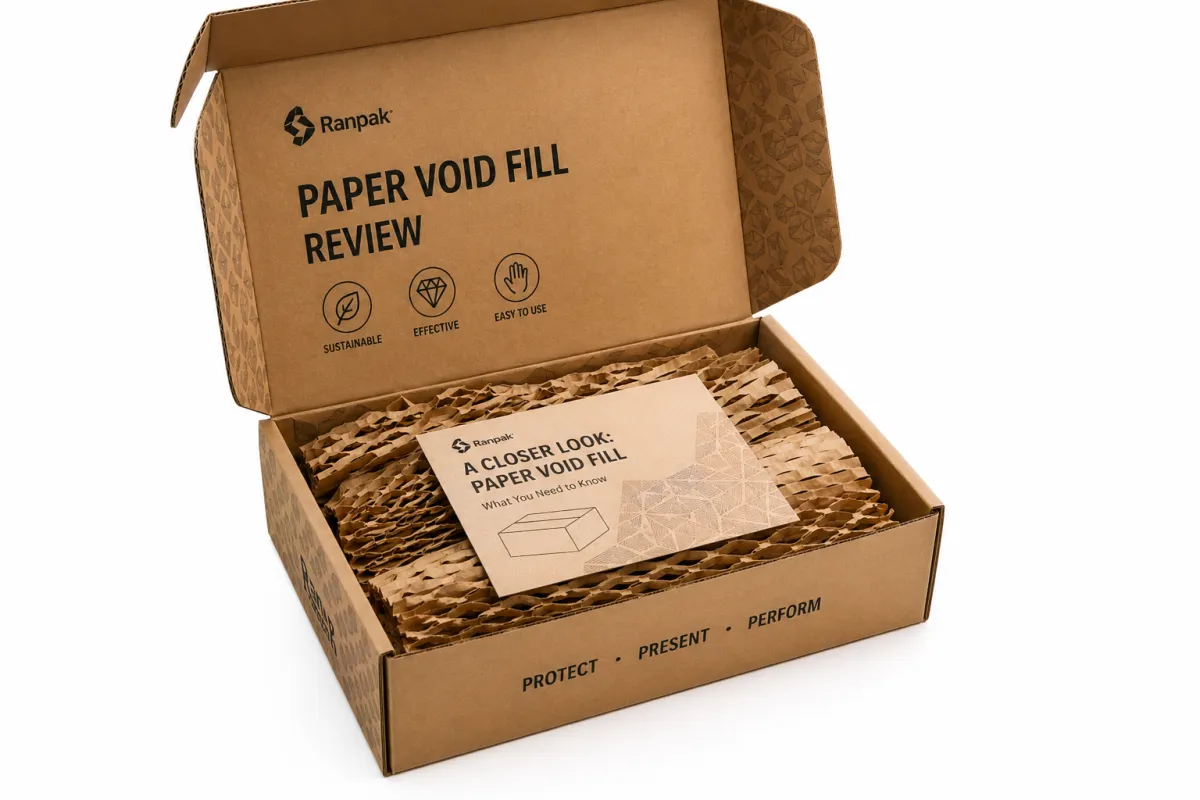
My review of paper void fill starts with the carton that looked wrong and performed right. A case of boxed glass droppers went into a standard RSC with what I thought was too little fill, yet the paper compressed into a firm cradle and kept the bottles from migrating during a simulated drop and vibration sequence on a 6-foot shaker table. That is the main lesson here: paper void fill often looks lighter than foam or bubble, but the movement control can be better because the paper grips the product instead of letting it float inside the void.
The box does not need to look stuffed to protect well, and that matters in a packing room where people judge by sight first and by damage claims later. I have seen people wrinkle their noses at a half-full carton and then grin after the drop test passed, which is usually the moment they stop arguing with the material. If you are doing a review of paper void fill for fragile goods, this is the moment that changes minds.
The best part of a review of paper void fill is how well it fits mixed-SKU teams. If you pack 40 different item shapes, you need something that does not require a custom insert every time a customer orders a lotion bottle, a ceramic mug, or a boxed accessory set. Paper void fill sits in a useful middle ground because it is clean, recyclable in most curbside streams, and fast enough for hand packing when the team is pulling 2 to 4 feet of material per box instead of cutting foam sheets at the bench.
On a 1,200-order week, that simplicity can save several labor hours and reduce bench clutter by one full gaylord compared with loose EPS chips. The setup stays simple, the learning curve stays short, and the line does not need a different material for every odd shape that comes through the door. That part alone has saved me from more than one headache, because I have no patience for systems that need a small engineering degree just to ship a candle. A practical review of paper void fill should always ask whether the line can sustain that simplicity on a busy Tuesday, not just in a controlled sample run.
Loose fill is the most flexible, crumpled kraft is the most common, paper pads are the neatest, and machine-dispensed kraft is the fastest once volume climbs. That is the practical structure I use in any review of Paper Void Fill: loose paper for odd shapes, machine paper for speed, pads for presentation, and branded or premium fill for customer-facing orders that need a better reveal. If you treat void fill as a tool for immobilizing product rather than just stuffing empty space, the category becomes much easier to judge, and the right option usually shows itself after one or two test runs.
I still remember a plant manager in Columbus, Ohio telling me, with a straight face, that he thought all paper was basically the same; five minutes later he was holding a sample carton made with 90 gsm kraft and saying, "Well, that explains a lot." A review of paper void fill gets easier once the team sees the difference between fill that merely occupies space and fill that actually holds the product still. It is kinda like the difference between a box that looks full and a box that actually survives the route.
Small ecommerce teams that want fewer damage claims, fulfillment centers that need lower labor per carton, and custom packaging buyers comparing protection, cost, and throughput all have something to gain from a careful review of paper void fill. It also matters for buyers shipping to retail partners, because a neat top layer of kraft paper can make a brown carton feel more intentional, which helps when the customer opens it in a showroom or receives it as a gift. Presentation has real weight in that moment, and paper has a way of making the whole package feel more deliberate without adding complicated parts.
That balance is why I keep coming back to it, even after years of seeing every cushioning trick in the book from Erie, Pennsylvania to Grand Rapids, Michigan. If your procurement team needs a cleaner story for both protection and presentation, a review of paper void fill can save a lot of debate later. Just do not pretend it solves every shipping problem, because it does not.
Review of Paper Void Fill: Top Options Compared
In this review of paper void fill, I compare four formats that show up most often in real packing rooms: manual crinkle paper, machine-dispensed kraft paper, recycled paper pads, and premium branded paper fill. Each one has a different mix of cushioning, box stabilization, dust level, storage footprint, and labor demand. One mistake I keep seeing in supplier meetings is treating all paper fill as interchangeable, when the gap between a hand-crumpled bundle and a dispenser-fed roll can be the difference between 120 cartons per hour and 80.
On a two-shift operation in Nashville or Newark, that gap adds up to real payroll. The production floor tells the truth quickly, and the numbers usually make the case before the sales pitch does. I have sat through enough supplier demos to know that a clean countertop tells you almost nothing about a real shift run. A review of paper void fill should separate the showroom from the shipping line every time.
Manual crinkle paper is the easiest option to start with, and it usually suits lightweight cosmetics, candle sets, and gift boxes under 6 lb. Machine-dispensed kraft paper wins when throughput matters, because the paper comes off the system in controlled lengths and packers do not waste time reaching for pre-torn bundles. Recycled paper pads are best for retail-ready orders where the top layer needs to look tidy, and premium branded paper fill works best when the unboxing moment is part of the sale.
That is the practical split I expect from a serious review of paper void fill, not a one-size-fits-all sales pitch that glosses over the tradeoffs. If a vendor tells you every format works the same, I would keep my hand on my wallet and my eyebrows raised. A good review of paper void fill should make the tradeoffs obvious without turning the page into a sales deck.
If appearance is the goal, paper pads and branded fill usually win. If speed is the goal, machine-dispensed kraft usually wins. If the box is irregular and the material needs to flow around corners, loose crinkle paper often performs better than a neat pad because it can be fluffed into 2 or 3 separate cavities instead of lying flat. In a review of paper void fill, I keep coming back to that tradeoff: the prettiest option is not always the fastest, and the fastest option is not always the cheapest once labor and damage are counted.
A packaging line rewards the material that actually fits the job, not the one that looks best on a sample table from a factory in Suzhou or a distributor warehouse in Atlanta. That is the part people forget when they get hypnotized by a tidy demo box under bright showroom lights. A practical review of paper void fill keeps the focus on how the material behaves after 100 cartons, not after the first unboxing photo.
| Option | Typical Price | Best Use Case | Main Strength | Main Weakness |
|---|---|---|---|---|
| Manual crinkle paper | $28-$45 per 25 lb case | Lightweight ecommerce, gift sets, small runs | Low upfront cost and easy setup | Slower packing and more storage bulk |
| Machine-dispensed kraft paper | $60-$95 per roll | High-volume fulfillment, mixed-SKU cartons | Fast pull speed and consistent output | Equipment cost and bench space |
| Recycled paper pads | $42-$70 per bale | Retail-ready orders, neat presentation | Clean look and good surface fill | Less adaptable to awkward voids |
| Premium branded paper fill | $85-$140 per case | Custom gifting, subscription boxes, premium brands | Strong unboxing appearance | Higher cost per shipment |
Detailed Reviews: What Stood Out in Our Paper Void Fill Test
My deeper review of paper void fill started with a simple test pattern: the same 12 x 9 x 6 corrugated carton, the same 4 lb ceramic product, and the same goal of no movement after closure. I tested each format three times, then checked for product centering, crush resistance, repeatability, and the time each packer needed to close the carton. That kind of hands-on review of paper void fill tells you far more than a product sheet ever will, because the test bench exposes the things that matter once the tape gun starts moving and the clock is running.
I trust a worn packing table in a warehouse outside Dallas more than a polished brochure with a stock photo of a smiling carton. A review of paper void fill built around repeatable tests gives you a lot more confidence than a one-time sample photo. It also gives you a cleaner way to compare formats without getting distracted by shiny marketing language.
Manual crinkle paper. This was the easiest to teach and the easiest to overuse. One packer could grab a handful, fluff it once, and get immediate resistance around a bottle or jar, which made it useful for small teams shipping 20 to 60 orders a day. The downside showed up on heavier items: once the product passed about 8 lb, the fill had to be packed tighter or it sprang back and left some headspace, which is not what I want in a serious review of paper void fill.
Still, for cosmetics, candles, and accessory kits, it was the most forgiving format and the least fussy at the bench. I also appreciated that it did not fight the packer; some materials act like they have a personality problem, and this was not one of them. In a review of paper void fill, manual crinkle is usually the first material I hand to a new packer because the learning curve stays manageable.
Machine-dispensed kraft paper. This one stood out for speed. On a bench line with a simple dispenser, the paper came off in controlled lengths, and each box took about 5 to 8 seconds less to load than with manual crinkle. That does not sound dramatic until you multiply it by 500 cartons and watch the shift clock keep pace with the stack of finished orders.
The paper also settled around corners more predictably, so the review of paper void fill favored it for mixed-SKU operations and standard RSC cartons. The weak spot was footprint: the dispenser needed a clear 18 to 24 inches of bench space, and one poorly placed tape gun could turn the station into a tangle. I have had enough battles with crowded benches to know that a few inches of bad layout can create a whole afternoon of grumbling.
Any review of paper void fill that includes machine paper should also include the bench layout, because the material and the station have to work together. If the packer has to twist, reach, and reset for every carton, the speed advantage gets eaten alive.
Recycled paper pads. These were the neatest to look at and the least messy to handle. In a retail-ready box, they created a clean top layer and helped a gift set look intentional when the lid opened, which mattered in the client meetings I sat through with premium brands in Brooklyn and Los Angeles. The catch is that pads do not always conform to odd voids as well as crinkle or machine paper, so the review of paper void fill showed some weakness with rounded bottles and irregularly shaped products.
On a 7 x 5 x 3 rigid mailer, though, they were excellent because the geometry was simple and the padding stayed where I put it. A tidy box with a simple product layout is where pads earn their place. If the SKU is a little awkward, though, pads can act like they missed the memo. A review of paper void fill will often show pads performing best when the carton already does most of the work.
Premium branded paper fill. This option made the best first impression in the room, no question. I have seen clients react instantly when they pulled open a box lined with branded kraft, because the order looked more intentional and less like a generic shipper. In the review of paper void fill, it scored highest for presentation and customer delight, especially in gift and subscription programs, but it also had the highest material cost and the least tolerance for sloppy packing.
If the team overfilled by even 15%, the carton closure looked bulky and the finish lost its polish. That small margin matters more than people expect, especially when the brand wants the box to feel tailored rather than padded by habit. I will be blunt: if the team is rushing and nobody cares about the reveal, save the branded fill for another project. A review of paper void fill that targets premium branding has to be strict about pack discipline.
"We were getting complaints about rattling in transit, not broken product," one operations manager in Charlotte told me after a pilot run. "Once we switched to paper void fill, the noise went away first, and the damage claims dropped next." That sequence matters, because it shows the material was doing its job before the KPI chart caught up.
One thing most people get wrong is assuming paper can only protect by adding thickness. In my review of paper void fill, I found the better results came from restraint, not stuffing. A snug 20% to 30% compression around the product usually gave better immobilization than a loose, fluffy carton that looked full but still let the item travel corner to corner.
For fragile glass, I would still pair the paper with a divider or tray, but for candles, cosmetics, and boxed accessories, the paper alone often did enough. The trick is to let the material brace the product instead of trying to build a soft nest that collapses the moment the carton gets handled. I have seen more than one packer overstuff a box like they were trying to win a stuffing contest, and, predictably, the seam looked like it was about to give up on life. That is why a disciplined review of paper void fill is so useful before volume buying starts.
Paper Void Fill Pricing and Total Cost Breakdown
Pricing is where a review of paper void fill gets more honest, because the invoice never tells the whole story. A 25 lb case of manual crinkle paper at $28 looks cheap until a packer spends 11 extra seconds per box pulling and fluffing it; a $95 roll of machine-dispensed kraft can look expensive until you see it cut labor by 15% on a 300-order day. I have watched buyers make the wrong call because they compared price per case instead of cost per shipped order, and that usually happens during a rushed sourcing meeting with too little math on the table.
A low sticker price can be the most expensive option once the line starts running, and I say that with the kind of weary affection you reserve for mistakes you have seen too many times. A review of paper void fill has to move from price per case to cost per carton before the numbers mean anything. Otherwise you end up choosing the wrong supply for reasons that feel tidy on a spreadsheet but ugly on the dock.
Here is how I frame the economics in a practical review of paper void fill. First, calculate material cost per carton after conversion loss, because not every pound or roll becomes useful fill. Second, add equipment cost if you need a dispenser or paper crumpler, which can run from $350 to $1,800 depending on the system and whether it comes from a shop in St. Louis, Ontario, or Foshan. Third, count labor, storage, and freight.
A pallet of bulky paper pads may be cheap on paper, but if it fills 36 square feet of floor space and arrives with a 10-day lead time from a warehouse in Kent, Washington, it is not the bargain it first appeared to be. Packaging managers feel that pain every time a pallet shows up and steals the staging lane they needed for outbound freight. I have literally watched a perfectly decent pallet become the most unwelcome guest in the room. A good review of paper void fill puts floor space and lead time on the same page as unit price.
The hidden costs show up in the shipping room. Manual fill creates more floor clutter if you store 40 cases at once. Machine systems need refill discipline and occasional maintenance, especially on multi-shift lines that run from 7:00 a.m. to 9:00 p.m. Loose paper can also increase the odds of overfill, which means more corrugate consumed per shipment and more cartons bulging at the seam.
In a thorough review of paper void fill, I always ask buyers to include freight damage, rework labor, and cleanup time, because those three costs can erase the savings from the cheapest roll. The real number is the one that includes the box, the labor, the damage, and the time spent fixing avoidable mistakes. If that sounds tedious, well, it is, but tedious math is still better than a surprise claim report. Any review of paper void fill that ignores rework and cleanup is missing the real expense.
For buyers who want a clean sustainability story, the paper side usually helps. Many kraft options are recyclable, and some suppliers offer FSC-certified paper, which can matter to retail clients who care about chain of custody and sourcing. For broader recycling guidance, I still point teams to the EPA's paper recycling resources at epa.gov, and for packaging transit testing I trust the test discipline described by ISTA more than a sales brochure.
A review of paper void fill that ignores those standards misses the part that protects your reputation when a customer opens a crushed carton and the contents have shifted. The customer never cares that the supplier said the fill looked good on a sample day in July. A practical review of paper void fill should connect the sustainability pitch to actual shipping performance. Otherwise the story is just packaging theater.
Process and Timeline: How Paper Void Fill Fits a Packing Line
The best review of paper void fill looks at workflow, not just material. On a packing line, the process starts with carton setup, then product placement, then void fill, then top-off, then closure and label application. If the void fill sits too far from the box sealer, packers lose seconds walking back and forth; if the dispenser sits too close to the carton stack, the station becomes cramped and the team starts twisting their shoulders all day.
I have seen both mistakes in small warehouses, including one in Richmond, Virginia where the label printer blocked the paper roll and forced the packer to turn 180 degrees every third box. A material that protects well can still become a headache if the station layout fights the people using it. You can have the right paper and still create the wrong job, which is one of those little warehouse truths nobody likes admitting out loud. A review of paper void fill should always include the bench layout, because layout can make or break the result.
For a small warehouse, rollout can happen in 1 to 2 days if the team has one lead packer, one backup, and a short script for carton sizes. For a larger fulfillment operation, I usually expect 1 to 2 weeks for trialing, training, and changeover because the team will want to test three carton sizes, two shifts, and at least one peak-hour rush. That timeline is part of my review of paper void fill because it tells you whether the material solves a daily problem or creates a new one during implementation.
Fast adoption is nice, but stable adoption is better when the line has to keep shipping through the busiest week of the month, especially in Q4 when the order mix can jump 30% from Monday to Friday. I have seen "quick" rollouts turn into three-week discussions because nobody agreed on where the dispenser should go. A review of paper void fill becomes much more useful once the rollout timeline is treated like part of the cost.
Dispenser placement matters more than buyers think. A good machine-fed setup should sit within arm's reach of the box-forming area, with a refill point that does not block the tape gun, scanner, or scale. Refill frequency also matters: on a 250-carton day, I would rather refill a kraft roll twice than stop every 20 boxes to hunt for loose fill. In the review of paper void fill, the smoother stations were the ones where the packer needed no more than 2 touches per carton to get the paper in place and close the flaps.
Fewer touches usually mean fewer mistakes, less fatigue, and a cleaner rhythm across the shift. Nobody wants to see a packing bench that looks like it lost a fight with its own supplies. A review of paper void fill that measures touches per carton will usually predict whether the line will stay steady after launch. That metric sounds small, but it tends to expose the ugly truth fast.
Maintenance stays simple if the line is organized. Keep the paper dry, keep the cutter sharp, and keep the bench free of stray labels and cut strap. Seasonal changes can complicate everything, especially when a line moves from small 6 x 4 x 3 orders in the spring to larger holiday gift sets in the fourth quarter. That is where paper void fill either shines or stalls: if the team can switch box sizes without swapping tools, the material earns its keep; if not, the labor savings disappear fast.
A packing room that can adapt without a toolbox full of adjustments usually gets more out of the same material. That flexibility has a real rhythm to it, and once you see it, you do not unsee it. A sensible review of paper void fill should check whether the team can change carton sizes without stopping the line. If they cannot, the solution may be good on paper and annoying in practice.
How Do You Choose the Right Paper Void Fill for Your Product?
The right choice starts with the product, not the paper. In every review of paper void fill I have done, the first filter is weight, fragility, and box-size variability. A 12 oz lotion bottle in a 9 x 6 x 4 carton needs a different solution than a 5 lb ceramic diffuser in a 14 x 10 x 6 shipper, and the gap becomes wider once you add inserts, sleeves, or retail packaging.
If you ignore product shape and jump straight to price, the material choice usually gets made twice, and the second round is almost always more expensive than the first. I have watched that mistake happen more than once, and it usually starts with someone saying, "We can probably just use the same fill for everything," which is exactly how good intentions drift into rework. A review of paper void fill should begin with item geometry, not with a price sheet.
Paper void fill is often better than air pillows when the box needs stabilization rather than just empty-space stuffing. Air pillows can be excellent for blocking and bracing, but they do not always create the same snug, friction-based hold around a product with odd corners or a heavy base. Bubble wrap still wins for surface scratch protection on delicate finishes, especially glossy lacquer or polished metal, and molded inserts remain the best answer when a SKU ships the same way every time.
A fair review of paper void fill has to admit that paper is not always the smartest answer, even if it is the easiest one to deploy on a busy line in Atlanta, Denver, or San Jose. I respect paper, but I do not worship it. A useful review of paper void fill should make room for other cushioning options when the product itself demands them. That honesty builds trust with the packing team and with the buyer.
Use this checklist Before You Buy in volume: carton type, average void volume, target pack time, expected damage rate, available storage space, and whether the order is retail-facing or plain brown box. If your packers need to close a 15-inch cube in under 45 seconds, machine-dispensed kraft may fit better than manual crinkle. If your average order is a single custom candle in a branded box, premium fill may be worth the extra cents because the visual impression matters.
That is the practical logic behind a good review of paper void fill, and it keeps the decision grounded in operations instead of guesswork or supplier enthusiasm. The numbers do not need to be fancy; they just need to be real. A strong review of paper void fill should make the choice feel operationally obvious once the carton mix is known.
Match the material to the business model. One-off custom boxes can tolerate more manual handling if the order value is high, while subscription kits usually need a neat, repeatable format that looks consistent from one month to the next. High-volume ecommerce teams should care most about speed and fill repeatability, because a 2-second delay per order becomes hours of labor over a week.
For FSC-minded brands, a certified kraft option can support the messaging without forcing a design compromise, which is another reason a review of paper void fill needs to include both operational and brand criteria. The best material is the one that keeps the line moving and the customer experience intact. If it also makes the customer smile when they open the box, that is a nice bonus, not a coincidence.
A thoughtful review of paper void fill connects the packaging choice to the business model as well as the product. That is the difference between a smart procurement decision and a pretty-looking mistake.
Our Recommendation and Next Steps for Paper Void Fill
If I had to give a clear recommendation after this review of paper void fill, I would split it by use case. Best budget option: manual crinkle paper, especially for teams under 100 orders a day and products under 6 lb. Best premium presentation option: branded paper fill or paper pads, especially for gift sets, cosmetics, and subscription boxes where the opening moment matters. Best high-speed fulfillment option: machine-dispensed kraft paper, especially where the line is packing 200-plus cartons a day and the team needs repeatable output with fewer touches.
Each of those answers makes sense in the right factory, on the right bench, with the right product mix, whether the paper is being converted in Dongguan, Guangdong or slit and rewound in Elkhart, Indiana. I can think of half a dozen plants where I would make a different call for each one, and none of them would be wrong. This review of paper void fill points to the same practical truth every time: choose the format that fits the line, not the one that looks best in the catalog.
The smartest next step is a small pilot, not a full conversion. Order samples, test three carton sizes, and measure damage, labor time, and material usage for one week before you commit to pallet quantities. I would run the same item through your current method and through paper void fill, then compare closure time, box stability, and the number of times a packer had to reopen a carton because the first pass looked wrong.
That kind of controlled review of paper void fill gives you clean numbers instead of supplier promises, and it usually reveals the real bottleneck before you spend money on a warehouse full of the wrong format. It also gives the packing team a chance to complain early, which, frankly, is useful data. If your pilot carton is built from 275 lb double-wall corrugate and your current fill is still rattling, the problem is probably not the box printer. A careful review of paper void fill in pilot mode is cheaper than a warehouse full of the wrong material.
If you want a simple pilot plan, use 30 cartons per SKU, 10 cartons each at the small, medium, and large box sizes you ship most often. Track three things only: seconds per box, material used per carton, and any sign of movement after a 24-hour hold. If the paper wins on at least 2 of those 3 measures, you have a real case for volume buying. If it does not, you still learned something valuable before filling a warehouse with 40 cases of the wrong format.
That is the practical, low-drama way I prefer to handle any review of paper void fill, because it keeps the decision tied to the line instead of the spreadsheet alone. And after enough warehouse meetings, low drama starts to feel like luxury. My honest takeaway is that paper void fill works best when it is chosen for the job, not because paper sounds greener or cleaner on its own.
I have seen it outperform foam in real shipping rooms, I have seen it underperform when the carton was too large, and I have seen it save a brand from rattling complaints simply because the product stopped moving inside the box. Before you buy in volume, use a one-week test, compare three options, and make the final call based on your own review of paper void fill, your own box sizes, and your own packer speed. The right answer is usually already sitting on the bench if you measure it carefully enough.
And if it is not, the box will tell you soon enough - usually by making a very expensive sound on the way to the carrier. A final review of paper void fill should always end with the box, the packer, and the carrier all telling the same story. If those three agree, you have your answer.
FAQ
Is paper void fill better than bubble wrap for shipping?
Paper void fill is often better when you need carton stabilization, a cleaner unboxing feel, and easier recyclability, especially in mixed-SKU shipping rooms that are packing 150 to 400 orders a day. Bubble wrap can still win for surface scratch protection on delicate finishes, so the right choice depends on the product and the failure mode you are trying to prevent.
In a review of paper void fill, I usually tell teams to think about the thing that actually breaks first, not the material that looks nicest on a shelf in a showroom in Seattle or Tampa. That way the decision is grounded in the real risk, not the packaging display.
How much paper void fill do I need per box?
Measure the empty volume around the product instead of guessing from carton size alone, because an odd-shaped item can double usage fast. Start with 10 to 20 test cartons, note how much paper is needed to stop movement without crushing the item, and keep a simple usage log by box size so you can forecast weekly demand.
In my review of paper void fill, I have found that usage falls into a pretty clear pattern once the team stops stuffing boxes like they are trying to win a county fair prize. Once you see the pattern, replenishment gets easier and the line stops guessing.
What is the cheapest paper void fill option for small businesses?
Manual crinkle paper usually has the lowest upfront Cost for Small teams, especially if the order volume stays under 100 cartons per day and the packaging line runs from a single bench in a 1,500-square-foot warehouse. Machine-dispensed kraft can become cheaper per shipment once volume rises enough to offset the equipment, but the cheapest line-item price is not always the cheapest total cost.
I have seen plenty of $32-per-case purchases turn into grumbling once the labor hours show up on Friday payroll, which is why a review of paper void fill has to include labor before it includes bragging rights. The ledger is usually a little less romantic than the catalog.
Does paper void fill work for fragile products like glass or cosmetics?
Yes, if the goal is to immobilize the item and keep it centered inside the carton. For highly fragile glass, I would pair paper void fill with an inner insert, divider, or double-box strategy instead of relying on fill alone, while cosmetics, candles, and packaged gift sets often do very well with paper because it supports both protection and presentation.
In my review of paper void fill, cosmetics are usually easier to please than glass, and glass is usually happier only after you give it a little extra help. That extra structure is what keeps a good pack from turning into a damaged one.
How do I know if paper void fill will slow down my packing line?
Time a small sample run and compare cartons packed with paper void fill against your current cushioning method. Watch for extra touches, refills, or awkward dispensing, because those are usually the reasons throughput drops, and a good setup should let packers finish each box without hunting for material.
If people start sighing every third carton, that is a sign too, even if nobody wrote it down. A quick review of paper void fill on the bench will usually tell you whether the line can keep pace, and if it cannot, you will know before the change turns into a headache.


