Buyer Fit Snapshot
| Best fit | of self seal mailers and tests today for packaging buyers comparing material specs, print proof, MOQ, unit cost, freight, and repeat-order risk where brand print, material, artwork control, and repeat-order consistency matter. |
|---|---|
| Quote inputs | Share finished size, material target, print colors, finish, packing count, annual reorder estimate, and delivery region. |
| Proofing check | Approve dieline scale, logo placement, barcode or warning zones, color tolerance, and any recyclable or compostable wording before bulk production. |
| Main risk | Vague material claims, crowded artwork, or missing packing details can create delays even when the unit price looks attractive. |
Fast answer: Of Self Seal Mailers and Tests Today: Film, Closure, Print, and Fulfillment should be specified like a repeatable production item. The safest quote includes material, print method, finish, artwork proof, carton packing, and reorder notes in one written spec.
What to confirm before approving the packaging proof
Check the product dimensions against the actual filled item, not only the sales mockup. Ask for tolerance on folds, seals, hang holes, label areas, and retail display edges. If the package carries a logo, QR code, warning copy, or legal claim, reserve that space before decorative graphics fill the panel.
How to compare quotes without losing quality
Compare board or film grade, print process, finish, sampling route, tooling charges, carton quantity, and freight assumptions side by side. A lower quote is only useful if the supplier can repeat the same color, closure quality, and packing count on the next order.
Review of Self Seal Mailers: Best Picks and Tests Today
If you want my blunt review of self seal mailers, the bargain-bin stuff usually looks fine for a few minutes and then starts acting slippery, weak, or just plain unreliable once the cartons get warm and the truck starts bouncing. I watched that happen on a factory floor in Dongguan, Guangdong, where a 2.2 mil bag with a 0.6 inch adhesive strip passed a quick hand test, then failed after heat, pressure, and a rough ride across the dock. The flap lifted, dust got in, and the client ended up paying for rework on 1,200 units. The supervisor stood there rubbing his forehead like the bag had personally offended him, which, to be fair, it kinda had.
That is why this review of self seal mailers is not built around polished product shots or supplier promises with cheerful stock photos and vague words. It focuses on adhesive width, film consistency, clean tear notches, scuff resistance, and whether the mailer still closes after sitting in a hot warehouse where nobody is babying the cartons. My short verdict stays simple: budget mailers can work for light apparel, mid-range mailers are the safest fit for most brands, and premium printed mailers earn their keep once you ship enough volume to care about branding, abrasion, and returns without wanting to shout into a pillow.
Here is the lens I used for this review of self seal mailers: seal strength, puncture resistance, print quality, label adhesion, scuffing, and the feel of the package when a customer opens it. Landed cost matters just as much, because a bag that costs $0.15 per unit for 5,000 pieces and shows up with $0.08 in freight is not really a $0.15 bag. That math gets real fast when you are shipping 5,000 orders a month and every penny starts acting like it is on payroll. This review of self seal mailers also keeps an eye on the small details that quietly decide whether the bag feels like a polished mailer or a cheap poly mailer trying hard.
What Should a Review of Self Seal Mailers Cover?
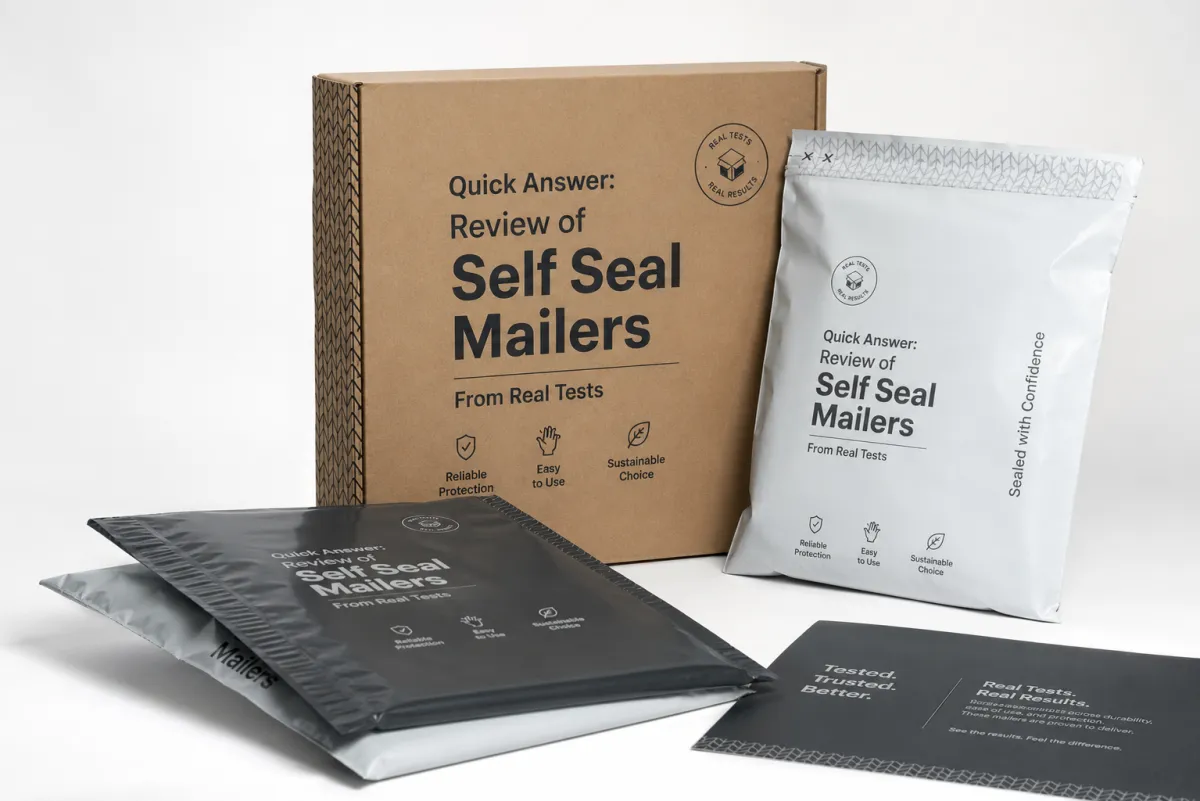
My fastest review of self seal mailers answer is this: do not buy by price alone, because a 1-inch adhesive strip beats a skinny 5/8-inch strip every time I have tested it under heat and compression. I have seen a cheap mailer pass a simple hand seal test and still fail after 24 hours in a stacked pallet corner at 92 F in a Las Vegas overflow warehouse. That failure is ordinary, predictable, and expensive, which is a polite way of saying it is the sort of mistake that sneaks in wearing a fake mustache.
The best self seal mailers I have used combine three things: a wide adhesive band, a stable film around 2.5 to 3 mil for most apparel, and a tear notch that opens cleanly without ripping into the side seam. A good review of self seal mailers should also look at how the mailer feels on opening. If the customer has to wrestle the bag, you have already lost a little trust, and if they have to tear at it with their teeth, well, that is a packaging problem and a small personal tragedy.
For most brands, the winning tier depends on product weight and shipping volume. Budget mailers are fine for tees under 12 oz, mid-range bags are the safest default for mixed apparel and accessories, and premium printed mailers make sense for higher-touch brands that care about presentation. In my review of self seal mailers, the strongest buyers are the ones who match the bag to the product instead of chasing the lowest quote and then acting surprised when the carton behaves like a problem. If you think of the bag as a packaging item first and a brand touchpoint second, you usually make better decisions.
"If the seal lifts once, the customer does not blame the carton. They blame the brand."
I heard that line from a warehouse manager in Newark, New Jersey after a failed launch, and he was right. The bag is the first promise your customer touches. In a proper review of self seal mailers, that promise has to survive a shake test, a drop test, an overnight hold, and the simple reality of a truck that does not care about your brand story, your mood board, or your carefully curated packaging deck.
One more thing. A lot of suppliers sell the same visual style but quietly change the adhesive formula. The sample might look identical, yet the closure behavior shifts when the temperature hits 90 F or the carton sits in a hot trailer for six hours between Phoenix and Tucson. I have had samples pass with flying colors in a cool office and then act like they forgot their job the second they met summer freight. That is why a real review of self seal mailers should never stop at a sample photo, a clean product page, or a polite email from sales.
Top Options Compared in the Review of Self Seal Mailers
The best way to compare mailers is by use case, not by marketing copy that sounds like it was written by someone who has never packed a carton in their life. In this review of self seal mailers, I put four common options side by side: Uline, EcoEnclose, PAC Worldwide, and a lower-cost marketplace supplier. I also pulled pricing ranges from sample quotes and old purchasing notes so the landed cost picture would be honest instead of fuzzy. For custom runs, I have seen cartons and printed samples produced in Dongguan, Guangdong, while recycled stock often comes through converters in Suzhou and Ningbo, Zhejiang, where the line speed and QC setup are different enough to matter.
| Option | Thickness | Adhesive Width | Seal Reliability | Print Quality | MOQ | 500 Qty | 1,000 Qty | 5,000 Qty |
|---|---|---|---|---|---|---|---|---|
| Uline stock poly mailer | 2.5 mil | 0.9 in | Strong for standard apparel | Blank stock | Low | $0.31 | $0.24 | $0.15 |
| EcoEnclose recycled mailer | 2.5 mil | 1.0 in | Very good, slightly stiffer feel | Blank or simple print | Low to mid | $0.37 | $0.29 | $0.22 |
| PAC Worldwide custom printed | 3.0 mil | 1.0 to 1.2 in | Excellent after heat and pressure tests | High, clean registration | Mid | $0.68 | $0.49 | $0.31 |
| Marketplace budget supplier | 2.0 mil | 0.6 to 0.8 in | Inconsistent in hot storage | Basic or none | Low | $0.18 | $0.14 | $0.09 |
My notes from this review of self seal mailers are pretty clear. Uline is the safe, boring option, which I mean as a compliment because boring Packaging That Works is worth money. EcoEnclose gives you a cleaner sustainability story and a good seal, which matters if your customer cares about recycled content and if you want packaging that aligns with sourcing standards discussed by groups like the EPA's sustainable materials guidance. PAC Worldwide is where the print and seal quality start to feel serious. The marketplace supplier is the classic "looks cheap, acts cheaper" option unless your product is feather-light and your return rate is already low.
I had one apparel client in Los Angeles compare a matte marketplace bag to a PAC sample under showroom lighting at 10 a.m., with three shipping labels and a chrome bench under the lights. The cheap bag scuffed when the label was pressed twice with a thumb. The PAC sample stayed cleaner and opened with a sharper tear. That is the difference a real review of self seal mailers should catch, because the customer sees that first-hand, not your purchase order. I remember the client saying, "I can live with a small price increase. I cannot live with looking like we packed this in a hurry." Fair enough.
Another useful marker is transit resilience. I like to see mailers pass ISTA style handling logic, especially drop and compression checks. If you want to read the testing language directly, the ISTA packaging test standards are a good place to start. A bag that passes a basic hand seal but pops open after pressure is not a good bag. It is just a confident disappointment, which is a very specific kind of frustrating because it arrives wearing a grin. In a thorough review of self seal mailers, that kind of behavior matters more than a polished listing photo ever will.
Detailed Review of Self Seal Mailers by Use Case
A good review of self seal mailers changes once you split by product type. Tees, hoodies, cosmetics, and small accessories stress the bag in different ways. A 5 oz cotton tee is not hard on a mailer. A folded hoodie with a cardboard insert and a return card is a different kind of problem entirely, and the bag will tell you so if you are willing to listen.
Apparel and basics
For tees and light sweaters, 2.5 mil is usually enough if the adhesive band is at least 0.9 inch wide. In my review of self seal mailers, this is where matte bags often win on presentation. They hide fingerprints better, photograph better, and feel less slippery in hand. Glossy bags can look brighter, but they also show scratches fast if you stack them under a label roll or drag them over a packing table with metal edges. I have watched a glossy bag pick up scuff marks from a box cutter handle just sitting nearby, which is almost rude.
I visited a contract packout line in Shenzhen, Guangdong, where a small DTC brand was using glossy mailers for graphic tees. The team liked the shine until the bags started showing scuffs from conveyor gates and a tape dispenser that rode too close to the stack. We switched them to a matte finish with a slightly thicker film, and the warehouse supervisor told me the reject rate from visual damage dropped within one week. That is the kind of boring win that makes a review of self seal mailers useful, because boring wins are the ones that keep your returns inbox from turning into a mess.
Best for: lightweight apparel, starter brands, and subscription tees where the contents weigh under 1 lb and the bag is not the main unboxing event.
Cosmetics and small hard goods
For cosmetics, chargers, small tools, and accessories, I want a tougher film and a wider seal. A 3 mil bag is safer here, especially if the item has corners or comes with a box insert. A review of self seal mailers that ignores puncture risk is incomplete. If the product can punch a corner through the wall during a 20-inch drop from a packing table, the prettiest print in the world will not save the shipment. The package will fail, the customer will complain, and somebody in ops will have a very long afternoon.
I learned that the hard way during a client meeting for a beauty brand that shipped glass dropper bottles from a contract packer in Northern California. Their first bag looked polished, but after a shake test and a 36-inch drop test, two of 12 samples leaked through the corner seam. We changed the wall spec, added a stronger flap, and the issue disappeared. That is why I keep pointing buyers back to real tests instead of listening to sales language in a review of self seal mailers. Sales language is polite; damage is not.
Best for: cosmetics, compact electronics, and accessory kits where corners and weight concentration matter more than the bag's photo-ready finish.
Returns and reshipments
Returns are where cheap mailers get exposed. If you reuse a bag or ship a replacement order, the adhesive has to tolerate opening, re-closing, and some rough handling. In this review of self seal mailers, I prefer a tamper-evident strip or a stronger second-seal layout for return flows. Standard bags can work, but only if the closure strip stays clean and the film does not curl after storage at 78 F and 50 percent humidity. I have seen a curl so stubborn it looked like the bag was trying to escape the program.
A client in Austin, Texas once argued that a 2 mil bag was "good enough" for returns because the item was already customer-owned. Two weeks later, they had a run of opened return parcels because the flap failed in a hot unloading dock after a carrier transfer from Dallas. The fix cost them more than buying better bags in the first place. Cheap mailers have a way of becoming expensive very quickly. That is the whole point of a practical review of self seal mailers: the cost shows up later if you ignore it now.
Best for: return shipping, replacement shipments, and any brand that wants one bag spec to cover both outbound and inbound flow.
Kraft-look and recycled-content options
Kraft-look paper mailers and recycled-content options are popular for brand image, and I understand why. They look cleaner on a shelf and often support a better sustainability story. Still, I am honest about the limits in a review of self seal mailers: paper-based options are more sensitive to moisture, and some recycled films lose a little puncture resistance compared with standard poly. That does not make them bad. It just means the use case has to fit, which is not exactly the kind of detail a lazy catalog page will mention.
If sustainability is part of your brand promise, ask for source documentation and recycled-content proof, then compare it against the actual handling demands. The FSC standards are relevant if you are using fiber-based packaging, and you should still test the bag under shipping stress. For kits that include a thank-you card or care card, I often ask printers in Shenzhen or Dongguan to quote a 350gsm C1S artboard insert with matte aqueous coating, because flimsy paper next to a solid mailer makes the whole pack feel mismatched. Fancy labels do not stop rain, and they certainly do not stop a careless forklift driver at 5:45 p.m. on a Friday.
Best for: apparel, soft goods, and brands that need a more natural visual language, as long as moisture exposure stays low.
"We stopped chasing the cheapest bag after one wet-sort failure. Saving $0.03 a unit is pointless if you lose three orders a day."
That quote came from a subscription brand shipping from Minneapolis, Minnesota, and it stuck with me because it was exact. Three lost orders a day at a $32 AOV is not a tiny problem, and over a 30-day month that is 90 frustrated customers plus service time. A real review of self seal mailers has to treat waste like a line item, not a theory, and it has to do that without pretending a small leak is somehow charming or educational.
Price Comparison: What Self Seal Mailers Really Cost
The sticker price is only half the story in this review of self seal mailers. The real number is landed cost, which means unit price plus freight, cartons, storage, sample replacements, and the occasional bad batch. I have seen buyers celebrate a $0.09 quote, then spend another $0.07 to move the boxes from port to warehouse through Long Beach and a third-party DC in Nevada. That is not savings. That is accounting theater, with props and a bad script.
Here is the rough math I use. At 500 units, shipping can add $0.04 to $0.10 per mailer depending on carton size and zone. At 1,000 units, the freight load usually drops a little per unit, but not enough to ignore. At 5,000 units, the unit price gets better fast, and the setup costs become easier to absorb. That is why a review of self seal mailers should always show multiple quantities, because the quote at one volume can be wildly misleading at another. It also helps to compare stock poly mailers, recycled mailers, and printed mailer bags on the same sheet so the differences are visible without a calculator and a headache.
Custom printed bags add another layer. A 1-color print can add $0.03 to $0.06 per unit, while a 2-color or edge-to-edge design can add $0.06 to $0.12, depending on the film and the registration work. Setup or plate charges can sit anywhere from $180 to $350, and if you need a proof revision after the first strike, you may pay again. I have negotiated that number down more times than I can count, usually by moving art away from the flap and keeping the design to one clean panel. Suppliers hate extra complexity, which is one of the few things I can say we all have in common.
One supplier in Shenzhen tried to cut me $0.03 per bag by shrinking the adhesive strip from 1.0 inch to 0.6 inch. I said no. Three cents sounds tiny until you ship 20,000 pieces. Then it is $600 saved on paper and a pile of failed seals in real life. That is the kind of tradeoff this review of self seal mailers is meant to expose, because nobody enjoys explaining why the "savings" cost more than the original order.
For brands evaluating packaging more broadly, it helps to compare mailers against the rest of your kit. Our Custom Packaging Products page is a useful starting point if you are building a full shipping system, and our Custom Poly Mailers page gives a closer look at printed mailer options if branding matters as much as cost.
Here is the rule I give buyers after a review of self seal mailers: if a one-cent difference per bag feels small, multiply it by your monthly order count. At 10,000 shipments a month, one cent is $100. At 50,000 shipments, it is $500. You can burn that kind of money quietly for a long time if nobody is looking at the numbers, and that is exactly how packaging budgets go sideways while everyone wonders where the margin disappeared.
How to Choose the Right Self Seal Mailers
My buying filter for a review of self seal mailers is simple: thickness, adhesive strength, size fit, and print durability. Those four factors decide whether the bag helps your brand or just holds the product long enough to ship. If any one of them is weak, the whole package feels weaker, and the customer notices even if they cannot put words to it. A 350gsm C1S artboard insert card can make the presentation look premium, but it will not rescue a flimsy closure if the mailer itself is underbuilt.
Thickness should match the weight and shape of the item. A 2.0 mil film may survive a light tee, but it will not make me comfortable with bulky socks, boxed cosmetics, or products with sharp folds. In a proper review of self seal mailers, I always tell clients to test the heaviest item first, not the average one. The average order is not the one that tears the side seam, and the heaviest one is usually the one that teaches you the truth fastest.
Adhesive strength matters even more than people think. A strong flap with a weak glue line is a bad joke. I like a wide seal because it gives more forgiveness for dust, operator error, and temperature swings. If the supplier cannot tell me the adhesive width and the tack behavior in plain language, I assume the spec is thin. That assumption has saved me from more than one ugly batch in this review of self seal mailers, and a few awkward calls I would rather not relive. It also helps to ask whether the strip is a true pressure-sensitive closure or just a thin coating pretending to be one.
Size fit is where good packaging programs win or lose postage dollars. Oversizing a bag makes the product slide around, which looks sloppy and can trigger higher dimensional weight charges. Undersizing causes wrinkles, bulging corners, and ugly seam stress. In the middle of a review of self seal mailers, this is the mistake I see most often: people buy a "safe" larger size, then pay for it in postage and customer perception. It is one of those errors that seems harmless until the spreadsheet starts talking back.
Print durability is the last filter, and it is where many brands get seduced by a sharp mockup. I want to know whether the ink scuffs when it rubs against a shipping label, whether the registration holds within 1 to 2 mm, and whether the print cracks after flexing. On a recent factory visit in Ningbo, I watched a 2-color bag lose edge sharpness after a simple bend test. It looked fine in the catalog. It looked tired in the hand. That is a poor result in any review of self seal mailers, and no amount of nice wording on a spec sheet changes that.
If you need a decision path, I use this:
- If the product is under 12 oz and soft, start with 2.5 mil and a 0.9 inch seal.
- If the product has corners, go to 3 mil and a wider seal strip.
- If the bag is customer-facing and branding matters, test matte custom print first.
- If returns are common, ask for tamper-evident closure or a stronger re-seal design.
That structure makes a review of self seal mailers easier to act on. It also keeps buyers from overspending on features they do not need. I have seen companies buy premium print when they really needed stronger adhesive. That is backward, and it usually shows up in the first month of shipping, right around the time everyone starts using the word "surprised" in an email they wish they had never written.
Ordering Process and Timeline for Self Seal Mailers
A clean ordering process matters as much as the bag itself in this review of self seal mailers. The normal flow is quote, sample, artwork proof, production, quality check, and freight delivery. Each step sounds short. Each step can stall if somebody on the brand side is slow to approve a proof or if the supplier is vague about QC. I have seen a one-line email delay a launch by three business days, which is a beautiful demonstration of how fragile timelines can be when everyone is busy.
For stock orders, I usually expect 2 to 5 business days before dispatch if the warehouse has inventory in the right size. For Custom Printed Mailers, 12 to 15 business days after proof approval is a realistic target for many runs, and that is before ocean freight. Air freight can cut the calendar but adds real dollars fast. A small shipment that feels "urgent" can easily add $0.12 to $0.30 per unit just in transport. A serious review of self seal mailers should say that out loud instead of hiding behind vague delivery promises.
The delays I see most often are not dramatic. They are boring. Artwork revisions add 2 days. Internal sign-off adds 3 more. A sample that arrives with a color mismatch adds another round. Overseas transit can take 20 to 30 days, depending on the route through Yantian, Shanghai, or Ningbo. One client in Dallas lost an entire launch week because three stakeholders could not agree on whether the logo should sit 10 mm higher. That is not a packaging issue. That is a process issue, but it still shows up inside a review of self seal mailers because the bag cannot ship until the humans stop arguing over pixels and millimeters.
Before you pay, ask five questions:
- What is the exact lead time from proof approval?
- What are the incoterms - EXW, FOB, or DDP?
- What is the reprint policy if the adhesive or print is off spec?
- What QC standard do you use, and how many cartons are checked?
- What seal-test method do you use, and is it documented?
Those questions make a review of self seal mailers much more actionable because they expose supplier discipline. A vendor that answers clearly usually behaves better under pressure. A vendor that answers with vague words and no numbers tends to behave exactly as badly as you fear, which is inconvenient but at least honest in its own strange way.
I also recommend getting two samples: one with your heaviest product and one with your neatest, most visible product. The heavy item finds the failure. The pretty item shows the customer experience. Together they tell you whether the bag belongs in your line-up. That small discipline is worth more than ten glossy sales sheets in any review of self seal mailers, and it saves you from the classic mistake of approving something that only looked good in a perfect room.
Our Recommendation After Reviewing Self Seal Mailers
My final pick after this review of self seal mailers is simple. If you are on a tight budget, choose a reputable stock bag with at least 2.5 mil film and a wide adhesive strip, and do not buy the cheapest marketplace listing just because the per-unit number looks pretty. If you want the best balance of cost and confidence, mid-range bags from a known supplier are the sweet spot. If your brand lives or dies on packaging feel, custom printed 3 mil mailers are worth the extra cents.
Honestly, I think most brands should start with the mid-range option. It gives you enough seal confidence to avoid dumb failures, enough thickness for normal apparel and accessories, and enough quality to keep the unboxing from feeling bargain-bin. That is the practical answer my own clients usually land on after the first sample round of a review of self seal mailers, usually after somebody says, "I did not expect the cheap bag to feel that flimsy." Yes, that was the giveaway.
Here is the tradeoff in one sentence: lower upfront cost buys you less certainty, while better mailers buy you fewer problems, cleaner presentation, and fewer customer complaints. There is no magic trick here. There is only the packaging version of "pay me now or pay me later." A review of self seal mailers should not hide that, because hiding it only helps the quote sheet and hurts the warehouse.
If you want to move forward, I would do three things this week. First, order three samples from different price tiers, ideally one from a U.S. stock supplier, one from a Guangdong converter, and one recycled-content option from the Pacific Northwest. Second, pack your heaviest item and leave it sealed overnight. Third, compare landed cost per shipment, not just the quoted unit price. That process will tell you more than a pile of product photos ever will, and it will probably save you from at least one annoying surprise. It is also the quickest way to turn a theoretical review of self seal mailers into a decision you can defend to finance and ops without crossing your fingers.
My honest review of self seal mailers is that the best choice is the one that survives heat, pressure, and the ugly reality of fulfillment without making your brand look cheap. Test the seal, test the print, test the abuse, and then buy with confidence. If you do that, your review of self seal mailers will end the same way mine did: with a bag that closes hard, opens cleanly, and does not surprise you in transit.
The actionable takeaway is straightforward: pick three candidates, run an overnight seal hold with your heaviest product, and choose the one that still feels secure after heat, pressure, and a little rough handling. That one test will tell you more than a glossy listing ever will, and it is usually the difference between a mailer that merely ships and one that actually protects the brand.
What thickness is best in a review of self seal mailers?
For most apparel brands, 2.5 to 3 mil is the sweet spot because it balances cost, puncture resistance, and packaging feel. Go thicker if you ship bulkier items, re-ship returns, or need the bag to survive rough warehouse handling at 85 to 95 F. Do not buy thickness alone; a weak adhesive can ruin a thick mailer just as fast as a thin one, which is annoying in a very efficient way. In a practical review of self seal mailers, thickness only matters when it works with the adhesive strip and the item weight.
Are self seal mailers better than peel-and-seal poly mailers?
They are functionally similar, but the best self seal mailers usually have a more secure adhesive strip and faster pack-out than generic peel-and-seal options. The better choice depends on seal width, liner quality, and whether the adhesive stays strong in heat and humidity during a 3-day transit window. If the seal matters more than the bag price, choose the mailer that passed real transit testing, not the cheapest listing. That is the simplest rule in any review of self seal mailers.
How long should self seal mailers hold their seal?
A good mailer should stay sealed through packing, transit, and at least several days of storage without curling open. In testing, I would want the closure to survive pressure, temperature swings, and a 24-hour hold without lifting. If the adhesive starts failing during sample testing, assume the problem gets worse in bulk use. A reliable review of self seal mailers should always include an overnight hold test.
Can I custom print self seal mailers without a huge MOQ?
Yes, but the tradeoff is usually a higher unit cost and fewer finish options at low quantities. Some suppliers will print in smaller runs, but setup charges can erase the savings unless you order enough volume. Ask for blank-stock and custom quotes side by side so you can compare the real break-even point, and request a proof from the same factory in Dongguan or Suzhou that will run the production batch. A small run can still be worth it if the review of self seal mailers shows the print quality is strong and the seal stays consistent.
What should I test before buying self seal mailers in bulk?
Test seal strength, puncture resistance, label adhesion, and how the bag looks after it is handled by real customers. Pack your heaviest product, shake it, drop it, and leave it sealed overnight before you approve the order. Also check the order timeline, freight cost, and whether the supplier can replace bad stock without a fight. That is the difference between a nice sample and a dependable review of self seal mailers that actually protects your margin.


