Buyer Fit Snapshot
| Best fit | practices for vendor onboarding tested work for packaging buyers comparing material specs, print proof, MOQ, unit cost, freight, and repeat-order risk where brand print, material, artwork control, and repeat-order consistency matter. |
|---|---|
| Quote inputs | Share finished size, material target, print colors, finish, packing count, annual reorder estimate, and delivery region. |
| Proofing check | Approve dieline scale, logo placement, barcode or warning zones, color tolerance, and any recyclable or compostable wording before bulk production. |
| Main risk | Vague material claims, crowded artwork, or missing packing details can create delays even when the unit price looks attractive. |
Fast answer: Practices for Vendor Onboarding Tested Work: Material, Print, MOQ, and Cost should be specified like a repeatable production item. The safest quote includes material, print method, finish, artwork proof, carton packing, and reorder notes in one written spec.
What to confirm before approving the packaging proof
Check the product dimensions against the actual filled item, not only the sales mockup. Ask for tolerance on folds, seals, hang holes, label areas, and retail display edges. If the package carries a logo, QR code, warning copy, or legal claim, reserve that space before decorative graphics fill the panel.
How to compare quotes without losing quality
Compare board or film grade, print process, finish, sampling route, tooling charges, carton quantity, and freight assumptions side by side. A lower quote is only useful if the supplier can repeat the same color, closure quality, and packing count on the next order.
Best Practices for Vendor Onboarding: Tested Tips That Actually Hold Up
The delay I see most often is not a quote, a PO, or a pricing dispute. It is the missing tax form, the unsigned banking letter, or the insurance certificate that landed in the wrong inbox and somehow stayed there for four days. I remember a packaging buyer in Indianapolis telling me, with the exhausted laugh of someone who had already lost the week, that they could negotiate a pallet price in twelve minutes and then spend twelve business days waiting on a W-9 from a supplier who insisted it had been "sent yesterday." After reviewing dozens of supplier setups for corrugated, label, folding-carton, and contract packaging buyers, I keep coming back to the same best practices for vendor onboarding: one intake form, one owner, SLA-based approvals, and one source of truth for every document from tax forms to certificates of insurance. These vendor onboarding best practices also keep supplier master data from turning into a second full-time job for finance.
That sounds tidy until finance, legal, procurement, and operations all touch the same vendor file in separate systems. A spreadsheet can look manageable at 20 suppliers and start slipping at 60, sometimes sooner if one team sits in Chicago, another in Dallas, and the plant is in Louisville. I have seen teams confuse "we are still keeping up" with "the process is healthy." Those are not the same thing. On one corrugate line in Ohio, a new tape supplier was ready to ship cartons at $0.18 per unit for 5,000 pieces, but the order stalled for nine days because the COI and banking details were buried in different email threads. I sat in another meeting in Chicago where three people thought they owned the same vendor record, and none of them could explain who approved the last bank change. That meeting had the special charm of a broken copier: loud, irritating, and weirdly hard to fix once everyone had already burned an hour on it.
The best practices for vendor onboarding are less about software than about decision discipline. Low-risk vendors should move in a few business days. Suppliers that touch food-contact packaging, cross-border payments, or sustainability claims need tighter checks, documented approvals, and a real audit trail. The mistake a lot of teams make is forcing the same heavy process onto every supplier, then acting surprised when nothing moves. I do not think that is a technology failure. I think it is a management habit, and a stubborn one at that, especially when the vendor list runs from a local converter in Nashville to a contract packager in Monterrey. Good vendor onboarding best practices start by separating routine setup from third-party risk review, then keeping both paths clear.
What Are the Best Practices for Vendor Onboarding?
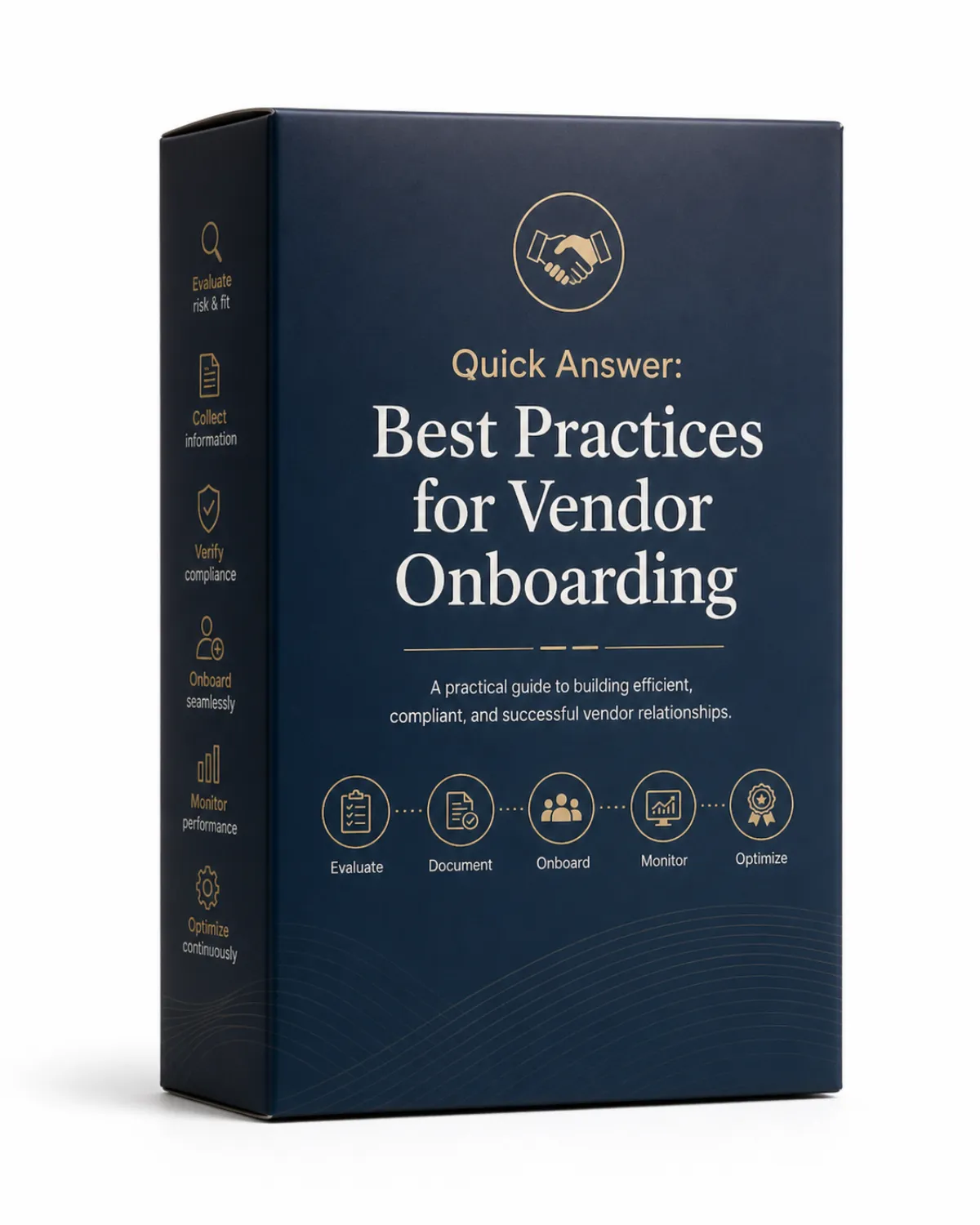
The best practices for vendor onboarding are a standardized intake form, a named process owner, SLA-based approvals, and a single system of record. That combination cuts duplicate data entry, trims rework, and makes it much easier to prove who approved what, when, and why. In my experience, those four pieces clear away most of the friction before any software purchase enters the conversation. I have seen teams argue for weeks about platform features when the real problem was that nobody knew who was supposed to chase the bank letter from the vendor’s finance contact in Charlotte.
The biggest delay is usually not negotiation. It is missing tax, banking, or insurance documents. A supplier can agree to pricing in fifteen minutes, then take ten business days to return a signed W-9, proof of insurance, and a bank confirmation letter. I watched that happen with a label converter that wanted to start production on a twelve- to fifteen-business-day proof cycle from proof approval, but the vendor file was still waiting on a bank verification step from finance. The artwork was approved on time, and the plate fees were already quoted at $275, yet production sat idle because the vendor master was not released. By the time that got sorted out, everyone was pretending not to be annoyed.
That is why the best practices for vendor onboarding have to begin with intake design, not tooling. One form should collect legal entity name, tax ID, remittance details, address, contact role, product category, and risk flags, plus a field for manufacturing region such as Guangdong, Jalisco, or the Midwest if the supplier ships packaging components. From there, the workflow should route automatically: procurement for commercial review, finance for payment setup, legal for contract review, and quality or compliance if the vendor touches regulated goods or branded packaging materials. If a supplier is making components that will end up in food-contact packaging, I want that routing to be explicit, not implied by a vague "we'll handle it later" note in somebody's inbox. That kind of clarity is one of the simplest vendor onboarding best practices to enforce.
"We were losing four to seven days per supplier just asking for the same three files twice," a procurement lead told me after a packaging rollout in Cleveland. "Once we made one intake form and one owner mandatory, half the chaos disappeared, and the remaining half became easy to see."
For small teams, a spreadsheet can work at low volume. I do not dismiss that. A sheet with 25 vendors, color-coded status, and weekly review meetings is perfectly serviceable, especially if the team is in one office and the plant is in the same time zone. Once finance, legal, and procurement all edit the same file, version control gets fragile. One overwritten cell can turn into a missed payment, a duplicate vendor record, or a fraud risk. I have personally watched a team spend an afternoon arguing over which tab was "the real one," which is not my idea of strategic sourcing. The best practices for vendor onboarding do not punish small teams for starting simple; they just ask that the process mature before supplier counts hit triple digits.
If your packaging line depends on corrugate, inks, or coated papers, I would also cross-check supplier documentation against FSC chain-of-custody rules and shipping verification methods from ISTA. Those standards are not paperwork decoration. They help separate suppliers that can support claims, testing, and traceability from those that only sound prepared in a sales call. I have a strong opinion here: if a vendor cannot produce the right paperwork without turning it into a scavenger hunt, they are probably not ready for the kind of work that carries real compliance weight, especially if the job requires 350gsm C1S artboard, water-based inks, or a carton drop test from 42 inches.
Quick Answer: Best Practices for Vendor Onboarding
If you need the short version, start here: the best practices for vendor onboarding are a standardized intake form, a named process owner, SLA-based approvals, and a single system of record. That combination cuts duplicate data entry, trims rework, and makes it much easier to prove who approved what, when, and why. In my experience, those four pieces clear away most of the friction before any software purchase enters the conversation. I have seen teams argue for weeks about platform features when the real problem was that nobody knew who was supposed to chase the bank letter from the vendor’s finance contact in Charlotte. For teams managing procure-to-pay handoffs, this is usually where the cleanest gains show up first.
The biggest delay is usually not negotiation. It is missing tax, banking, or insurance documents. A supplier can agree to pricing in fifteen minutes, then take ten business days to return a signed W-9, proof of insurance, and a bank confirmation letter. I watched that happen with a label converter that wanted to start production on a twelve- to fifteen-business-day proof cycle from proof approval, but the vendor file was still waiting on a bank verification step from finance. The artwork was approved on time, and the plate fees were already quoted at $275, yet production sat idle because the vendor master was not released. These are the kinds of delays that make vendor onboarding best practices feel less like policy and more like protection.
That is why the best practices for vendor onboarding have to begin with intake design, not tooling. One form should collect legal entity name, tax ID, remittance details, address, contact role, product category, and risk flags, plus a field for manufacturing region such as Guangdong, Jalisco, or the Midwest if the supplier ships packaging components. From there, the workflow should route automatically: procurement for commercial review, finance for payment setup, legal for contract review, and quality or compliance if the vendor touches regulated goods or branded packaging materials. If a supplier is making components that will end up in food-contact packaging, I want that routing to be explicit, not implied by a vague "we'll handle it later" note in somebody's inbox. That level of specificity is one of the practical best practices for vendor onboarding that actually keeps the line moving.
"We were losing four to seven days per supplier just asking for the same three files twice," a procurement lead told me after a packaging rollout in Cleveland. "Once we made one intake form and one owner mandatory, half the chaos disappeared, and the remaining half became easy to see."
For small teams, a spreadsheet can work at low volume. I do not dismiss that. A sheet with 25 vendors, color-coded status, and weekly review meetings is perfectly serviceable, especially if the team is in one office and the plant is in the same time zone. Once finance, legal, and procurement all edit the same file, version control gets fragile. One overwritten cell can turn into a missed payment, a duplicate vendor record, or a fraud risk. I have personally watched a team spend an afternoon arguing over which tab was "the real one," which is not my idea of strategic sourcing. The best practices for vendor onboarding do not punish small teams for starting simple; they just ask that the process mature before supplier counts hit triple digits.
If your packaging line depends on corrugate, inks, or coated papers, I would also cross-check supplier documentation against FSC chain-of-custody rules and shipping verification methods from ISTA. Those standards are not paperwork decoration. They help separate suppliers that can support claims, testing, and traceability from those that only sound prepared in a sales call. I have a strong opinion here: if a vendor cannot produce the right paperwork without turning it into a scavenger hunt, they are probably not ready for the kind of work that carries real compliance weight, especially if the job requires 350gsm C1S artboard, water-based inks, or a carton drop test from 42 inches.
Top Options Compared: Best Practices for Vendor Onboarding Tools
The four most common approaches are spreadsheet tracking, shared-drive or email workflows, dedicated supplier portals, and ERP-integrated onboarding. Each one makes a different trade-off between speed, visibility, auditability, and setup effort. If you are comparing the best practices for vendor onboarding across tools, do not ask which option is "best" in the abstract. Ask Which One Fits your vendor volume, compliance burden, and internal headcount, because the wrong answer usually looks attractive in a demo and irritating in week three. The best vendor onboarding best practices always match the tool to the way the business already works.
| Option | Upfront Cost | Labor Load | Audit Trail | Best Fit | Blunt Verdict |
|---|---|---|---|---|---|
| Spreadsheet tracking | $0 to $200 for templates and shared storage | High once you pass 30 to 50 vendors | Weak unless tightly managed | Tiny vendor lists and one-owner teams | Cheap upfront, expensive in rework |
| Shared inbox plus checklist | Low, usually no new software | Medium to high, depending on volume | Moderate if threads are disciplined | Mid-market teams with simple approvals | Fast to start, messy when people go on vacation |
| Supplier portal or SaaS | Subscription plus setup time | Lower after rollout | Strong, with role-based access and logs | Growing teams and regulated buyers | Saves labor fastest if setup is handled well |
| ERP-connected onboarding | Highest, due to integration and implementation | Lowest once stable | Strongest for finance and master data control | Enterprise procurement and multi-system operations | Best long-term control, slowest to launch |
Spreadsheet tracking looks appealing because there is no license fee. That is the trap. The hidden cost is labor: status checks, duplicate entry, manual reminders, and rekeying data into an ERP or accounting platform. I have seen a packaging buyer spend six hours a week chasing vendor responses across two sheets and one shared drive in Milwaukee. At an hourly burden rate of $42, that is roughly $10,400 a year before you count rework. And if the spreadsheet is shared by five people, you are not just managing vendors; you are managing everyone’s interpretation of the spreadsheet, which is a very different and far more exhausting job.
Shared inbox workflows are better than unmanaged email because they centralize requests, but they still depend on human discipline. One absent coordinator and the thread dies. One copied attachment with the wrong tax ID and the finance queue backs up. For the best practices for vendor onboarding, that model works only when the supplier list is small, the risk is low, and there is a clear owner who checks the queue every day. I like predictable processes, and I like lunch breaks even more, so I am not eager to make one person the human router forever unless there is genuinely no better alternative.
Portal-based software usually lands in the sweet spot for teams that need repeatability. Stronger systems collect documents, trigger reminders, and show exactly where each vendor sits in the workflow. That matters when you are onboarding 12 packaging converters in a quarter and every one of them needs a different insurance threshold, a different remittance format, and a different approval route. I have seen this cut cycle time by 30% to 40% once the template was right, especially for suppliers in the U.S. Midwest and northern Mexico. Not magic, just fewer chances for paperwork to wander off into the void. For many teams, this is where vendor onboarding best practices become visible enough to defend in a budget meeting.
ERP-integrated onboarding is the most controlled option, but it asks for patience. Implementation can take 8 to 16 weeks, and integration work often needs IT, finance, and procurement to agree on field mapping before the first supplier goes live. Even so, for businesses with high transaction volume, that upfront effort can be worth it. The best practices for vendor onboarding at enterprise scale often depend on data consistency more than interface polish. A pretty screen does not help if vendor IDs, bank fields, and tax classes do not reconcile downstream. Supplier master data has to stay clean or the whole procure-to-pay chain starts to wobble.
Detailed Reviews: Where Each Vendor Onboarding Approach Wins
Spreadsheet-based onboarding is easy to start, which is why so many teams begin there. You can create fields for legal name, contact email, tax status, and bank details in less than an hour, and you can build a color code for "waiting on W-9" or "bank letter received" before lunch. The trouble shows up later: permissions are weak, version history gets messy, and reminders depend on someone remembering to send them. I once reviewed a vendor file where three columns had been copied from an old template, and the vendor was paid against the wrong remittance address for 21 days. Nobody was trying to be careless. They were just trying to keep the lights on, which is how small errors get promoted into expensive ones.
If you are using spreadsheets, the best practices for vendor onboarding should include read-only access for most users, one edit owner, a locked template, and a weekly exception review. That will not make the process elegant, but it can keep the process safe. I would still reserve spreadsheets for fewer than 30 active suppliers unless the process is unusually simple. Once the process starts involving compliance checks, banking changes, or multiple approvers, the spreadsheet starts behaving like a cardboard box in the rain.
Portal or SaaS-based onboarding is stronger because it keeps documents in one place and makes the workflow visible. Status is clear. Missing files are obvious. Repeated requests are avoided. Better tools also allow document expiration dates, which is useful for insurance certificates, bank letters, and annual certifications. A packaging supplier that handles food-contact liners, for example, may need a fresh compliance packet every 12 months, not just once at sign-up. I prefer this model because it lets humans focus on judgment instead of rummaging through email attachments like archaeologists with better shoes. It is one of the most practical best practices for vendor onboarding when volume begins to rise.
The downside is setup discipline. If you do not define approval stages, document rules, and exception handling before launch, the portal becomes a prettier version of email chaos. I have seen teams buy software and still lose six days because no one agreed on who should review a non-domestic bank account from a supplier in Toronto or whether a COI from a Seoul-based broker needed a second review. That is why the best practices for vendor onboarding require process design before configuration. Otherwise you just automate confusion, and that is a very expensive hobby.
ERP-linked onboarding works best when vendor master data must sync with purchasing, invoice matching, and payment controls. It is powerful, but it is not casual. Master data teams usually want duplicate checks, tax validation, bank verification, and supplier categorization all locked down. In one negotiation with a contract manufacturer in Monterrey, the ERP team insisted on eight mandatory fields before activation, including DUNS, remittance contact, currency, and region code. The supplier thought it was excessive. Finance thought it was common sense. Both were right, depending on the risk profile. I think that is one of the less glamorous truths of vendor management: the right amount of control depends on how painful the mistake would be if you got it wrong.
Managed or outsourced onboarding support can help when internal teams are overloaded. That option is useful during a merger, a rebrand, or a plant expansion in places like Greenville, South Carolina, or Juarez when the procurement team is also handling sourcing, quality, and contract renewals. The cost is real, and ownership can get blurry if the vendor coordination sits outside the company. The best practices for vendor onboarding still need one internal steward, even if some administrative work is delegated. Otherwise you end up with a polite but unhelpful situation where everybody thinks someone else is "on it."
Here is the blunt test I use: who speeds up approvals, who creates duplicate work, and who hides exceptions until the end? The strongest system reveals the bottleneck within a week. The weakest system hides it until an invoice is rejected or a shipment is ready and the vendor is still not active. That is the difference between an onboarding process and a paperwork pile. And yes, I have seen the paperwork pile topple both metaphorically and literally, usually right next to a pallet of printed sample cartons and a stack of bank letters dated three days apart.
Process and Timeline: A Vendor Onboarding Workflow That Actually Moves
The cleanest vendor onboarding workflow has six stages: intake, risk review, compliance checks, banking validation, account creation, and first-order test. That sequence sounds obvious, yet I have seen teams skip directly from intake to account setup and then spend days repairing the missing steps. The best practices for vendor onboarding are about sequencing the work so no one downstream has to reverse decisions upstream. If the bank verification happens after the first invoice is cut, you are not onboarding. You are improvising, usually at 4:45 p.m. on a Friday.
For low-risk vendors with complete paperwork, the process can move in a few business days. For standard B2B suppliers, one to three weeks is a more realistic range once finance, legal, and system setup are included. Regulated or international suppliers often take longer because they bring extra verification: tax registration checks, sanctions screening, cross-border banking review, or product certification review from a lab in Shenzhen or Rotterdam. That timing is not slow by accident. It is the cost of reducing error later. I would rather hear "we need two more days to verify" than "we already paid the wrong account." One is annoying. The other is a fire drill with spreadsheets and a call to the bank.
Delays usually cluster in four places. First, no one owns follow-up. Second, documents arrive in the wrong format, such as a photo of a bank letter instead of a PDF. Third, data is rekeyed into different systems by different people. Fourth, the legal or finance queue has no service-level target, so the request simply waits. The best practices for vendor onboarding should assign an owner, define turnaround times, and escalate anything that sits untouched for more than 48 hours. I am very partial to the 48-hour rule because it keeps small delays from becoming mysterious, week-long disappearances.
At a supplier meeting for a Custom Folding Carton program in St. Louis, I watched a vendor that could hit a twelve-business-day sample schedule lose the first production slot because the finance team had not validated the account number. The carton design was done, the ink specs were approved, and the quote was based on $0.15 per unit for 5,000 pieces. The onboarding packet was missing one bank confirmation letter. That is the kind of delay people underestimate because it looks administrative, but it can push a launch date by a week. If you have ever had a production calendar unravel because of one tiny missing field, you know exactly how absurdly large a small mistake can feel.
My practical rule is simple. Separate low-risk vendors from high-risk vendors. A stationery printer and a contract packager do not deserve the same review chain. The best practices for vendor onboarding include a tiered workflow with a fast lane for low-risk suppliers and a deeper review for vendors that touch branded, regulated, or high-value goods. A one-size-fits-all process is usually just a fancy way of making the safe vendors wait for the risky ones, which is a terrible use of everybody’s Monday morning.
Turnaround times should be published. If finance needs two business days for bank validation, say two business days. If legal can review a contract annex in five business days, say five. Once those numbers are visible, people stop guessing and start planning around actual capacity. That one change alone can cut follow-up emails by 25% in my experience. It also reduces the awkward, passive-aggressive "just checking in" messages that everybody hates but nobody seems able to stop sending.
Price Comparison: What Vendor Onboarding Really Costs
The sticker price is never the full price. A spreadsheet may appear free, but the labor attached to it is not. A portal may charge a monthly subscription, yet it can still cost less overall if it removes duplicate entry, manual reminders, and approval rework. That is why the best practices for vendor onboarding should be evaluated on total cost, not just software fee. I think a lot of teams quietly know this, but the word "subscription" still makes everybody glance at the budget line like it personally insulted them.
Here is the simplest way to think about the money. At the low end, spreadsheet or shared inbox workflows can cost almost nothing in licenses, but they consume internal time. At the mid-tier, software subscriptions often sit in the range of a few hundred to a few thousand dollars per month, depending on vendor count and modules. At the enterprise end, implementation and integration fees can exceed the first year of subscription cost, especially if ERP sync, identity controls, or complex approval routing are involved. A mid-sized buyer in Columbus once told me their portal cost $1,400 a month, but it saved two people a half-day each week, which turned out to be a better number than the one in the vendor proposal.
Hidden costs matter even more. Duplicate data entry between procurement and accounting can burn 15 to 30 minutes per vendor. If you onboard 80 suppliers a year, that is a meaningful labor bill. Missed early-payment discounts can add another layer, especially if vendor activation is delayed by days and invoices sit in limbo. Fraud exposure also belongs in the math, because a weak process around bank changes is not just inconvenient; it can be expensive. I have seen people spend hours debating a $600 subscription while ignoring the fact that one bad payment path can cost far more than that in a single mistake. The best practices for vendor onboarding are part cost control, part risk control, and part patience test.
I have seen one packaging team lose a $1,200 early-payment discount because the vendor master was not active in time for the first invoice run. That is a small number in isolation. Over a year, a few similar misses can easily outrun the monthly cost of a better tool. The best practices for vendor onboarding are supposed to reduce this friction, not merely document it after the fact. Nobody gets a prize for having a beautifully organized folder full of expensive mistakes.
| Cost Category | Spreadsheet / Email | Portal / SaaS | ERP-Integrated Setup |
|---|---|---|---|
| License or subscription | $0 to very low | Moderate monthly fee | Highest ongoing platform cost |
| Implementation | Minimal | Low to moderate | Moderate to high |
| Internal admin time | High | Lower after setup | Lowest after stabilization |
| Rework and error risk | High | Medium | Low if master data is disciplined |
| Best economic value | Only for tiny volume | Growing teams | High-volume, complex operations |
The cheapest option becomes the most expensive when labor gets buried. If one bad workflow burns four hours a week across finance and procurement, that is more than 200 hours a year. At a blended cost of $35 to $50 per hour, the annual labor can hit $7,000 to $10,000 before software even enters the conversation. That is why the best practices for vendor onboarding are a finance decision as much as a process decision. I would argue they are also a sanity decision, because nobody enjoys cleaning up the same mistake over and over.
If you are in packaging, add another layer: materials traceability. A cardboard supplier may need FSC proof, a shipper may need insurance, and a testing partner may need clean documentation from ISTA-style drop or vibration protocols. A converter in the Carolinas making 350gsm C1S artboard cartons for a cosmetics launch may also need migration data, ink safety sheets, and a dated certificate of origin. Those compliance details are not free, but they are cheaper than rework after a failed launch or a rejected claim. I have seen one missing certification stall a whole shipment of converted materials, and that kind of delay has a way of making everyone suddenly very interested in document control.
How to Choose the Right Vendor Onboarding Setup
The right setup depends on five variables: vendor volume, compliance burden, internal systems, supplier geography, and how often vendors change bank or tax details. If you only onboard 12 vendors a year, a simple shared workflow may be enough. If you activate 120 vendors across the U.S., Mexico, and Southeast Asia, then the best practices for vendor onboarding usually call for software, documented approvals, and a real owner for exceptions. That is not me being dramatic. That is just the point where manual follow-up stops being charming and starts being a drain.
I would break it down like this. Small business teams need simplicity and low cost more than they need automation depth. Scaling operations need visibility, reminders, and fewer manual touches. Regulated buyers need audit logs, role-based access, and strong document refresh cycles. Enterprise procurement teams need integration, master data control, and a way to prevent duplicate vendors across regions. Different businesses absolutely need different tools, and I think anyone who tells you otherwise is either selling something or has not had to clean up the mess yet. The best practices for vendor onboarding are only useful if they fit the risk, the headcount, and the pace of the business.
During demos, ask direct questions. How does the system handle approval routing? Can it send reminders after 48 hours? Does it keep an audit log for every document upload and status change? Can you rerun onboarding for an existing vendor who changes tax status or remittance details? The best practices for vendor onboarding are visible in these answers. Weak tools sound polished but vague. Strong tools answer the hard questions without blinking.
Red flags are easy to spot if you stay disciplined. No audit trail means no accountability. No owner assignment means follow-up drifts between teams. No exception handling means every odd case becomes a manual fire drill. No easy way to refresh vendor records means stale data will accumulate, which is how bank details and insurance certificates go out of date. I have a particular dislike for systems that make routine updates feel like a punishment; there is enough friction in vendor work without software acting like a gatekeeper from 1998.
I also recommend a simple scorecard with five criteria, each scored from 1 to 5: setup time, approval visibility, compliance control, integration fit, and labor savings. A tool that scores 25 out of 25 is rare, but a scorecard prevents you from being distracted by a slick interface and a low first-year quote. The best practices for vendor onboarding deserve a decision method, not just a gut feel. Gut feel is fine for choosing coffee in Seattle. It is a little less useful for deciding where supplier banking data lives.
One client in a supplier-heavy packaging business chose a portal after comparing three options with a one-page scorecard. The portal was not the cheapest option. It was the one that cut manual reminders by 70% and gave finance a clean audit trail for every bank change, every document upload, and every exception approval. That matters more than a lower sticker price when the team is processing supplier records every week. I remember the procurement director saying, "I do not need pretty. I need fewer callbacks." Fair enough, and probably the most honest software requirement I have ever heard.
Our Recommendation: Best Practices for Vendor Onboarding Next Steps
My recommendation is direct: start with standardized intake, named ownership, and SLA-based approvals, then move to software when volume, risk, or manual work starts to break the process. Do not buy a platform first and assume the workflow will fix itself. The best practices for vendor onboarding work because the process is defined, not because the interface looks modern. A shiny interface cannot rescue a vague handoff, especially if the vendor packet is already missing tax data, banking proof, and a signed terms sheet.
For the first 30 days, map the current workflow exactly as it exists. Count every handoff. List every document. Track how long each step takes from request to activation. Then define the required packet: legal entity details, tax form, banking proof, insurance certificate if needed, and any category-specific documents such as FSC chain-of-custody evidence or product testing files. If a vendor touches branded packaging, add the quality and sustainability checks at this stage, not later. I would rather be the person who asks the awkward compliance question early than the one explaining a launch delay later.
By day 60, review bottlenecks with actual numbers. Which step takes the most time? Which owner responds slowest? Which document is missing most often? Remove duplicate steps, clarify who can approve exceptions, and publish the turnaround times. That is where the best practices for vendor onboarding start saving real hours. I have seen teams cut their average cycle time just by admitting that one approval path was doing nothing except making everybody wait.
By day 90, tighten your rules around stale records. Vendors change bank details, tax IDs, and compliance documents more often than teams admit. A recertification cycle every 12 months for insurance and every 24 months for lower-risk data is a practical place to begin. High-risk suppliers may need more frequent review. The exact cadence depends on the risk profile, and I would not pretend otherwise. If your supplier base includes international vendors or regulated materials, you may want a stricter timetable and a sharper escalation path, because stale records have a nasty habit of showing up exactly when you are busiest.
"A vendor file is not a one-time project," a finance director in Detroit told me after a painful audit. "It is a living record. Treat it like one, or it will cost you later, usually right when you think the quarter is clean."
That is the heart of it. The best practices for vendor onboarding are not glamorous, and they do not require a dramatic transformation. They require a form that asks the right questions, an owner who answers for the process, and a system that keeps everybody from rebuilding the same file three different ways. If you get those basics right, activation gets faster, payment risk drops, and procurement stops feeling like a relay race with a dropped baton. I can live without the drama. I suspect your finance team can too.
If you do one thing this week, make it this: map the intake packet, assign one accountable owner, and publish two service levels, one for finance and one for legal. That single change is usually enough to expose the bottleneck that has been hiding in plain sight.
What are the best practices for vendor onboarding in procurement?
Use one standardized intake form so finance, legal, and procurement are not collecting the same data in different places. Assign a single owner for each vendor so follow-ups, approvals, and exceptions do not get lost between teams. Set service-level targets for each step and track cycle time, rejection reasons, and rework. I would also keep a simple exception log, because memory is a terrible control system, and a worse spreadsheet column, especially once vendor counts pass 40.
How long should vendor onboarding take in a normal process?
Low-risk vendors with complete paperwork can often be approved in a few business days. Typical B2B onboarding takes one to three weeks once compliance, banking, and system setup are included. High-risk or regulated vendors usually take longer because of extra verification and legal review. If it is taking much longer than that, I start looking for the hidden handoff nobody owns, or the bank letter that is still sitting in a sales inbox in Atlanta.
What documents are usually required for vendor onboarding?
Most teams need tax forms, banking details, legal entity information, and an insurance certificate if the vendor is handling physical goods or services. Many buyers also ask for compliance documents such as sanctions checks, cybersecurity questionnaires, or product certifications. If the vendor is international, add VAT or equivalent tax registration details and cross-border payment information. In my experience, the more precise the request packet, the less time you spend answering "can you resend that?" for the third time on a Tuesday.
How much does vendor onboarding software cost?
Lightweight tools are usually cheaper upfront, but they may still require setup time and internal admin work. Mid-market platforms often charge by user, vendor volume, or module, while enterprise systems add integration and implementation fees. The real cost depends on labor saved, not just subscription price, so compare cycle time and error reduction too. I always tell teams to price the rework honestly, because hidden labor has a habit of becoming the most expensive line item in the room, especially when one missing field delays a $40,000 order.
How do you reduce risk during vendor onboarding?
Separate low-risk and high-risk vendors so the same controls are not applied to every supplier. Verify banking and tax details before the first payment, and keep an audit trail for every approval. Require periodic recertification so vendor records do not go stale after the initial setup. If a vendor cannot support the documentation trail you need, that is not a minor inconvenience; it is a warning sign worth listening to, whether the supplier is in New Jersey, Nuevo Leon, or Suzhou.