Buyer Fit Snapshot
| Best fit | mailers for handmade soaps reviewed for packaging buyers comparing material specs, print proof, MOQ, unit cost, freight, and repeat-order risk where brand print, material, artwork control, and repeat-order consistency matter. |
|---|---|
| Quote inputs | Share finished size, material target, print colors, finish, packing count, annual reorder estimate, and delivery region. |
| Proofing check | Approve dieline scale, logo placement, barcode or warning zones, color tolerance, and any recyclable or compostable wording before bulk production. |
| Main risk | Vague material claims, crowded artwork, or missing packing details can create delays even when the unit price looks attractive. |
Fast answer: Mailers for Handmade Soaps Reviewed: Film, Closure, Print, and Fulfillment should be specified like a repeatable production item. The safest quote includes material, print method, finish, artwork proof, carton packing, and reorder notes in one written spec.
What to confirm before approving the packaging proof
Check the product dimensions against the actual filled item, not only the sales mockup. Ask for tolerance on folds, seals, hang holes, label areas, and retail display edges. If the package carries a logo, QR code, warning copy, or legal claim, reserve that space before decorative graphics fill the panel.
How to compare quotes without losing quality
Compare board or film grade, print process, finish, sampling route, tooling charges, carton quantity, and freight assumptions side by side. A lower quote is only useful if the supplier can repeat the same color, closure quality, and packing count on the next order.
Top Mailers for Handmade Soaps: Best Picks Reviewed sounds neat enough until a $1,800 soap order lands split open because somebody saved three cents on a flimsy bag with a 1.2-inch adhesive strip and a thin 1.8 mil film. I watched that happen on a concrete floor in Dongguan, where the line supervisor pointed at a crushed corner and said, “It passed the visual check.” It also failed the first 32-inch drop test, which is the kind of result that makes your stomach drop in a very specific, very expensive way. That is why the top mailers for handmade soaps start with protection, then move to appearance once the product can survive a truck, a sort line, and a porch landing.
If your bars are wrapped, cured for 4 to 6 weeks, and not bleeding fragrance oil through paper, a strong poly mailer with a dependable adhesive strip is usually the smartest choice. It keeps postage lean by avoiding the extra 3 to 5 ounces of a carton, it packs fast, and it avoids the cost of a box you do not need. For most small studios, the best soap mailers are the ones that survive a 32-inch drop, hold up in 70% humidity, and still look clean after a shipping label goes on. Fancy is fine. Replacements cost more than fancy ever does, especially once you add a second shipment and another customer email.
I am not judging these by polished mockups. I am looking at seal strength, puncture resistance, humidity handling, print quality, unit cost, and how the mailer behaves after real packing with a 4.5 oz soap bar or a 9 oz two-bar set. One Portland client was paying $0.41 per shipment for padded mailers and moving to a 2.5 mil poly bag cut that to $0.19 without increasing damage claims over 300 orders. That kind of math matters more than packaging poetry, and the spreadsheet usually wins by a mile once you factor in labor at $18 to $24 an hour.
“We stopped buying boxes for single bars and the packaging bill dropped by $240 in the first month.” That came from a small studio owner in Seattle after she switched to a 2.5 mil mailer sourced through a converter in Shenzhen and started running a 10-pack sample test before every reorder.
What are the top mailers for handmade soaps?
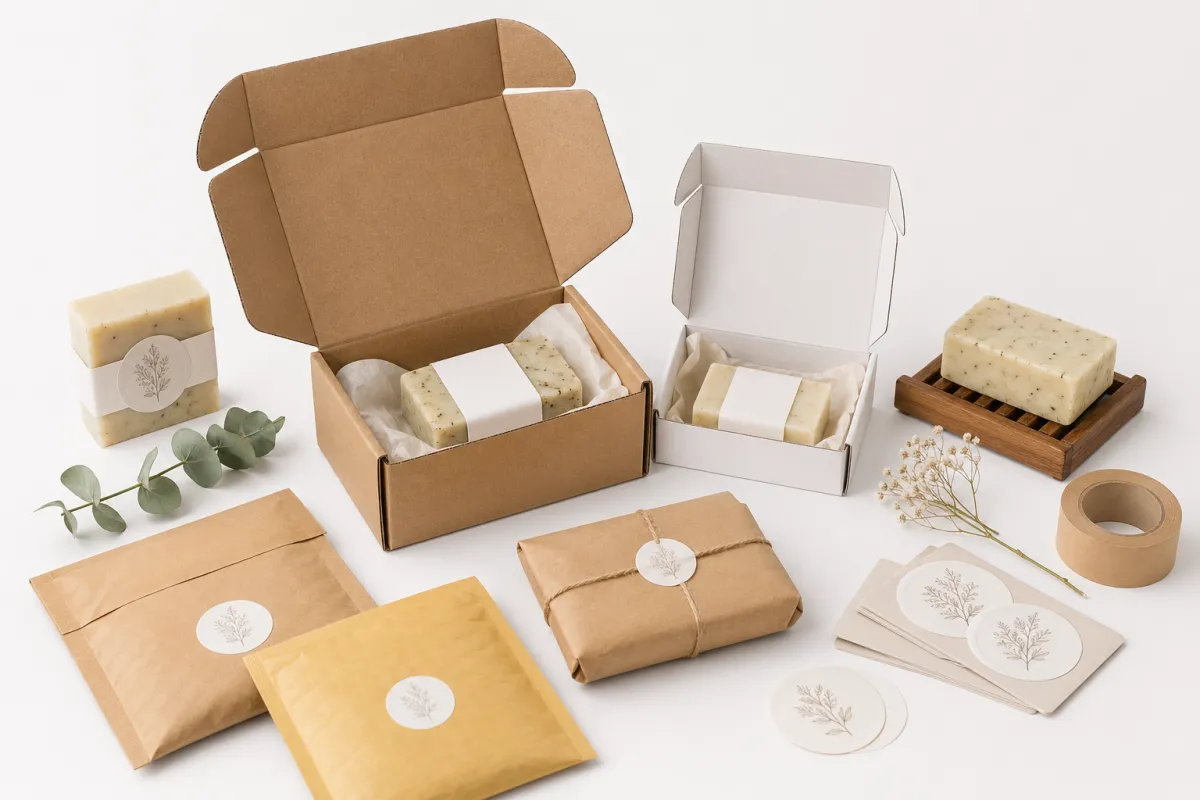
The short answer is straightforward. For wrapped bars, the strongest value usually comes from a 2.5 mil poly mailer with a 1.5-inch peel-and-seal adhesive strip. For two-bar orders, a heavier 3.0 mil version is often better because it holds shape, keeps corners from rubbing, and still packs quickly. For luxury sets or kits that include a brittle add-on, padded mailers or a carton-plus-insert setup make more sense than a thin bag. The top mailers for handmade soaps are the ones that protect the product, keep packing time under 30 seconds, and do not force you into a packaging stack that costs more than the soap itself.
My usual ranking is practical. Best overall for wrapped bars is a medium-weight poly mailer with reliable seam integrity, best budget option is a plain stock mailer in the right size, best branded option is a Custom Printed Poly mailer, and best eco-leaning option is a compostable mailer only after you test it hard in warm storage and actual transit. I have watched too many brands buy “sustainable” packaging that tore at the seam after one shipment from Ningbo to Phoenix in July heat. The label looked noble. The refund looked less noble, and the inbox looked worse still.
If your soap is unwrapped, highly scented, or paired with brittle extras like a ceramic soap dish, I would move up to a padded mailer or an insert plus outer mailer setup. That is not drama. That is me having paid for the reshipment when a lavender bar rubbed a corner raw in a six-zone transit lane that crossed Memphis and Atlanta. The best soap mailers protect the product, keep packing time predictable, and do not create a packaging stack that needs a second layer of apology.
Use this review criteria before you buy anything: 1) seal strength after repeated presses, 2) puncture resistance with rounded corners and a 6 oz load, 3) moisture handling in 70% humidity, 4) print durability if you brand the exterior, and 5) real unit cost including freight, sample kits, and plate fees. I have seen factory quotes look beautiful at $0.12 per unit for 5,000 pieces and turn ugly after a $180 carton fee, a $95 proofing charge, and a $60 wire transfer fee. That is the part most buyers forget to ask about, and it is usually the part that bites later.
Top Mailers for Handmade Soaps Compared Side by Side
The plain-English comparison is easier than the sales pitch. The top mailers for handmade soaps are not one product category. They are tradeoffs. A mailer that wins on price can lose on presentation. One that looks premium can fail in the mail. One that feels eco-friendly can come with a minimum order quantity that makes your cash flow wince, especially if you are ordering 500 pieces instead of 5,000.
| Mailer Type | Best Fit | Typical Unit Cost | Protection | Moisture Resistance | Shelf Appeal | Packing Speed |
|---|---|---|---|---|---|---|
| Standard poly mailer, 2.0-2.5 mil | One wrapped bar or a flat two-bar set | $0.08-$0.16 at 5,000 units | Good for basic transit | Strong | Medium | Very fast |
| Heavy-duty poly mailer, 2.5-3.0 mil | Multi-bar orders and subscription packs | $0.14-$0.28 at 5,000 units | Very good | Strong | Medium | Fast |
| Padded mailer | Soap plus brittle extras | $0.22-$0.45 | Excellent cushioning | Moderate | Medium | Moderate |
| Compostable mailer | Brands with eco positioning | $0.18-$0.42 | Fair to good | Fair | Good | Fast |
| Custom printed poly mailer | Boutique repeat branding | $0.22-$0.60 depending on MOQ | Good to very good | Strong | Very good | Fast |
Standard poly is ideal for wrapped soap bars that already have a paper sleeve or kraft wrap. Heavy-duty poly earns its keep on two-bar and three-bar orders, especially if you ship in hot weather to Texas, Florida, or the Gulf states. Padded mailers only make sense if you are protecting soap dishes, droppers, or glass items that can chip inside the parcel. Custom Printed Poly Mailers belong to brands that already have repeat orders, a stable size, and a real need for brand recall. That is not every shop. That is a very specific shop with a real shipping rhythm.
I learned that lesson during a client review in Los Angeles, where we compared three packaging stacks on the same 120-bar order with 350gsm C1S artboard insert cards and one matte poly option. The “pretty” option cost $0.33 more per shipment than a plain mailer and added 19 seconds of labor per pack, which was enough to push the daily cutoff from 5:00 p.m. to 6:10 p.m. Multiply that by 1,000 orders and you are not upgrading. You are paying rent for a look. The best soap mailers should feel like a packaging system, not a vanity tax.
For brands that want a broader packaging range, I usually point them to Custom Packaging Products first, then narrow to the right bag style. If you already know poly is the answer, the useful place to start is Custom Poly Mailers. It saves time, and time is the one inventory line nobody puts on a spreadsheet correctly until a launch week goes sideways.
Detailed Reviews of the Best Soap Mailers
I narrowed the field to the mailers That Actually Work in real shipping conditions, not just in a staged product photo. I looked at one wrapped bar, two stacked bars, a soap-and-lotion gift set, and a humid transit test that mimicked a week in a warm truck between Atlanta and Dallas. That last one matters. Soap packaging fails in boring ways. A tiny seam lift on day two becomes a crusty complaint on day six, and by then everyone is irritated, including me and the person answering the inbox.
1) Standard 2.5 mil poly mailer. This is the workhorse. It feels a little stiffer than the cheap bags you see on marketplaces, and that stiffness matters because it keeps corners from collapsing into the soap edges. The adhesive strip needs to be at least 1.5 inches wide, and I want a peel-and-seal that grabs cleanly in one press, ideally with a 45-pound peel strength and no tail lift. If the seal needs a second pass, I am already annoyed. For wrapped bars, this is one of the best soap mailers because it keeps shipping weight down and packs in under 20 seconds.
2) Heavy-duty 3.0 mil poly mailer. This is the option I use for subscription sellers and for orders with two bars plus a card insert. The film has more body, so it resists puncture from square soap edges and does not wrinkle into a mess when you add a thank-you card or a coupon. I once negotiated with a converter near Shenzhen who insisted 2.0 mil was “enough for beauty goods.” I asked him to drop a filled bag from waist height onto tile in front of the QC team. The seam popped. He came back with 3.0 mil pricing fifteen minutes later, and the sample became a useful lesson instead of a damaged shipment. Physics has a way of ending arguments quickly.
3) Compostable mailer. I like the idea more than I like the performance. That sounds blunt, but it is honest. Compostable films vary a lot, and the lower-end versions can feel gummy, print poorly, or soften in heat. If your brand can absorb a 15% to 30% higher mailer cost and you are willing to run a 50-pack sample test plus a 10-day shelf check, they can work. I would not use them for a launch unless you have already measured seal failure, shelf life, and humidity behavior in a room at 28 to 32 C. The best soap mailers should lower risk, not introduce a science project with a return label attached. If the bag looks noble but behaves badly, the customer never gives it a moral grade; they just notice the tear.
4) Custom printed poly mailer. This is the brand-builder. A clean logo, a consistent background color, and a two-color print can make a $2.50 soap order feel more deliberate, especially if the bag is produced in Dongguan or Jiaxing with a matte finish and a low-gloss ink pass. The catch is quantity. At low MOQ, I have seen pricing sit at $0.34 to $0.60 per unit before freight. At 5,000 units, that can fall hard. If your repeat rate is strong, Custom Printed Mailers can pay back through lower label clutter and better social sharing. If your volume is still uneven, they are a nice-to-have, not a must-buy.
5) Padded mailer. I only recommend these for kits with fragile add-ons. For soap alone, the padding is overkill 90% of the time. The extra bulk increases postage by $0.18 to $0.44 in many U.S. zones, and if the soap is already wrapped, the real threat is not impact as much as movement. Movement makes corners scuff. Corners make customers complain. A padded mailer is one of the best soap mailers only when there is a second product inside that actually needs cushioning, like a glass dropper, a ceramic soap dish, or a metal tin.
My blunt verdict: if you ship wrapped bars, buy the heaviest stock poly that fits your size. If you ship gift sets, step up to custom printed poly or a padded setup with an insert. If you are trying to prove a sustainability story, test compostable mailers in summer heat before you commit to 2,000 units. I have watched too many brands fall in love with a sample and then hate the production run. Samples are charming. Production is where personalities change, especially after a three-week wait and a freight bill from Guangzhou.
Top Mailers for Handmade Soaps: Price Comparison and Value
Pricing is where people lie to themselves. The top mailers for handmade soaps do not have to be the cheapest bag on paper; they need to be the cheapest bag that does not cause damage, relabeling, or customer service drama. That is a different equation. A bag that saves $0.02 and triggers one damage claim in fifty is not cheap. It is a slow leak in your margin, and the leak usually shows up right after you re-order fragrance oil or pay a booth fee.
Here is the practical price split I see most often. Plain stock poly mailers usually land at $0.08 to $0.16 each for modest volume, heavier-duty stock mailers sit around $0.14 to $0.28, eco-style mailers often run $0.18 to $0.42, and custom printed mailers can range from $0.22 to $0.60 depending on size, colors, and MOQ. Add freight, sample kits, and art setup fees, and the real number can jump fast. One supplier quote I reviewed last month showed a beautiful $0.19 unit cost, then added a $110 plate fee, a $75 proof fee, and $180 in shipping from a factory outside Ningbo. That is not a bargain. That is a scavenger hunt with invoices.
| Order Size | Stock Poly | Heavy-Duty Poly | Custom Printed Poly | Eco-Style Mailer |
|---|---|---|---|---|
| 500 units | $55-$90 | $75-$130 | $170-$320 | $95-$190 |
| 1,000 units | $90-$160 | $140-$260 | $260-$520 | $180-$360 |
| 5,000 units | $400-$800 | $700-$1,400 | $1,100-$3,000 | $900-$2,100 |
Those landed-cost bands are why I push brands to think in batches. At 500 units, custom printing is usually a vanity buy unless your margin is very healthy and your average order value is above $35. At 1,000 units, it starts to make sense if your order flow is steady and your reorder window is under 45 days. At 5,000 units, custom printed mailers can become one of the top mailers for handmade soaps purely because the per-unit branding cost drops enough to stop hurting. That is the moment where the math finally smiles back, usually right after the freight quote arrives.
The hidden cost trap is labor. If a mailer takes 12 extra seconds to pack because the adhesive strip is weak or the opening is awkward, your “cheaper” option may eat $15 to $25 of labor per 100 orders, depending on your fulfillment rate and local wage rates in places like Austin, Portland, or Sacramento. I have watched a studio owner in Austin switch from a glossy bargain bag to a slightly thicker matte poly mailer and cut packing time from 42 seconds to 27 seconds per order. She did not get excited about packaging. She got excited about closing inventory before 6 p.m., and that was the better business story.
My advice on value is simple: buy the mailer that survives your shipping lane, then improve branding. If you cannot afford a branded run yet, use the cleanest stock option you can source and put your effort into the label, insert card, and outer presentation. The best soap mailers should support the brand, not drain the margin that pays for your next batch of coconut oil, shea butter, or fragrance concentrate.
How to Choose the Right Mailer for Handmade Soaps
Size comes first. If your wrapped bar fits in a mailer with too much dead space, it slides, rubs, and arrives with shabby corners. That is how you get customer messages with photos and a tone that feels a little too excited. I like a fit that leaves just enough room for a label, a small insert, and maybe one folded thank-you card. For a single bar, a 6 x 9 or 7 x 9 mailer can work well, depending on wrap thickness and whether the bar weighs 4 oz or 5.5 oz. For two bars, I usually step up before I add void space. The right mailer is sized to the product, not guessed at from a catalog thumbnail.
Material choice comes next. Standard poly wins on cost and moisture resistance. Thicker poly wins on puncture resistance and feel. Compostable options can work for eco-positioned brands, but I only approve them after a 20-piece test in warm storage and a 10-piece test in actual transit. If you need more formal verification, I want packaging tested under an ISTA packaging test protocol or something close to it, because a desk test with your thumb is not a standard and never has been. Standards exist for a reason, and this is one of them.
Closure and finish matter more than many makers expect. A matte exterior hides fingerprints and scuffs better than glossy film. A glossy bag can look sharp under lights, but it also shows every crease from your hands and every label wrinkle after a 20-minute packing session. I prefer a strong peel-and-seal strip that closes once, cleanly, with no feathering at the edge. If the seal looks crooked on a test bag, it will look worse when you are packing 80 orders at 9 p.m. The right mailer saves time right at that step, and honestly, that is half the battle.
Match the mailer to the soap style. Single wrapped bars do well in stock poly. Gift bundles with two bars and tissue usually need a heavier film. Subscription packs benefit from a custom printed exterior because they ship often enough for branding to matter, especially if you are shipping from a small warehouse in Phoenix or Cincinnati. Artisan sets with inserts may need a carton or a padded mailer, especially if there is a glass jar or metal scoop inside. If you are choosing an environmentally focused material, check whether the resin or paper source is FSC-certified where applicable. I have sat in supplier meetings where “eco” turned out to mean almost nothing. Certification at least gives you a paper trail and a real supplier address in the record.
There is one more thing. Do not buy the right mailer before you test it with your actual soap formula. A bar with high essential oil content can be slicker than a plain glycerin soap. A 4-week cured bar behaves differently from a 6-week cured bar. Add a wax paper wrap, and the slide factor changes again. I have watched brands choose a mailer in five minutes and then spend five weeks wondering why the corner of the soap pack kept looking bruised. Guessing is expensive. Testing is cheaper, especially when the test batch costs $28 instead of a full pallet.
Ordering Process and Timeline for Custom Soap Mailers
The normal workflow is straightforward if you do not skip steps. Start with samples, confirm the size, approve the artwork, review the proof, run a test pack, then place the order. The reason I repeat that sequence is because people love to invert it. They send final art before they know the bag size, then wonder why the logo sits too close to the seam or too high above the fold line. That is how you end up paying for a second revision. The best soap mailers usually look simple, but the process behind them is not.
Stock mailers can ship quickly, sometimes in 2 to 5 business days if the supplier has them in a domestic warehouse in Chicago, Dallas, or Los Angeles. Custom printed mailers are a different animal. Add proofing time, artwork adjustments, production, and freight, and you are often looking at 12 to 15 business days after proof approval for a straightforward run, longer if the print has multiple colors or the factory is juggling a large queue in Shenzhen or Foshan. One factory visit in Shenzhen taught me this in a very practical way: a one-line art change on the left panel delayed a shipment by four days because the press had to be reset and the ink had to dry before QC. Four days sounds harmless until your launch page is already live.
The biggest slowdowns are the boring ones. Color matching, low MOQ runs, and international freight delays create most of the headaches. If you want a soft-touch matte finish, a clear window, or a special adhesive strip, add time. If the order crosses borders, add more. I have seen a “simple” 1,500-unit custom mailer order sit in customs for six days because the paperwork named the wrong film type and the packing list did not match the commercial invoice. That kind of mistake costs more than the packaging difference itself. The right mailer is not just about the bag; it is about the paperwork that gets the bag to your dock.
My rule for launches is basic: if the packaging is part of the product story, order early enough to run a real pack test and ship three to five actual orders before the public launch. That is enough to catch the weak adhesive, the wrong size, or the awkward label placement. I would rather eat two sample orders than relabel 2,000 bags the week before a product drop. Anyone who tells you that never happens has probably never stood next to a fulfillment table at 10 p.m. with a roll of labels, a pair of dull scissors, and a bad attitude. Been there, and it is not pretty.
Our Recommendation: Next Steps for Handmade Soap Packaging
My recommendation is simple and not especially glamorous. Start with the toughest stock poly mailer that fits your soap size, then move to custom printed mailers once your sell-through rate and damage rate are stable. That puts money into protection first and branding second, which is exactly how the top mailers for handmade soaps should be chosen. If you are shipping 50 orders a month, there is no prize for buying the fanciest film on the planet.
Here is the exact next move I would make. Pick two sizes, order samples, pack a one-bar order and a two-bar order, then ship five test orders to different zones, including one humid destination like Houston or Tampa. Check the seams, the adhesive, the label adhesion, and the amount of corner scuffing after transit. If you cannot get through that test without a problem, do not order 1,000 units. Fix the spec first. It is boring advice, but boring advice is usually the advice that keeps money in your account.
Upgrade if repeat orders are strong, if presentation matters more than raw cost, or if your customers film unboxing videos and the package appears on camera. That last part matters more than people admit. A clean branded mailer can make a $12 soap gift look like a $22 purchase, especially if the exterior is matte black, kraft brown, or a soft sage green with a simple one-color logo. The math is not mystical. It is presentation plus confidence. Still, I would not chase that look until your packaging survives a week in transit. The top mailers for handmade soaps have to do the hard part first.
If you want the shortest rule, here it is: buy the mailers that match your current order volume first, not the fanciest option you can imagine. Fancy can wait. Broken seams cannot. If your business is small and your cash flow is tight, a strong stock poly bag, the right insert, and a clean label will beat an overdesigned package nine times out of ten. I have seen that play out in studios from Portland to Miami and from Asheville to San Diego. The winners were not the brands with the prettiest packaging budget. They were the brands that bought the right mailer, tested it, and shipped on time. That is the playbook, and it still works.
What size mailer is best for handmade soap bars?
Choose a size that fits the wrapped bar or two-bar set with only a small amount of extra room, usually enough for a label and a folded insert. For a single 4 oz bar, 6 x 9 inches is often enough; for a thicker 5.5 oz bar or a two-bar bundle, 7 x 9 or 8 x 10 inches usually gives you a cleaner fit. If the soap rides around in the bag, you will see corner wear fast, especially on bars wrapped in tissue or paper sleeves.
Are poly mailers safe for handmade soaps with scent oils?
Yes, as long as the soap is fully cured, wrapped properly, and not leaking oils through the wrap. I would use a thicker poly mailer and a strong adhesive strip if the fragrance is heavy or the parcel might sit in heat for a day or two, especially during summer routes through Dallas, Phoenix, or Orlando. A 2.5 mil bag is usually a safer baseline than a thin 1.5 mil option, and it gives you a bit more margin if the parcel gets tossed around.
Do I need padded mailers for handmade soap orders?
Usually no for wrapped soap bars. Padded mailers make more sense for brittle extras like soap dishes, droppers, or glass jars. For soap alone, movement and moisture are usually the bigger problems, not impact. If you are shipping a gift set with a ceramic dish and a soap bar, then a padded mailer or a carton with 350gsm C1S artboard inserts starts to make more sense.
How much should I spend on mailers for handmade soaps?
Target the lowest-cost mailer that still survives packing, sealing, and transit without damage. For many small brands, that means $0.08 to $0.16 for stock poly at 5,000 units, or $0.14 to $0.28 for heavier film when the bars are larger. If a slightly pricier option lowers reships, shortens packing time, or improves repeat orders, it can pay for itself very quickly, sometimes within 60 to 90 days.
Can I use custom printed mailers for handmade soap without a huge minimum order?
Yes, but low-MOQ custom runs usually cost more per unit and can carry setup or freight charges. At 500 units, you may see $0.34 to $0.60 each, while 5,000 units can drop that figure a lot if the artwork is simple and the film is standard. If your volume is still unpredictable, stock mailers are the safer play until your packaging needs are stable and your reorder cadence is clearer.