Buyer Fit Snapshot
| Best fit | Rigid Mailer Cartons Price projects where brand print, material claims, artwork control, MOQ, and repeat-order consistency need to be specified before quoting. |
|---|---|
| Quote inputs | Share finished size, material target, print colors, finish, packing count, annual reorder estimate, ship-to region, and any compliance wording. |
| Proofing check | Approve dieline scale, logo placement, barcode or warning zones, color tolerance, closure strength, and carton packing before bulk production. |
| Main risk | Vague material claims, crowded artwork, missing packing details, or unclear freight terms can make a low unit price expensive after revisions. |
Fast answer: Rigid Mailer Cartons Price: Costs, MOQ, and Options should be specified like a repeatable production item. The safest quote records material, print method, finish, artwork proof, packing count, and reorder notes in one written spec.
Production checks before approval
Compare the actual filled-product size with the drawing, then confirm tolerance on folds, seals, hang holes, label areas, and retail display edges. Reserve space for logos, QR codes, warning copy, and material claims before decorative graphics fill the panel.
Quote comparison points
Review material grade, print process, finish, sampling route, tooling charges, carton quantity, and freight assumptions side by side. A quote is only useful when the supplier can repeat the same color, closure quality, and packing count on the next order.
Rigid mailer cartons price can look like a simple line item until the order lands, the freight bill shows up, and the “cheap” cartons start arriving scuffed, crushed, or just plain wrong. That first quote is often seductive. Low numbers do that. The problem is what gets left out, and the missing pieces are usually the ones that cost you real money.
From a packaging buyer’s point of view, the real question is not, “Who is cheapest?” It is, “Who is quoting the same size, same board, same print, same destination, and same service level?” If those details do not line up, the rigid mailer cartons price comparison is garbage. Polite garbage, but still garbage.
I see this mistake all the time. Someone compares a bare carton quote from one supplier against a printed, tested, delivered offer from another and acts shocked when the bargain version turns into the expensive one. That is not pricing. That is bad math wearing a suit.
"The first quote looked great. The second quote looked expensive. The third quote paid for itself because the cartons arrived flat, clean, and on time."
Rigid Mailer Cartons Price: The Cheap Quote Trap
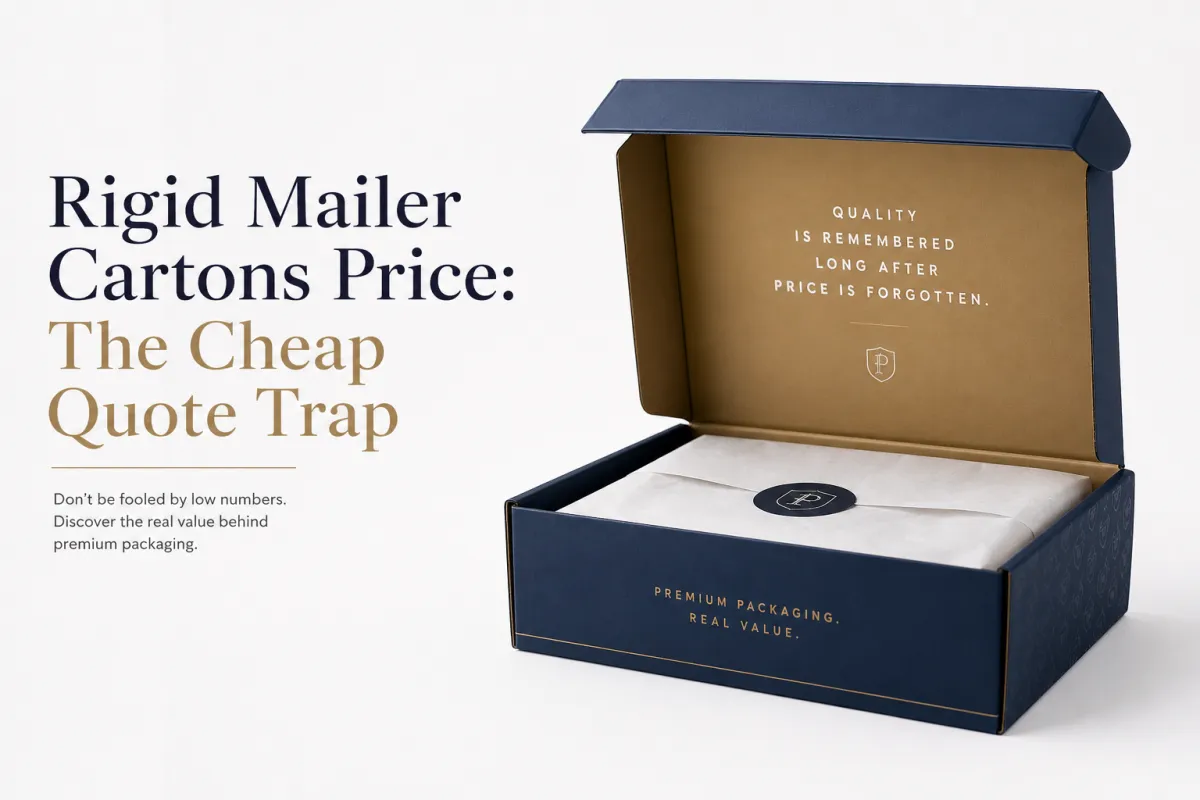
The lowest rigid mailer cartons price usually hides something. Thinner board. Simplified print. Missing freight. A different size. Sometimes the quote is technically correct and commercially useless. That is not a great combo if you care about margin, brand presentation, or not having a mildly annoying week later.
Picture a skincare brand shipping a launch kit to retailers. The carton has to look premium, protect glass jars, and keep its shape after parcel handling. A bargain carton might shave a few cents off the unit price, then cost far more when corner crush, scuffed print, or a weak closure forces reprints and replacements. That is not savings. That is just a delayed invoice with a nicer personality.
A useful rigid mailer cartons price comparison starts with four matching points: size, structure, board thickness, and destination. If those do not match, the quotes are not comparable. It is the packaging version of pretending apples and oranges are the same because both are round enough to fool someone in a hurry.
The better question is whether the carton does the job at the lowest total landed cost. A slightly higher rigid mailer cartons price can win if it reduces rework, keeps product presentable, and cuts damage claims. Brands shipping fragile, premium, or gift-ready products figure this out quickly. Usually after the first painful reorder. Sometimes after the second, if they are stubborn.
If the order is simple, low-value, and not customer-facing, a lighter structure may make sense. If the contents are premium, fragile, or meant to be seen, the right carton is worth paying for. That is the real tradeoff behind rigid mailer cartons price: spend a little more on structure and save somewhere else, or save a little up front and pay later in claims, reprints, and embarrassment.
For brands that only need a softer outer pack, comparing against Custom Poly Mailers is often the honest move. No point paying for board strength you do not need. That is how buyers keep rigid mailer cartons price under control without kidding themselves.
What You Are Actually Buying With Rigid Mailer Cartons
A rigid mailer carton is not just a box. It is structure, print surface, closure style, and presentation rolled into one piece of packaging. The board does the heavy lifting, the locking design keeps it shut, and the finish decides how the brand feels the second the customer touches it. All of that feeds into rigid mailer cartons price.
Most buyers are really paying for two things at once: protection and perception. A carton that survives transit but looks cheap can wreck the unboxing experience. A carton that looks premium but falls apart in shipping is worse. The better rigid mailer cartons price is tied to the actual job the carton needs to do, not just the box on a flat lay photo.
Common uses include subscription boxes, cosmetics, fragrance kits, sample mailers, influencer kits, premium apparel inserts, and retail promotions. These are not the same product category wearing different clothes. A lightweight promo mailer can use a simpler structure than a rigid gift carton carrying glass, metal, or layered inserts. That difference shows up fast in rigid mailer cartons price.
The standard feature set usually includes a die-cut structure, folded or self-locking closure, printed outer wrap, and flat shipping format. Upgrades include soft-touch lamination, foil, embossing, magnetic closures, tear strips, internal partitions, and custom inserts. Each one pushes rigid mailer cartons price upward because it adds material, setup, or finishing time.
Here is the buyer mistake I see most often: treating print as decoration instead of part of the packaging function. A carton with full-wrap art, spot UV, or a premium matte finish is not just prettier. It changes the production flow, the inspection points, and the cost structure. That is why the same-size box can produce a very different rigid mailer cartons price.
If brand presentation matters, build that into the spec from the start. If the carton is going into an e-commerce fulfillment line, keep closure behavior and stacking strength high on the list. If the product is fragile, ask for packaging that can survive handling aligned with common parcel testing methods, including ISTA-style drop and vibration expectations. A good place to start is the ISTA testing standards reference. If your sourcing policy requires certified board, check the claim directly with FSC instead of trusting a tiny logo and a hopeful salesman.
So yes, structure matters. Finish matters. Print matters. They matter because they shape the final rigid mailer cartons price and the buyer’s real outcome: a carton that ships well and sells the brand without looking like a compromise.
Specifications That Move Rigid Mailer Cartons Price
The fastest way to understand rigid mailer cartons price is to break it into spec drivers. Start with dimensions. Move to board thickness, board grade, print coverage, finish, and any insert or divider. That order matters because size and structure set the material baseline before the fancy stuff even enters the room.
Size is not just “bigger box, higher price.” Larger cartons consume more board, weigh more, take more shipping space, and sometimes trigger higher freight charges or worse carton packing efficiency. A small jump in size can raise rigid mailer cartons price more than buyers expect, especially if the carton has wide flaps or a deep gusset that changes the die layout.
Board thickness is another blunt instrument. A move from lightweight paperboard to heavier chipboard or rigid board can add strength, but it also changes die-cut behavior and folding resistance. In practice, thicker board usually raises rigid mailer cartons price because you are using more fiber and more pressure on the machine line.
Board grade matters too. A clean white SBS-style surface for premium print is not the same as a recycled greyboard construction. One may cost more, but it may also produce a better print finish and cleaner presentation. That choice affects both appearance and rigid mailer cartons price. I have seen brands save a little on board and then spend double fixing the way the box looked under store lighting. Not a win.
Print coverage is where buyers often lose control of the spec. A one-color logo in a small area is very different from full-wrap artwork with tight registration and heavy ink coverage. Add foil or embossing and the quote moves again. Not because the supplier is being dramatic. Because the process changed. That is why rigid mailer cartons price can jump fast even when the carton still “looks like the same box.”
Inserts and dividers deserve their own warning label. A carton with a simple empty cavity is cheaper than one with foam, paperboard partitions, or custom-fit die-cut inserts. If the product needs movement control, spend the money and do it properly. If it does not, skip the extra parts and keep rigid mailer cartons price sane.
Durability and spend always fight each other. The trick is knowing which side gets priority. For cosmetics, a premium finish may be worth every cent because the carton is part of the brand experience. For a subscription refill, the structure can be simpler. That is how a buyer controls rigid mailer cartons price without overbuilding a carton just to feel safe.
- Higher cost drivers: larger size, thicker board, full-coverage print, specialty finishes, custom inserts.
- Lower cost drivers: simpler artwork, standard sizes, fewer finishing steps, no internal partitions.
- Hidden cost drivers: tight tolerances, late artwork revisions, multiple SKU versions, and low freight efficiency.
One more thing: the cleanest spec sheet usually gets the cleanest rigid mailer cartons price. If your dimensions are vague, the supplier pads the estimate. If your print file is still “in progress,” expect another layer of safety in the number. Clear specs save money because they remove guesswork. That part is boring, sure, but boring is usually cheaper.
Rigid Mailer Cartons Price, MOQ, and Unit Cost Math
MOQ changes everything. The setup cost for a carton run does not vanish because the order is small. It gets divided across fewer units, which pushes the unit price up. That is why rigid mailer cartons price on 250 pieces can look wildly different from the same structure at 3,000 pieces.
Think of it as fixed cost plus variable cost. Fixed cost includes tooling, plate setup, color matching, proofing, and production preparation. Variable cost includes board, print, finishing, and packing. As quantity rises, the fixed cost portion shrinks per unit, which is why the rigid mailer cartons price curve usually flattens after the first few hundred pieces.
| Quantity | Typical Unit Price Range | What Usually Happens | Best Fit |
|---|---|---|---|
| 250 units | $1.60 - $3.00 | Setup cost is heavy; proofs and handling matter a lot. | Small launches, internal samples, test runs |
| 500 units | $1.05 - $2.10 | Setup cost begins spreading out, but freight still bites. | Limited releases, PR kits, small retail programs |
| 1000 units | $0.72 - $1.35 | Better efficiency, easier to justify print and finish upgrades. | Ongoing campaigns, e-commerce launches |
| 3000 units | $0.42 - $0.88 | Most fixed costs are diluted; freight and packing become more visible. | Repeat orders, established SKUs, larger promotions |
Those ranges are broad on purpose. A small carton with one-color print sits lower. A larger carton with soft-touch lamination and an insert sits higher. The pattern still holds: the rigid mailer cartons price usually drops sharply once you move from tiny runs into serious production volume.
Now the part people forget. A low unit price does not mean a low landed cost. Freight, samples, pack-out, and rush handling can chew through savings fast. If one supplier quotes a better rigid mailer cartons price but adds expensive shipping, the order can end up dearer than the supposedly pricier local quote. Landed cost is the real number. Everything else is spreadsheet theater.
MOQ also changes by format. A single size in one print layout is easier to price than multiple sizes or multiple graphics. If you want three versions of the same carton, the setup math gets ugly very quickly. That is why the same brand can receive very different rigid mailer cartons price quotes depending on whether they are ordering one SKU or trying to be clever with six. That “efficient” idea always sounds better in the meeting than it does in the quote.
Sample costs deserve their own line item. Plain samples often run around $25-$60 plus freight. Fully printed and finished samples can run $80-$180 or more depending on complexity. If the supplier credits samples back against production, great. Do not assume it. Ask. That one question can improve the effective rigid mailer cartons price more than haggling over a few cents.
Here is the practical rule: ask for price at 250, 500, 1000, and 3000 pieces. If the supplier only gives one number, you are missing the break-even point. A real buyer wants the ladder, not the headline.
Process and Timeline: From Artwork to Delivery
A good rigid mailer cartons price is only useful if the order actually lands on time. The process is usually straightforward, and the delays are predictable too. Most of them come from missing information, not manufacturing wizardry.
The normal flow starts with a brief: dimensions, product weight, destination, print needs, quantity, and finish. Then comes the dieline review. If the buyer already has a dieline, the job moves faster. If not, the supplier prepares one and checks clearances for folds, tabs, and artwork placement. That is where the first version of rigid mailer cartons price can tighten or widen depending on structural complexity.
After that comes proofing. A PDF proof is quick. A physical sample takes longer. For simple unprinted samples, two to four business days is common once the spec is confirmed. Printed samples usually take five to eight business days, depending on finishing and whether the supplier needs to match an exact brand color. If you need a comp that reflects the final finish, expect the sample stage to cost more and take more time. That is normal. The carton does not care about your launch deadline.
Production on a standard order often runs around 12-18 business days after proof approval, assuming material is available and nothing gets changed midstream. Rush orders can be faster, sometimes 7-10 business days, but rush pricing is exactly what it sounds like: a premium for jumping the queue. The rigid mailer cartons price may look acceptable until the expedite charge shows up.
Delays usually happen in three places. First, artwork approval stalls because someone keeps asking for one more version. Second, the buyer sends a size that does not fit the product, then asks for a revision after proofing. Third, production starts and the client changes the finish, which is a terrific way to waste everyone’s afternoon. Every one of those mistakes drives up the final rigid mailer cartons price.
To shorten the schedule, keep one person accountable on the buyer side, send exact dimensions, approve proofs quickly, and do not treat sample review like a committee sport. Consensus is overrated when the launch date is real.
For buyers comparing packaging formats, a simple side-by-side with Custom Poly Mailers can also help. Sometimes rigid board is the right answer. Sometimes it is just a more expensive answer. A clean comparison keeps the rigid mailer cartons price discussion honest.
Why Choose Us for Rigid Mailer Cartons
Buyers do not need poetry. They need a clear rigid mailer cartons price, a carton that holds up, and a delivery window that does not drift every week. That is the standard. Anything less creates extra work, and extra work has a habit of turning into extra cost.
Custom Logo Things is built around practical packaging decisions, not vague premium language. If the carton needs a cleaner print surface, I would rather explain why and quote it plainly than hide the cost in a fluffy line item. If the spec can be simplified without hurting the product, I would rather say that too. That kind of clarity keeps rigid mailer cartons price under control.
There is real value in a supplier who tells you what is driving the number. A thicker board? Fine, here is the impact. A specialty finish? Fine, here is the added step. A larger format? Fine, here is what that does to board usage and freight. That makes decisions easier and protects margin. This is not glamorous work. It is just the work that keeps the order from becoming a mess.
Good packaging also protects repeat business. If the first run is right, the next runs go faster, and the rigid mailer cartons price often improves because the spec is already locked. Less rework. Less waste. Less time spent arguing over measurements that should have been settled before quote stage. I have watched a “small” revision snowball into a full production delay more times than I care to admit.
For brands that need cross-sell packaging, we can also help you compare rigid cartons against lighter alternatives like Custom Poly Mailers. That matters more than people admit. Sometimes the best packaging choice is the one that ships for less and still protects the product. Wild idea, I know.
We also pay attention to consistency across repeat orders. Color drift, closure issues, and carton fit problems all get expensive when the same SKU is replenished month after month. A supplier who keeps the spec stable saves more money than one who drops the initial rigid mailer cartons price by a few cents and then changes the build on the second run.
So the value is straightforward: transparent pricing, useful guidance, and cartons that behave the way a buyer expects. No smoke. No mystery. No weird surprises buried in the freight line.
Next Steps: Get a Real Quote Without Guesswork
If you want an accurate rigid mailer cartons price, send the supplier a complete brief. Not a vibe. Not “something around this size.” Send the exact dimensions, board preference, print coverage, quantity, delivery location, deadline, and whether you need inserts, finishes, or any special closure feature.
Here is the cleanest way to ask for pricing:
- Share finished size, not approximate size.
- State board thickness or performance target.
- Specify print area, colors, and finish.
- Request quotes at 250, 500, 1000, and 3000 units.
- Ask for sample cost and freight as separate lines.
- Confirm whether the quote includes packaging, packing, and delivery.
That list sounds basic because it is basic. It still fixes most of the problems that make rigid mailer cartons price look random. A vague brief creates vague pricing. An exact brief gives you numbers that can actually be compared.
You should also ask for landed cost, not just unit price. Freight to a warehouse, freight to a residence, and freight to multiple drops can all change the math. A quote that looks cheap on the unit line can lose once shipping is added. That is why the smartest buyers test several scenarios before placing the order.
If the carton is carrying fragile or premium product, request a sample or mockup and check fit, closure strength, and edge protection before production. If the carton is for retail presentation, review the print proof under the same lighting the customer will see on arrival. Small details decide whether the box feels premium or merely expensive. The difference affects both brand perception and rigid mailer cartons price.
One final point. Do not approve a spec because it sounds fancy. Approve it because it matches the job. That is the practical way to keep rigid mailer cartons price in range while still getting a carton that ships well, looks right, and does not embarrass the brand.
If you are ready to move from estimate to accurate quote, send the details and compare a few quantity breaks. The fastest path to a real rigid mailer cartons price is a clean spec, a landed-cost breakdown, and a sample that proves the carton can do the job before you commit to production.
What affects rigid mailer cartons price the most?
The biggest drivers are size, board thickness, print coverage, and order quantity. Freight and destination can matter more than people expect, especially on small runs. Special finishes and custom inserts usually raise the unit cost faster than plain structural changes, so those are the first items I would review if the rigid mailer cartons price feels too high.
Is rigid mailer cartons price lower at higher MOQ?
Yes. Higher MOQ usually lowers the unit price because setup and tooling get spread across more boxes. The real question is where the break-even point sits, not whether a larger order is cheaper in theory. Ask for quotes at several quantities so you can compare actual savings, not just a single rigid mailer cartons price.
Do printed cartons raise rigid mailer cartons price a lot?
Simple print usually adds less than specialty finishes, heavy coverage, or multiple color passes. Foil, embossing, and full-wrap artwork increase setup and production cost more quickly. If budget matters, keep the outer print simple and put the brand story on the insert or label so the rigid mailer cartons price stays closer to target.
What sample cost should I expect for rigid mailer cartons?
Plain samples are usually cheaper than fully custom samples with print and finish matching. Some suppliers credit sample costs back on production orders, but do not assume that without asking. Request a sample before a large run if you care about fit, closure strength, or presentation quality, because a bad sample is usually the first warning that the final rigid mailer cartons price is not the whole story.
How do I get the most accurate rigid mailer cartons price quote?
Send exact dimensions, material preference, print details, quantity, destination zip, and any insert or finish requirements. Include a dieline, sample photo, or reference box if you have one; vague specs create vague pricing. Ask for separate pricing on sample, production, and freight so you can compare the full landed cost and judge the rigid mailer cartons price properly.