Buyer Fit Snapshot
| Best fit | Self Seal Poly Mailers Bulk projects where brand print, material claims, artwork control, MOQ, and repeat-order consistency need to be specified before quoting. |
|---|---|
| Quote inputs | Share finished size, material target, print colors, finish, packing count, annual reorder estimate, ship-to region, and any compliance wording. |
| Proofing check | Approve dieline scale, logo placement, barcode or warning zones, color tolerance, closure strength, and carton packing before bulk production. |
| Main risk | Vague material claims, crowded artwork, missing packing details, or unclear freight terms can make a low unit price expensive after revisions. |
Fast answer: Self Seal Poly Mailers Bulk: Specs, Pricing & MOQ Options should be specified like a repeatable production item. The safest quote records material, print method, finish, artwork proof, packing count, and reorder notes in one written spec.
Production checks before approval
Compare the actual filled-product size with the drawing, then confirm tolerance on folds, seals, hang holes, label areas, and retail display edges. Reserve space for logos, QR codes, warning copy, and material claims before decorative graphics fill the panel.
Quote comparison points
Review material grade, print process, finish, sampling route, tooling charges, carton quantity, and freight assumptions side by side. A quote is only useful when the supplier can repeat the same color, closure quality, and packing count on the next order.
Self Seal Poly Mailers Bulk: Specs, Pricing & MOQ Options
Buying self seal Poly Mailers Bulk sounds simple until the quote lands and the real math starts. The line item may look tiny, then packing labor, freight class, dimensional weight, and the minutes lost to tape or mis-sized bags begin showing up in the ledger. I have watched teams focus on a fraction of a cent per unit and then burn that savings in rework by Friday. That is the part many buyers miss. Orders for self seal poly mailers bulk can cut touch time at the pack station, keep shipping costs steadier, and reduce the little corrections that slow a busy fulfillment team down.
From a packaging buyer's point of view, the comparison is rarely just one mailer against another mailer. It is plain stock versus custom print, a lighter film versus a heavier one, and one size versus a mixed program that creates extra handling. Once those variables are laid out, self seal poly mailers bulk stops looking like a commodity buy and starts looking like an operations decision.
Self Seal Poly Mailers Bulk: Why the Unit Cost Drops Fast
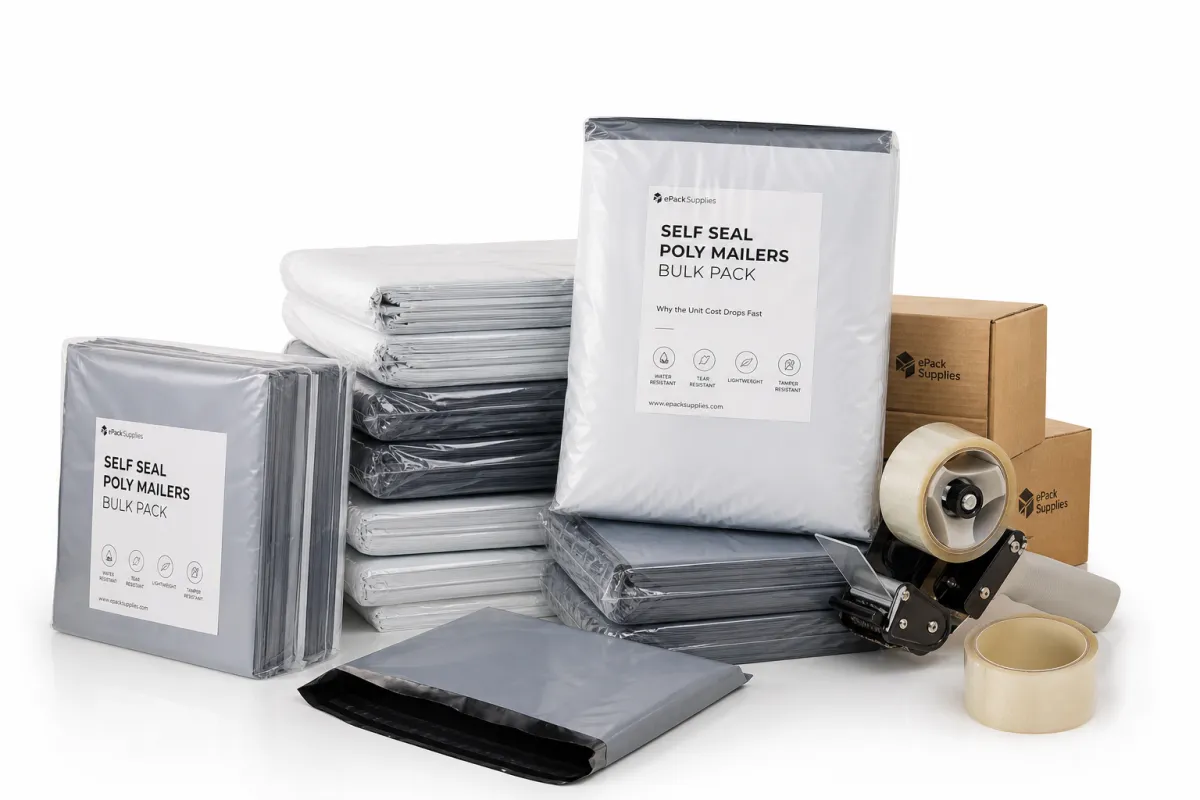
The cheapest-looking mailer is not always the cheapest order. A 2-cent difference in unit price means very little if the crew spends another 4 to 6 seconds sealing each pack with tape, or if oversized cartons push the shipment into a higher dimensional weight tier. Multiply that across a week of shipping and the savings can vanish. In practice, self seal poly mailers bulk lowers cost in three places at once: material procurement, pack-out labor, and order consistency.
Material procurement is the obvious piece. Larger runs reduce resin and conversion costs because the press, slitting, and sealing lines stay in motion longer with fewer changeovers. Labor savings matter just as much. A self-seal closure removes a separate taping step, and that matters when an ecommerce operation ships hundreds or thousands of parcels a day. The third gain is less visible. With self seal poly mailers bulk, the pack line is less likely to overpack, underseal, or improvise with void fill that never should have been needed for a soft-goods shipment.
Apparel, socks, accessories, beauty kits, and other compressible products usually benefit first. A rigid item still needs protection. A soft item usually needs a clean closure and a package that survives sortation. If the product bends without damage, self seal poly mailers bulk often beats a box on material cost alone. If the item is sharp, fragile, or easily crushed, the equation changes and the buyer should not force a mailer into the wrong job.
Buyers also need to separate plain stock from custom production. A plain white or gray mailer may look inexpensive, yet a custom printed run can add brand value that pays back at the unboxing moment and in repeat recognition. The main mistake is assuming all self seal poly mailers bulk quotes are comparable. Different gauges, print coverage, adhesive styles, and size mixes can move the final number more than most non-packaging teams expect.
A lower unit price only matters if the landed cost falls with it. In packaging, the order that looks cheapest on a line item can still lose once labor, freight, and rework are counted.
That point gets sharper in high-throughput operations. Saving half a cent on film is meaningless if damaged seals trigger rework or replacements. The best self seal poly mailers bulk decisions are made with the pack line in view, not just the purchasing spreadsheet.
What Are Self Seal Poly Mailers Bulk Best For?
Most self seal poly mailers bulk products are made from polyethylene film, usually LDPE or a similar blend chosen for flexibility, tear resistance, and print performance. The construction looks simple from the outside, but the details matter. A good mailer includes a pressure-sensitive adhesive strip, an easy-release liner, and enough film memory that the opening stays flat during packing instead of curling back into the operator's hands. That last part sounds minor. It is not minor when someone is packing 800 orders before lunch.
Buyers often ask about finish first. Opaque finishes protect privacy and present a cleaner branded surface, while semi-opaque or translucent options can lower cost and give a softer visual effect. If branding matters, self seal poly mailers bulk can be printed in one color, multiple colors, or full coverage depending on the production method. For many merchants, a simple logo and return-message panel does the job. For others, the mailer becomes part of the brand experience and deserves more print space.
Size selection is where a lot of waste begins. A mailer should fit the folded product with enough allowance for easy insertion, but not so much extra space that the package swims inside the bag. A useful rule is to measure the product after folding or boxing it in the shape it will ship, then add only the clearance needed for a smooth slide and a clean seal. If the item is too tight, the adhesive edge takes stress. If it is too loose, self seal poly mailers bulk can create a sloppy pack line and higher dimensional weight.
The practical sizes often range from small apparel mailers around 6 x 9 inches up through larger formats such as 10 x 13, 12 x 15.5, or even bigger specialty sizes for bulkier soft goods. For a buyer comparing self seal poly mailers bulk options, it helps to match the bag not just to the product, but to the final folded footprint after tissue, inserts, or hangtags are included.
Brands that want tighter control over the whole packaging system often pair mailers with a broader sourcing plan. That is where Custom Packaging Products and Custom Poly Mailers become useful reference points. A packaging program works better when the mailer size, carton count, and brand print are aligned from the start instead of being chosen in isolation.
One more detail matters: the seal style. Standard self-seal adhesive is enough for most parcels, but dual-seal, tamper-evident, or tear-strip upgrades can make sense when returns, privacy, or repeated handling are concerns. For self seal poly mailers bulk, those upgrades usually add cost, yet they can save more than they cost if the brand ships higher-value goods or expects a lot of return traffic.
Common Construction Choices
Film is the base. Thickness, opacity, and surface finish all change how the mailer behaves in transit and how premium it feels at the pack station. A 2.5 mil bag is not the same as a 4 mil bag, even if both fit the same size product. The difference shows up in feel, puncture resistance, and how much the package shrugs off rough handling.
Closure is the second decision. Self-seal adhesive speeds packing and reduces inconsistency between operators. For high-volume self seal poly mailers bulk programs, that repeatability is often worth more than a small unit-price difference.
Branding is the third. Plain stock works for unbranded or back-end shipments. Custom print belongs on the table when the package needs to carry recognition, instructions, or a more polished presentation. A mailer travels farther than the product itself in many cases, so the print has a bigger audience than buyers first assume.
Specifications That Affect Performance and Fit
Film thickness is the spec most buyers notice first, but it should not be the only one. A thinner mailer can be perfectly acceptable for light apparel, while a slightly heavier film may be better value for items with corners, snaps, or rough surfaces. In self seal poly mailers bulk, gauge affects puncture resistance, stretch, feel, and the odds that the package survives conveyor handling without scuffing through.
The range most buyers compare is roughly 1.5 mil to 4 mil, though the right number depends on the product and route. Lightweight tees and accessories may perform well in standard film. Heavier hoodies, boxed accessories, or items with sharper edges may need a sturdier spec. A buyer is usually better off choosing the right gauge once than paying for a premium film that solves the wrong problem.
Adhesive quality is another overlooked variable. Seal failures usually start with a mismatch between adhesive strength and usage conditions, not with dramatic abuse in the shipping network. Temperature during application, dwell time after sealing, and the amount of stretch placed on the lip all matter. A buyer comparing self seal poly mailers bulk quotes should ask for seal width, closure performance range, and any storage guidance for colder warehouses or hotter docks.
Opacity deserves a closer look as well. Some buyers want full privacy because the contents are a retail secret or because the brand wants a solid visual block. Others only need enough opacity to obscure the product without paying for a fully opaque film. For self seal poly mailers bulk, that choice affects both cost and presentation. A semi-opaque bag may look fine for internal fulfillment; a premium retail shipment may need a denser, more deliberate finish.
Testing should not get skipped. If a product has a high return rate, a sharp edge, or a long transit path, ask whether the mailer has been evaluated against transit simulation methods such as ISTA procedures or related tensile and impact tests. The industry's broader guidance at ISTA is useful when you need a more disciplined way to judge performance, and packaging design principles from packaging.org help frame the trade-off between protection and efficiency. That matters more than a glossy product sheet.
Packaging format matters too. Some suppliers ship self seal poly mailers bulk in inner bundles within master cartons. Others palletize by size or print run. That changes how the order moves through receiving and how much space it consumes on the warehouse floor. A clean spec checklist should include dimensions, gauge, opacity, print coverage, adhesive type, bundle count per carton, and cartons per pallet. If any one of those is vague, the quote is only half-finished.
Simple Spec Checklist
- Finished bag dimensions and usable opening size
- Film gauge or mil thickness
- Opacity level and surface finish
- Adhesive style, seal width, and closure method
- Print method, color count, and coverage area
- Carton pack, pallet count, and expected storage footprint
For operations with recurring volume, those details protect margins. A buyer who nails the spec on self seal poly mailers bulk orders tends to spend less time correcting small problems later, which is where cost leakage likes to hide.
Pricing, MOQ, and How Bulk Breaks Work
Pricing follows a predictable pattern. Larger runs lower the unit cost, but setup charges, artwork prep, print plates or cylinders, and special finishes can raise the entry point. With self seal poly mailers bulk, the first quote should be read as a mix of unit price and program structure, not as a simple cheap-or-expensive verdict.
Minimum order quantity depends on whether the order is stock or custom. Stock mailers may be available by carton or by pallet, while custom printed runs often begin at 5,000 to 10,000 pieces depending on size, number of colors, and finish. For self seal poly mailers bulk, the MOQ is often less about arbitrary policy and more about production economics. A wide print run needs enough volume to justify setup, proofing, and changeover time.
Here is the part that buyers sometimes miss: a lower MOQ does not always mean lower risk. Smaller orders can look attractive when cash is tight, but they may carry higher per-unit costs and more frequent reorders. A better tactic is to compare total landed cost across a useful planning window. Freight, carton space, reorder admin time, and the cost of holding inventory should all be in the calculation. For many teams, self seal poly mailers bulk makes more financial sense once the monthly usage rate is steady and the design is stable.
| Option | Typical MOQ | Indicative Unit Price | Best Fit | Main Watch-Out |
|---|---|---|---|---|
| Plain stock mailers | 1 carton to 1 pallet | $0.08-$0.18 each | Standard ecommerce and repeat ship-from-stock needs | Less brand impact, limited size/color choice |
| 1-color custom print | 5,000-10,000 pieces | $0.14-$0.26 each | Logo-led branding with moderate volume | Artwork setup and proof timing |
| Full-color custom print | 10,000+ pieces | $0.18-$0.34 each | Retail presentation and promotional programs | Higher setup cost and tighter approval discipline |
| Heavier gauge or special closure | Usually 5,000+ pieces | $0.16-$0.30 each | Heavier apparel, sharper edges, or added security | More expensive film and stricter spec matching |
The numbers above are planning ranges, not promises. Resin markets move. Freight moves. Even seasonality can nudge a quote. Still, the table helps buyers compare apples to apples. A quote that appears higher may actually be more competitive if it includes the right gauge, stronger adhesive, a cleaner print, and better freight assumptions. With self seal poly mailers bulk, the cheapest line item often loses once you price the complete order.
One more reason to compare carefully: size changes can move the economics fast. A modest upsizing may push the order into a larger carton footprint or a higher dimensional freight tier. If the item only needs another half-inch of width, the buyer should verify whether that extra room truly improves packing efficiency. Sometimes it does. Sometimes it only increases cost. That judgment call is where a good packaging partner earns its keep on self seal poly mailers bulk sourcing.
Businesses that reorder often should ask about program pricing and recurring freight assumptions. A supplier that offers Wholesale Programs can sometimes help lock in more stable pricing for repeat-volume mailers, especially when the spec does not change between runs. That stability matters more than most people admit. Procurement teams like predictability because it keeps the month-end numbers calm and the replenishment plan less fragile.
There is also a practical cash-flow angle. A larger purchase can reduce per-unit cost, but if the company does not have room to store the cartons or the cash tied up in inventory, the savings vanish on the balance sheet. For self seal poly mailers bulk, the right buy is usually the one that fits both shipping volume and storage reality.
Self Seal Poly Mailers Bulk: Process and Timeline
The fastest orders start with the clearest inputs. If the buyer sends dimensions, estimated monthly volume, print requirements, and whether the program needs stock or custom production, the quote process moves faster. When a team asks for self seal poly mailers bulk pricing without those basics, the supplier has to guess at the spec, and guessing is the enemy of speed.
A typical sequence begins with a quote request, then sample review or spec confirmation, followed by artwork proofing if the order is printed. That proof step is where many programs stall. A logo file that is low resolution, missing fonts, or built in the wrong color mode can add days. The cleanest workflow for self seal poly mailers bulk is simple: send vector artwork when possible, confirm Pantone or CMYK expectations, and approve the proof quickly once the layout is correct.
Stock inventory ships faster because it does not need print setup. Depending on warehouse location and freight method, stock mailers may leave in a few business days once payment is approved. Custom production needs more runway. A realistic planning window for self seal poly mailers bulk is often 12 to 18 business days from proof approval, then transit time on top of that. If the order is shipping cross-country or moving by ocean freight, the calendar stretches accordingly.
That difference between production time and transit time deserves attention. A lot of buyers hear "two weeks" and assume the cartons will be at their dock in two weeks. Not always. The production clock and the shipping clock are separate. If the use date is tied to a sale event, launch, or seasonal rush, the reorder should be placed early enough that both clocks are covered. That is especially true for self seal poly mailers bulk orders where the program depends on a specific printed design.
Sample evaluation is not a formality. Hold the bag. Load a few actual products. Seal it. Shake it. Stack it. Then check whether the seal opens under stress or whether the bag fights the packer because the opening is too narrow. This is where a buyer learns whether the selected gauge and size are truly right. A sample pack can save a lot of frustration, and it is cheaper than correcting a full production run of self seal poly mailers bulk that fits poorly.
I have seen one soft-goods team discover, on a sample bench, that their "standard" mailer was actually stretching the adhesive lip just enough to make the seal unreliable. That tiny flaw would have been invisible in the quote. It was obvious in the hand.
What Usually Delays an Order
- Unclear dimensions or weight assumptions
- Artwork that is not production-ready
- Late proof approval
- Changing the size or print count after quoting
- Freight booking delays during peak season
Planning around those delays is not difficult. Build in one buffer week for approvals, and another buffer if the order must arrive before a known sales peak. For teams that reorder every month or quarter, a simple inventory calendar is enough to prevent a stockout. The point of self seal poly mailers bulk is not just lower cost. It is operational calm.
Why Choose Us for Bulk Mailers
A supplier is not just a carton source. The better ones help buyers Choose the Right gauge, the right size, and the right print setup before money is spent on the wrong version. That is where a program built around self seal poly mailers bulk becomes more valuable than a one-off purchase. Spec control cuts surprises, and surprises are what blow up reorder schedules.
Manufacturing control matters because adhesive performance, film consistency, and print repeatability all affect the final customer experience. If the seal is inconsistent from batch to batch, the pack line slows down. If the print shifts, the brand image looks sloppy. If the film varies, the team has to adjust handling on the fly. A reliable self seal poly mailers bulk supplier reduces those variables instead of creating them.
That same logic applies to repeat programs. The strongest wholesale relationships are built on predictability: repeatable color, dependable lead times, and an order history that makes reordering simple. For buyers comparing vendors, Custom Packaging Products should be judged on whether the mailer program stays stable from quote to reorder. A packaging partner should act like one, especially when the business ships the same item every week.
There is another buyer benefit that is easy to overlook: guidance that prevents unnecessary upgrades. A lot of customers assume they need a heavier film, a more expensive closure, or a larger format than the product really requires. Good packaging advice can save money by stripping out those extras. That advice is especially useful with self seal poly mailers bulk, because over-specifying the bag can quietly erase the savings the buyer expected to earn from buying in volume.
For brands with a growing print program, consistency is a form of value. The difference between a mailer that looks "close enough" and one that looks intentionally produced is not dramatic in isolation. It becomes dramatic across 20,000 shipments. That is why buyers return to self seal poly mailers bulk suppliers that can hold color, size, and adhesive quality steady across multiple runs.
Bottom line: a strong packaging partner saves more than paper and film. It saves time, protects margin, and keeps the fulfillment team from firefighting avoidable problems. That is the real reason many buyers stick with self seal poly mailers bulk programs instead of hopping from quote to quote.
Next Steps for Self Seal Poly Mailers Bulk Orders
Start with three inputs: product dimensions, monthly ship volume, and whether the order needs plain stock or custom print. Those three numbers tell the supplier almost everything needed to build a practical quote for self seal poly mailers bulk. If the product is soft but bulky, include folded dimensions. If the item has corners or edges, say so. The more concrete the brief, the tighter the quote.
Next, request a sample pack or a detailed spec sheet before committing to a full run. This is where the team verifies fit, seal strength, opacity, and print quality against the real product, not a guess. A sample also helps operations estimate pack speed. If the bag opens easily and closes cleanly, self seal poly mailers bulk becomes easier to defend internally because the labor savings are visible, not theoretical.
Then build a reorder calendar. If the current usage rate is 10,000 pieces a month and the supplier lead time is two to three weeks plus transit, the reorder should not start when the last carton is opened. That is how stockouts happen. Good procurement planning creates a cushion, and a cushion is cheaper than expediting. For teams that rely on self seal poly mailers bulk, this step matters more than brand color or print gloss.
When quotes come back, compare them side by side. Do not just scan the headline price. Check gauge, size, seal style, print count, MOQ, freight assumptions, and any storage or pallet terms. A quote that is a few cents lower can still cost more if it produces a worse pack-out result or a higher freight bill. The best self seal poly mailers bulk choice is the one with the best total value, not the lowest sticker price.
If the program is recurring, a wholesale relationship usually pays off. Stable specifications make it easier to forecast, and forecastability is what keeps the packaging chain steady. Buyers who treat self seal poly mailers bulk as a repeat system, rather than a one-time purchase, tend to get better pricing discipline and fewer late surprises.
When the goal is consistent, branded shipping at a controlled cost, the answer is usually not a bigger box or more void fill. It is a properly specified mailer that closes fast, ships cleanly, and arrives looking like it belongs to the brand. That is why self seal poly mailers bulk remains one of the most practical options for soft-goods ecommerce, and why the best order is the one planned before inventory gets tight.
Before you place the next run, measure the product as it ships, confirm the adhesive and gauge with a real sample, and compare landed cost rather than headline price. If those three checks line up, the order is probably right. If one of them is fuzzy, the quote needs another pass.
FAQ
What thickness is best for self seal poly mailers bulk orders?
Choose thickness based on product weight, shape, and puncture risk rather than assuming thicker is always better. Light apparel often works in standard gauges, while heavier or sharper items usually need a stronger film. For self seal poly mailers bulk, a good spec is the one that survives transit without overpaying for unused strength.
How do I know the right size for self seal poly mailers bulk packaging?
Measure the folded product, then add enough room for the item to slide in without stressing the seal. Avoid oversizing, since a mailer that is too large can raise dimensional weight and shipping cost. In many self seal poly mailers bulk programs, the best size is the smallest one that still packs cleanly.
Are self seal poly mailers bulk orders cheaper than custom boxes?
For soft goods and lightweight products, mailers are usually cheaper because they use less material and reduce packing labor. Boxes can still win for fragile or rigid items, so the best choice depends on product protection needs. If the item does not need structure, self seal poly mailers bulk often gives better total economics.
What is the usual MOQ for self seal poly mailers bulk purchases?
MOQ depends on whether the order is stock or custom printed, with printed runs typically requiring higher minimums. Size, color, and print coverage can also change the minimum order threshold. For many buyers, self seal poly mailers bulk becomes most efficient once usage is steady enough to justify a larger production run.
How long do self seal poly mailers bulk orders take to ship?
Stock items usually move faster because they do not require print setup or proof approval. Custom orders need more time for artwork, sampling, and production, so planning ahead matters. If the date is fixed, build in both manufacturing time and transit time before committing to self seal poly mailers bulk.
For brands that need a practical, branded shipping format, self seal poly mailers bulk remains a sharp buy when the specs are right, the MOQ fits the plan, and the timeline leaves room for approvals and transit. The best orders are not just cheaper on paper; they are easier to pack, easier to reorder, and easier to defend when the numbers are reviewed later.


