Buyer Fit Snapshot
| Best fit | Shipping Boxes Custom Printed projects where brand print, material claims, artwork control, MOQ, and repeat-order consistency need to be specified before quoting. |
|---|---|
| Quote inputs | Share finished size, material target, print colors, finish, packing count, annual reorder estimate, ship-to region, and any compliance wording. |
| Proofing check | Approve dieline scale, logo placement, barcode or warning zones, color tolerance, closure strength, and carton packing before bulk production. |
| Main risk | Vague material claims, crowded artwork, missing packing details, or unclear freight terms can make a low unit price expensive after revisions. |
Fast answer: Shipping Boxes Custom Printed: Protect, Brand, and Save should be specified like a repeatable production item. The safest quote records material, print method, finish, artwork proof, packing count, and reorder notes in one written spec.
Production checks before approval
Compare the actual filled-product size with the drawing, then confirm tolerance on folds, seals, hang holes, label areas, and retail display edges. Reserve space for logos, QR codes, warning copy, and material claims before decorative graphics fill the panel.
Quote comparison points
Review material grade, print process, finish, sampling route, tooling charges, carton quantity, and freight assumptions side by side. A quote is only useful when the supplier can repeat the same color, closure quality, and packing count on the next order.
Shipping boxes custom printed are one of those packaging choices that look decorative at first and then quietly start steering real operational outcomes. I have watched several small teams discover this after one-quarter pilots: damage complaints dip, exceptions drop, and warehouse calls quiet down because the carton itself is carrying information better than the SOP document. The win is not in the print style by itself; it is in using the surface as a logistics tool before it is ever handled by the customer.
On the production floor, shipping boxes custom printed are corrugated cartons with a working information layer applied before leaving the converter. That layer can include handling icons, return instructions, compliance marks, scan fields, and brand messaging, all mapped to the same geometry that the carton is built from. In practice, this means the design is not decoration; it is part of process control. If you compare Custom Packaging Products, Custom Shipping Boxes, and Custom Poly Mailers, the same rule applies: the print can either reduce friction or create it, and operations feel the result immediately.
One client I worked with had a “looks fine” plain carton program for months while its team spent time resolving misroutes every day. After replacing those boxes with shipping boxes custom printed carrying strict orientation cues and clear return zones, the pack floor stopped asking “is this the right carton?” and started moving faster. That shift happened because fulfillment teams could interpret the package faster than they could navigate ad hoc notes.
This article is built on execution, not promises. It covers mechanics, cost, timeline, and rollout practice, and it calls out where shipping boxes custom printed help—and where they are not the right tool. If your team is cutting delay, rework, and avoidable labor, this approach is about what is measurable, not what looks nice in a render.
Shipping Boxes Custom Printed: The Surprising Advantage Many Brands Ignore
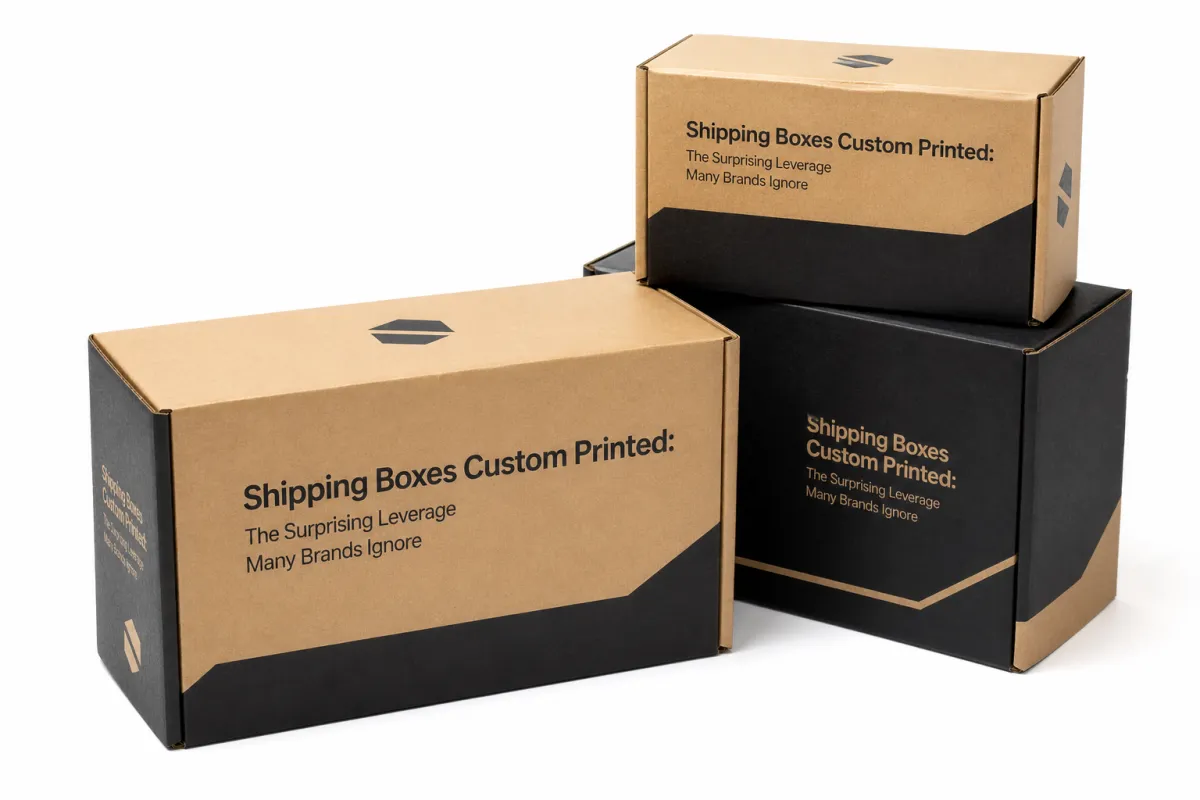
Take a practical case. A growing ecommerce brand moved from plain brown cartons to shipping boxes custom printed with simple handling icons, a clear return panel, and a reserved label area. Within three months, the biggest change was not visual polish; it was fewer misroutes, fewer clarification calls during packing, and fewer escalations to customer support. The same operators who said “we can do this in the head” now saw the carton making half the decisions for them.
The carton is the first physical interface between the fulfillment system, carriers, and your customer. A branded exterior may make a first impression, but a smart custom print layout improves the sequence of actions. A useful printed carton tells staff what is up, where to place labels, where to avoid tape, and where scanning must happen. Less ambiguity means fewer exceptions and cleaner handoffs.
From a sourcing standpoint, shipping boxes custom printed can be standardized more easily than teams assume. Return guidance, legal marks, FSC symbols, handling instructions, and SKU identifiers can all coexist on one surface without turning the workflow into chaos. That is where operational quality improves: one panel carrying instruction plus identity, rather than distributing the same requirements across multiple systems.
The budget myth is common: custom print exists only for premium presentation. That view is narrow and can be expensive. In audits, the most expensive decisions are often the ones with unclear intent. A carton that clearly states what it is, how to handle it, and where it should go reduces coaching and training load while making errors easier to prevent.
"A printed carton does not need to impress. It needs to direct."
Not every shipment needs wall-to-wall art. For many operation-heavy teams, a restrained logo plus high-contrast handling logic beats a crowded layout, especially if workers already have to process a lot of detail in the same minute. Shipping boxes custom printed should follow fulfillment complexity, not mood-board inspiration. A subscription program shipping predictable SKUs at high frequency may need tighter scan logic than a boutique line with mixed packaging styles. More ink is not automatically better if it turns clarity into noise.
In practical terms, shipping boxes custom printed merge retail expectations with transport mechanics. The carton can protect, instruct, and identify at once. That bundling usually beats splitting these tasks into separate systems and hoping the team stitches the process together under pressure.
Why Do Shipping Boxes Custom Printed Matter Beyond Branding?
Shipping boxes custom printed matter because they compress several operational functions into one physical surface. They guide handling, support compliance, reinforce identity, and reduce waste at the same time. Packaging is usually designed for one job. The printed carton gets asked to do four or five jobs, so it deserves engineering-style review, not just design review.
Think of the difference between a plain form and a field map. Both occupy space. Only one tells people where to go next. The same is true here: a carton full of useful print reduces handoffs, wrong-aisle moves, and unnecessary calls while staff are on task.
There is a meaningful customer-side effect before they even open anything. If the exterior stays clean and legible, customers infer control and care from the first touchpoint, which can improve perception of service quality. This does not require premium graphics; it requires discipline in placement and readability.
The operational advantage for scale is control. Shipping boxes custom printed make pack operations more repeatable when staff changes, peak season substitutions, or multiple fulfillment sites disrupt informal routines. Standardization is dull work in meetings and a money-maker in daily fulfillment. That is not flashy, but it is where consistency and margin get made.
How Shipping Boxes Custom Printed Work and Why That Changes Operations
Shipping boxes custom printed travel through a design-to-manufacturing chain. The sequence usually starts with artwork and dieline, then maps fold lines, score points, glue flaps, seams, tabs, and safe zones before final placement. After that, teams confirm substrate, print setup, ink calibration, full print run, die-cutting, and finishing tasks like edge gluing and flattening, then pack, bundle, and ship. Once this is mapped, design and operations stop being separate departments and become one system.
Method choice is operationally decisive. Digital printing is often best for short runs, quick tweaks, and variable content, especially when artwork is expected to evolve mid-quarter. Flexographic printing commonly performs better for larger, stable volumes when consistency is required run after run. Offset can still be the right choice for certain visual complexity and board types, but it needs tighter prepress controls and often longer setup windows. The practical question is not “which method is best,” but “which method fits this forecasted run without creating avoidable rework.”
Print method choice connects directly to fulfillment timing. If scanners and carriers are part of the same carton journey, scan reliability becomes non-negotiable. A smudged or low-contrast barcode can pause an entire lane. Shipping boxes custom printed must stay legible under warehouse light, minor abrasion, and typical handling movement; if not, line speed drops and manual exceptions rise.
Structural design and print design must be synchronized from day one. Single-wall board often serves light-to-moderate payloads, while double-wall is usually safer for heavier or fragile SKUs, longer transfer chains, and harsher drop profiles. Flute choice changes bending and crush behavior, and print placement must respect those seams and stress points. If design elements cross fold lines or high-strain edges, visual clarity and durability both suffer. A misalignment here becomes expensive in sorting and support operations.
Performance is validated through recognized methods such as ISTA distribution testing and ASTM-style load checks, especially for heavier or fragile goods. A beautiful print without structural integrity is a false economy. Shipping boxes custom printed are effective only when the print behavior and board behavior match real transport stress.
A practical operating framework looks like this:
- Handling cues improve orientation and reduce misroutes.
- Scan zones reduce reading retries and rework at handoff points.
- Brand panels stay readable while still allowing operational instructions to dominate.
- Route-specific marks cut repack events in high-friction lanes.
- Structural planning protects the print and the product under real shipping loads.
That is the difference. A plain carton mostly transports. A shipping boxes custom printed carton instructs, confirms, and protects at the same time. That distinction matters on high-throughput lines where every avoided exception compounds into capacity, labor, and customer satisfaction gains.
Key Factors for Choosing Shipping Boxes Custom Printed in Logistics Operations
Selection starts with shipping reality, not creative preference. What is your lane structure? How heavy is the heaviest realistic box in a week, not the average? Will cartons spend time in humid staging areas? Will customers return them or discard them after unpacking? These details determine board grade, print area, finish, and adhesive strategy faster than any mood-board session.
Weight and dimensional profile are foundational filters. Bulky-light boxes usually require geometry and panel optimization more than extra board thickness. Dense SKUs may need better edge support and heavier core selection. Shipping boxes custom printed should be spec’d against peak pack composition, including return spikes and best-case misuse scenarios, not just the spreadsheet average. Most under-specification failures only become visible after claims start rising.
Climate is frequently missed. Corrugated performs differently under humidity and temperature swings. If your parcels sit near docks or cross marine corridors, route conditions may require coatings, moisture-resistant board, or alternative finishes. Shipping boxes custom printed can remain sharp and stable with the right material stack, but only when environment is part of the spec. Treating climate as afterthought is a typical way to pay for avoidable replacements.
Placement and registration are silent cost centers. If key text lands too close to folds, seams, or label blocks, scanability drops and logos look misaligned after handling. Critical contrast and minimum clear space are not beautification; they are production controls. A practical rule: designs should still be understandable after minor scuffs, compression, and one controlled handling cycle. Carrier mockups before final approval are cheap insurance.
Compliance issues sit outside design taste but can stop shipments cold. Cross-border routes commonly require country-of-origin data, language variants, legal marks, and strict label placement. Distribution channels can reserve mandatory zones for specific marks. Shipping boxes custom printed that do not follow these requirements may pass internal proof and fail at carriers or customs, producing delays and extra costs.
Material and design questions worth asking
Before you sign, demand quantified answers, not promises. You are gonna avoid most reprint pain by forcing this into a standard checklist:
- Which board weight and flute structure support the heaviest realistic shipment mix?
- What is the target crush resistance after print and finishing?
- Does ink type or coating impact flap and glue strength?
- Can fold lines be preserved without distortions or text loss?
- How readable is the print after abrasion testing and repeated handling?
- What scan margin and label-overlap tolerance is allowed by carriers?
Environmental positioning must also be operationally verifiable. If FSC matters, request chain-of-custody documentation and validate supplier capability before final signoff. If reducing material waste is a bigger priority than richer graphics, right-fit sizing and void reduction usually deliver faster impact than deep print upgrades. For broader context, EPA recycling resources can help with baseline framing.
The internal capacity filter is often most overlooked. A small fulfillment team usually performs better with one carton configuration, two colors, and stable instructions. Larger operations can support regional variants, seasonal modifications, and multiple SKU cartons. Shipping boxes custom printed are only practical if the team running the floor can maintain version control and daily execution without confusion.
Shipping Boxes Custom Printed Cost and Pricing: What to Expect Before You Sign
Pricing for shipping boxes custom printed is multi-layered. You need to evaluate tooling, setup, prepress, board grade, color treatment, finishing, freight, and any duties before deciding if it is the right business choice. A cheap unit line on a quote can become expensive after revision loops, rejected samples, and delayed shipments. Always compare landed cost per usable carton, not unit price alone.
Low-volume production usually carries higher per-unit cost because setup costs are spread thinly across fewer boxes. A 500-unit digital run often costs much more per piece than a 5,000-unit flexographic run if design complexity is similar. Map price breakpoints before you commit and align printing method with forecast realism, not just budget optimism.
| Option | Typical Setup | Approximate Unit Cost | Best Fit |
|---|---|---|---|
| Simple one-color digital run | Low setup, fast proofing | $0.85-$1.60 per unit at 500-1,000 boxes | Launches, seasonal tests, frequent artwork changes |
| Two-color flexographic run | Plate setup, better repeatability | $0.28-$0.65 per unit at 5,000+ boxes | Stable SKUs, recurring ecommerce shipping needs |
| High-detail printed cartons with finish | More prepress, possible coating or varnish | $0.55-$1.20 per unit depending on coverage | Premium branded packaging, retail packaging crossover |
These bands vary with board choice, print area, order location, and carrier transit realities. Sometimes fewer colors win because setup windows and press behavior are simpler than expected. Optional upgrades like UV coatings, textured effects, or foil add process complexity and can increase failure points if not justified. Every premium on shipping boxes custom printed should deliver either operational time savings, better customer outcomes, or lower damage exposure.
Watch for hidden charges that shift total cost after approval. You may see add-ons for file cleanup, additional proofs, overages, storage, and rework windows outside normal terms. A supplier quote that looks aggressive and excludes these items often becomes a budget problem by week two.
Quarterly economics can show true value. If a carton costs a few cents more but reduces returns, repacks, and repeat handling, the system can still win. Heavier, fragile SKUs especially benefit because durable structure plus readable print often lowers the hidden “double-touch” tax more than any premium visual treatment can.
Use a practical estimate model before release:
Total order value = base print cost + tooling + prepress + finishing + freight + duties; divide by usable units after planning at least 5% rejects and 10% growth buffer.
That buffer is not theoretical. It prevents emergency shortages in campaign windows and avoids a scramble when order volume jumps faster than your forecast. Shipping boxes custom printed become cheaper in practice when planning quality is solid.
Process and Timeline for Shipping Boxes Custom Printed: Proof to Final Delivery
Most shipping boxes custom printed programs follow a predictable flow, but timeline quality depends on file readiness and supplier load. Typical sequencing can look like 0-2 days for quote response, 2-4 for artwork validation, 4-7 for sample build, 7-10 for revisions/approval, and roughly 10-15 for full production once the first clean file is exchanged. This is a framework, not a guarantee, and real-world timing changes when one dependency slips.
Timelines break for practical reasons. A delayed substrate shipment, absent approver, or congested freight lane can all push delivery even when printing itself is smooth. That is why teams need explicit milestones and contingency slots, not a generic “estimate depends on many factors” line in an email.
Three standard workflow modes are common:
- Standard: clean designs, normal revision cycle, regular urgency.
- Accelerated: faster review windows with tightly capped changes.
- Rush: only practical when art is final and press capacity is already open.
Rush orders mostly compress review windows, not physics. Ink dry times, inspection windows, and transit realities still apply. Pushing a calendar date harder than process tolerance usually just shifts risk forward.
Quality checking works best in layers. First, file QA for dieline alignment, color profile, copy clarity, and barcode settings. Second, first-article comparison on real board material, not just a screen. Third, pre-shipment review for carton count, bundling, edge integrity, and dispatch labeling. This sequence catches the issues teams discover too late when they are already paying freight.
Repeatable reorder planning prevents avoidable downtime. Waiting until inventory is nearly exhausted creates shipping interruptions in operations that depend on consistent packaging supply. A practical rule is to reorder at one completed run plus a documented safety buffer for rejects and transit variance. Shipping boxes custom printed deliver reliability when replenishment is treated as part of planning, not an afterthought.
If shipments face rough handling, do not rely only on visual inspection. Ask for test evidence tied to ISTA-style and ASTM checks relevant to your lane stress. A beautiful press sample that fails vibration or edge-burden behavior in transit is a costly signal you need to catch early. Printed cartons are only useful if they hold up through the route they are designed for.
Step-by-Step Guide to Ordering Shipping Boxes Custom Printed Without Headaches
Start with outcomes, not aesthetics. Pick two measurable goals before discussing graphics: fewer handling exceptions, lower repack labor, fewer damage events, cleaner returns, or clearer regional fulfillment execution. If you do not define this, the process becomes opinion-led and revision-heavy.
Next, use shipping history as a diagnostic tool. Pull average weights, top routes, damage codes, and return reasons. If crushed corners are dominant, strengthen board, corner reinforcement, and handling guidance first. If mislabels dominate, prioritize barcode field size and scan hierarchy.
Then build a full specification package and keep it disciplined. Include dieline, barcode sizes, color profile, safe zones, handling icons, recycle notes, and legal language by destination from the start. International markets usually need multilingual variants, and they should be separated into release-ready files to avoid accidental mix-ups during approval rounds.
Supplier qualification comes after price comparison, not before. Request proof sets and evaluate responsiveness, revision handling, quality reporting, board options, and delivery consistency. A supplier with stronger process discipline can outperform a lower quote if it prevents expensive rework and schedule drift.
Run a pilot before scaling. Use real live orders, real pickers, live scanners, and normal daily pace. Track scan retries, repack time, and claims against a current-control baseline for at least two weeks. This is the point where shipping boxes custom printed either prove their value or expose a bad spec.
In many operations, a two-week pilot gives enough signal if you track it correctly. I have seen teams clear the bar for full rollout with fewer than three major issues once the pilot checklist is strict. Skipping this step usually means learning by mistake at volume.
Practical rollout checklist
- Lock one approved artwork version before sample release.
- Keep critical copy inside fold-safe and scan-safe zones.
- Run live scan checks on handled samples and verify contrast after mild abrasion.
- Review the cartons with fulfillment staff, not marketing alone.
- Scale only after thresholds are hit and documented.
The process can look overly formal, and in some teams that's exactly why it works. One outdated PDF in production is still the number one root cause of preventable reprints.
Common Mistakes in Shipping Boxes Custom Printed and Expert-Level Fixes
Overcrowding the fold and seam zones is still a top issue. A clean looking file can fail once it is folded, packed, and moved. Critical labels near seam lines can disappear under stress or become unreadable after loading cycles. The fix is straightforward: define safe zones and treat high-tension edges as restricted design space.
Barcode planning is often left until late, then blamed for poor scans. A barcode can be present and still fail through low contrast, odd placement, or insufficient size. Use carrier overlays and physical handling checks on proof units. If scan success varies across shifts, the carton design likely needs adjustment before production scale.
Moisture resistance can be underestimated. A carton that looks perfect in controlled lighting can degrade in humid docks or customs holding areas. Route-based risk assessment should guide board, coating, and ink chemistry decisions. That is also where supplier technical conversations should get specific rather than polite.
Another recurring miss is design-only approval. Marketing may produce a strong visual concept, but fulfillment teams spot operational breakpoints much earlier. Include packers and pickers in final reviews and require signoff from someone who actually scans boxes every day. A carton used hourly deserves input from hourly users.
Some teams treat shipping boxes custom printed as a static brand move and never revisit settings. But SKUs, return patterns, and seasonal peak behavior change constantly. Review printed systems periodically and tune cue placement, colors, and structural details as handling patterns shift. If lane damage changes, your print strategy should change with it.
The biggest risk is scale without learning. A controlled pilot and documented review protect against the expensive reprint cycle that hits hardest during peak demand. If issues emerge, isolate one variable at a time instead of redesigning everything.
Expert Tips and Action Plan: What to Do Next for Shipping Boxes Custom Printed
Move from aesthetics-first procurement to an outcome scorecard. Score quotes on durability, timeline reliability, correction policy, and process transparency, not just color depth. For this category, supplier selection is logistics work, not graphic procurement.
Set a 30-day measurement window and keep it consistent. Track carton defect rate, damage frequency, return reasons, and labor per order before and after introduction. The strongest signal is often hidden in labor time: cartons that aid orientation and closing can reduce fulfillment effort without requiring extra hires.
Unify design, ecommerce, and shipping ownership through version control. One repository for approved files, one approval path, and one timestamped revision standard reduces preventable errors. Version drift is a common cause of re-runs because an old version can look valid while carrying wrong scan zones or instructions.
Reorder policy should be explicit. Use a trigger tied to the next replenishment cycle plus a buffer for rejections and delay variance. Long lead times and unexpected freight constraints will punish teams that let inventory run to zero.
For compliance-focused teams, confirm legal and FSC claims early with documentation. For heavy products, require lane-specific board and finish recommendations based on your actual route stress. For brand-forward teams, constrain visual hierarchy around high contrast and low ambiguity. There is no universal template; the strongest setup depends on risk profile, operating tempo, and tolerance for reruns.
One practical system works in most cases. Pick one high-volume SKU family, get two supplier quotes, then run a two-week controlled comparison. Scale only if scan reliability, handling errors, and returns improve in measurable ways. If performance does not improve, adjust variables and test again before full commitment. That cycle keeps shipping boxes custom printed decisions data-driven instead of assumption-driven.
The bottom line is clear and practical: pick a layout that protects the product, improves instruction clarity, and simplifies fulfillment flow. If your cartons cannot do those three things, they are unlikely to pay for themselves. If they can, shipping boxes custom printed become one of the easiest packaging improvements to prove with real numbers.
FAQ
How much do shipping boxes custom printed typically cost per shipment?
Expect the total price to include setup, tooling, board grade, color count, finishing, freight, and any order size effects. Low quantities usually cost more per unit than large runs, especially on short lead projects, but the decision should be based on landed cost per 1,000 usable cartons and the operational savings tied to lower damage or rework.
How long does it take to get shipping boxes custom printed for a new product line?
Many operations complete standard programs in roughly 10 to 15 business days after proof approval when files and supply availability are stable. Revisions, legal checks, and any route-specific compliance edits can add 2 to 5 extra days or more. Count backward from the shipment date and include sample review, scanner checks, and correction cycles to avoid last-minute compression.
What is the practical difference between digital and flexographic printing for shipping boxes custom printed?
Digital is generally strongest for shorter runs, frequent changes, and quick approvals because setup time is shorter and updates are easier. Flexographic usually wins on repeat quality and unit economics at higher, stable volumes. If the design is expected to change often, digital is usually the practical choice. If demand is stable and high, flexographic often provides better consistency and cost efficiency over the full run.
Can shipping boxes custom printed handle international shipping stress and customs handling?
They can, if specification is built for those lanes from the start. Long chains, humidity changes, and customs handling increase edge stress and print wear, so board strength and durable ink systems matter more than visual complexity. Place mandatory markings and barcode logic correctly, and validate with the right test method before mass production so delays are less likely during carrier intake.
How can I avoid expensive rework when moving to shipping boxes custom printed?
Lock the technical specification before approvals begin: dieline, color profile, barcode dimensions, legal copy by destination, safe zones, and revision ownership. Require physical samples and run scan, bend, and handling checks with fulfillment teams rather than relying only on digital reviews. Keep one controlled version source; most production errors start when outdated artwork slips back into queue.

