Buyer Fit Snapshot
| Best fit | Personalized Paper Boxes Bulk projects where brand print, material claims, artwork control, MOQ, and repeat-order consistency need to be specified before quoting. |
|---|---|
| Quote inputs | Share finished size, material target, print colors, finish, packing count, annual reorder estimate, ship-to region, and any compliance wording. |
| Proofing check | Approve dieline scale, logo placement, barcode or warning zones, color tolerance, closure strength, and carton packing before bulk production. |
| Main risk | Vague material claims, crowded artwork, missing packing details, or unclear freight terms can make a low unit price expensive after revisions. |
Fast answer: Personalized Paper Boxes Bulk: Packaging That Scales Profit should be specified like a repeatable production item. The safest quote records material, print method, finish, artwork proof, packing count, and reorder notes in one written spec.
Production checks before approval
Compare the actual filled-product size with the drawing, then confirm tolerance on folds, seals, hang holes, label areas, and retail display edges. Reserve space for logos, QR codes, warning copy, and material claims before decorative graphics fill the panel.
Quote comparison points
Review material grade, print process, finish, sampling route, tooling charges, carton quantity, and freight assumptions side by side. A quote is only useful when the supplier can repeat the same color, closure quality, and packing count on the next order.
Personalized Paper Boxes Bulk can look like a branding decision right up until one bad carton spec turns into returns, damaged product, and a rushed reprint. Then it stops being a design choice and starts acting like a margin defense decision. In more than one program I have reviewed, a wrong size, a weak fold, or a sloppy artwork lock created 2x to 3x more waste than the buyer planned for, and the bill showed up in labor, freight density, and customer complaints long before finance saw the invoice.
From a packaging buyer’s point of view, the real test is not whether the boxes photograph well on a shelf or in an unboxing clip. The real test is whether personalized paper boxes bulk reduce handling touchpoints, protect product quality, and keep repeat spend predictable while still giving each package enough polish for brand credibility. That is where profit gets protected, or quietly shaved down, especially for brands comparing Custom Printed Boxes, folding cartons, and other branded packaging formats.
Bulk packaging has another layer the glossy mockups never show. A one-tab closure change, a 3 mm dimension adjustment, or a shift from gloss to soft-touch can alter landed cost at scale in ways no pricing page catches. I have watched buyers lock in low unit print costs only to give them back through extra packing labor, larger freight cubes, or expensive rework from poor fit. That pattern explains why the strongest teams treat personalized paper boxes bulk as a system instead of a commodity line item.
The operational target is plain enough: fewer defects, fewer bounced approvals, fewer late-stage surprises, and a packaging program that holds steady across repeated orders. That target matters even more when orders jump into the thousands. A 5 mm miss can hide in sampling and then become a full pallet problem at scale. Packaging rarely fails dramatically; it usually fails in small, boring ways first.
Personalized Paper Boxes Bulk: The Hidden Cost of Guessing Wrong
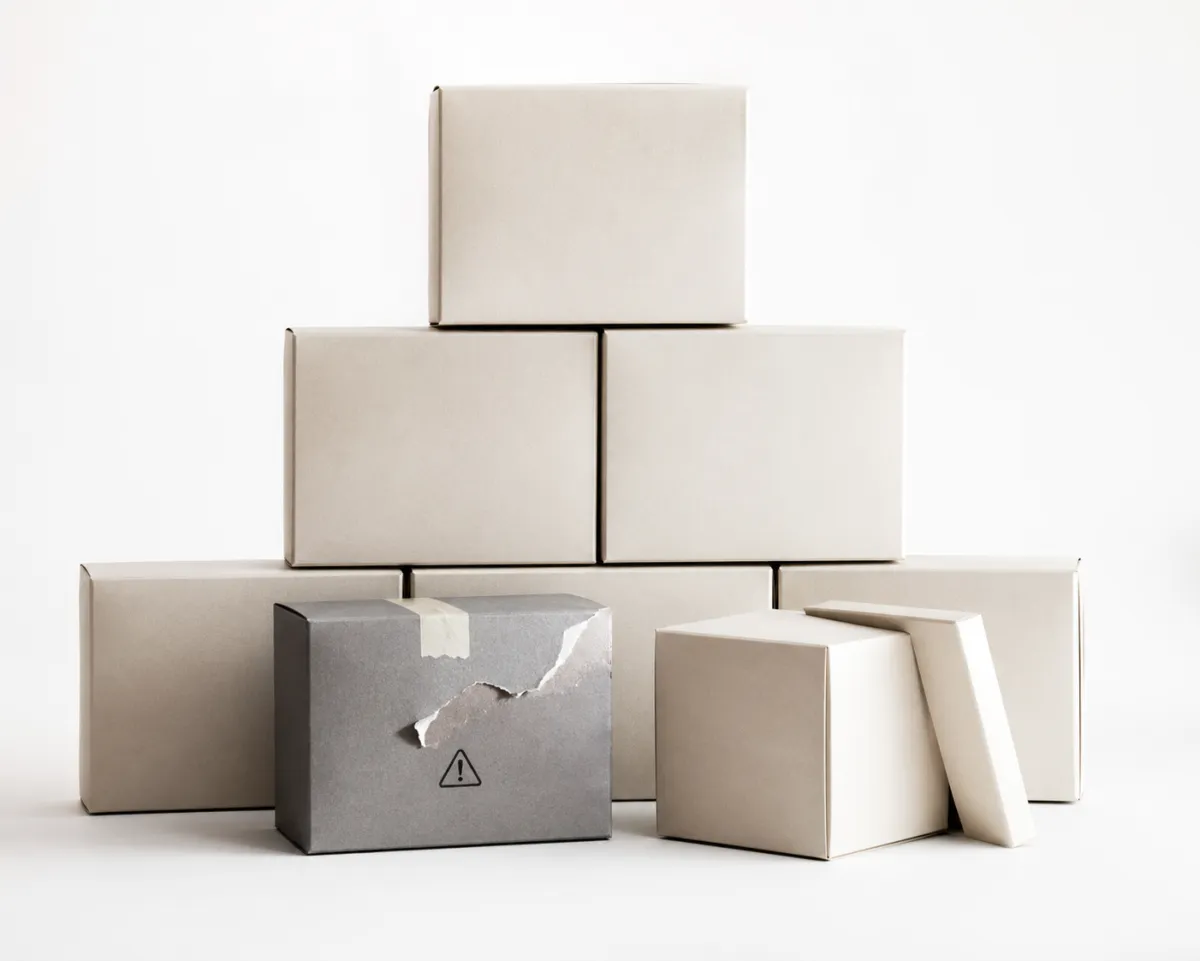
Guessing wrong on a bulk box run hurts because the damage compounds. A carton that is 2 mm too tight can slow packing, bruise edges, and trigger a rejection pattern that only appears when the warehouse starts filling outbound pallets. A loose carton can look perfect in sample photos, then fail in transit when product movement and insert slippage wear down the design.
That is why many teams stop asking, “How much do the boxes cost?” and start asking, “What does this box do to the total order economics?” A good build improves pick efficiency, reduces pick-and-pack labor, and increases freight density because cartons stack and nest consistently. A weak build does the opposite: extra hand-folding, extra void fill, extra rework at receiving, and extra conversation on every reorder.
There is also a hard brand line between one-off presentation and repeated execution. A smaller operation can absorb an occasional off-center logo or imperfect fold. A growing brand cannot. Customers notice every batch, and logistics teams feel every bad batch before the buyer has a chance to fix it later. For that reason, personalized paper boxes bulk should be judged on repeatability before decoration.
For some SKUs, one structural move changes the entire cost model more than any print upgrade. Adding a tuck tab may tighten closure security and reduce returns. Adding a score line can improve fold speed. If the new structure adds only four or five seconds to assembly per unit, labor impact can wipe out print savings across a large run. Procurement teams should model that tradeoff before green-lighting the order, not after the first pallet ships.
“The cheapest quote is rarely the lowest landed cost once reprints, freight, and damaged goods are counted.”
Demand pressure is amplifying this issue. Brands now ask packaging to protect, comply, communicate, move quickly, and still look premium on camera. That turns personalized paper boxes bulk into a strategic purchase instead of a decorative afterthought. The winning pattern is consistent: define structure, verify print workflow, then lock the repeat-order spec before volume expands.
Product Details: What Makes Personalized Paper Boxes Bulk Perform
Personalized paper boxes bulk do not all perform the same way. They usually fall into practical categories, each with different behavior in production and in market delivery. Rigid mailers support premium direct-to-consumer shipping, presentation boxes support retail and gifting, folding cartons fit shelf-ready flow, and specialty gift packs manage multi-piece sets or fragile products. Pick the correct category first, then refine graphics. Forcing a product into the wrong format creates a bigger and costlier correction later.
Branding layers matter only when they support function. Spot UV can sharpen logos and edges without changing structure. Embossing gives a tactile signature that reads premium in hand. Foil accents may make a top panel stand out in competitive shelves, while too much foil drives up cost and can slow finishing. Interior design, insert architecture, and closure logic often shape first-use perception more than an overloaded outer graphic. Personalized paper boxes bulk should be built from use case first, decoration second.
Four functions typically justify the spend: structural strength, shelf impact, product compatibility with shelf-life demands, and unboxing speed. Strength determines whether cartons survive handling and stacking. Shelf impact decides if the pack survives a retail encounter. Shelf-life compatibility protects moisture- or light-sensitive products from avoidable degradation. Unboxing speed protects fulfillment throughput. Missing any one creates underperformance no matter how sharp the print looks.
Material matrix for common use cases
A practical shortlist for buying teams starts with paper behavior, not marketing language. SBS board usually gives crisp print and a premium look. Kraft board suits natural branding and works well for sustainability-forward stories. Recycled boards support sourcing goals while usually demanding stricter color control. Premium coated paperboard often delivers the sharpest reproduction and accepts matte varnish, soft-touch lamination, and foil accents well. The right choice depends on item weight, handling conditions, and how much shelf presence the brand wants from personalized paper boxes bulk.
- SBS board: Best for premium graphics, clean folds, and high-contrast brand execution.
- Kraft board: Best for natural positioning, restrained gloss, and a sturdier look-and-feel.
- Recycled board: Best when recycled content and source transparency are business priorities.
- Coated artboard: Best for vivid image work, precise typography, and editorial-style visuals.
Matching logic is not random. Heavier products need thicker board, controlled scores, and often an insert or tray to prevent shifting. Irregular shapes reward smarter die-cut geometry and stronger corner profiles. Flat products are easier to pack densely, which can improve pallet use and reduce freight cost. Fragile SKUs often justify tighter closures or internal dividers. That means personalized paper boxes bulk is less about decorative outer boxes and more about board, geometry, and closure behaving like one product system.
When creating a package family, compare this box architecture with the rest of your packaging line. If you are also using cartons, trays, or display packs, run a full review against the broader Custom Packaging Products range so materials, closures, and finishes stay aligned. If volume is the constraint, the Wholesale Programs page can clarify how higher commitments affect pricing and service levels.
Compliance and testing need to be built into evaluation before final approval. If shipping is parcel-driven, ask for transit-test references tied to standards such as ISTA. For sourcing transparency, verify fiber origin with FSC documentation where required. These data points do not replace structural quality, but they help justify the structure in procurement meetings. They also keep the conversation honest, which matters more than a slick sales deck.
I learned that the hard way on a run for a vitamin line that looked clean on screen and then started pinching the bottle shoulders once production moved up to volume. The fix was not a prettier print file. It was a better score, a looser tolerance window, and a board choice that held its shape after humid storage. That kind of correction is boring, but boring is what keeps returns down.
What Should You Lock Down Before Ordering Personalized Paper Boxes Bulk?
Delays often begin when teams approve a sample before the real specification is locked. A sample can appear correct and still fail in production if inner dimension, score line location, or grain direction was never finalized. Clear documentation replaces memory-based assumptions. The more customized the box, the stronger the case for exact specs.
Core dimensions and structure
- Internal dimensions: Lock length, width, and height in millimeters or inches, and treat them as non-negotiable.
- Tolerance window: Define acceptable deviation, commonly plus/minus 1 to 2 mm, based on fit risks.
- Flap and lock style: Specify tuck, auto-lock, magnet closure, sleeve, or crash-lock with no ambiguity.
- Wall thickness or board caliper: Lock substrate thickness to avoid fit drift at volume.
- Die-line version: Finalize the exact structure file before print approval starts.
Color control is a common point where teams either stabilize or trigger rework. If brand color must remain exact, ask for a Pantone-based workflow instead of default CMYK assumptions. CMYK can still work for many photographic designs, but solid brand tones often need spot-color control. White-core blocking also appears in certain stocks when cuts or folds expose pale edges; it is acceptable for a rustic look but risky for premium personalized paper boxes bulk.
Finishing decisions need equal rigor. Soft-touch lamination can improve tactile perception, yet the coating can scuff differently than matte varnish. Foil accents read well in product shots, while delicate fine lines can break if artwork is too thin. Spot UV requires a clean contrast field to stay legible. If adhesive is part of the structure, verify that coating chemistry will not weaken bonding. A beautiful finish that reduces structural trust is the wrong finish for this context, no matter how nice it looks in the sample room.
Artwork is where most timelines bleed time. Bleed and crop marks must be production-ready, type should hold legibility at run size, and barcode placement needs clear scanner access outside fold interference. Legal and compliance copy must sit within safe zones away from folds and seams. This becomes essential when personalized paper boxes bulk has to repeat across multiple SKUs without translation to a new file set each cycle.
Frequent rejection points include uneven folding resistance from wrong grain direction, weak registration leading to blurred mark placement, inner dimensions that look fine in CAD but fail in packed form, and aggressive score lines that crack heavier board stocks. These issues are ordinary, and they are all preventable with a pre-release checklist. They are also the reason production teams sound cautious; they have usually seen the same mistake more than once.
Get a written checklist confirmed before approval:
- Exact internal size and tolerance range.
- Board grade and coating finish.
- Print method, color standard, and proof type.
- Closure style, insert fit, and glue points.
- Barcode, legal text, and artwork safety zones.
- Production sample approval and revision lock date.
That list may look procedural, yet it is the difference between smooth execution and a reorder cycle that keeps stretching the launch calendar. In packaging procurement, precision is rarely bureaucracy. It is damage control insurance. And if a team says the spec is “close enough,” I start looking for the line item that is gonna cost them later.
Pricing & MOQ for Personalized Paper Boxes Bulk by Build and Volume
Pricing for personalized paper boxes bulk is controlled by a small set of variables, and comparisons go wrong when two suppliers are not pricing the same build. Paper grade, print area, color count, finish complexity, die-cutting, insert complexity, and pack style all move unit cost. Even packing method affects cost because nested, flat, or pre-glued structures demand different labor and handling approaches.
MOQ should be treated as an economic switch, not a supplier obstacle. It marks the point where setup and tooling are absorbed enough to make unit economics realistic. A 1,000-unit threshold may look expensive next to 5,000 units, and 10,000 units can reduce per-unit cost, but only if files are clean and structure is stable.
A practical formula keeps teams aligned before requesting quotes:
Total Cost = Setup + Materials + Printing/Conversion + Finishing + Freight and handling
Divide that total by usable units. This method often exposes hidden charges faster than a single unit headline does. A low unit price with high setup and change fees can still undercut your budget once the second revision appears. That is the part many quote sheets hide behind friendly-looking numbers.
| Box Build | Typical MOQ | Common Use | Indicative Unit Range | Main Cost Drivers |
|---|---|---|---|---|
| Folding carton | 1,000-5,000 | Retail goods, cosmetics, supplements | $0.22-$0.48 | Board grade, print coverage, die-cut precision |
| Kraft mailer box | 1,000-3,000 | DTC shipping, subscription packs | $0.35-$0.75 | Structure, closure style, insert complexity |
| Presentation box | 500-2,000 | Gift sets, premium launches | $0.85-$1.95 | Lamination, foil, embossing, rigid board |
| Rigid gift box | 300-1,500 | High-value items, seasonal sets | $1.10-$2.80 | Assembly labor, board thickness, premium finish |
These ranges are references, not promises. A full-bleed finish with foil and soft-touch sits above a plain kraft build with one-color print. Larger order size can reduce unit costs, and repeated sample revisions can erase those gains quickly. That is why procurement teams should compare quotes only after the spec is frozen.
Repeat orders often improve pricing because fixed costs are already paid: dieline is approved, art is stable, and operators already understand board behavior. That said, each change request still resets part of the equation. A new finish, insert, or run length shifts cost even with the same supplier.
Discount patterns and surcharge triggers are fairly predictable. Volume commitments unlock better rates. Rush production usually carries premiums because scheduling becomes compressed. Art rework introduces late charges when files are not final. Skipping proofing can save an initial day and then cost weeks when mistakes emerge post-print. For personalized paper boxes bulk, the lowest quoted number is rarely the cleanest option.
“A clean file, a frozen dieline, and a stable reorder plan often beat a lower quote with vague terms.”
Process & Timeline for Personalized Paper Boxes Bulk Delivery
A strong personalized paper boxes bulk schedule works like a chain of clear gates. Inquiry and intake confirm structure, print area, quantity, and finish. Quote confirmation follows, then sample or proof validation of carton size, image placement, and substrate choice. Pre-production approval hands off to production, then QC, then packing and dispatch. If any gate is fuzzy, the schedule slips by the next gate.
Timelines move with complexity. A simple print build with no structural revision can move from proof approval into production quickly. A custom die-cut, foil, insert-led order with multiple rounds of revision can stretch far beyond that window. A standard run often lands around 12 to 15 business days after proof approval, while a more complex structure can exceed this if finish sign-off and tooling are not finalized. I have seen a launch slip because one barcode moved by 8 mm; the artwork was fine, but the scanning spec was not.
What slows the clock
Most delays come from process friction, not pure machine time. Revision loops, late art edits, and unclear approval ownership restart the clock. A final die-line change after sampling can force a reset. Barcode movement after proof adds another validation cycle. If shipment commitments are set before structure lock, pressure usually shows up at dispatch and again in freight booking.
- Approved dieline freeze date: No changes after this point unless the order is re-quoted.
- Proof sign-off deadline: The date artwork and finish receive formal approval.
- Production start confirmation: The point at which conversion work is authorized.
- QC release checkpoint: The review for dimensions, print, and edge integrity.
- Dispatch cutoff: The final lock before freight booking and pickup scheduling.
Documentation keeps the schedule honest. A complete order pack should include the spec sheet, purchase order, approved proof, artwork lock note, carton style confirmation, and compliance checklist. For larger personalized paper boxes bulk jobs, include a revision log so teams can confirm exactly which file version was signed and when.
Climate can still interfere when teams forget the basics. Paper and coatings shift under humidity and temperature stress, especially during storage and line-side staging. If boxes cross humid zones or long import routes, confirm how moisture protection is handled: pallet wrap, carton wrap, and any desiccant strategy should be explicit in planning.
Once volume grows, cadence becomes part of execution quality. Daily or shift-level status updates are not overhead; they are control points. A simple sequence of confirmations helps: proof approved, material released, first-article checked, conversion underway, pack-out complete, freight booked. Issues caught there are usually file-based. Catch them later and they become pallet-based.
One practical comparison helps frame priority: a cleanly moving order often costs less than a slightly cheaper quote that stalls for a week in artwork review. The lost time can hold inventory, delay a launch, and force expensive shipping decisions. In practical terms, personalized paper boxes bulk is a logistics discipline as much as a design activity.
Why Choose Us for Personalized Paper Boxes Bulk at Scale
Suppliers are not kept because they sound polished on discovery calls. They are kept because they stay predictable through repeated demand. For personalized paper boxes bulk, what matters most is capacity discipline, equipment fit, sample reliability, QA depth, and escalation response when things drift.
Transparency in process builds trust faster than slide decks. Version control should be visible. Pre-press checks should happen before money is spent on wrong cuts, wrong scores, or wrong materials. Live status checkpoints matter on high-volume orders because every handoff carries risk. Photo updates are evidence, not marketing, that the job still matches the approved spec.
Common buyer concerns usually cluster around three areas: lead-time risk, artwork risk, and MOQ pressure. Sustainability is another frequent constraint, especially where recycled board, FSC sourcing, or waste targets are mandatory. A capable supplier does not dismiss these concerns; it turns them into structured options, clearer samples, and explicit distinction between non-negotiable cost increases and optional upgrades.
Operational skill matters more than style language. Can the team keep tolerance consistency across repeated runs? Can they absorb one correction without eroding control? Can they propose a costed alternative quickly if the first build is too expensive? Those are the questions that determine personalized paper boxes bulk outcomes.
Post-launch review should track measurable behavior: defect trend, on-time fulfillment, complaint recovery speed, and reprint response quality. If those signals are stable, a supplier earns a reliable place in the approved list. If they drift, the “cheaper” option becomes expensive in less than one cycle.
Packaging programs often stall because teams keep optimizing decoration while execution gaps remain open. A premium look in a sample does not compensate for late shipments, extra handwork, or unpredictable fit. personalized paper boxes bulk at scale magnifies discipline, which is exactly why consistency beats theatrics. Pretty is nice. Predictable pays.
Personalized Paper Boxes Bulk: Final Decision Steps and Order Roadmap
To move from interest to placement, teams usually start with dimensions, lock design options, set a target MOQ, and submit a complete first file package. It sounds procedural because it is procedural. Once carton size, board, finish, and closure are fixed, personalized paper boxes bulk becomes execution, not experiment.
Use this action list before the next internal review:
- Measure the final product with insert or inner tray included.
- Choose the carton style that matches shipping and shelf-use requirements.
- Confirm board grade, finish, and color standard.
- Set target MOQ and expected reorder cadence.
- Gather logo files, barcode files, and legal text in production-ready format.
- Request proof timing and production-ready sign-off deadlines.
Teams that skip this step usually end up with version chaos. A useful 7-day pre-order routine starts with stock audit to understand existing packaging buffers. Build approved color references from prior runs or physical swatches. Lock proof review timelines so feedback is not stranded in email threads. Define who has sign-off authority for each file version. Set test-batch criteria that judge size, handling, and print before full-scale release.
Use a production-readiness scorecard before approval. Score areas like print clarity, size accuracy, fold behavior, closure integrity, insert fit, and board strength against pre-set thresholds. A blurred logo edge fails acceptance. An insert that shifts by a few millimeters fails acceptance. A fold crack on heavy board fails acceptance. If one of those shows up in a sample, do not talk yourself into it because the rest looks good.
Supplier quote comparison improves when separated into fixed, variable, and conditional costs. Baseline, setup, change, finishing, and shipping are different categories and should not be mixed in a single line item. Add revision policy, proofing policy, and damage handling to the evaluation matrix. A quote that looks low can become expensive when hidden conditions are activated.
Before you place the order, answer three practical checks: Can the supplier repeat the build without tolerance drift? Can they keep communication clear through every stage? Can they solve issues without turning each fix into a new billable package? A positive answer from all three usually signals readiness.
The clearest takeaway is this: freeze the dieline, board grade, finish, and approval owner before you shop the cheapest unit price. If those four items are still moving, personalized paper boxes bulk is not ready for purchase, no matter how good the mockup looks.
How fast can I get personalized paper boxes bulk delivered with no compromise on quality?
Most standard runs settle into a stable rhythm when artwork is approved early and sample quality is validated before production. A typical chain moves through proof, conversion, inspection, and dispatch. Rush service can be arranged, but it usually adds a surcharge and narrows finish options. The strongest timing control is a quoted proof date and a separate production-ready sign-off date.
What MOQ is practical for personalized paper boxes bulk and how does it affect unit price?
MOQ marks the threshold where setup and tooling are spread across more units, so unit price often drops in bands after that point. Larger volume lowers per-unit cost only when artwork is stable and sample quality has already passed. A pilot run can be a safe option for tight budgets, but only if first-pass quality is validated before scale-up. That is usually the cleaner path for personalized paper boxes bulk.
Can personalized paper boxes bulk include UV coating, foil, or soft-touch finishes without breaking the timeline?
Yes, if finish planning is moved into design instead of bolted on later. UV, foil, and soft-touch add prep, sample, and QC checkpoints, especially on full wrap or textured surfaces. Finish-specific samples help because screen previews rarely show scuff behavior or depth accurately. Decide on all finish choices before production starts to avoid timeline drift in personalized paper boxes bulk.
What exact specifications should be finalized before approving personalized paper boxes bulk samples?
Prioritize carton dimensions, fold logic, glue zones, internal clearance, weight class, print placement, and barcode location. After that, lock material grade and finish against real shipping and storage conditions. Once sample sign-off is done, hold dieline, color references, and version notes constant. That reduces approval drift and avoids costly rework in personalized paper boxes bulk.
How do I evaluate personalized paper boxes bulk pricing by reorder cycle and avoid unexpected fees?
Start with the split: fixed costs per change (setup, die modifications, file remakes) versus scalable costs (materials, print, labor). Record every revision and approval round as a cost event in the order sheet. A rolling reorder model stays affordable when art, carton specification, and supplier windows remain stable across cycles. That is usually the clearest way to keep personalized paper boxes bulk pricing predictable.