Buyer Fit Snapshot
| Best fit | Shipping Carton Cost for Enterprises projects where brand print, material claims, artwork control, MOQ, and repeat-order consistency need to be specified before quoting. |
|---|---|
| Quote inputs | Share finished size, material target, print colors, finish, packing count, annual reorder estimate, ship-to region, and any compliance wording. |
| Proofing check | Approve dieline scale, logo placement, barcode or warning zones, color tolerance, closure strength, and carton packing before bulk production. |
| Main risk | Vague material claims, crowded artwork, missing packing details, or unclear freight terms can make a low unit price expensive after revisions. |
Fast answer: Shipping Carton Cost for Enterprises: What Really Drives It should be specified like a repeatable production item. The safest quote records material, print method, finish, artwork proof, packing count, and reorder notes in one written spec.
Production checks before approval
Compare the actual filled-product size with the drawing, then confirm tolerance on folds, seals, hang holes, label areas, and retail display edges. Reserve space for logos, QR codes, warning copy, and material claims before decorative graphics fill the panel.
Quote comparison points
Review material grade, print process, finish, sampling route, tooling charges, carton quantity, and freight assumptions side by side. A quote is only useful when the supplier can repeat the same color, closure quality, and packing count on the next order.
Shipping Carton Cost for Enterprises: What Really Drives It
The first time I watched a buyer chase the lowest Shipping Carton Cost for enterprises, the savings survived exactly one receiving cycle. The cartons were $0.08 cheaper per unit on a 10,000-piece order, but the lane picked up 11% more freight, 3% more damage, and nearly 40 minutes of repack labor per pallet at a Midwest DC outside Columbus, Ohio. I remember standing there with a clipboard and a stack of claims forms, doing the math twice because I wanted the numbers to be wrong. They were not. A quote can look clean in a spreadsheet and still turn expensive the moment it reaches the dock at 6:30 a.m.
I have seen the same pattern in a distribution center near Fort Worth with 18 dock doors, in a cosmetics line outside Monterrey running 24 SKUs, and in a contract packer in Dongguan, Guangdong that thought thinner board would rescue margin pressure. It never did. The real number is not the sticker price; it is the landed cost, the claim rate, the cube utilization, the pallet count, and the labor tied up in order fulfillment. If your team only compares carton unit price, half the bill stays hidden, which is a charming little accounting trick until finance asks for the quarterly variance by Tuesday afternoon.
That is why I always frame shipping carton cost for enterprises as a program decision rather than a box decision. A carton that looks 12% cheaper can become more expensive after pallet inefficiency, carrier dim weight, and a little extra void fill. In one retail meeting I joined in Chicago, the finance lead was proud of a $0.26 carton until we mapped the load plan and found 14 additional trailers in a quarter across two lanes, one to Phoenix and one to Charlotte. One whiteboard session changed the math, and I could practically hear the room get quieter by a full octave.
Here is the blunt version: if the carton does not fit the product, the pallet, and the ship mode, the savings are mostly imaginary. A lot of procurement pain comes from trying to force a neat unit-cost answer onto a messy transportation problem. I have never seen a procurement team regret paying 3 cents more for a spec That Cut Damage by 1.5 points and stabilized the pallet stack at 1.8 meters high. I have seen them regret the opposite, usually after two weeks of customer complaints, a carrier audit, and a stack of returns waiting at the service desk like a bad punch line.
"We saved on the carton line item and spent the difference twice over in freight and rework." That was a buyer in Cleveland, Ohio, on a 14,000-unit program, and the note still stays with me because the numbers were so clean. The box was cheaper. The program was not.
The rest of this piece stays focused on the real drivers behind shipping carton cost for enterprises. Not the sticker. Not the first quote. The total spend across transit packaging, freight, labor, damage, and replenishment. If you are buying for a network with three sites in Texas or thirty sites across the Southeast and Midwest, that distinction matters right away, because scale tends to punish sloppy assumptions faster than anyone expects.
Why shipping carton cost for enterprises is rarely just the box
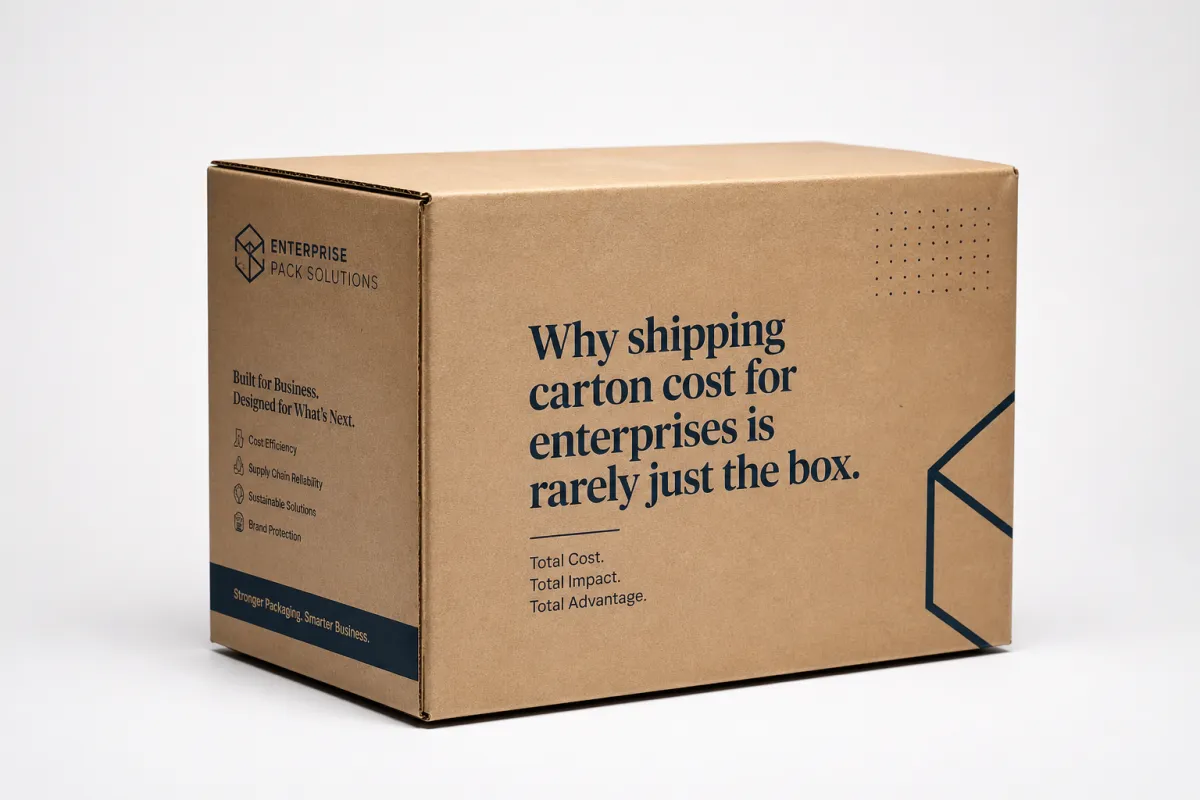
Most enterprise buyers start with a unit price because it is easy to compare. A carton at $0.31 and another at $0.27 look like a clear choice on paper. Yet shipping carton cost for enterprises rarely stays inside the carton itself. The box touches freight, storage, damage, repack labor, and customer experience. Two quotes that differ by 4 cents can create a 9 cent swing in actual program cost once everything lands, and that is before the first seasonal spike shows up in November or the spring reset hits.
In one client meeting in Nashville, a packaging engineer showed me two versions of the same shipper. The cheaper one used a narrower flute and saved 12% on board cost at the mill. The sample looked smart in the conference room. On the line, it caused a 7% rise in crushed corners during peak season because the product was riding humid lanes from Atlanta to Houston and then sitting on a dock for 36 hours. I still remember the operator picking up one of the failed cartons and giving me a look that said, very clearly, "well, there goes that idea." The correction added $0.05 in board, but it removed $0.18 in claims. That trade is easy to make once you see the whole lane.
The comparison gets even more interesting with dimensional weight. A carton that is 12% cheaper on the invoice can still cost more if it adds an inch of air in every direction. Carriers price on dimensional weight, not just actual weight, so a small change in internal dimensions can inflate your freight bill across thousands of ecommerce shipping orders. I have watched one 1.5-inch overhang add enough cube to change pallet count, trailer load, and carrier billing in the same week on a route from Reno to Denver. It is one of those problems that feels tiny until it starts writing checks.
Shipping carton cost for enterprises also gets distorted by repack labor. If a box is awkward to assemble, the line slows down by 6 to 10 seconds per unit. That sounds small until you multiply it by 25,000 monthly shipments. A 7-second delay at pack-out can cost more than a 2-cent board upgrade, and that is before anyone counts worker fatigue or mispacks on a second-shift line in Louisville. I have seen teams fight over 1 cent of board and ignore the bigger drag from a carton that takes two hands, a hip check, and a quiet prayer to assemble.
Too many teams treat the carton as a stand-alone item instead of one part of a supply chain. In practice, it sits inside a larger shipping materials system. The right carton program supports package protection, keeps line speed stable, and preserves the pallet pattern all the way to the dock. That is the frame I use with every buyer, because it keeps the conversation anchored to reality instead of whatever the lowest quote happened to be that morning.
For teams that need a broader view of packaging spend, I often start with a review of Custom Packaging Products and then narrow into the carton format that fits the lane. For smaller ship sets, some programs mix cartons with Custom Poly Mailers so the carton only handles the parcels that truly need rigid transit packaging. That split alone can make a surprisingly large dent in shipping carton cost for enterprises, especially when a 0.5 kg apparel item no longer needs a rigid corrugated box to travel from Shenzhen to Seattle.
There is also a practical purchasing truth here. The more sites involved, the more shipping carton cost for enterprises becomes a standardization problem. One plant may want a slightly stronger board, another may want a smaller footprint, and a third may only care about cube. If procurement does not reconcile those needs, the network ends up buying three box families instead of one. Cost then leaks into storage, forecast complexity, and MOQ pressure, which is exactly the sort of mess that grows quietly and then shows up in a budget review with a grin.
Product details that shape shipping carton cost for enterprises
If you strip away the sales language, the product details explain most of the shipping carton cost for enterprises. The first question is carton style. A stock RSC, or regular slotted container, usually carries the lowest setup cost because it is familiar, fast to convert, and easy to source. A custom slotted carton adds design flexibility, but it also adds board optimization decisions. Die-cut mailers bring cleaner presentation and better pack speed for some ecommerce shipping programs, though they usually cost more in tooling and board utilization. Pallet-ready cartons sit at the other end: strong, efficient on a load plan, and often the best choice for heavier unit loads, but not always the cheapest on the invoice.
I stood beside a corrugator once in a plant outside Shenzhen while a buyer pushed for a lighter board on a 14 kg electrical component headed to a warehouse in Dallas. The sample looked fine in hand. The test stack told a different story. A move from 32 ECT single wall to a 44 ECT double-wall format added $0.07 per carton, but it eliminated the collapse that had been happening on the bottom row of a 1.8 meter pallet. That kind of change lowers shipping carton cost for enterprises after you account for the full route, not just the line item that looks good in a presentation.
Flute choice matters more than most teams expect. A B-flute gives better printability and decent puncture resistance. A C-flute brings more crush strength and better stacking for many transit packaging programs. BC double wall costs more, but if your cartons sit in a humid cross-dock for 36 hours in Savannah or Houston, that extra wall can be the difference between a clean delivery and a damaged pallet. Recycled content also shifts the equation. Some mills in Zhejiang and Hebei can hold 30% recycled fiber with stable performance; others need higher virgin fiber content to maintain caliper and edge crush. The paper mix changes both unit cost and reliability, and the wrong mix will remind you in a hurry.
Shipping carton cost for enterprises also responds to the extras. Print coverage, aqueous coating, handles, windows, tear strips, and inserts all add cost, but not equally. I tell buyers to spend on the feature that improves either pack speed or product safety. A handle can be worth 2 cents if it cuts manual lifting injuries in a 50,000-unit annual program. A window cut is rarely worth it if it weakens the panel and raises the claim rate. A heavy four-color print on a carton that spends its life in a warehouse usually adds marketing cost without operational payoff. I say that with love for design teams, but also with a little fatigue after enough difficult launch meetings in Chicago and Monterrey.
Here is a useful comparison I show procurement teams. It is not perfect, because every lane differs, but it is honest about the tradeoffs that shape shipping carton cost for enterprises.
| Carton type | Typical use case | Common MOQ | Approx. unit cost at 10,000 | Main cost driver |
|---|---|---|---|---|
| Stock RSC | General order fulfillment, mixed-SKU replenishment | 500 to 2,500 | $0.24 to $0.38 | Board grade and freight |
| Custom slotted carton | Right-sized transit packaging, improved cube | 3,000 to 10,000 | $0.27 to $0.44 | Die setup and board optimization |
| Die-cut mailer | Ecommerce shipping, premium presentation | 5,000 to 20,000 | $0.31 to $0.58 | Tooling, print, and fold complexity |
| Pallet-ready carton | Bulk supply, heavier units, stable stacking | 2,000 to 8,000 | $0.42 to $0.76 | Double-wall board and compression target |
The table tells a simple story. The cheapest carton on paper is not always the cheapest carton in use. If your team ships 8,000 units a month and each carton saves 1.5 seconds of pack time, the labor savings alone can outweigh a 3 cent board increase. That is why shipping carton cost for enterprises should be measured against labor, freight, and damage, not against a single line item in a quote from a converter in Dongguan or Qingdao.
For buyers who need a cleaner fit for branded transit packaging, I often point them toward Custom Shipping Boxes because the right structure can reduce empty space by 8% to 15%. That kind of right-sizing improves pallet fill, trims dimensional weight, and steadies the total shipping carton cost for enterprises over time. It also makes the packing room look less like a cardboard storage accident, which nobody ever complains about.
Specifications that protect performance and budget
Once the carton style is chosen, the spec sheet does the heavy lifting. If the spec is vague, shipping carton cost for enterprises will drift upward through overpacking, guesswork, and repeat sampling. The minimum fields I want locked are internal dimensions, product weight, board grade, wall construction, and the performance target. If the product weighs 7.4 kg and the box is built for 9 kg, you are already spending money on excess board. If the box is underspecified, you are buying claim risk, and that is a much worse purchase order.
Internal dimensions matter because even a 5 mm change can alter pallet count, filler usage, and freight class. I once reviewed a beauty program where the team left 18 mm of headspace in each carton. They thought the extra room made packing easier. It did, but it also pushed a lane into a higher cube bracket and added nearly 6% to shipping cost on the route from Los Angeles to Portland. The fix was a tighter carton with a 2 mm tolerance, and that alone improved pallet density across 22 stores. That is a direct reduction in shipping carton cost for enterprises, not a theoretical one scribbled on a whiteboard and forgotten by Friday.
Test criteria are not optional. For enterprise transit packaging, I want a compression target, a drop test, a vibration profile, and a ship simulation that matches the actual lane. ISTA and ASTM protocols help here, especially if the cartons move through multiple hubs, summer humidity, or long dwell times. For teams building a formal qualification plan, the standards published by ISTA are a useful anchor, and the EPA's material efficiency guidance at EPA Sustainable Materials Management helps frame waste reduction without losing package protection.
Here is the part many buyers overlook: tighter specs reduce the need to overpack. That means less void fill, fewer dunnage inserts, and less time spent adjusting cartons on the line. A spec that saves 10 seconds per pack and cuts fill volume by 15% can reduce shipping carton cost for enterprises in both labor and materials. The effect compounds across network scale. A 5-site program sees it faster than a single warehouse ever would, which is why I keep pushing teams to look at the whole system and not just the carton drawing.
Humidity exposure deserves its own line item. If cartons are stored in a facility that swings from 35% to 80% relative humidity, board strength will move. A paperboard spec that looks perfect in a dry test room may soften after 24 hours on a dock in Charleston or Tampa. In that scenario, I prefer to specify the lane rather than the lab. The result is less surprise damage and a more stable shipping carton cost for enterprises across seasons. I have seen summer humidity do more damage to a budget than a bad spreadsheet ever could.
Buyers often ask whether a higher ECT rating automatically solves the problem. It does not. A 44 ECT carton with sloppy dimensions and a poor pallet pattern can still perform worse than a 32 ECT carton that is right-sized, tightly packed, and tested on the actual route. That is why I push for spec clarity before quoting. Every inch, ounce, and flute change moves the total cost profile, and the supplier cannot responsibly guess their way out of that.
- Internal dimensions: set to the product plus only the clearance needed for packout, usually 2 to 6 mm per side.
- Product weight: declare the real packed weight, not the empty unit weight.
- Board grade: choose ECT or burst strength based on stack and lane exposure.
- Wall construction: use single wall or double wall based on compression and pallet height.
- Humidity exposure: define storage and transit conditions so board performance matches the route.
That list is where shipping carton cost for enterprises becomes controllable. Without it, the supplier guesses. With it, you can compare quotes on the same basis, which is the only comparison that matters.
Shipping carton cost for enterprises: pricing and MOQ
Pricing for shipping carton cost for enterprises is built from several layers, and the fastest way to get a misleading number is to ask only for the unit price. I want to see the carton rate, tooling, print setup, freight, inventory carrying cost, and any testing fees. If the box is stock-based, the setup may be minimal. If it is custom, the die charge and artwork proofing can change the economics completely. I have been in more than one meeting where the "cheap" option turned into the expensive one the second the tooling line showed up from a converter in Ningbo.
MOQ is usually the next surprise. A stock conversion might start at 500 to 2,500 units because the board already exists and the run can be slotted into an existing schedule. A fully custom carton with new tooling and print can require 3,000, 5,000, or even 10,000 units depending on board conversion and press efficiency. The MOQ is not arbitrary. It ties back to make-ready waste, die cost, and the amount of dedicated inventory your supplier must hold. Suppliers do not dream these numbers up just to torment buyers, although it can feel that way on a rough afternoon in procurement.
I have had finance teams ask why a 20,000-unit order is cheaper per box than a 4,000-unit order by 14%. The answer is straightforward. Setup cost gets spread over more units, the press runs longer, and freight can be consolidated. A second layer matters too: larger runs usually reduce the unit cost of shipping carton cost for enterprises only if storage, forecast, and consumption can absorb the inventory without tying up cash for months. If the boxes sit in a warehouse in Atlanta or Sacramento like a very expensive paper sculpture, the math gets less romantic fast.
Here is how I break the quote into pieces for a buyer who wants clean numbers:
- Per-unit carton price: the board, conversion, and finishing cost.
- Tooling: die charge, print plates, or structural setup.
- Freight: inbound carton freight or delivered pricing to each site.
- Inventory carrying cost: warehouse space, capital tie-up, and obsolescence risk.
- Testing or samples: compression tests, prototypes, or lane validation runs.
Tiered pricing tells the story better than a single price point. If a quote only shows 5,000 units, you cannot see the payoff from scale. I prefer bands at 5,000, 10,000, 25,000, and 50,000 because those points show how fast shipping carton cost for enterprises falls as volume rises. That is useful for finance, and it is useful for operations because it highlights where a reorder point might create avoidable rush charges. More than once, that simple tier chart has saved me from a very avoidable "why is this order overnight?" call.
One buyer I worked with was paying $0.41 at 5,000 units, $0.33 at 10,000, and $0.29 at 25,000. The lowest unit price looked attractive, but the 25,000-unit run sat in storage for 4 months and tied up more cash than the board savings justified. We trimmed the spec by 3 mm, kept the 10,000-unit band, and lowered total annual spend by $12,600. That is the kind of decision that makes shipping carton cost for enterprises a finance conversation, not just a packaging one. Honestly, that is usually where it belongs.
Quote comparison should always be landed cost per shipped unit. A supplier with a $0.02 higher box price can still be the better choice if they reduce freight by $0.03, damage by $0.04, and pack labor by 2 seconds per carton. That is the unit economics that matters. I have watched too many teams get pulled in by a low sticker price and then pay the difference three times over in the field. It is the procurement version of saving a dollar on an umbrella and getting soaked anyway on the walk from the parking lot.
For enterprise buyers who want a practical starting point, I usually recommend requesting both a standard and a right-sized version of the carton. The delta between them often reveals hidden savings in shipping carton cost for enterprises. Sometimes the biggest gain is simply removing air from the box, which sounds almost too obvious until you see how much money was hiding in that air.
Process and timeline from brief to delivery
A clean process keeps shipping carton cost for enterprises from drifting during production. The order flow should be simple: discovery, specification review, sample build, quote, approval, production, quality check, and delivery. Trouble starts when one of those steps gets handled by email alone and the others are assumed. A missing dimension or an unapproved print line can add a week without warning, and then everyone acts surprised, which I find deeply unhelpful.
In my experience, the longest delays come from artwork approvals, structural changes, and freight booking. Production itself is often the easiest part. I have seen a carton program sit idle for 9 days because a marketing team wanted one more logo alignment check. I have also seen a rush order move in 7 business days because the brief was clean, the dieline was already approved, and the ship mode was decided on day one. That is the difference a disciplined process makes to shipping carton cost for enterprises, and it is usually the difference between calm and chaos on the warehouse floor.
For stock conversions, a realistic timeline is often 7 to 10 business days from approval, assuming the board is available and the run is not fighting peak capacity. For new custom cartons, 12 to 15 business days from proof approval is a better planning window, and complex print or testing can extend that to 18 or even 20 days. Rush options exist, but they are not magic. They usually cost more, and they often wipe out the freight efficiencies that make the project worth doing. The word "rush" tends to come with a small price tag and a surprisingly large headache.
I tell procurement, operations, and fulfillment to sign off together. A carton that pleases one department and frustrates the others usually gets changed later. The finance team may focus on shipping carton cost for enterprises, the warehouse may focus on pack speed, and the brand team may focus on print quality. If those three groups do not agree on the spec, the project slips after the sample stage. That is where most timelines break, and it is always more expensive to fix after print plates are made at a plant in Shenzhen or Wenzhou.
One small factory-floor story says a lot. In a line review I joined last year, the operator was spending 11 extra seconds folding a carton because the side panels were designed with too much resistance. We adjusted the score line and cut the fold time by nearly half. That change did not just save labor. It reduced misfolds, improved seal consistency, and dropped one point of waste from the line. The carton was the same size. The program cost was not. That is the sort of thing that makes me care about details other people would rather wave away.
If you want to keep the project moving, ask for these checkpoints:
- Day 1 to 2: brief, dimensions, weight, and ship lane review.
- Day 3 to 5: sample or structural proof.
- Day 6 to 8: pricing confirmation and internal approval.
- Day 9 to 15: production, quality inspection, and freight booking.
That kind of schedule keeps shipping carton cost for enterprises tied to actual milestones. It also gives the buyer a better chance of catching issues before they become expensive rework, which is the kind of boring success I have learned to appreciate.
Why enterprises choose us for carton programs
Enterprise buyers do not stay with a packaging partner because of slogans. They stay because the quotes are clear, the engineering support is real, and the quality control does not wobble from one run to the next. That is the service model that keeps shipping carton cost for enterprises predictable. Transparent quoting matters because it shows exactly where the money is going. Engineering support matters because it trims board, improves fit, and reduces damage before the first production run ever starts.
I have sat through enough supplier negotiations to know that responsiveness is not a soft metric. If a supplier answers a spec change in 2 hours instead of 2 days, the buyer avoids a missed booking, a delayed launch, or a production restart. That is worth real money. Documentation matters too. Enterprises need files that support internal approvals, site onboarding, and vendor scorecards. A supplier who can provide drawings, material specs, and test summaries keeps the chain moving. The ones who can only send a vague PDF and a hopeful smile tend not to last long, especially once a plant manager in Ohio asks for lot traceability.
Quality control is where trust gets built. At our facility, we check board caliper, slot accuracy, and print registration on every production lot, and we pull samples against the agreed spec before release. If the carton is part of a multi-site program, I want the same result in site 1 and site 7. Consistency is what makes shipping carton cost for enterprises manageable over time. A cheap run that varies by 3 mm from lot to lot is not cheap. It is a liability with a low initial invoice.
There is also a hidden advantage to working with one partner on cartons, labels, and related shipping materials. The more of the program lives in one file set, the less chance there is for mismatched specs, duplicate purchasing, and freight surprises. That is why some teams combine carton programs with branded components from Custom Packaging Products and channel their smaller, lighter SKUs into the right ship mode instead of forcing every item into the same box format. That sort of segmentation makes the whole program feel less like improvisation and more like a plan.
For smaller or flatter products, I also like pairing carton programs with Custom Poly Mailers to keep the packaging mix lean. That kind of segmentation can reduce shipping carton cost for enterprises because not every item needs the same level of corrugated protection. The best carton program is the one that does not over-serve the product, even if that means telling a team their favorite oversized box is not actually doing anyone any favors.
Enterprise reality also includes replenishment. Multi-site ordering, predictable lead times, and controlled revision management matter as much as the box itself. A program that cuts surprise cost changes by even 2% over a year can free up budget for better labels, stronger tape, or more rigorous testing. Those are the practical wins that procurement teams can defend in a review meeting, and they are usually more persuasive than a glossy brochure ever is.
Buyers value a supplier most when the supplier says "no" to a bad idea with data. If a requested carton adds 18% more board and only improves brand appearance in a warehouse that nobody sees, that is not a strong business case. A good partner will say so. That honesty keeps shipping carton cost for enterprises aligned with the actual business goal, which is the whole point even if nobody puts it that plainly in a kickoff call.
Next steps to reduce shipping carton cost for enterprises
If you want faster, sharper quotes for shipping carton cost for enterprises, gather five inputs before you ask suppliers to price anything: internal dimensions, product weight, monthly volume, ship-to locations, and target ship mode. Those five details let a packaging partner estimate board grade, freight, and MOQ without guessing. Add your current carton spec if you have it, because the comparison becomes much more useful. Otherwise, everyone ends up squinting at a quote and making polite assumptions, which is not a business strategy.
The next thing I recommend is a short audit. Look at damage data for the last 90 days, count how much empty space sits in the box, and check whether pallet patterns are forcing inefficient trailer loads. I have seen programs uncover 6% to 14% savings simply by reducing void and improving cube. That is not theoretical. It is visible on the dock, in the claim log, and on the freight invoice. If you want a quick win, that audit is often the least glamorous and most useful hour you can spend.
Ask for three things from any serious quote: a sample, a landed-cost comparison, and a pilot run on one or two SKUs. The sample tells you whether the carton packs the way the drawing claims. The landed-cost view tells finance what the numbers mean after freight and labor. The pilot tells you whether the spec survives real order fulfillment. Without those three checks, shipping carton cost for enterprises can look good and still fail in the field, which is a mistake I would rather help people avoid than explain after the fact.
Send a complete brief. I mean the real one, not a two-line email. Include dimensions, weight, volume, ship lane, pallet pattern, damage history, and any print files you already have. If you can add photos of the current packout, even better. That is the fastest path to an accurate quote on shipping carton cost for enterprises, and it gives your supplier enough context to recommend a better carton instead of just a cheaper one. The better carton is usually the one that stops causing quiet problems later.
One last point. Do not approve a carton because it is the lowest line item in the folder. Approve it because it lowers total spend, reduces damage, supports package protection, and holds up across the network. That is the standard I use, and it is the only one that survives a quarter-end review. Every time I have ignored that rule, the carton has found a way to remind me I was wrong.
If you are ready to evaluate shipping carton cost for enterprises with real numbers, send your specs, your monthly volume, and your ship modes together. That is how you get a quote that reflects the actual program instead of a guess, whether the cartons are being made in Dongguan, Ningbo, or a converter network closer to your Midwest DC.
How can enterprises lower shipping carton cost without hurting protection?
The best way to lower shipping carton cost for enterprises without weakening the package is to right-size the box, specify the correct board grade, and test the carton on the actual lane before scaling it. That usually means trimming empty space, confirming compression performance, and checking whether the pallet pattern still holds under humidity, vibration, and normal dock handling. I have seen teams save money by removing just enough cube to cut dimensional weight while keeping the carton strong enough for the route from the plant to the final distribution center.
Start with the product, not the box catalog. If the carton is oversized, you pay for air in freight, storage, and void fill. If the carton is underspecified, you pay in claims and rework. The middle path is a carton that fits the packed unit closely, uses the right flute, and carries only the features that improve either pack speed or protection. That is usually where shipping carton cost for enterprises improves in a way finance can see and operations can live with.
For multi-site programs, I also recommend standardizing on a small number of carton families. Fewer SKUs mean cleaner replenishment, less revision confusion, and a better chance of holding the same shipping carton cost for enterprises across the network. A simple pilot on one or two high-volume SKUs will usually show whether the spec can be rolled out safely. If it can, the savings tend to compound quickly because the same box logic can be repeated across similar products instead of reinvented at every site.
Frequently asked questions
How is shipping carton cost for enterprises calculated?
Start with board grade, wall construction, dimensions, and print coverage, then add tooling, freight, inventory carrying cost, and any testing or sampling fees. The cleanest comparison is landed cost per shipped unit, because a low carton price can still produce a higher total bill once freight and labor are counted. That is the practical way I review shipping carton cost for enterprises, and it saves a lot of back-and-forth later. On a 10,000-piece order, a $0.15 per unit carton can still lose to a $0.18 carton if the latter cuts dim weight and labor.
What MOQ should I expect for enterprise shipping cartons?
Stock sizes can run lower, often 500 to 2,500 units, while custom printed or die-cut cartons usually need higher commitments. MOQ is driven by board conversion, die costs, press setup, and whether inventory is dedicated to your program. If your volumes move up and down, ask for tiered pricing and a blanket-order option so shipping carton cost for enterprises does not spike on every reorder. In many cases, 5,000 pieces is the first band where the unit cost drops sharply, especially when the run is coming from a facility in Qingdao or Dongguan.
Can right-sizing reduce shipping carton cost without hurting protection?
Yes. Reducing empty space can improve pallet density and lower dimensional weight, which helps freight cost right away. The best savings come from removing excess cube while keeping drop and compression performance intact. I always recommend a sample packout before rolling a new spec across every SKU, because shipping carton cost for enterprises should fall without raising the damage rate. A carton built with 32 ECT board and 3 mm tighter clearance can outperform a loose 44 ECT box on a stable lane.
How long does a custom shipping carton program take?
Stock conversions move faster than fully custom cartons with new tooling or print proofs. Approval cycles often take longer than production itself, especially if artwork or structural changes are involved. Plan time for at least one sample review, one proof cycle, and a freight booking window. A realistic timeline protects shipping carton cost for enterprises from rush fees and avoidable delays. For most custom programs, production is typically 12-15 business days from proof approval, and more complex structures can run 18 to 20 business days.
What should I send for the fastest shipping carton cost quote?
Provide internal dimensions, product weight, monthly volume, ship-to locations, and preferred ship mode. Include the current carton spec, print files, pallet pattern, and any damage history you already track. Photos of the existing packout help suppliers spot savings and quote more accurately, which makes shipping carton cost for enterprises easier to price correctly the first time. If you already have a board callout like 350gsm C1S artboard for a retail sleeve or 44 ECT single wall for a shipper, send that too so the comparison is exact.
Practical takeaway: if you want the next carton decision to hold up under finance, operations, and the dock crew, quote the current spec, a right-sized alternative, and one tested lane version side by side. That three-way comparison is usually enough to show where the real savings are hiding, and it keeps shipping carton cost for enterprises grounded in landed cost instead of wishful thinking.

