Buyer Fit Snapshot
| Best fit | Price for Custom Label Rolls projects where brand print, material claims, artwork control, MOQ, and repeat-order consistency need to be specified before quoting. |
|---|---|
| Quote inputs | Share finished size, material target, print colors, finish, packing count, annual reorder estimate, ship-to region, and any compliance wording. |
| Proofing check | Approve dieline scale, logo placement, barcode or warning zones, color tolerance, closure strength, and carton packing before bulk production. |
| Main risk | Vague material claims, crowded artwork, missing packing details, or unclear freight terms can make a low unit price expensive after revisions. |
Fast answer: Price for Custom Label Rolls: What Affects the Quote should be specified like a repeatable production item. The safest quote records material, print method, finish, artwork proof, packing count, and reorder notes in one written spec.
Production checks before approval
Compare the actual filled-product size with the drawing, then confirm tolerance on folds, seals, hang holes, label areas, and retail display edges. Reserve space for logos, QR codes, warning copy, and material claims before decorative graphics fill the panel.
Quote comparison points
Review material grade, print process, finish, sampling route, tooling charges, carton quantity, and freight assumptions side by side. A quote is only useful when the supplier can repeat the same color, closure quality, and packing count on the next order.
Price for Custom Label Rolls: What Affects the Quote
I have watched more than one buyer chase the lowest Price for Custom label rolls only to spend more after the first shipment because the rolls were wound wrong, the adhesive failed on refrigerated cartons, or the press had to rerun 2,000 labels after an artwork mistake. A quote that looks sharp at $0.12 per unit for 10,000 pieces can turn expensive fast if the line stops for even 30 minutes, and that is before rush freight from a plant in Dongguan, Guangdong, or a reprint in Monterrey, Nuevo Leon, gets added to the bill. The lowest number on the page can look clever and still become the most expensive choice once waste, reprints, and schedule pressure show up in the real job.
When I review label RFQs, I look first at the details that actually move the Price for Custom label rolls: substrate, adhesive, size, print coverage, roll construction, and lead time. Buyers do not need theory; they need a clean way to compare a $45 setup fee, a $0.15 per unit run on 5,000 pieces, and a 12-15 business day production window from proof approval without getting surprised later by a separate plate charge. I also want the quote to fit the rest of the product packaging plan, whether the labels are going on cartons, jars, bottles, or mailers that already carry a heavy package branding load. I remember one launch where the label looked great, but the mailers were built from plain kraft board while the shipper inserts were 350gsm C1S artboard, and the whole set felt like two different brands arguing in the same room.
One client stays in my mind because the brand team pushed hard for a lower unit price. We checked the roll spec and found the applicator was rejecting the narrow core, which caused feed issues and extra labor on the line at about 20 cases per hour. We changed the roll width and core size, kept the same artwork, and the final project cost dropped because the operators stopped pausing every 15 minutes to clear the machine. That is the kind of savings that matters more than two cents on the quote for custom label rolls, especially when the line is scheduled for a 6 a.m. start and the crew in the Chicago, Illinois warehouse is already short one operator.
If you are comparing the price for custom label rolls, this guide walks through the factors that move the number, the places suppliers hide setup costs, and the details you should send so the quote reflects the real job. I also tie the label decision back to the bigger picture: packaging design, retail packaging, and projects that include Custom Labels & Tags or broader Custom Packaging Products. In my experience, that wider view saves headaches later, even if it takes an extra 10 minutes to map the label against a 350gsm C1S artboard carton or a 5-layer corrugated shipper before the order is approved.
Price for Custom Label Rolls: Why Buyers Ask This First
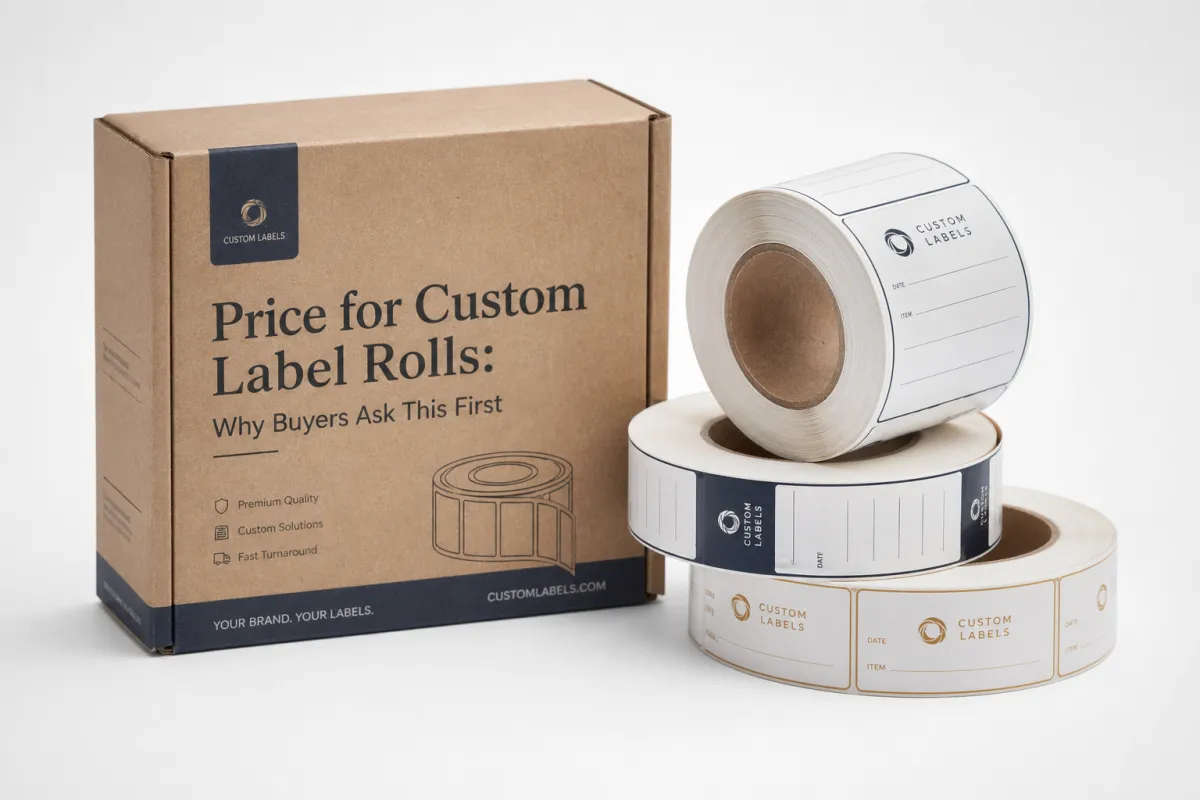
The first question I hear is almost always the same: "What is the price for custom label rolls?" The answer matters because a label is rarely a decorative afterthought; it is usually one of the last items approved before launch, fulfillment, or a retailer deadline, and a small miss in the quote can throw off the whole margin model. On a 20,000-unit run, a difference of $0.03 per label turns into $600 quickly, and that is before freight, proofing, or a rerun caused by a file issue. If you have ever had to explain that to a finance team in Portland, Oregon or Atlanta, Georgia, you know the room gets very quiet very fast.
The part people overlook is simple: the lowest roll quote often does not equal the lowest total cost. I have seen buyers save $140 on the print line and then lose $300 in labor because the rolls were too wide for their applicator, which was running at 85 labels per minute. I have also seen a beverage brand switch to a better 3-inch core size and avoid 7% waste during high-speed application on a line in Louisville, Kentucky. Those fixes do not look dramatic in a quote sheet, yet they matter where the work actually happens, on the factory floor in one of the busiest shifts of the week.
I see the same pattern again and again. Buyers compare suppliers before they have locked size, material, or roll direction, then ask for "a price" as though the spec can stay vague. That is like asking for a carton quote without stating flute grade or print coverage, or asking for a label price without saying whether the roll diameter needs to stay under 8 inches for an automated applicator. Accurate pricing only works when the quote mirrors the production method, not a placeholder guess, and I have had more than one conversation where I had to ask for the label width three separate times before the numbers made any sense.
At Custom Logo Things, the most useful quotes separate one-time costs from recurring costs. You should be able to see the setup fee, the proof charge if there is one, the unit price, and the freight estimate as separate lines, whether the shipment is going by ground from Dallas, Texas or airfreight from Shenzhen, Guangdong for a 72-hour schedule. If a supplier cannot explain the price for custom label rolls at that level of detail, the number is not ready to buy against. I trust a quote less when it tries to hide everything in one tidy line item and then adds a $65 "administrative adjustment" after approval.
When a client is also working on branded mailers, retail sleeves, or Custom Printed Boxes, I push hard for consistent specs across the whole package system. A polished label on a low-grade carton creates a mismatch, and the cost of that mismatch is rarely included in the first quote; for example, a 4" x 6" BOPP label can look luxurious on a box made from 350gsm C1S artboard, but it looks out of place on a rough 200gsm chipboard mailer. The same logic applies to package branding: the label has to support the shelf story, not fight it, because a premium ink system cannot fix a carton that is structurally underbuilt by 15%.
I visited a converter floor in Dongguan, Guangdong, where the operator showed me three rolls of the same art, each wound differently for three customers. One buyer wanted a 1-inch core, one needed a 3-inch core, and one requested a specific unwind direction for an automated applicator running 40 cases per minute. The unit price barely changed, but the total job cost did, because the wrong unwind direction would have required a manual flip on every pallet. That is why the price for custom label rolls cannot be judged from artwork alone; the roll build is part of the product, whether people want to think about it or not.
Custom Label Roll Product Details That Change the Quote
The physical spec drives the quote more than most first-time buyers expect. A 2" x 1" label on paper stock with a standard permanent adhesive is a very different product from a 4" x 6" clear BOPP label with white ink, a removable adhesive, and a gloss finish, and the gap between those two jobs can easily be $0.08 to $0.18 per unit depending on the run size. Press time, waste rate, finishing steps, and inspection time all shift with that kind of change, which is why the price for custom label rolls can move quickly as the specification gets more complex.
Start with the basics: label size, shape, roll diameter, core size, gap-based or mark-based registration, and winding direction. Those details decide how the labels run on applicators and whether a roll can be packed efficiently for shipping from a plant in Foshan, Guangdong or a fulfillment center in Nashville, Tennessee. A wider roll may use less labor because there are fewer changeovers, but it can cost more to ship; a smaller core may reduce freight volume but create feed problems on a machine. There is almost always a tradeoff, and the machine usually has the final opinion, which is rarely subtle when it starts skipping every 12th label.
Material choice is the next big lever. Paper labels are usually the most economical, especially for dry goods, shipping, and many retail uses, and I have seen plain coated paper print as low as $0.10 per unit for 10,000 pieces when the artwork is a single black pass. BOPP, whether white, clear, or metallic, costs more but stands up better to moisture, oils, and rough handling, particularly on refrigerated products and cosmetics that move through Miami, Florida or Houston, Texas distribution hubs. Textured stocks create a premium look for wine, cosmetics, or gift packaging, but they can increase waste if the press needs slower speeds or special ink management. Eco-conscious substrates, including FSC-certified papers, can also affect the quote depending on supply and certification requirements, so I recommend checking the source directly at FSC and reviewing broader packaging guidance from Packaging Coalition/industry resources when the job involves recycled content or material reduction.
Adhesive matters more than people think. A permanent adhesive is the default for many retail packaging jobs, but a removable adhesive may be better for seasonal promotions, reusable containers, or applications where residue is a problem after a 90-day shelf cycle. Freezer-grade adhesive is a different animal entirely; it has to grip at low temperatures and survive condensation at 32 to 40 degrees Fahrenheit. If the label is going onto rough corrugate, recycled board, or a curved bottle with cold fill, an aggressive adhesive may be the safer choice. That extra performance usually changes the price for custom label rolls by $0.02 to $0.05 per label, but it can also prevent returns, relabeling, or package failure. I once saw a team try to save a few pennies with the wrong adhesive and then spend the afternoon peeling labels off cold bottles with a fingernail in a warehouse in Columbus, Ohio; that is not a fun day for anyone.
Print coverage and finish are another major cost driver. A one-color black label on kraft paper is not priced like a full-color label with metallic foil or spot varnish, and a foil-stamped label from a press line in Suzhou, Jiangsu will usually carry a very different setup profile than a simple digital run. Matte, gloss, and soft-touch finishes each create a different feel and a different production step, with soft-touch often adding $0.04 to $0.07 per unit on shorter runs. Metallic effects can look strong under retail lights, but they often require tighter registration and a more careful prepress workflow. If your label is part of a coordinated branded packaging program, the finish should be matched to the carton, insert, or outer shipper so the whole set feels deliberate.
In my experience, customers often underestimate how much coverage changes the quote. A label with 15% ink coverage may print efficiently at about $0.11 per unit for 5,000 pieces. A label with 90% coverage, a solid black flood, and small reversed type will use more ink, more drying time, and more inspection, and the price can jump to $0.19 or $0.24 per unit depending on the substrate. That is why a label that looks simple can still be expensive if the art is heavy. The same is true for white ink on clear film; it is not just another color, it is often an extra print step, and the press crew will absolutely notice it on a 14-inch web.
Common Spec Drivers
- Label size: A 2" x 1" label uses less substrate than a 4" x 6" label, but smaller formats may run slower on certain applicators and can raise the cost by 8% to 12% on short runs.
- Material: Paper, BOPP, clear film, metallic stocks, and textured papers all sit at different cost levels, with white BOPP often landing around $0.14 per unit at 10,000 pieces.
- Adhesive: Permanent, removable, freezer-grade, and aggressive adhesives each solve a different production problem and can alter the quote by $25 to $150 on a mid-size order.
- Roll build: Core size, roll diameter, unwind direction, and gap or black-mark sensing affect handling on lines in Chicago, Illinois, and Anaheim, California.
- Finish: Matte, gloss, soft-touch, and specialty effects add production steps and change the price for custom label rolls by a measurable amount.
For one cosmetics client, the quote changed more from a material switch than from the artwork itself. They moved from coated paper to clear BOPP because the jar had a translucent finish, and suddenly the label had to behave more like part of the container design. The production manager told me later that the higher label price was worth it because the shelf presentation finally matched the rest of the line, including the 350gsm C1S artboard carton and the satin-finish insert. That is the point where custom printed boxes and labels start working as one system instead of two separate purchases.
If you are choosing between material options, ask how the label will behave after 24 hours, after refrigeration, and after transport. Those are the moments that expose a weak spec, especially on a route that runs from a plant in Monterrey, Nuevo Leon to a cold warehouse in Newark, New Jersey. A label that looks perfect at first scan can still curl, smudge, or lift after a night in a cold room. That is a hidden cost, not a cosmetic issue, and it tends to show up on the busiest day possible.
Specifications That Affect Print Quality and Durability
The price for custom label rolls is not only about appearance. It is also about how the label survives moisture, oils, abrasion, UV exposure, and refrigeration, which is why a hand soap label printed for a storefront in Phoenix, Arizona needs different behavior than a shipping label for a cold-chain order leaving Seattle, Washington. A label for a hand soap bottle needs different ink and substrate behavior than a shipping label on corrugate. A warehouse inventory label has to stay readable under dust, friction, and handling, and a wine bottle label may face condensation, cold storage, and long display time under bright retail lighting. Those are not interchangeable use cases, even if someone in procurement tries to treat them that way.
On a factory visit for a beverage project in San Diego, California, I saw a print team test three label versions with water spray and an ice bath before approving production. The cheapest roll looked fine at room temperature, but it started lifting around the edges after 20 minutes in cold water at about 38 degrees Fahrenheit. The buyer first thought the premium option was too expensive; then he compared the cost of relabeling 8,000 bottles at $0.12 per unit versus paying $0.03 more per label and changed his mind in under five minutes. That is the right kind of cost comparison, and it is one of those moments where the room goes from skeptical to very, very quiet.
Durability usually pushes the price for custom label rolls upward, but it can lower the total project cost if it prevents spoilage, returns, or relabeling. A label that survives shipping on a pallet from Dallas, Texas to Columbus, Ohio is worth more than a label that is two cents cheaper and fails after the first condensation cycle. I have seen brands spend more on the label to protect the larger packaging budget, and that is often the smartest move because the label is doing part of the job that the carton, insert, and outer shipper cannot fix later.
File setup also affects production time and cost. If the art file comes in with a clean dieline, correct bleed, 300 dpi images, and vector text, the press team can move faster. If the file has missing fonts, low-resolution logos, or a dieline that does not match the die, a prepress technician has to rebuild part of it, and that labor can add $40 to $120 depending on complexity. That is not a hidden charge in the abstract; it is real labor, and it can also push the proof cycle from one round to three. I have seen a straightforward order get delayed four business days because the barcode sat too close to the trim line, which is the kind of mistake that feels tiny until a fulfillment line starts scanning every carton.
The right standard depends on the application. For shipping and distribution, many buyers care about scan accuracy and abrasion resistance more than premium appearance, especially for labels moving through an 80,000-square-foot warehouse in Indianapolis, Indiana. For a fragrance bottle or gift item, the visual finish matters more, and the label may need to align with the carton and insert as part of the full package branding story. For warehouse inventory, readability and adhesive strength trump everything else. That is why I ask buyers to describe the surface first and the design second; the surface tells me how the label has to behave once nobody is watching it.
If you are building a label spec for a regulated or rough-handling environment, it helps to think in terms of performance tests. The International Safe Transit Association sets common packaging tests for transport and handling; you can see their standards and resources at ISTA. A label does not always need the full package test battery, but the mindset is useful. If the package will be shaken, stacked, chilled, or dragged through a fulfillment line, the label spec needs to reflect that reality. I would rather over-check a label than explain a failure after launch, which is never a pleasant phone call and usually costs at least one extra reprint.
One supplier negotiation still sticks with me. The buyer wanted a "premium" label, but he had not defined what premium meant. We priced glossy paper, then BOPP, then a soft-touch laminate, and the spread between the first and third option was nearly $0.09 per unit at 5,000 pieces. The third option was the one his marketing team loved, but the first option was the one that fit the machine in the plant outside Milwaukee, Wisconsin. That conversation saved a week of back-and-forth because we tied the spec to the function instead of the mood board, and in packaging design, function usually wins after the first round.
Price for Custom Label Rolls: MOQ, Run Length, and Tier Breaks
MOQ, or minimum order quantity, is where many buyers feel the first real sting in the price for custom label rolls. Smaller runs are usually more expensive per roll because setup time gets spread across fewer units, so a 2,500-piece order might land at $0.22 per label while a 10,000-piece order drops to $0.13 per label with the same art. The press still has to be calibrated, the dies or digital setup still has to be prepared, and the proof still has to be approved. Whether you order 1,000 labels or 50,000, some of those steps happen either way, and the machine does not really care that the budget is tight.
That is why tier pricing matters. A quote at 2,500 pieces may look high, but the 5,000-piece number might drop sharply because the setup cost is being absorbed more efficiently. At 10,000 pieces, the unit cost often drops again, sometimes by another $0.02 to $0.04 depending on the substrate and finish. I tell buyers to ask for three pricing points at minimum: the smallest acceptable run, a mid-tier quantity, and the level they would actually buy if inventory and cash flow allowed it. That is how you find the break-even point instead of guessing, and it prevents those "why is the 5k quote only a little higher than the 2.5k quote?" moments that make everyone squint at the spreadsheet.
One of the most common mistakes I see is treating setup fees like they are optional. They are not. Plate charges, die charges, proofing fees, and file cleanup can all appear as one-time costs, often in the $35 to $95 range for standard work and more for complex metallic or foil jobs. If a supplier rolls them into the unit price, fine, but you still need to know they exist. Otherwise, you will compare a quote that includes $85 in setup against a quote that hides it inside the run rate, and that is not an apples-to-apples comparison.
Here is a simple comparison I use with buyers who want the price for custom label rolls in plain terms. These numbers are illustrative, not a promise, but they show the pattern clearly and reflect the kind of pricing I see from production in Guangdong and central Mexico.
| Label Spec | Quantity | Example Unit Price | One-Time Setup | Typical Lead Time | Best Fit |
|---|---|---|---|---|---|
| 2" x 1" paper, 1-color, permanent adhesive, 3" core | 5,000 | $0.15/unit | $45 | 12-15 business days | Retail packaging, shipping, short-run promotions |
| 3" x 2" white BOPP, full color, gloss finish, permanent adhesive | 10,000 | $0.11/unit | $45 | 10-14 business days | Beverage, wellness, and high-handling products |
| 4" x 6" clear BOPP, white ink, removable adhesive, matte finish | 2,500 | $0.28/unit | $60 | 15-18 business days | Premium jars, seasonal launches, specialty jars |
Those sample numbers show the core pricing logic. Higher quantities usually lower the unit rate because the press runs longer with fewer changeovers, and the 10,000-piece job often lands at a better per-unit rate than two separate 5,000-piece runs. More complex materials or finishes push the unit price upward. The price for custom label rolls does not move in a straight line; it moves in tiers, and each tier has a different value proposition. I wish it were flatter and easier to explain sometimes, but packaging pricing rarely cooperates that nicely.
I have also seen buyers choose the wrong quantity because they focused on the first invoice, not the total cost of ownership. If you save $120 by ordering 2,500 labels today but have to reorder in 6 weeks and pay another setup fee, you may have spent more than if you had bought 7,500 at once, especially when shipping from a plant in Monterrey, Nuevo Leon adds a second freight charge. That is especially true for seasonal SKUs, where the labels might sit in inventory for a few months before launch. The invoice looks smaller, but the story underneath is messier.
My practical rule is simple: ask for pricing at several quantities and then compare the break point against actual usage. If the product moves 1,200 units per month and the run setup fee is $55, the math is not hard. The right run length depends on shelf life, cash flow, storage space, and forecast confidence, and a warehouse in Phoenix, Arizona has a very different storage cost than one in Cleveland, Ohio. That is a business decision, not a print decision alone, and I prefer when buyers think that through before everybody starts pretending the cheapest line item is the best plan.
Process and Timeline From Proof to Delivery
The production path is usually straightforward, but each step can affect the price for custom label rolls if it slows the schedule or adds correction work. A standard order moves through quote request, artwork review, proof approval, production, finishing, packing, and shipment, and a normal cycle can be 12-15 business days from proof approval when the stock is already in hand. If every file is clean and the material is available, the job can move quickly from a facility in Dongguan, Guangdong or one in Guadalajara, Jalisco. If not, one missing barcode or a vague unwind direction can stall the line. I have seen a beautiful label design come to a dead stop because nobody specified the core size, which is not glamorous but is very real.
Delay usually starts with the quote request itself. A buyer sends a logo, a size guess, and a deadline like "as soon as possible." That is not enough. The supplier still needs the application surface, adhesive type, finish, roll direction, core size, and whether the labels are for manual application or machine application at a rate like 25 labels per minute or 120 labels per minute. If those details arrive late, the proof has to be revised. Every revision pushes the calendar and sometimes changes the price, and a rushed answer can be more expensive than a patient one.
In practical terms, a standard custom label job can take 12-15 business days from proof approval, while a rush order may land in 6-8 business days if the materials are available and the format is simple. Complex orders with specialty finishes, clear film, white ink, or heavy coverage may need 15-18 business days, especially if the work is going through prepress in a plant near Shenzhen, Guangdong and then converted elsewhere. I am careful with time estimates because missing one part can add 48 hours without warning. The price for custom label rolls and the turnaround time should be discussed together, not separately. If you only talk about one, the other one tends to surprise you later.
One client in my notes had a launch tied to a trade show in Las Vegas, Nevada. The label proof sat for three days because the marketing team could not agree on whether the product name should sit centered or slightly high on the face. That tiny design delay cost them a rush freight premium later, which pushed the shipping bill up by $180. It was not the printer's fault; it was a decision bottleneck. That happens more often than people admit, and I have learned to ask early who has final approval because otherwise the proof becomes a group therapy session.
If your label program involves high-value products or fragile shipments, the packaging logistics matter too. The label roll has to arrive in the same condition as the cartons, inserts, and outer packaging, whether those ship from a warehouse in Nashville, Tennessee or a production site in Penang, Malaysia. Labels and Custom Packaging Products should be planned together, because inventory gets messy when one piece lands early and the other one is still in transit. If the label job ships early but the cartons are late, you have created storage risk. If both ship together, warehouse work stays cleaner and the launch is easier to manage.
To keep the schedule tight, I recommend a simple rule: approve the proof only after every field is checked, including barcode contrast, die size, color callouts, and roll winding details. That sounds obvious, but I have seen a 1,000-label test run get scrapped because the unwind direction was wrong for the applicator in a Denver, Colorado packing room. A 10-minute review would have saved two production days and about $95 in handling. I would much rather annoy someone with one extra check than watch an entire run go sideways.
Expedited production almost always affects the price for custom label rolls. Not always dramatically, but enough to matter. Rush work may require overtime, priority scheduling, split shipments, or extra freight handling, and an air shipment from Dongguan to Los Angeles can add hundreds of dollars to a modest order. If the deadline is fixed, say so early. If the budget is fixed, say that too. The best quote is the one that reflects both constraints honestly, and that kind of clarity saves everybody from the awkward "we thought that was included" conversation later.
Why Choose Us for Custom Label Rolls
Buyers do not need vague reassurance. They need quote accuracy, production consistency, and prepress support that prevents expensive mistakes, whether the order is 2,500 labels or 25,000 labels. That is the standard I would expect from any supplier handling the price for custom label rolls. If a vendor can tell you exactly why the number changed, you are dealing with a real production partner. If they cannot, the risk moves to your team, and packaging is full of pleasant-sounding mistakes that cost real money later.
At Custom Logo Things, the value sits in the details that protect the order before it reaches the press. We look at art files, roll specs, material choices, and application needs before the job gets locked in, and that can save a buyer $60 in cleanup charges or a full reprint on a 5,000-piece order. That reduces reproofs and makes the final quote more trustworthy. It also helps first-time buyers avoid one of the most common problems in packaging: buying a label that looks good on screen but fails in real use. The right price for custom label rolls should reflect that kind of preflight work instead of charging you later for preventable mistakes.
Material sourcing matters too. A supplier that understands paper stocks, BOPP, removable adhesives, and freezer-grade performance can guide the buyer toward the right balance of cost and durability, whether the print run is being managed in Guadalajara, Jalisco or Dongguan, Guangdong. That is especially useful for brands building out branded packaging across labels, cartons, inserts, and shippers. If the label spec aligns with the rest of the packaging program, the brand looks cleaner and the operational risks drop. That kind of consistency is not flashy, but it is the difference between looking assembled and looking accidental.
I once sat in a negotiation where a buyer had three quotes within 8% of each other, and the spread was something like $0.12, $0.13, and $0.14 per unit on a 10,000-piece run. The cheapest quote looked attractive until we asked about proofing, freight, and reprint policy. The mid-priced supplier was actually the better value because they included prepress checks and caught a barcode issue before it became waste. That sort of support is not flashy, but it lowers the total project cost, and quiet competence is often the best deal.
If you are comparing suppliers, ask how they handle file correction, proof approval, and color consistency. Ask how they manage repeat orders so the second run matches the first, especially if the first run was produced in Cincinnati, Ohio and the repeat is scheduled through a different plant in Monterrey, Nuevo Leon. Ask whether the quoted price for custom label rolls includes the same wind direction, core size, and finishing standards you will need on the line. Those questions save time later. They also make it much harder for anyone to hand-wave the spec and hope you do not notice until the truck shows up.
And yes, the label matters beyond the roll itself. Many customers come to us for labels first, then ask about carton sets, sleeves, or Custom Packaging Products because the whole package system needs to feel coherent. That is where the conversation moves from a line item to a package program. Once you start seeing it that way, the cheap shortcut usually stops looking cheap, especially when the carton is built from 350gsm C1S artboard and the labels need to match a matte-coated retail sleeve.
What to Send Next for a Fast, Accurate Quote
If you want a quote that is actually usable, send complete specs. Not a sketch. Not "same as last time." The best RFQs for the price for custom label rolls include the label dimensions, quantity, material preference, adhesive type, finish, roll diameter, core size, and unwind direction. If the labels are going on bottles, jars, corrugate, or flexible pouches, say that too, because the application surface changes the recommendation. I still get requests that leave out the most important part, which is usually the part that changes the price by the biggest amount.
You should also send artwork files, even if they are not final. A PDF, AI, or EPS file lets the prepress team check resolution, bleed, registration, and text thickness. If you have a deadline, include it, down to the date and the hour if the product is going to a retailer in New York, New York or a show in Anaheim, California. A rough target date helps the supplier tell you whether standard production fits or whether the project needs rush handling. That is how the quote reflects reality instead of guesswork, and I would rather see a file early and messy than late and mysterious.
Here is the checklist I use when I help clients compare quotes for the price for custom label rolls:
- Dimensions: Exact width, height, and shape in inches or millimeters.
- Quantity: The order quantity plus one or two alternate tiers for comparison.
- Stock: Paper, BOPP, clear film, textured paper, or a specialty substrate.
- Adhesive: Permanent, removable, freezer-grade, or aggressive.
- Finish: Matte, gloss, soft-touch, metallic, or spot effects.
- Roll spec: Core size, roll diameter, unwind direction, and gap or black-mark format.
- Surface: Glass, plastic, corrugate, metal, refrigerated packaging, or flexible packaging.
- Deadline: Launch date, warehouse date, or promo start date.
There are a few questions every buyer should ask before approving an order. Is proofing included? Are artwork corrections charged separately? Is shipping included or billed later? Are setup fees one-time or recurring? Does the quote assume the exact same roll build you need for your label applicator in a plant running 30 cycles per minute? Those answers keep the price for custom label rolls honest. They also keep you from discovering the fine print only after someone has already hit "approve."
When brands are moving fast, they sometimes rush this step and regret it later. I have seen a label order go through on a vague spec, only for the buyer to discover that the rolls were wound backwards for their machine. That mistake cost a second shipment and a week of schedule pressure, plus about $210 in freight on a route that should have cost half that. A 15-minute spec review would have prevented it, and I still think about that one because it was such an avoidable headache.
If your team is already planning new retail packaging, seasonal sleeves, or a refreshed shelf look, include that context in the quote request. The label may need to coordinate with the carton color, the typography on a shipper, or a larger packaging design system, such as a 350gsm C1S artboard folding carton paired with a gloss BOPP label. The better the context, the more accurate the price. That is how you get the right price for custom label rolls without paying for surprises later, and it is how you avoid the classic packaging conversation where the label looks great and everything around it looks like an afterthought.
Send the specs, send the art, and send the deadline. Then ask for the price for custom label rolls at two or three quantities so you can see the break-even point clearly. That is the fastest path from research to purchase, and it usually leads to a cleaner order the first time around, whether the job is being produced in Dongguan, Guangdong or shipped into a warehouse in Charlotte, North Carolina.
What affects the price for custom label rolls the most?
Size, material, adhesive, and quantity usually have the biggest impact on the price for custom label rolls. A 2" x 1" paper label at 10,000 pieces may sit around $0.11 to $0.15 per unit, while a clear BOPP label with white ink can move closer to $0.24 per unit depending on finish and setup. Specialty finishes, heavy ink coverage, and durable substrates can raise the unit price, and one-time setup, proofing, and rush production may add separate charges that buyers should ask about upfront.
Why is the price per roll lower at higher quantities?
Production setup gets spread across more rolls, so the cost per unit drops as quantity rises. A 2,500-piece run might price at $0.22 per label while 5,000 pieces come in at $0.15 per label and 10,000 pieces drop to $0.11 or $0.12 per label, depending on the material. Longer runs also improve press efficiency and reduce changeover time, which is why asking for pricing at 2,500, 5,000, and 10,000 pieces often reveals the real break-even point for the price for custom label rolls.
Do custom label roll quotes include design or artwork help?
Some suppliers include basic prepress checks, while others charge for artwork cleanup. Ask whether bleed, dieline, barcode review, and file correction support are included before approving the order, because a correction package can add $40 to $120 on a short run. If your files need work, that should be separated from the print price so you can compare the price for custom label rolls fairly and avoid a surprise line item after proof approval.
How long does it take to produce custom label rolls?
Timeline depends on proof approval, material availability, run size, and finishing steps. Standard orders often run 12-15 business days from proof approval, while rush work can move faster if the spec is simple and the stock is in hand. A clear BOPP label with white ink may need 15-18 business days, especially if the job is coming through conversion in Dongguan, Guangdong or Guadalajara, Jalisco. If you need a firm ship date, provide final artwork early and ask how the schedule affects the price for custom label rolls.
What information should I send to get an accurate quote?
Include dimensions, quantity, material, adhesive, finish, roll build, and application surface. Add your artwork files and deadline so the supplier can check compatibility and timing before production starts, whether the order is for a warehouse in Cleveland, Ohio or a retail launch in Miami, Florida. The more complete the brief, the more useful the price for custom label rolls will be for planning and comparison, and the fewer surprises you will have when the shipment arrives.
The clearest takeaway is simple: send the full spec, ask for pricing at two or three quantities, and compare the quote against the real machine, the real container, and the real launch date. That is the cleanest way to buy labels without paying for guesswork, whether the job is built around a 3-inch core, a 4-inch roll diameter, or a 350gsm C1S artboard carton that needs the label to match on day one.

