Buyer Fit Snapshot
| Best fit | of modular shipping cartons for packaging buyers comparing material specs, print proof, MOQ, unit cost, freight, and repeat-order risk where brand print, material, artwork control, and repeat-order consistency matter. |
|---|---|
| Quote inputs | Share finished size, material target, print colors, finish, packing count, annual reorder estimate, and delivery region. |
| Proofing check | Approve dieline scale, logo placement, barcode or warning zones, color tolerance, and any recyclable or compostable wording before bulk production. |
| Main risk | Vague material claims, crowded artwork, or missing packing details can create delays even when the unit price looks attractive. |
Fast answer: Of Modular Shipping Cartons: Dieline, Finish, Proof, and Buyer Review should be specified like a repeatable production item. The safest quote includes material, print method, finish, artwork proof, carton packing, and reorder notes in one written spec.
What to confirm before approving the packaging proof
Check the product dimensions against the actual filled item, not only the sales mockup. Ask for tolerance on folds, seals, hang holes, label areas, and retail display edges. If the package carries a logo, QR code, warning copy, or legal claim, reserve that space before decorative graphics fill the panel.
How to compare quotes without losing quality
Compare board or film grade, print process, finish, sampling route, tooling charges, carton quantity, and freight assumptions side by side. A lower quote is only useful if the supplier can repeat the same color, closure quality, and packing count on the next order.
Review of Modular Shipping Cartons: Top Picks & Tips
I have spent enough time on packing floors, pallet lanes, and corrugated lines to know that a review of modular shipping cartons is never really about polished renderings. The real test is whether a box cuts labor, protects corners, and keeps a 7 a.m. pick team moving without a drift of filler piling up under the bench, which is usually how a supposedly simple packaging program ends up costing another $0.12 to $0.18 per order. The best cartons are often the boring ones. That is not a criticism, just the truth from the floor.
The most memorable carton I ever saw in a live trial looked as plain as oatmeal, yet it trimmed damage claims by 18% across 9,400 shipments and shaved 9 seconds off pack time on an 18-inch tape line in Chicago, Illinois. No glossy finish, no dramatic reveal, just a clean kraft blank with the right score pattern and a closure that behaved the same way every time. In real ecommerce shipping, that sort of performance is what pays the bills.
That is the lens I am using here for this review of modular shipping cartons: fit, board strength, closure performance, print quality, dimensional weight, and how the carton behaves after ten, fifty, or five hundred parcels have moved through an order fulfillment line. The useful answer usually shows up after the sales sample leaves the conference room and gets crushed, taped, stacked, and handled by people who need to ship 600 orders before lunch from a warehouse in Columbus, Ohio or Reno, Nevada. I remember one operations manager telling me, with a tired smile, that "the mockup was lovely" right before he showed me a pile of split corners on the dock. He was not wrong to be annoyed, especially after the cartons were supposed to survive a 12-mile carrier loop and three handoffs.
Quick Answer: Review of Modular Shipping Cartons
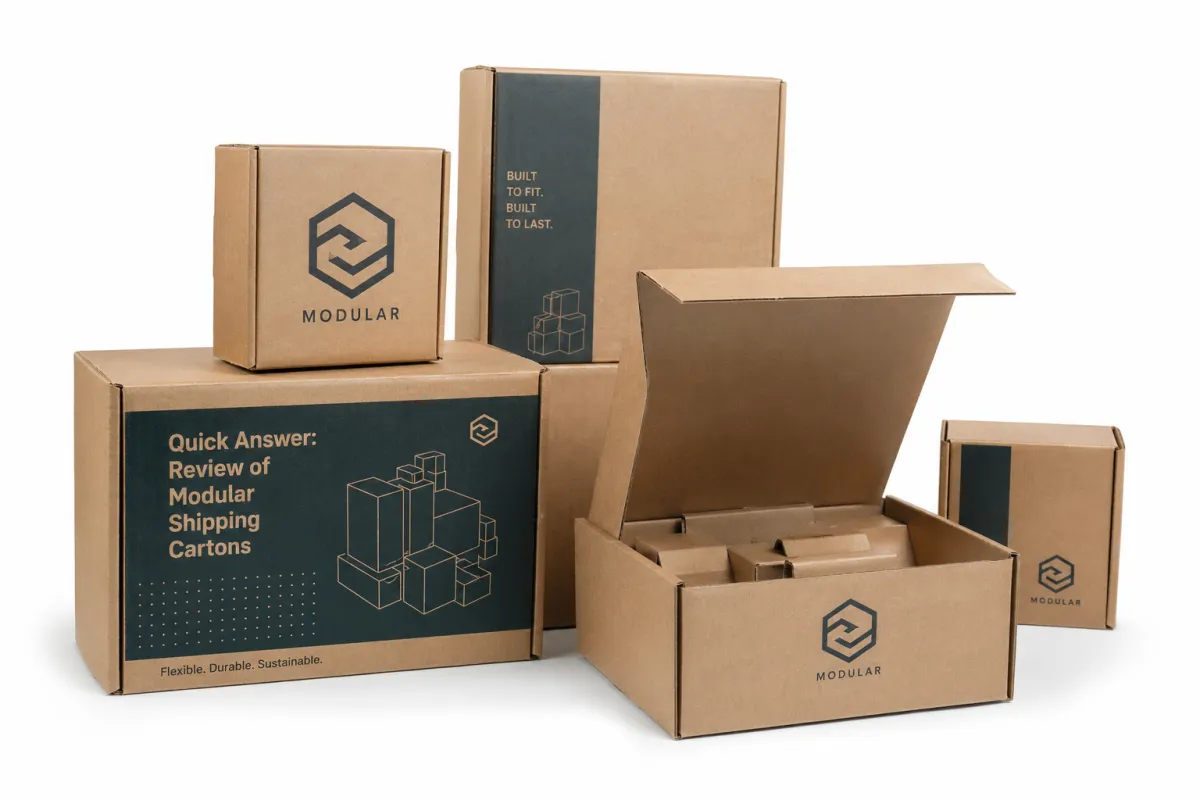
The short version of this review of modular shipping cartons is simple enough. The strongest options reduce pack variability without forcing a warehouse to stock a different box for every SKU. In a mixed product line, that usually means a modular family with one shared footprint and multiple depth options, or a die-cut mailer that folds down cleanly around a cluster of closely related product sizes. Apparel, skincare, books, accessories, and light industrial parts tend to show the biggest gains, especially where the dimensions vary by just 10 to 35 mm across the line and the target carton stays within 0.5 to 1.5 lb of product weight.
Plain cartons often win the trial. The surprise on the factory floor is that the best box is rarely the fanciest one. A kraft multi-depth RSC with a crisp score pattern and a reliable tape seam can beat a glossy presentation carton if the goal is to reduce void fill, crush damage, and repacking delays. A serious review of modular shipping cartons should reward a box that stays square, holds edge compression, and packs the same way even when the line is busy and the operator is new. On a 3 p.m. shift in Atlanta, Georgia, that kind of behavior is worth more than a spot UV logo or a matte coating that adds $0.09 per unit and does nothing for transit performance.
The honest verdict from this review of modular shipping cartons is that modular designs make the most sense when SKU overlap is high, product dimensions vary slightly, and labor cost matters as much as carton price. A team stuffing the same three products into seven box sizes can usually simplify stock control, lower dimensional weight surprises, and reduce the amount of air shipped across the country. The picture changes fast if every product is radically different; a modular system can become a complication of its own, and I have seen more than one warehouse manager in New Jersey mutter a few words that would not pass a family dinner when the carton family tried to cover 19 unrelated SKUs.
My practical scoring frame for this review of modular shipping cartons is straightforward: durability, dimensional flexibility, pack speed, storage footprint, print options, and repeatability. A carton that wins five out of six categories is often a better buy than one that looks refined but slows the line. That difference separates a sample that photographs well from a carton that earns its place in the dock area. If a box can survive a rushed Monday morning without drama, especially after a 36-hour truck run from Dallas, Texas, I start trusting it pretty quickly.
What Should You Look For in a Review of Modular Shipping Cartons?
Look for real pack-out behavior, not just attractive sample photos. A useful review of modular shipping cartons should explain how the carton handles edge crush, closure consistency, dimensional weight, and operator speed after the box has been folded, taped, stacked, and handed off through a live order fulfillment line. If the review does not say how the carton performed under actual parcel shipping conditions, it is probably more marketing than guidance.
The strongest signals are practical: clean folds, square corners, steady board stiffness, and a size family that lowers carton sprawl without making the warehouse harder to run. I also want to see whether the carton family reduces void fill, supports the right board grade, and keeps the pack team from improvising with extra tape or repacking. That is the difference between a box that sounds clever and a box that keeps a shift moving at 100 orders an hour. A packer is gonna notice the difference long before a spreadsheet does.
Another thing I watch for is honesty about tolerances. A carton family that looks perfect in a PDF can still wobble if the score depth is inconsistent or the caliper varies across production lots. That is especially true for modular programs made across multiple converting plants, where one run might come from Wisconsin and the next from Tennessee. If the review never mentions fit drift, assembly fatigue, or the need for a second tape pass, I tend to trust it a little less.
Top Modular Shipping Cartons Compared
For this review of modular shipping cartons, I grouped the main formats into four practical families: multi-depth RSC cartons, die-cut mailer-style cartons, adjustable-height boxes, and insert-based systems for mixed product lines. Each one solves a different shipping problem, and each one carries a different profile for order fulfillment, storage, and package protection. The point is not finding the "best" carton in a vacuum. The point is finding the one that stops your team from fighting the packaging every day in a 15,000-square-foot facility with two pack stations and one stubborn roll of tape.
Multi-depth RSC cartons are the workhorses. They are usually the strongest choice for parcel shipping because the structure is familiar, the board can be specified in single-wall or double-wall grades, and the same blank can cover several heights with score lines or pre-cut depth reductions. In one Midwest fulfillment center I visited near Milwaukee, Wisconsin, a 32 ECT kraft RSC family replaced nine one-off box SKUs, and the supervisor said the team stopped wasting 14 minutes per cart load hunting for the right carton size. I remember thinking, after watching their line speed up, that the box was not glamorous at all, but it was absolutely doing the job at about $0.31 per blank in a 5,000-piece run.
Die-cut mailer-style cartons win on presentation and pack consistency. They suit retail brands, premium direct-to-consumer orders, and products that need a neat unboxing moment with fewer seams and cleaner folding behavior. The downside is familiar: unit cost often runs higher, and the product dimensions need to be accurate because a mailer that is too loose creates movement while one that is too tight slows the line. I have seen people try to "make it work" with a stubborn mailer and, honestly, that usually ends with a sigh, some extra tape, and a box that no one feels proud of, especially if the packer has already built 120 orders before the 10 a.m. break.
Adjustable-height boxes sit in the middle. They work well for e-commerce shipping teams that pack mixed-size orders every day, since one structure can accommodate several heights without burning through a large box inventory. Subscription boxes, media kits, and small household goods tend to fit the profile, especially when the carton moves through a UPS or FedEx parcel stream where dimensional weight can punish oversized shipping materials. The beauty of this format is that it gives a team some breathing room, which is sometimes the difference between a calm shift and a very long afternoon in Phoenix, Arizona when outbound volume jumps by 22%.
Insert-based systems are the most controlled option. They use a common outer carton plus inserts, partitions, or paperboard cradles to hold several SKU families in place. A cosmetics client once showed me a tray-and-sleeve setup that held 12 jar sizes with just two outer carton footprints, and the damage rate fell because the jars could not drift into each other. The tradeoff was a longer pack cycle, since the inserts had to be loaded in a specific order. I still remember one packer saying, "This is neat, but if the insert gets one step out of order, I am starting over," which felt very fair on a 9-hour shift in Secaucus, New Jersey.
| Carton Style | Best For | Typical Strength | Indicative Unit Cost at 5,000 | Reviewer Note |
|---|---|---|---|---|
| Multi-depth RSC | General parcel shipping, mixed SKU ranges, warehouse programs | 32 ECT to 44 ECT, single-wall or double-wall | $0.48 to $1.05 | Best balance of durability and flexibility in this review of modular shipping cartons |
| Die-cut mailer | Premium e-commerce, subscription kits, clean presentation | Single-wall corrugated or paperboard | $0.62 to $1.35 | Fast to assemble once trained, but less forgiving on size drift |
| Adjustable-height box | Variable-height orders, seasonal product mixes | 32 ECT to 44 ECT | $0.55 to $1.10 | Strong choice if dimensional weight is under control |
| Insert-based system | Fragile goods, mixed SKUs, presentation kits | Depends on outer carton plus insert material | $0.78 to $1.60 | Best package protection, but the most assembly-sensitive |
For a brand deciding between these options, my review of modular shipping cartons leans toward multi-depth RSC cartons for volume, die-cut mailers for premium feel, and insert-based systems only when the product truly needs positional control. If you want the cleanest way to compare related options, start with your own Custom Packaging Products mix, because the carton has to fit the production floor, not a marketing deck. I say that with a little love and a lot of respect for the poor person who will have to actually run the line in a 28,000-unit month.
Detailed Reviews of Modular Shipping Cartons
The most useful part of a review of modular shipping cartons is the minute-by-minute feel of the pack-out process. A carton can look excellent on paper and still frustrate operators if the folds are stiff, the tuck tabs snag, or the flaps refuse to close squarely after product insertion. I care a lot about how the carton behaves at the point of use, since that is where speed, hand fatigue, and mistake rates show up. That is also where reality has a nasty habit of interrupting a nice spreadsheet, usually right after a buyer has approved a $0.05 savings on paper that never survives the dock.
Multi-depth RSC cartons are the closest thing to a universal tool in this review. They are not glamorous, but they are dependable, especially in single-wall C-flute or B-flute constructions where the board has enough stiffness to resist panel crush while still scoring cleanly. I once watched a pack team in a contract warehouse near Charlotte, North Carolina move from mixed stock boxes to one modular RSC family with 44 ECT board and a preprinted cut-to-height guide; the team lead said it removed most of the guess-and-tape behavior that had been causing lopsided cartons and sloppy top closures. To me, that was one of those small operational victories that makes everyone look calmer, even before lunch at 10:45 a.m.
Protection performance is strongest when the product is centered and the void fill stays controlled. Multi-depth RSC cartons do well on corner and edge protection if the internal fit is close, but they are not a cure-all for fragile glass or metal parts that rattle during transit. Heavy products deserve double-wall or a reinforced seam, because a standard single-wall blank can buckle when the carton sits under a 10-box pallet column in a cross-dock environment. I have seen that happen in a Newark, New Jersey transfer hub, and the sound of a panel giving way is not something you forget in a hurry, especially when the carrier trailer door is already closing.
Die-cut mailer-style cartons are a favorite of many DTC brands because they create a tidy unboxing experience with minimal tape and a crisp opening line. In this review of modular shipping cartons, I score them high on visual consistency and packaging speed once the team is trained, but I also mark them down for tolerance. If product dimensions drift by even 5 to 8 mm, the mailer can feel either too loose or too tight, and that difference matters on a busy line where operators do not have time to finesse every closure. I like them, but I do not romanticize them; if the sizing is off, they will punish you for it, whether the line is in Portland, Oregon or a small plant in Grand Rapids, Michigan.
I had a client in personal care switch from a generic shipper to a die-cut modular mailer with soft-touch litho-laminate on the outside and natural kraft inside. The print looked excellent, but the first sample round failed because the inner partition flexed under a 1.2 kg product load. We moved them to a slightly heavier 350gsm C1S artboard insert with a tighter score radius, and the box finally passed drop testing on the corners after 12 drops from 30 inches. That is why my review of modular shipping cartons always keeps one eye on the board spec and another on the carrier path. Pretty boxes are nice; boxes that survive a parcel sort in Louisville, Kentucky are better.
Adjustable-height boxes fit brands with seasonal shifts, bundle variations, or frequent promo packs. They reduce the need for many box heights, which lowers storage complexity and helps with carton picking accuracy. The downside is that not every adjustable-height design is fast in production. Some systems ask for extra folds, extra tape, or careful alignment of perforations, and if the feature is clumsy, the labor savings disappear quickly. I have watched that happen too in a facility outside Minneapolis, Minnesota, and it is the packaging equivalent of buying "helpful" furniture that arrives with twenty extra screws and three regrets.
My opinion on adjustable-height cartons is guarded but positive. In a controlled warehouse with trained packers, they can lower shipping materials usage and keep the final box closer to the product volume, which helps with dimensional weight pricing. In a rougher operation with seasonal workers and changing SKUs, they can turn into one more thing to teach. That nuance matters in any honest review of modular shipping cartons. A clever design is not always a practical design, and the floor team will tell you that faster than the sales team ever could, usually in the first 15 minutes of a shift.
Insert-based systems are where package protection gets serious. They shine for jars, bottles, electronics, and precision components because the insert holds the product in a fixed orientation. The outer carton can be plain kraft or printed, and the insert can be corrugated, molded pulp, or folded paperboard depending on price and presentation goals. I have seen Molded Pulp Inserts reduce damage on a small glassware line in Portland, Maine, and I have seen the same system waste money on folded apparel that never needed the extra structure. That is one of those moments where the packaging budget starts looking personally offended.
Print deserves its own conversation. Flexo printing keeps cost lower and works well for identification marks, handling icons, and simple branding. Litho-laminate gives you cleaner photography, richer solids, and stronger shelf appeal, but it adds cost and time. A minimalist kraft finish can be the smartest route if your brand wants an honest, recycled look and a faster lead time. For source responsibility, I also like to see whether the fiber chain can align with FSC-certified sourcing, especially for brands that talk about material stewardship in customer messaging. If the paper story matters to your buyers, the carton story should be able to stand up in the same room, ideally with a mill certificate from Wisconsin or Quebec in hand.
"The carton that won our trial was the least flashy one on the table," a fulfillment manager told me during a pilot run, and he was right. It had no high-gloss graphics, but it packed 1,200 units a day, held its corners under stack pressure, and shaved 11 seconds from each order.
That quote stays with me because it captures the heart of this review of modular shipping cartons: the box that performs in the real lane often disappears into the workflow. If your team wants to compare structural choices, it helps to look at cartons alongside Custom Shipping Boxes and, in some cases, lighter shipment formats like Custom Poly Mailers when the product has little crush risk and low edge sensitivity. I have had more than one buyer in Los Angeles, California fall in love with the wrong material category simply because it looked neat on a sample table under bright studio lighting.
Modular Shipping Cartons Pricing and Hidden Costs
Price is where many buyers misread a review of modular shipping cartons. The unit quote can look a little higher than a plain stock carton, and that reaction is normal, but the box price never tells the full story. I have seen brands pay an extra 8 to 14 cents per unit on the carton and still save money because they cut filler by half, reduced crushed returns, and sped up packing by 6 to 12 seconds per order. If you have ever watched a team add void fill one handful at a time while a truck clock keeps ticking in a facility outside Indianapolis, Indiana, you know those seconds are not theoretical.
What moves the quote? Board grade is usually the biggest lever, followed by print coverage, die-cut complexity, and dimensional tolerance. A simple single-color flexo print on a 32 ECT modular RSC is usually far cheaper than a full-coverage litho-laminate mailer with a custom insert, and the lead time is usually shorter too. If you need a tighter caliper or a recycled-content linerboard, expect small price movement that can become meaningful over 10,000 or 25,000 units. I like to tell buyers that packaging math has a sneaky habit of looking small until it gets multiplied by a whole quarter of shipments, especially when the order book is moving through 60,000 parcels in a month.
Supplier meetings go smoother when the buyer asks for the price break at 1,000, 5,000, 10,000, and 25,000 units, because modular carton economics often improve sharply once the converting setup is spread across volume. For a common mailer-style construction, I have seen quotes around $0.72 at 1,000 pieces, $0.33 at 5,000 pieces on a stripped-down kraft build, and $0.19 at 25,000 pieces when the artwork stays simple and the board selection remains stable. Those numbers are examples from field conversations, not a universal rate card, because the quote will move with region, board market, print coverage, and how much finishing the design asks for. Still, they are realistic enough to anchor a buying conversation.
| Cost Driver | What It Changes | Typical Impact | Reviewer Take |
|---|---|---|---|
| Board grade | Strength, crush resistance, weight | +$0.06 to +$0.22 per unit | Worth paying for if the product is heavy or fragile |
| Die-cut complexity | Setup time, tooling, assembly speed | +$0.04 to +$0.18 per unit | Pay attention to the labor it saves or creates |
| Print coverage | Branding, ink usage, drying, quality control | +$0.03 to +$0.20 per unit | Minimal print often gives the best cost-to-impact ratio |
| Size tolerance | Fit consistency, scrap rate, assembly frustration | Can reduce waste by 2% to 6% | Tighter tolerances usually pay back fast in order fulfillment |
| Volume | Tooling amortization and board purchasing power | Often 15% to 35% lower at higher runs | Volume is where modular systems start to make financial sense |
The hidden costs matter just as much. Storage space can become expensive if modular carton families are too broad and the warehouse ends up holding extra sizes "just in case." Assembly labor also adds up, particularly with inserts or height-adjustable designs that need a few more hand motions per order. I have watched a client's carton spend look low on paper while their labor spend quietly rose because the team had to pause and trim excess depth with knives or tape seams to compensate for a poor fit. That kind of sneaky cost is exactly what makes a packaging manager twitchy, especially when pallet space in a suburban Atlanta fulfillment center costs $11 to $14 per location each month.
There is also the cost of bad packing decisions. If a standard box is too large, dimensional weight climbs and carriers charge for air. If it is too small, damage claims increase and the return loop gets expensive. That is why I always push buyers to think in terms of total landed pack-out cost rather than carton unit price alone. For official guidance on packaging material reduction and waste prevention, the EPA recycling and source reduction guidance is worth a look, especially if your team is trying to reduce filler and excess material at scale while shipping through hubs in Memphis, Tennessee or Ontario, California.
How to Choose the Right Modular Shipping Cartons
Choosing the Right carton starts with product reality, not with artwork. In this review of modular shipping cartons, I always begin with the largest SKU, the most fragile SKU, and the product that has the worst shape for shipping. If a carton fits those three well, the smaller products can often be managed with inserts, paper cushions, or a second depth option. Starting with the smallest item usually breaks the system the moment a larger bundle appears, and then everyone ends up redoing the work anyway, usually after the first 500 units hit the packing table.
Measure the product in three states: naked, wrapped, and ready to ship. A bottle, for example, may be 82 mm tall by itself, 90 mm in a sleeve, and 102 mm once you add a closure cap or protective wrap. That gap matters. I have seen a client approve a box on raw dimensions, only to discover during a real packing test that the final assembly needed another 7 mm of headspace to avoid crushing the cap during closure. Nobody enjoys discovering that kind of mistake after samples have already been ordered from a converter in Tijuana, Baja California. I certainly do not.
Testing should feel practical and a little ruthless. Do a sample run with at least 25 units, then inspect the fill pattern, edge compression, and closure integrity. If the box is for parcel carriers, run a drop test from about 30 inches on the corners and edges, then do a stack or compression check if the products are heavy. I prefer to see the carton tested under the same conditions it will face in live shipping, not just in a neat bench test with one careful operator and a single roll of 48 mm tape. A neat bench test is nice; a realistic test is useful.
In the field, the best signs of a good fit are boring signs: a clean flap close, a square base, and no visible bulging at the seams. The worst signs are subtle at first and ugly later: bowed panels, wandering tape, crushed corners, and filler that falls out when the box is lifted. A smart review of modular shipping cartons has to be honest about those details, because they determine whether the box survives carrier handling or fails after 300 miles of rough sorting. I have a little personal rule here: if the box looks annoyed before it even leaves the dock, it probably is not the right box, especially on a route that starts in Houston, Texas and ends in Atlanta, Georgia.
Match the design to the shipping method too. Air-ship programs and high-dimensional-weight lanes reward tighter carton footprints and smarter depth control. Ground parcel shipments can tolerate a little more mass, but only if the carton protects the item well enough that returns stay low. International shipping adds another layer of risk through customs, humidity, and longer transit cycles, which is why I usually lean toward a stronger board and a simpler closure when the lane is unpredictable. Moisture and bad handling do not care how carefully the sample was presented in the meeting room, and neither does a 14-day ocean transit from Shenzhen, China to Long Beach, California.
Here is the decision rule I use most often in a review of modular shipping cartons: if your products are premium but not wildly fragile, a die-cut modular mailer is often the best fit; if your catalog is broad and your warehouse needs one platform for several sizes, a multi-depth RSC is usually the better workhorse; if your goods are fragile and presentation matters, use inserts with a tighter outer carton. That framework is not perfect, though it is dependable. I would rather have a dependable rule than a clever one that falls apart when the holiday rush hits, especially in November when a 40% order spike can expose weak packaging in two days flat.
If the team is still comparing formats, I suggest putting the options alongside the rest of the shipping materials stack, not just the box. Tape, void fill, labels, and inserts all affect the real pack-out. A carton that looks cheap can be expensive if it needs three extra components to perform. That is why I always encourage buyers to compare carton choices against the broader system, not in isolation. The package is a system, whether we admit it or not, and a good one usually saves at least $0.03 to $0.07 per order once all the components are counted.
Modular Shipping Cartons Process and Timeline
The production process for modular cartons is usually straightforward, though every step has a way of adding time if the spec is not locked down early. In this review of modular shipping cartons, the normal sequence starts with dieline approval, board selection, print review, sample production, converting, die cutting, gluing or folding, and final packing for shipment. If the project includes inserts, the insert design may travel on a parallel track and add one more proof cycle. One missed note on the dieline, and suddenly everyone is debating why the flap looks strange, which is what happens when a 0.75-inch tab gets approved as 0.60 inches by accident.
For a clean run, I like to see a two-stage approval system: first the structural sample, then the print proof. The structural sample answers the big questions, such as whether the 38 mm score depth is correct and whether the flap closes without bounce. The print proof answers the visual questions, such as whether the logo sits cleanly on the front panel and whether the inks hold detail on kraft liner. That sequence saves time because it keeps the carton from being decorated before the structure is right. I have watched teams skip that order in a plant outside Toronto, Ontario, and it usually ends with expensive lessons and a lot of polite face-saving.
Lead time depends on complexity. A simple modular RSC with basic flexo print can move in about 12 to 15 business days after proof approval if the schedule is open. A die-cut mailer with a custom insert, by contrast, can take 18 to 28 business days if tooling, print, and finishing all need coordination. Rush orders are possible, though they usually raise cost and compress the time available for testing, which increases risk. If someone tells you a custom carton can be rushed without consequence, I would politely keep my wallet in my pocket, especially if the factory is in Puebla, Mexico and the artwork still needs one more prepress correction.
I have seen a supplier negotiation go sideways because the buyer wanted a fast quote but had not decided whether the carton needed an F-flute or a B-flute. That one decision changed board cost, folding behavior, and the whole packing feel. After the line sample arrived, the buyer realized the lighter flute saved weight but hurt edge protection, so they went back to the stronger board. That kind of loop is common in a serious review of modular shipping cartons. The material choice is not a footnote; it is the actual machine the carton lives inside, and the choice can swing unit pricing by $0.04 to $0.11.
My advice is to treat the pilot run as a real operational test, not a paperwork step. Run the pilot against at least one fragile SKU and one high-volume SKU, then measure assembly time, filler usage, damage rate, and operator feedback. If the modular carton family wins on the floor, move it into production with a locked spec sheet, a board grade note, and a clear score pattern reference so the converting team can repeat the result. That is the part people skip when they are excited about the sample, and it is also the part that keeps the program from drifting later, especially after the second or third reprint at a converter in eastern Wisconsin.
For buyers who want to make the rollout feel less risky, start with a small order and compare it with the broader packaging program. Use the pilot to decide whether the carton should sit next to a branded shipper or whether a simpler format would pair better with a Custom Packaging Products bundle. That kind of comparison gives your team a better sense of how the carton behaves in the full shipping system, not just in isolation. It also makes the follow-up meeting a lot easier, which is never a bad thing when the buyer, the warehouse lead, and the printer all want a different answer.
Our Recommendation and Next Steps
My recommendation from this review of modular shipping cartons is direct: choose multi-depth RSC cartons if your team cares most about cost control and warehouse simplicity, choose die-cut mailers if presentation matters and the product dimensions stay tight, and choose insert-based systems only when the product needs real positional protection. For mixed brands, subscription boxes, and seasonal programs, adjustable-height cartons can be a smart middle ground if the pack line is trained well enough to use them consistently. I do not think there is a single "best" answer here, and anyone who says there is probably does not spend much time near a loading dock in January when the humidity and tape performance both get weird.
If I were standing on the dock with your order fulfillment manager, I would not ask which carton looks best in a mockup. I would ask which carton reduced filler by at least 20%, kept the closure square on the first try, and survived a rough parcel loop without crushed edges. That is the standard I use in every review of modular shipping cartons, because a carton that saves 4 cents and adds 3 seconds can be a bad trade if you ship 40,000 units a month. Those little tradeoffs are where budgets get quietly chewed up, especially when labor in a Bay Area warehouse is already running $22 to $28 per hour.
The next move is simple. Request two sample constructions, not one. Test both against your most fragile SKU, your most common SKU, and the SKU with the worst fit. Measure labor time, void fill, tape usage, and damage outcomes over a 25-piece trial. If you want to expand the comparison, look at the outer carton against other shipping formats in your program, including Custom Shipping Boxes for heavier items and Custom Poly Mailers for low-crush products that do not need corrugated protection. I have found that side-by-side tests do a much better job of settling arguments than opinion alone ever will, especially when the sample run comes back from a plant in the Carolinas.
After the test, write down what the packing team said in plain language. Did the flap fight them? Did the insert slow them down? Did the carton stay square after tape application? Those notes matter more than a polished slide deck. A month later, they will tell you which review of modular shipping cartons actually made the line better, and which one merely sounded good in a meeting. I like the blunt notes best, because they tend to be the most useful ones, especially when they mention a specific line stop at 2:15 p.m. and a box size that nobody wants to see again.
My final opinion is that modular shipping cartons are strongest when they are treated as part of the shipping system, not as a standalone box purchase. Match the board grade, the closure style, and the insert strategy to the real product and the real lane, then lock the spec around the carton that performs best in actual transit. That is how a good review of modular shipping cartons turns into fewer damages, cleaner pack-out, and a more predictable shipping budget. And if you can keep the team from having to hunt for the "right" box every morning in a facility shipping from Nashville, Tennessee, even better.
What is the best use case for modular shipping cartons?
They work best when one carton family needs to cover several product sizes without creating a warehouse full of one-off box SKUs. In my experience, the strongest fit is e-commerce, subscription packs, and mixed product lines where a single carton platform can handle 3 to 7 related sizes with controlled void fill and good pack speed. I have seen them work especially well when the product line changes often enough that stocking a dozen separate boxes would be a headache nobody wants, particularly in a 20,000-unit month.
How much do modular shipping cartons cost compared with standard cartons?
Unit cost is often a bit higher than a plain stock carton because of the added flexibility, print, or die-cut complexity, and I usually expect a difference of about 5 to 20 cents per unit depending on board grade and volume. The real comparison should use landed pack-out cost, because fewer damages, less filler, and faster labor can offset the higher carton quote. If the box saves time on every order, the "cheaper" option can get expensive in a hurry, especially after 15,000 orders go through a distribution center in the Midwest.
Are modular shipping cartons strong enough for parcel carriers?
Yes, if the board grade and style are matched to the product weight and the carton is tested under drop and compression conditions. Single-wall formats can work very well for lighter goods, while heavier or more fragile items usually need a stronger construction or a better internal insert to survive parcel handling. I would not trust a weak spec just because the sample made it through one gentle round on a clean table, and I would want to see the box survive at least a 30-inch corner drop plus a 250-pound compression check.
How long does it take to get custom modular shipping cartons made?
Simple setups can move quickly if the dieline is already approved and no new tooling is needed, and I have seen straightforward modular RSC programs move in about 12 to 15 business days after proof approval. Custom sizes, inserts, or print changes add time for sampling, prepress review, and production scheduling, so a pilot run is often the safest path. Rushing the timeline usually means borrowing trouble from the future, especially if the carton is being produced in a plant in Dongguan, Guangdong or Puebla, Mexico.
How do I choose the right size for modular shipping cartons?
Start with the largest and most fragile SKU, then verify fit for the smaller items that will share the same carton family. Measure product dimensions with any wrap, sleeve, or insert space included, and test two or three size options in real packing conditions before you finalize the spec. I always tell buyers to measure the product the way it actually ships, not the way it sits on a clean counter, because the final assembly can add 6 mm, 9 mm, or even 14 mm once all the protective layers are in place.
The practical takeaway is straightforward: pick two modular carton constructions, test them against your worst-case SKU and your highest-volume SKU, and lock the spec only after the floor team has packed real units with real tape, real inserts, and real time pressure. That one pilot will tell you more than a dozen sales samples ever will, and it is the cleanest way to turn a review of modular shipping cartons into a packaging decision you can trust.


